
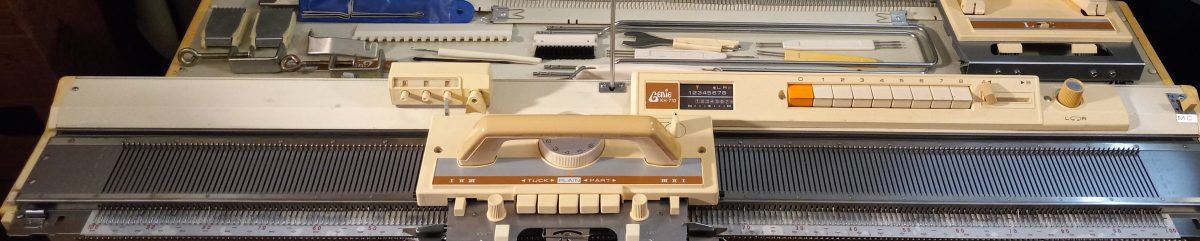
 Say hello to my freshly refurbished and tested Brother KH930 knitting machine. It was made in Japan in 1986 and is a standard machine with 200 needles. Standard means that the gauge is 4.5 mm (the gauge is the distance between needles). The needle bed is metal. This and the electronic components make this machine pretty heavy.
The machine has electronic patterning capabilities to knit slip, tuck, fair isle, and single motifs as well as lace and weaving.
Since this was the first electronic machine I ever used, I would like to elaborate on the pros and cons of it first. I must say that there are barely any cons in my opinion as I am completely in love with this machine.
 Pros:
Pros:
- Very easy to move the carriage, especially in KC mode (the mode where the carriage latches onto the timing belt, which makes the carriage move even easier).
- Very smooth knitting overall
- The manual is very well-written and covers everything that a user would need to start knitting. In fact, after reading numerous knitting machine manuals, I was amazed at how well the manual for KH930 is written. Just make sure you read it without rushing to the next bullet point and pay attention to all details. I did not even refer to any other tutorials (videos on your tube or brochures).
- I had the best ever experience knitting a single-motif fair isle. Prior to that, my only experience was knitting single motifs on Punch card Singer/Studio/Silver reed machines. In the case of Brother KH930 knitting a single motif was absolutely a no-brainer. Look what I got:
- I absolutely loved the simplicity of this machine. Although, some beginning machine-knitters might find it confusing…
- A built-in storage box with a lid: fit all accessories.


 A convenient holder for tools is located to the very left of the electronic display:
- This model can be used with a variety of other accessories: knit leader, color changer, garter carriage, etc.
- Replacement parts (needles, sponge bar, transfer tools, etc.) are very easy to find, for example, on Aliexpress. Another source of electronic components is Knit and Sew world. However, the rumors are that after their transition to a new website, it is hard to find information. One needs to call them and ask specifically. But yes, they have electronic replacement components.
- The machine has an outlet to connect a cable for data transfer. Some electronic Brother knitting machine models do not have this option. Some consider it a con and some a pro. However, in the case of Brother KH-930, you can have an option to connect the machine to an external disk driver (PPD-100 or FD-100), to a computer equipped with special software (DAK) or to be modified to connect to a free source software (like AYAB or image track).
- A lace carriage comes with every set. In some machines, the lace carriage is optional but not with the Brother KH930. When not in use, it sits inside the lid. When in use, it is compact on the bed or can be moved to the side of the extension rails.


Cons:
-
Without power, only the stockinet stitch can be knitted. Some patterning can only be achieved with manual stitch manipulation. I assume that to live without electricity these days is nearly impossible but the electric components can be damaged. However, electronic replacement parts are often pop up on Ebay (for example through the dragonfly.knitting.machine.parts store), Etsy and FB marketplace. A German company sells (through Facebook only) an AYAB interface that can be used as a replacement if the original electronics fails.
- Some might find the manual a bit confusing but once the user follows all steps, the explanations will start making complete sense.
- IMPORTANT: turn off your machine when not in use. The patterning will remain active in the machine memory (including where you stopped your knitting). However, overheating is one of the main reasons for electronic part failure. for example, when I knitted stockinet – I turned the machine off. even if I stepped for a coffee – I turned the machine off. MY husband (who is an electrical engineer) even recommended installing a mini fan by the machine to ensure the prolonged safe operation of the electronic parts.
On this particular machine (I am going to call it August 22 because I refurbished it in August 2022) I tested stockinet, tuck-stitch, slip (or skip)-stitch on a full bed. Also, fair-isle, single-motif fair-isle. I did not test any weaving and lace capabilities. I did not test the lace carriage. However, the extensive testing on a full bed ensured that all needles are in great shape, that all major levers are in working order, and that the operational functions of the machine worked.
All accessories are included (with the exception of the design sheets which is simply glorified graphed paper). The paper showing needle numbers is faded on the left side… But the users can write numbers with a fine marker.

I also tested its memory capabilities and was able to transfer a large pattern to knit (see the pictures of the baby blanket above). The memory is somewhat limited and could transfer this large pattern in 5 different sections. It is not the most convenient way of doing it but it was relatively straightforward and I was able to do my first transfer without mistakes. Some KH930 have extended memories. I think a memory card from an analogous KH940 is simply inserted into the console. But it was not the case for this machine.
 For example, a friend sent me a pattern for a blanket. The file was 200 stitches by 270 rows. Because 930 has limited memory, such a large file DAK can only be uploaded into the 930 in 66-row sections. So, 5 sections total. So, I first knitted 5 rows of stockinet (which is always recommended), then patterned the device and knitted the first section. The machine beeped and flashed 66 when my carriage was on the left. All needles were selected. While the carriage was on the left, I uploaded another pattern. Then I programmed the pattern and then knitted the last row of the previous section (where all the needles were still selected).
I was so impressed with how easy it was to knit single motif on this model, that I want to dedicate it to a special paragraph outside of the Pros/Cons section. Before this machine, I only tried single motifs on punch card machines (where you have to set up magic cams, yarn separators, points cams… oh, man!!). It was a lot of struggle for me to get a hang of knitting single motifs using a punch-card-machine. So, I intuitively suspected that a single motif on electronic should be much more straightforward, and it indeed WAS!!!
 While testing this machine, I manually entered two patterns (W and S for a vest for my son’s teddy bear) into the machine’s memory and used them to knit a vest. I successfully loaded a pattern from a disk (through FB100) and I also transferred a pattern through a direct link cable (from DAK) and knitted a book cover for my son with his initials.
Overall, I cannot even express how excited I was to knit with this machine. It offers a lot of various levels of challenge. So, you will never get bored with it. And with the patterning capabilities (including external ones on DAK or other software), the possibilities are truly endless.
 My ultimate goal is to learn about knitting machines as much as possible. Out of all machines I tested so far, which is only 12 (which includes Singer/Studio/Silver reed punch card machines, Brother manual and Brother push-button machines), this is by far my favorite. Luckily, I have three more of these machines and one is definitely going to live in my machine knitting garage!!! I hope you will think the same!!
Read more about this model in my Knitting Machine Encyclopedia: https://mightyknittymachines.com/brother-kh930-electronic-knitting-machine/


 I took on a project of cleaning and conditioning this machine with enthusiasm because I already restored one Brother KH551 earlier this year. This machine was easy to clean – it needed some dusting, wiping, needle inspection, some needle replacement.


 My personal history with this machine was the following. Since I am an avid knitter and an avid yarn collector, I wanted to knit faster so I asked my daughter to get me a circular knitting machine. She got me both Addi big and small and I enjoyed it tremendously. Addi’s have certain limitations in terms of the yarn it can use – it hates slippery yarns!!! It also hates chenille yarns.


