
… in progress while I am organizing my thoughts on this subject.
The comparisons below are done for the 4- and 8-pushbutton machines versus the 24-stitch repeat punchcard machines. This means Brother KH800 and KH801 are not participating in this comparison. The hybrid model, Brother KH811, is also not considered here. A full current list of machines included in this article is at the end of this post.
At first sight, Brother pushbutton and punch card machines have different patterning mechanisms. However, the actual needle selection occurs using the same patterning plates, a basic mechanism of almost ALL Brother knitting machines.
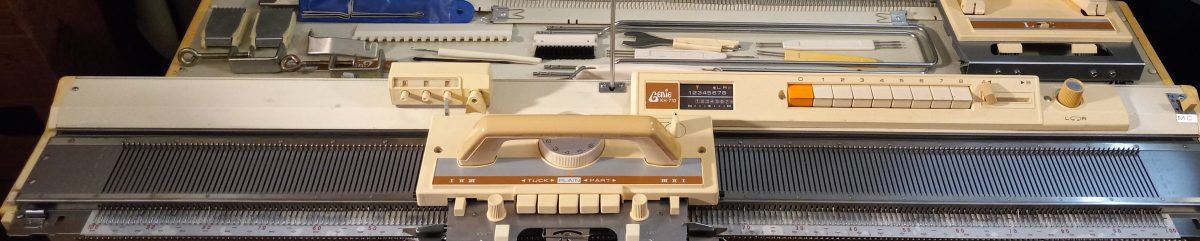
Pushbutton machines need a ratchet tool to activate the needle selection. Punchcard machines just need a prepatterned punchcard inserted into a slot of a card reader, and after that the needle selection is automatic.
Pushbutton machines offer an 8-stitch repeat pattern, while punchcards 24. However, the users are still limited to the punchcards themselves: there is somewhat limited selection of premade punchcards unless knitters hunt down knittery and other custom cards or punch them themselves. It would seem that pushbutton would offer more variety but more of a more involved (some are by hand manipulations) process.
I feel that keeping track of knitting cables spread at even distances from each othter is easier on pushbutton machines: I can memorize which buttons to press to move the needles (that mark my cable positions) forward.
It seems that the list of accessories compatible with punchcard machines is much bigger. Ribbers for pushbutton machines are hard to find and there is only a limited number of models that fit. Ribbers for punchcard knitting machines are all interchangeable, and they are easier to find on the used market. Thus, I feel pushbutton machines offer more flexibility in terms of creating patterns, which might be important to designers and those who ar enot ready to give up satisfaction of manipulation stitches by hand. Punchcard machines offer faster automation of knitting patterns.
Additionally, minor accessories, like linking, transfer, and intarsia carriages, as well as color changers were NOT made for pushbutton machines.
I heard that lace patterns come out very nice on pushbutton machines.
Pushbutton machnes are somewhat lighter than punchcard ones. Most pushbutton machines have all-metal robust case. It is sometimes prone to rusting when not stored properly. Out of dozens pusbutton machines I only saw two that were not really fixable. Punchcard machines have metal lid and the case but the end caps and covers are plastic. These plastic parts are prone to sun light damage. Visible damage is yellowing but the over time degradation makes the plastic fragile. These plastic components often break during shipping.
However, if a pushbutton machine misbehaves, it is easier to troubleshoot it: punchcard machines have way more complicated timing-belt-based patterning process, which might be overwhelming to tune up.
There is no bulky gauge pushbutton machine. On a flip side, Brother’s only fine-gauge machine is pushbutton.
My personal choise would be to keep pushbutton machine for creating patterns and having a punchcard for quick patterned design of already established (in my head/skill level) garments/items.
List of 4- and 8-pushbutton machines as well as 24-stitch repeat punch-based knitting machines:
| 4-button | 8-button | 24-stitch repeat punchcard |
| KH511, KH521, Brother KH531, Brother Profile 551 | Hi-Knitter Auto, Profile 552, KH552, KH561, KH571, KH580, KH581, Profile 583, KH583 Profile 585, KH585, KH587, Brother Profile 588, KH588, KH601, KH610, KH701, KH705, KH710, KH880 | KH260, KH264P, KH810, KH820, KH821, KH830, KH831, KH835, KH836, KH838, KH840, KH850, KH851, KH860, KH864, KH868, KH871, KH881, KH890, KH891, KH892, KH893, KH894 |