
The pictures below are applicable to most 8-push-button knitting machines.


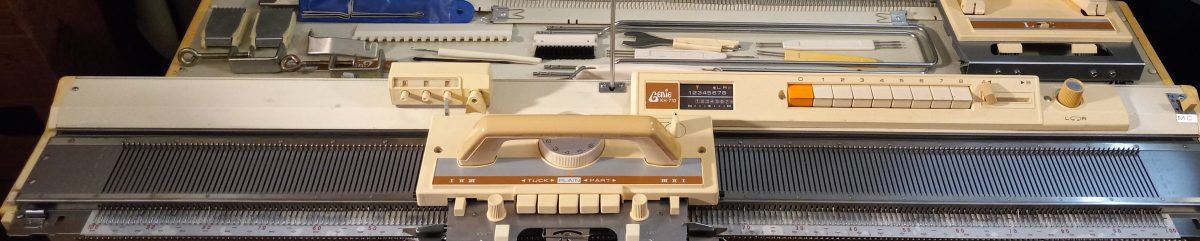
The pictures below are applicable to most 8-push-button knitting machines.
So far, I’ve been able to become very familiar with the Silver/Empisal Knitmaster/Studio/Singer turn-knob knitting machines: Empisal Knitmaster mod. 305, Knitmaster ES-302, Riccar RK-601, Silver SK-301, Silver SK-302, Silver SK-303, Silver SK-305, Singer 666, Singer 888, Studio SK-301, Studio SK-303. Thus, the pros and cons below are applicable to the following models:
PROS:
CONS:
If you are new to machine knitting on flatbed machines and you just got a machine, consider the beginner-friendly projects I recommend to all my students and customers. These projects can be done on any machine with any gauge. Also, if you are unsure how to choose a knitting machine, check out an article I put together.
…stay tuned for more insights as I test other turn-knob knitting machines.
… in progress. Last update: June 2026
Knitting machines with punchcard capabilities have carriages with drums that glide on the back rail and also assist in needle selection when they are passed over a punchcard reading mechanism pegs.
Well, since these patterning drums are such a prominent feature (which also makes these machines stand out from Brother punchcard knitting machines), a lot of cons and pros are associated with them.
PROS:
CONS:
Here are my other observations/feedback so far:
Pegs on the drums pass the needles to either B position or C position.
When the patterning dial is in the fair isle position, the mani yarn goes onto the needles in C position.
I see blog posts stating that some of the clanking noise might be due to the static in the yarn. To solve this issue, attach wax to the tension mast so the yarn passes through it.
But some knitters experience that noise even when there is no yarn in the carriage. Sometimes, if the carriage was not recently serviced or the sponge in the retaining bar is old, you might hear some clanking noise. I am discussing this issue (as well as how to address/minimize it) in my video.
When the ribber connecting arm is attached (from SRP50 ribber – maybe others, still researching), the carriage cam dial does not turn from L to Stockinet freely. You will need to disconnect the connecting arm, and the problem will be solved.