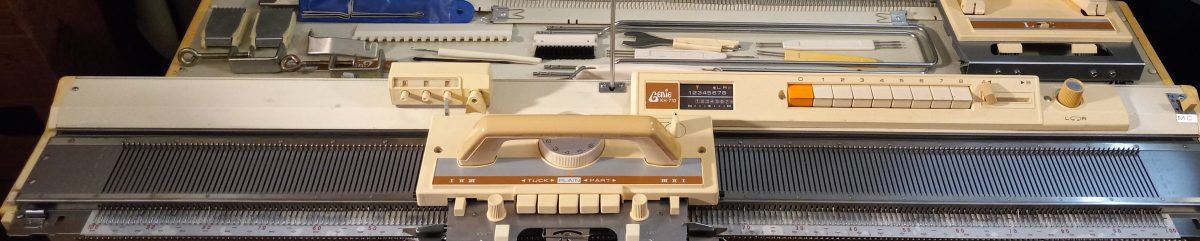
Brother KH 930E, my second one, restored/cleaned/tested in October 2022

What was done with this machine in terms of cleaning and refurbishing:

  • Included tools that were missing (some are still missing-please read below). All major parts and assesories are included.
  • Cleaned outside
  • Opened the lid and cleaned under the lids using only isopropanol around the electronics
  • Inserted absolutely new sponge and a retaining bar (it is NOT a refurbished retaining/sponge bar). So, it should last longer.
  • Inspected all needs – run 2-3 visual inspections under different “angles”. Replaced all defective needles with brand-new ones.

All assesories are included except for:

  • Pattern book (it can be downloaded from here)
  • A hard copy of the manual (it can be downloaded here. The pdf cover page states that the manual is for KH940 but KH940 and KH930/930e are identical in their operations. The only difference between KH940 and KH930/930e is the size of the electronic storage memory: KH940 has more memory.)
  • Design sheets (they are simply graph paper; if you REALLY need it, any graph paper would do)
  • Tapestry needle (any plastic or metal needle would do)
  • Oil (the container that came with the machine was empty; but regardless – I recommend using newer/fresher oil. I typically use this gun oil)
  • Wax (the one that came with the machine was too old and crumbled)

Here are the pictures of all accessories. They all fit into a small build-in compartment (see the two left-hand side photos below).

The hole in the carriage handle is to attach the machine to the motor. The previous owner made this hole, not me. I don’t own such a motor!!!

Tests performed on this machine:

  • Tested needle selection – works great!
  • Tested on a full bed tuck, slip/part and fair isle – all worked great.
  • Tested file transfer – work great! Knitted a small item from this custom pattern.

Read more about pros and cons of this model in my Knitting Machine Encyclopedia: https://mightyknittymachines.com/brother-kh930-electronic-knitting-machine/

Additional notes on this machine:

  1. During tuck knitting, I always check the tuck wheels to make sure that they are always in their working position (pushed forward). I reach with my hand under the sinker plate while it is still on the bed and check it. When they accidentally slid back, the stitches move slightly forward on the needles and the nest row does not form correctly and a lot of looping occurs. So, this is why in the video you will see me constantly checking under the sinker plate. Once I figures out what to look for in my stitches (namely, not too much moving forward on the needles), I stopped checking these wheels/brushes. I also feel that if this problem occurs, the operator should play a bit with the tension (on the tension mast and on the tension dial) of their yarn. Also, tuck-stitching requires an optimized yarn tension and weight combination.
  2. The machine is somewhat sensitive to the yarn tension. Honestly, they all are so I recommend when starting a new yarn to play with tension on a small swatch before making a garment and knitting fast.
  3. The eight pins where the transfer cable gets inserted are fragile. Please be careful.
  4. Always turn off and even unplug this machine when not using its patterning capabilities. There are stories about motherboards being damaged if left for too long in ON condition. If this happens, replacement boards are available for purchase from somewhere in Honk Kong (but it is a reliable source).

The transfer cable is NOT included. I used my personal one.

Enjoy!

Flat Bed Brother KX350 knitting machine, cleaned and tested in October 2022

Let me introduce a freshly cleaned and tested Brother KX350 knitting machine. It is a plastic flat bed knitting machine with 132 needles positioned 7 mm apart. So, it is considered a mid-gauge. But it handles bulky yarns (medium worsted) pretty well. I was able to easily knit Red Heart Super Saver yarn on this machine.

It is extremely straightforward how to assembly and setup p the machine. The manual is written very well.

The machine is very light-weight, which makes it easy to handle.IT comes with all assesories including a video tape (if you are into that kind of things )


About this specific machine:

All worked great. The box shows some tear and wear.

Pros and cons not mentioned earlier:

(+) The sinker plates is NOT detachable, which prevents it from being lost.

(+) Simple and straightforward to use.

(+) Includes heavy-duty combs, which act as cast-on combs and weights at the same time.

(+) Very clear manual with some instructions on knitting garments and other knitting techniques.

(+) Not as loud as metal beds when knits

(+) There is a stopping mechanism to prevent the carriage from accidentally sliding when knitting too vigorously

(+) Numbers for the needles are written right on the bed. I like it a lot since nobody has to worry about misplacing the strip

(+) putting the machine back to the box is so EASY! (especially comparing with the metal beds with heavy lids). All assesories are stored in their designated places inside a sterofoam.

Cons:

(-) plastic bed (which to me does not seem to be a con at all…. I am not worried about rust. I am also not worried about plastic being brittle and discolored if I keep the machine in the box when not in use)

(-) comes in a carboard box, which is not a bid turn off for me anyways…

(-) the machine has only basic patterning capabilities. But since it knits regular yarns (those that you can buy in Michael’s and Joan Fabric) – no patterning is needed since you can get self-striping and variegated yarns that provide a lot of interesting color combination and self-patterning. .


Read more on pros and cons on this machine in my previous article about this machine.


While testing this particular machine, I knitted using medium worsted yarn the cowl/neck warmer below.

The original box has some minor staining. The machine will be shipped in original box covered with brown shipping paper.

Overall, in my opinion, this machine is perfect for a beginning machine knitting. You will get a feel of what it is – machine knitting. You will not kill your back trying to carry this machine. You can still knit a lot of various patterns, however, they will require a lot of hand-manipulations. Which is again great for people who LOVE hand-knitting and just need to have knitting with more even stitches and faster.

Watch this machine in action in my video blog.

Brother KH260 refurbished in September 2022

Brother KH260 are wonderful and highly desired machines. They habe 110 needles, spaced 9 mm apart from each other).

This distance and large needles makes this machine “bulky”. Brother KH260 can handle a large variety of thicker yarns, including worsted. I tried double-thrded boucle yarn and it ahndled it well as well. I was especially happy about it because I love textures yarn, especially boucle, but not many machines can handle them.


What I did on this machine:

  • Removed all needles, cleaned them and inspected individually and then during knitting on a full bed.
  • Oiled carriage and ensured that all levers and kbod ove frely and do not mis-function during knitting
  • Cleaned the bed and gently cleaned the plastic parts

Overall the machine was in good shape before I started cleaning it. The case does not have any major bends/scratches. Only minor ones.

This machine came with all its assesories with some minor exeptions.

The card clips were missing – I cinluded two paris of new ones (small yellow plastic things in the picture below).

The assesories that are missing from the machine and wll not be included are:

  • Oil canister. I do not include old oil on purpose. Please, get a fresh/new oil. The recommended by many machine kntiters is Hoppe’s Elite Gun Oil
  • No ravel cord is included but any smooth strong yarn can be used.
  • Place card holder was missing from the set. As you can see in the video, I was not even using it and the cardreder worked well. However, any straight or bent hand-knitting needles will work. I included one.
  • -some manuals state that the machine comes wth 20-count punch card set. The hard copy of the manual that came with this machine lists only 15 cards. Indeed, a set containing only 15 cards came with it.


All tools fit into a tool box: a buil-tin compartment on the main bed.

This tool box is excellent to store assesories whlie the machine is not in use. The sinker plate, tuck-brushes, punchcard, tension rod and the row counter also fit wonderfully into the lid of the case when not in use.

The machine size is larger than all other single-bed flat-bed machines. The bed is winder and slitly longer.

The machine performed wonderfully with slip, tuck and fair isle patterning on full bed. I did not even have my usual trial/error starts. I did nothave to putz around too much with tension and the right number of hanging weights…. I was very pleased how well everything went.

I used this machine to knit simple stockinet, fair-isle, slip and tuck-stitch patterning. You can see those in my video. Below are the things I made while testing this machine and filming my demo.

Cowl/hoodie from a variegated dark red yarn using slip-stitch. Reversible/double sided.


Cowl/hoodie with a matching hat. Hoodie was knitted using a self-striping yarn and tuck-stitch patterning. Can be worn as reversible. The hat was knitted using simple stockinet. The ribbing was made by a mock-1×1 ribbing.

Cowl/hoodie knitted using fair isle and custom-made punch card. It can be worn as double-sided/reversible.


I did not really find a lot of cons for this machine. Maybe simple specifics of the machine which make it to stand out.

So, pros and cons are:

Pros:

+ Carriage (despite being heavy) is still relatively easy to move especially in KC mode (attached to a timing belt)

+ capable of handling thicker and textures (typically challenging) yarns

+ accessories, including needles, are still easy to find.

+ straightforward manual

+ because of the usage of thicker yarn, creates a texture similar to hand-knitting. I personally love those large stitches. Makes me instantly feel warm and cozy. The thicker yarn when knitted on loose tension also make the knitted fabric very soft and moldable (not stiff as on some standard machines).


Cons:

– Larger than other machines, including some other bulky models. It is also heavier.

– Expensive as they are highly desirable.

– carriage levers prone to sticking, especially when not in use for a long time. This might result in improper needle selection. But can be done with regular maintenance/care.

– requires more weights than other machines very likely because of heavier yarns.

– tuck brushes need to be installed. Some machines (mostly standard) already have built-in tuck-brushes on sinker plate. This is not really a con but just one more thing to keep track of and not to misplace.


Overall, machine knitters all over the world call Brother KH 260 a working horse. And I am in complete agreement!!

Brother KH551 tested and cleaned in September 2022

Preface: If I had to describe this machine with just one word – it would be FLAWLESS!!!

But, first, a little bit of history. Brother KH551 knitting machines were introduced to the market in the 1960s and were the first machine with somewhat semi-automatic patterning capabilities. In this machine, there are 4 buttons, that you push to prepare for the needle selection and then rotate the knob (using the wrench) to select the corresponding needles. It is an excellent machine for beginning knitters. I feel that it would be also great for people who are not quite yet ready to give up hand-knitting but want to have more even stitches and a bit faster progress…. Brother KH551 is also lighter than other machines mostly because its bed is narrower. The carriage is also significantly lighter and I could easily move it with just one hand.

The machine comes with heavy-duty cast-on combs that eliminate the need for any other weights. As you can see from my video, I did not attach any additional weights and had only one small problem with an uneven stitch which is amazing considering no additional weights and a rather difficult (with specs and boucle) yarn.

Not the whole machine is light, but the carriage is also light and small and is ideal for somebody with small hands and not a lot of upper body strength. Its lightweight makes it pretty portable, compared to other machines. The machine is capable of plain old knitting with hand manipulations of the needles. But also is capable of semi-automatic needle selection. The petiteness of the machine also makes it easier to store when not in use. I like the three-thread tension mast and a yarn clip in from of the tension mast rod. I love the three-horned tension section of the mast (not just a triangle) where each color of yarn can be inserted individually. However, the tension on the second and middle tension disk only has two settings (although they might depend on the very right one).

One feature of this model that I have not observed in others: There is some kind of protective lever at the end of the bed because the machine does not slide very easily from the end of the bed. One has to work really hard to “accidentally” pull it off the machine. In the video, you will see me seemingly struggling with the carriage towards the bed’s end (when knitting on a full bed only). But the knitting itself did not struggle: I believe it was just that protective mechanism in action.

The setup includes all major accessories. A couple of minor things are missing:

  • Sinker plate yarn hanger. The machine came with only one. However, when or if or both you decide to knit using the plating technique (see p. 18-19 in the manual), you can just make a similarly shaped hanger out of a heavy-duty paper clip). On other machines, when I knitted multicolor slip- and tuck-patterns, I was just leaving the thread on the side of the machine to keep it out of the way…Regardless of the technique you chose, the absence of this part does not affect the machine’s functioning and you can still do a LOT of various things with it using a variety of techniques.
  • I did not want to include the old container with oil because I did not want to risk putting such old oil onto this machine. I recommend getting a Hoppe’s gun oil (this is what I used to clean the needles and lightly oil the machine) and oil only lightly on the parts mentioned in the manual.

This machine comes with two brochures: a hard copy of the manual (which is in great shape) and a knitter’s guide (which contains techniques, a bunch of how-tos advice, and a couple of examples on garment knitting). I used this brochure when I knitted my sweater last year (using another KH551). The manual is also available online but the scanned copy is not of great quality.

I tested this machine and other KH551 and I was very pleasantly surprised by how well it handles potentially challenging yarns. This machine handled boucle yarn without any problems. In fact, I did not even have to restart the knitting of this shawl. Check out a pretty pathetic attempt of me modeling it below. I later added decorative edging to the shawl. I found a yarn that matched the color of the tiny yarn specs (boucle), made a cord out of it, and then attached it to the edges. I actually like how it turned out. Light yet warm garments are the most favorite types of garments for my constantly-cold petite body.


A couple of other things I liked about KH551: Love the small container for tools. I like that it is so easy to remove and position onto the bed. I also love a special container that stores all the tools when not in use. The table clips are somewhat different than the younger models. It is first screwed onto the case and then onto the table.

I removed all the needles, cleaned them and inspected them all individually. I then knitted on a full bed machine, which helps me to identify faulty needles even more: when there is a propagating error or a flaw in the knitting that appears in the same place, it is definitely due to faulty needles.

A couple of disclaimers about this machine. The case (lid and the bottom part) has several very small dents (hey – it is over 50 years old after all! It is like us having age spots and wrinkles). The table clamp attachments (on the bottom portion of the case) were rusty and I cleaned them and painted those areas with rustoleum to slow down or even prevent further rusting to extend the life of this wonderful machine. It appeared to be the only place, where I observed rust on the main bed. There is some rust on the lid – at the ends where the metal ends touch the cover panel.

I replaced the sponge bar and cleaned the machine, carriage and sinker plate from dust/lint.

The row counter is easy to operate: also shows how many rows remained and how many rows are current. The numbers do not jump uncontrollably as in a couple of other machines I tested when you are trying to re-zero the ones- or tens positions. Basically, the numbers do not slip when you turn the wrong way. This type of row counter is actually my most favorite out of all other machines I tested.

To summarize, below are the lists of pros and cons for the Brother KH551:

Pros:

+ Carriage is very light and slides very easily

+ The bed is narrower than other machines – which makes it more compact

+ …and makes the machine lighter than other similar models

+ relatively easy deep cleaning – all parts are solid and straightforward to insert/assemble/disassemble

+ The needle count is engraved on the bed – so these slippery and constantly in-the-way paper liners showing the needle count won’t annoy you by constantly sliding and getting lost.

+ Threading the yarn is a bit more intuitive and straightforward in my opinion

+ built-in capabilities for 3 different yarns

+ the hard case is a combination of fake leather and plastic, which makes it not only look neater and nicer than other machines but also made durable. The case shows absolutely no discoloration despite the age of this machine.

Cons:

  • The push-button mechanism helps to select the needles but you need to change the needles selected quite often (basically turn the ratchet tool to SET and OFF). It might be tedious and you need to keep track of the correct order. When I tested this machine, I got into this zen-like rhythm that helped no prevent mistakes…
  • Some might find the machine too simple – yes, it has only limited patterning capabilities. However, with manual needle selection and yarn manipulation, the possibilities are endless.
  • I discovered some typos in the manual when I was testing the patterns. I vaguely remember that I’ve seen an addendum to correct the errors but I cannot find it now. Maybe it was for another machine… Just keep it in mind when you try the patterns from the manual and they are not working.

A little bit more about potential typos in the manual. I tried at least a dozen of times to knit the patterns on p. 33: a purl-like stitch on the left and another one on the right. The purl-like was either dropping stitches on the whole swatch or was tangling the yarn so bad that I had to start all over again multiple times…I do not exclude a complete operator failure….But: when I started reviewing the pattern on the right-hand side (the anonymous one on p. 33), I noticed some inconsistencies. I was still able to knit it but the pattern did not look like in the manual: see the picture below (the very top swatch) of what I got and compare it to the manual – two big differences. Well, at least the swatch did not fall off the bed like in the case of the “purl-like” pattern attempt. But that pattern (on the right-hand side in the manual) definitely had typos: Look at the schematics: it shows TUCK but the description writes PART. I vaguely remember seeing an addendum to one of the manuals of the machines I refurbished last year… Maybe the purrlike stitch pattern on the left also had typos/errors and this is why I could not figure it out… But I successfully knitted herringbone (not shown in my video – sorry), seed stitch A, seed stitch B (pics below and on a video), and diamond design (pattern I in the book on p28)….I then knitted these patterns on the whole bed and converted what I got into a hood/neck warmer/cowl…

Not much else to say about this machine left, other than it was an extremely pleasant experience working on it. Indeed, now, after failed attempts to knit a “purl-like” pattern, I want to go back and experiment with all possible knob and lever combinations to see what other UNKNOW YET patterns I will come up with.

Electronic knitting machines and software combinations

This is a list for me as I am learning about various software and knitting machine combos. Feel free to comment if you see errors.


Wincrea

Passap E6000


image2track

Brother KH-930, KH-930e, KH-940, KH-950i, KH-965i, KH-970


Knit and Sew

Brother kh-940, KH-950i, KH-965i, KH-970, KH-930, KH-930M


DAK (design a knit)

All (to the best of my knowledge)


AYAB (All yours are beautiful)

Brother electronic machines


My first ever electronic KH930

Say hello to my freshly refurbished and tested Brother KH930 knitting machine. It was made in Japan in 1986 and is a standard machine with 200 needles. Standard means that the gauge is 4.5 mm (the gauge is the distance between needles). The needle bed is metal. This and the electronic components make this machine pretty heavy.

The machine has electronic patterning capabilities to knit slip, tuck, fair isle, and single motifs as well as lace and weaving.

Since this was the first electronic machine I ever used, I would like to elaborate on the pros and cons of it first. I must say that there are barely any cons in my opinion as I am completely in love with this machine.

Pros:

  • Very easy to move the carriage, especially in KC mode (the mode where the carriage latches onto the timing belt, which makes the carriage move even easier).
  • Very smooth knitting overall
  • The manual is very well-written and covers everything that a user would need to start knitting. In fact, after reading numerous knitting machine manuals, I was amazed at how well the manual for KH930 is written. Just make sure you read it without rushing to the next bullet point and pay attention to all details. I did not even refer to any other tutorials (videos on your tube or brochures).
  • I had the best ever experience knitting a single-motif fair isle. Prior to that, my only experience was knitting single motifs on Punch card Singer/Studio/Silver reed machines. In the case of Brother KH930 knitting a single motif was absolutely a no-brainer. Look what I got:
  • I absolutely loved the simplicity of this machine. Although, some beginning machine-knitters might find it confusing…
  • A built-in storage box with a lid: fit all accessories.

  • A convenient holder for tools is located to the very left of the electronic display:
  • This model can be used with a variety of other accessories: knit leader, color changer, garter carriage, etc.
  • Replacement parts (needles, sponge bar, transfer tools, etc.) are very easy to find, for example, on Aliexpress. Another source of electronic components is Knit and Sew world. However, the rumors are that after their transition to a new website, it is hard to find information. One needs to call them and ask specifically. But yes, they have electronic replacement components.
  • The machine has an outlet to connect a cable for data transfer. Some electronic Brother knitting machine models do not have this option. Some consider it a con and some a pro. However, in the case of Brother KH-930, you can have an option to connect the machine to an external disk driver (PPD-100 or FD-100), to a computer equipped with special software (DAK) or to be modified to connect to a free source software (like AYAB or image track).
  • A lace carriage comes with every set. In some machines, the lace carriage is optional but not with the Brother KH930. When not in use, it sits inside the lid. When in use, it is compact on the bed or can be moved to the side of the extension rails.

Cons:

  • Without power, only the stockinet stitch can be knitted. Some patterning can only be achieved with manual stitch manipulation. I assume that to live without electricity these days is nearly impossible but the electric components can be damaged. However, electronic replacement parts are often pop up on Ebay (for example through the dragonfly.knitting.machine.parts store), Etsy and FB marketplace. A German company sells (through Facebook only) an AYAB interface that can be used as a replacement if the original electronics fails.
  • Some might find the manual a bit confusing but once the user follows all steps, the explanations will start making complete sense.
  • IMPORTANT: turn off your machine when not in use. The patterning will remain active in the machine memory (including where you stopped your knitting). However, overheating is one of the main reasons for electronic part failure. for example, when I knitted stockinet – I turned the machine off. even if I stepped for a coffee – I turned the machine off. MY husband (who is an electrical engineer) even recommended installing a mini fan by the machine to ensure the prolonged safe operation of the electronic parts.

On this particular machine (I am going to call it August 22 because I refurbished it in August 2022) I tested stockinet, tuck-stitch, slip (or skip)-stitch on a full bed. Also, fair-isle, single-motif fair-isle. I did not test any weaving and lace capabilities. I did not test the lace carriage. However, the extensive testing on a full bed ensured that all needles are in great shape, that all major levers are in working order, and that the operational functions of the machine worked.

All accessories are included (with the exception of the design sheets which is simply glorified graphed paper). The paper showing needle numbers is faded on the left side… But the users can write numbers with a fine marker.

I also tested its memory capabilities and was able to transfer a large pattern to knit (see the pictures of the baby blanket above). The memory is somewhat limited and could transfer this large pattern in 5 different sections. It is not the most convenient way of doing it but it was relatively straightforward and I was able to do my first transfer without mistakes. Some KH930 have extended memories. I think a memory card from an analogous KH940 is simply inserted into the console. But it was not the case for this machine.

For example, a friend sent me a pattern for a blanket. The file was 200 stitches by 270 rows. Because 930 has limited memory, such a large file DAK can only be uploaded into the 930 in 66-row sections. So, 5 sections total. So, I first knitted 5 rows of stockinet (which is always recommended), then patterned the device and knitted the first section. The machine beeped and flashed 66 when my carriage was on the left. All needles were selected. While the carriage was on the left, I uploaded another pattern. Then I programmed the pattern and then knitted the last row of the previous section (where all the needles were still selected).

I was so impressed with how easy it was to knit single motif on this model, that I want to dedicate it to a special paragraph outside of the Pros/Cons section. Before this machine, I only tried single motifs on punch card machines (where you have to set up magic cams, yarn separators, points cams… oh, man!!). It was a lot of struggle for me to get a hang of knitting single motifs using a punch-card-machine. So, I intuitively suspected that a single motif on electronic should be much more straightforward, and it indeed WAS!!!

While testing this machine, I manually entered two patterns (W and S for a vest for my son’s teddy bear) into the machine’s memory and used them to knit a vest. I successfully loaded a pattern from a disk (through FB100) and I also transferred a pattern through a direct link cable (from DAK) and knitted a book cover for my son with his initials.

Overall, I cannot even express how excited I was to knit with this machine. It offers a lot of various levels of challenge. So, you will never get bored with it. And with the patterning capabilities (including external ones on DAK or other software), the possibilities are truly endless.

My ultimate goal is to learn about knitting machines as much as possible. Out of all machines I tested so far, which is only 12 (which includes Singer/Studio/Silver reed punch card machines, Brother manual and Brother push-button machines), this is by far my favorite. Luckily, I have three more of these machines and one is definitely going to live in my machine knitting garage!!! I hope you will think the same!!

Read more about this model in my Knitting Machine Encyclopedia: https://mightyknittymachines.com/brother-kh930-electronic-knitting-machine/

List of pros and cons of knitting machines I used

…in progress. Updated: June 2025

abbreviations:

b-in = built-in

mb = metal bed

sg = standard gauge

st = stitch

mb, sg, 200 needles, 24-st punchcard

https://youtu.be/L1GwyLg46V0 Can do tuck slip, 2-color fair isle; if carriage is stuck, unscrew the sinker plate, no built-in toolbox; has built-in knit leader; standard set of punchcards has only 10 cards, no hard case lid (all parts are inside a sterofoam packaging; budget, lightweight model. https://wordpress.com/post/thoughtsandknits.wordpress.com/427

m, sg, 200 needles, 24-st punchcard

https://youtu.be/27blcVPYAlw Can do tuck slip, 2-color fair isle; if carriage is stuck, unscrew the sinker plate, no built-in toolbox; no built-knit leader; compatible with standard add-ons (ribbers, knit-leaders, color changers, row counter) http://thoughtsandknits.com/2025/05/26/studio-mod-324-knitting-machine-prepared-for-lara/

md, sg 200 needles, 24-stpunchcard; b-in knit leader, tool tray

https://youtu.be/0PnXE_Bc8yc Can do tuck slip, 2-color fair isle; if carriage is stuck, unscrew the sinker plate, no built-in (but has stand-alone) toolbox; compatible with standard add-ons (ribbers, color changers, row counters) http://thoughtsandknits.com/2022/06/11/studio-326/

XXX

XXX

XXX

XXX

XXX

XXX

XXX

XXX

XXX

Brother yarn winder

As all my other assesories, this yarn winder was inherited by me with the two large lots of knitting machine and their assesories.

After testing several variety of different yarn winders, I realized that this model and this yarn winding mechanism is actually my favorite (check my blog for the pros and cons of other yarn winder as well as a table comparing severla at once).

Like most home and hobby yarn widners, this one has a screw-on clamp that has a winder range and allows the winder to be attach to variety of thick and thin table surfaces.

Both of the yarn-guide rods have a spiral thread-through mechanism – so if you screwed up your yarn winding, you don’t have to cut it to start all over (like some other models).

The second rod (or yarn guide) is rotating which allows for a more even yarn distribution and also for a bigger yarn skeins to be wound.

Well, it is kind of hard to find many words to describe this yarn winder (as well as others).

I think it would be better if you simply watch my short video:


I really hope you can buy this yarn winder since , in my opinion, it is one of the best ones!!

Brother KH551 – my second one

I took on a project of cleaning and conditioning this machine with enthusiasm because I already restored one Brother KH551 earlier this year. This machine was easy to clean – it needed some dusting, wiping, needle inspection, some needle replacement.


It came with ALL accessories (even including a silky thread) with the exception of hard copy of the manual (which can be found in here absolutely free: http://machineknittingetc.com/brother-kh551-user-guide.html).

Despite being familiar with Brother KH551 already, I was puzzled by some of the quirky perks of this machine.

For example, the sinker plate’s thread guide was somewhat different from the previous KH551 I restored: it had a bracket. I checked with FB experts on push button machines and they assured me that some KH551 indeed have such brace for better control over color change. When I was threading the yarn through this bracket, it did not cause me any discomfort and it only took two tries to get used to it.


Overall, the machine was in great shape even before I started restoring it. The row counter was not even stractch despite this machine being made in 1960s.

Even the undercarraige and the pegs were without any rust.


I extensively tested the patterning mechanism. I was not a big fan of constant ratcheting but I was pleased with the result. At least it was straightforward and easy to understand. Maybe sometimes challenging to keep track of the order of operation especially for a long pattern. Below you see several patterns I knitted by following the instrucions in the manual.


Then I wanted to make sure that the whole set of 200 needles functions smoothly. So, I started a blanket on a full bed and had good success!!

In my video I created specifically for this machine (https://youtu.be/epZrcb1MEZA) I show that it managed some challenging yarn pretty good as well!!


Below are the general pros and cons of Brother KH551:


Pros:

+ Carriage is very light and slides very easily

+ The bed is narrower than other machines – which makes it more compact

+ …and makes the machine lighter than other similar models

+ relatively easy deep cleaning – all parts are solid and straightforward to insert/assemble/disassemble

+ The needle count is engraved on the bed – so these slippery and constantly in the way paper liners showing the needle count won’t annoy you by constantly sliding and getting lost.

+ Threading the yarn is a bit more intuitive and straightforward in my opinion

+ built-in capabilities for 3 different yarns

+ the hard case is a combination of fake leather and plastic, which makes it not only look neater and nicer than other machines but also mode durable. The case shows absolutely no discoloration despite the age of this machine.


Cons:

  • The push-button mechanism helps to select the needles but every row, you need to change the needles selected (basically turn the ratchet tool to SET and OFF). It might be tedious and you need to keep track of the correct order.
  • Some might find the machine too simple – yes, it has only limited patterning capabilities. However, with manual needle selection and yarn manipulation the possibilities are endless.


Overall, I think this machine is excellent for somebody who wants to simply knit blankets, scarves or for people who find punchcard mechanisms and electronic mechanisms too overwhelming. It is also excellent machine for beginners since it is very robust and simple.

Also, you don’t even need to use patterning. Just find a thin self-striping yarn and knit by a simply stockinet stitch like I did to create this wonderful sweater for myself!!

Brother KX350 knitting machine tested in November 2021

My personal history with this machine was the following. Since I am an avid knitter and an avid yarn collector, I wanted to knit faster so I asked my daughter to get me a circular knitting machine. She got me both Addi big and small and I enjoyed it tremendously. Addi’s have certain limitations in terms of the yarn it can use – it hates slippery yarns!!! It also hates chenille yarns.

After I knitted a ton of headbands, scarves, bags, dog coats, head warmers, four sweaters, and several blankets, I wanted to continue experimenting with more techniques and yarns and my husband bought me Home Knitter KX350 on eBay.

It arrived in a pretty bit-up box but the insides (except for some dead flies and bugs) were excellent.

All accessories are inside a Styrofoam holder, which is an extremely convenient way to store and transport them.

The bed itself sits on the bottom of the cardboard box and the two Styrofoam packages are on each side of the plastic carriage.

Everything felt good about this machine. I liked how it felt to touch, and how the carriage moved (it was light and easy – which became especially important when I hurt my shoulder but did not want to give up knitting).

All the plastic parts – the two yarn clamps on each side, the tension rod, the row counter, and the tension mast holder – were inserted easily into the main machine. With the clamps being also attached to the main bed – you can move the whole setup up easily if, for example, you need to change tables.

I even liked how heavy-duty the cast-on combs are. Typical cast-on combs on metal flatbed Brother have very thin “teeth” that bend very easily and get tangled on almost any hanging yarn. The cast-on combs that come with KX350 are so heavy-duty that you don’t even need additional weights.

However, while wiping some dust off the machine, I discovered a lot of weird cruds when I flipped the machine over. I diligently removed the crud together with a strange long piece of fabric and was very proud of myself for how clean my new possession looked.

This crud and a long piece of narrow fabric turned out to be a completely gone-bad sponge bar…. Well, not realizing how important the sponge bar is, I started experimenting with knitting and made a lot of good progress. Yes, I got a lot of dropped stitches and spilled lots of curse words, but eventually figured out how to adjust the tension in certain parts and finished a scarf, a vest with cables (by hand-manipulation stitches) and a had with a mock-ribbing.

When the initial excitement subsided, I decided to expand my knowledge and started watching other videos on the knitting machine, and then somebody mentioned the sponge bar and how it helps with dropped stitches and even tension…. A revelation!!! I immediately realized that whatever the curd was, it needed to be put back but in better shape. One week later I was inserting a sponge bar – my first one ever!!! I thought all knitting machines had a sponge bar insertion process like this one….I almost gave up machine knitting when I read that the sponge bar needs to be replaced frequently.

It has a lot of pros compared to sponge bars of other flatbed machines and a couple of cons as well.

Needles for this machine are big and sturdy and from what I read are not interchangeable with other machines. But they can be easily found online.

Pros:

(+) Very easy to assemble and disassemble. If you are like me, always struggling with placing the sinker plate, the tension rod and cast-on bars inside the lid of metal flatbed knitting machines, you will like this setup – no more struggle. Guaranteed!!

(+) The sponge can be replaced without the need of glue.

(+) Needles are easily replaced without removing the sponge which is a HUGE advantage. They can be even changed in the middle of your project!

Pros of the machine itself:

(+) Most of the parts and replacement parts are readily available online. If you can’t find some, they can be 3D printed on a home printer – just ask around, there are a lot of machine-knitters, who are also 3D-printing enthusiasts.

(+) The plastic components of this machine make it very light and easy to handle – pack, unpack, move, and even assemble and disassemble. The way the brackets are hiding under the bed and unfold underneath it when you need them is very neat. I wish all machines had this way. The lightweight of this machine is excellent for people with some space limitations (take it out when using and then put it under the bed without too much straight when not in use).

(+) can be bought easily and use weather stripping. Size is important but not as for the metal flatbeds with metal sponge bars. You can even use pieces of two different sponges. The whole sponge sites pretty tightly inside that narrow passage – there is no way it will slide on its own.

(+) after you manage to insert it, needle insertion and reinsertion can be done without removing the sponge bar – which is a HUGE advantage compared to metal flatbed knitting machines. I even managed to replace a needle in the middle of one of my knitting projects.

(+) No hot glue or any other glue is required to insert it into the machine. This eliminates a lot of problems – as glue might stick to the insides of the machine, etc.

(+) no sinker plate – all mechanisms are inside the carriage. One less part to worry about getting lost! I see so many knitting machines being sold without sinker plates. In the case of KX350 you don’t have to worry about the sinker plate getting lost. Well, if you lose the whole carriage that’s another story.

(+) easily knits relatively thick yarns. I used a wool/acrylic blend on this machine (100g/230 m, 3.5 oz/255 yards) without any problems.

Cons of the sponge of KX350:

(-) Well, it is not a BAR but simply a long narrow sponge, like a weather stripping (for windows and doors). Inserting it without the solid support of a metal bar (like other Japanese machines have) is challenging. I did it without removing the holding plates (the way the Answer Lady shows in her video) and managed to accomplish quite a lot. That’s the only con so far.

Cons of the machine itself:

(-) It is not a metal bed machine – it is plastic (which later brings us to con number two below). So, technically parts are not as durable as parts for metallic flatbed machines. However, I kind of think of it as almost an advantage: plastic can be glued on but getting rid of the rusted parts on a metal knitting machine is a big pain.

(-) Because of its being plastic, when it works (when you move the carriage back and forth) the sound gets pretty strange. My husband calls it “an old typewriter noise”. It is different from the noise the metal flatbed machine makes but very similar to the noise other flatbed machines do (Like HK100, Addi, etc.). You can check my youtube video (https://youtu.be/OPesDA95b5M) to make sure you are ok with that noise. However, keep in mind that all machines make some sort of noise when being operated.

(-) Sponge bar replacement is somewhat challenging.

Overall, I feel that this is an ideal machine for beginners and as a first transition machine from plastic circular machines (like Addi and Snetro), like it was for me. It is also easy to store and transport as it is lightweight and all the parts are easy to install. I especially love the retractable table clamps. It is also ideal to knit “regular” yarn sold in hobby stores. I hope you will consider fostering or even adopting this wonderful setup!