

Brother Profile KH500 Knitting machine is a lightweight machine with manual-only needle manipulation capability. It looks very similar to 4-push button machine, like Profile KH 551. But since it has a more advanced row counter, I assumed that it was manufactured after it – maybe in the very early 1970-ies. A could not find any specific information anywhere on the web or in printed brochures. Other indications that this machine was a later but simplified version of push-button machines is KH500 still has slots for the extension rail (but does not come with the lace carriage) and slots to attach a ribber. The original cardboard box still shows the older version of the row counter….

The standard setup comes with cast-on combs but without a case lid and without a lace carriage. To the best of my knowledge, this model does not have a compatible ribber but based on my experience with similar machines and compatible ribbers, ribber KR551 and KR560-580 might be compatible with this machine.
The absence of the lid and needle selection mechanism makes this machine very lightweight, which is excellent for people with smaller complexions or with weaker upper bodies. It also makes this machine easy to transport. I kind of even like that this machine does not have a lid – it often takes a while to close the lid (after all major parts are tucked inside it), especially if the case or the lid were bent during the long life of this machine.
Despite only manual needle manipulation capabilities, this machine can still produce patterns: you just need to push needles to the desired positions by hand. With the several needle pushers with various gauges, it is easy – just need to keep track of which needles to select next! Some might say that it is a limitation, but some will argue that needle manipulation by hand is more satisfying and is closer to hand-knitting…
About this specific machine:
I inserted a brand-new retaining bar and sponge (not remade, but purchased from a supplier). I cleaned and inspected all needles, one by one. Cleaned under the main bed. I did not see any rust on the machine or on the carriage. Overall, the machine is in great shape and works great! A video of it being fully tested is here. In that video, I showed a couple of examples of how to create patterns on this machine (by manually selecting needles) and also stockinet on a full bed. The fabric knitted on a full bed was then converted to a bag/pouch to hold a pickleball paddle. My friend needed a new pouch with pockets, and I needed to test a machine and practice how to create pockets!!! My favorite thing – combining education with producing something useful and something that makes people happy!!

The machine came with minimal accessories, so I had to put together a set. To you, this machine will come with all major accessories with a couple of exceptions. So, this leads us to discuss minor flaws of the machine and the whole setup.

The minor accessories not included are:
- Cast on thread: any thin, strong thread/yarn will work instead
- Oil bottle – none came with the machine. A good oil for knitting machines is gun oil available on Amazon for purchase.
- The toolbox and its lid are not included.
- The carriage lock was missing, but I fastened the carriage with a 3D-printed carriage lock.
- Paraffin will not come with this machine.

The left-hand side screw on the carriage that holds the knob to hold the sinker plate was bent really badly, so I replaced it with a different, shorter one. It is a bit wobbly while ONLY the clamp screw/knob is on top but is secure and not wobbly when it is tightened on the carriage with the sinker plate attached. See a video – it shows what I mean.

The left-hand side claim on the tension mast is a bit cracked. To fold the tension mast and the yarn tension wires, loosen a screw (by just a notch) and fold it. When unfolding, secure the position by tightening the screw on the left-hand side end cap.


The fastening plate on one of the clamps comes off. In the past, I attempted to fix such a loose plate, and honestly, it completely destroyed the thread, making the whole clamp unusable. So, since these clamps just needed a bit of an adjustment (holding the plate while screwing the clamps to the table), I decided not to try to tighten or glue them to the threaded rod. These clamps are hard to find these days, and since it worked with some adjustments, I decided not to mess with it.
 .
.
I hope you will find these minor flaws not to be flaws but just small things that add character to this machine. I believe that this machine in the hands of a designer or a hand-knitter trying to accelerate their masterwork or to knit more even pieces will create wonderful knitted gifts and garments!

 This machine is simple but offers tremendous potential for those who want to continue to feel the satisfaction of knitting manually. This machine is excellent for those transitioning from hand-knitting to machine knitting, for those who are not quite ready to give up control over stitch manipulations to the machine, for those who like simple knits but can’t quite get the stitches even, and for fiber artists.


 The two round pillars to screw the handle onto the carriage are a bit discolored. I decided not to polish it not to remove even more of a protective coating. The handle still crews on without problems.


 the main


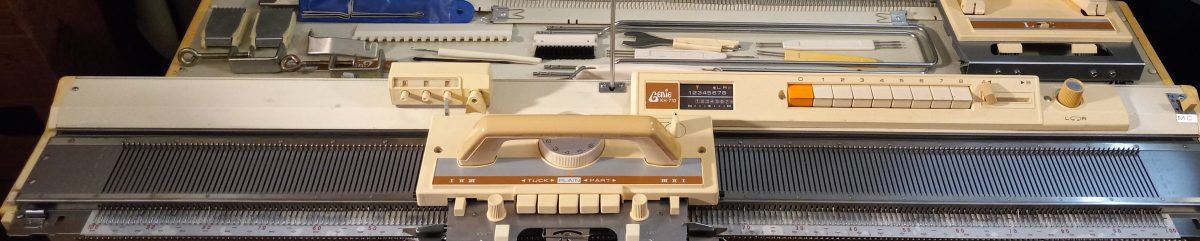
 The pattern center features 8-push buttons, set-lever (the one that moves the needles after the corresponding buttons are pushed), reverse lever (to determine whether the operator wants to bring forward the needles that are selected or those NOT selected), slide dial (the knob helping the knitter to shift the needle selection by 1-8 positions without pushing/unpushing or selectin/unselecting the needles) and MC change lever.


 KnitKing Simple seven is a plastic flatbed knitting machine. It is also known as Brother KX350.
 It packs nicely into an original box with the styrofoam pieces cut out for all the parts so there is no confusion about where each part goes. The box is a bit beat-up but still holds everything nicely.


