
MESSAGE ME AT FACEBOOK/COMFIKNITS IF YOU DONT SEE A PAYPAL PURCHASE BUTTON.
THIS MACHINE IS ALREADY SOLD….CHECK MY OTHER POSTINGS AS THE NEW MACHINES ARE COMING 1-2 TIMES A MONTH
A little bit about this model: Brother KH581 is an 8-push button machine. It first appeared on the market in 1969. This particular model was probably made specifically for Japan as the carriage has Japanese markings only (although this is the first and only KH581 I’ve seen so far in real life). It is similar to other eight push buttons Brother machines sold under models KH 588, KH561, KH560, KH585, although I have not tested those yet and there might be some minor differences. This model comes in pretty blue color and even some the assesories have blue tints. I find this color very attractive and unusual.
The standard setup comes with a lace carriage and rails. I think that is the first model to have both of these in its standard setup.
A big advancement of this model over its 4-push button knitting machines (like KH551) is the presence of a whole “pattern center”. It consists of familiar push buttons and a lever with a wrench but also of a slide indicator and a reverse knob. The manual is very clear about what they are but it still took me some time of playing with them to get what it does. Once I figured it out, it was almost like an EUREKA moment to me! I, once again, just was amazed how smart Japanese engineers are.
So, in regular 4-push buttons machines, we need to select the buttons (and then unpush them) every time we need to select certain needles. In 8-push button machines, we select the needles once and then the reverse knob and we simply tell the patterning center by how much the needle selection needs to be shifted. Once I got a hang of it, I was blown away by how simple it became to memorize your needle selection. In fact, you don’t memorize – you simply shift it. Also, excellent pattern charts in the manual explain it really well. Just don’t be discouraged by a learning curve and experiment with the swatch. You will see in my video that while knitting the butterfly pattern (referred to in the manual as “holding” pattern, I selected the buttons only once at the beginning. The rest of the needle selection was done by only turning the reverse and slide knobs. I also feel that this helps to reduce wear and tear on the buttons: the spring indeed will loose their strength from constant pushing and unpushing.
The manual shows how to work the most basic patterns. Additional patterns can be found in here.
The machine setup is very easy and almost intuitive. I still recommend following the instructions.
Pros and cons of KH581 in comparison to other brother knitting machines.
Pros (in no particular order):
+ Much simpler needle selection process especially for complex patterns, where different needles need to be selected during each row.
+ Lighter than more modern machines. Thus, it would be ideal for those with weaker upper bodies.
+ Relatively compact: needle bed is narrower than its younger counterparts.
+ Excellent for hand-knitters who want to transition to machine knitting. Often hand knitters are seeking for more even stitches or for less wear on their hand and finger joints when knitting every stitch manually, yet they don’t want to give up the pleasure and satisfaction of manipulating stitches. I had several customers who bought push -button machines from me for this exact reason.
+ Excellent for beginners, crocheters and knitters, as it is not overwhelming as electronic and punch card machines might seem at first.
+ Since the machine is mostly mechanical, not many things can go wrong. Just keep this machine free of dust (which can be achieved with regular vacuuming and sponge bar replacement) and free of moisture.
+ Pretty blue color which makes this machine stand out.
+ All tools are interchangible with other 4.5 mm gauge machines and can be easily purchased new or used.
+ Carriage is very easy to move. I was able to do it with just one hand (but it also depends on a correct combination of yarn and tension).
+ Matching ribbers are available and can still be found on the used market. In fact, I am testing a matching ribber (Brother KR580) right now.
 Cons (in no particular order):
- I was not a big fan of the tension mast being stuck inside the tool holder…
- Replacement needles can only be found on a used market. Nobody makes them anymore. I have plenty or replacement available in my shop.
- Fair isle knitting might not be as easy as on punch-card and electronic knitting machines.
- Hand-manipulations of stitches and keeping track of which buttons to push and which levers to turn might be overwhelming for some knitters.
 About this machine in particular:
It knitted very well and handled sport yarn, acrylic and wool, at different tensions really well. I did not feel that the machine was sensitive to yarn tension, which was pleasant and allowed me to relax while knitting.
I inspected every needle on this machine to make sure the bed has only good and well-functioning needles. I also inspected the stitches they make (this is why I run all my knitting demos on a full bed). I replaced a sponge bar and cleaned the machine.
Tests on a full bed confirmed that everything works great. I tested stockinet, slip-stitch, tuck-stitch and tuck with hold patterning. Check out my video to see this machine in action on a full bed. Below are pictures showing the swatches with patterns I tested.


I did not test the lace carriage but I thoroughly cleaned it and ensured that all buttons, knobs and levers moved freely.
All major assesories are included with this particular machine except for:
- A hard copy of a manual. A scanned pdf copy can be downloaded for free here or here (this particular manual is the exact copy of the hard copy I used to learn this machine).
- The lid to the storage box – it arrived to me just shuttered. It probably weakened due to its age and got cracked during transport.
- Parafin (or wax) is not included. The original one was too crumbled to include it. When I tested this machine on three different yarns, including 100% wool and 100% acrylic, I did not feel I needed it. There are two groups of knitters with regard to using wax: those who swear by it and those who care less. You decide which one you are for yourself
- A bottle with oil is also not included. The one that came with this machine was too dark to use it. I recommend Gun oil. A lot of knitters use it and I use it to clean and oil all my machines.
- Cast-on thread is also not included but any smooth yarn of the correct thickness can be used instead.
None of these missing assesories affect the functioning of the machine.

This machine was probably meant for the Japanese market. Thus, the wording on the carriage is in Japanese. But you will very quickly learn that the two button on the left-hand side are for tuck and the two buttons on the right-hand side are for “slip” patterns. The position of these buttons is standard across all Japanese knitting machines.

I also felt that the buttons on this machine needed an extra strong push to remain in their pushed position ( I had to do it with my thumb, which is stronger, than an index finger). Just keep that in mind while playing with buttons.
I always convert the fabrics I create while testing the machines into cowls/neck warmers, which I then donate to local charities. Here is what I got while testing this machine:


Overall, I was pretty impressed with this model and this machine. I so wanted to play and experiment with how many different patterns I can come up with I hope you will enjoy experimenting with it too.

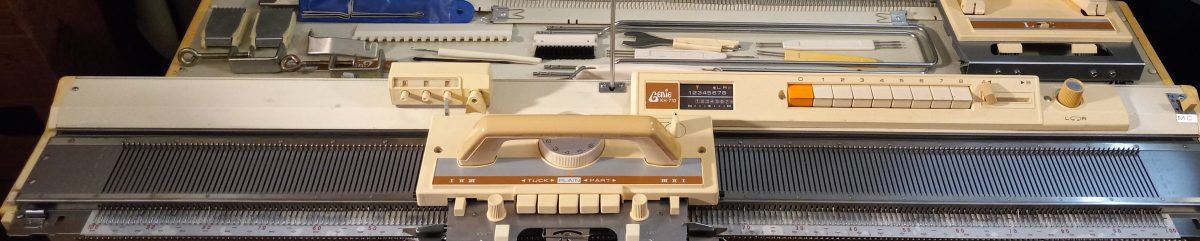


 This is a Brother KH588 knitting machine with an 8-push button needle selection mechanism. This model was released to the market in the late 1960s-early1970s. This model is equivalent to a rebranded Genie 710 (in case you need to search for information related to this machine). These are other 8-push button models similar to this one: KH581, KH560, and KH552, but their pattern control center is a bit less “sophisticated”. The pattern control center in KH588 makes your job of creating patterns and following the sequence of which buttons and levers to push the easiest.
 About this particular brother KH 588 machine.


 Preface: If I had to describe this machine with just one word – it would be FLAWLESS!!!
 prepare for the needle selection and then rotate the knob (using the wrench) to select the corresponding needles. It is an excellent machine for beginning knitters. I feel that it would be also great for people who are not quite yet ready to give up hand-knitting but want to have more even stitches and a bit faster progress…. Brother KH551 is also lighter than other machines mostly because its bed is narrower. The carriage is also significantly lighter and I could easily move it with just one hand.
 uneven stitch which is amazing considering no additional weights and a rather difficult (with specs and boucle) yarn.
 machine also makes it easier to store when not in use. I like the three-thread tension mast and a yarn clip in from of the tension mast rod. I love the three-horned tension section of the mast (not just a triangle) where each color of yarn can be inserted individually. However, the tension on the second and middle tension disk only has two settings (although they might depend on the very right one).
 l), you can just make a similarly shaped hanger out of a heavy-duty paper clip). On other machines, when I knitted multicolor slip- and tuck-patterns, I was just leaving the thread on the side of the machine to keep it out of the way…Regardless of the technique you chose, the absence of this part does not affect the machine’s functioning and you can still do a LOT of various things with it using a variety of techniques.


 mind when you try the patterns from the manual and they are not working.
 A little bit more about potential typos in the manual. I tried at least a dozen of times to knit the patterns on p. 33: a purl-like stitch on the left and another one on the right. The purl-like was either dropping stitches on the whole swatch or was tangling the yarn so bad that I had to start all over again multiple times…I do not exclude a complete operator failure….But: when I started reviewing the pattern on the right-hand side (the anonymous one on p. 33), I noticed some inconsistencies. I was still able to knit it but the pattern did not look like in the manual: see the picture below (the very top swatch) of what I got and compare it to the manual – two big differences. Well, at least the swatch did not fall off the bed like in the case of the “purl-like” pattern attempt. But that pattern (on the right-hand side in the manual) definitely had typos: Look at the schematics: it shows TUCK but the description writes PART. I vaguely remember seeing an addendum to one of the manuals of the machines I refurbished last year… Maybe the purrlike stitch pattern on the left also had typos/errors and this is why I could not figure it out… But I successfully knitted herringbone (not shown in my video – sorry), seed stitch A, seed stitch B (pics below and on a video), and diamond design (pattern I in the book on p28)….I then knitted these patterns on the whole bed and converted what I got into a hood/neck warmer/cowl…
 I took on a project of cleaning and conditioning this machine with enthusiasm because I already restored one Brother KH551 earlier this year. This machine was easy to clean – it needed some dusting, wiping, needle inspection, some needle replacement.


