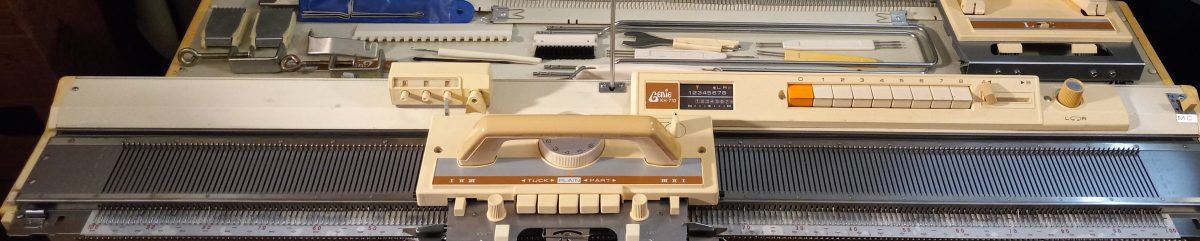
Singer 700 Mod Memo-Matic Knitting machine

When I got this machine, it was in excellent shape. Previously I restored and cleaned Singer 210 MemoMatic and Studio 360K so I was familiar with Singer’s knitting machines designs.

Singer 700 is very similar to Studio 360: the most obvious differences are positions of punch card reader, knit leader and a row counter. Another prominent difference is that the row counter dial in Singer 700 is in the middle of the bed (versus at the very end of the bed on Singer 360). Singer 700 is also a later-released model. But maybe the reason for a later release is simply a rebranding – the name changed from Studio to Singer (or vice versa). Since all of this not critical, let’s get to the actual machine.

Singer 700 is a 24-hole punch card reading machine capable of slip- and tuck- stitch patterning and fair isle knitting. In fact, I learned fair isle knitting on this machine for the first time. I will post in a several blog article my thoughts about fair isle, common mistakes and problems and how to trouble shoot mis-patterning issues.

The machine came to me with all accessories, including all transfer tools, knit leader sheets, weights, etc. The gauge guides did not come with this machine (see number 8 below). The punch cards that came with this machine are mostly the same with some exception. (For example, intarsia card is not as shown in the manual). Some other cards are different as well. I tested the tuck and slip stitch cards and they worked fine.

The machine has its own original box and hard cover, both of which are in excellent shape.

The set of manuals that came with this machine includes only Operation manual (http://machineknittingetc.com/knitmaster-600-700-operation-knitting-machine-instruction-manual.html).

The knitting manual (which explains how to use the knit radar) is available here: http://machineknittingetc.com/knitmaster-600-700-knitting-machine-instruction-manual.html

The pattern book for this model is available here: http://machineknittingetc.com/knitmaster-600-700-pattern-manual.html

The accessories fit nicely into a storage box on the side of the machine. I used it also as a stand to keep my handy tools (stitch transfer and needle selector) during the actual knitting – otherwise they are constantly getting lost!

In this machine, I replaced a sponge but the bar is original. (the metal sort of “railing” that holds the sponge). Unfortunately, the machine came to me with a slightly chipped sponge bar end – the plastic piece that we grab to remove the sponge bar. However, it absolutely does not affect the function of the sponge bar and, especially, of the machine. I could still easily move the bar in and out.

As needles often rust due to the old sponge bar not being replaced in time, I remove all of them to make sure they did not rust. All needles were in excellent shape. I examined every single needle.

I tested this machine extensively with the exception of the knit leader (I don’t use knit leader as I do all my calculations myself). I am simply not used to knit leaders – it’s just the way I was first taught how to knit). Since this machine is very similar to Studio 360K and I already knew how to do simply tuck- and slip-stitch patterning, with this machine I mostly focused on learning how to knit fair isle.

I knitted fair isle on a full bed and then on only middle 90 needles to make leg warmers. I made several pairs and one of them are shown below. (I used a card I had for my other machine).

The machine has similar pros and cons to the 360K with one exception: the carriage on Singer 700 Mod moves much easier than on Studio 360K even though it does not have a timing belt!!!

Pros:

  • The patterning drums make it very easy to move the machine. They engage with the punch card mechanism very nicely without much noise.
  • The manual is very well-written and I was able to follow the instructions with ease and to learn all the techniques.
  • All manuals and brochures are available online.
  • All tools fit nicely into a built-in storage box, the cover of which actually shows how to arrange them.

  • Easy-to find replacement needles since these models are relatively “newer” ones.
  • The carriage has a release lever (earlier Studio/Singer models do not), which comes handy when the carriage gets stuck and needs to be removed from the bed in the idle of knitting.
  • The tools are pretty standard and are pretty interchangible with other models.


  • The carriage moves very easily – I currently have a shoulder injury but still move it without any pain.
  • Some might find having the built-in knit-leaders very handy: there is no need to have a separate long setup laying around – in this setup all fits into one carrier box
  • I found that putting this machine to storage and opening and closing is much easier than multiple brother machines I had a chance to struggle with. There is a very clear schematic on the cover with the order of how placing the parts together. I found this extremely helpful as putting these machines away is often a big frustrating struggle.
  • Built-in row counter: knitters should not worry that a detachable row counter would be lost (like for Brother machines).
  • All parts fit into a case. The schematics on the case lid shows how to put away the machine and it is very easy to follow (much easier than on Brother).


  • Easy-to-learn patterning. The knobs on the carriage are straightforward – just follow the steps in the manual.


    The cons are:

  • The most significant flow in my mind is that the patterning drums often get stuck if not oiled regularly, especially when not used for a very long time or put into storage (I restored already two OTHER machines where the drums were simply shut… They needed soak in an oil bath and some heavy-duty disassembling). To avoid this problem, put some light oil regularly on the patterning drums. Lucky for me, this machine had the drums in excellent shape.
  • I personally wish the setup included cast-on bars but it might also be my personal preference. However, cast on bars can be easily purchased.

    Take a look again at this beautiful setup and check it out on my Etsy page.

Singer 210 Memomatic restored in November 2021


This Singer 210 memo-matic came to me in a very good shape yet still needed some TLC….

When I purchased it, I did not know much about Singer/Studio machines. So, I first restored Singer/Studio 360 and only then pulled this one out from my closet

I have to say that my shoulder did not complain a whole lot because this machine feels lighter than all others I handled so far. It is still not the lightest but I think what makes it light is that it does not come with a hard case cover. It came in a nice original cardboard box with Styrofoam layer, in which all accessories were stored.


This machine works flawless. I made a blanket on it while testing all its tuck and slip punch cards.


Pros:

(+) Worked great

(+) Looked at first not as overwhelming as other machines: it has less knobs and does not have a built in knit leader

(+) Not electronics – no need to rely on old electronic mother boards or on electricity

(+) Light-weight because it has no hard case cover but comes with the nice original cardboard box and a Styrofoam packing.

(+) easy to handle row counter: some row counters are flaky and the numbers jump back and forth when you are changing the dial manually…This dial did not give me any troubles at all!!

(+) putting machine and accessories into the case is really straightforward. Those who tried and struggle with placing the machine back into the storage into cases with hard cover (in which the sinker plate and the mast are stored in the lid) know what a struggle it is!! No struggle in this case – all accessories are inside a Styrofoam molds, which a re placed on top of the bed, which adds additional cushioning and security while storing the transporting the main bed.

(+) The carriage has a release lever which helps to remove the carriage in the middle of knitting (if it gets stuck) without removing the sinker plate.


Cons:

(-) the absence of hard case cover might be considered by some people as a con since storing this machine might come with its challenges: what is the carboard gets wet, what is the mice eat the Styrofoam?…It was not a problem for me and indeed, I liked it that it was not as heavy as my other machines.

(-) as with all Singer/Studio punch card knitting machines the patterning drums might freeze if the machine has not been used in a long time or stored, especially outside. This can be fixed though by spraying AeroKroil. There are a lot of resources explaining how to do it.

(-) not electronic and because of this the automatic patterning is somewhat limited. However, it is limitless, in combination with some manual stitch manipulation.

(-) does not come with cast-on combs – this was probably the biggest challenge for me (but I took cast-on combs from my other machines).

(-) I personally found that the tension mast is a bit close to the place where I was clipping the punch cards. It might not be a struggle for other people and it really was not for me, but I though I would mention it….


Compassion with Singer/Studio MemoMatic 360:

The comparison below simply shows difference features of the two models, and these features are not necessarily pros or cons. The reason I decided to put this comparison table together since, in my opinion, this machine is almost the same as Singer 360…. So, see below…


Singer 210 MemoMatic

Singer 360 MemoMatic

Hard case cover

NO

YES

Built-in knit leaders

NO

YES

Weight?

Lighter

Heavier

Punch card set

10 cards

15 cards


I really hope you will considering purchasing this model as your standard gauge machine (from me or from other seller). It is a great machine and definitely deserves your attention and love!

List of machines I tested/refurbished/cleaned/fixed

Updated: May 2026

Total machine count: 97

18 ribbers

2 circular plastic

3 bulky basic

6 mid-gauge plastic bed

35 standard-gauge punchcard

2 bulky punchcards

3 turn-knob

2 standard, basic

10 four-pushbutton

10 eight-pushbutton

6 electronic standard-gauge

Specific Machines:

Ribbers


Accesories

Garter carriages: KG95, including a two-color metal adapter

Transfer carriages: Brother

Color changers:

Linking carriages: Studio

Linkers: Hague

My first Singer 360 MemoMatic 360K


I purchased this machine, as all my others, with several other ones in a bit lot of various knitting machines. To learn punch card machine and knitting with a punch card pattern mechanism, I chose this particular machine because it was the most complete and best looking, I wanted to make sure I learned on a good machine so later on I can figure out problems with other, less ideal, machines.

If you want to see how it works, check out my youtube video.

Unlike other similar rescued machines, this had all accessories, including ravel cord and a small container with oil!! the lace carriage is not included though as it often sold separately.

Almost all accessories fit into the small compartment on the left-hand side of the carriage. The picture below shows this compartment but the majority of the accessories are working since I took this picture in the midle of knitting a garment


I tested this machine extensively – in action: I knitted a whole garment from the beginning to the end using a punch card number 12-A. I tested several other punch cards on tuck and slip settings. I did not try any lace patterns. I tested the knitleader buttons and knobs but I did not use it – I do my own calculations on decrease/increases.

Both needles and bed were in excellent shape – absolutely no rust. I removed all needles to make sure because sometimes when the sponge bar gets too old, it can corrode the needles.


Here is an overall picture of what is included :


This machine has a lot of excellent features.

Pros:

  • The patterning drums make it very easy to move the machine. They engage with the punch card mechanism very nicely without much noise.
  • The manual is very well-written and I was able to follow the instructions with ease and to learn all the techniques.
  • The other two brochures included with the setup up contain information on the settings for punch cards to achieve certain pattern as well as how to knit garments of various shapes. I know these are available online, but when one knits, it is always nice to have a hard, high-quality, copy handy. Needles are easy
  • Easy-to find replacement needles since these models are relatively “newer” ones. I get mine on Aliexpress.
  • The tools are pretty standard and are pretty interchangible with other models.
  • Some might find having the built-in knit-leaders very handy: there is no need to have a separate long setup laying around – in this setup all fits into one carrier box
  • Includes an optional lace carriage
  • I found that putting this machine to storage and opening and closing is much easier than multiple brother machines I had a chance to struggle with. There is a very clear schematic on the cover with the order of how placing the parts together. I found this extremely helpful as putting these machines away is often a big frustrating struggle.
  • The carriage has a release lever (earlier Studio/Singer models do not), which is very convenient when a carriage needs to be removed from the bed in the middle of knitting if it gets stuck. In earlier models without this lever, one needs to unscrew the sinker plate and then lift the top cover of the carriage to remove the carriage from the bed.

The cons are:

  • no timing belt, which might make the carriage movements somewhat hard depending on your tension and knitting pattern and technique. It was not a problem for me at all but after 200 rows of knitting my garment my hands and arms were a bit soar. Well, I guess this is how I can substitute my work out now.
  • The most significant flow in my mind is that the patterning drums often get stuck if not oiled regularly, especially when not used for a very long time or put into storage (I restored already two OTHER machines where the drums were simply shut… They needed soak in an oil bath and some heavy-duty disassembling). To avoid this problem, put some light oil regularly on the patterning drums. Lucky for me, this machine had the drums in excellent shape
  • Unlike Brother punch card machines, lace carriage is in a separate box. So, just one more thing to keep track off.
  • The row counter dial is at the end of the bed. Not too inconvenient but I personally prefer the row count to be right in front of me – not at the end of the bed.


Well, below is one more look at this wonderful machine. Sorry for so many pictures of this machine – I just could not get enough of it – it is so perfect!!! Alas, I want now to restore my other I want now to learn Brother punch card machines and then electronic ones.

The whole setup right now is for sale on my Etsy page.