
… still in progress. Last update: June 1, 2026
A vast majority of knitting machines on the current used market are from Brother and Silver Reed (also released under the Singer, Studio, and Empisal Knitmaster, Riccar, Silver names) manufacturers. In turn, a lot of models from these makers are machines capable of patterning using punch cards.
This article gives a general comparison of the punch-card reading and patterning mechanism of Singer/Silver Reed/Studio/Empisal knitting machines versus those released to the markets by Brother Co.
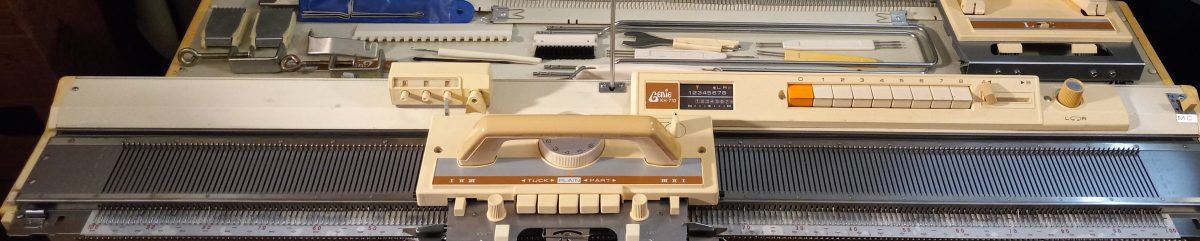
The patterning mechanism of Brother punchcard knitting machines is activated when the carriage is locked into the timing belt. Silver Reed (and also some of the Toyota models, like Elna EK2300) machines have patterned drums on the carriage.
I find that knitting on machines with patterning drums is a bit quieter than when knitting on machines with a timing belt. However, it is somewhat easier to move the carriage when it is also guided by the timing belt.
Both types of machines have their own problems. For example, yarn often tangles on machines with patterning drums. While machines with timing belts have a lot of issues with timing belt misalignment.
However, I find it easier and more straightforward to set up a tension mast on the Silver Reed machines than on the Brother. Sometimes I feel that when I unfold the head of the tension mast on Brother machines, I bend it too much.
Concerning the tension masts: there are two slots on Singer/Studio/Silver Reed/Empisal machines (and they are in the case handle – so in the middle of the needlebed) to insert the tension mast. On Brother machines, there is one in the middle. The tension mast seems more user-friendly than Brother masts: it is so easy to lock the head with tension wires into the right position on Silver Reed than on Brother.
I like that on Brother machines, the needles move forward according to the punch card. So, it is somewhat easier to see if the machine mispatterns. On Silver Reed/Studio/Singer machines, all needles (selected and not selected according to the punchcard) remain in one position (B). Thus, sometimes it is hard to see if the pattern is transferred to the needles correctly.
Patterning of the Singer/Siler Reed/Studio/Empisal knitting machines occurs when the drums pass the patterning center. Brother patterning occurs when the timing belt is latched onto the carriage (by activating the KC button). Thus, it is very important to follow the instructions on how to start knitting and patterning using the punch cards for both models.
Clearing of the patterning in Silver Reed machines occurs when the lever passes the “clearing center “, while on Brother, the patterning selection changes when the carriage turns.
After working with it, I feel that standard-gauge Singer/Studio/Silver Reed takes yarns thinner and smoother than the same gauge Brother machines. It seems that Brother machines can handle yarns not just thicker but with a wider variety of textures. But it might be just my experience. Working with various yarns is always an interplay between tension, use experience, how tight the yarn is in the cake/cone, static (which depends not only on your yarn but on the condition of the bed and your environment, which also changes seasonally), etc.
The more I knit on Brother and Silver Reed punchcard machines, the more I am discovering that the ever problematic tuck-stitch is better knit on Silver Reed machines. On Brother machines, I need to find the perfect combination of yarn, its tension, weights, speed of moving the carriage across the bed…. In silver Reed machines, I do not even think about all these precautions…. I strongly suspect it has something to do with the way the needles are selected and the stitch is patterned.
… to be continued.
A quick guide to which machines have punchcard patterning capabilities:
| Brother/Defendi/KnitKing/Jones* | Empisal/Riccar/Silver/Silver Reed/Singer/Studio, etc. |
| STANDARD GAUGE | |
| Brother: KH810, KH810**, KH811**, KH820, KH821, KH830, KH831, KH835, KH836, KH838, KH840, KH850, KH851, KH860, KH864, KH868, KH871, KH880, KH881, KH890, KH891, KH892, KH893, KH894 Defendi: KM2000, KM3000 KingKing: KK91, KK93, KK98, KH830, KH840, KH881, KH891 | Empisal KnitMaster: MK70, 260, SK313, 321, 322, 323, 324, 326, 328, 329, 360K, mod. 600, mod. 700, 700K Riccar: RK-701, RK-702, RK-703, RK-704K, RK-705K, RK-706K, RK-707, RK-708, RK-708A, Riccar 709, LECLE Silver: SK250L, SK311, SK312, SK313, SK315, SK321, SK322, SK325, SK326, SK327, SK328, SK329, SK330, SK360 Silver Reed: 250L, SK280, SK282, SK360, SK640, SK700, SK700N Singer: MK70, 210, 312, 313, mod. 313, 321, 322, 323, mod. 323, 327, 328, 329, 360K, 700K, mod. 700, 740 Studio: 280, by White mod. 280, SK312, SK313, 315, mod. 321, mod. 322, mod. 323, mod. 324, mod. 326, mod. 327, mod. 328, mod. 329, 350, 360K, mod. 600, mod. 700, by White SK740 |
| BULKY GAUGE | |
| Brother: KH260, KH264P KnitKing: KH260, PC bulky | ELNA: EK2300 Empisal Knitmaster: mod. 155 Silver Reed: SK155, SK155P Singer: mod. 155 Studio: mod. 155 Toyota: KS650 |
| FINE GAUGE | |
| Brother KH1101 | Empisal Knitmaster: F270, F370 Silver Reed: F270, F370, SK370, SK670 Studio: 270, 370 |
*KH800 and KH801 models have a slightly different punchcard mechanism and thus are not considered in this comparison
**KH811 also has pushbuttons in the patterning center. Punchcard reading and needle selection work like in all other Brother punchcard machines.
*** Some Elna machines have patterning drums similar to those of Silver Reed machines. This is why Elna machines are in this table/article.

2 thoughts on “Comparison, pros and cons of Brother and Studio/Silver Reed/Singer punch-card knitting machines”