Tension spring for Brother Knitting machine

Carriages of Brother knitting machines have several types of springs to ensure smooth needle handling. This article is about a medium size spring, part of the intricate mechanism of Brother knitting machine carriages. These springs can be purchased in my store.

In particular, this short blog article is about a tension spring responsible for smooth the movement of the middle button on the carriage. (At the end of this article, I show other places in the carriage where the same type of spring can be used). This button is typically used to knit fair isle or/and to reset all other buttons.

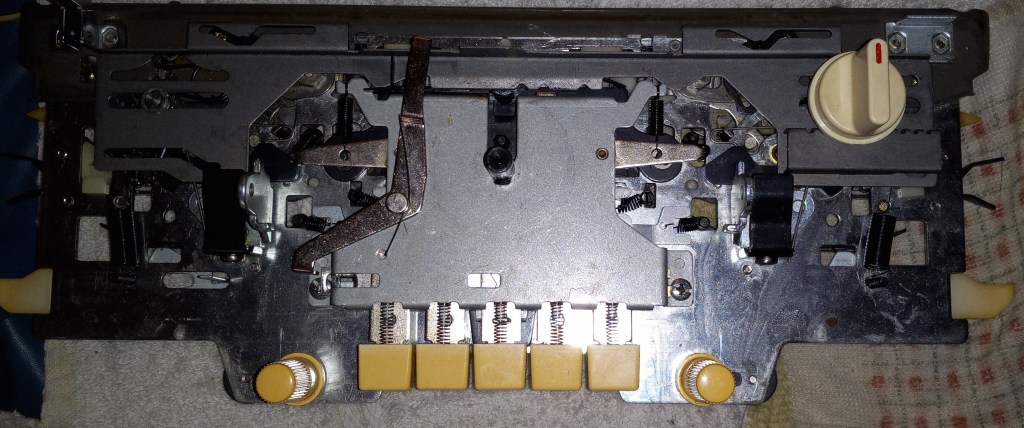
To expose that spring, one needs to remove the plastic carriage cover (this step NOT covered in this article) and then remove the metal cover.

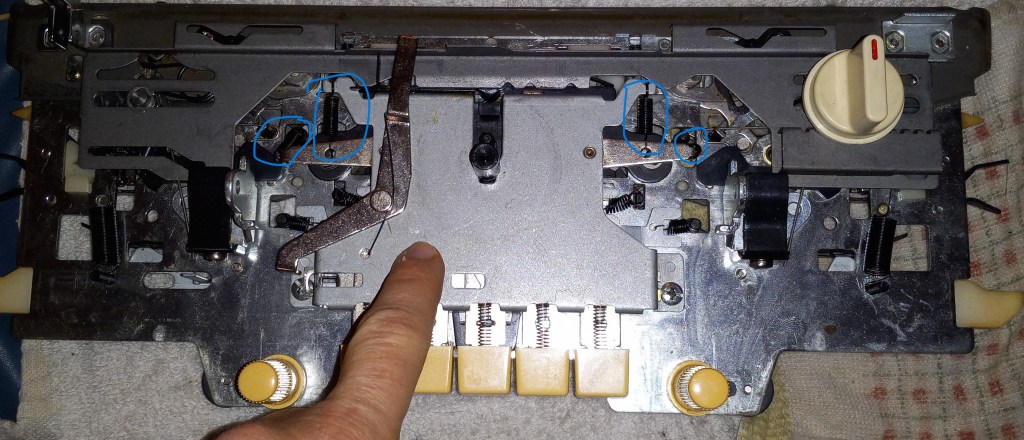
For that purpose, remove the two screws marked below.

The plate will then hang by the springs marked in the picture below but they do not have to be removed. Just push the metal plate out of the way. If the springs detach, they are easily to put back. Just take a picture of the agreement before removing the cover.

Once the cover is removed, you will see the springs right away. In my case, one of the springs was simply missing and the mechanism was not retracting automatically the way it was supposed to.

So the replacement spring was placed where one was missing. I made a short video showing where the spring was installed.

“How” the spring was installed is NOT shown in that video because it is kind of hard to capture how to attach the spring. But the loops of the spring need to grab the posts marked in the picture below.

The same spring can be used in positions shown below. The springs marked with crosses are either small/bigger in size or a spring without the loops (springs for the buttons) and thus, cannot be used.

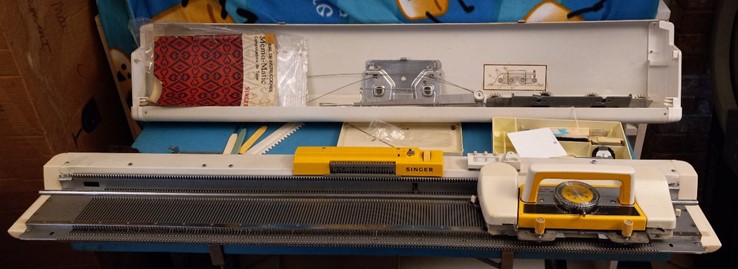
Singer 360 with 700 carriage for Isabella

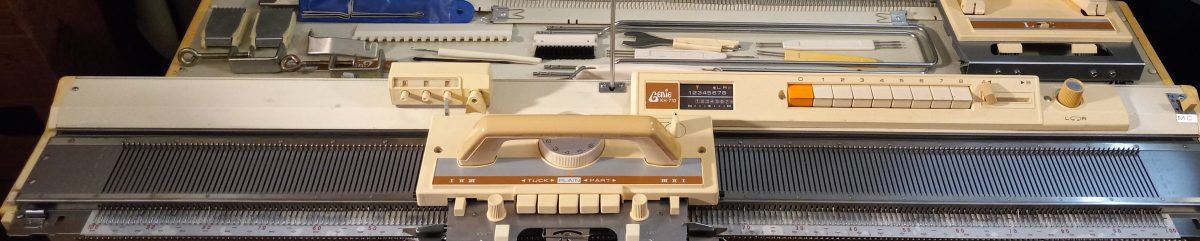
Singer 360 knitting machine is a standard gauge knitting machine (distance between needles is 4.5 mm). The machine has a built-in knit leader. It patterns automatically using a punch-card mechanism.

Specifically about this machine cleaned for Isabella:

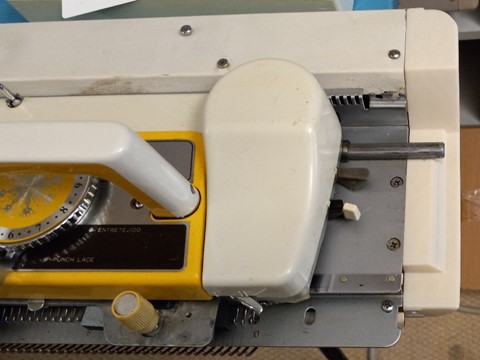
The carriage that came originally with this machine was acting up. I opened it up to fix and noticed that somebody already tried to fix it and assembled it incorrectly. I did not want to delay the delivery of the machine so this 360k will be equipped with a more advanced carriage from a 700mod model and a matching sinker.

The main bed, all needles, all knobs and levers on the punch-card reader and knit leader are in excellent shape. All needles were inspected and the machine has a new sponge. The machine was tested on full bed to knit stockinet, slip-stitch, tuck-stitch and 2-color fair isle patterning (see my video with these tests). All needles behaved flawlessly and the carriage was moving freely without any problems at all. I was very pleased! Below are the panels I knitted. As always, these will be converted to cowls/neck warmers for charity.

In general, all knobs and buttons on 360 and 700 carriages are the same. One major exception is the levers for the tuck-knitting. 700 carriage does not have those levers. It was actually very easy to knit a tuck-stitch pattern with this carriage. I had zero problems from the beginning. The tuck-brushes on the 700 carriage do not have to be moved and they do not get tangled in thread when knitting. All these are huge advantages.

I did not test the knit leader but all knobs and levers move freely.

The machine will come with all major assesories.

A couple of minor assesories missing are:

  • Only two yarn separators are included. These are needed to knit single-motif. So, with just two yarn separators you can still knit a single motif but only one per panel.
  • A tapestry needle is not included: any metal or plastic needle will do
  • Only two point-cams are included. These too are needed to knit single-motif. With just two point-cams you can still knit a single motif but only one per panel.
  • Only one unravel cord is included. I typically use any contrasting yarn: not very thick and preferably very silky.

I also included an extra tool – very useful for beginners: a claw-weight/cast-on comb. In this case, you can knit one row on every other needle, hang a cast-on comb, knit a couple more rows until all stitches are knit, and then knit on all needles (described better in this manual on p. 9)

Because this machine had two major parts from two different machines below is the list of resources and manuals that Isabella will need to knit usefully on this setup. These brochures are available for free and discuss how to use the machines and how to knit garments:

  • Operation manual for 360mod knitting machine. This is a resource to go to when you need to know how to setup your machine, how to assemble it, troubleshoot, etc.
  • Knitting manual describes how to swatch, calculate gauge, how to use pattern paper and a knit leader to knit garments and how to make cloth in general.
  • Pattern book shows how the patterns on punch cards will look when knitted using different techniques. Although some of the cards might be slightly different.
  • Operation manual for 700 machine. Here is learn how to setup the knobs and levers on your 700 carriage.
  • Read pros and cons of Singer 360 in my previous posts:

http://thoughtsandknits.com/2022/09/04/360-for-laura-cleaned-in-august-2022/

http://thoughtsandknits.com/2022/08/07/studio-360-k-memomatci-reported-in-august-2022/

http://thoughtsandknits.com/2021/10/13/my-first-singer-360-memomatic-360k/

Now about imperfections:

The imperfections are mostly on the top lid of the whole case. It has several minor bumps.

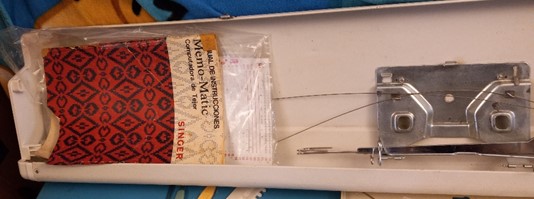
There is one bend in the middle but the machine still closes. I decided against beating it up with the hammer to straighten it because It creates additional microcracks and makes the metal more prone to corrosion. The lid still closes with just a small push.


The case panel that attaches to the main bed (the bottom panel) has one bend as well (not shown in here).

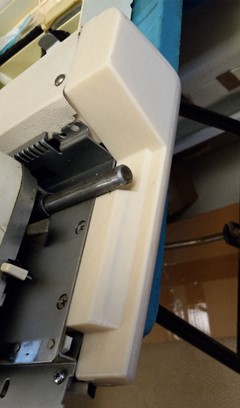
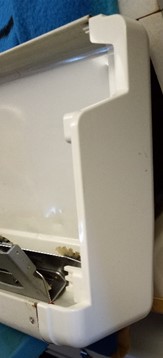
The end-cap of the lid has a crack. It is pretty minor so I did not replace it to keep the cost low.

I am 100% confident that you will like this machine like I did!!! Happy knitting!

SRN321 ribber, suitable for Singer/Studio/Silver Reed knitting machines.

This ribber is sold out but check my Store for other ribbers and machines.

If you came here because you are looking for a ribber for your Singer 321 or earlier model knitting machine, you came to the right place.

Ribbing attachment SRN321 is so easy to install (aka, attach to the main bed) and so fun to use! Need one now? Check out my Etsy store.

Want to know more? Keep on reading!

Studio SRN321 ribber is an attachment that allows alternating knit and purl stitches. It was released in 1972. The ribber has 200 needles. Studio SRN321 ribbing attachment fits the following knitting machines: Singer/Studio 321, as well as models MOD. 315, 313, 312 and 305. SRN321 ribber adds so many patterning possibilities, as mentioned in the instructions and beyond. I did not see in the instructions if this ribber can provide double jacquard possibilities and I did not test it myself yet.

About this particular ribber.

I tested it in combination with Singer 321 knitting machine. The carriage slides very easily on the full ribber bed. I feel that the instruction explain really well how to knit all kinds of ribbing.

Tested on 1k 1p rib, double rib (see the cast on-thread and the first several rows below) on 30 needle swatch and on the almost full bed with the singer 321 knitting machine (not shown – forgot to take pictures but check out my video). The 1×1 ribbing created on this machine was so stretchy and pretty! I fell in love The carriage is so easy to move although it might take some time to get used to it (as opposed to using only the knitting machine).

I also tested the partial ribbing on this machine while the main bed was knitting the tuck-stitch pattern (see my video for that as well).

All major assesories included. Minor assesories missing are:

  • Hard copy of the manual will not come with this machine but could be obtained online.
  • Oil (it was old and I discarded it). Good oil to buy for any knitting machine is Gun oil.
  • Screw driver but any flat metal piece would work. It is mostly to screw the large bolts onto a machine. I used a thin coin.
  • Replacement needles: I am currently outsourcing them and hopefully I will have them soon.

I personally did not find any cons with this ribber. It does the job so well. It was absolutely not overwhelming to use and was extremely easy to set up. I think it is an excellent ribbing attachment for beginning machine knitters.

I hope you will be as excited as I was using this ribber. It is available in my Etsy store.

Pictures of upgraded Singer 321 for Katherine

Overall view of the setup.

Right-hand side end cap on the main bed

The left-hand-side end cap on the main bed

The lid with replaced end-caps

The lid end cap upclose

Singer HK100, fully serviced and tested in December 2022

Singer HK100 plastic flat-bed knitting machine was made in 1983 to supply hobbyists with less expensive and simpler knitting machines. Indeed, it is extremely easy to set up and is almost intuitive to use. It still can produce a lot of nice garments with a variety of yarns. I personally tested some cotton yarns, acrylic (Red Heart – shown in my video), and the worsted wool blend. This machine is excellent for beginners who are just trying to get a feel for what machine knitting is like.

Singer HK100 is considered a mid-gauge/bulky knitting machine. It contains 120 needles and is capable of only manual stitch and needle manipulation to create various patterns, like, tuck, slip, fair isle, cables, lace, etc. However, there are so many youtube tutorials and printed patterns that the possibilities are endless.

The machine has a unique brown/white color combination, which makes this machine very distinguishable.

What I found especially user-friendly is the yarn guide/tension mast. It simply inserts into the carriage while the yarn cone or cake is positioned on the floor. The reason I find it newbie-friendly is that even seasoned machine knitters sometimes struggle with the metal tension masts on more advanced knitting machine models. Additionally, when I knit on my flat beds, I typically don’t lift my head up to see what’s going on with the yarn on the mast and sometimes there are sudden stops if the yarn tangles. In the case of HK100 and the yarn being right in front of you, you will always see what is happening with it and you can easily catch the knots before they choke your carriage. In fact, my video shows that there was a knot in the yarn, I caught as it was about to enter the carriage, untangled it, and then continued knitting without problems. I was very pleased that I fixed the problem on the go.

I also liked very much the intuitiveness of this machine. For example, when I was a newbie on my metal flatbed machines, I always had to look in the manual as to what the position of the levers meant; what I need to do to simply slide the carriage without knitting. On Singer HK100 there are not that many levers and the only function of the levers on the side of the carriage is to NOT KNIT 😊 You will see in my video that after I made a mistake, I simply pressed the lever and slid the carriage out of the way without knitting.

Another interesting observation I made with this model is that it handles knots without too much drama 😊 Here is what I mean by that: during one of my tests, my worsted wool blend tangled a bit and formed a small loose knot. It passed through the carriage so easily that I only saw the knitted-in knot after 10 (or so) rows. On one side, I was pleased because in my other machines, a knot in the yarn means a tighter row, breakage, sudden stop… But in this case, the knot became part of the knitted fabric. In fact, the knitted-in know was visible only on the wrong side but not on the right side.

Below are the specifics on the machine, I cleaned and tested and offering for sale here and in my Etsy store:

When I just took the machine out of the box (which looked like it was the original box), it looked like it was never used. However, it was dusty. I took out all the needles and cleaned and inspected each individually. I removed the sponge bar, cleaned the “canal” for it inside the machine (right under the flatbed), and inserted a new sponge bar. (Video on how to remove a retaining for inspection, or for a needle change bar is here.

The machine comes with all major assesories, a hard copy of the manual, and three brochures on how to knit various things (all in excellent, barely-use, like-new shape).

A couple of minor things missing are:

  • The plastic gauge ruler (also called a gauge scale). The gauge scale can be easily calculated manually. In fact, I find these rulers confusing.
  • Tapestry needle, but any needle can be used. In fact, I like using colored plastic needles since they have a larger opening and are not as sharp, and easier to see if dropped. But I am also not worried if I, my kids, or my other family members including dogs step on one.
  • Ravel cord. Actually, any smooth yarn could be used as a ravel cord (also sometimes called a waste-yarn thread). I keep several long sections of various yarns on the hook next to my machines to use as a ravel cord. Some knitters don’t even use ravel cords at all.

The fact that all these minor assesories are missing, does not affect how the machine works.

One missing part that I had to fix is a row counter tripper. The machine arrived to me without it. I glued a yellow piece of plastic shown below and it stayed throughout my whole testing.

To make sure it does not break again, I packed it with lots of bubble wrap. Other solutions are possible as well (for example, inserting an L-shape piece of plastic into one of the slots on the back of the carriage).


I recorded a video of almost all the tests I ran on this machine. The knitted fabrics were converted into a colorful cowl/neck warmer, and a set of matching scarf, and a slouchy hat.


A favor: please, comment on the blanket in the background. Apparently, I used it without my son’s permission and I am now in trouble. But if he hears from my readers how cute his favorite blanket is (it is his camping blanket), I might be forgiven 😊)

Personal knitting machines museum (those I personally tested_.

MACHINES:

Standard (4.5 mm gauge/distance between needles):

Basic models: Brother KH550

4-push buttons: Brother KH551

8-push buttons: Brother KH552, Brother KH581, Brother KH585, Brother KH588,  Brother KH601, Brother (Genie) KH710

Punch-cards:

Studio/Silver Reed.Studio.Empisal: Singer 321, Studio 326, Studio 360K, Singer 360K, Singer 210, Singer 700 memomatic

Brother: KH800, KH830, KH836, KH840, KH860, KH890,

Electronic: Brother KH930,  Brother KH930e, Brother KH940

Mid-gauge:

Basic models: KX350 (7 mm gauge), KnitKing Simple Seven (7 mm),  Singer KH100 (8 mm gauge)

Bulky:

Basic models: Brother KH210 (9 mm), Silver Reed SK120 (8 mm)

Punch-cards: Brother 260, Brother 260e

RIBBERS:

Standard: Studio SRN321, Brother KR580, Brother KR810, Brother KR830, Brother KR850, Brother KR850e,

Bulky:

Singer 360K for Philip

Overview and run down of Singer 360 K for Philip

Test performed: full bed stockinet, slip, fair isle, 1×1 mock ribbing.

Sport yarn is the best. Thicker (e.g., worsted yarn – best on every other neelde).

I did not extensively test the knit leaders but all knobs and levels work.

The machine came with some assesories and some I added. I added a set of punch cards. The set is brand new but differs a bit from the original Singer/Studio set. The machine came with some knit leader sheets, and they will be included.

The overveiw is below.

Missing are:

  • Oil canister. I do not include old oil on purpose. Please, get a fresh/new oil. The recommended by many machine kntiters is Hoppe’s Elite Gun Oil
  • Only one ravel cord in included but any smooth strong yarn can be used
  • only one set of point cams (number 15) and yarn separators were included. These are usd for single-motif knitting. This is somewhat advanced technique and if you are proficient enough with just one single motif (two sets are needed to knit two single motifs) you will know by then where to get additional sets. To be honest, I tried single single-motif and it was so challenging that I simply gave up. It is challenging by all the small details needed to kniw a single motif. There are other machines to do it much easier. Plus, I like motifs throughout the whole bed anyways… But with just one set of point cams and yarn separators you will still be able to knit just one single motif.


All tools fit into a built-in storage.

The machine itself is in great shape.

There are couple of impercets on the plastic and on the cover.

They are:

  • Masking tape stain on the tool box lid

Some writing on the carriage. I wiped it but did not rub too much to avoid damaging already old and potentially brittle plastic.


The case and the lid have minor scratches and minor bend. The most prominent is the red stain on the lid.


The strip with numbers has some minor staining (seen on video).


Video just for you:


I also recommend getting this small cast-on comb. (I am not affiliated with them). It makes the cast on so much easier for beginners…


Manual and recommended brochures specifically for this machine are here:

(but keep in mind that I am sending you generic punch cards – they might not match the numbers shown in the third brochure).

https://mkmanuals.com/knitmaster-360-260-knitting-machine-manual.html

https://mkmanuals.com/knitmaster-360-260-operation-knitting-machine-manual.html

https://mkmanuals.com/knitmaster-360-260-pattern-book-knitting-machine-manual.html

Please read my other post on overall pros and cons of Singer/Studio knitting machines and 360K model in general.

http://thoughtsandknits.com/2022/09/04/360-for-laura-cleaned-in-august-2022/

http://thoughtsandknits.com/2022/08/07/studio-360-k-memomatci-reported-in-august-2022/

Second Singer Studio 360 Mod restored/cleaned/refurbished in March 2022

http://thoughtsandknits.com/2021/10/13/my-first-singer-360-memomatic-360k/


Some pictures as I am putting the whole package together.

360 for Laura, cleaned in August 2022

Studio (also known as Singer, Silver Reed and Elna) machines are great machines to have for beginners or advanced knitters…They offer a lot of versatility. So far, I had a simple (without any automatic patterning with the exception of manual needle selection) and punch-card Studio machines. Studio 360K appeared on the market in 1980-1982. They are equipped with a 24-stitch patterning mechanism transferred to the needles using the punch-card reader.

The hero of this blog, Studio 360K, has 200 needles. The distance between needles (which is also called a gauge) is 4.5 mm, which is considered a “standard”. The best yarn for this machine is sports weight. Thicker yarns can be kitted on every-other needle.

This particular Studio 360K knitting machine came to me in a pretty decent shape so no major disassembling was required. There was no rust. I removed dust/dirt using a brush from under the bed (I did not disassemble it). I removed all needles and polished them as there was a tiny bit of rust on them where a bad (decomposed) sponge bar was touching them (it is pretty typical for old neglected machines). However, all the needles were inspected individually and I tested them by knitting on a full bed using different techniques. The short answer is – everything looked good. For more justification/information on how I judge it – refer to the youtube video made for this machine. The sponge bar was replaced at the beginning of August 2022. It was only used to test this machine (made three cowls on it – see below).

The carriage was somewhat more sensitive to the combination of yarn and tension than the other machines I refurbished. If possible, I would recommend using new sport weight yarn, wound into cakes, and taking the yarn from the middle of the cake while knitting.

The machine came with no end rails. This is a typical problem for most Studio/Singer machines. These end-rails are rubber, which decomposes with time. Some Singer/Studio machines have metallic end rails but this one had separate rubber ones. They typically tend to decompose due to time and fall off. So, initially, these rubber end-rails were still present but while I was using the machine they fell off since they already showed a lot of cracking and deterioration. These end rails are also not very critical pieces and the machine will work fine without them. They are important when knitting on all 200 needles. But even in this case, if you slow down the carriage on the last 10-20 needles and don’t let the carriage slide too far, you will be ok. These end rails are needed to prevent drums from mis-patterning if the carriage is moved too far from the bed.

I typically do not include end-rails with my refurbished machines because most knitters do not use the full bed – only some needles in the middle. However, I felt that because this machine is sensitive to tension, it could be relatively easy for a new knitter to accidentally slide the machine from the bed. So, I installed the new Installed end rails. The carriage without them did not run as smoothly. FYI: if these decompose and fall again, the new ones simply snap on but the lid needs to be removed. Contact me if you need help with that.

BEFORE:                                                  AFTER:

I did not extensively test the knit leaders because I do all my calculations myself. But all buttons turn freely and the paper advances as the carriage moves back and forth. The video shows this as well.

The machine came to me without the original punch cards. I purchased a set so this machine has all accessories. Some of the punch cards correspond to the original set and some are different (more exciting, in my opinion).

The machine also DID not come with a hard copy of the manual but it can be found here (totally free). This and this brochures are also typically included with the package for 360K. they cover some knitting techniques as well as garment shaping. I found them very useful when I knitted my sweater last year.

All the tools are present, including replacement needles. If more are needed, I recommend purchasing the replacement needles here. Only one set of unraveling cord, card snaps, point cam, and yarn separators are included. The yarn separators and point cams are needed to knit 2 single motifs. To be honest, a single motif on punchcard machines requires a lot of skills. So, by the time the user decided to knit two single motifs (where two sets of these are needed), this knitter would be considered advanced and will either know where to get these parts or will switch to an electronic machine (single motif on electronic machines is so easy!!!). The carriage lock (accessory number 2) was not supplied with the original setup. So, I ordered a 3D printed one specifically for this machine. The card guide was also missing (accessory number 18). But I included a large knitting needle that I used while testing this setup.

This carriage runs on the bed a bit tighter than my other 360k. It is also very sensitive to tension. Make sure the yarn flows really REALLY smoothly and that the cake/bobbin/cone is right underneath the tension mast.

The machine has several cosmetic imperfections. They are:

  1. The discoloration on the carriage. It is not affecting its function. Probably a previous owner attached a sticker to it and the plastic around it became darker with time.
  2. Shipped end by the end rail. It also does not affect the functioning of the machine.
  3. A couple of scoff marks on the knit leader card advancing mechanism.

I also replaced the two front top panels (they are slightly lighter than the middle one – see the last picture above). They were severely cracked and needed to be totally replaced.

To learn about the general pros and cons of Studio/Singer 360K, please, refer to my previous post.

When I test machines, I really like to knit something in the process. So, I am making these wide pieces of knitted fabric, which I then convert to cows/hoods/neck warmers. Below are the cowls that I made while testing this machine:

You can see me making these in this video (no instructions though – yet!)

All these are going to charity to support the Happy Hats Maryland project to supply 1000 hats and scarves to those in need in my county.

Happy knitting with this machine!!

Electronic knitting machines and software combinations

This is a list for me as I am learning about various software and knitting machine combos. Feel free to comment if you see errors.


Wincrea

Passap E6000


image2track

Brother KH-930, KH-930e, KH-940, KH-950i, KH-965i, KH-970


Knit and Sew

Brother kh-940, KH-950i, KH-965i, KH-970, KH-930, KH-930M


DAK (design a knit)

All (to the best of my knowledge)


AYAB (All yours are beautiful)

Brother electronic machines


Studio 360 K memomatic reported in August 2022

This post is in progress as I am editing it while cleaning the machine.

Replaed two main plastic consoles since they were broken. Took these parts from identical (but for parts) Studio 360K. Cleaned very thoroughly inside the mechanism (but I did not disassle it since there was no rust and overall everything looks in good shape and everything moed freey).

This machine was a rare find since the patterning drums did not shut stuck and moved freely. I suspect this machine was not used a lot since even during cleaning I did not see a lot of fold grime.

Replaced sponge bar, inspected all needs, polished and visually chcked. Also checked all needles in action (see my video on a full-bed knitting) to make sure the needles not just looked good but also functioned well.