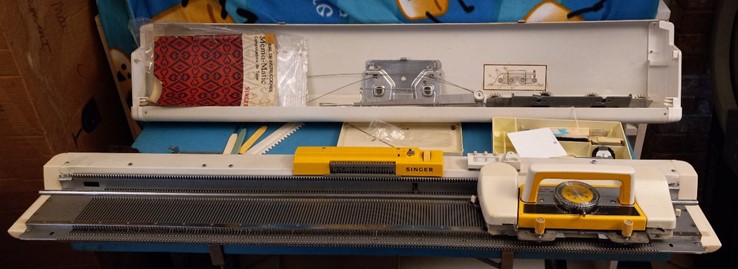
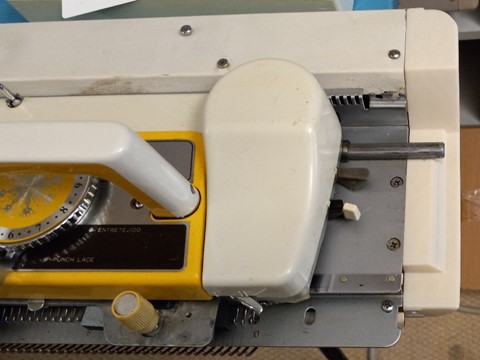
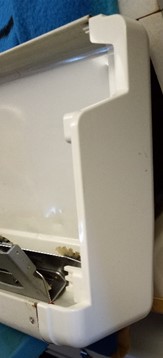
Brother KR580 ribber was first introduced to the market in 1966 to knit with 8-push button machines (KH552 and above all the way to KH560-KH588). According to some charts by creationgroup.com, KR580 ribber can even fit KH800 knitting machine. Genie 710 machine (sometimes called Brother KH710) is also an 8-push button machine but I could not information anywhere whether KR580 ribber will fit it. KH710 had some innovative design features (like all-plastic end-caps) that none of the earlier 8-push button machines have (KH562, KH581, Profile 585, KH588) but the width of the bed is the same and the needles are all interchangible among all 8-push button machines.
Because it is an older model, capable to create purl stitches when coupled with older models, the main carriage knits first and then the ribbing carriage moves the needles to working position.
The ribber needles simply latch on the yarn hanging between the needles on the main bed creating purl stitches. See a full demo in my video.
I feel that this gives a knitter a better idea which carriages causes troubles (if any) and see that needles are knitting and what not. Later ribber setups (equipped with a connecting arm, that attaches main carriage and a ribber carriages) work the same way but they ensure that only one movement is needed because the main and ribber carriage move at the same time.
About this particular ribber:
It was tested on Brother Profile 585 machine.
It has a pretty white color This is the first ribber for 8-oush button machines I’ve seen in real life and worked on. So, maybe all of them come in this pretty white color but I like it. It has such a classic 60ies look, like those corvettes you see on the road that cost nothing for the car insurance companies but are so pretty and so valuable on the used market.
The retaining bar is plastic – big PLUS: no need to replace it and worry about decomposing sponge in retaining bar corroding needles.
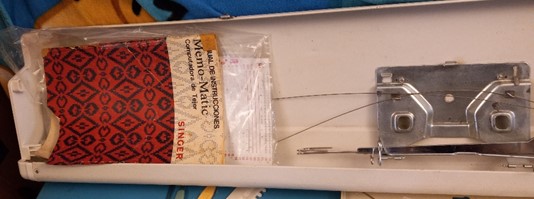
The machine comes with ALL assesories. Hard copy of the manual will not be included but it can be found online for free.
Tested a swatch on 1×1 ribbing
and 1×1 ribbing on the full bed but when every-other-needle was selected.
Hard copy of the manual will not be included but it can be found online for free.
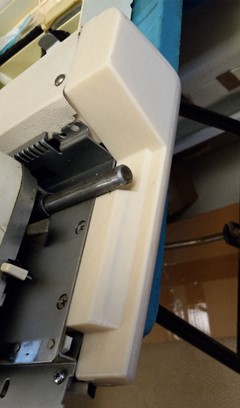
Photos below show how the ribber fits onto the machine. The manual describes step-by-step instructions how to attach the ribber to the main bed.
The large screw goes into a place where a rail guard normally attaches.
Singer 360 knitting machine is a standard gauge knitting machine (distance between needles is 4.5 mm). The machine has a built-in knit leader. It patterns automatically using a punch-card mechanism.
Specifically about this machine cleaned for Isabella:
The carriage that came originally with this machine was acting up. I opened it up to fix and noticed that somebody already tried to fix it and assembled it incorrectly. I did not want to delay the delivery of the machine so this 360k will be equipped with a more advanced carriage from a 700mod model and a matching sinker.
The main bed, all needles, all knobs and levers on the punch-card reader and knit leader are in excellent shape. All needles were inspected and the machine has a new sponge. The machine was tested on full bed to knit stockinet, slip-stitch, tuck-stitch and 2-color fair isle patterning (see my video with these tests). All needles behaved flawlessly and the carriage was moving freely without any problems at all. I was very pleased! Below are the panels I knitted. As always, these will be converted to cowls/neck warmers for charity.
In general, all knobs and buttons on 360 and 700 carriages are the same. One major exception is the levers for the tuck-knitting. 700 carriage does not have those levers. It was actually very easy to knit a tuck-stitch pattern with this carriage. I had zero problems from the beginning. The tuck-brushes on the 700 carriage do not have to be moved and they do not get tangled in thread when knitting. All these are huge advantages.
I did not test the knit leader but all knobs and levers move freely.
The machine will come with all major assesories.
A couple of minor assesories missing are:
Only two yarn separators are included. These are needed to knit single-motif. So, with just two yarn separators you can still knit a single motif but only one per panel.
A tapestry needle is not included: any metal or plastic needle will do
Only two point-cams are included. These too are needed to knit single-motif. With just two point-cams you can still knit a single motif but only one per panel.
Only one unravel cord is included. I typically use any contrasting yarn: not very thick and preferably very silky.
I also included an extra tool – very useful for beginners: a claw-weight/cast-on comb. In this case, you can knit one row on every other needle, hang a cast-on comb, knit a couple more rows until all stitches are knit, and then knit on all needles (described better in this manual on p. 9)
Because this machine had two major parts from two different machines below is the list of resources and manuals that Isabella will need to knit usefully on this setup. These brochures are available for free and discuss how to use the machines and how to knit garments:
Operation manual for 360mod knitting machine. This is a resource to go to when you need to know how to setup your machine, how to assemble it, troubleshoot, etc.
Knitting manual describes how to swatch, calculate gauge, how to use pattern paper and a knit leader to knit garments and how to make cloth in general.
Pattern book shows how the patterns on punch cards will look when knitted using different techniques. Although some of the cards might be slightly different.
Operation manual for 700 machine. Here is learn how to setup the knobs and levers on your 700 carriage.
Read pros and cons of Singer 360 in my previous posts:
The imperfections are mostly on the top lid of the whole case. It has several minor bumps.
There is one bend in the middle but the machine still closes. I decided against beating it up with the hammer to straighten it because It creates additional microcracks and makes the metal more prone to corrosion. The lid still closes with just a small push.
The case panel that attaches to the main bed (the bottom panel) has one bend as well (not shown in here).
The end-cap of the lid has a crack. It is pretty minor so I did not replace it to keep the cost low.
I am 100% confident that you will like this machine like I did!!! Happy knitting!
Brother Profile 585 (sometimes called KH585) is an 8-push button knitting machine manufactured by Brother Company in the early 1970-ies or late 1960-ies. It is one of the last machines (besides Profile 588) to have metal end caps, which makes this machine very durable, and easy to ship and handle. Its bed is narrower than later models (with numbers above 710).
In addition to eight push buttons that control which needles will be selected, Brother Profile 585 has a pattern center. It includes the push buttons, reset button, A/B and L/R knobs. Reset button (blue on the left-hand side) unpushes all buttons currently pushed in. A/B knob determines which needles will be brought forward: those selected (the knob in position A) or Not selected (the knob in position B). L/R knob determines how much to shift the needle selection. This shift is shown on the small dial on the left-hand side. It might sound confusing but once you start working according to got the instructions in the manual, it will be more clear.
Specifically about this machine:
The machine was cleaned. A new sponge bar is inserted. All needles are inspected and cleaned manually one by one. The machine was tested on all needles to knit stockinet, tuck-stitch, and part-knitting patterning. Details of this testing are shown in my video. All tests went great and all needles knit wonderfully. Push buttons are very easy to operate. Just in some cases, they need to be pressed very firmly but it happened just once. Typically, when it happens, I just reset all the pattern center knobs.
The machine came to me without any assesories so I made a set from my own supplies. So, all major assesories will be included and some extra.
Comes with all major assesories. The assesories did not come with this machine but I made a set of all major tools. The selection rulers are not identical to those mentioned in the manual but is a good start.
Minor assesories not included are:
Unravel cord (any smooth thread will work)
Wax (the one that came with the machine was crumbled but when I tested the machine with acrylic yarn I did not feel the need for waxing)
The box for assesories (including its lid) is not included as it was missing from the original setup
The needle selection rules are somewhat different than in the manual but I included couple of extra ones
A hard copy of the manual is not included but can be found online (it is a generic one for 8-push button machines).
The mast that came with the original machine was causing me problems. I replaced it with the working one from my stash. So, it fits a bit funky into the lid but is still manageable.
The assesories setup comes with only a long cast-on comb. To knit swatches, I recommend purchasing a small cast-on comb like this one or this one.
The rail guards need to be a bit lose when inserting the rails. Tighten them after the rails are inserted. Also, if using a ribber, they need to be removed. Keep them in a safe place because the replacements are hard to find.
The only imperfections with this machine were on the case itself (see the pictures below).
One minor rust spot on the lid (on the end cap). The case has usual very minor pumps and discolorations.
Some minor bumps and scruffs on the case:
Other than that I don’t have any other complaints or imperfections for this machine.
Below is what I knitted on this machine while testing it: a reversible cowl/neck warmer/hood.
I hope you, a reader of this blog, will be soon a proud owner of this machine!!
Brother Profile 552 knitting machine is an 8-push-button knitting machine. It is probably the first 8-push-button machine, and it appeared on the market around 1964. The pattern center includes eight needle selection buttons, a reverse lever, a slide dial, and a set lever.
This is my fifth 8-push-button knitting machine refurbished and prepared for other knitters, and I am completely falling in love with these machines!!
The role of the set lever is to bring the needles forward: you push the corresponding buttons and then rotate the set lever with a special wrench, and the needles move forward.
The role of the reverse lever is that, for example, you want to select needles 2 through 8. So, you simply push button #1, turn the reverse lever to B, and rotate the set lever: all but needles in position 1 will be brought forward.
The role of the slide dial is to shift the needle selection. For example, a pattern requires the selection of needles 1 and 5, then 2 and 6, then 3 and 8. Instead of pushing and unpushing the corresponding buttons, you simply push buttons 1 and 5 and then simply move the slide dial to the corresponding number of places. If you move the dial only once, needles 2 and 6 will be selected even though buttons 1 and 5 are still pushed in. If you move the slide dial two places, then (even though the buttons 1 and 5 are pushed in) needles in positions 3 and 7 will be moved forward.
The additional patterning is accomplished by moving and holding the cam lever in positions I, II, or III and by pressing pattern selector buttons.
Now about this specific machine. I refurbished, cleaned, and serviced it. A completely new sponge bar was inserted. All needles are cleaned and inspected individually. They were also checked by knitting on a full bed to make sure they form the stitches properly.
It will come with all major accessories:
The toolbox with a lid
Latch hook, crochet hook
Transfer tools
Needle selection rulers
Claw weights (greenish to match the color of the machine)
Brush to clean the carriage and the needle bed
Replacement needles
Ratchet for the set lever
Carriage lock
Handle for the mani carriage
Two cast-on combs: one long for the full bed and one shorter for swatches
Table clamps
I will even include
Yarn mast
Bottle with oil
Wax (two small wax cylinders will be included; the reason why is below).
The hard copy of the manual will not be included, but it can be found here.
All these assesories are shown in the picture below.
The accessories fit nicely into a special toolbox.
And the toolbox then sits on the bed. So, you have all you need for your knitting set up in one place.
I always like to knit on a full bed when I test my machines. First, it gives me a chance to see if I overlooked any defective needles. Even when inspecting each needle individually, it is easy to miss a latch that is not moving as freely, a slight bend in the tip of the needle, etc. So, when I knit on a full bed, I see immediately if there are needles that repeatedly mispattern or create strange stitches. If defects on the fabric occur randomly, it is very likely not a defective needle since these defects might be due to carriage snags, some small knots, or imperfections in the yarn (yarn splits sometimes, which might also result in uneven stitches randomly appearing on the knitted fabric).
The second reason to knit on a full bed, which is especially important for push-button machines, is to see if all needle pushers inside the machine are working as they are supposed to be. The patterning mechanism on push-button machines uses long strips. They look sort of like needle selection tools (some people call them combs or rulers). Each metal strip has “teeth”, shifted by one position on each strip. There are 4 strips for 4-button machines and 8 for 8-button machines. The position of the teeth is shifted by one on every strip. There are, accordingly, 4 and 8 positions on the strips for 4- and 8-button machines. So, if these “teeth” are bent or damaged, not all needles will be pushed forward. And this is what I am checking when I knit patterns on the full bed on push-button machines.
So, on this machine, I knitted slip-stitch and tuck-stitch on the full bed. The stockinet was very easy to knit. When I knitted the pattern, I noticed that the tension was getting tighter and tighter. It was due to the static accumulation. This was the first time I experienced such static accumulation (using the same yarns on other machines) but attaching a wax to the tension mast solved the problem.
Knitting a 1×1 tuck pattern on this machine uses all needles. In the first row of the pattern, all odd needles are selected and in the second row of the pattern, all even needles are selected. So, on a full bed when knitting this tuck-stitch, we test the needle selection and how needles knit the tuck-stitch. All went well as shown in my video. After such a successful test, I then knitted a pouch for my husband’s paddle (the knitting process is shown in the video, and the end result is on the picture to your right).
This brings us to the imperfections of this particular Brother Profil 552 knitting machine:
Buttons need firm pushing. Sometimes I had to press the button twice or three times. The firmer you press, the fewer times you’ll need to repeat pressing. Also, all the levers need to be in their default positions when you start pressing the buttons. Once the buttons are pressed, they are firmly sitting in their positions and do not jump back. It took me some time to get used to firmly pressing the buttons. But once I got used to the right force needed to push the buttons and reset all levers before, all went smoothly. This is one of the reasons this machine needs a patient knitter. Watch my video to see how these buttons sometimes misbehave.
The second imperfection of this machine is slight discoloration of the metal surface as well as roughness. I only see this discoloration on the carriage. However, keeping in mind that this machine is over 55 years old, this should not be surprising. And I still think that this machine has a lot to offer for another 20-30 years, especially if serviced and maintained well. However, because of this, the static accumulation on this machine is a bit more than average. But this problem is solved by using wax and regular oiling. Thus, with this setup, I am including two wax cylinders. This is the second reason this machine needs a patient and caring knitter who will ensure all the setup steps are undertaken prior to the knitting and ensure this machine is well-kept and serviced on time. One tube of oil will be included.
The third imperfection is the levers on the carriage. The lever on the right-hand side slides not as smoothly as on the left-hand side. The metal bracket on the left-hand side popped out when I got this machine. I fixed it and secured it (it will NOT pop out again), but the metal grooves are not as smooth. I am a petite woman with medium-strength hands, and I still move the levers without too much force. At the end of my video, I show the movements of these two side levers.
Video of tests and demo of all imperfections is here.
A couple of cosmetic flaws are shown in the photos below.
Scratches inside the lid:
Minor dents on the outside of the lid.
Scuff mark on the right-hand side of the carriage.
The machine knits wonderfully despite imperfections. In fact, push-button machines handle some unusual yarns better than punch-card machines (not sure why, but maybe due to the more fragile nature of the punch-card mechanism if lint or dirt is stuck in it, it will not pattern properly…??). This is why I like these machines so much. They are working horses!! A combination of automatic stitch selection with hand manipulation of the needles will give a knitter a lot of possibilities!! Yes, punch cards and electronic machines are more versatile, and people think they are easier. But think about it: to come up with a novel design for a punch-card machine, a knitter needs to carefully punch a card and then test it. But the design is limited to a 12-24 stitch-repeat pattern. Yes, on an electronic machine one can use repeat patterns with more stitches, but then the software is needed, special cables, and all those machines are still expensive to buy!!
The bottom line is: there are fewer things going wrong with the mechanically-patterning push-button machines, and this is why I love them and highly recommend them to a beginner machine knitter or to hand-knitters who still would like to maintain the satisfactory feeling of knitting by hand but with a bit of help from the machine in speed and forming more even stitches!!
I am currently testing the KR580 ribber, which fits the Brother Profile KH552 machine.
Brother KH588 knitting machine is a gauge (4.5 mm) knitting machine manufactured in Japan. It features 200 needles and is capable of patterning using semi-automatic needle selection performed by 8-push buttons and a pattern center. It was manufactured in the mid-seventies of the last century. I could not find more precise information on their first appearance on the market.
The machine and all associated assesories are blue in color. The end caps of the machine case and the lid are metal. The machine comes with a lace carriage, cast-on combs and extension rails to hold the lace and the main carriages. The handles on these carriages detach (screw on) and when not in use, are stored separately in the lid on the toolbox.
The pattern center features 8-push buttons, a set-lever (it engages by a special ratchet tool and moves the needles after the corresponding buttons are pushed), a reverse lever (to determine whether the operator wants to bring forward the needles that are selected or those NOT selected), slide dial (the knob helping the knitter to shift the needle selection by 1-8 positions without pushing/unpushing or selecting/unselecting the needles) and MC change lever.
The picture below shows part of the pattern center for the KH588: 8 push buttons, a reverse lever and a slide dial.
MC change lever has N and MC positions also accompanied by the open and black triangles, which helps if you get a machine with Japanese writing for all main functions on the main
bed and carriage. MC change lever is used for fair isle patterning (when moved to the MC position).
The shapes of the table clamps is typical for older models – with two wide screws, one of which is attached to the main bed.
Unlike many other machines I refurbished, Brother KH588 comes with laying-in thread feeders (two metal pieces laying next to the blue claw-weights in the picture to the left). They are used for weaving. They are inserted under the knobs between the knob and the sinker plate.
The KH588 machine I worked on had all words written in Japanese (see the picture below). Next to it is a carriage from Brother KH588 released to the English-speaking market. Unlike some other Brother machines, including some 8-push buttons ones, holding cam levers (marked on the bottom side of the carriage as I, II, and III) are moving horizontally along the low side of the carriage. On many machines, these cam levers are on the side. The carriage also has a change knob (on the top right-hand side of the carriage). This knob chooses normal, weaving, or fair-isle knitting.
Brother KH588 can knit with KR586, KR587 and KR710 ribbers according to this chart.
Replacement needles for these machines are still available on the used market. They are shaped differently than newer models of Brother knitting machines. They have an unusual concaveness next to the needle butt which makes them stand out. Sponge/retaining bars, however, can be found easier. The retaining bar is 41 x 0.5 inch and those are still sold new. Some knitters replace only the sponge and any dense sponge with the smooth fabric top should work.
Since KH588 needle selection is fully mechanical, there are only a number of things that can go wrong and they are easily fixable (unlike electronic and punch-card machines). This feature makes these machines very reliable horses. It is excellent for designers who prefer to have control and like hand-manipulations. This machine is also excellent for beginners who just start machine knitting. I also feel that Brother KH588 would be an excellent fit for somebody who is transitioning from hand-knitting to machine knitting and simply wants to accelerate their work while maintaining satisfaction from manipulating stitches and patterns by hand. This machine is compact as the bed is more narrow than newer models. Because of this, it is light-weight of this machine makes it excellent for people who are not as strong with their upper bodies or for older knitters.
I hope this information helps you to know more about Japanese knitting machines and maybe to consider getting this machine for your craft, creative and/or production needs.
This article was published using my personal observations and experience using Brother KH588 knitting machine.
If you are interested to learn about other 8-push button knitting machines, check my other articles on KH710, KH581.
Brother KH588 and Genie 710 knitting machines are both standard gauge (4.5 mm) knitting machines manufactured in Japan. Both feature 200 needles and are capable of patterning using semi-automatic needle selection performed by 8-push buttons.
This website states that these machines are the same but my experience is somewhat different as I had a chance to work on both machines. Below is my assessment.
Brother KH588
The machine and all associated assesories are blue in color. The end-caps of the machine case and the lid are metal. The machine comes with lace carriage, cast on combs and extension rails. The handle on the carriage detaches (screws on) and when not in use, is stored separately in the lid on in the tool box.
The pattern center features 8-push buttons, set-lever (the one that moves the needles after the corresponding buttons are pushed), reverse lever (to determine whether the operator wants to bring forward the needles that are selected or those NOT selected), slide dial (the knob helping the knitter to shift the needle selection by 1-8 positions without pushing/unpushing or selectin/unselecting the needles) and MC change lever.
The shapes of the table clamps is typical for older models – with two wide screws, one of which is attached to the main bed.
Brother KH588 comes with laying-in thread feeders (two metal pieces laying next to the blue claw-weights in the picture to the left). They are used for weaving. They are inserted under the knobs between the knob and the sinker plate. See the images below.
Picture below shows part of the pattern center for the KH588: 8 push buttons , reverse lever and a slide dial.
The pictures of the MC change lever (shown below) features the N and MC positions also accompanies by the open and black triangles, which helps if you get a machine with Japanese writing for all main functions on the main bed and carriage.
The KH588 machine I worked on had all words written in Japanese (see the picture below). Next to it is a carriage from Brother KH588 released to English-speaking market. Unlike some other Brother machines, including some 8-push buttons ones, holding cam levers (marked on the bottom side of the carriage as I, II and III) are moving horizontally along the low side of the carriage. On many machines these cam levers are on the side. The carriage also has a change knob (on the top right-hand side of the carriage). This knob chooses normal, weaving or fair-isle knitting.
Brother KH588 can knit with KR586, KR587 and KR710 ribbers according to this chart.
Genie KH710
Genie KH710 is white/brown/orange in color scheme and some with all the same assesories (lace carriage, extension rails, cast-on combs). The laying-in feeders did not with the standard setup for Genie KH710. The table clamps for this machine are of newer design: they simply slide into the main bed slots and then screwed on to the table.
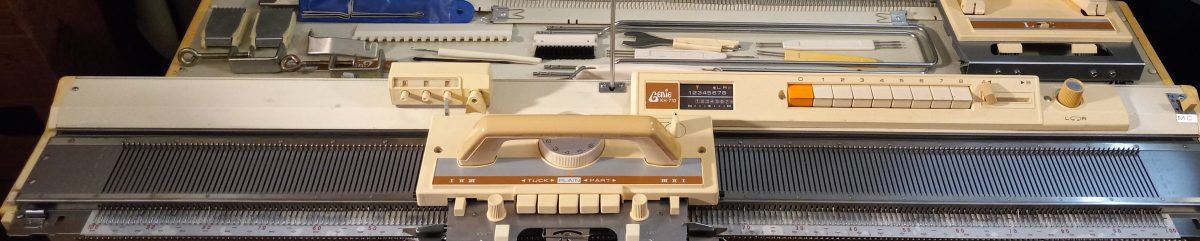
Genie 710 has 8-push buttons, reverse lever, slide dial and the MC lever.
Carriage for Genie 710 featuring a change knob, foldable handle, set levers moving horizontally along the length of the carriage.
Genie 710 is very similar to KH588 and I will not explain in this post the purpose of the main levers and buttons as I did for KH588. I also have a dedicated post to KH710 specifically.
So, the summary of the differences:
Genie 710 did not come with the laying-in yarn feeders and KH588 did
Genie 710 is white and brown/orange in color and KH588 is blue
Handles for main and lace carriages screw on in KH588 and are permanently attached in Genie 710 but can be folded
End-caps for the main bed case and for the lid are plastic in Genie 710 and are metal for KH588
Table clamps are of different shapes: KH588 has clamps that screw on to the main bed and table clamps for the Genie 710 slide into the main bed to hold it to the table
KH710 is a bit newer model than KH588 judging by its computability with ribbers and newer table clamp design.
If you discovered other differences I did not mention, please message me so we can update this information. I would also appreciate if you message me if you found this article useful.
Brother/Genie KH710 knitting machine is a 4.5 mm (standard) gauge machine with 200 needles. This chart states that it is the same as KH588 but my experience with both KH710 and KH588 is that those are slightly different (see my other post).
Brother KH710 is one of the latest models for the 8-push button knitting machines and has a lot of modifications not present in earlier models (like KH552-KH588). The case has more plastic (for example, end caps are plastic and not metal like in KH588 and earlier 8-push button models). The carriage covers as well as the handle are also not metal but plastic. The standard setup comes with a lace carriage and cast-on combs. The handle no longers screws on but is permanently attached to the carriage (good – fewer things to lose – I see so many machines arriving without these screw-on handles). But the handle folds for easier fitting into the case.
Besides 8-push buttons, genie 710 has a pattern center, which allows you to fix the needle selection and simply move the following needle selection relative to the initial position. It also allows (using the reverse lever) to select either needles push-in or select needles, not pished-in.
About this particular machine:
It was very easy to use it. The carriage slides very easily – in my video I show that I could use just one hand.
The machine comes with all major and minor assesories.
The assesories fit nicely into a special toolbox with a matching lid.
The hard copy of the manual will not be included. The manual is available for download here. It mentions some of the patterns and button/lever variations. More patterns and variations of push buttons can be found here.
I inserted a brand-new retaining bar with a brand-new sponge. All needles were inspected individually. I tested this machine on a full bed using stockinet, pull-up, and tuck-stitch patterning (shown in my video). None of the needles were mispatterning and the knitted fabric looked even and great.
After I gave it some TLC, the machine feels and looks like new. It is very lightweight (because end-caps are plastic.
The case has some cracks: see the pictures below but they do not affect the functioning of the machine.
Genie 710 is excellent for beginners or for advanced knitters who prefer hand-manipulations of stitches and needles. I hope you will consider adding this machine to your craft room.
KnitKing Simple seven is a plastic flatbed knitting machine. It is also known as Brother KX350.
It is considered mid-gauge but it can actually knit pretty bulky yarns (like RedHeart Super saver).
This model of knitting machine is excellent for beginners as it is easy to maintain, operate, handle, and lift.
I have a lot of experience with Brother KX350 and can tell you it can handle many tough situations other machines often struggle with. I knitted cables (shown in my video specifically for this machine in here).
It packs nicely into an original box with the styrofoam pieces cut out for all the parts so there is no confusion about where each part goes. The box is a bit beat-up but still holds everything nicely.
The machine will come with all major assesories except for:
A can of oil. The oil that came with this machine was old and I discarded it. A good oil can be purchased on Amazon.
A hard copy of the manual will not come but can be found online for free.
A typical setup includes a videotape with instructions. But this machine did not come with a videotape. With a myriad of youtube videos available on this machine, I doubt you will miss that videotape.
Additionally, I will include 3 extra needles in case you need replacement.
A brand new sponge was inserted (the black strip shown under the needles in the under-carriage view of the machine shown below). So you will not need to replace it for several months.
This particular machine was thoroughly cleaned, and every needle was inspected and tested to make sure that they were all straight and no stuck latches. I knitted two headbands shown below and all stitches formed nicely.
I hope this blog convinced you to consider Simple Seven for your craft needs. It is a wonderful machine and is excellent not only for beginners but also for advanced knitters (who sometimes combine two or more beds to knit wider panels). If you got this machine and do not know where to start, patterns specific for Brother KX350 can be found online but any other pattern for the chunky machine will work too.
Read more about the Brother KX350 model’s pros and cons in my previous blogs.
This ribber is sold out but check my Store for other ribbers and machines.
If you came here because you are looking for a ribber for your Singer 321 or earlier model knitting machine, you came to the right place.
Ribbing attachment SRN321 is so easy to install (aka, attach to the main bed) and so fun to use! Need one now? Check out my Etsy store.
Want to know more? Keep on reading!
Studio SRN321 ribber is an attachment that allows alternating knit and purl stitches. It was released in 1972. The ribber has 200 needles. Studio SRN321 ribbing attachment fits the following knitting machines: Singer/Studio 321, as well as models MOD. 315, 313, 312 and 305. SRN321 ribber adds so many patterning possibilities, as mentioned in the instructions and beyond. I did not see in the instructions if this ribber can provide double jacquard possibilities and I did not test it myself yet.
About this particular ribber.
I tested it in combination with Singer 321 knitting machine. The carriage slides very easily on the full ribber bed. I feel that the instruction explain really well how to knit all kinds of ribbing.
Tested on 1k 1p rib, double rib (see the cast on-thread and the first several rows below) on 30 needle swatch and on the almost full bed with the singer 321 knitting machine (not shown – forgot to take pictures but check out my video). The 1×1 ribbing created on this machine was so stretchy and pretty! I fell in love The carriage is so easy to move although it might take some time to get used to it (as opposed to using only the knitting machine).
I also tested the partial ribbing on this machine while the main bed was knitting the tuck-stitch pattern (see my video for that as well).
All major assesories included. Minor assesories missing are:
Hard copy of the manual will not come with this machine but could be obtained online.
Oil (it was old and I discarded it). Good oil to buy for any knitting machine is Gun oil.
Screw driver but any flat metal piece would work. It is mostly to screw the large bolts onto a machine. I used a thin coin.
Replacement needles: I am currently outsourcing them and hopefully I will have them soon.
I personally did not find any cons with this ribber. It does the job so well. It was absolutely not overwhelming to use and was extremely easy to set up. I think it is an excellent ribbing attachment for beginning machine knitters.
I hope you will be as excited as I was using this ribber. It is available in my Etsy store.



 the main


 The pattern center features 8-push buttons, set-lever (the one that moves the needles after the corresponding buttons are pushed), reverse lever (to determine whether the operator wants to bring forward the needles that are selected or those NOT selected), slide dial (the knob helping the knitter to shift the needle selection by 1-8 positions without pushing/unpushing or selectin/unselecting the needles) and MC change lever.


 KnitKing Simple seven is a plastic flatbed knitting machine. It is also known as Brother KX350.
 It packs nicely into an original box with the styrofoam pieces cut out for all the parts so there is no confusion about where each part goes. The box is a bit beat-up but still holds everything nicely.


 Studio SRN321 ribber is an attachment that allows alternating knit and purl stitches. It was released in 1972. The ribber has 200 needles. Studio SRN321 ribbing attachment fits the following knitting machines: Singer/Studio 321, as well as models MOD. 315, 313, 312 and 305. SRN321 ribber adds so many patterning possibilities, as mentioned in the instructions and beyond. I did not see in the instructions if this ribber can provide double jacquard possibilities and I did not test it myself yet.