
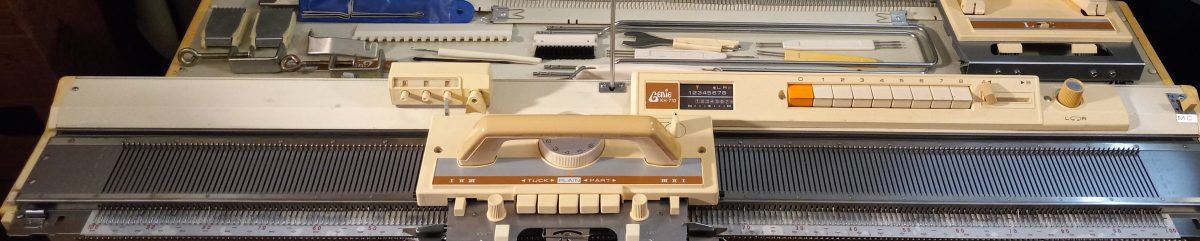

Brother KH588 knitting machine is a gauge (4.5 mm) knitting machine manufactured in Japan. It features 200 needles and is capable of patterning using semi-automatic needle selection performed by 8-push buttons and a pattern center. It was manufactured in the mid-seventies of the last century. I could not find more precise information on their first appearance on the market.
The machine and all associated assesories are blue in color. The end caps of the machine case and the lid are metal. The machine comes with a lace carriage, cast-on combs and extension rails to hold the lace and the main carriages. The handles on these carriages detach (screw on) and when not in use, are stored separately in the lid on the toolbox.
The pattern center features 8-push buttons, a set-lever (it engages by a special ratchet tool and moves the needles after the corresponding buttons are pushed), a reverse lever (to determine whether the operator wants to bring forward the needles that are selected or those NOT selected), slide dial (the knob helping the knitter to shift the needle selection by 1-8 positions without pushing/unpushing or selecting/unselecting the needles) and MC change lever.
The picture below shows part of the pattern center for the KH588: 8 push buttons, a reverse lever and a slide dial.


MC change lever has N and MC positions also accompanied by the open and black triangles, which helps if you get a machine with Japanese writing for all main functions on 
 the main
bed and carriage. MC change lever is used for fair isle patterning (when moved to the MC position).

The shapes of the table clamps is typical for older models – with two wide screws, one of which is attached to the main bed.
Unlike many other machines I refurbished, Brother KH588 comes with laying-in thread feeders (two metal pieces laying next to the blue claw-weights in the picture to the left). They are used for weaving. They are inserted under the knobs between the knob and the sinker plate.


The KH588 machine I worked on had all words written in Japanese (see the picture below). Next to it is a carriage from Brother KH588 released to the English-speaking market. Unlike some other Brother machines, including some 8-push buttons ones, holding cam levers (marked on the bottom side of the carriage as I, II, and III) are moving horizontally along the low side of the carriage. On many machines, these cam levers are on the side. The carriage also has a change knob (on the top right-hand side of the carriage). This knob chooses normal, weaving, or fair-isle knitting.


Brother KH588 can knit with KR586, KR587 and KR710 ribbers according to this chart.
Replacement needles for these machines are still available on the used market. They are shaped differently than newer models of Brother knitting machines. They have an unusual concaveness next to the needle butt which makes them stand out. Sponge/retaining bars, however, can be found easier. The retaining bar is 41 x 0.5 inch and those are still sold new. Some knitters replace only the sponge and any dense sponge with the smooth fabric top should work.

Since KH588 needle selection is fully mechanical, there are only a number of things that can go wrong and they are easily fixable (unlike electronic and punch-card machines). This feature makes these machines very reliable horses. It is excellent for designers who prefer to have control and like hand-manipulations. This machine is also excellent for beginners who just start machine knitting. I also feel that Brother KH588 would be an excellent fit for somebody who is transitioning from hand-knitting to machine knitting and simply wants to accelerate their work while maintaining satisfaction from manipulating stitches and patterns by hand. This machine is compact as the bed is more narrow than newer models. Because of this, it is light-weight of this machine makes it excellent for people who are not as strong with their upper bodies or for older knitters.
I hope this information helps you to know more about Japanese knitting machines and maybe to consider getting this machine for your craft, creative and/or production needs.
This article was published using my personal observations and experience using Brother KH588 knitting machine.
If you are interested to learn about other 8-push button knitting machines, check my other articles on KH710, KH581.

 The pattern center features 8-push buttons, set-lever (the one that moves the needles after the corresponding buttons are pushed), reverse lever (to determine whether the operator wants to bring forward the needles that are selected or those NOT selected), slide dial (the knob helping the knitter to shift the needle selection by 1-8 positions without pushing/unpushing or selectin/unselecting the needles) and MC change lever.


 Studio SRN321 ribber is an attachment that allows alternating knit and purl stitches. It was released in 1972. The ribber has 200 needles. Studio SRN321 ribbing attachment fits the following knitting machines: Singer/Studio 321, as well as models MOD. 315, 313, 312 and 305. SRN321 ribber adds so many patterning possibilities, as mentioned in the instructions and beyond. I did not see in the instructions if this ribber can provide double jacquard possibilities and I did not test it myself yet.


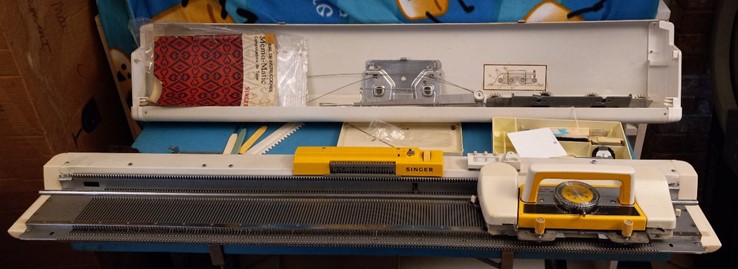
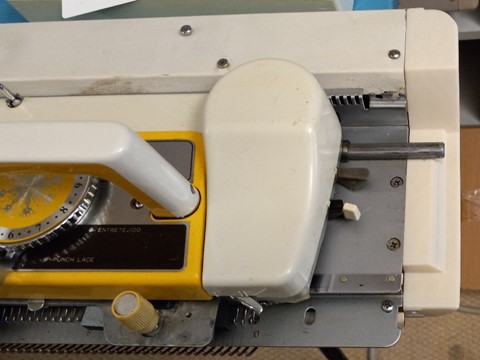
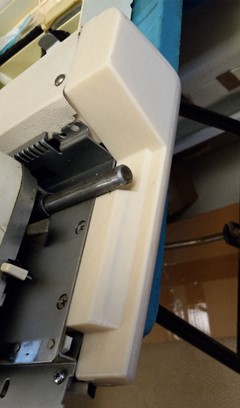

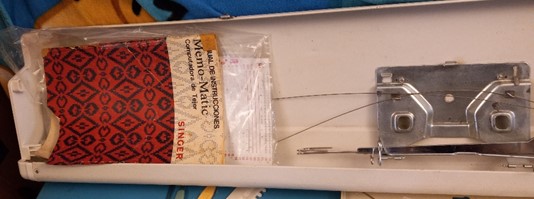

 This is a Brother KH588 knitting machine with an 8-push button needle selection mechanism. This model was released to the market in the late 1960s-early1970s. This model is equivalent to a rebranded Genie 710 (in case you need to search for information related to this machine). These are other 8-push button models similar to this one: KH581, KH560, and KH552, but their pattern control center is a bit less “sophisticated”. The pattern control center in KH588 makes your job of creating patterns and following the sequence of which buttons and levers to push the easiest.
 About this particular brother KH 588 machine.


 Brother KH930E is identical to Brother KH930. The only difference is This brother knitting machine has greenish color on the carriage. Brother KH930e was an anniversary edition and this is why the difference. Brother KH930 machines are capable of electronic needle selection to knit various patterns. There is a vast library of built-in patterns, which are listed in the
 The machine did not come with many tools but I put together a set of tools. Looks like some of the tools that were actually included were added later. For example, the lid color is different from the rest of the machine. The electric cable also looks a bit worn out but works great. Cast-on comb, rails, and lace carriage look in good shape (although I did not test the lace carriage except for making sure all buttons move freely).


 Cons (in no particular order):
 About this machine in particular:


