
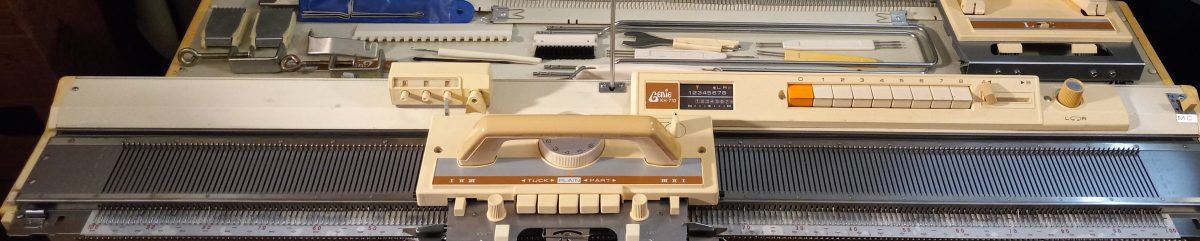
…this post is a collection of tests and tricks I use when I test knitting machines I refurbish. It is a continuous work in progress as I learn more about various knitting machines. LAST updated: June 2026.
Preparation for the knitting:
- After you have fully serviced your machine (read the list of steps I follow in here – sponge bar section is especially important), place the carriage onto the need bed (while ALL needles are in non-working position A) and move it across the needle bed (without the sinker plate attached). Ensure that the carriage runs smoothly on the needle bed. Apply oil if necessary according to the instructions if you feel that your machine does NOT run smoothly. Also, check the contact points (between the carriage and the needle bed) for gunks/rust/debris since they can contribute not only to poor movement of the carriage but also to static accumulation and other problems down the road. Some Brother machines have a lip on the carriage. Make sure this lip hugs the needlebed and not on top of it.
- Attach the sinker plate to the carriage according to the instructions. Run the carriage + sinker across the bed (the needles are still in non-working position A).
- Using a 1×1 needle selection comb (AKA ruler) move 20-30 needles to the B position (15 needles from the left of the “0” mark and 15 needles to the right). You will have every other needle in the B position. Run the carriage over the needles first, without the sinker plate. You will see how the needles move while you run the carriage. If everything goes well, run the carriage with the sinker plate attached to the carriage.
- Move the remaining needles to B position. You will now have 30 needles next to each other, all in B position. Run the carriage and then the carriage+sinker over these needles. Watch the needles move freely. If the needles move freely with only the carriage but not with the carriage+sinker, you might have a damaged sinker plate.
- If your machine has a patterning mechanism (pushbutton-, turn-knob-, punchcard- or electronics-based ones) , you could do the same (run the carriage and then carriage+sinker plate) when the patterning is activated. Passing the carriage back and forth without yarn while the patterning is activated will demonstrate if there are any patterning issues. I recommend using a simple card, where every other or every two other needles are selected.
- If steps 1-5 did not give you any trouble, you are ready to knit your first swatch.
Knitting a first swatch:
- Review the manual to determine which yarn is best for your machine. When choosing yarn for your first swatch, stay on the thinner side – we want to have our first knitting steps go smoothly and not go wrong because of the poor yarn choice. Once you learn to know your machine, you will know which yarns it can handle (and what to do so the machine can handle these yarns). For standard machines, I recommend sock-yarn-thickness and even thinner, for bulky and medium gauge machines – use sport-weight yarn.
- If your yarn came in a cone or a cake – you can skip this step. If your yarn is in a skein or a ball, you need to use a yarn winder to rewind your yarn into a cake or onto a cone. The reason is that during machine knitting you want as even yarn tension as possible.
- Bring 20-30 needles upfront and select every other needle (move them to the working position B). Run the carriage back and forth to even out the needles.
- Cast-on: I recommend using a cast-on method with a cast-on comb. Most Brother knitting machines have cast-on combs. Silver/Silver Reed/Studio cast-on combs do not typically come with cast-on combs. Cast-on combs can be purchased online. Or you can use an e-wrap cast-on method. Refer to the instruction manual of your machine for the recommended cast-on method.
- Once the first initial row is knit, knit several rows on every other needle. It will give you a good feel for the yarn thickness, tension and carriage behavior. Adjust tension as needed. The carriage needs to run smoothly.
- Bring the remaining needles to the working position. Increase the number on the tension dial. On all needles, the yarn tension needs to be looser than on every other needle. Knit several rows.
If all these tests are successful, you can now start experimenting with patterning as well as knitting on a full bed.

One thought on “First steps of testing and learning a new-to-you knitting machine.”