

… this article is constantly being updated depending on the questions my customers ask me. So, check frequently.
LAST UPDATE: March 22, 2026
My customers often ask me: what machine will I recommend for a beginner, for a fiber artist, for an experienced hand-knitter, to start a small craft business, or to experiment with stitches and techniques?
There are several things to consider. For example:
- You are a hand-knitter (or crocheter) with a large stash of yarn and fiber, or your stitches are not even, or the small finger movements are no longer feasible for you;

- or you have never hand-knitted before and just want to explore what machine-knitting is.
If you know how to hand-knit, then the next question is: what do you want to do with this machine? Design cloth, make new fabrics, make custom patterns, or simply knit through your yarn stash? Do you want to make blankets and throws and if yes, how wide? Also, ask yourself: do I just want to knit for friends and family or to sell? The next series of questions is how much patterning you would like your machine to do. And of course, you need to have a clear picture of what your budget is and how comfortable you would feel with servicing a new-to-you machine.
Here are some of the things to consider for the options mentioned above.
If you are considering getting a machine to go through your stash quicker, check what is the thickness of the yarn you have the most. If sport-weight and below, you will be able to go through your stash with the standard-gauge knitting machine. If thicker – then you should consider getting bulky and mid-gauge knitting machines. Fine-gauge knitting machines create wonderful, profesionally-looking fabrics, but they are not recommended for knitters who are just starting to explore machine knitting.
Overall, good entry-level knitting machines are circular plastic ones (like Addi or Sentro), and plastic flat-bed mid-gauge, like Brother KX350 or Silver Reed LK-series. These will take worsted yarns or double-threaded thinner yarn (available in craft stores for hand knitting) and will create lots of great hats, scarves, vests, and simple sweaters.
If you are a hand-knitter transitioning that just wants to make sure all stitches are even, the panels are knitted faster but you are not quite ready to give up the satisfaction from hand manipulation stitches (like creating cables, lace, etc.), consider standard-, bulky, and/or mid-gauge knitting machines with only manual/basic patterning capabilities.

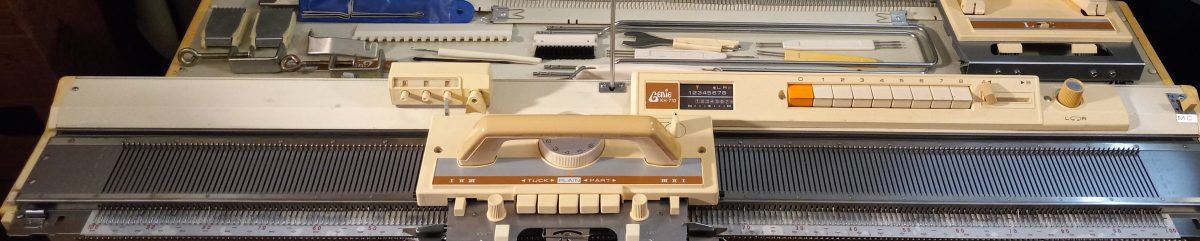
If you want to create a lot of intricate patterns and designs, you will need to consider machines that can pattern with less annual needle selection and stitch manipulation. Namely, the needles would move to the patterning positions with some button pressing and the type of stitches will form in a predetermined way. The highest technology for such performance is electronic knitting machines. Those not only have several hundred built-in patterns but can also accept custom patterns from external sources. You can create those patterns yourself. Knitters can still do all the same manual stitch manipulations on electronic machines as on basic knitting machines (just turn off the electronics and select needles by hand). Read separate posts on how to choose Brother and/or Studio/Silver Reed/Singer electronic machines. Also, let’s not forget that Passap also made electronic machines for hobbyists and small shops.

If you are not super technology-savvy and could settle for less intricate patterns, consider machines with punchcard-reading capabilities. They come in bulk and standard gauges. The repetition pattern is typically 12-24 stitches. There are so many various designs circulating on premade punchcards. You can also punch your own cards (doable but quite a tedious process). Some drawbacks are somewhat finicky punchcard reading mechanisms, that sometimes cause troubles. Also, punching custom-punchcards is somewhat a tedious process but doable with enough patience and practice. On a punchcard machine, knitters can still do all the same manipulation and stitches as on manual/basic machines if the punchcard reader is not activated.
If even this seems too much to manage, consider push-button or turn-knob machines. These machines offer 4- to 8-stitch repeat patterns. With some hand manipulations, patterns with more stitch repetitions can be accomplished. Despite being the oldest patterning technology in machine knitting, these machines are robust (almost all metal), and offer endless possibilities. I only saw standard- and fine-gauge turn-knob and push-button machines. I put couple of articles together on pros and cons of pushbutton, turn-knob, punchcard and electronic knitting machines.
A lot of fiber artists like pushbutton machines a lot because they feel more control over the stitch manipulation and needle selection, yet it is still not completely manual. However, sometimes it is hard to accessorize these machines with attachments (knit-leader, ribber, color changer) due to their vintage nature.
Now, about picking a machine depending on your desired projects. If you know for sure that you want to knit sweaters or garments, you should probably get a machine with a built-in knit leader (aka charting device) or a machine that can be attached to one. Some older models of knitting machines cannot be accessorized with knit leaders, so keep that in mind. There are only a couple of models of Brother Machines with built-in knit leaders (most popular ones are Brother KH881, KH891), while Singer/Silver Reed/Empisal KNitmaster/Stuio were more prolific in that sense. Check out a full list.
If you want to knit beanies: do you want them to be seamless (then get a circular machine, which are very affordable) or don’t you mind seams (flat bed is ok in this case)? Or what about socks? Circular sock machines are pretty expensive. Plastic circular machines are be used as well, but socks do not come out as nice looking. There are patterns for flat-bed machines for socks with and without seams and their looks are different as well depening on the technique.
If you want to knit colored patterns (jacquard or fair-isle) with more than two colors, your desired machines should probably be compatible with color changers unless you are willing to manually changing color, which is a rewarding but tedious process. Also, do you want to knit double jacquard, no floats in the back? Then you will need your machine to be compatible with a ribber. Some ribbers have an automatic option to allow knitters to know double-jacquard semi-automatically (read on Brother KR850 ribbers). Some still require hand manipulations, but much easier than if you did not have a ribber.
If you want to knit blankets that create knits mostly resembling handknitting, get a machine with the most stitches in a row like a mid-gauge manual SK160 or electronic SK860, but, boy, they are pricey and hard to find. Standard-gauge machines will knit wide enough panels but it will look like machine knitting. If you want to knit custom patterns, or for production, consider electronic machines as they can be fitted with many additional accessories later. Additionally, for blankets, knitters often get a couple of plastic bed machines, like HK100 and KX350, and combine the beds (it is very easy to do – just remove the connecting plates and then reconnect the plastic parts of the bed onto the first bed) to get a double length.
With regards to the manufacturer, very popular machines for beginners are Brother (also branded under Knit King and other names) and Silver Reed (also branded under Singer and Studio names). The parts for these machines are still available in the new and used markets, which is a huge advantage. There are other wonderful knitting machine makers, including Toyota, Corona, Passap, etc.
A lot also depends on your budget. Plastic flatbeds are typically less expensive. Brother machines in general are a bit more expensive than Silver Reed, but it all depends on the dealer or the marketplace where you are looking. Additionally, the more patterning capability diversity the machines have, the more expensive it is (because it is more desirable). Thus, electronic machines typically cost more than manual or pushbutton. Additionally, bulky machines are more expensive than standard-gauge machines. Mid- and fine-gauge are the most expensive because not so many of them were on the market to begin with and they are highly desirable. As you can now guess, the most expensive machines are electronic bulky and mid-gauge machines. All these machines have their pros and cons, about which you can read in my Knitting Machine Encyclopedia.
You need to think about what kind of stitches and fabric you want to knit. Lace? – make sure your machine comes with a lace carriage. Garter stitches? – Make sure your machine is compatible with Garter carriages (only standard-gauge Brother knitting machines model numbers KH8xx and up). Fair Isle? – better if you can use at least two yarns at a time. Or make sure your machine is compatible with a color changer. The same principle applies to weaving.
Also, would you like to knit both purl- and knit-stitches? A ribbing attachment does a good job doing that so choose a machine that can be matched with a ribber. Ribbers for electronic and punchcard machines are somewhat easier to find than ribbers for pushbutton and turn knob machines but they are still doable. Another nice attachment that can knit purl stitches, is a Garter carriage but it is only available for Brother knitting machines.
Also, consider your physical limitations. Can you lift a 20+ pound knitting machine? If yes, then metal flat beds are indeed for you. If not, you should consider getting a plastic flat or circular bed knitting machine. The latter ones are also great if you cannot live without knitting and want to travel with your machine.
Last but not least, consider how much you want to grow with your new hobby of machine knitting. (I know – sometimes we don’t know what we don’t know but we know ourselves). For example, do you think you might outgrow the basic functions of your machine quickly and will want to purchase add-on accessories (ribbers, color changes, etc.)? If so, consider getting machines for which these accessories exist and are easy to find. For example, some basic vintage machines never had ribbers or color changers manufactured for them. Some push-button Brother machines and some turn-knob Silver Reeds had ribbers but those are hard to find. So, settle on punchcard-reading machines.
But I do not recommend buying a machine with all accessories at once (Unless you came across a super deal in a local garage sale where the machine is included with all accessories). You might feel overwhelmed, and intimidated and might regret spending all that money at once. need to buy all gadgets at once. For example, if you can’t get a hold of a machine with built-in knit leader, but a machine with a built-in knit leader landed on your radar, you should go for is and get a stand-alone knit leader later while you are learning a new-to-you machine, including shaping (stitch transfer for decreases, patterning, gauging, switching, etc.)
Overall, I would suggest just to trust your gut, your budget and your skills. For example, if you are not tech-savvy, electronic machines might not be the right choice for you. Or you will only be limited to the built-in patterns (but there are plenty of those). If you are having issues with hands, do not get machines where patterning is activated with a ratchet tool (Brother push-button machines, some Toyota machines and a 12-stitch punchcard Brother KH800 model).
To sum up and not considering factors like maintenance and availability of the spare parts: if you are just exploring and want to get rid of your hand-knitting yarn stash, get a simple machine, like Addi or mid-gauge plastic bed (like KX350 or LK100). If you are exploring but with specific projects in mind, get machines that can pattern more automatically and can grow with you.
I wish all of you good luck with discovering your dream knitting machine and starting your new adventure of machine knitting. Shoot me a comment on what machine you decided to get and why.

One thought on “How to choose your first knitting machine.”