
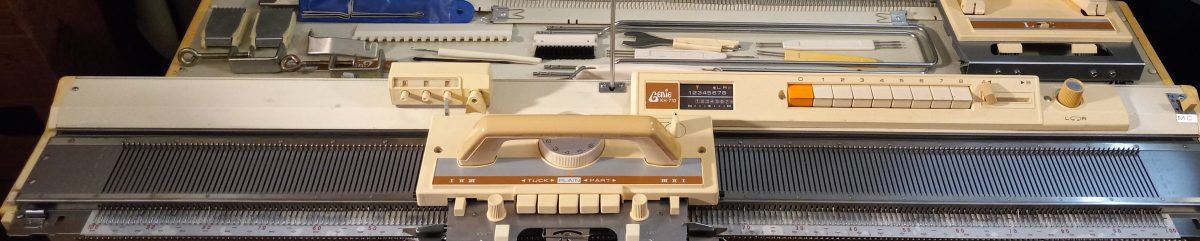
.. this article is a constant work in progress as I collect more information and personal experience…
… Please, read the whole article first before proceeding.
First cleaning steps:
- Check against the manual if all parts are present. (If your ribber did not come with a hard copy of the manual, google its model number and you will find free pdf file of the manual). The most critical ones are carriage, side brackets, connecting arm, at least one cast-on comb with a wire, setting plates, weights and table clamps. If others are missing, you can probably manage to knit without them. If something is missing, search on the Internet to purchase them and while they are arriving, work on the steps below.
- Clean/wipe the visible dirt from all parts.
- Remove all needles, clean/wipe them and inspect. I visually inspect if there is deep rust (if there is just shallow rust – I gently polish the needles with fine sand-paper), obvious bends.
- Vacuum from underneath of the ribber bed and from the top (simply run the narrowest attachment your vacuum have over the needle bed).
- If you have a brush with long wire, insert it into the slot for the retaining bar and move it back and forth, in and out. Vacuum again. Repeat several times until you see no more lint/dirt coming out.
- Inspect the metal parts of the needle bed as well as connecting arm and carriage (especially from underneath) for any major or minor rust. Major rust – medium size to large orange spots. Minor rust – series of small to medium sized black-ish dots. Read a separate article on my recommendation on how to deal with rust.
- Insert the needles back in. While doing it, check if the latches move freely. Insert the retaining bar. It goes on top of the needles. For Brother ribbers, the groove of the plastic retaining bar should be facing you. When all needles are inserted, look if the distances between the needles are even. If not, you might have a bend needles you did not catch.
If all parts are present, you are now ready to start your first tests. They are outlined in my other article.
If you are passing this ribber to somebody else, repeat the wiping, vacuuming and visual needle inspection again.
