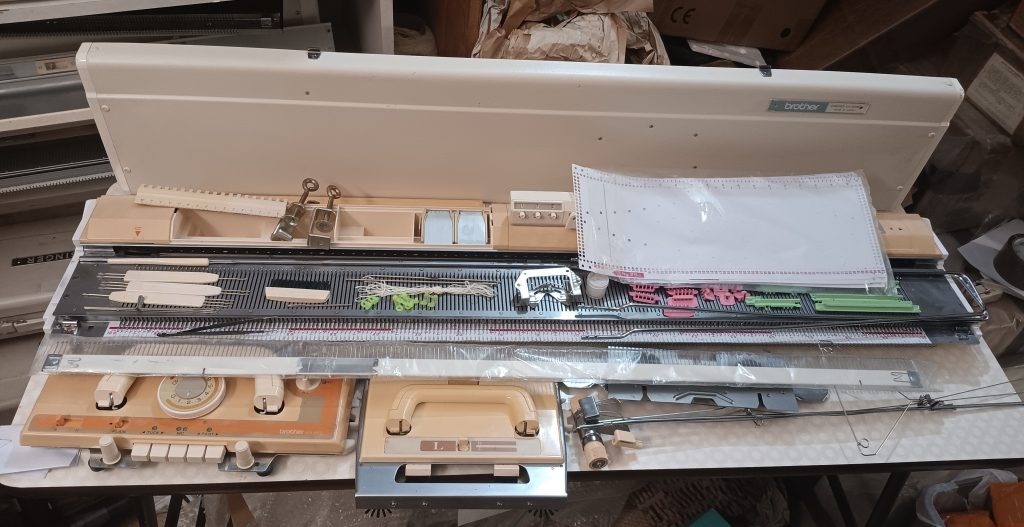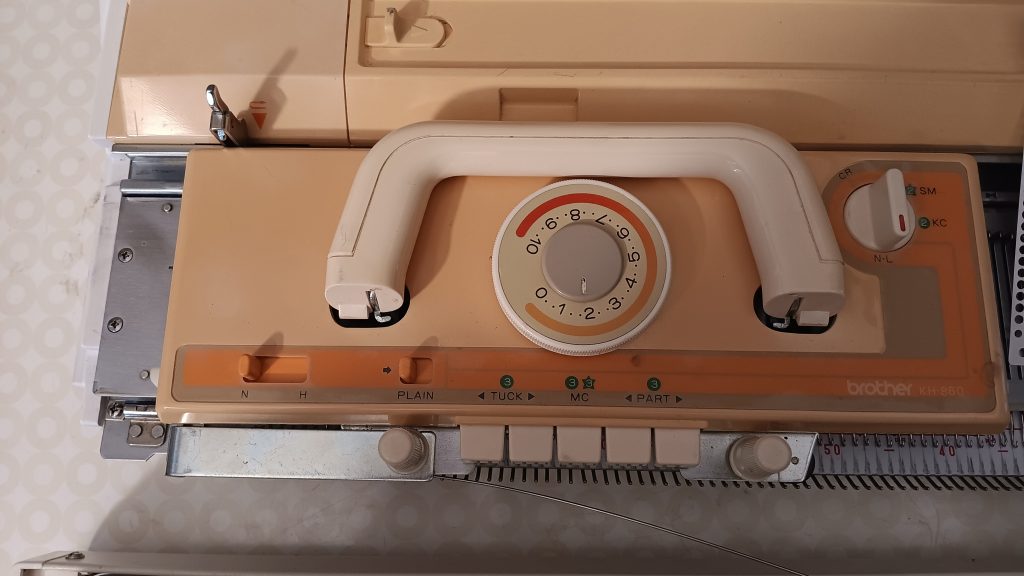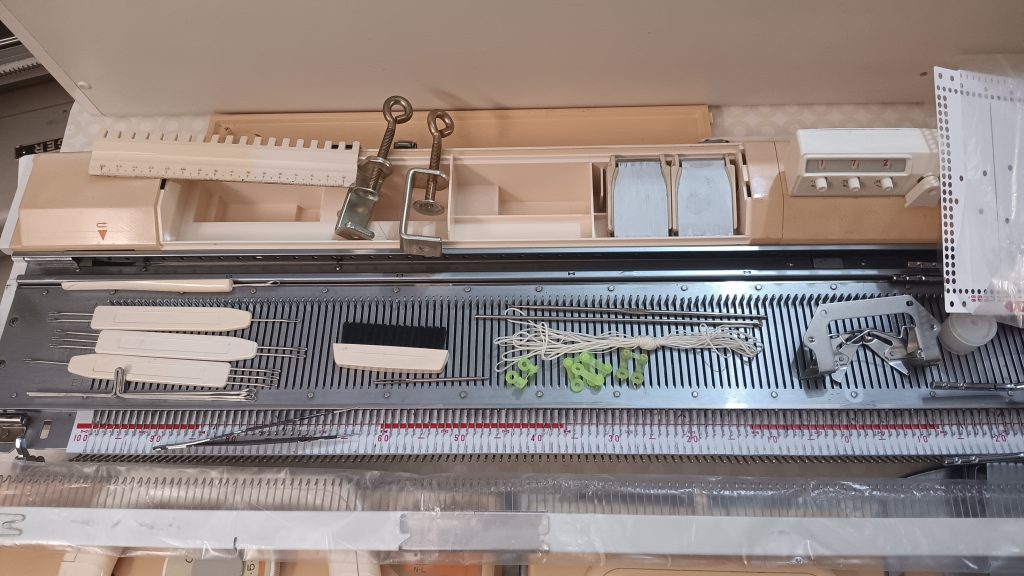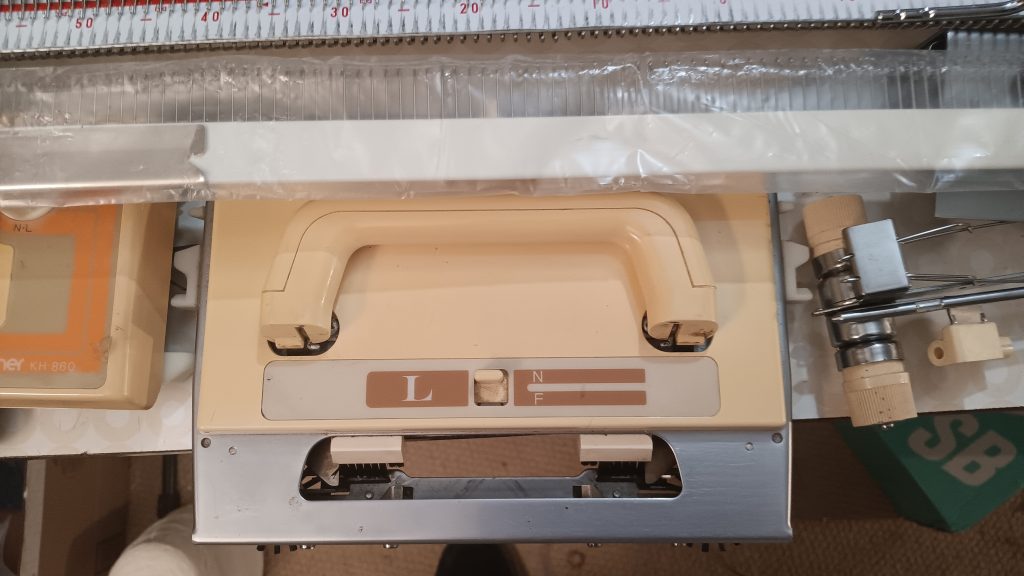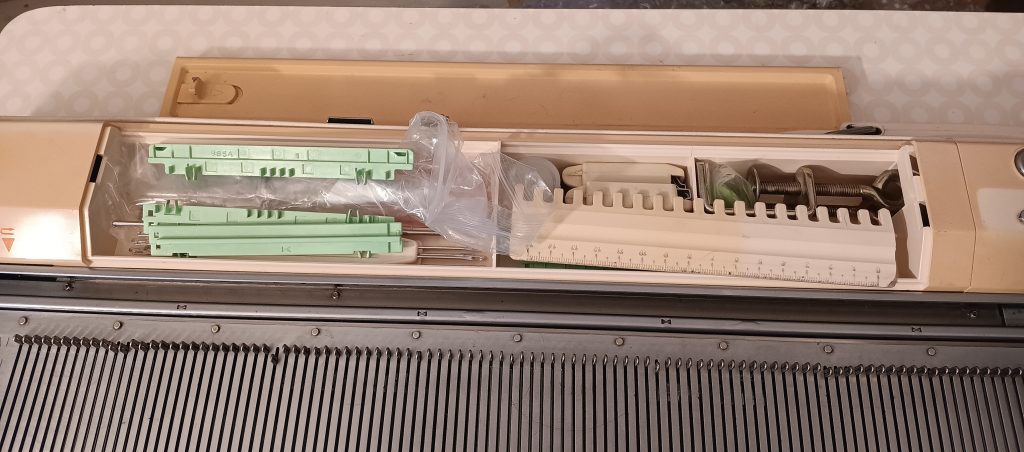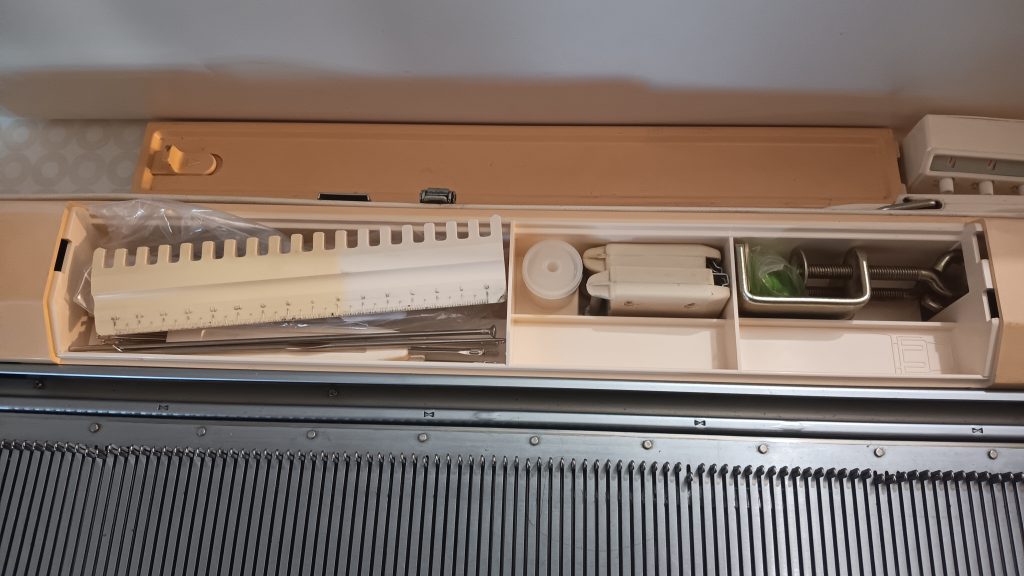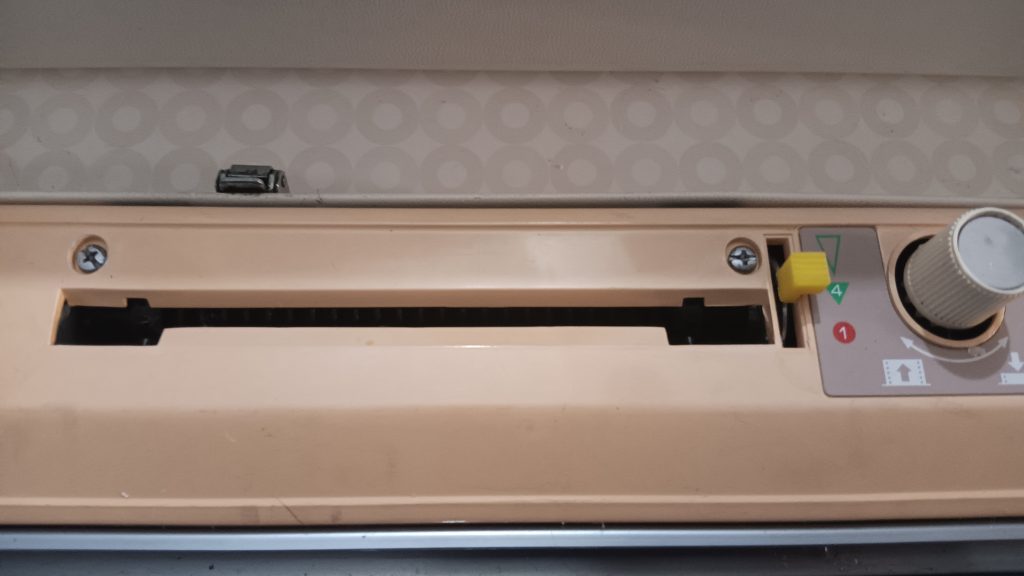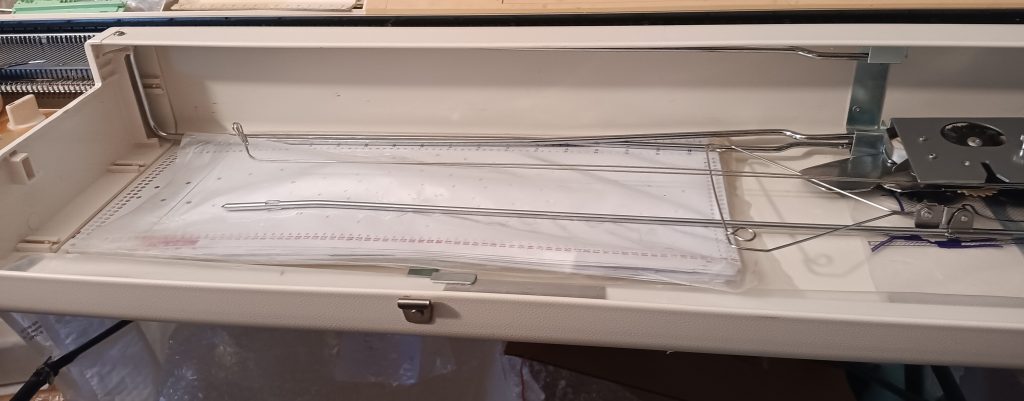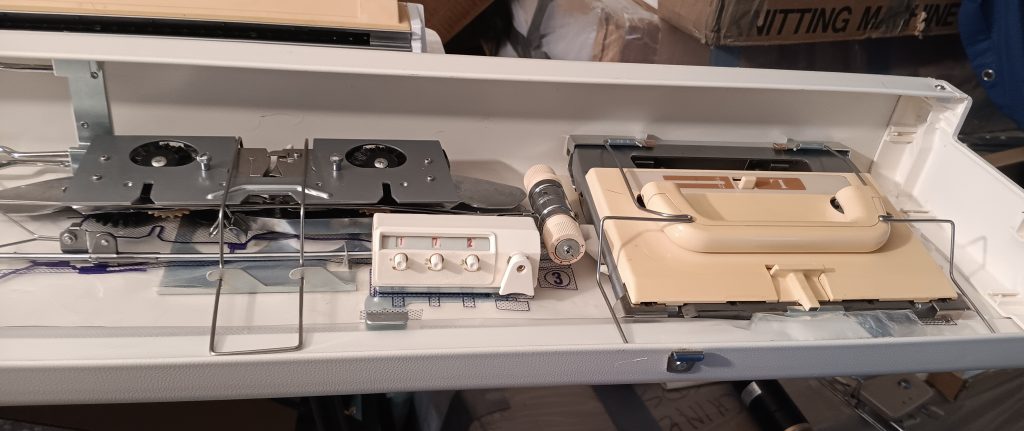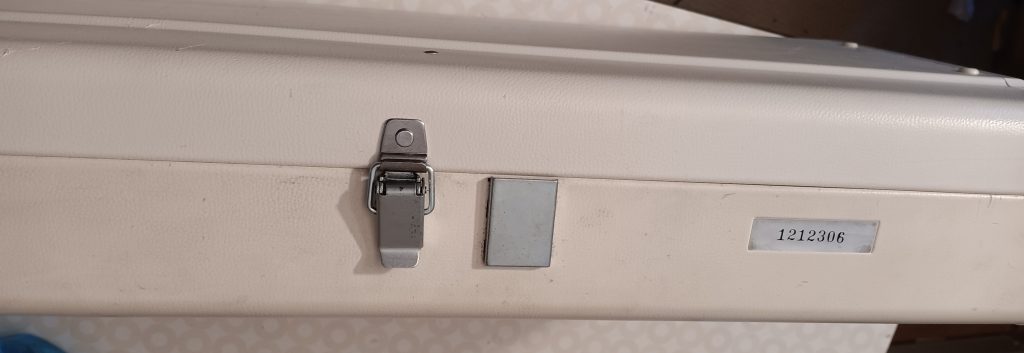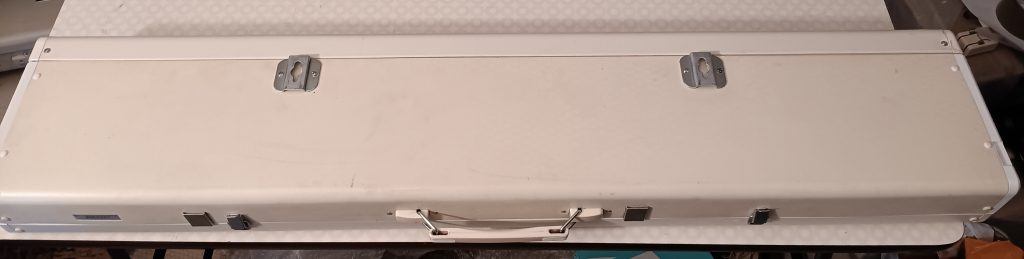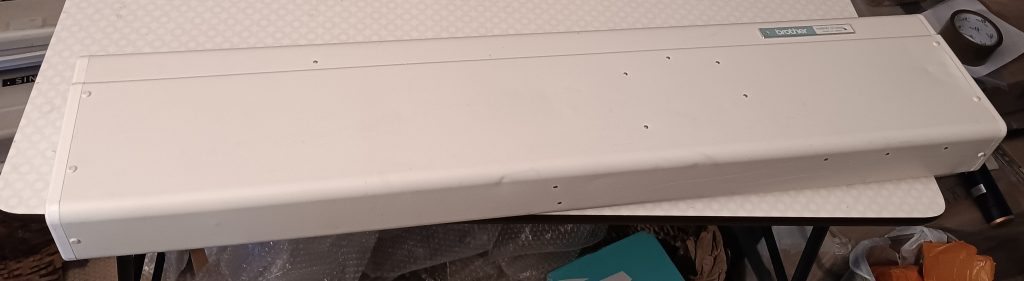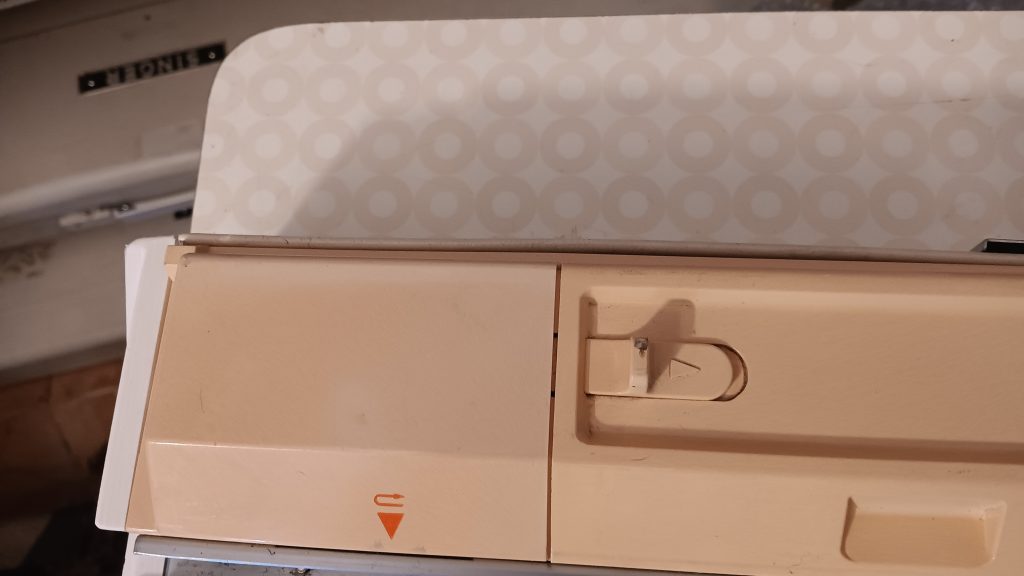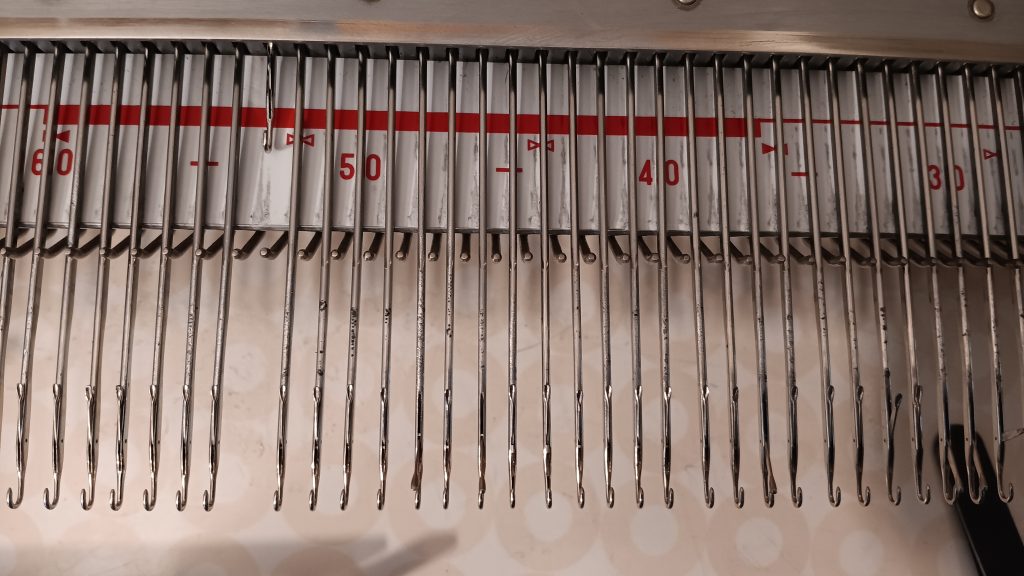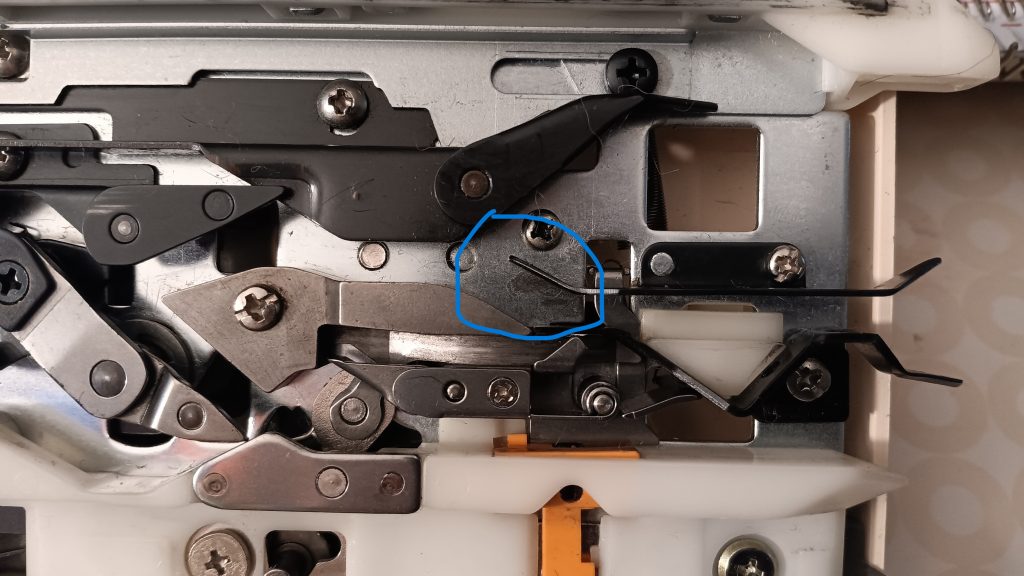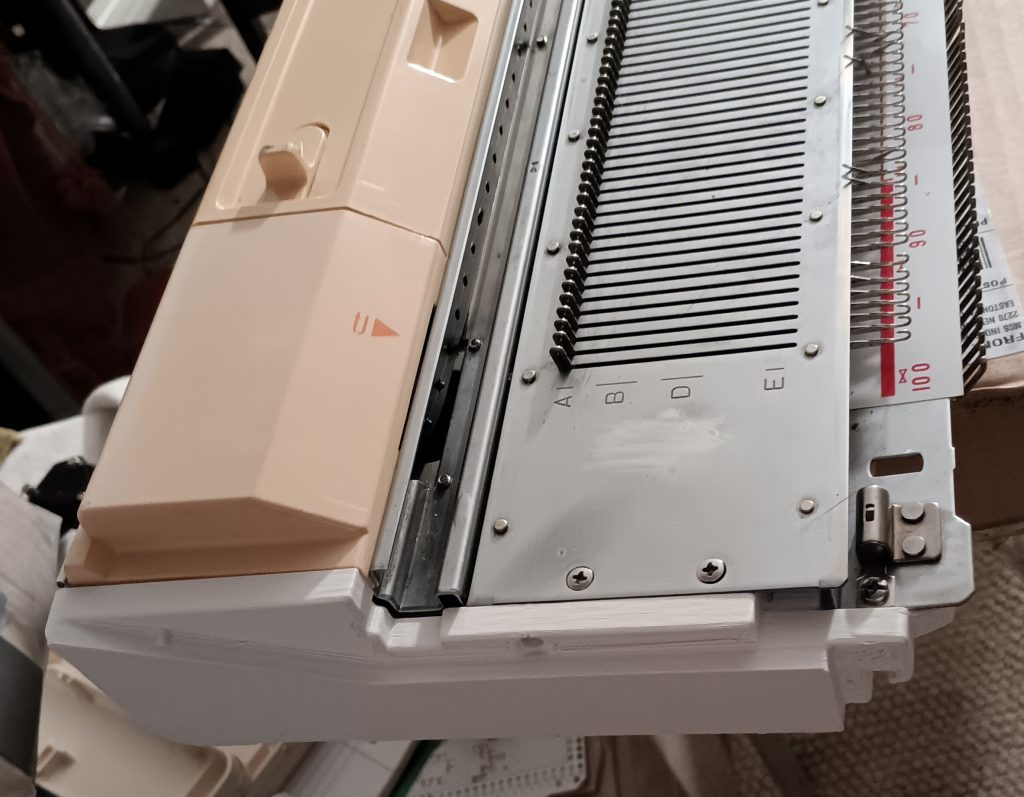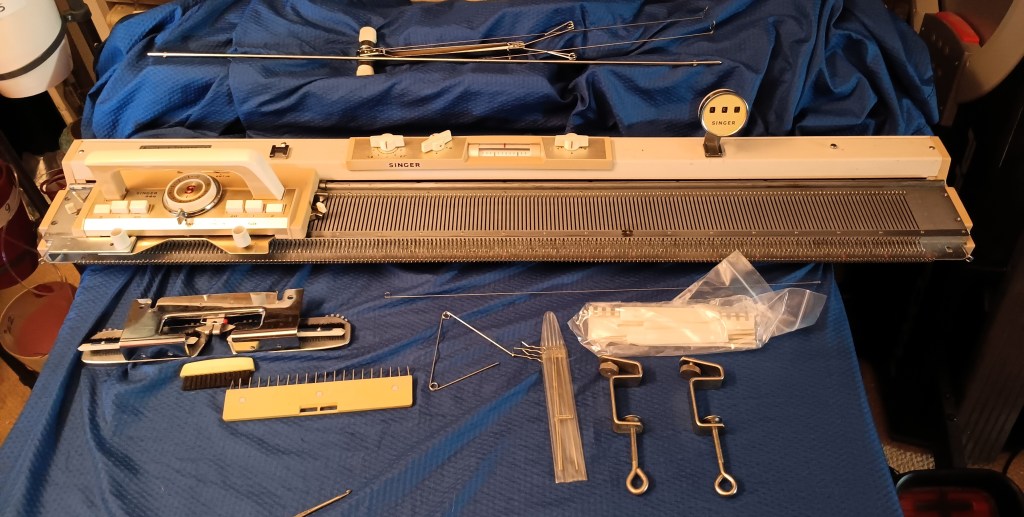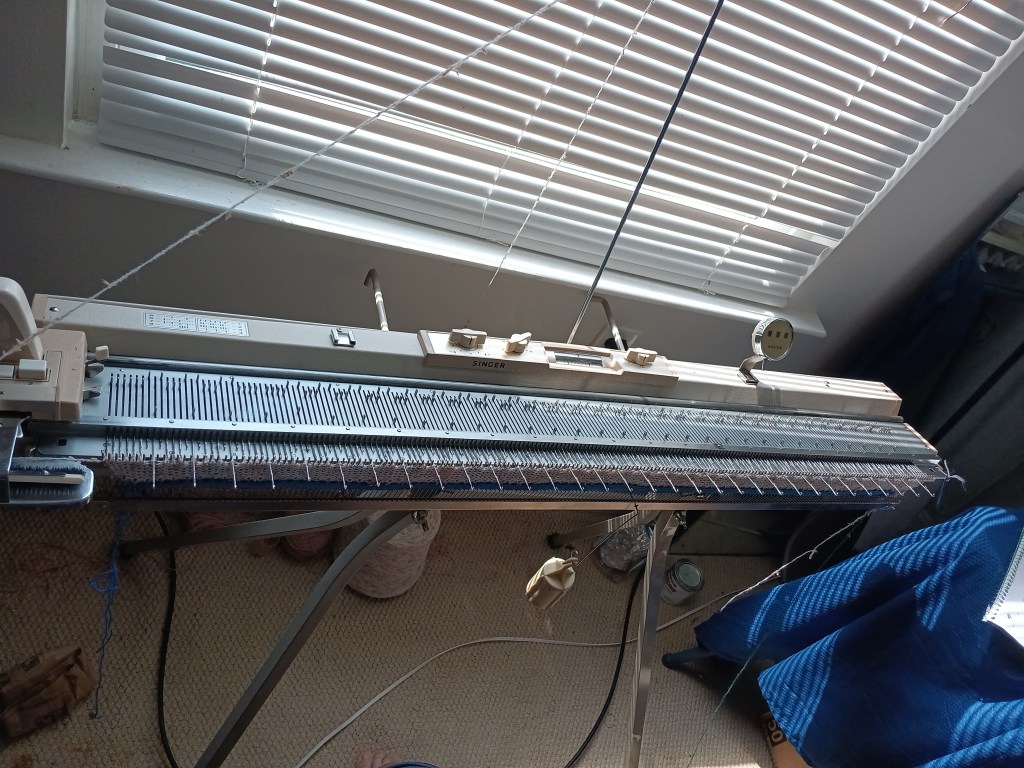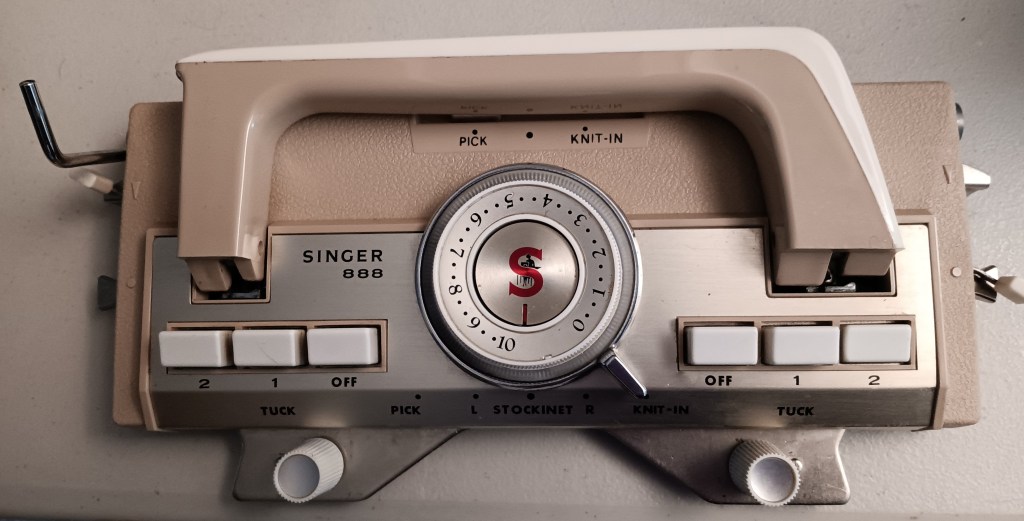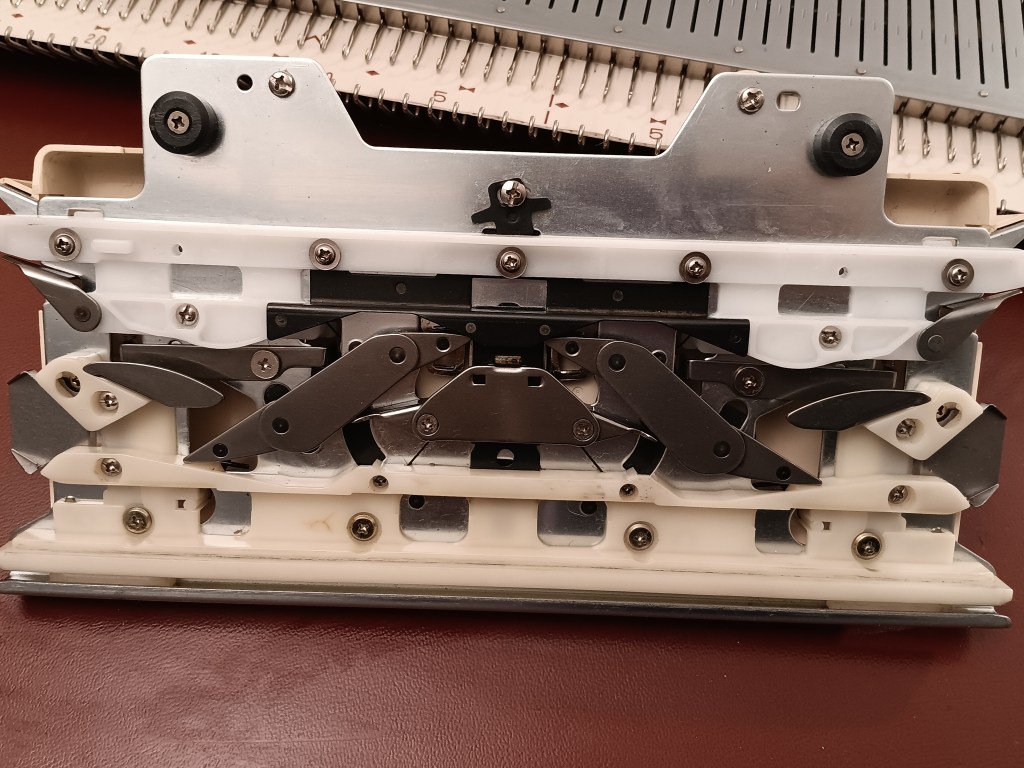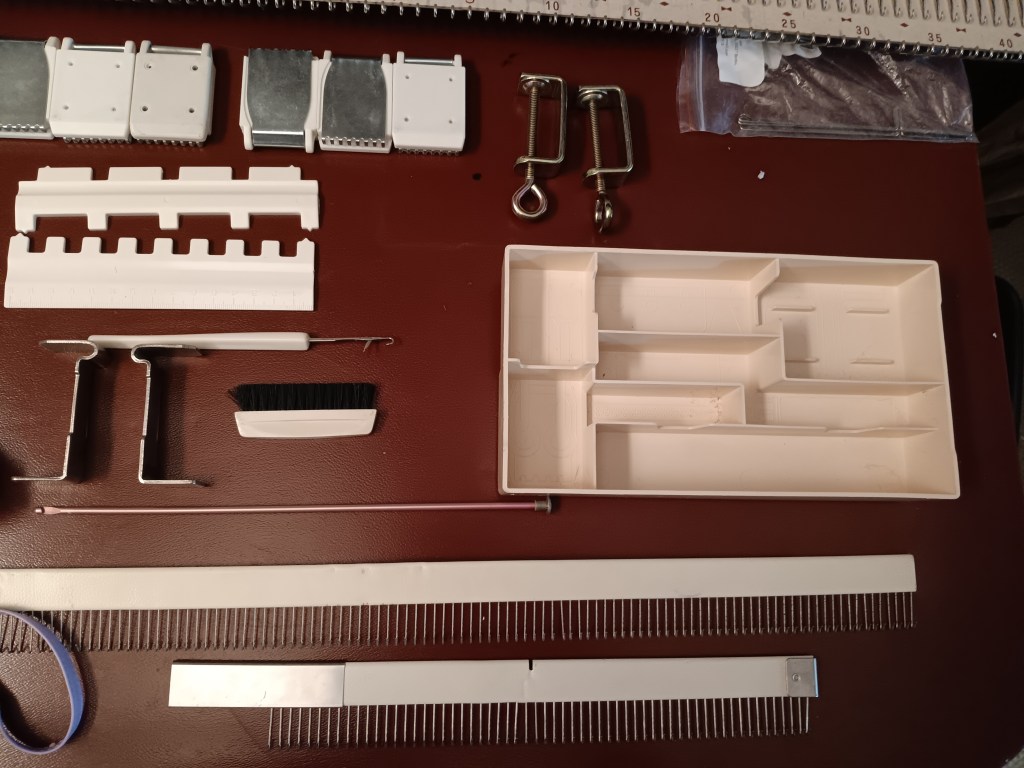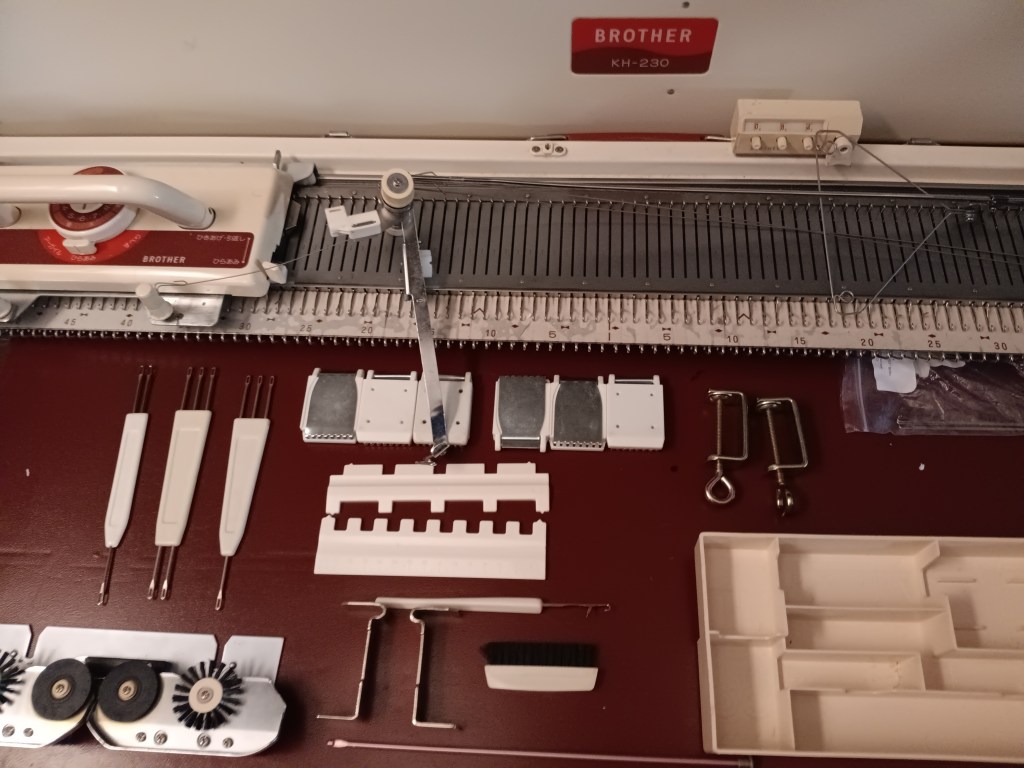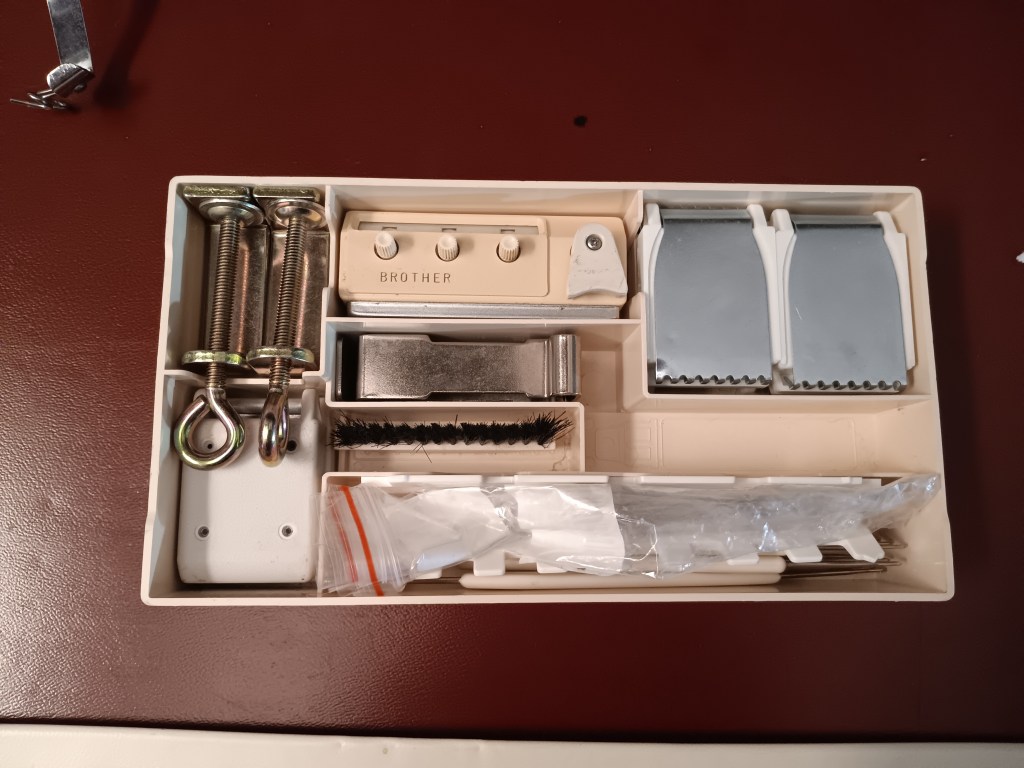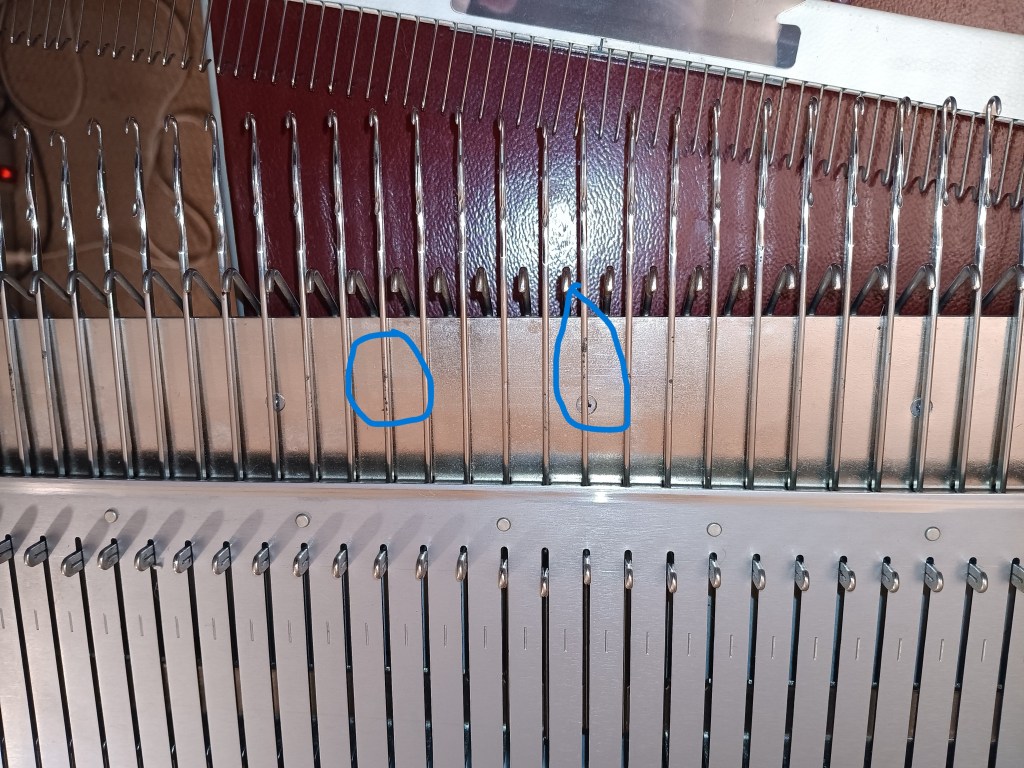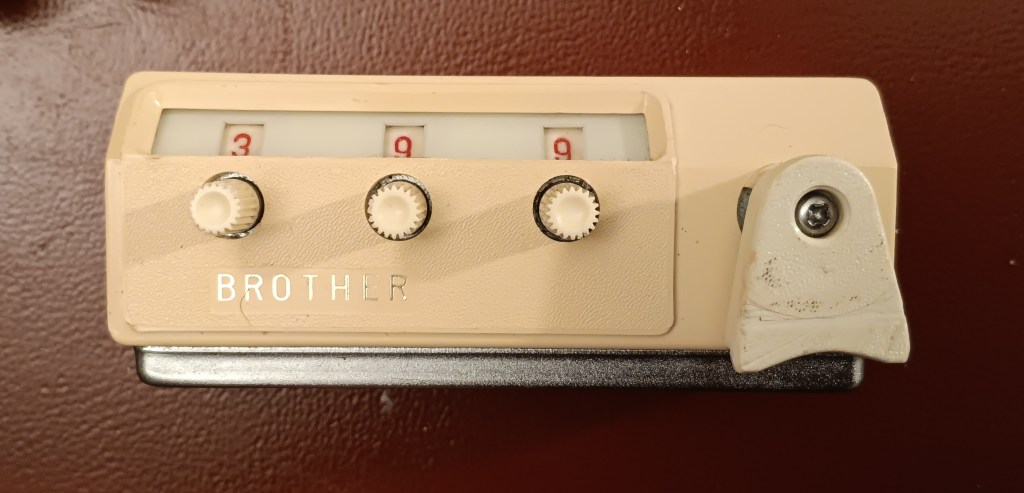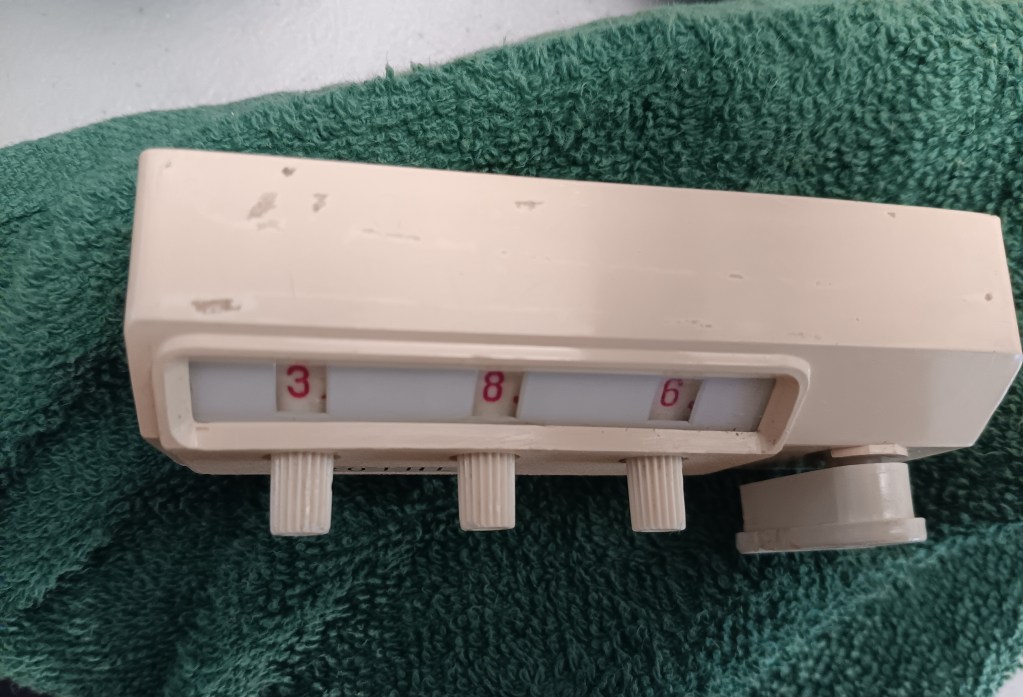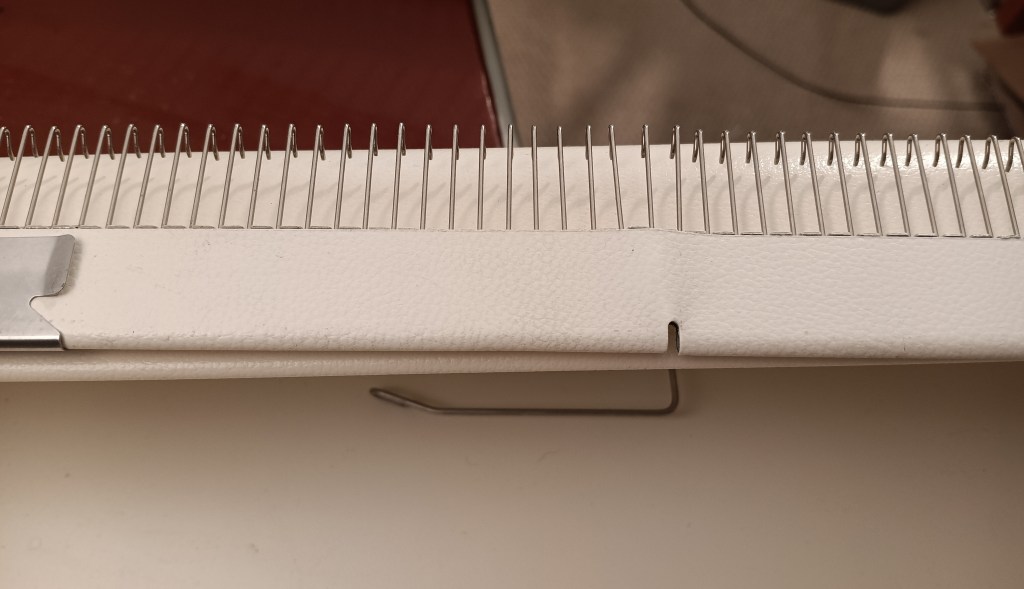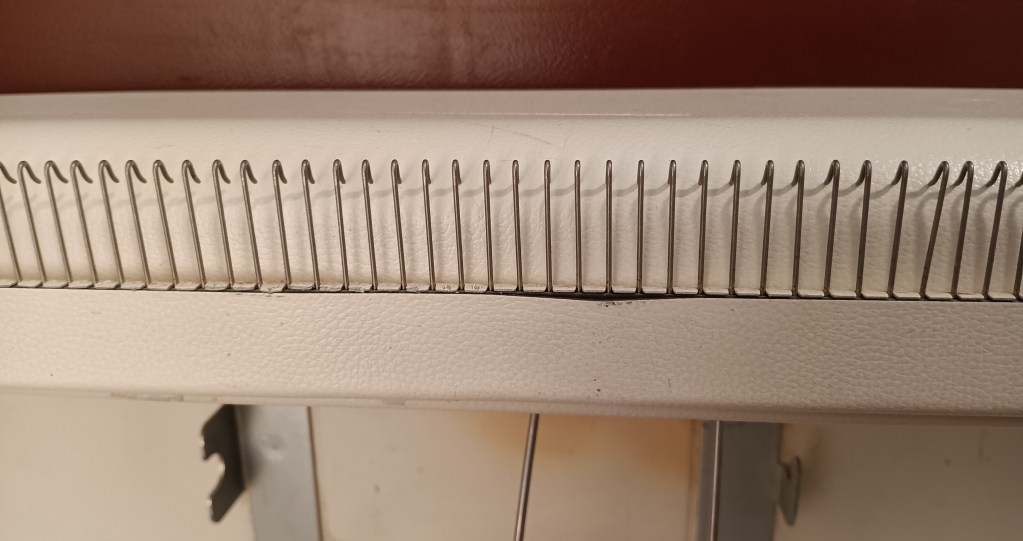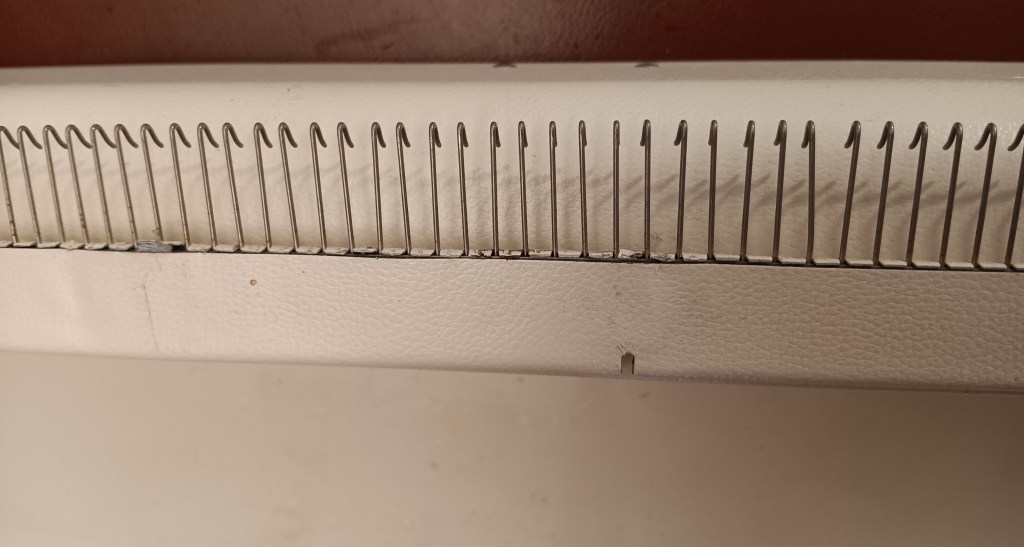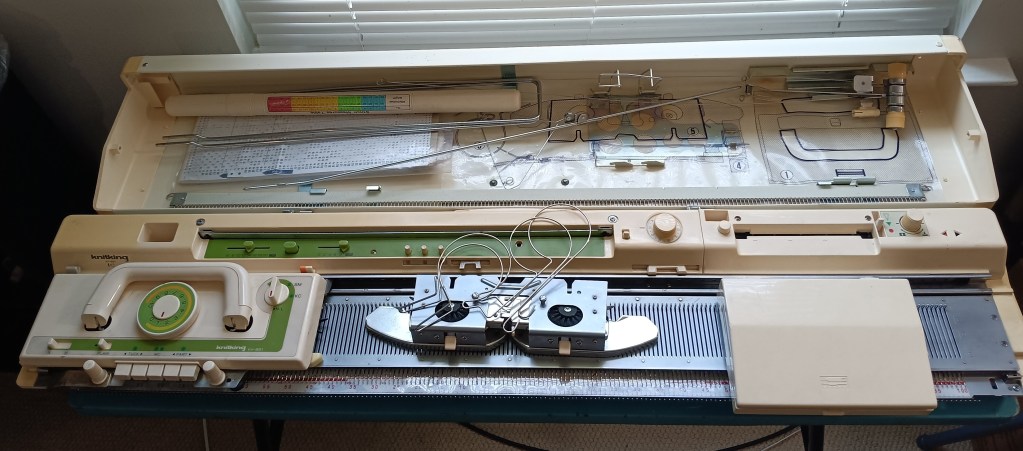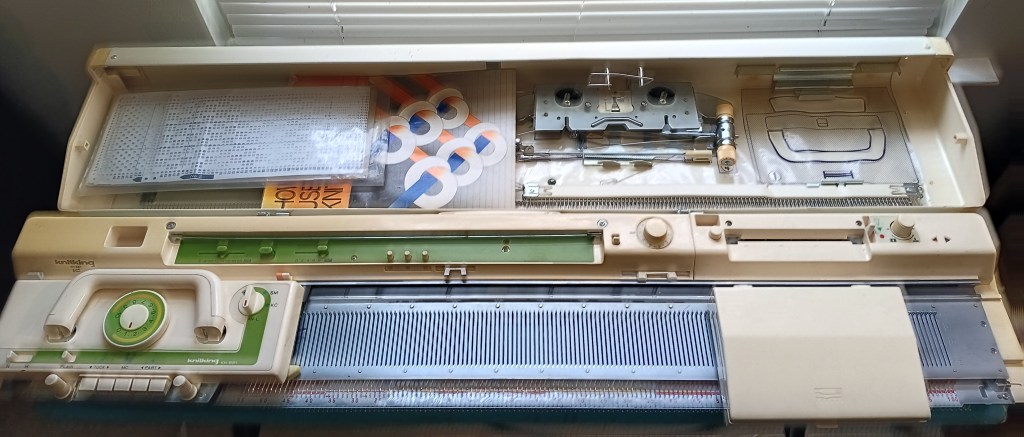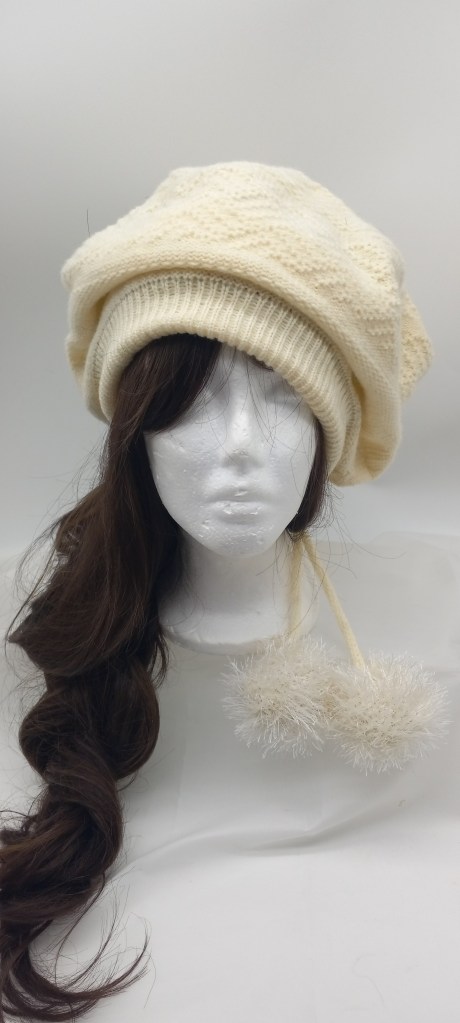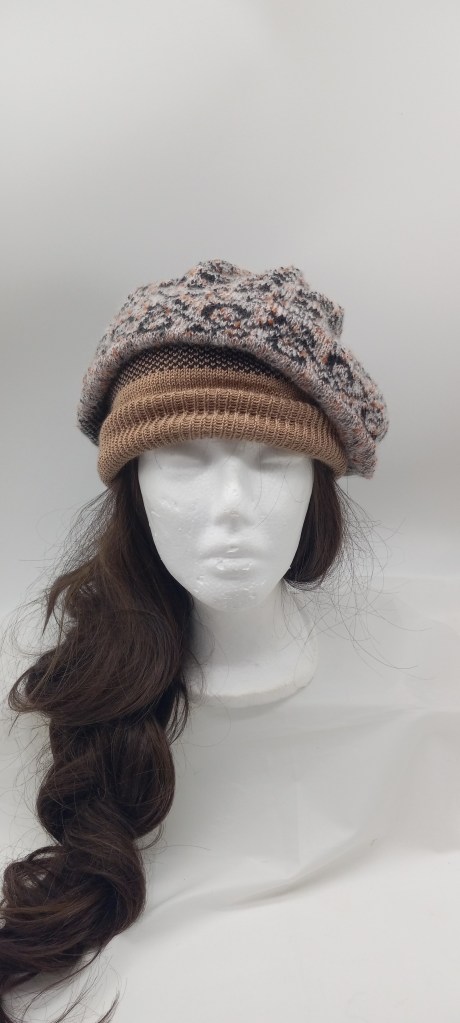
Singer 888 knitting machine ($505) + shipping ($50)
Shipping to Hawaii, Alaska, and west coast might be extra
$555.00
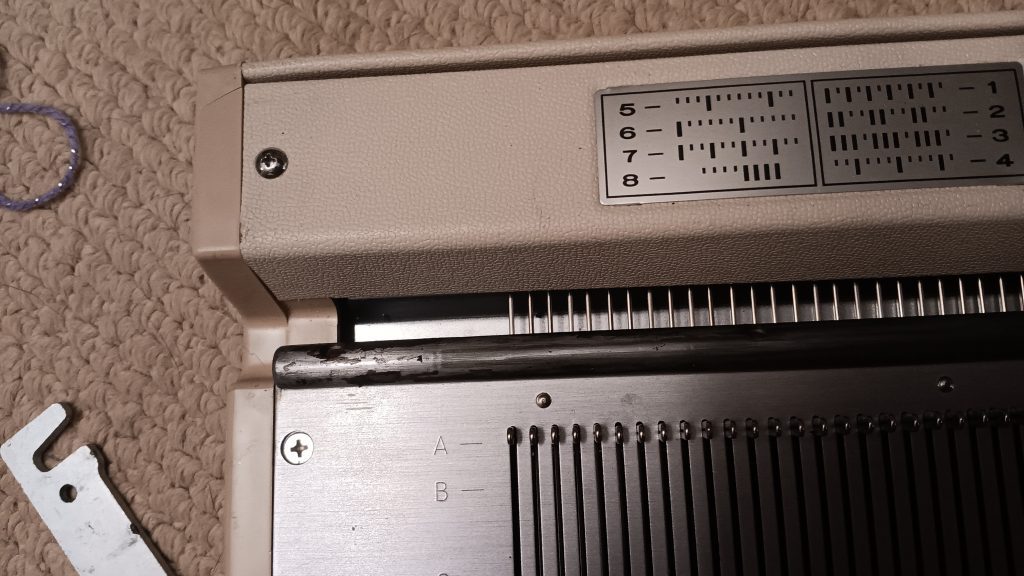
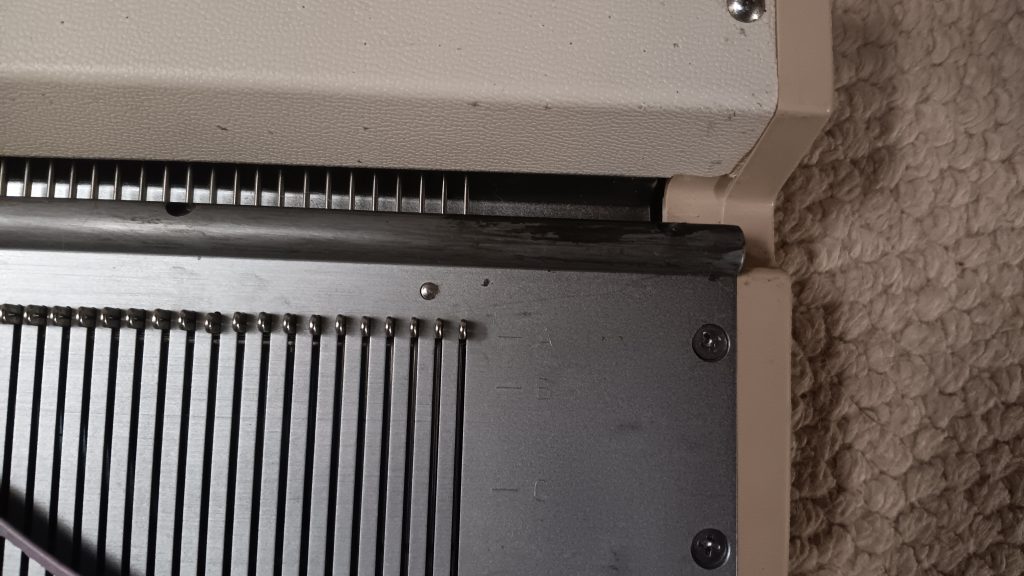
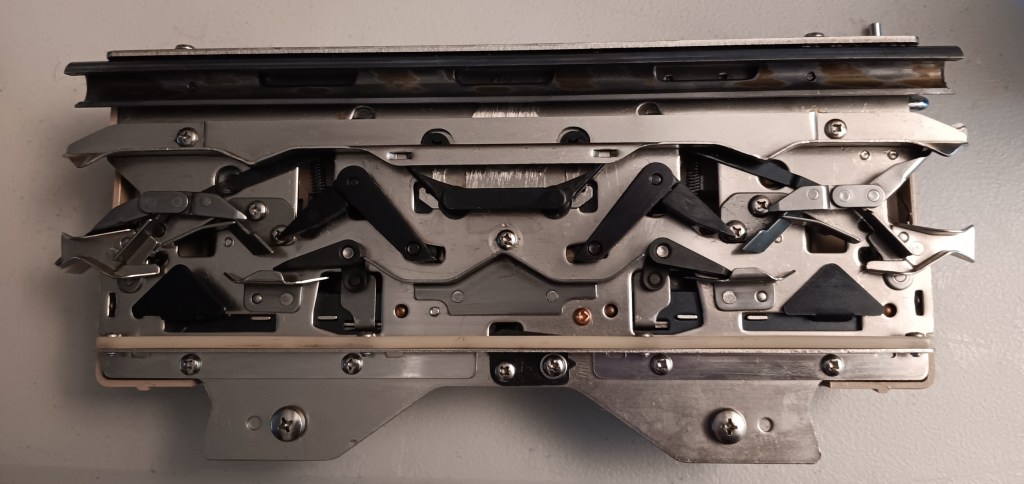
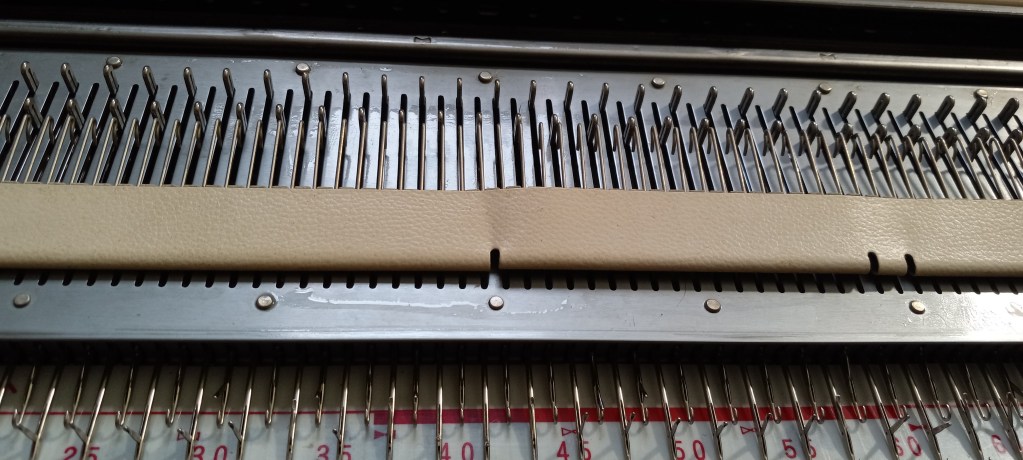
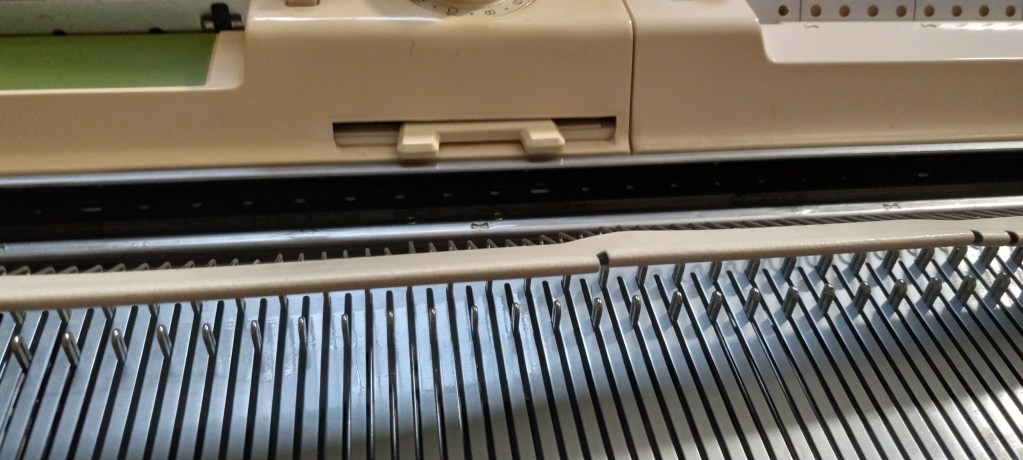
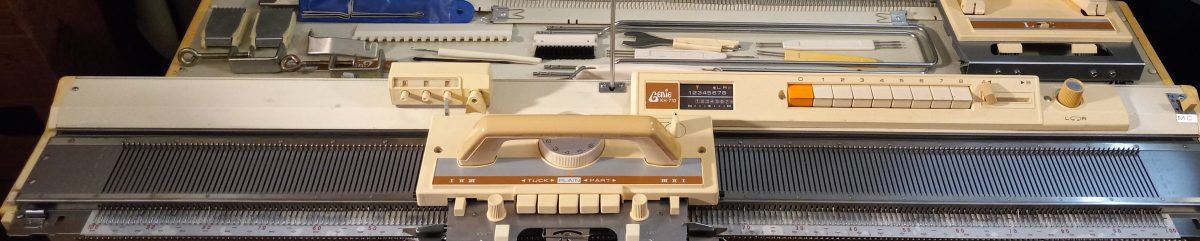
Singer 888 knitting machine model has 200 needles, 4.5 mm apart, which makes it a standard-gauge knitting machine. It was released to the market in the mid-to-late 1960s. It has turn knobs, controlling needle selection and, thus, patterning when knitting. Read more about this model in my Knitting Machine Encyclopedia. The rest of the post below is dedicated to a specific Singer 888 knitting machine, serviced and tested in my shop.
Just a quick disclosure: I was nervous starting testing this machine with so many buttons and levers and moving parts but as I started working with it fell in love with this machine. Patterning was so easy and kind of almost meditating. Check out the video of these tests.
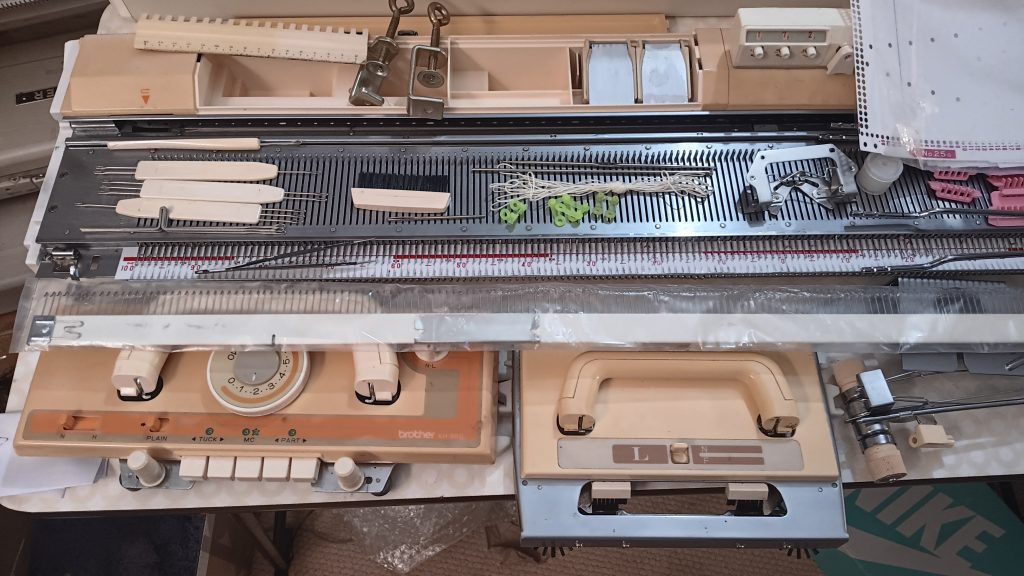
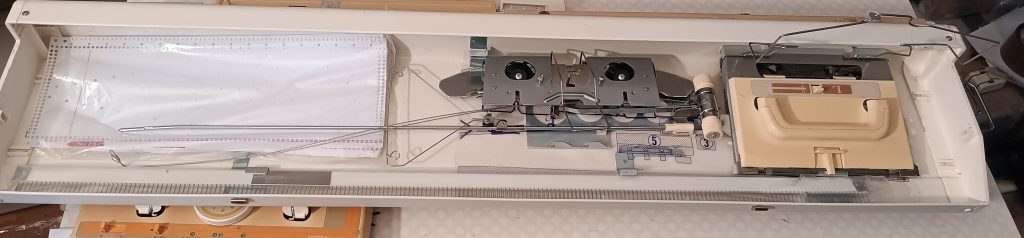
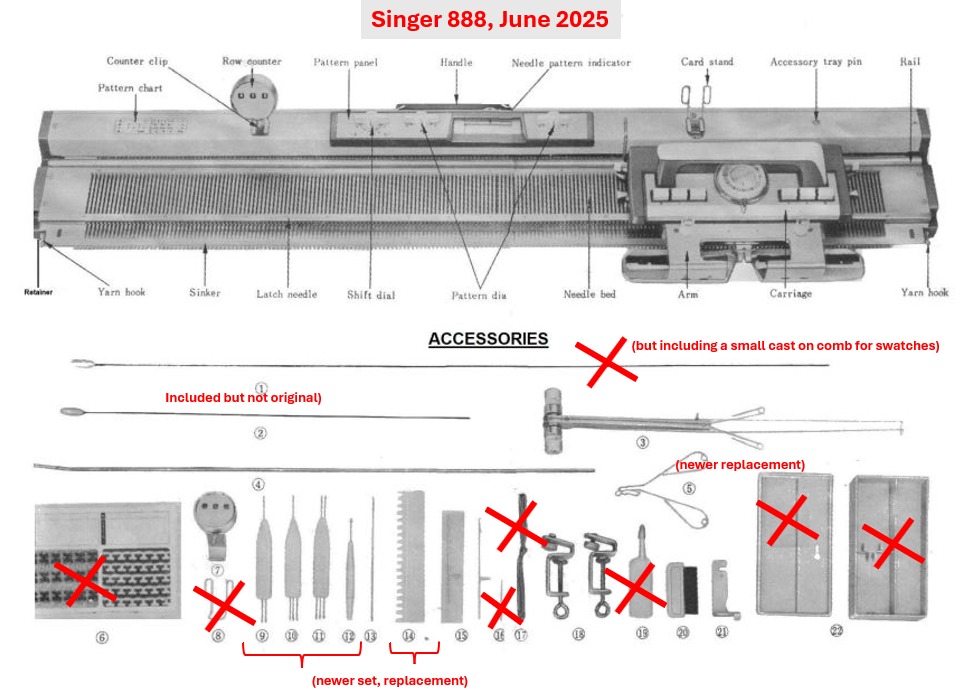
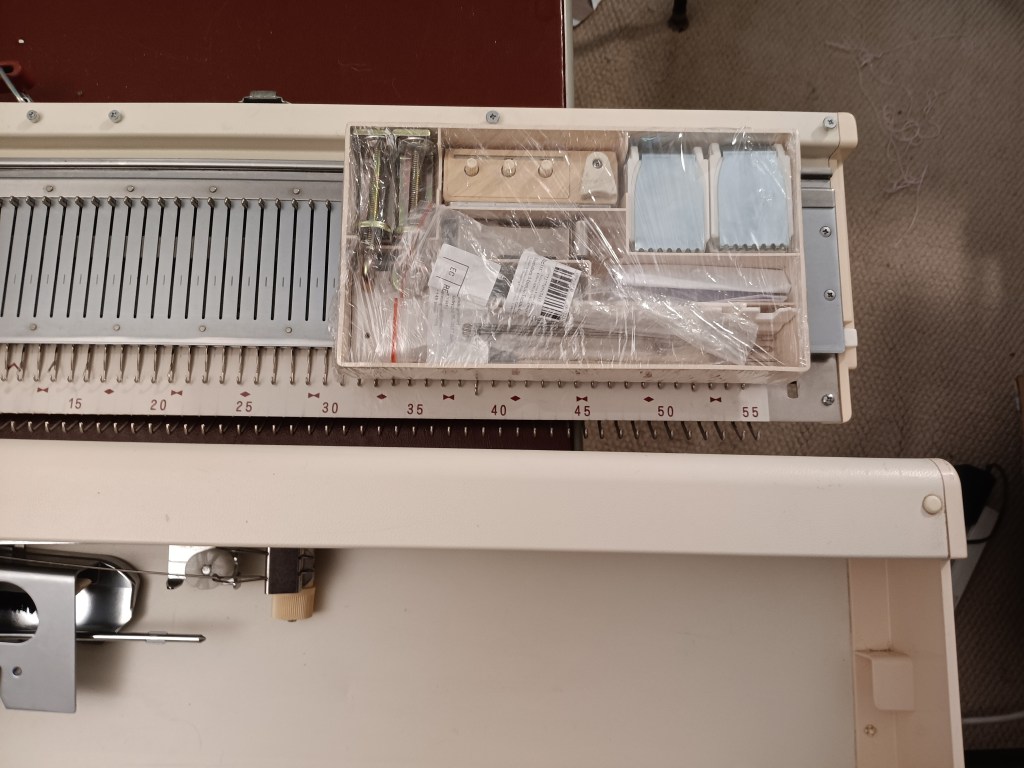
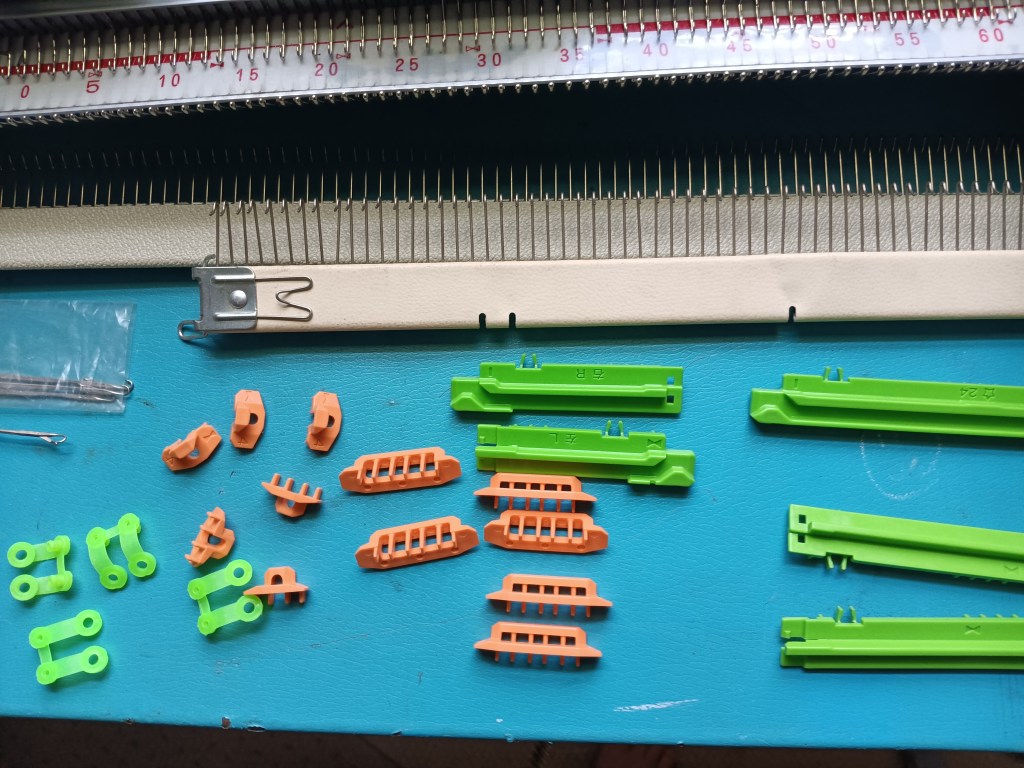
The machine will come with almost all and most critical major (carriage, sinker plate, row counter, tension mast) and most all minor accessories (table clamps, transfer tools, needle selection ruler, replacement needles). A lot of accessories were missing when I got the machine but i was able to outsource most of them.
All levers, knob, dials and button on the carriage move freely.
The hard copy of the manual will not be included. However, it can be found online (look on that site for the info on Knitmaster ES-302, Studio SK-302, and Silver SK-302 knitting machines as they are similar to Singer 888). Silver SK-301, Studio SK301, Silver 303, Silver 305 and Empisal Knitmaster mod. 305 are also similar turn-knob machines that will provide a lot of useful tips if instructions for the 302-series models.
The case to store tools is not included. The tools will be secured to ship even without the case. Oil was too old and I tossed it away. For maintenance get a Hopp’s gun oil on Amazon. The clips to hold pattern cared also did not come with the machine. Tapestry needle and cast on thread are not included. Any needle and any silky and strong thread will work.
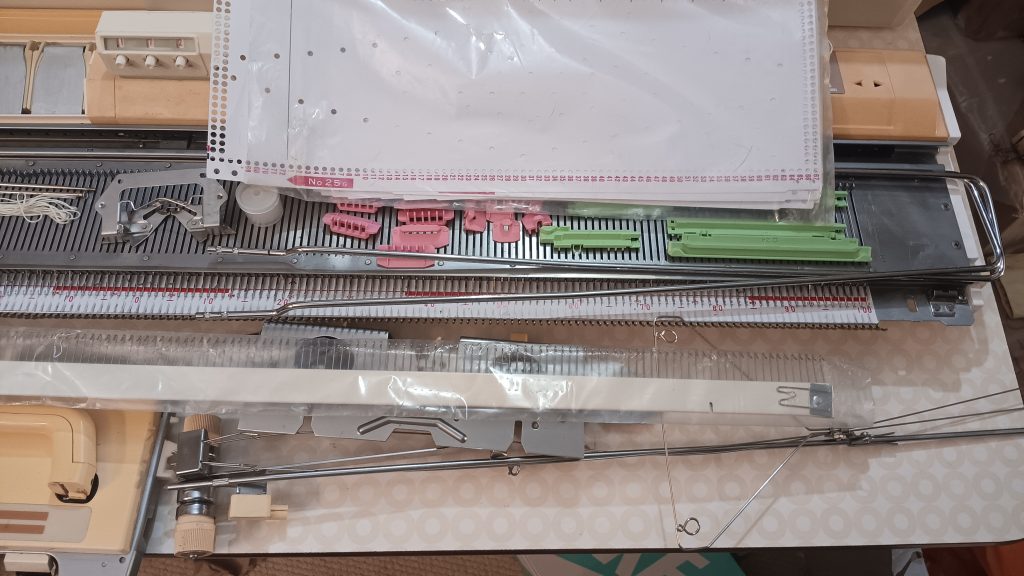
The table clamps are original. The transfer tools were missing but i am including a new set which also comes with a new needle selection ruler. Only one, 100 stitches, cast-on wire will be included. It came with the machine but does not seem to be the original (the bead on the end is not oval; a wire is simply bent into knot). As a courtesy, i am including a small cast-on comb to quickly cast on for swatches while learning the machine. I am not sure using case-on wires is a popular cast-on method since I most often see e-wrap based cast ons. Howeer, for quick swatches and quick tests, cast-on comb-based is my favorite.
The pattern cards also did not come with this machine but they are also available online.
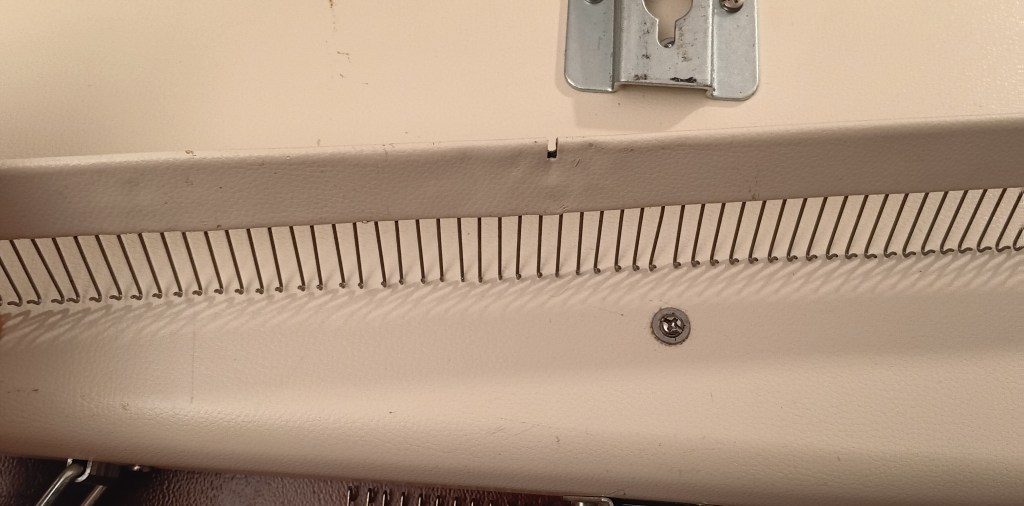
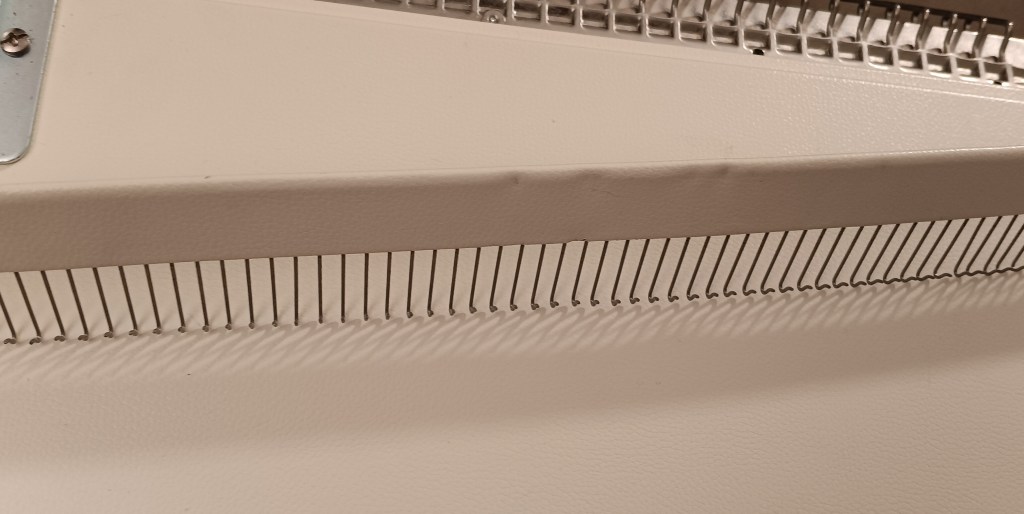
The needle bed, all needles, the patterning center and the inside of the machine were thoroughly inspected and cleaned. The carriage was thoroughly oiled to ensure all buttons, dials and levers move freely.
The sinker plate and all its wheels are in great shape.
I knitted several swatches with different patterns to ensure that the carriage performs the needle selection and patterning well.
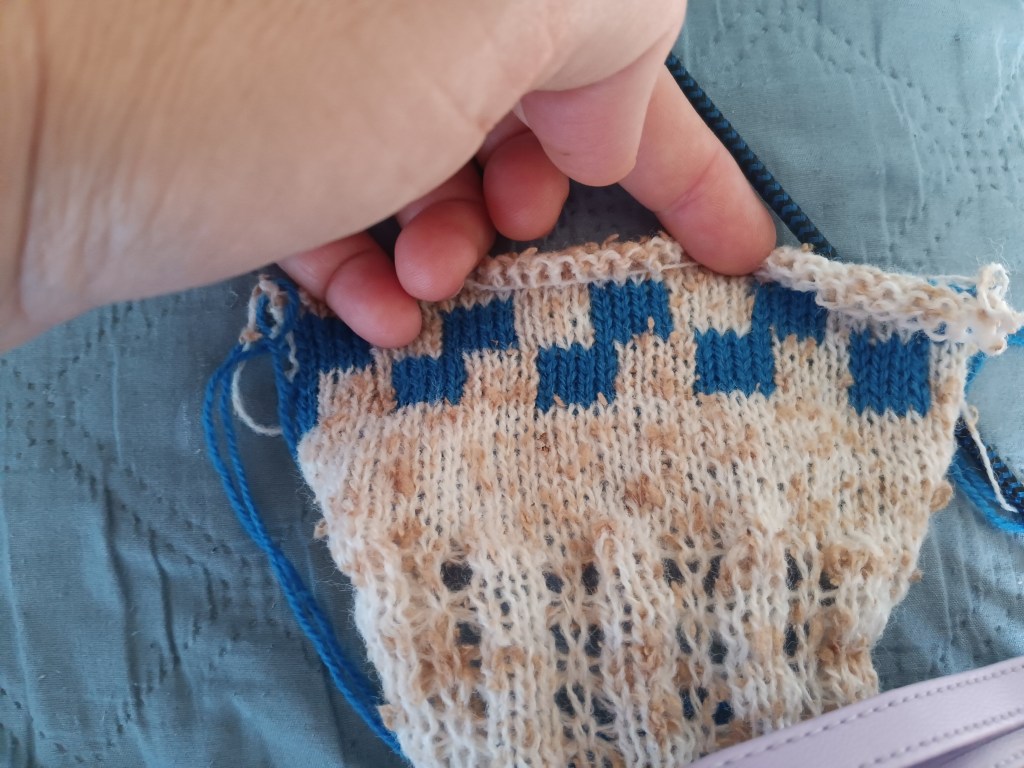
Then I knitted on the full bed to ensure that all needles form correct stitches. I knitted on all 200 needles stockinet, tuck and slip-stitch. The two-color fair isle was only done on a swatch.
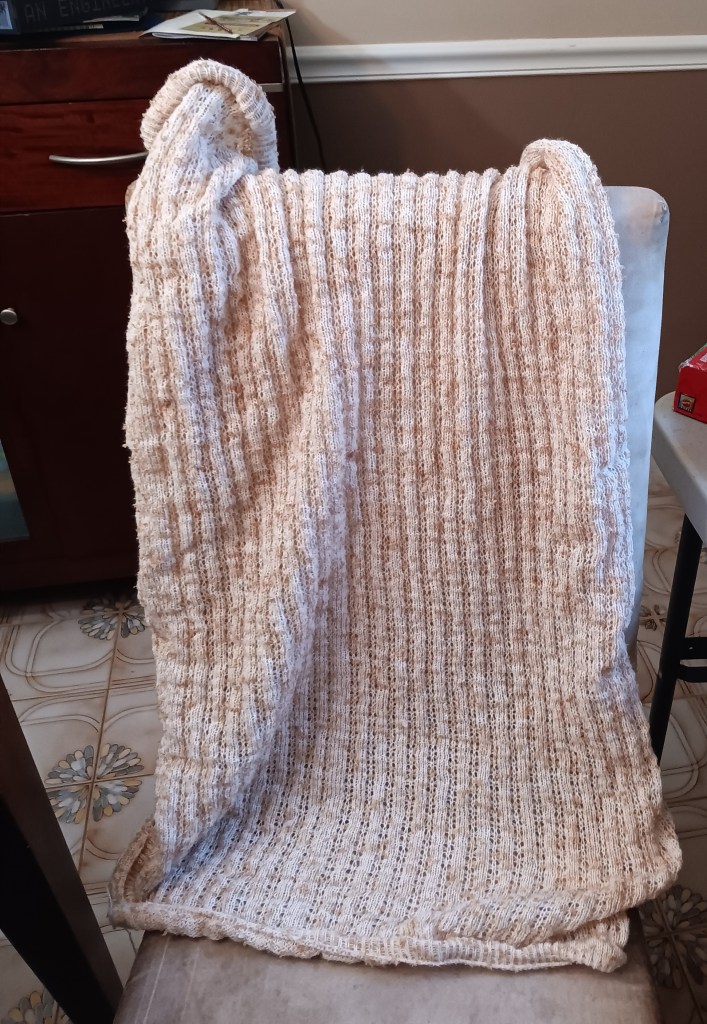
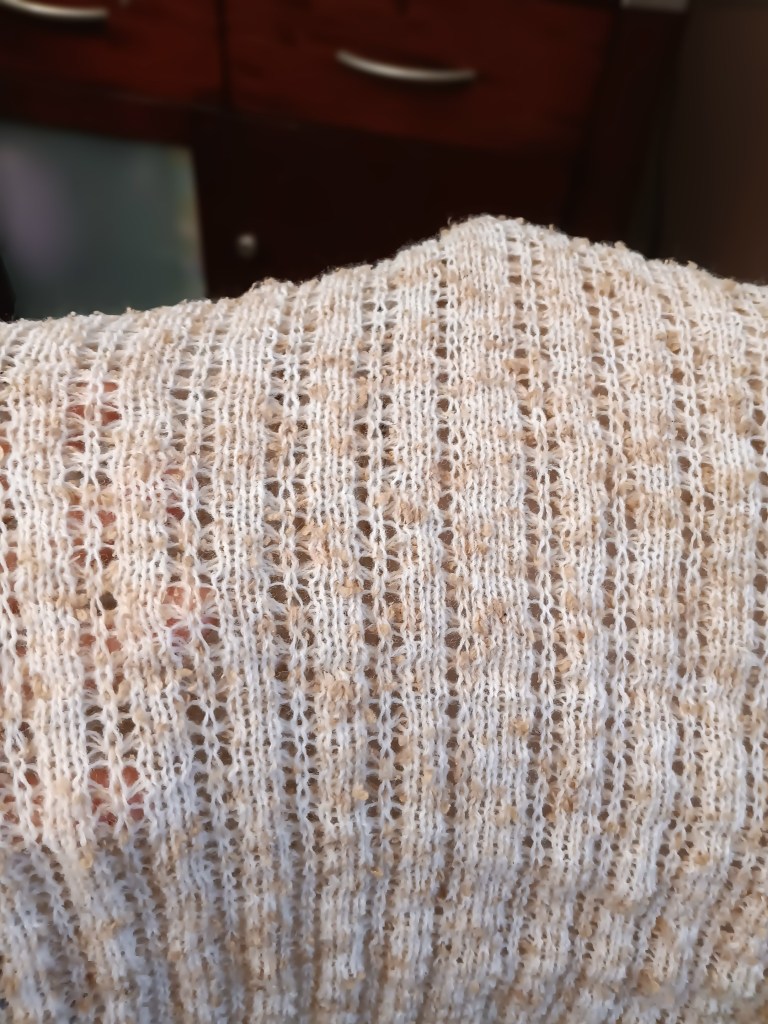
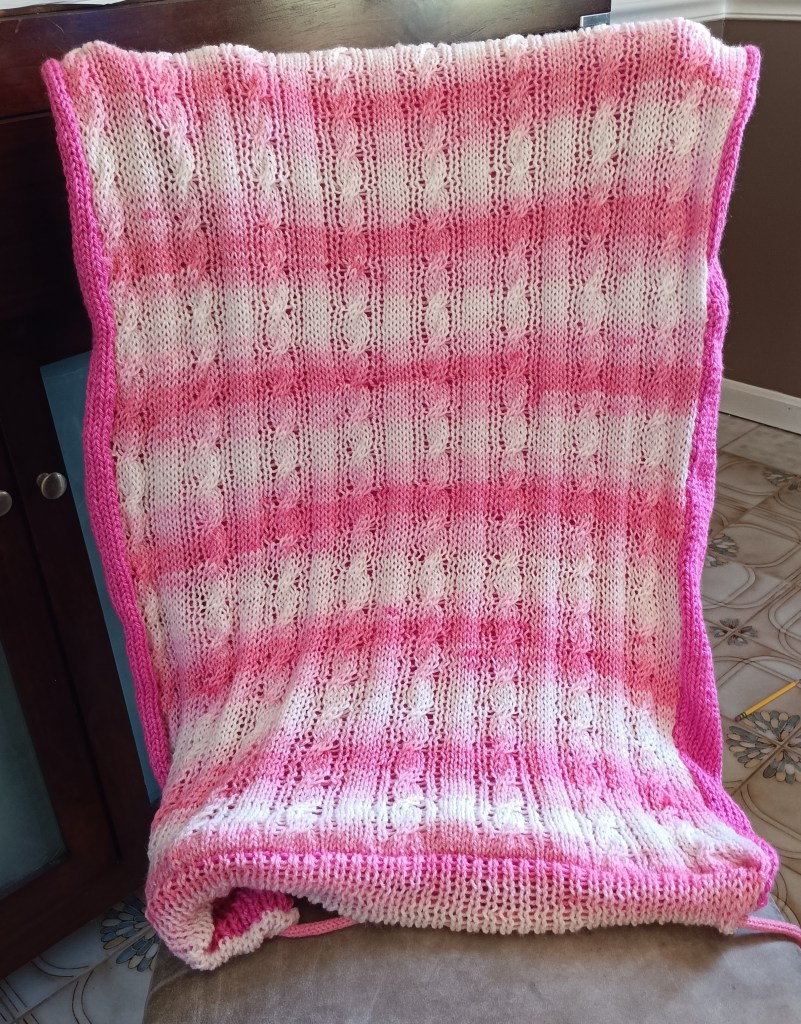
I like making something from the knitted panels I knit while testing the machines. This time, I made a very light-weight but still warm baby blanket for a friend.
Now about imperfections of this machine:
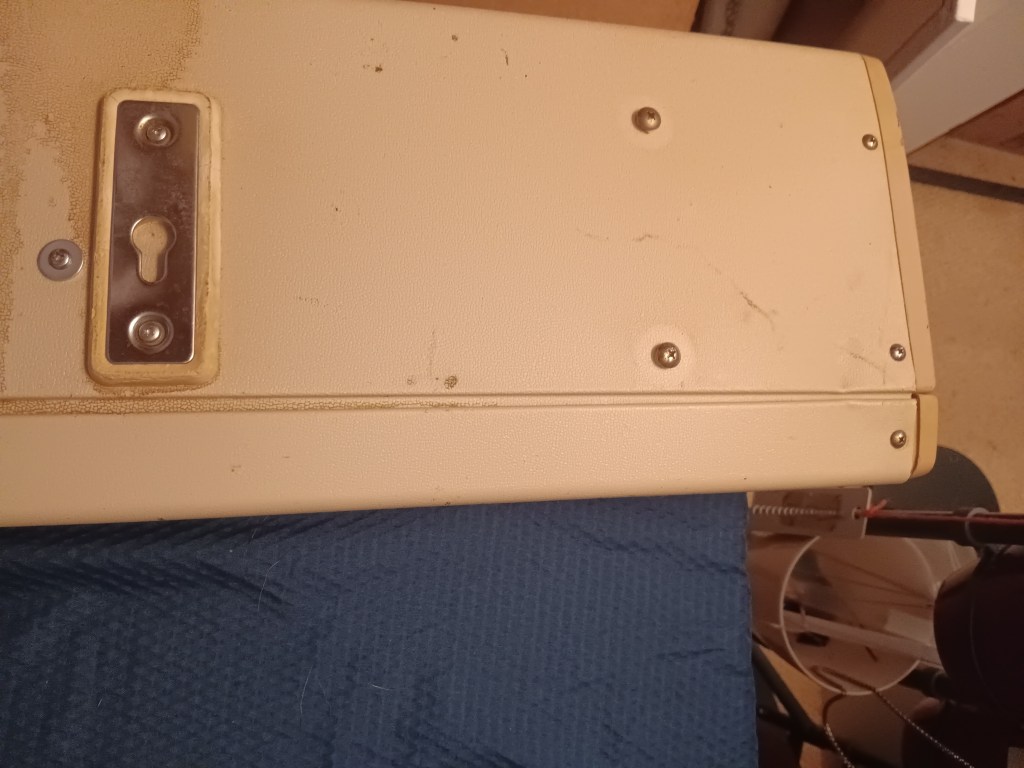
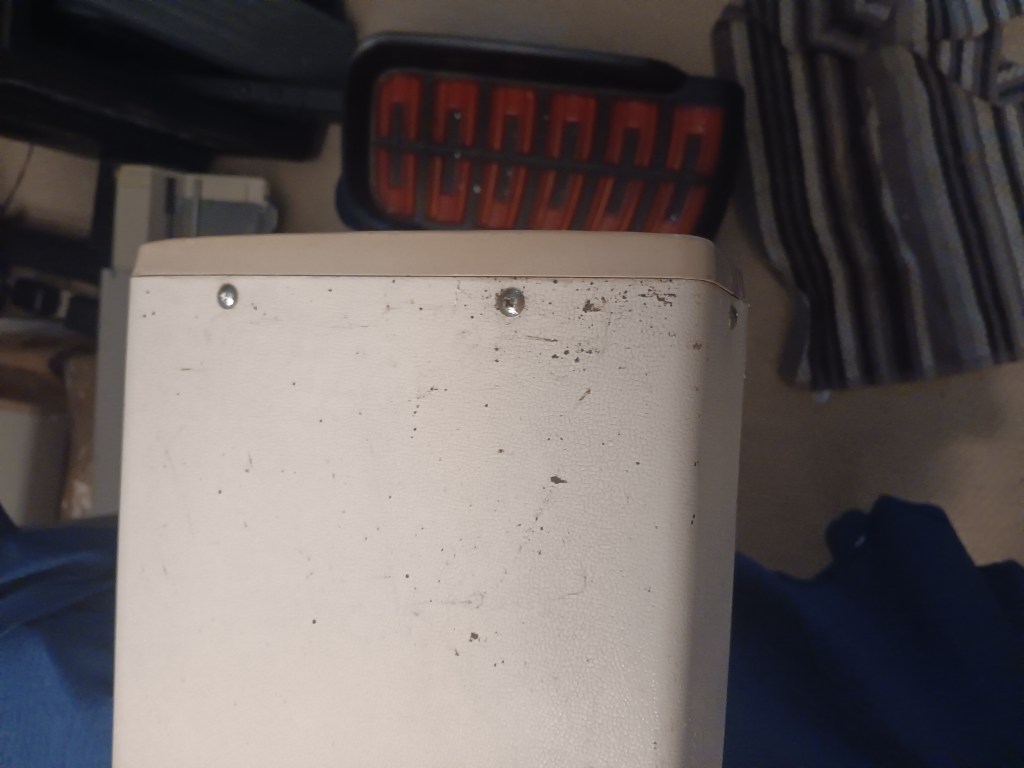
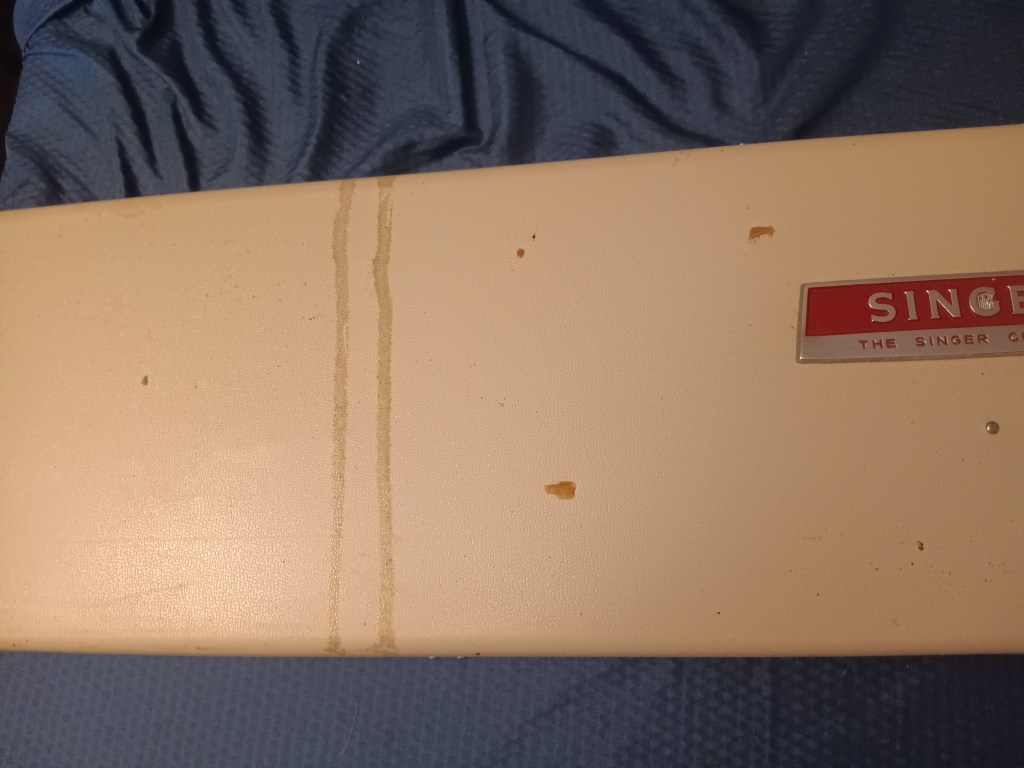
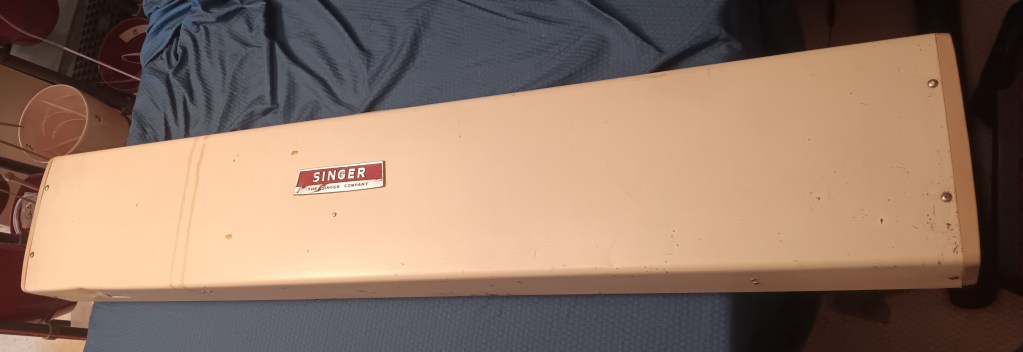
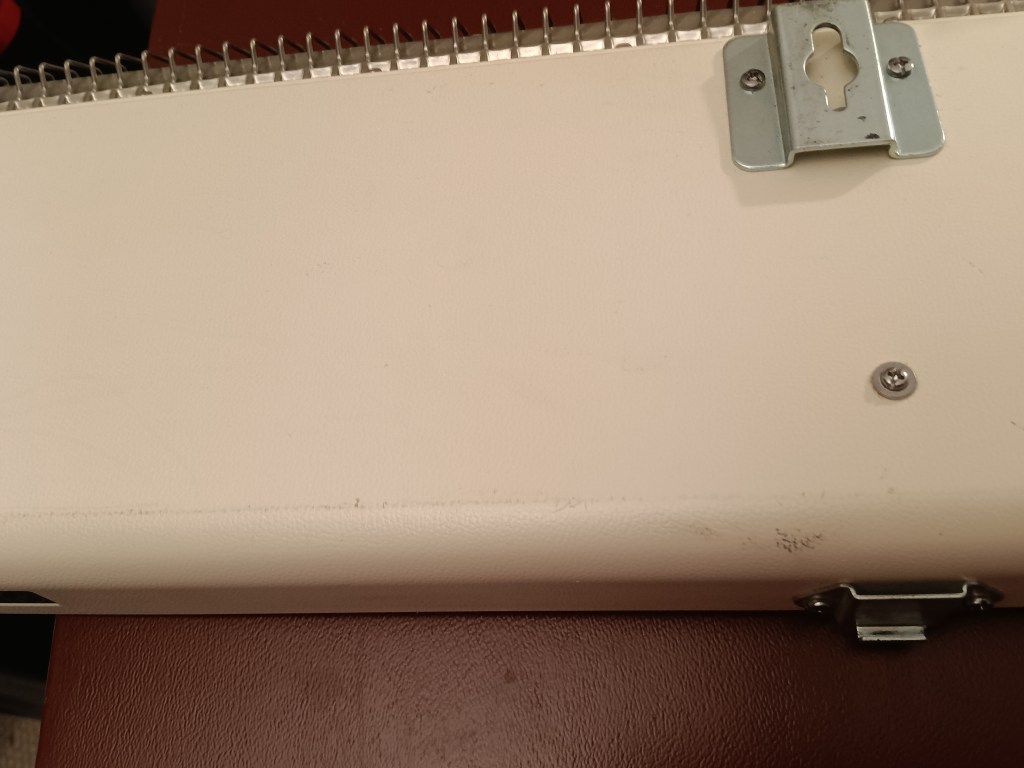
There is some staining on the case which I could not remove. I, however, do not use harsh chemicals because I fear damaging the original coating more than I dislike the stains.
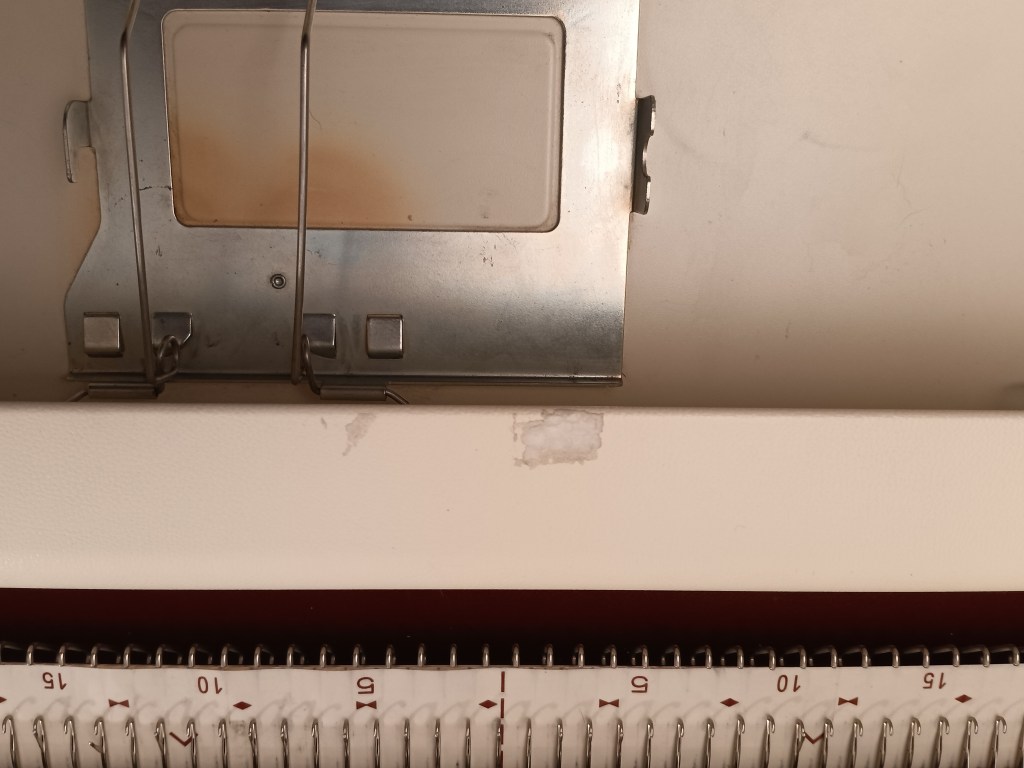
The lid has some staining too.
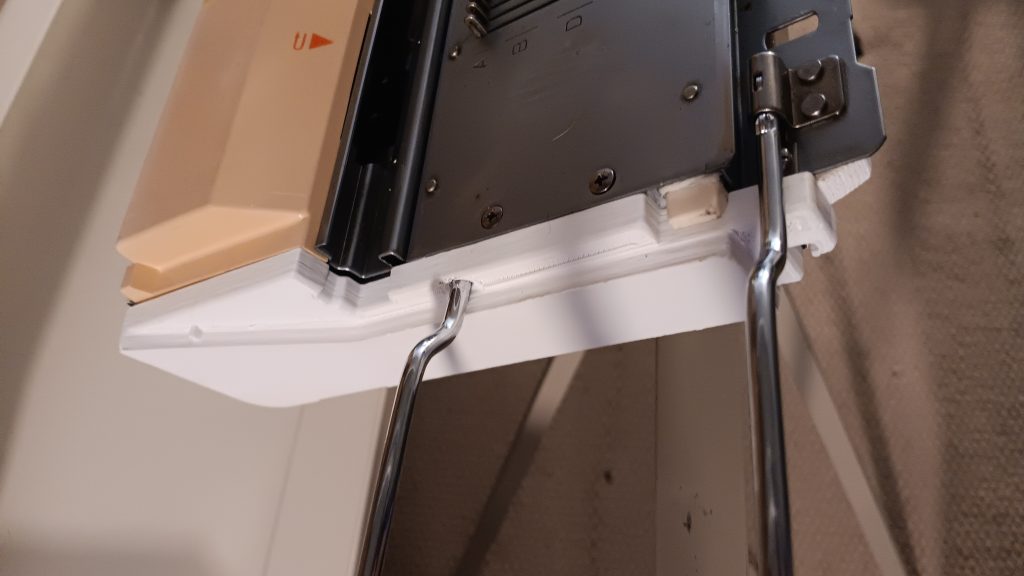
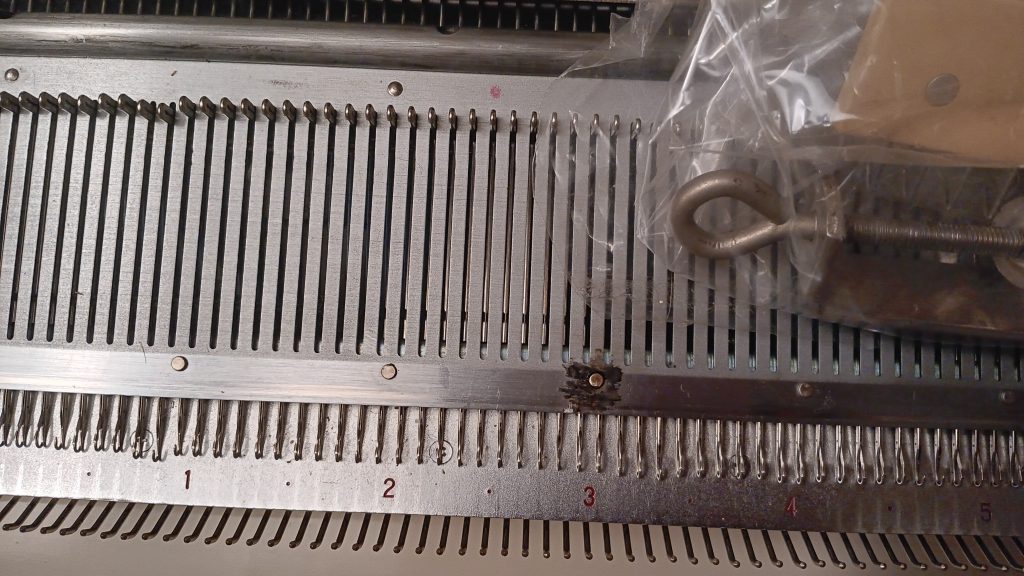
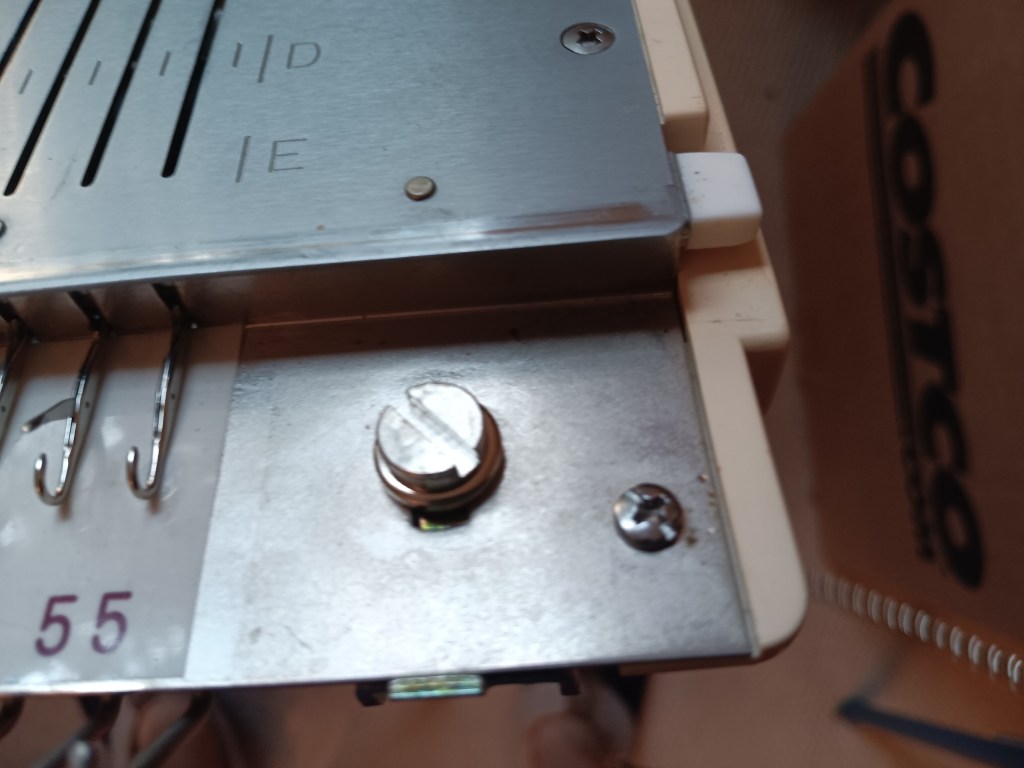
The underside of the carriage has some discoloration and scratches on the metal. Discoloration looks a bit like rust (but is still smooth) so I covered it with a protective coating. None of these affected knitting: the carriage still glides smoothly and no static is forming (although static accumulation can also depend on the yarn).
These minor flaws and imperfections do not affect the functioning of the machine at all.
It is a lovely, light-weight and straightforward machine to use. It is easier to pattern in my opinion than the pushbutton Brother machines since no additional steps (like turning the ratchet) is required.
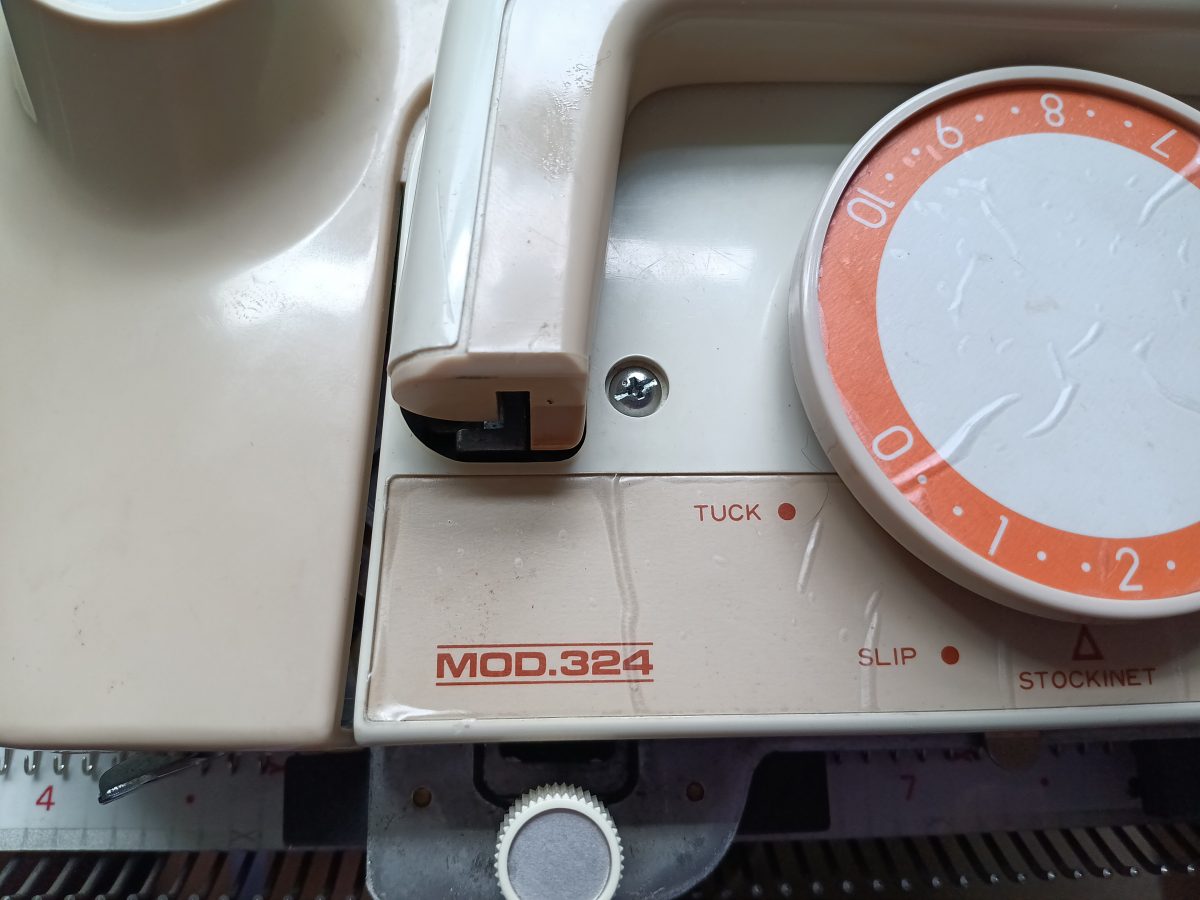
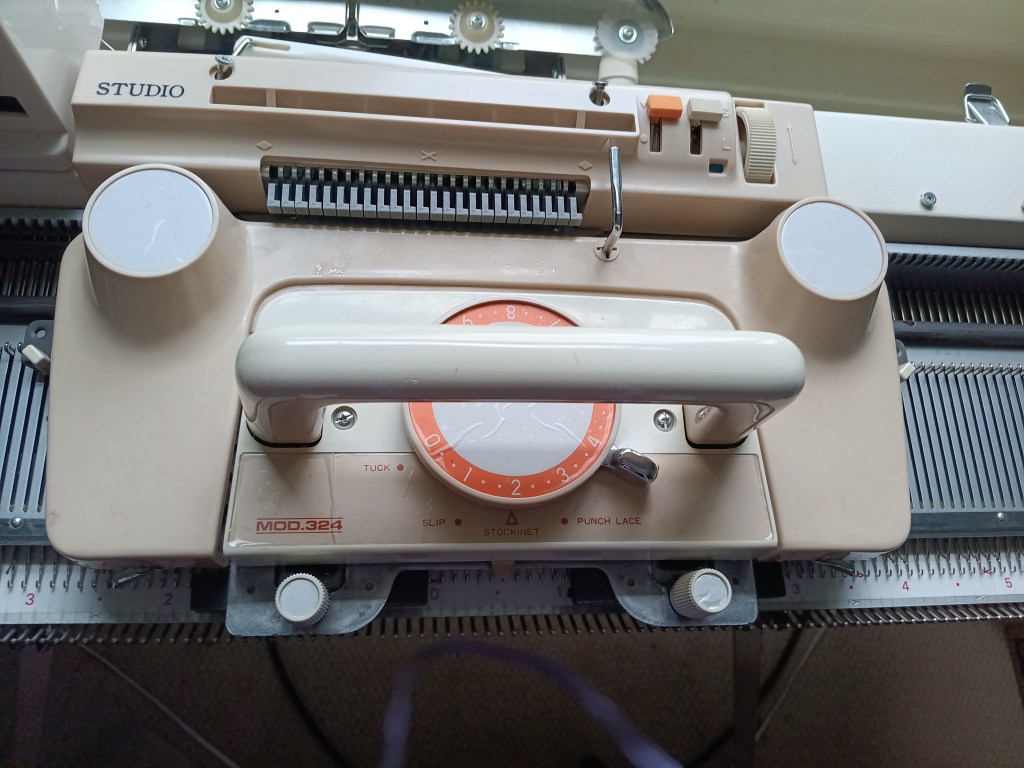
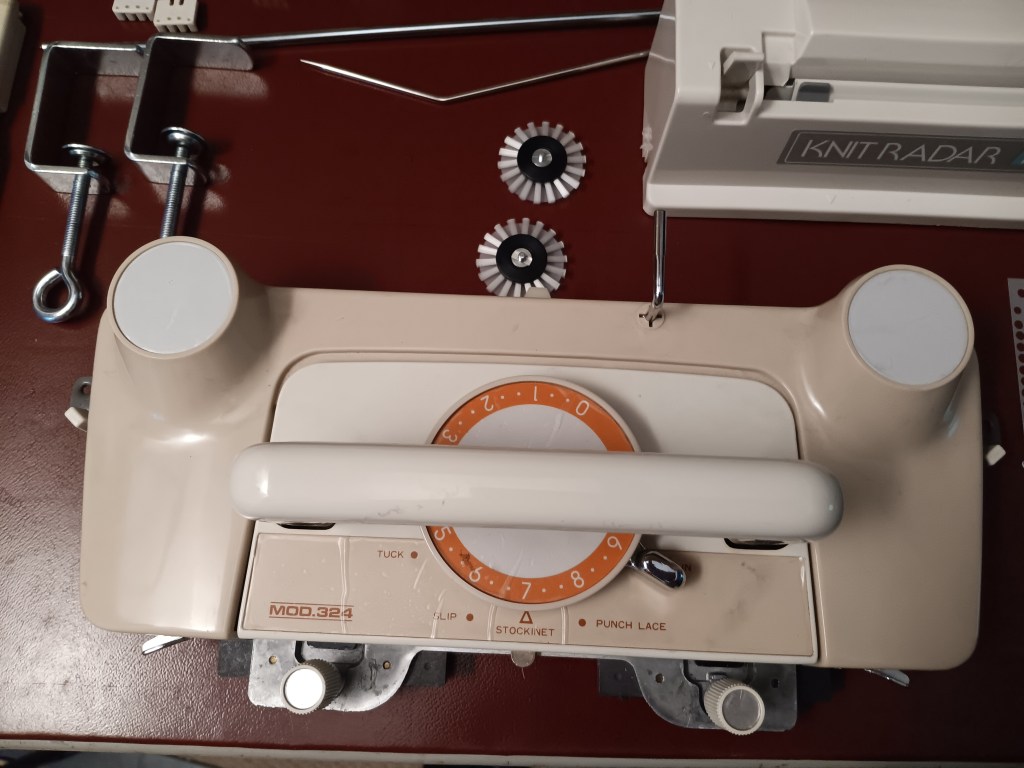
Studio mod. 324 knitting machine is a standard-gauge knitting machine with 200 needles. Read more about this model in my Knitting Machine Encyclopedia. This post is dedicated to a specific machine serviced and tested in my shop in May 2025.
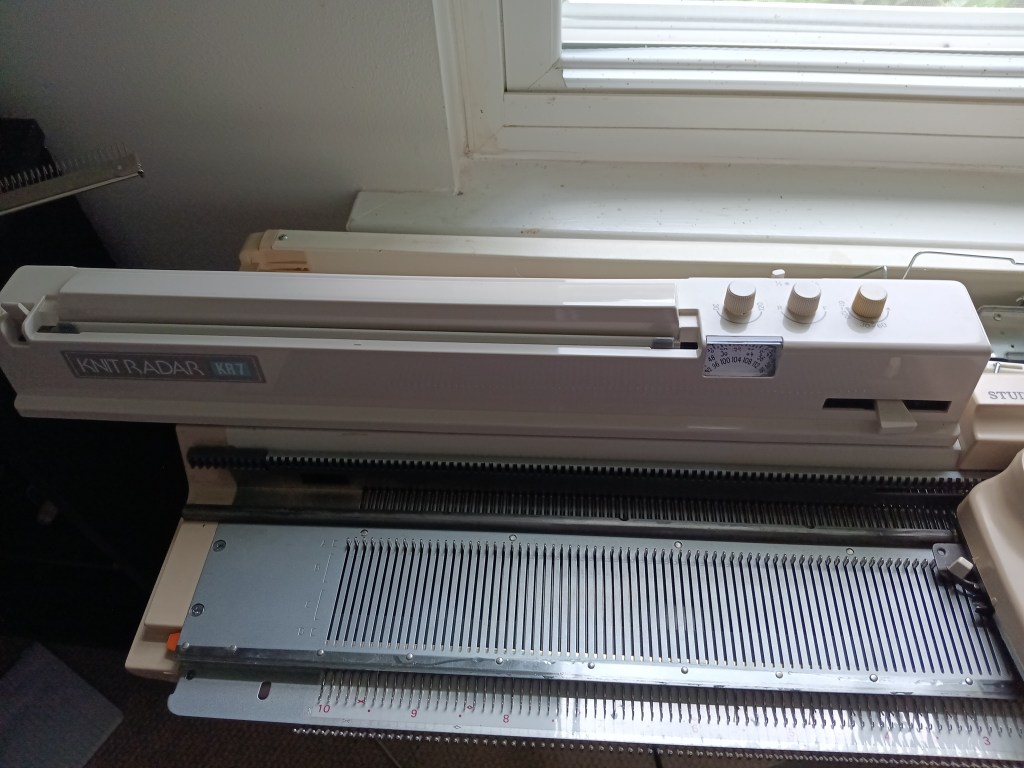
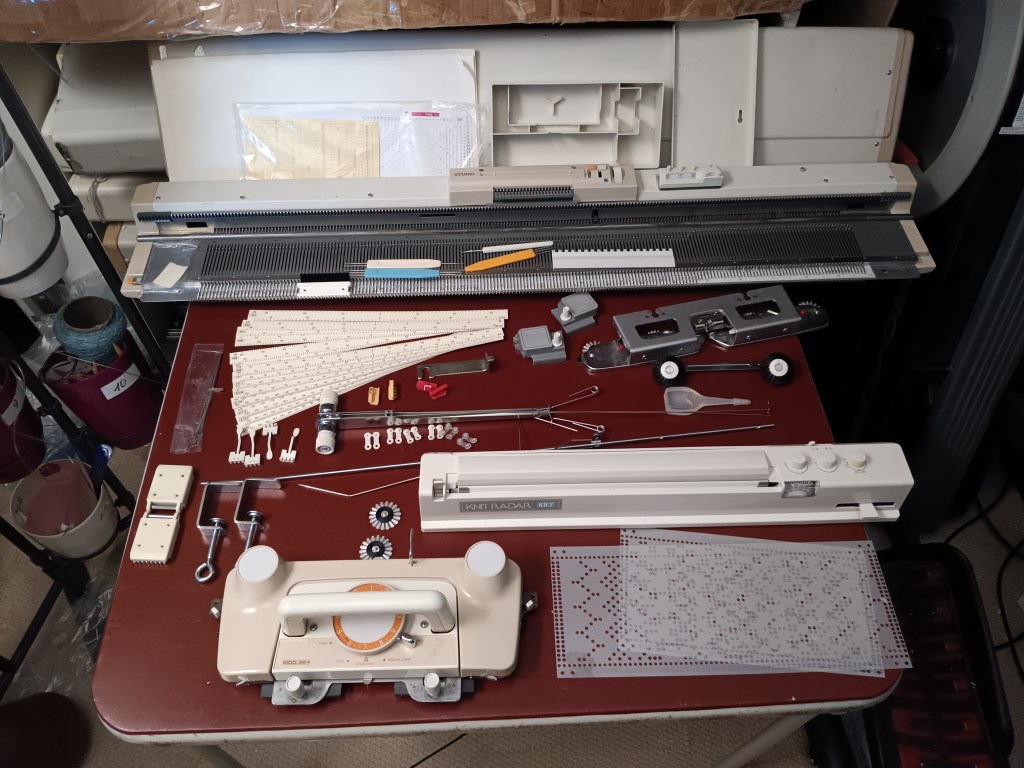
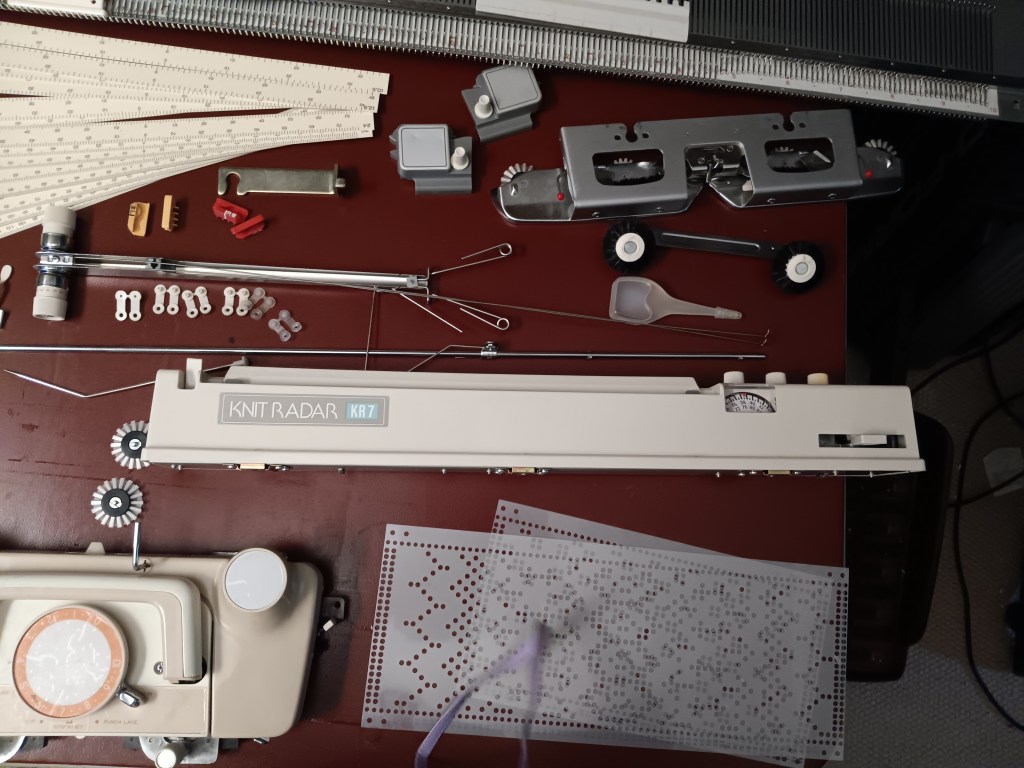
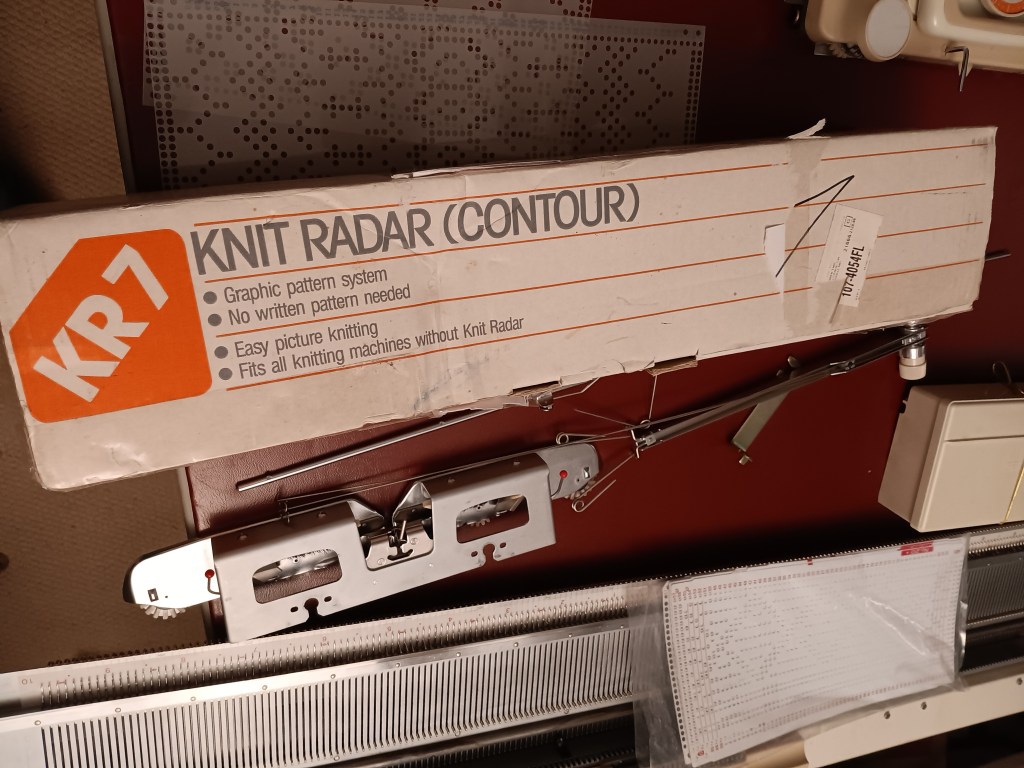
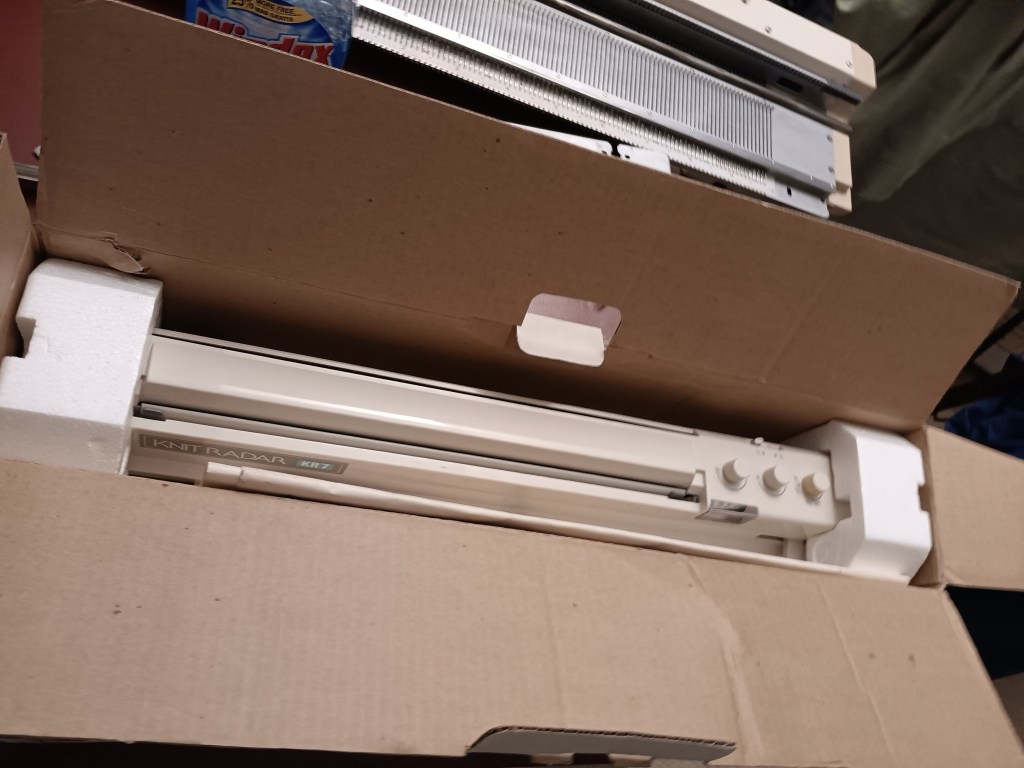
The setup will include the machine with all major accessories and a stand-alone knit radar (model KR7).
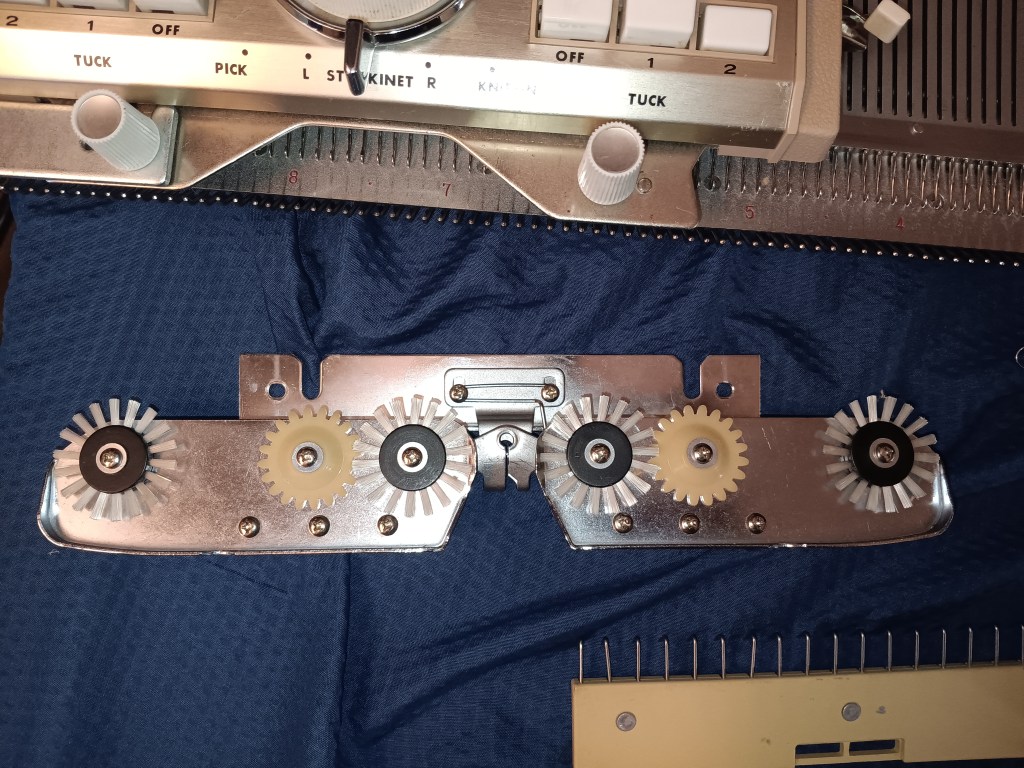
The machine, the carriage, the card reader, and the knit radar were thoroughly cleaned. I opened the carriage and cleaned it of old gunk. The atterning drums move freely (see the test video) so do all levers, knobs and buttons on the carriage.
All needles were removed, cleaned, and inspected. All latches were checked on how they move (sticky latches form tucked or other incorrect stitches). All faulty needles were replaced.
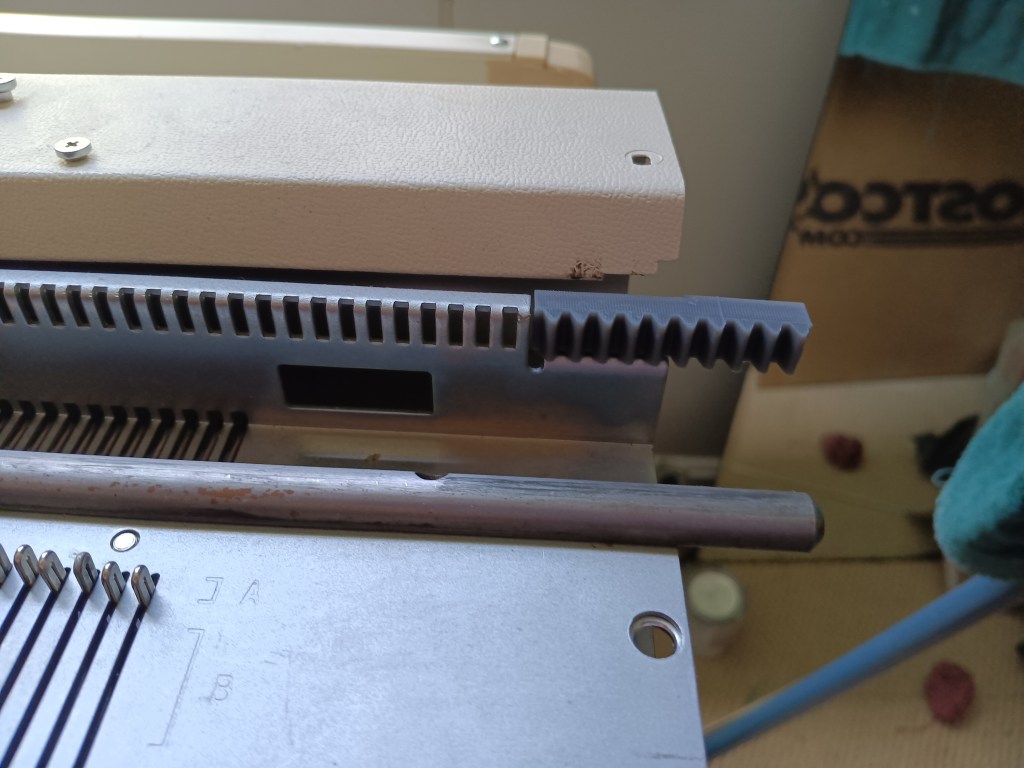
I replaced the end racks as well. Some minor discoloration spots, which seemed like rust, were covered with a protective coating.
A new sponge was attached to the original metal retaining bar.
With regards to the minor accessories for the machine:
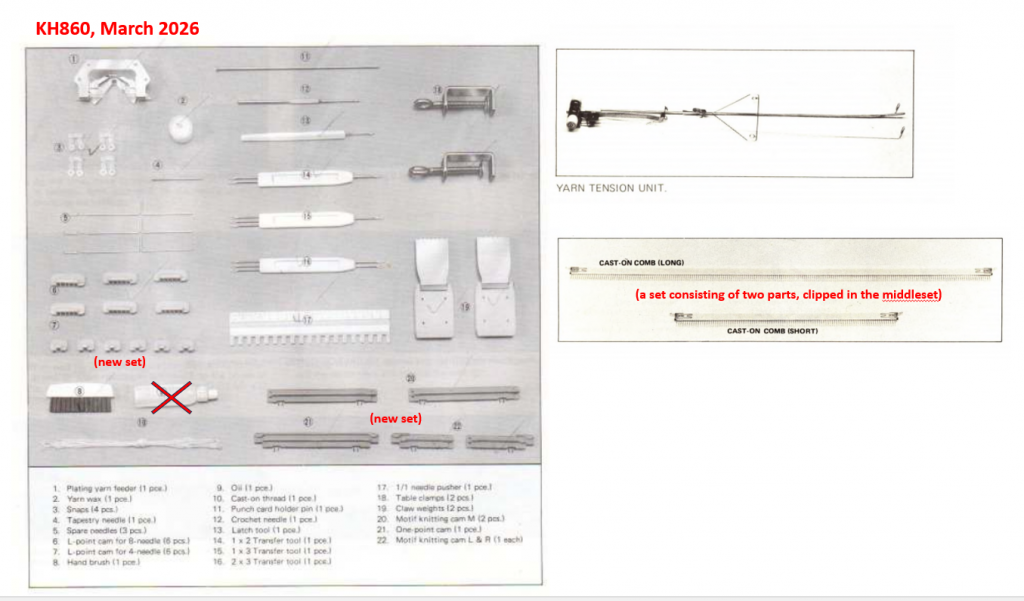
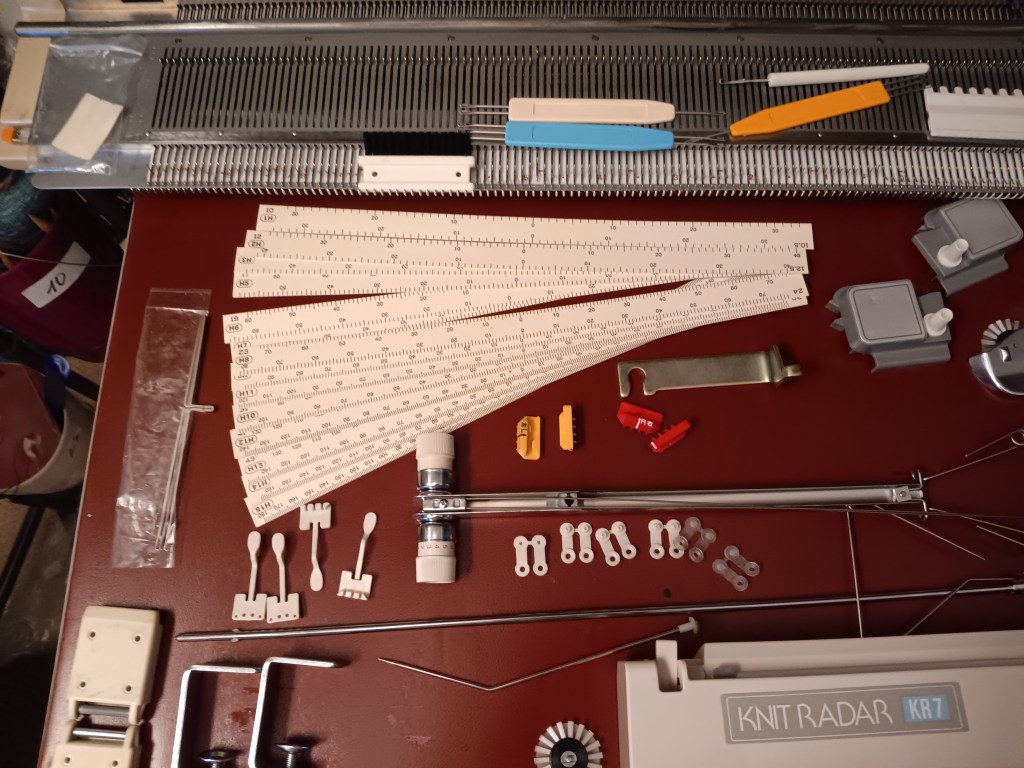
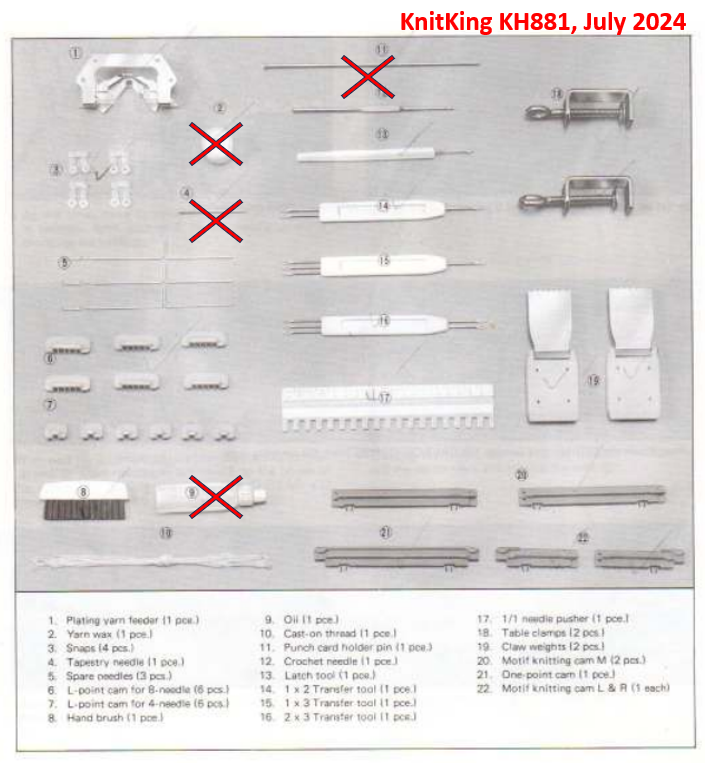
The machine came with almost all of them. Even the oil looks good, so it will be included (which I normally do not do and recommend getting Hopp’s gun oil off Amazon). The table clamps and the claw weights are new (new stock). The hard copy of the manual was missing, and I do not have one in my collection either. But it can be found online for free. This original manual does not list all accessories on one page. Thus, I borrowed the accessory diagram from the manual of another similar machine. But that machine has a slightly different set of accessories (I know – confusing).
So, the accessories that were supposed to be included but will not be are:
crochet hook (any will work, and honestly, with all the machine knitting work I do, latch hook and needle transfer tools are the most handy tools);
tapestry needle (any needle of your personal choice will work)
cast on cord (any silky and strong yarn will work)
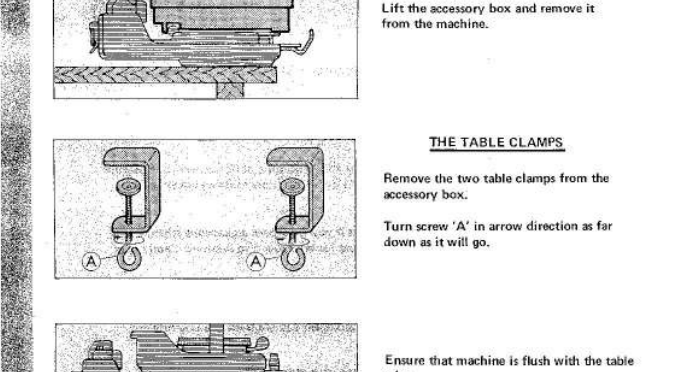
The accessories that are on the diagram below but still not be included are:
rib frame components (they did not come with the machine)
3/1 and 1/3 needle pushers (they also might be for that older machine, and they did not come with this machine either)
needle retaining bar pusher (I honestly have never seen it be included with any of the setups I had experience with. I simply use flat-head screw driver the push the retaiing bar out of its slot.
the intended table clamps are not slanted (the old-fashioned ones) but flat. The diagram above shows slanted table clamps. But this diagram from an earlier model (it still reflects all accessories correctly, just not as accurately). The original manual shows flat table clamps.
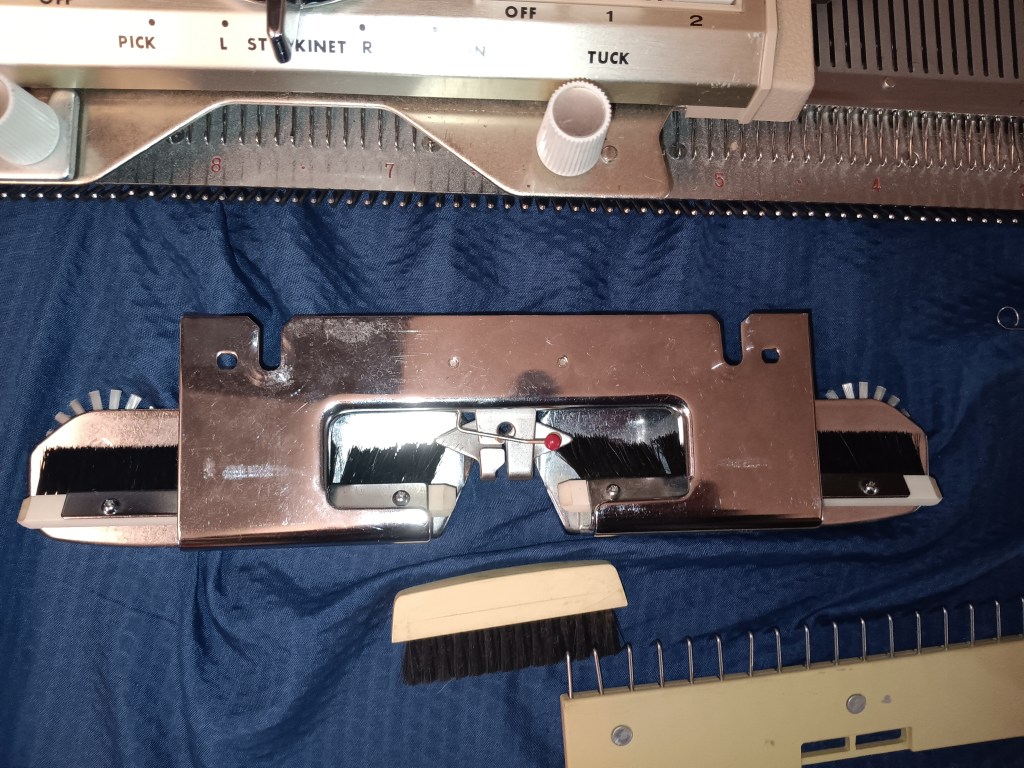
The weaving and round brushes are original as well. The only briefly explains what the round brushes are for (and it is also buried inside a lot of other info). There is a diagram showing that these brushes are used for tuck and plating knitting/patterning. I did not test plating, but tuck-knitting was performed without these brushes and it knitted very well on several different yarns.
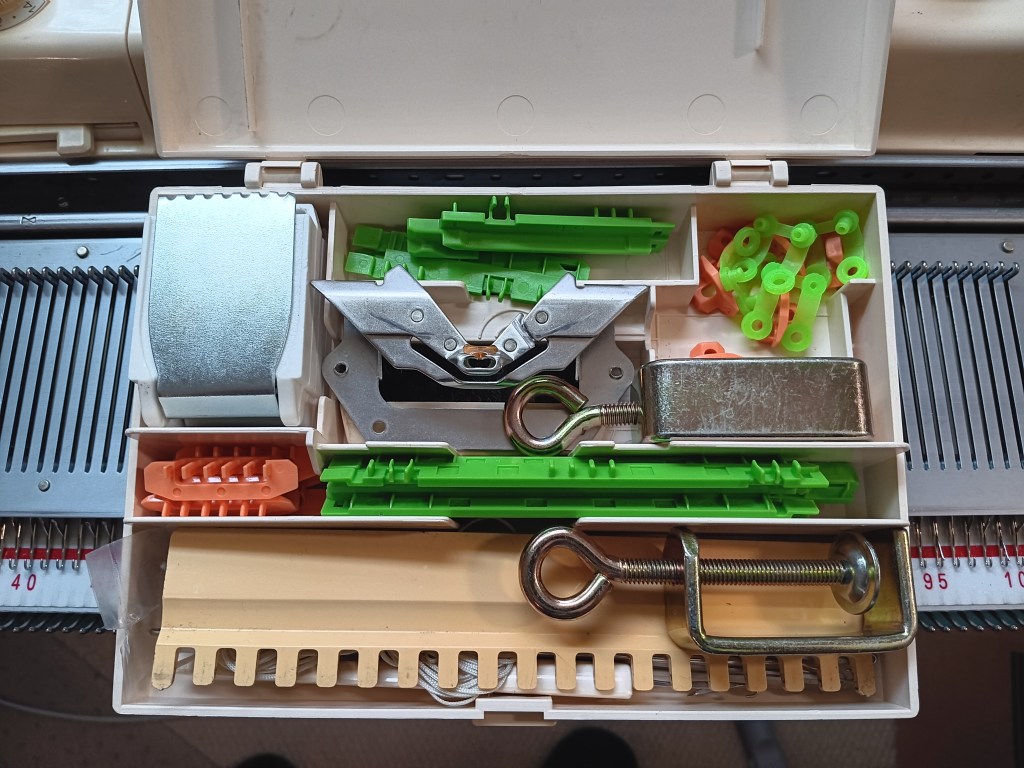
The toolbox to store accessories is in great shape. All accessories fit nicely into the box.
Apparently, the lid can be hooked onto the one of the sticking metal “screws” to use as a tool tray (refer to the manual).
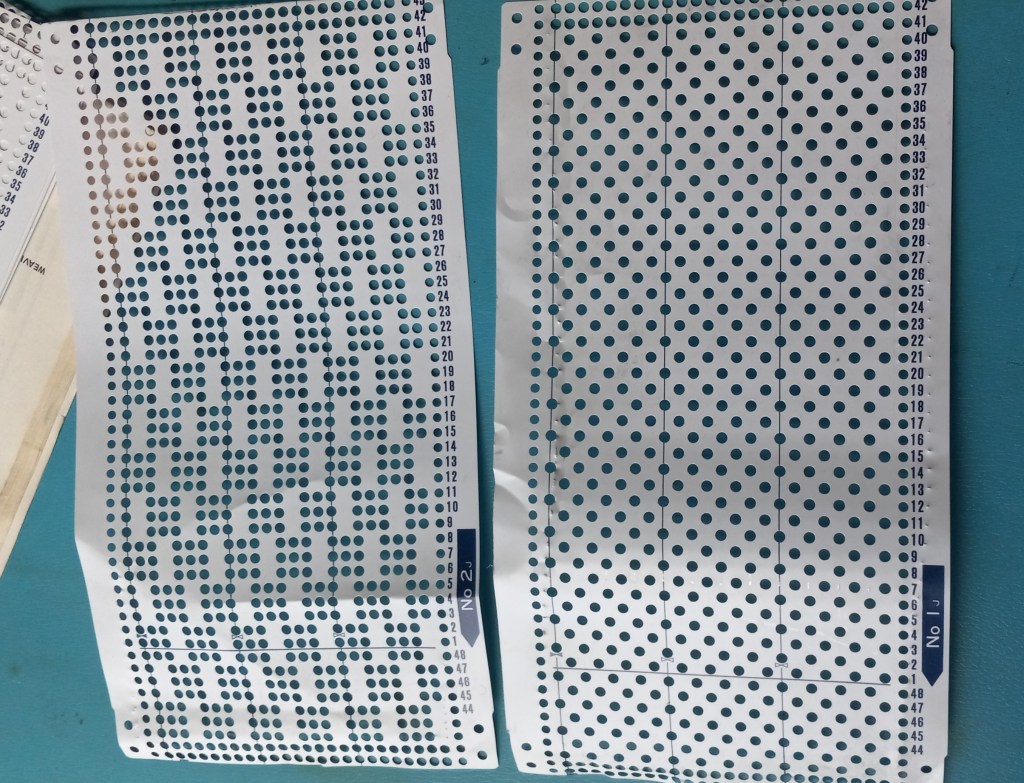
The punchcard set looks like the original one. It includes the card with the description, which punchcards can be used for what kind of patterning, in case they don’t match what the manual mentions.
I am also including two custom punchcards (as a thank you for waiting for my patience customer! :))
I am also including two extra card clips (transparent ones) as I think the original white ones are kind of hard to clip.
The setup will include a stand-alone knit radar KR7. The hard copy of the manual will not be included but a pdf copy is available online.
As you can see in the video, the carriage moves super smoothly when the needles are in A and B positions (I was able to move it with just one hand). All levers, buttons, and drums move well too, which is extremely important for patterning and advanced knitting.
I tested the carriage by knitting swatches using different yarns (not all shown in the video) as well as on the full bed to ensure all needles form correct stitches. I like doing full-bed tests with card #1 because any mispatterning or faults will be noticed immediately (even the tiny random ones): the fabric will not be even.
In the video I show tests with tuck-, slip-, and fair isle stitches/patterns using Etamin yarn (for hand knitting). I also used slightly thicker yarn (sport weight) but it needed the loosest tension possible. These tests are shown at the end of the video. However, it is recommended to use sport-weight yarn on every other needle.
Knit radar:
It is in great shape and looks like it has barely been used. It will come in its original (although kind of beat up) packing cardboard box.
However, it did not come with a hard copy of the manual but a good quality online version can be found (for free) here. One plastic panel chipped on the side (not shown) – I glued it together. It is barely visible. It does not affect the functioning of the knit radar.
Stitch scale #4 is missing. If I find it, I will ship it later for free.
If I think of something else while I pack the machine, I will post it accordingly.
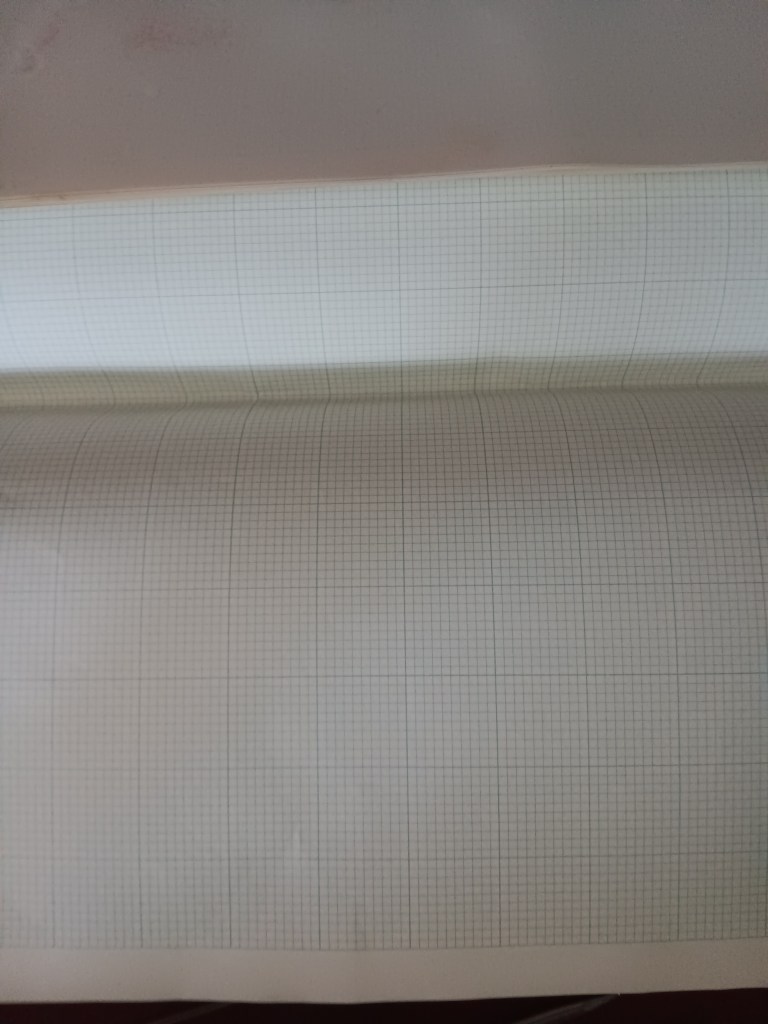
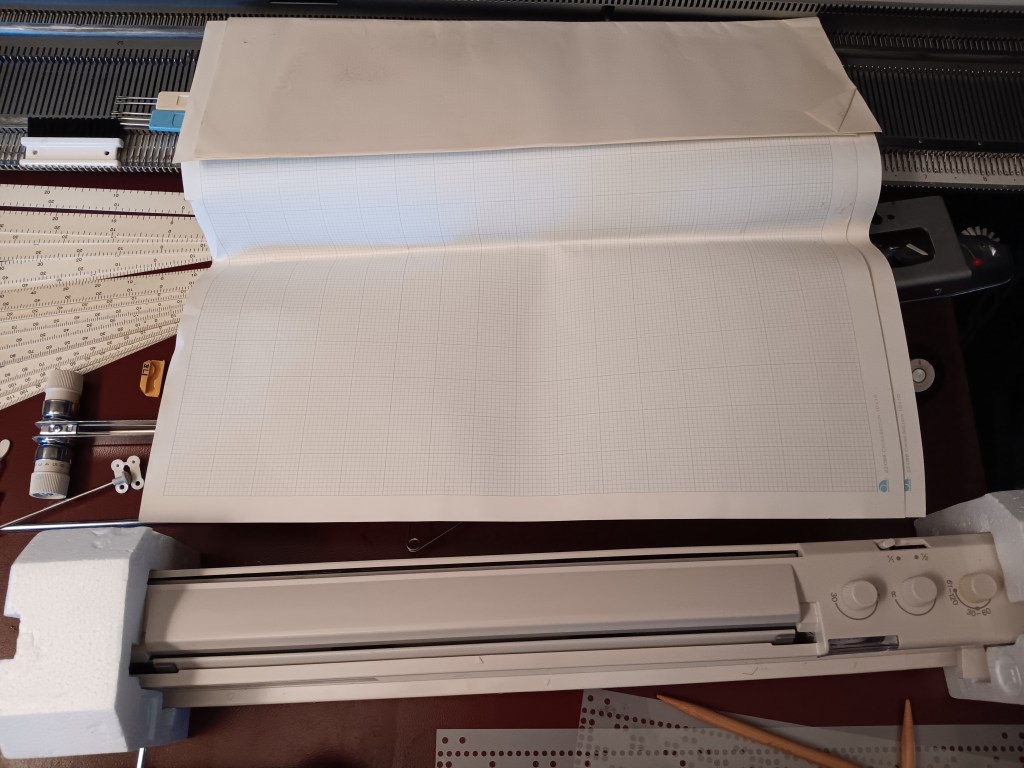
The original pattern paper is missing, but I am including a generous 5-sheet pack of graphed paper. It is wider but can be easily cut. It is the same quality (thickness and feel) as pattern paper for other knit leaders I have (but they are half size).
When I was looking for a replacement pattern paper, I did a lot of research. Even if I found the original paper, the overall opinion in the knitting machine groups is that the models of the closing on those patterns are outdated. So it feels like you will be better off using he graph paper for your own designs than having the original patterns, which would be useless.
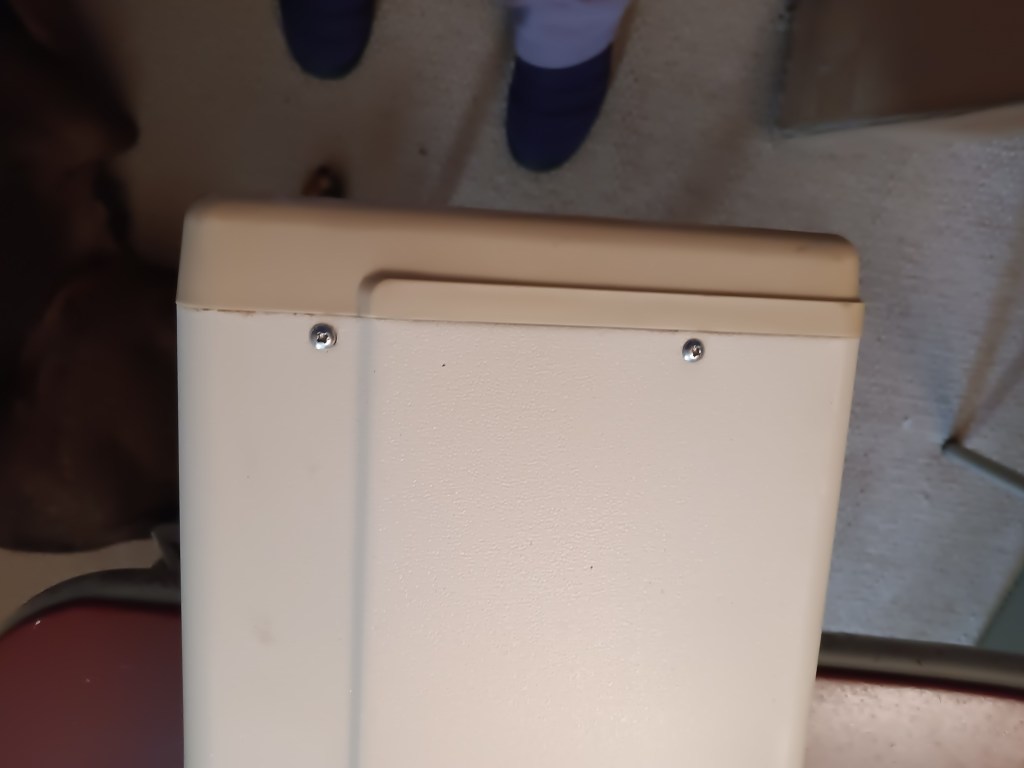
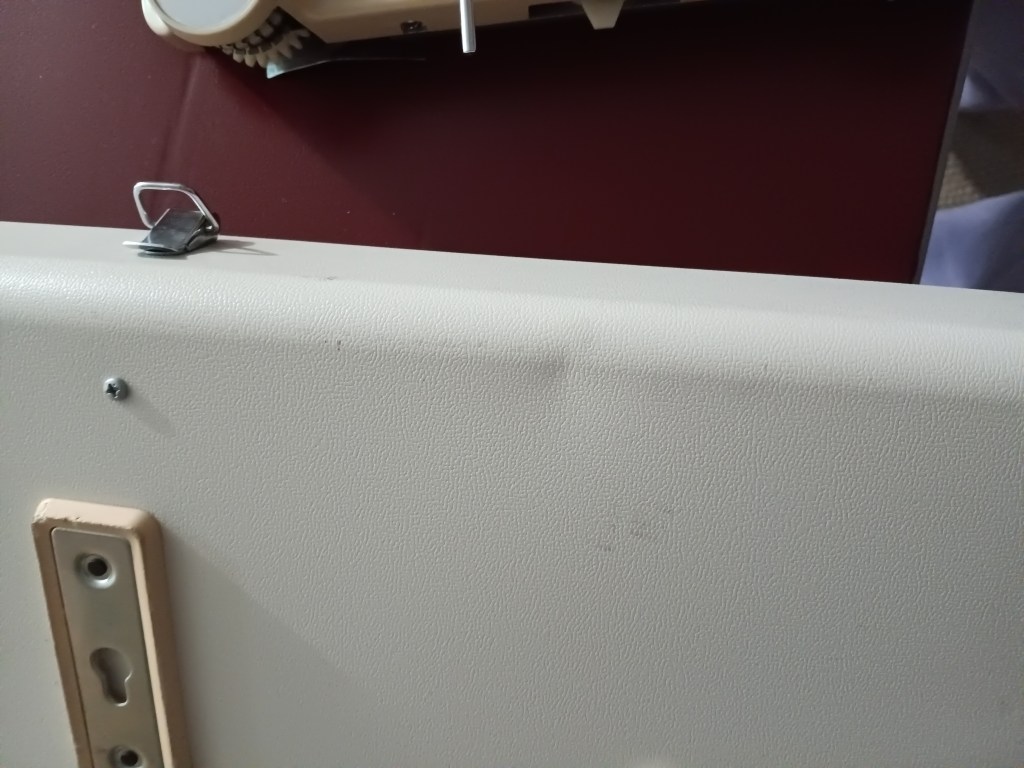
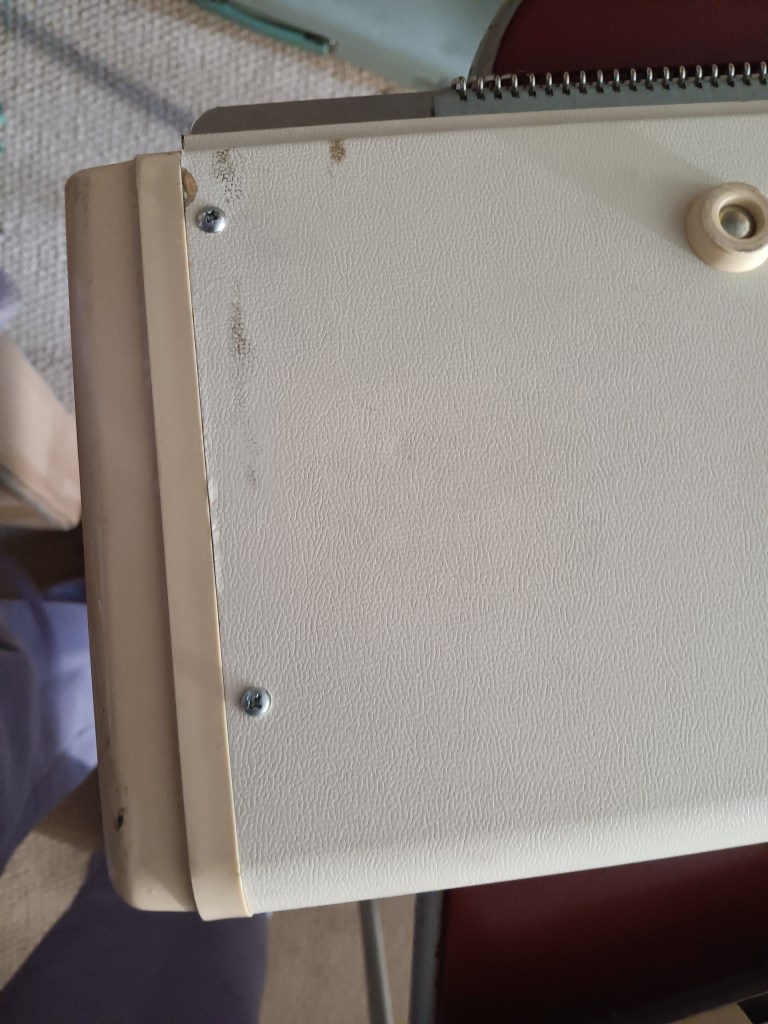
Some imperfections include the missing accessories (described above), some minor scratches and dents on the case, and discoloration on the plastic parts (from exposure to sunlight). Some are shown below.
I enjoyed working with this machine and testing it. It has a lot of life in it – unlimited if well taken for! Happy Knitting!
A vast majority of knitting machines on the current used market are from Brother and Silver Reed (also released under the Singer, Studio and Empisal names) manufacturers. In turn, a lot of models from these makers are machines capable of patterning using punchcards.
This article gives a general comparison of the punch-card reading and patterning mechanism of Singer/Silver Reed/Studio/Empisal knitting machines versus those released to the markets by Brother Co.
The patterning mechanism of Brother punchcard knitting machines is activated when the carriage is locked into the timing belt. Silver Reed machines have patterned drums on the carriage.
I find that knitting on machines with patterning drums is a bit quieter than when knitting on machines with a timing belt. However, it is somewhat easier to move the carriage when it is also guided by the timing belt.
Both types of machines have their own problems. For example, yarn ofen tangels on machines with patterning drums. While machines with timing belts have a lot of issues with timing belt misalignment.
However, I find it easier and more straightforward to setup a tension mast on the Silver Reed machines than on Brother. Sometimes I feel that when I unfold the head of the tension mast on Brother machines, I bend it too much.
With the regards to the tension masts: there are two slots on Singer/Studio/Silver Reed/Empisal machines (and they are in the case handle – so in the middle of the needlebed) to insert the tension mast. On Brother machines, there is one in the middle
I like that on Brother machines, the needles move forward according to the punch card. So, it is somewhat easier to see if the machine mispatterns. On Silver Reed/Studio/Singer machines, all needles (selected and not selected according to the punchcard) remain in one position (B). Thus, sometimes it is hard to see if the pattern is transferred to the needles correctly.
Patterning of the Singer/Siler Reed/Studio/Empisal knitting machines occurs when the drums pass the patterning center. Brother patterning occurs when the timing belt is latched onto the carriage (by activating the KC button). Thus, it is very important to follow the instructions of how to start knitting andpatterning using the punchcards for both models.
Clearing of the patterning in Silver Reed machines occurs when the lever passes the “clearing center “, while on Brother the patterning selection changes when the carriage turns.
After working with I feel that standard-gauge Singer/Studio/Silver Reed takes yarns thinner and smoother than the same gauge Brother machines. It seems that Brother machines can handle yarns not just thicker but with a wider variety of textures. But it might be just my experience. Working with various yarns is always an interplay between tension, use experience, how tight the yarn is in the cake/cone, static (which depends not only on your yarn but on the condition of the bed and your environment, which also changes seasonally), etc.
*KH800 and KH801 models have a slightly different punchcard mechanism and thus are not considered for this comparison **KH811 also has pushbuttons in the patterning center. Punchcard reading and needleselection works like in all other Brother punchcard machines.
Brother KH892e is a blueish-color combo (anniversary edition) of the standard-gauge knitting machine Brother KH892. Read more about the pros and cons and features of KH892 in my Knitting Machine Encyclopedia.
This blog post is dedicated strictly to the Brther KH892e I serviced and tested in my shop in March 2025.
I removed the old sponge, cleaned the metal section of the retaining bar, and removed, cleaned, and inspected all needles. I was checking each needle for good latches, for being straight, and for having no rust.
I cleaned, serviced and inspected the punchcard reader mechanism, timing belt, and the drums guiding the timing belt to ensure absolutely reliable needle selection and patterning. The carriage was opened and deep cleaned as well.
After the machine was thoroughly serviced and cleaned, I first tested on all number of needles to ensure all carriage functions run well. I knitted stockinet first and then fair isle (see the video).
Then, I tested the machine on all needles to ensure that all needles formed correct stitches and that the needle selection worked across the full needle bed. All tests passed with flying colors (see the video).
The machine came with some accessories missing but I was able to source most of them out. So I included new-stock claw weights, table clamps, transfer tools, replacement needles, punchcards, and card snaps. I only used them during my tests.
The tension mast also did not come with the machine so I am including a brand new (new stock) mast. It is a bit hard to insert (and then to remove) it into the place for the tension mast but I kinda like it because sometimes when the tension mast sits too loose, it is too wobbly and messes up with my knitting (or yarn tension).
The cast on comb did come with the machine. It is a new design where the two sections, a longer and a shorter one, attach to each other. Well, the slide out each other easily. But I was still able to use it without problems. (All my tests in the video were made with that cast-on comb). I actually find of like it because in the past, some of the cast on combs attach to each other so hard that it actually hurts to pull them apart.
The original lace carriage will come with the machine. I cleaned the carriage and tested all the knobs but I did not test it in action. It is a simple enough carriage where I do not anticipate any problems.
The hard copy of the manual will NOT be included. But a free online version can be found here.
The punncard set (20 cards total, like in the manual) also did not come with the machine, so I included a set I purchased from new stock. Card #1 was used quite extensively during my tests, so it is a bit bent (which still did not affect its functionality). But all other cards are in great shape. Some match the cards in the manual and some don’t.
Cast-on lace is not included, but any strong, thin (and preferably silky) yarn will work the same. A tapestry needle is not included: any needle of your choice with a wide eye will work as fine. The oil will also not be included. I use Hoppe’s gun oil I purchase on Amazon for everyday lubricating and when I clean needles.
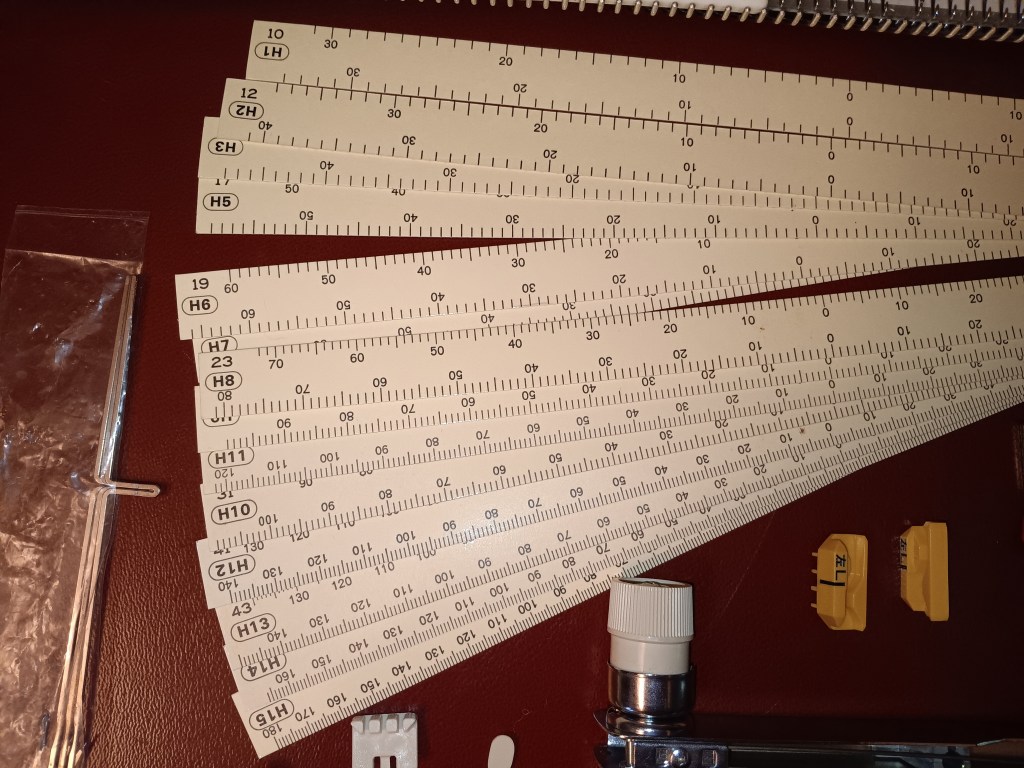
The original metal carriage also did not come with the machine. I am including a 3D printed plastic one.
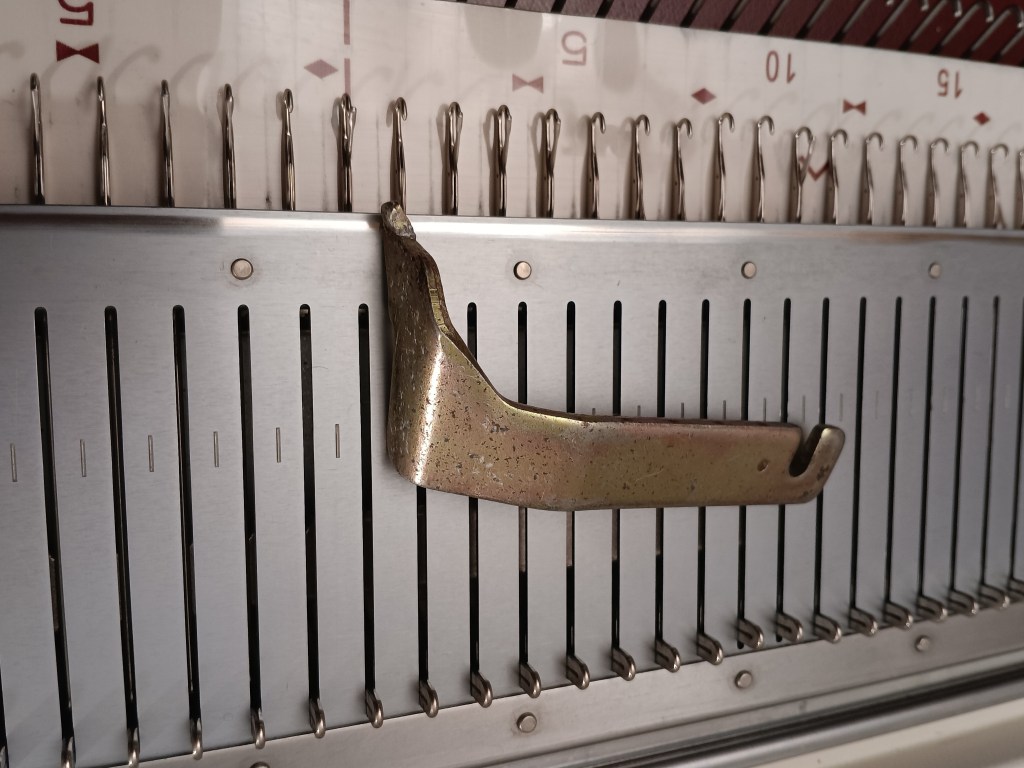
The punchcard holder pin is also not included but all the tests I ran in the video were done without it so it is actually not such a critical component.
I replaced broken plastic rivets with new ones (new stock); therefore, some of them look whiter than others (not shown).
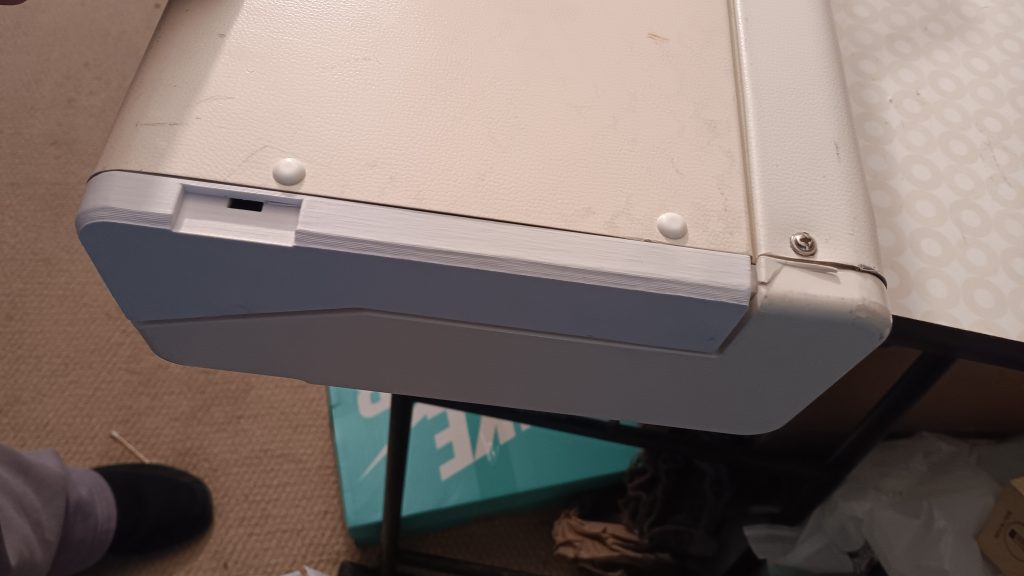
The little cap for the punchcard reader lever was cracked, and I replaced it with a new 3D printed one (on the right-hand side in the picture below).
Some of the imperfections:
– since I oiled the machine really well and used greaseless lubricants to clean the old gunk/first, the first tests might cause he machine to “sweat”( meaning the excessive oil might come to the service when heated due to the carriage being moved back and forth). Just have a piece of cloth by your side to wipe it away. It is shown in the video of my tests.
– The tension mast sits very tightly in its socket on the needlebed. Thus, some pressure/strength needs to be applied when inserting and pulling the tension mast out.
– Some of the teeth on the cast on the comb are a bit rusted. I chose to leave them be instead of risking them being bent. This is NOT a critical con at all.
– There is a tiny crack on the lever on the sinker plate. I see it pretty often in punchcard machines. It is not critical and does not affect knitting.
The spring that holds the lace carriage in the lid is acting up. I do not have a replacement spring, but this is a very non-critical component. I am posting it here so you are aware that it is not behaving when the lace carriage is removed from the case and put back together.
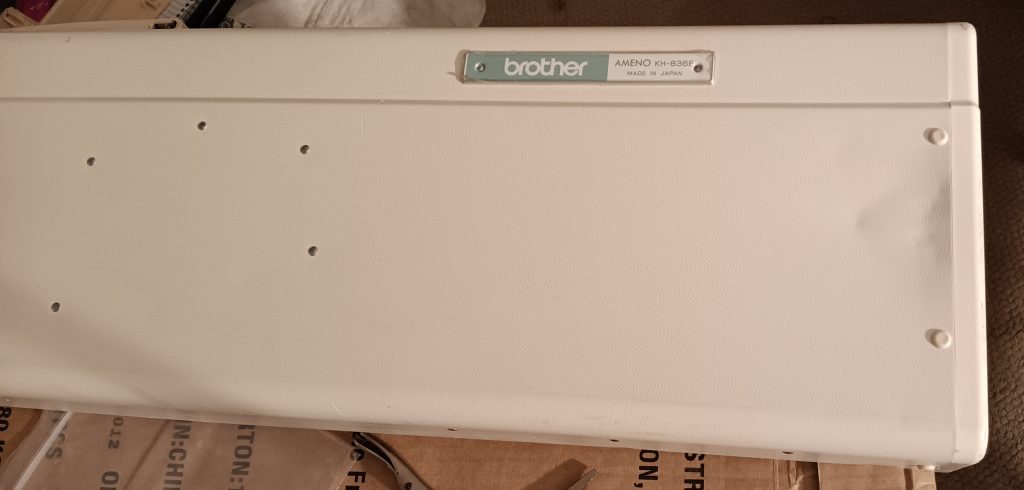
– The case and the lid have minor scratches and bumps. The most serious ones are shown in the photographs below.
Despite these minor flaws, this machine is beautiful and works beautifully.
I made the gift bag below from the fabric I knitted while testing this machine. Hoping the new owner will enjoy it too!
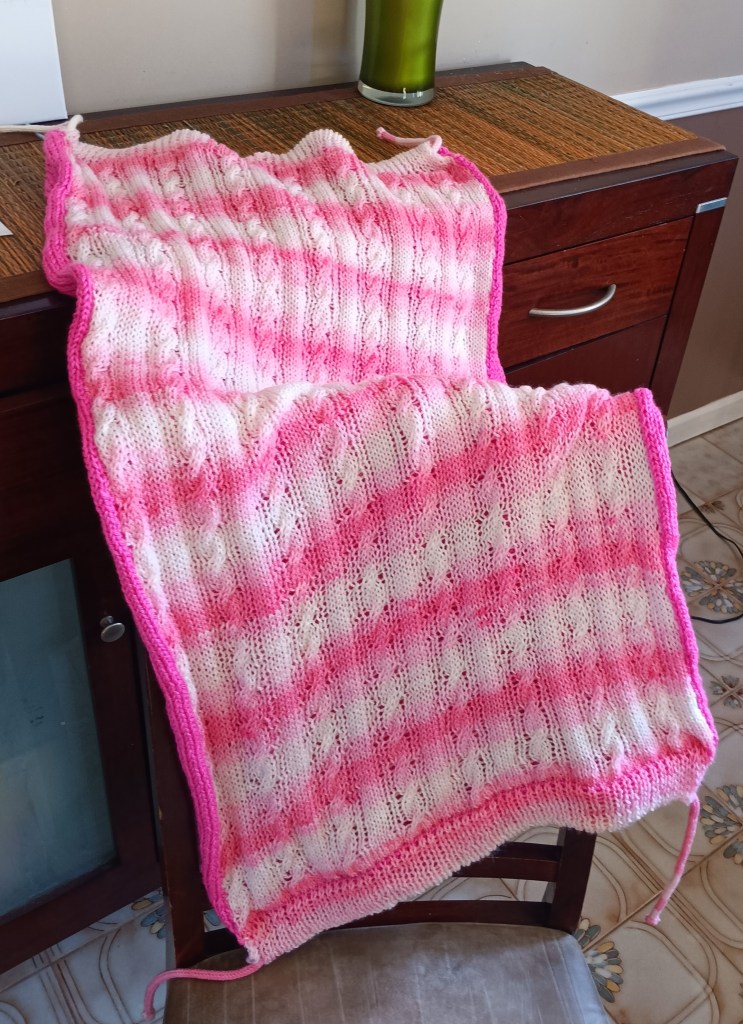
This tutorial describes step by step how to make a double-layered blanket on a knitting machine without a ribber. The cables are separated by mock purl stitches to make them stand out.
The demo below was made on a bulky knitting machine (Brother KH230), but it can be applicable to any knitting machine of any gauge (standard, mid-, and fine-gauges): push-button machines like Brother KH551 and KH588, punchcard machines like Brother KH840 and Studio mod. 360, Silver Reed SK280 and even electronic knitting machines without using their electronic functions, just to name a few.
The video of the steps can be found here. My two yarns were different (the fuchsia yarn was thicker, and the pink yarn was thinner), so I had to knit a couple of swatches to figure out how many rows to knit to have the same length measurements. If you are a bit off, blocking will solve it (like ironing in sewing). By knitting swatches, you’ll also determine what is the best tension to run the yarn of your choice at.
1. Knitting the mock-ribbing.
– Bring every-other needle to position B across the whole needlebed or as desired. Cast-on using a cast-on comb with waste yarn. Knit several rows with the waste yarn. The last row (before starting knitting with main yarns) should be with either an unravel cord or any other easy-to-remove yarn.
– Reset the row counter to zero. Knit ten (or as many as desired) rows using yarn #1 (the backing yarn: in my case, the fuchsia colored yarn).
– Remove yarn #1 from the sinker plate (you can cut it or secure it behind the bed, out of the way) and thread a second yarn (from the side, yarn #2).
– Apply weights when needed on the edges to keep them neat and on the cast-on comb as well (which is especially needed for bulkier yarns).
– Knit 12 rows with yarn #2 (I knitted two more rows because my yarn #2 was thinner and also because I wanted the folded mock-ribbing to overhang a bit on the wrong side and not on the right side). I didn’t want any fuchsia color to show on the “right” side of the fold.
2. Folding the mock ribbing to create a rim for the cord (which we’ll add later).
– Remove side weights and remove the cast-on comb.
– Using a single-tip needle transfer tool, grab a yarn of the very first stitch on the first row knitted with yarn #2 and move it to the needle that is currently in position A. After the stitch is latched onto the needle, push this needle to the B position. Continue throughout the whole width of the knitted panel. At the end, you will have all needles in the B positions.
3. Preparing the front panel to knit cables.
– Hang the cast on comb on just-bolded mock-ribbing fold and add a weight onto it (to push the folded fabric a bit down so it does not get in the way of the carriage; without the weights, the folded fabric might jam the carriage).
– Loosen the tension a bit by 1-2 digits on the carriage dial (because now we have ALL needles in B position) and knit two rows with yarn #2 (the right-side yarn).
– Set the tension back to the optimum tension for yarn #2, and knit two more rows.
– Preparing for the mock-purl runners:
a) Starting with the needles in the center (closest to position “zero”), gently nudge the two needles on each side of it slightly forward. Perform this after every four needles. The stitches on the needles we slightly pushed forward will be transferred to the neighboring needles (and the freed needles will be pushed to A position). This empty space will create separation in the fabric, which will mimic the effect of purl-stitch runners around cables. Continue with this needle selection for the rest of the needle bed, including on the right-hand side. Your needles should be positioned as shown below. The first row is needles in position B; the second row is just slightly below position B. Note: on the very right-hand side edge of the needlebed, you will have 5 needles: 4 for a cable and one for the seam. On the left-hand side, you will have only four needles (we will not make a cable in the very left block of 4 needles).
b) Using a one-pring needle transfer tool, move the stitches from the needles we just slightly pushed forward onto the needles at the beginning of each 4-needle block (see the schematic below).
c) After the stitches are transferred, push the freed needle to A position. After you complete the needle transfer for all needles, your needle selection should look like the picture below. The empty spaces will create separation from the cables and 4-stitch stockinet blocks, acting at the same time like mock purl stitches. The contrasting backing will help with this effect.
– Knit two rows with yarn #2.
4. Making cables:
– Use two 2-prong transfer tools to switch two pairs of stitches to make a cable. Start with the first 4-needle block. It does not matter if you switch the stitches from left to right or from right to left. Just be consistent. After each swap of the stitches, move the needles to the E position (all the way out), which will be easier for your machine to handle.
– The second 4-needle block will be plan stockinet (not a cable), the third will be a cable, etc. So, you will have alternating 4-stitch stockinet runs with cable runs like those shown below in the photographs and in the schematics.
– After all cables are made, knit 6 rows with yarn #2 (“right” -side yarn), and then make cables again above those made in the previous section (starting with the first 4-needle block). Note: the first row right after the cables were knit will always be a bit tight. So, loosen the tension a bit (by 0.5-1), but then set the tension to the usual tension (after the first row).
– Knit repeating the cables every six rows until the desired length of the front panel is achieved. It is best (for a more pleasant visual appearance) to keep a 3:4 or 5:7 ratio between the width and the length of the blanket. So, when you make your swatch at the beginning of the project, calculate your final width and then figure out how many rows you’ll need to knit to achieve the desired length.
– After the desired length is achieved, move the needles that were in the A position into the working position B and knit two rows with yarn #2. Alternatively, if you prefer this second method better, prior to knitting the last two rows, make the stitches onto the needles that were in the A position all this time by pulling the walls of the neighboring stitches onto these needles.
5. Knitting a second mock-ribbing.
– Transfer every other stitch onto a neighboring needle and push the freed needle into A position. Do this for the whole width of the needlebed. You can use a one-prong tool or an adjustable 7-prong tool if making this blanket on a standard knitting machine (such a tool is not available for bulky machines unless it is custom-made).
– After this transfer, you will have only every other needle in B position. On every other needle, knit 12 rows with yarn #2 and 10 rows with yarn #1.
6. Folding the second mock ribbing.
– Remove all weights and a cast-on comb.
– Grab with 1-prong the stitch on the first row when we just started knitting on every other needle (the second mock-ribbing) and transfer it onto the needles in A position, while also bringing them into the B positions. It will create the fold.
– Attach the weights back on (I do it by hooking the cast-on comb onto the knitted panel and then attaching the weights to it; in this case, the weight is evenly distributed).
7. Knitting the backing.
-The yarn #1 should still be threaded through the sinker plate. So, continue to simple stockinet using yarn #1. Remember that the first row after we transferred all every-other-needle stitches might feel a bit tighter because now we have ALL needles in B position. So, you might want to loosen the tension by 1-2 for the first row. But then move it to the regular tension. In my case, yarn #1 was thicker than yarn #2, so I had to adjust the tension accordingly.
– Continue knitting stockinet until a desired length (AKA number of rows) is achieved. Don’t forget to rehang weights periodically.
8. Linking the panels together.
– Go to the mock-ribbing fold we made at the very beginning and remove the contrasting waste yarn (just one row we knitted at the end of the waste-yarn rows). Remove the waste yarn section.
– Find the last row of that mock ribbing that we knitted using yarn #1 and attach those stitches onto the needle bed onto every other needle. Take your time, and a nice seam will form. Continue for the rest of the bed.
– After all sitches are hooked onto the bed, attach a cast on comb (to push the folded fabric out of the carriage way) to the panel and weights and knit one row with yarn #1. Remove the cast-on comb.
9. Cast-off
– Use your favorite cast-off method to finish the panel and take it off the needles. The formed edge (seam) might seem a bit too thick if the blanket is made on the bulky knitting machine. So, as an option, link this edge/seam to the mock-ribbing fold to make it less obvious and to hide the linked seam of the fold.
10. Final steps.
– Link the sides together using a mattress stitch
– Knit two cords on the cord machine or on your own knitting machine (see here how to do it); insert them into the mock-ribbing folds.
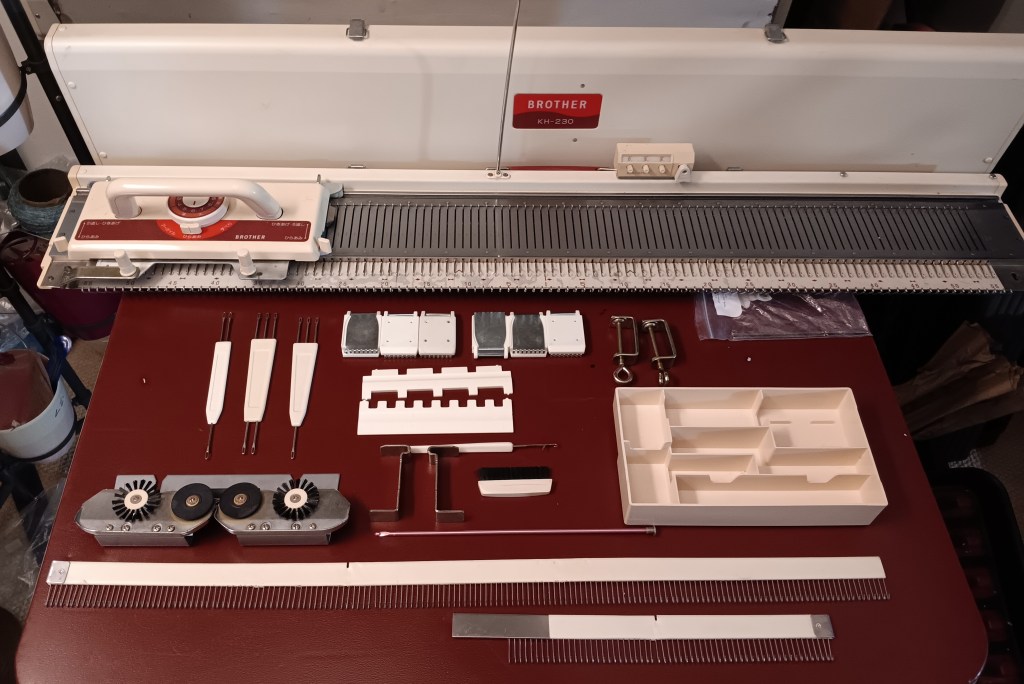
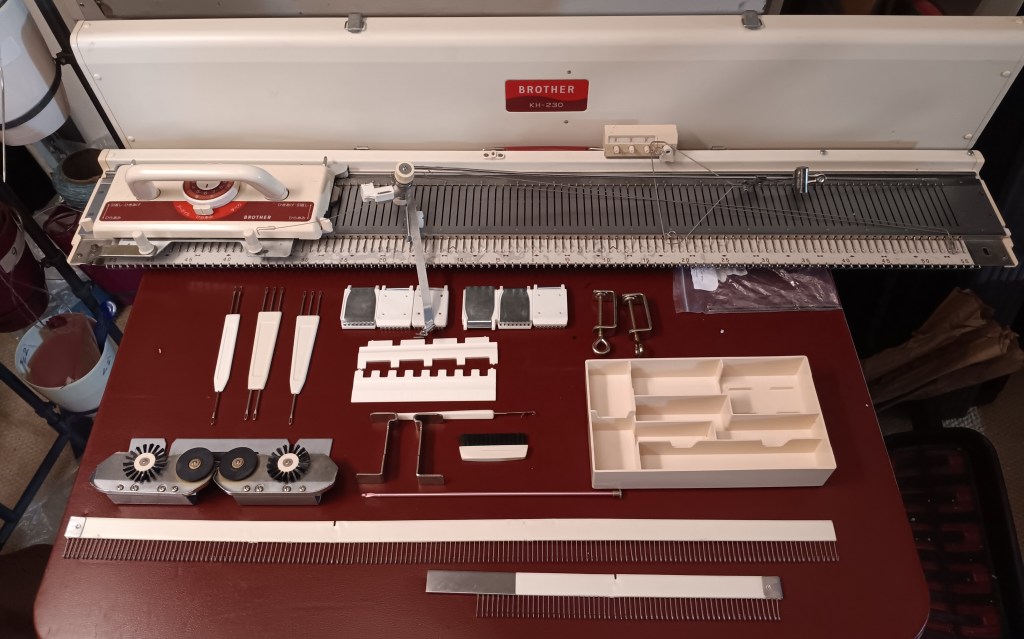
Brother KH230 is a bulky-gauge (9 mm between the needles) knitting machine with 110 needles. It has only manual/basic stitch manipulation capabilities. Read about the pros and cons of this model in my Knitting Machine Encyclopedia. The rest of this post is dedicated to a specific machine serviced, cleaned, and tested in my shop.
I did the usual maintenance on this machine: removed, inspected, and cleaned all needles (some were rusty and I either replaced them or cleaned and polished them), replaced the sponge bar, and cleaned the machine inside and outside.
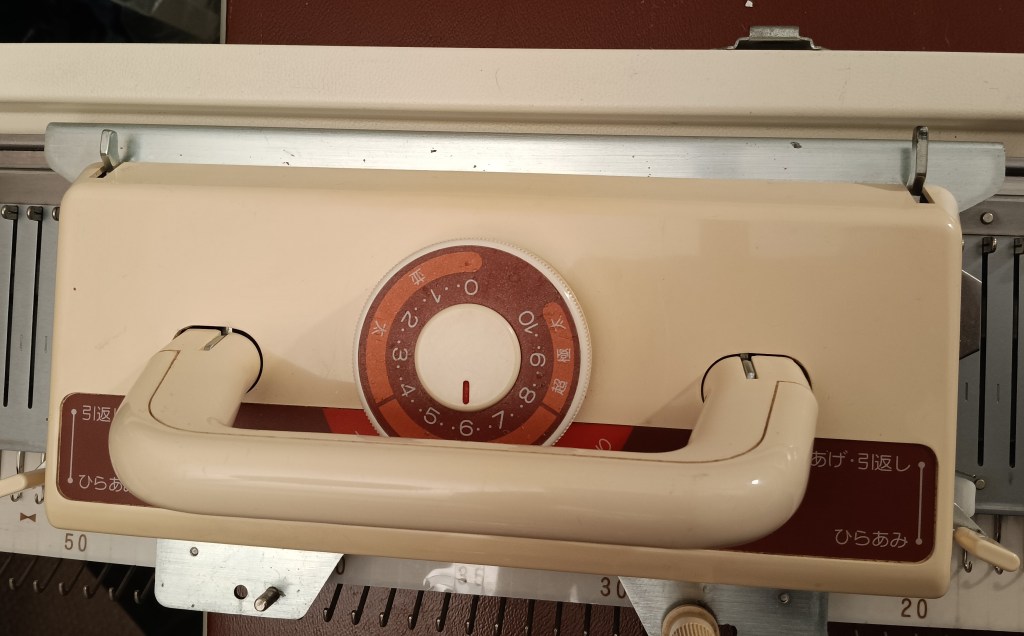
I also tested the machine on all needles to ensure that all needles form correct stitches and that the carriage moves freely across the needlebed. I tested several yarns on this machine (see the video): thick wool/acrylic blend (just a swatch with a blue yarn), 100% acrylic yarn (for hand knitting from KnitPicks, and acrylic/wool blend). The machine handled all yarns beautifully. I made a pink blanket on this machine while testing it. I did not experience any static but used the tension mast with a wax already attached to it.
The machine will come with all major accessories and most minor ones. A lot of accessories were missing, so I replaced them with new ones, new or old stock (some claw weights are new, needle selection tools/rules are new/old stock). The knit leader scales are new stock as well.
The case and the lid had several new plastic rivets missing, so I replaced them too (in case you notice them to be of a different color; not shown).
The toolbox is still very sturdy but is missing a lid. Other missing accessories are:
tapestry needle (any needle, even plastic, will do the job).
original two-sided hook; I included a plastic replacement (to be honest, I never even use those hooks; I prefer the latch hook).
oil bottle is not included; I use Hoppe’s gun oil from Amazon to lubricate the machine during kntiting.
unravel cord is also not included, but any silky and smooth yarn will do
The carriage is in good shape. There are very minor discoloration spots, but they are smooth to the touch, and I treated them with a special corrosion-stopping and preventing solution. During the tests, I did not experience any static (which sometimes happens due to the corrosion on the parts and carriage).
Now, about imperfections of this machine:
A hard copy of the manual is not included but pdf copy can be found online.
The carraige lock is original but has some discoloration.
You might notice that some of the needles are discolored. Those were polished and are smooth to touch. The discoloration is only cosmetic. All tets were performed with these needles.
The case has some very minor bumps and scuffs (only most major and most noticeable ones are shown below)
The lid has some as well (only most major ones shown below)
The row counter has some minor scratches but works just fine.
the cast-on combs have some minor dents but also work just fine. All tests on this machine were made with these cast-on combs. Cast-on combs for KH230 are very rare: they are shorter than the combs for the KH260 but longer that those for standard-gauge machines.
The toolbox comes without a lid. I covered it with plastic wrap for transport.
The tension mast is not original but rather a standard Brother tension mast (old stock). It fits almost all knitting machines, including electronic, including those that can knit with a Garter carriage (note the white holder-like addition on the mast – it is for the garter carriage sensor. It will not get in the way of knitting on this KH230). I am also going to leave the way sitting there. I used this mast setup during all tests.
the needle bed under the connecting screw on the left-hand side is indented. It still did not affect the functioning of the machine but keep that in mind and check and tighten that bolt often.
Despite all these imperfections, the machine is in overall great shape, and I had a lot of fun knitting on it. Keep in mind that it seems that there are a lot of imperfections, but I am just listing them all because I am thorough and because I want my customers to know in advance about these imperfections and how they affect the functioning of the machine. In fact, none of these mentioned above affected the knitting on this machine (with and without the ribber).
Hello, and I bet you are extremely frustrated after you discovered that the new-to-you knitting machine does not select needles properly.
I bet you watched numerous videos and thoroughly cleaned the punchcard reading mechanism, but nothing works…
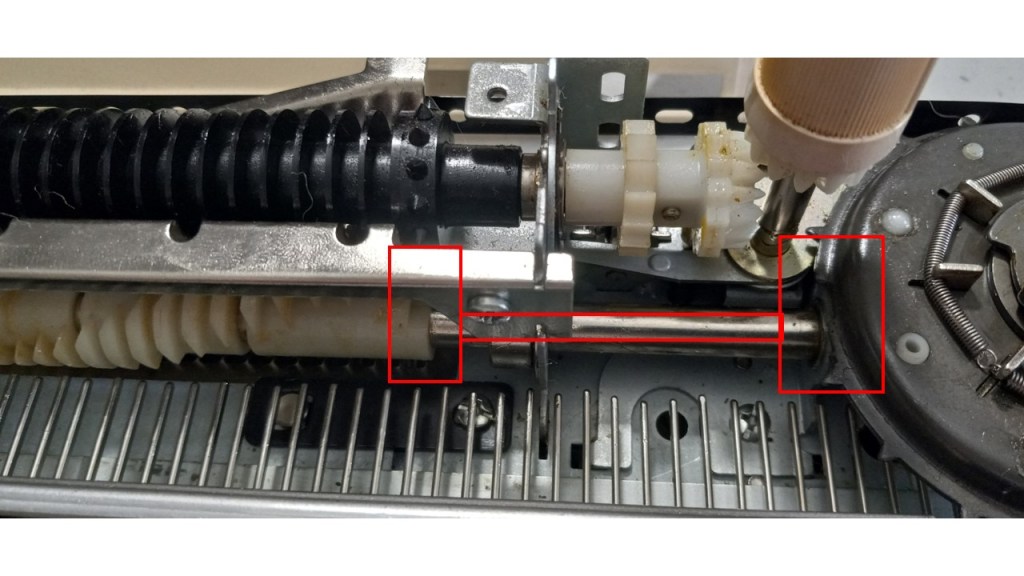
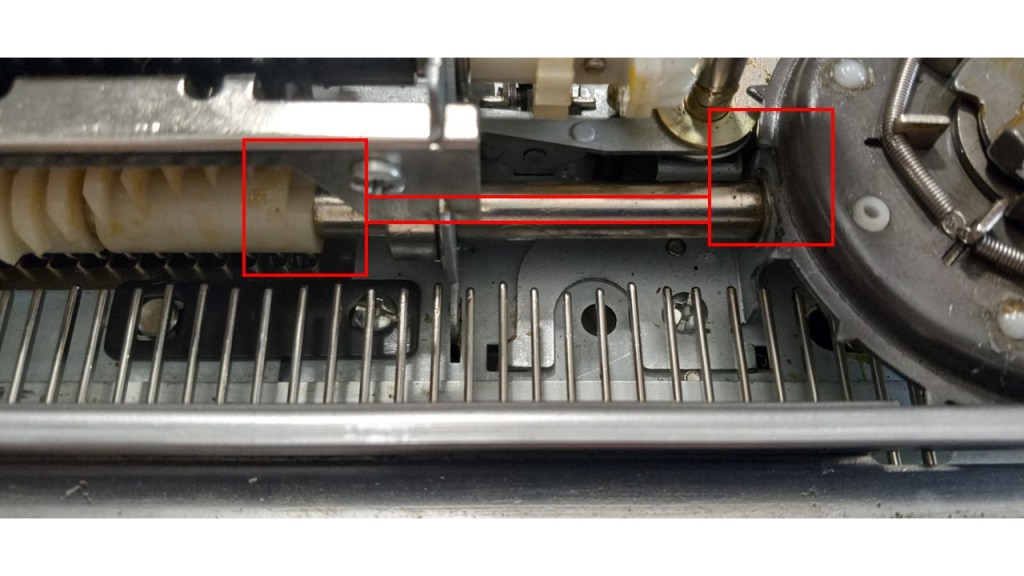
I’ve been there … I disassembled my machines and discovered that this problem is pretty complex. And the service manual does not really explain well how to solve it. On top of that, most manuals available for free online are of poor quality and sometimes it is hard to see clearly enough all these small (and extremely important) details.
Below is one of the solutions to why your punch-card knitting machine does not select needles correctly.
This article applies to standard-gauge punchcard Brother knitting machines with model numbers KH820-KH894. (For bulky models, like Brother KH260, the alignment of the plastic cylinder with the clutch wheel is a bit different.)
I will not go into details on how to disassemble to the state shown in the pictures below: there are enough resources. Just one piece of advice : take detailed pictures of each step of disassembly or even record a video.
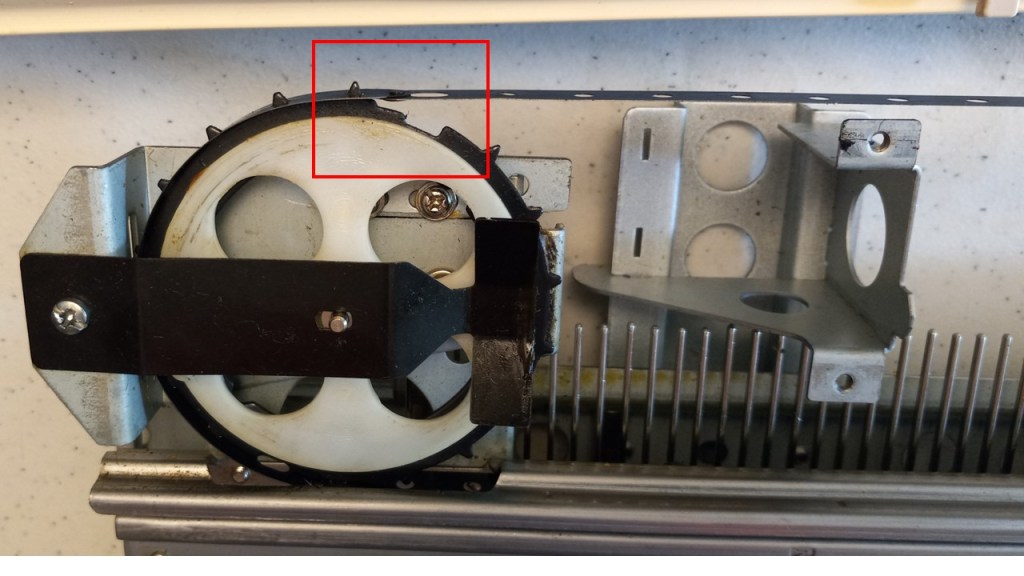
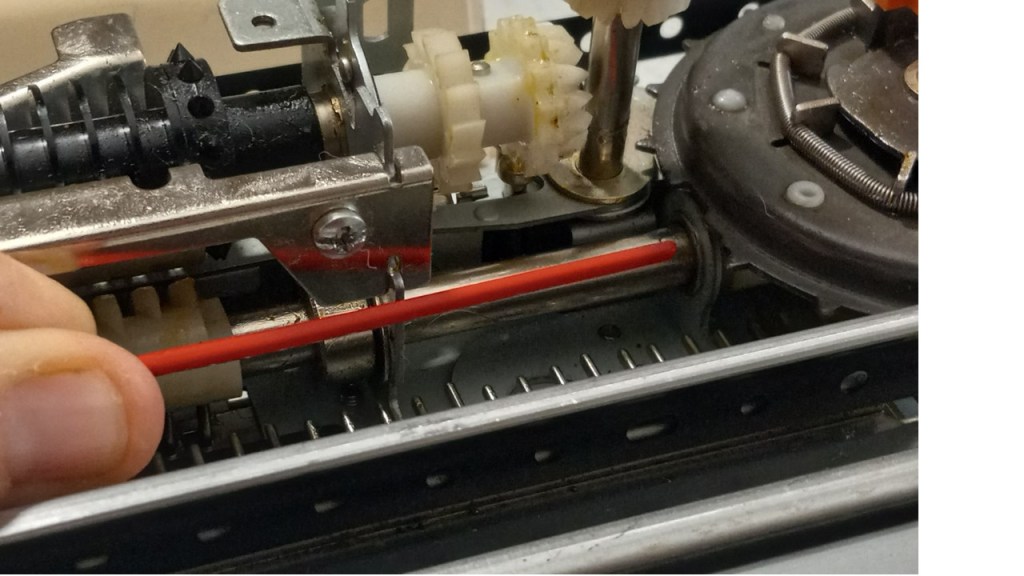
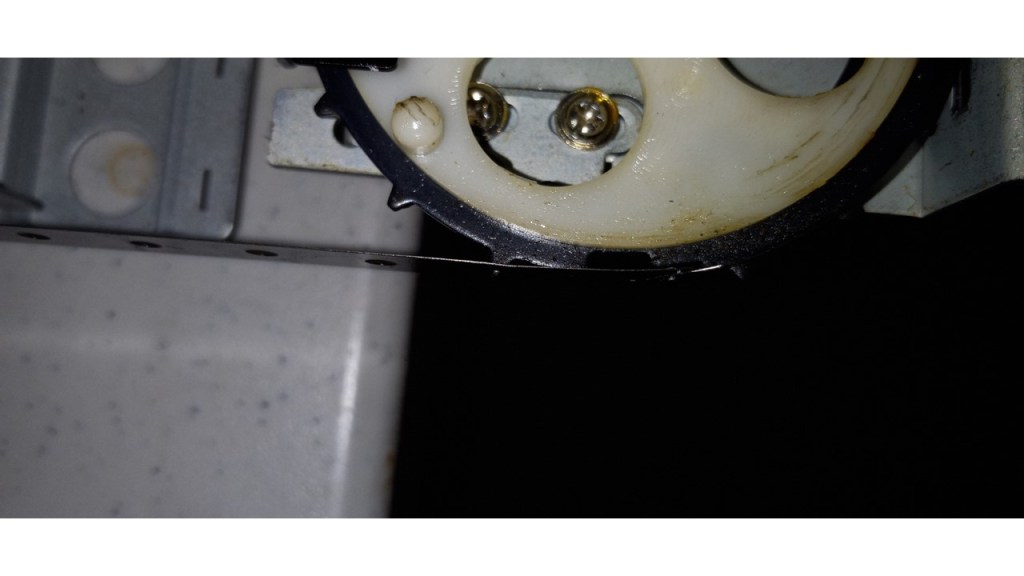
First of all, if you had to replace or remove your timing belt, make sure that the piece of the belt where the ends get together needs to be aligned with the little divot of the pulley (the manual calls it a concave part).
If you still need help, consider purchasing a lesson from my Etsy store. We’ll figure it out together!
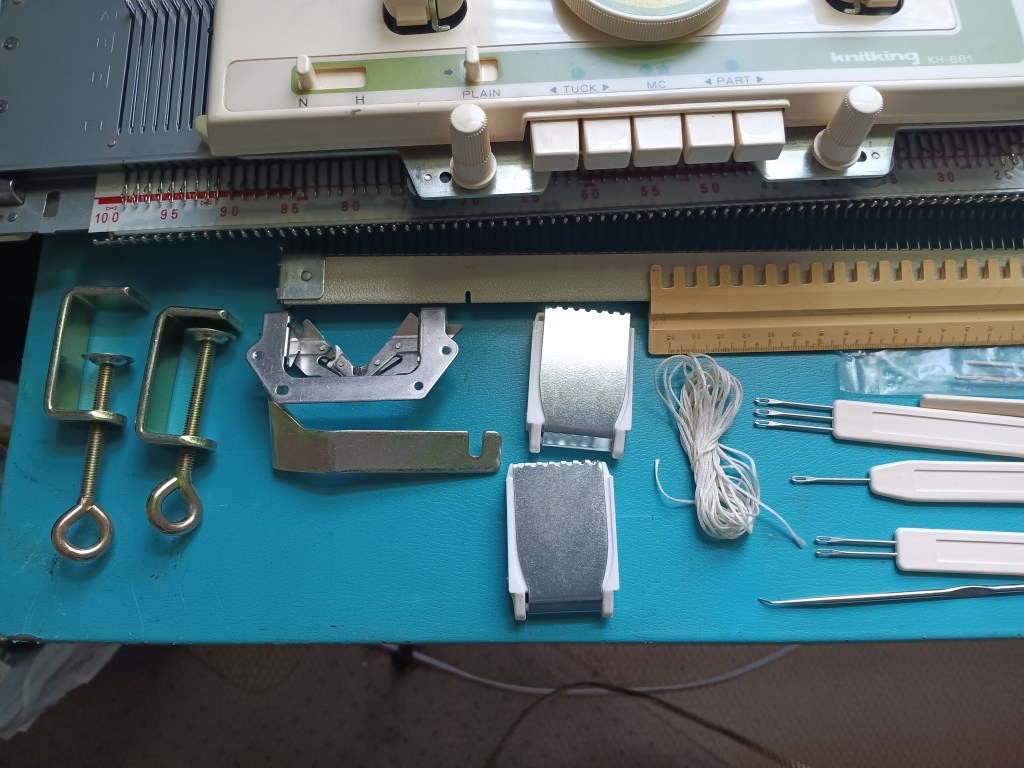
KnitKing KH881 knitting machine is a standard-gauge knitting machine with 200 needles, 4.5 mm apart. It is identical to Brother KH881. It contains a built-in knit leader. Read more about this model in my Knitting Machine Encyclopedia. The remainder of this article will be dedicated to a specific KnitKing KH881 knitting machine, serviced in my shop in July 2024.
This machine was cleaned; the card reader mechanism was thoroughly inspected and cleaned as well. The sponge in the retaining bar was replaced. All needles were taken out, cleaned, and inspected. Faulty needles were replaced with new ones (from a new stock). The knit leader was also deep-cleaned and inspected.
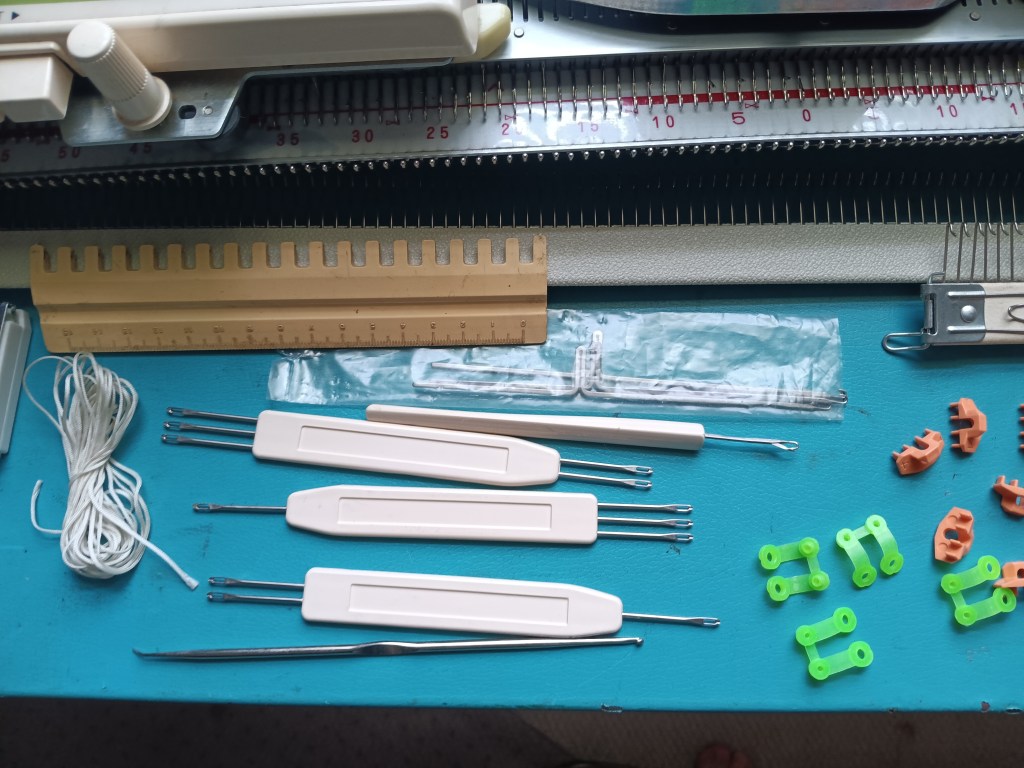
The machine came to me without the carriage and all other major accessories. I collected the major accessories from new and old stock to ensure a complete set. Thus, the knit-leader scales, sheet guides, mylar sheet, extension rails, tension mast, sinker plate, tool storage box and cast-on combs are all included.
The lace carriage, however, is NOT included with this machine. The absence of lace carriage is reflected in the price of the machine. Lace carriages can be purchased either as a new- and/or old-stock online for $70-100.
The machine was tested by knitting on a full bed to ensure that the patterning is flawless on the whole needle bed and that all needles form the correct stitches. Watch the video of these tests. I demonstrated in another video how a faulty needle was identified and replaced. after it was replaced, all stitches formed very nicely. The patterning on the full bed was done using tuck-, slip- (part) and fair-isle stitches. All patterns were knitted beautifully.
The carriage moved very smoothly and I did not experience any static with the two different yarns I used: very silky etamin yarn, 100% acrylic yarn of fingering weight and a textures yarn with some fuzz and occasional boucle features. The machine handled all these yarns wonderfully. Below are the items I made from the fabrics I knitted while testing this machine. They are going to the local charity.
The knitleader was not tested with the mylar sheet but all buttons and levers of the knitleader move and the wheels rotate (thus, the paper will advance) as the carriage moves across the needlebed triggering the knitleader advancement mechanism.
Because the machine did not come with this particular carriage, the color of the carriage is lighter than that of the plastic on the rest of the machine: it is yellowish from the sunlight damage.
The long cast-on comb is in excellent shape but is from my personal stash. The color is a bit off-white since it is from another machine.
The majority of the minor accessories are also included, including a hard copy of the manual.
The toolbox sits on the needle bed when the machine is not in use.
All minor accessories fit inside a toolbox with a lid. The table clamps and the craw weights are from the new-stock and are still clean and shiny.
A couple of minor accessories that are missing and not going to be included are:
tapestry needle,
punchcard rod (during my tests I knitted without using this rod and the punchcard reader worked well and the cards advanced without problems)
wax – the wax that came with the machine was so old, it stumbled.
oil – it was brown and old so I disposed of it. For your knitting machine needs, use Hoppe’s gun oil available on Amazon.
The only knitleader accessory that is not included is a felt pen. I read on forums that Crayola markers work well. Check out my Knitting Machine Encyclopedia on recommendations for the felt pen substitute.
Now about imperfections:
The color large cast-on comb is a bit off because it did not come with the machine and is from my personal stash
No lace carriage is included, which is reflected in the price.
the case and the case lid have some minor bends and scratches (too many to list here)
Some of the punchcards that came with the machine are a bit torn/bent but they still work really well (I’ve seen cards in worth conditions and they still worked well)
The small cast-on comb has a slight bent. It does not affect its functioning (latching onto the stitches). See the video demonstrating that the teeth latch onto the stitches very nicely without any problems. In the video, some of the teeth are slightly bent. I already unbent them (which was very easy). But keep in mind that these teeth bend easily but it is also very straightforward to push them back into their correct position.
(+) More needles than any of the hobbyist’s Silver Reed/Studio and/or Brother electronic knitting machines.
(+) Double bed: no need to putz around with aligning robbers to the main needlebed.
(+) Numerous built-in patterns.
(+) Knit great double bed jacquard, lace, etc.
Cons:
(-) Bulky: big in size; bigger footprint than other knitting machines
(-) More expensive than other electronic knitting machines. The exclusion would be bulky electronic Brother KH270, Silver Reed SK890, fine-gauge Silver Reedk SK830, mid-gauge Silver Reed SK860, and standard-gauge Brother KH970. Those machines are either on the same price range or just a bit more expensive depending on the geographic area and demand in your market.
… still in progress. Stay tuned as I collect more information.
If you already read my post on how to choose a knitting machine and decided that you want an electronic knitting machine and in particular a Brother one, you are in the right place then.
I would strongly recommend electronic knitting machines to both computer/electronics savvy and non-savvy knitters.
People who are just users of electronics can have a lot of fun with the over 500 of various built-in patterns (only 50 for KH900 and non for KH910).
On top of that, computer-savvy people can create their own patterns in various programs, download them onto the machine, and knit wonderful custom things. Some even hack/modify the electronics to get the machine to read the patterns automatically from the computer.
Pros of Brother electronic knitting machines: – Electronic brother machines have a lot of built-in fair-isle, weaving-, tuck-, part/slip-, and lace patterns (the exception is KH 910 – more on that later). – All electronic Brother machines can be accessorized with a color changer (4-color changer for most KH9xx machines and 6-color changer for KH970). 4-color changers are easy to find and are pretty affordable. – All electronic Brother knitting machines can be easily accessorized with ribbers (KR830, KR850, KR880 and KR900), which are also easy to find. – Custom patterns with different colors could be created using various software and then transferred to the machine (read a separate article on that).
– Electronics can also be modified and the patterns can be read by the machine directly from the computer. Thus, no need of transfers (some machines do not have enough memory to accept a large pattern. In this case, the pattern needs to be split into several transfers, which adds uncertainty to inexperienced knitters).
Cons of electronic knitting machines: – Brother KH910 without conversion (aka hacking) to AYAB can only use mylar sheets to knit patterns. Those are hard to find. But still possible. It does NOT have any built-in patterns. Because of all of this, and because of only the 60-stitch repeat pattern built-in mechanism, machine knitters learned how to hack the electronics, forgo the mylar sheets, and just pass on the patterns from the computer. – Brother KH930: has over 500 built-in patterns. It is a bit more desirable than KH910 because of this. It, however, has limited memory and large custom patterns need to be uploaded in parts. but there are ways to go around it. KH940 is identical to KH930 but has a bit more of memory (but harder to find than KH930) and a whole pattern for, let’s say, medium size throw can be loaded in one file transfer. – electronics can be finicky sometimes and, thus, need lots of TLC and attention (like, making sure the machine it turned off and not left ON overnight; if the machine feels warm, stop knitting and turn the machine off). However, replacement motherboards are still available or the machine can be converted to AYAB.
– KH970 are very desirable but also hard to find. However, be aware that some knitters love it and some hate. The electronic console is not as straightforward/intuitive to learn. This machine can still be connected to DAK. AYAB is not recommended because this machine is so expensive and because it has so many prebuilt-in patterns.