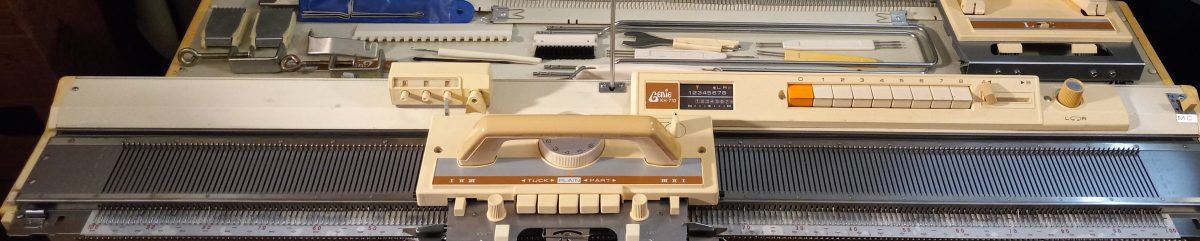
Brother KH260 refurbished in September 2022

Brother KH260 are wonderful and highly desired machines. They habe 110 needles, spaced 9 mm apart from each other).

This distance and large needles makes this machine “bulky”. Brother KH260 can handle a large variety of thicker yarns, including worsted. I tried double-thrded boucle yarn and it ahndled it well as well. I was especially happy about it because I love textures yarn, especially boucle, but not many machines can handle them.


What I did on this machine:

  • Removed all needles, cleaned them and inspected individually and then during knitting on a full bed.
  • Oiled carriage and ensured that all levers and kbod ove frely and do not mis-function during knitting
  • Cleaned the bed and gently cleaned the plastic parts

Overall the machine was in good shape before I started cleaning it. The case does not have any major bends/scratches. Only minor ones.

This machine came with all its assesories with some minor exeptions.

The card clips were missing – I cinluded two paris of new ones (small yellow plastic things in the picture below).

The assesories that are missing from the machine and wll not be included are:

  • Oil canister. I do not include old oil on purpose. Please, get a fresh/new oil. The recommended by many machine kntiters is Hoppe’s Elite Gun Oil
  • No ravel cord is included but any smooth strong yarn can be used.
  • Place card holder was missing from the set. As you can see in the video, I was not even using it and the cardreder worked well. However, any straight or bent hand-knitting needles will work. I included one.
  • -some manuals state that the machine comes wth 20-count punch card set. The hard copy of the manual that came with this machine lists only 15 cards. Indeed, a set containing only 15 cards came with it.


All tools fit into a tool box: a buil-tin compartment on the main bed.

This tool box is excellent to store assesories whlie the machine is not in use. The sinker plate, tuck-brushes, punchcard, tension rod and the row counter also fit wonderfully into the lid of the case when not in use.

The machine size is larger than all other single-bed flat-bed machines. The bed is winder and slitly longer.

The machine performed wonderfully with slip, tuck and fair isle patterning on full bed. I did not even have my usual trial/error starts. I did nothave to putz around too much with tension and the right number of hanging weights…. I was very pleased how well everything went.

I used this machine to knit simple stockinet, fair-isle, slip and tuck-stitch patterning. You can see those in my video. Below are the things I made while testing this machine and filming my demo.

Cowl/hoodie from a variegated dark red yarn using slip-stitch. Reversible/double sided.


Cowl/hoodie with a matching hat. Hoodie was knitted using a self-striping yarn and tuck-stitch patterning. Can be worn as reversible. The hat was knitted using simple stockinet. The ribbing was made by a mock-1×1 ribbing.

Cowl/hoodie knitted using fair isle and custom-made punch card. It can be worn as double-sided/reversible.


I did not really find a lot of cons for this machine. Maybe simple specifics of the machine which make it to stand out.

So, pros and cons are:

Pros:

+ Carriage (despite being heavy) is still relatively easy to move especially in KC mode (attached to a timing belt)

+ capable of handling thicker and textures (typically challenging) yarns

+ accessories, including needles, are still easy to find.

+ straightforward manual

+ because of the usage of thicker yarn, creates a texture similar to hand-knitting. I personally love those large stitches. Makes me instantly feel warm and cozy. The thicker yarn when knitted on loose tension also make the knitted fabric very soft and moldable (not stiff as on some standard machines).


Cons:

– Larger than other machines, including some other bulky models. It is also heavier.

– Expensive as they are highly desirable.

– carriage levers prone to sticking, especially when not in use for a long time. This might result in improper needle selection. But can be done with regular maintenance/care.

– requires more weights than other machines very likely because of heavier yarns.

– tuck brushes need to be installed. Some machines (mostly standard) already have built-in tuck-brushes on sinker plate. This is not really a con but just one more thing to keep track of and not to misplace.


Overall, machine knitters all over the world call Brother KH 260 a working horse. And I am in complete agreement!!

Singer 360K for Philip

Overview and run down of Singer 360 K for Philip

Test performed: full bed stockinet, slip, fair isle, 1×1 mock ribbing.

Sport yarn is the best. Thicker (e.g., worsted yarn – best on every other neelde).

I did not extensively test the knit leaders but all knobs and levels work.

The machine came with some assesories and some I added. I added a set of punch cards. The set is brand new but differs a bit from the original Singer/Studio set. The machine came with some knit leader sheets, and they will be included.

The overveiw is below.

Missing are:

  • Oil canister. I do not include old oil on purpose. Please, get a fresh/new oil. The recommended by many machine kntiters is Hoppe’s Elite Gun Oil
  • Only one ravel cord in included but any smooth strong yarn can be used
  • only one set of point cams (number 15) and yarn separators were included. These are usd for single-motif knitting. This is somewhat advanced technique and if you are proficient enough with just one single motif (two sets are needed to knit two single motifs) you will know by then where to get additional sets. To be honest, I tried single single-motif and it was so challenging that I simply gave up. It is challenging by all the small details needed to kniw a single motif. There are other machines to do it much easier. Plus, I like motifs throughout the whole bed anyways… But with just one set of point cams and yarn separators you will still be able to knit just one single motif.


All tools fit into a built-in storage.

The machine itself is in great shape.

There are couple of impercets on the plastic and on the cover.

They are:

  • Masking tape stain on the tool box lid

Some writing on the carriage. I wiped it but did not rub too much to avoid damaging already old and potentially brittle plastic.


The case and the lid have minor scratches and minor bend. The most prominent is the red stain on the lid.


The strip with numbers has some minor staining (seen on video).


Video just for you:


I also recommend getting this small cast-on comb. (I am not affiliated with them). It makes the cast on so much easier for beginners…


Manual and recommended brochures specifically for this machine are here:

(but keep in mind that I am sending you generic punch cards – they might not match the numbers shown in the third brochure).

https://mkmanuals.com/knitmaster-360-260-knitting-machine-manual.html

https://mkmanuals.com/knitmaster-360-260-operation-knitting-machine-manual.html

https://mkmanuals.com/knitmaster-360-260-pattern-book-knitting-machine-manual.html

Please read my other post on overall pros and cons of Singer/Studio knitting machines and 360K model in general.

http://thoughtsandknits.com/2022/09/04/360-for-laura-cleaned-in-august-2022/

http://thoughtsandknits.com/2022/08/07/studio-360-k-memomatci-reported-in-august-2022/

Second Singer Studio 360 Mod restored/cleaned/refurbished in March 2022

http://thoughtsandknits.com/2021/10/13/my-first-singer-360-memomatic-360k/


Some pictures as I am putting the whole package together.

360 for Laura, cleaned in August 2022

Studio (also known as Singer, Silver Reed and Elna) machines are great machines to have for beginners or advanced knitters…They offer a lot of versatility. So far, I had a simple (without any automatic patterning with the exception of manual needle selection) and punch-card Studio machines. Studio 360K appeared on the market in 1980-1982. They are equipped with a 24-stitch patterning mechanism transferred to the needles using the punch-card reader.

The hero of this blog, Studio 360K, has 200 needles. The distance between needles (which is also called a gauge) is 4.5 mm, which is considered a “standard”. The best yarn for this machine is sports weight. Thicker yarns can be kitted on every-other needle.

This particular Studio 360K knitting machine came to me in a pretty decent shape so no major disassembling was required. There was no rust. I removed dust/dirt using a brush from under the bed (I did not disassemble it). I removed all needles and polished them as there was a tiny bit of rust on them where a bad (decomposed) sponge bar was touching them (it is pretty typical for old neglected machines). However, all the needles were inspected individually and I tested them by knitting on a full bed using different techniques. The short answer is – everything looked good. For more justification/information on how I judge it – refer to the youtube video made for this machine. The sponge bar was replaced at the beginning of August 2022. It was only used to test this machine (made three cowls on it – see below).

The carriage was somewhat more sensitive to the combination of yarn and tension than the other machines I refurbished. If possible, I would recommend using new sport weight yarn, wound into cakes, and taking the yarn from the middle of the cake while knitting.

The machine came with no end rails. This is a typical problem for most Studio/Singer machines. These end-rails are rubber, which decomposes with time. Some Singer/Studio machines have metallic end rails but this one had separate rubber ones. They typically tend to decompose due to time and fall off. So, initially, these rubber end-rails were still present but while I was using the machine they fell off since they already showed a lot of cracking and deterioration. These end rails are also not very critical pieces and the machine will work fine without them. They are important when knitting on all 200 needles. But even in this case, if you slow down the carriage on the last 10-20 needles and don’t let the carriage slide too far, you will be ok. These end rails are needed to prevent drums from mis-patterning if the carriage is moved too far from the bed.

I typically do not include end-rails with my refurbished machines because most knitters do not use the full bed – only some needles in the middle. However, I felt that because this machine is sensitive to tension, it could be relatively easy for a new knitter to accidentally slide the machine from the bed. So, I installed the new Installed end rails. The carriage without them did not run as smoothly. FYI: if these decompose and fall again, the new ones simply snap on but the lid needs to be removed. Contact me if you need help with that.

BEFORE:                                                  AFTER:

I did not extensively test the knit leaders because I do all my calculations myself. But all buttons turn freely and the paper advances as the carriage moves back and forth. The video shows this as well.

The machine came to me without the original punch cards. I purchased a set so this machine has all accessories. Some of the punch cards correspond to the original set and some are different (more exciting, in my opinion).

The machine also DID not come with a hard copy of the manual but it can be found here (totally free). This and this brochures are also typically included with the package for 360K. they cover some knitting techniques as well as garment shaping. I found them very useful when I knitted my sweater last year.

All the tools are present, including replacement needles. If more are needed, I recommend purchasing the replacement needles here. Only one set of unraveling cord, card snaps, point cam, and yarn separators are included. The yarn separators and point cams are needed to knit 2 single motifs. To be honest, a single motif on punchcard machines requires a lot of skills. So, by the time the user decided to knit two single motifs (where two sets of these are needed), this knitter would be considered advanced and will either know where to get these parts or will switch to an electronic machine (single motif on electronic machines is so easy!!!). The carriage lock (accessory number 2) was not supplied with the original setup. So, I ordered a 3D printed one specifically for this machine. The card guide was also missing (accessory number 18). But I included a large knitting needle that I used while testing this setup.

This carriage runs on the bed a bit tighter than my other 360k. It is also very sensitive to tension. Make sure the yarn flows really REALLY smoothly and that the cake/bobbin/cone is right underneath the tension mast.

The machine has several cosmetic imperfections. They are:

  1. The discoloration on the carriage. It is not affecting its function. Probably a previous owner attached a sticker to it and the plastic around it became darker with time.
  2. Shipped end by the end rail. It also does not affect the functioning of the machine.
  3. A couple of scoff marks on the knit leader card advancing mechanism.

I also replaced the two front top panels (they are slightly lighter than the middle one – see the last picture above). They were severely cracked and needed to be totally replaced.

To learn about the general pros and cons of Studio/Singer 360K, please, refer to my previous post.

When I test machines, I really like to knit something in the process. So, I am making these wide pieces of knitted fabric, which I then convert to cows/hoods/neck warmers. Below are the cowls that I made while testing this machine:

You can see me making these in this video (no instructions though – yet!)

All these are going to charity to support the Happy Hats Maryland project to supply 1000 hats and scarves to those in need in my county.

Happy knitting with this machine!!

Studio 360 K memomatic reported in August 2022

This post is in progress as I am editing it while cleaning the machine.

Replaed two main plastic consoles since they were broken. Took these parts from identical (but for parts) Studio 360K. Cleaned very thoroughly inside the mechanism (but I did not disassle it since there was no rust and overall everything looks in good shape and everything moed freey).

This machine was a rare find since the patterning drums did not shut stuck and moved freely. I suspect this machine was not used a lot since even during cleaning I did not see a lot of fold grime.

Replaced sponge bar, inspected all needs, polished and visually chcked. Also checked all needles in action (see my video on a full-bed knitting) to make sure the needles not just looked good but also functioned well.

Singer 321 with English manual and English writing on carriage

Well, this caption is so strangely phrased because the very first Singer 321 came with a Spanish manual and with the knitting terms written on the machine in Spanish 😊 But both machines are in great shape and are workhorses no matter in what language their menu is.

I thoroughly cleaned this machine. I would like all my buyers to be aware that I only completely disassemble machines that are in very VERY rough shape or severely rusted.

Checked all needles, replaced sponge bar and tested how it knits tuck stitch, slip stitch, fair isle and stockinet. I did it on the whole bed to make sure all needles function properly. The machine is capable of patterning using the old-fashioned punch-card technology.

A little bit of history: Singer/Studio 321 machines were introduced in1972 and were the second earliest model capable of patterning with 24-stitch punch cards. It is a standard (4.5 mm) gauge machine with 200 needles. So, this machine is 50 years old!!

It is still beautiful and this particular model has barely any age-related discoloration.

The machine came with all accessories with couple of exceptions:

  • Box to pack all the tools is missing. It did not come with this machine. I will pack all the tools in a sturdy bubble-enforced plastic bag. All other accessories are included.
  • The carriage lock is unfortunately missing too. The lock secures the carriage on the metal bed during storage and transport. I will secure the carriage with zip ties to make sure it does not slide.

Pros and Cons of this particular machine:

Pros:

  • Typically, these machines have rubber end rails to keep the carriage from sliding from the bed and mis-patterning as a result. These end rails are made from rubber, which degrades with time (years). But not in this machine: you don’t have to worry about them. This machine has metal end-rails, which will stay forever.

Cons:

  • No built in leader. It is not a deal breaker for me – I calculate and keep track of all my patterns and forms myself.
  • This model does not come with a lace carriage
  • The carriage does not have a release lever – if the carriage gets stuck during knitting, you will have to do remove the sinker plate and then move the carriage.

The rest of pros and cons is typical for all other singer/studio knitting machines with punch card mechanism, namely:

General Pros and Cons for Singer/Studio machine with punch card patterning mechanism:

Pros

  • The patterning drums make it very easy to move the machine. They engage with the punch card mechanism very nicely without much noise.
  • The manual is very well-written and I was able to follow the instructions with ease and to learn all the techniques.
  • Easy-to find replacement needles since these models are relatively “newer” ones. I get mine on Aliexpress.
  • The tools are pretty standard and are pretty interchangible with other models. Aliexpress also sells them.
  • I found that putting this machine to storage and opening and closing is much easier than multiple brother machines I had a chance to struggle with. There is a very clear schematic on the cover with the order of how placing the parts together. I found this extremely helpful as putting these machines away is often a big frustrating struggle.

The cons are:

  • no timing belt, which might make the carriage movements somewhat hard depending on your tension and knitting pattern and technique. It was not a problem for me at all.
  • The most significant flow in my mind is that the patterning drums often get stuck if not oiled regularly, especially when not used for a very long time or put into storage (I restored already two OTHER machines where the drums were simply shut… They needed soak in an oil bath and some heavy-duty disassembling). To avoid this problem, put some light oil regularly on the patterning drums. Lucky for me, this machine had the drums in excellent shape

Check out my freshly posted youtube video: https://youtu.be/te0sV0o78FI

This is what I knitted while I tested this machine: a two-in-one cowl/scarf and a head cover. I love multipurpose things.

This machine is a beauty despite some of its minor flaws (Like missing pieces). It has beautiful color combination and barely any discoloration of the plastic.

Studio 326 restored in May 2022

This wonderful machine was made in 1970th and, I think, it was the first model to include a built-in knit leader. Like most standard gauge knitting machines, the Singer 326 has 200 needles spaced 4.5 mm apart. It has a built-in row counter, punch-card reading mechanism for automatic patterning using a punch-card reading mechanism. I gave this machine a thorough clean. The carriage was also deep-cleaned and serviced and all knobs and levers and functions were thoroughly tested. Drums on the carriage move freely.

It comes with all accessories including (numbers are going in the order as they are listed in the manual).

1) magic cams,

2) point cams,

3) separators,

4) box to store and transport all tools,

5) replacement knitting needles,

6) brush to clean the machine,

8) weaving arm,

9) container with oil

10) crochet hook

11) tapestry needle,

12) ravel cord for cast-on and to use as one-row intermediate level during waste-yarn knitting,

13) round brushes for tuck knitting (I already installed them on the sinking plate for you),

14) card snaps to clip the patterning cards together,

15) stitch scale (simply a set of rulers to help with knit-leader and stitch counting),

16) gauge scale to count stitches and your gauge on a swatch,

17) and 18) tension mast assembly,

19) weights to hang on the ends of your knitted piece,

20) set of stitch transfer tools,

21) tappet tool,

22) clamps to secure the machine to the table. On this particular machine with these particular clamps, it is somewhat hard to attach them to the bed– the bed needs to be at a certain angle. But with enough wiggle, they will fit in.

23) carriage lock to secure the carriage during transport and storage

24) card guide,

25) needle pusher and needle selector,

26) set of punchcards: the original set was supposed to include 20 cards but this machine came with only 19. Card #19 is missing,

27) a set of pattern paper with some patterns for knit-leader (also known as knit contour).

All accessories fit nicely in the box.

A couple of minor accessories are missing:

  • Only two-point cams are included. These are used for single-motif fair isle knitting. By the time you are ready to knit a single motif, you will be an expert in knitting and will know where to find the second pair (if you need to knit two single motifs).
  • Name paper: it was included with the originally new machine so the owners can write their names to mark the machine as belonging to them.
  • Ravel cord: any silky or acrylic yarn will work

I tested the machine on single -and double-color slip-stitch, tuck-stitch and fair isle techniques. On

this machine, the ‘fair isle’ is marked as a ”knit-in on the carriage. Old terminology? Hm..

I knitted on a full bed to make sure all needles were not bent and without any other defects. I knitted a double-sided reversible cowl on this machine.

A disclaimer: I typically completely disassemble machines only if they show a significant amount of rust or damage. The old screws often don’t make it threw frequent screwing and unscrewing. And these screws are hard to find in regular hardware stores.

A couple of things to keep in mind about Singer/Studio machines in general. It seems that table clamps for Singer/Studio are slightly different than those from Brother machines. Singer clamps have a slightly longer top part. However, not all Singer/Studio machines have clamps with flat tops (some have large screw-top fasteners).

Some Singer/Studio machines have metallic end rails but this one had separate rubber ones. They typically tend to decompose due to time and fall off. So, initially, these rubber end-rails were still present but while I was using the machine they fell off since they already showed a lot of cracking and deterioration. These end rails are also not very critical pieces and the machine will work fine without them. They are important when knitting on all 200 needles. But even in this case, if you slow down the carriage on the last 10-20 needles and don’t let the carriage slide too far, you will be ok. These end rails are needed to prevent drums from mispatterning if the carriage is moved too far from the bed.

Some of the pictures above were taken prior to a complete cleanup – so the machine looks dusty on some. But it is much cleaner and happier now because it is a working horse and I hope you will adopt it for your knitting projects.

I did not extensively test the knit leaders because I do all my calculations myself. But all buttons turn freely.

The tuck brushes, according to the manual, need to be installed when knitting tuck-stitch patterns. In the video I created for this machine, I demonstrated that these brushes can stay on the sinker when knitting slip-stitch, stockinet, and fair-isle. Also, tuck-stitch can be knitted without these brushes (also shown in my video).

The sinker plate comes with already installed tuck-brushes and honestly, I do not recommend removing them as it is rather painful to put them back.

Overall, I was very pleased with this machine: it absolutely does not show its age and knits wonderfully! I hope you will be able to enjoy it soon too and knit a lot of wonderful garments! Talking about age: it might have some super minor scratches on the bed but everything else looks great.

And last, but not least, pros and cons:

Pros:

  • The patterning drums make it very easy to move the machine. They engage with the punch card mechanism very nicely without much noise.
  • The manual is very well-written and I was able to follow the instructions with ease and to learn all the techniques.
  • Easy to find replacement needles since these models are relatively “newer” ones. I get mine on Aliexpress.
  • The tools are pretty standard and are pretty interchangeable with other models. Aliexpress also sells them.
  • Some might find having the built-in knit-leaders very handy: there is no need to have a separate long setup lying around – in this setup, all fit into one carrier box
  • I found that putting this machine to storage and opening and closing is much easier than multiple brother machines I had a chance to struggle with. There is a very clear schematic on the cover with the order of how to place the parts together. I found this extremely helpful as putting these machines away is often a big frustrating struggle.

The cons are:

  • no timing belt, which might make the carriage movements somewhat hard depending on your tension and knitting pattern and technique. It was not a problem for me at all.
  • The most significant flow in my mind is that the patterning drums often get stuck if not oiled regularly, especially when not used for a very long time or put into storage (I restored already two OTHER machines where the drums were simply shut… They needed to be soaked in an oil bath and some heavy-duty disassembling). To avoid this problem, put some light oil regularly on the patterning drums. Lucky for me, this machine had the drums in excellent shape
  • This model does not come with a lace carriage
  • The carriage does not have a release lever – if the carriage gets stuck during knitting, you will have to remove the sinker plate and then move the carriage.

So, I did everything for this machine so you can simply take it out of the box and start knitting (cleaned, tested, replaced sponge bar, and checked all needles). I hope this machine will soon find you 🙂

List of pros and cons of knitting machines I used

…in progress. Updated: June 2025

abbreviations:

b-in = built-in

mb = metal bed

sg = standard gauge

st = stitch

mb, sg, 200 needles, 24-st punchcard

https://youtu.be/L1GwyLg46V0 Can do tuck slip, 2-color fair isle; if carriage is stuck, unscrew the sinker plate, no built-in toolbox; has built-in knit leader; standard set of punchcards has only 10 cards, no hard case lid (all parts are inside a sterofoam packaging; budget, lightweight model. https://wordpress.com/post/thoughtsandknits.wordpress.com/427

m, sg, 200 needles, 24-st punchcard

https://youtu.be/27blcVPYAlw Can do tuck slip, 2-color fair isle; if carriage is stuck, unscrew the sinker plate, no built-in toolbox; no built-knit leader; compatible with standard add-ons (ribbers, knit-leaders, color changers, row counter) http://thoughtsandknits.com/2025/05/26/studio-mod-324-knitting-machine-prepared-for-lara/

md, sg 200 needles, 24-stpunchcard; b-in knit leader, tool tray

https://youtu.be/0PnXE_Bc8yc Can do tuck slip, 2-color fair isle; if carriage is stuck, unscrew the sinker plate, no built-in (but has stand-alone) toolbox; compatible with standard add-ons (ribbers, color changers, row counters) http://thoughtsandknits.com/2022/06/11/studio-326/

XXX

XXX

XXX

XXX

XXX

XXX

XXX

XXX

XXX

Singer 321, manual and carriage in Spanish

This was the first Singer 321 that I refurbished and cleaned. But having already gained experience in servicing and refurbishing Singer/Studio machines, I did not hesitate to start working on it.

A little bit of history: Singer/Studio 321 machines were introduced in 1972 and were the second earliest model capable of patterning with 24-stitch punch cards. It is a standard (4.5 mm) gauge machine with 200 needles. So, this machine is 50 years old!!

I inserted a brand new sponge bar and sponge bar (purchased it from the Knitting Closet). It was specifically advertised for Studio/Singer machines. It fit right in but the white plastic end sticks out only on one side. So, make sure you don’t push the bar too far otherwise it will be hard to get it out to replace the needles and to replace the sponge.

I removed all removable rust from the inside of the machine and covered some rusty spots inside the case with an anti-rust coating.

To remove the carriage from the needles in working positions (for example, to unravel a row or if the carriage is stuck), the sinker plate needs to be removed from the carriage first. It is a bit not as convenient as other, newer models, but not the end of the world, in my opinion. The dial on the carriage is in Spanish but it is intuitive to use, especially if you have an English copy of the manual in front of you. If you are a Spanish speaker, then it is an extra bonus for you!!!

The manual is very well written. This machine could be accompanied by Spanish or English versions. This particular machine has words in Spanish )on the carriage) and an accompanying manual in Spanish. Please, let me know which copy you prefer. I liked very much that this machine have pegs to attach a row counter on both sides of the bed. I knitted a shawl and was glad that I did not have to transfer carriage all the way to the opposite end just t count my rows. The machine comes with all accessories mentioned in the manual, all of which fit nicely into a special box. It includes a set of punch cards but only 18 – cards 14 and 16 are missing.


I tested all the knobs, levers and card readers extensively. I knitted patterns using tuck-stitch, slip-stitch and fair isle on partial and full bed.

The sinker plate and the tension mast fit inside the case lid when not in use.

Now about the imperfections. Maybe because this machine is 50 years old, or maybe because the previous owners did not love her as much, there are some cosmetic imperfections and cracks on the case. None of these affect the machine performance. See the pictures below with brief description.

Side racks are missing. They are rubber pieces that go on the ends of the bed to prevent the carriage from mis-patterning if knitting on a full bed. However, with careful knitting and by not going too fast, it can be avoided. As I demonstrated in my video, it did not affect me tuck-stitch knitting on a full bed.

The body of the machine has a spot that I could not remove.

The case cover has several dents. The one below is especially visible.

Some spots and discoloration on the outside of the case, including the handle

These are where the holding clamps attach at the bottom of the machine. They are rusty but are very strong and held a machine for me without problems/.

Overall, I was extremely pleased with this machine. It is simple yet strong and will serve its new owners long years if serviced and take care of correctly. Check my video blog, showing this machine in action.

Second Singer Studio 360 Mod restored/cleaned/refurbished in March 2022

This machine was in decent shape when I got it. Even now, look how it shines even though there is some age-related discoloration on the plastic. It still needed a new sponge bar. A typical problem when the old sponge bars are not replaced in time is that it corrodes all needles. So, yes, some of the needles needed to be polished.

It was dusty so I also cleaned the bed and all the mechanisms. Patterning drums and the carriage needed some Kroil-oil treatment to get levers unstuck.

The machine works really well. I tested it on a full bed with stockinette stitch (to make sure all needles perform as they are supposed to). Check out my youtube video recorded specifically on this machine, which shows all these tests. (The only thing I did not test is the knit leader. I just do all my calculations myself and as of now don’t see a need in a kinit leader for my projects. The drum rotates though.

I tested fair isle, touch and slip stitch patterning. I also did a full bed fair isle testing.

See what cam out of these experiments on this machine:

  • A double-sided reversible scarf/neck warmer
  • And cozy, soft and very comfortable leg warmers

Some minor accessories are missing (but it will not prevent you from knitting even sophisticated things):

  1. No lace carriage: lace carriages are typically sold for Memo Matic Singer 360K separately.
  2. The machine came with only one set of punch card clamps, one set of yarn separators, one set of point cams and one silky thread/cord. Please, refer to the diagram below to know what these are. Point cams and yarn separators are only needed for single motif fair isle knitting. When you know how to do that, that means you are already very advance and by that time you will know whether you need an additional set and where to get it. Punch-card clips don’t break often but if they do, it is easy to get them on Aliexpress or Amazon.
  3. The machine also did not come with an auxiliary feeding cam (number 22 on the diagram below). This cam is needed when knitters knit garments with the help of knit-leader (also often called a knit radar or knit contour). I consider myself an intermediate knitter but I yet to use a knit leader. I do all my calculations myself.

Now about several imperfections on this machine.

  1. The tension dial on the carriage has slight dents (see below right under the handle). It absolutely did not affect my knitting, tension setup or stitch pick-up.
  2. Side racks (also often called as rail ends) are missing. Typically, these are plastic pieces with ribbing that are attached on each end of the bed. They can be ordered online as well. The machine actually came with them but they were so crumpled that fell off the bed instantly. So, I had to throw them away. Why I do not find them to be the critical components? An average knitter would rarely use a full bed to knit. These rail ends are needed so if your carriage to maintain the patterning of the drums when you are close to the end of the metal bed. Sometimes the carriage accidentally comes of the bed and the patterning can be messed up. However, even without these side racks, I was able to demonstrate a full-bed knitting with punch cards: I just slowed down the arrange movements towards the end-sides of the bed to make sure that the patterning drum remains on the tracks.
  3. I feel that on this machine, the carriage runs back and forth a bit louder than other machines even after a thorough oiling. I did not find any issues with the knitting though.
  4. The lid of the whole case has some chipping. The most critical is on one side (see the two pictures below).

The case, however, is still structurally intact. I simply recommend when the machine is in storage, to put it n a dry environment maybe just wrapped with a large plastic bed on the side where you see this hole.

Two other minor cracks/broken pieces are on the other side of the case lid and inside the lid where the tension mast attaches. These are not critical.

Overall pros and cons of Singer 360K:

Pros:

  • The patterning drums make it very easy to move the machine. They engage with the punch card mechanism very nicely without much noise.
  • The manual is very well-written and I was able to follow the instructions with ease and to learn all the techniques.
  • The other optional brochures included with the setup up contain information on the settings for punch cards to achieve certain pattern as well as how to knit garments of various shapes. I know these are available online, but when one knits, it is always nice to have a hard, high-quality, copy handy. All brochures could be found online.
  • Easy-to find replacement needles since these models are relatively “newer” ones. I get mine on Aliexpress.
  • The tools are pretty standard and are pretty interchangible with other models. All tools fit into a built-in box on the left-hand side of the machine.
  • Some might find having the built-in knit-leaders very handy: there is no need to have a separate long setup laying around – in this setup all fits into one carrier box
  • Includes an optional lace carriage
  • I found that putting this machine to storage and opening and closing is much easier than multiple brother machines I had a chance to struggle with. There is a very clear schematic on the cover with the order of how placing the parts together. I found this extremely helpful as putting these machines away is often a big frustrating struggle.


  • The carriage has a release lever (earlier Studio/Singer models do not), which is very convenient when a carriage needs to be removed from the bed in the middle of knitting if it gets stuck. In earlier models without this lever, one needs to unscrew the sinker plate and then lift the top cover of the carriage to remove the carriage from the bed.
  • Built-in row counter.

The cons are:

  • no timing belt, which might make the carriage movements somewhat hard depending on your tension and knitting pattern and technique. It was not a problem for me at all but after 200 rows of knitting my garment my hands and arms were a bit soar. Well, I guess this is how I can substitute my work out now.
  • The most significant flow in my mind is that the patterning drums often get stuck if not oiled regularly, especially when not used for a very long time or put into storage (I restored already two OTHER machines where the drums were simply shut… They needed soak in an oil bath and some heavy-duty disassembling). To avoid this problem, put some light oil regularly on the patterning drums.
  • Unlike Brother punch card machines, lace carriage is in a separate box. So, just one more thing to keep track off.
  • The row counter dial is at the end of the bed. Not too inconvenient but I personally prefer the row count to be right in front of me – not at the end of the bed.

The machine is currently for sale in my Etsy store.

Singer 700 Mod Memo-Matic Knitting machine

When I got this machine, it was in excellent shape. Previously I restored and cleaned Singer 210 MemoMatic and Studio 360K so I was familiar with Singer’s knitting machines designs.

Singer 700 is very similar to Studio 360: the most obvious differences are positions of punch card reader, knit leader and a row counter. Another prominent difference is that the row counter dial in Singer 700 is in the middle of the bed (versus at the very end of the bed on Singer 360). Singer 700 is also a later-released model. But maybe the reason for a later release is simply a rebranding – the name changed from Studio to Singer (or vice versa). Since all of this not critical, let’s get to the actual machine.

Singer 700 is a 24-hole punch card reading machine capable of slip- and tuck- stitch patterning and fair isle knitting. In fact, I learned fair isle knitting on this machine for the first time. I will post in a several blog article my thoughts about fair isle, common mistakes and problems and how to trouble shoot mis-patterning issues.

The machine came to me with all accessories, including all transfer tools, knit leader sheets, weights, etc. The gauge guides did not come with this machine (see number 8 below). The punch cards that came with this machine are mostly the same with some exception. (For example, intarsia card is not as shown in the manual). Some other cards are different as well. I tested the tuck and slip stitch cards and they worked fine.

The machine has its own original box and hard cover, both of which are in excellent shape.

The set of manuals that came with this machine includes only Operation manual (http://machineknittingetc.com/knitmaster-600-700-operation-knitting-machine-instruction-manual.html).

The knitting manual (which explains how to use the knit radar) is available here: http://machineknittingetc.com/knitmaster-600-700-knitting-machine-instruction-manual.html

The pattern book for this model is available here: http://machineknittingetc.com/knitmaster-600-700-pattern-manual.html

The accessories fit nicely into a storage box on the side of the machine. I used it also as a stand to keep my handy tools (stitch transfer and needle selector) during the actual knitting – otherwise they are constantly getting lost!

In this machine, I replaced a sponge but the bar is original. (the metal sort of “railing” that holds the sponge). Unfortunately, the machine came to me with a slightly chipped sponge bar end – the plastic piece that we grab to remove the sponge bar. However, it absolutely does not affect the function of the sponge bar and, especially, of the machine. I could still easily move the bar in and out.

As needles often rust due to the old sponge bar not being replaced in time, I remove all of them to make sure they did not rust. All needles were in excellent shape. I examined every single needle.

I tested this machine extensively with the exception of the knit leader (I don’t use knit leader as I do all my calculations myself). I am simply not used to knit leaders – it’s just the way I was first taught how to knit). Since this machine is very similar to Studio 360K and I already knew how to do simply tuck- and slip-stitch patterning, with this machine I mostly focused on learning how to knit fair isle.

I knitted fair isle on a full bed and then on only middle 90 needles to make leg warmers. I made several pairs and one of them are shown below. (I used a card I had for my other machine).

The machine has similar pros and cons to the 360K with one exception: the carriage on Singer 700 Mod moves much easier than on Studio 360K even though it does not have a timing belt!!!

Pros:

  • The patterning drums make it very easy to move the machine. They engage with the punch card mechanism very nicely without much noise.
  • The manual is very well-written and I was able to follow the instructions with ease and to learn all the techniques.
  • All manuals and brochures are available online.
  • All tools fit nicely into a built-in storage box, the cover of which actually shows how to arrange them.

  • Easy-to find replacement needles since these models are relatively “newer” ones.
  • The carriage has a release lever (earlier Studio/Singer models do not), which comes handy when the carriage gets stuck and needs to be removed from the bed in the idle of knitting.
  • The tools are pretty standard and are pretty interchangible with other models.


  • The carriage moves very easily – I currently have a shoulder injury but still move it without any pain.
  • Some might find having the built-in knit-leaders very handy: there is no need to have a separate long setup laying around – in this setup all fits into one carrier box
  • I found that putting this machine to storage and opening and closing is much easier than multiple brother machines I had a chance to struggle with. There is a very clear schematic on the cover with the order of how placing the parts together. I found this extremely helpful as putting these machines away is often a big frustrating struggle.
  • Built-in row counter: knitters should not worry that a detachable row counter would be lost (like for Brother machines).
  • All parts fit into a case. The schematics on the case lid shows how to put away the machine and it is very easy to follow (much easier than on Brother).


  • Easy-to-learn patterning. The knobs on the carriage are straightforward – just follow the steps in the manual.


    The cons are:

  • The most significant flow in my mind is that the patterning drums often get stuck if not oiled regularly, especially when not used for a very long time or put into storage (I restored already two OTHER machines where the drums were simply shut… They needed soak in an oil bath and some heavy-duty disassembling). To avoid this problem, put some light oil regularly on the patterning drums. Lucky for me, this machine had the drums in excellent shape.
  • I personally wish the setup included cast-on bars but it might also be my personal preference. However, cast on bars can be easily purchased.

    Take a look again at this beautiful setup and check it out on my Etsy page.