Blog

Problems with ribbers and how to avoid/fix them.

…this post is a constant work in progress (last updated December 2025). But I hope several solutions/problems outlined in here are still useful.

The most important aspect of attaching the ribber to your knitting machine is the distance between the main and the ribber needle beds. An incorrect distance between the ribber and the main bed can manifest itself as:

  1. dropped stitches
  2. poorly formed stitches
  3. grinding noise (which can be heard only when moving the carriage from one side and not the other way)

Thus, spend a decent time learning how to setup the correct distance before attempting to knit. There is a separate article on how to set up Brother ribbers as well as Studio/Silver Reed/Singer ribbers. There are a lot of online resources how to do it as well.

The second most important aspect is to correctly attach the connecting arm. An incorrectly attached connecting arm to the ribber can manifest itself as:

  1. grinding noise
  2. lots of damaged needles or bent latches
  3. poorly formed or dropped stitches
  4. ribber carriage comes out of the connecting arm pin during knitting

Some older models do not have such a connecting arm, which makes this step redundant but then the knitter needs to move the two carriages separately, one after another.

There is a separate article on how to attach the connecting arm for Brother as well as Singer/Silver Reed/Studio knitting machines. There are a lot of online (including video) resources as well.

There are several other problems, such as:

  • static

Possible reasons of problems with Singer/Silver Reed/Empisal Knitmaster/Riccar/Studio knitting machines

… this article is a constant work in progress as I accumulate more experience (personal) and based on what other people write about their problems and their fixes…

Last update: January 2026

The working mechanisms of Singer/Silver/Silver Reed/Studio/Empisal Knitmaster/Riccar knitting machines (you can read about them here) are unique and different from the most popular Brother knitting machines (check out their differences here). Thus, sometimes a different approach is needed.

Problems with the knitting machines related to the carriages often manifest themselves as:

  • carriage moves smoothly on the needlebed from left to right, but NOT from right to left (and vice versa).
  • carriage gets stuck on the bed
  • buttons/levers/knobs/dials on the bed, which do not move freely, move slowly, or do not retract sharply, as they are supposed to be
  • mispatterned stitches or/and not correctly selected needles

Below are possible reasons and a brief explanation of how to fix them. More detailed explanations on how to fix these problems are available on the Internet.

  • If your machine has patterning drums and they are not moving freely or are stuck completely, it might be because of the old oil/grease, old lint, and/or some yarn wrapped around the moving parts. SOLUTION: visually inspect the drums on the sides and remove any visible junk. Apply Kroil Oil first to the drums and see if they start moving freely. I typically try to rotate the drums every 2-4 hours after applying (generously) the Kroil oil around them.
  • Due to the old gunk and dried-up oil, some of the moving levers (responsible for guiding the needles through the intricate passages of the carriage) get stuck. If you suspect a lever does not move, check against the same lever on the mirror side of the carriage: compare its movement, how fast it retracts, etc. SOLUTION: Apply Kroil oil around the lever to remove the old gunk.
  • The carriage might have too much old grease and lint to move freely. SOLUTION: Clean the undercarriage with 100% alcohol, a ton of Q-tips, and UPS greaseless lubricant.
  • Springs inside the carriage disconnected from their corresponding posts. This might happen because the springs lost their tension/torque, but also due to the impact (the machine or the carriage was dropped). SOLUTION: Check for any dangling springs. Compare the springs on both sides of the carriage to make sure the springs are attached correctly. Or refer to the manual or pictures on the Internet on how to attach the springs. One of such tutorials (but for the Brother knitting machine) was published by me and is also available as a video.

If you think none of these problems/solutions apply to you, it might not be a problem with the carriage. It might be an incorrect position of the carriage on the needle bed, bent needles, incorrect yarn threading through the mast, incorrect tension of the yarn, static, too-thick yarn, or (the culprit of almost all problems with knitting machines) an old sponge in the retaining bar.

If your carriage works ok and moves smoothly but the mechanism is mispatterning, it could be related to:

  • misaligned punchcard reader. I had a machine where the punchcard reader was slightly off-center: the left side was a bit closer to the needlebed than the right side. As a result, the patterning drum did not touch the pins on the reader strongly enough to engage the pegs. Watch the video on how to troubleshoot it and fix it.

If you have a Brother machine, you might have some specific problems, which are described in another article.

Possible reasons of problems with Brother knitting machine carriages

… this article is a constant work in progress as I accumulate more experience (personal) and based on what other people write about their problems and their fixes…

Problems with knitting machines related to carriages often manifest themselves as:

  • the carriage moves smoothly on the needle bed from left to right but NOT from right to left (and vice versa)
  • carriage gets stuck on the bed
  • buttons/levers/knobs/dials on the bed do not move freely or move slowly or do not retract sharply as they supposed to be
  • mispatterned stitches or/and not correctly selected needles (read more on this here)

Below are possible reasons and a brief explanation of how to fix them. More detailed explanations on how to fix these problems are available on the Internet.

  • Due to the old gunk and dried-up oil, some of the moving levers (responsible for guiding the needles through the intricate passages of the carriage) get stuck. If you suspect a lever does not move, check against the same lever on the mirror side of the carriage: compare its movement, how fast it retracts, etc. SOLUTION: Apply Kroil oil around the lever to remove the old gunk.
  • The carriage might have too much old grease and lint to move freely. SOLUTION: Clean the undercarriage with 100% alcohol, ton of Q-tips, and UPS greaseless lubricant.
  • Buttons (tuck, part, MC) do not move. SOLUTION: apply Kroil oil around the buttons, let it sit for a couple of hours, and try to move them. Repeat until the button moves again. Do not force the buttons to move too much to avoid damaging them.
  • Springs inside the carriage disconnected from their corresponding posts. This might happen because the springs lost their tension/torque but also due to the impact (the machine or the carriage was dropped). SOLUTION: Check for any dangling springs. Compare the springs on the mirror side of the carriage to make sure the springs are attached correctly. Or refer to the manual or pictures on the Internet on how to attach the springs. One of such tutorial (for the MC button retraction) was published by me and also available as a video.

If you think none of these problems/solutions apply to you, it might not be a problem with the carriage. It might be an incorrect position of the carriage on the needle bed, faulty (or incorrectly installed) timing belt, bent needles, incorrect yarn threading through the mast, incorrect tension of the yarn, static, too-thick yarn, or (the culprit of almost all problems with knitting machines) old sponge in the retaining bar.

If you have a Singer/Silver Reed/Studio knitting machine, you might have some specific problems, which are described in another article.

Tension spring for Brother Knitting machine

Carriages of Brother knitting machines have several types of springs to ensure smooth needle handling. This article is about a medium size spring, part of the intricate mechanism of Brother knitting machine carriages. These springs can be purchased in my store.

In particular, this short blog article is about a tension spring responsible for smooth the movement of the middle button on the carriage. (At the end of this article, I show other places in the carriage where the same type of spring can be used). This button is typically used to knit fair isle or/and to reset all other buttons.

To expose that spring, one needs to remove the plastic carriage cover (this step NOT covered in this article) and then remove the metal cover.

For that purpose, remove the two screws marked below.

The plate will then hang by the springs marked in the picture below but they do not have to be removed. Just push the metal plate out of the way. If the springs detach, they are easily to put back. Just take a picture of the agreement before removing the cover.

Once the cover is removed, you will see the springs right away. In my case, one of the springs was simply missing and the mechanism was not retracting automatically the way it was supposed to.

So the replacement spring was placed where one was missing. I made a short video showing where the spring was installed.

“How” the spring was installed is NOT shown in that video because it is kind of hard to capture how to attach the spring. But the loops of the spring need to grab the posts marked in the picture below.

The same spring can be used in positions shown below. The springs marked with crosses are either small/bigger in size or a spring without the loops (springs for the buttons) and thus, cannot be used.

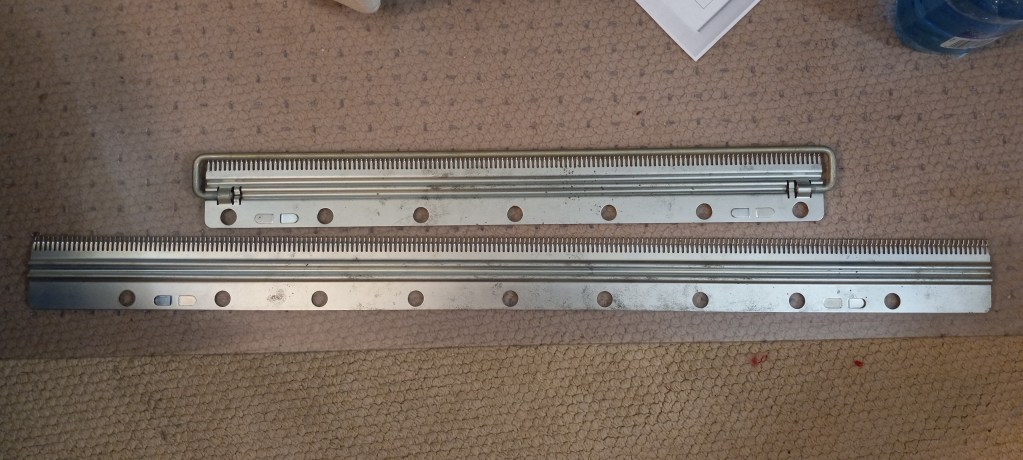
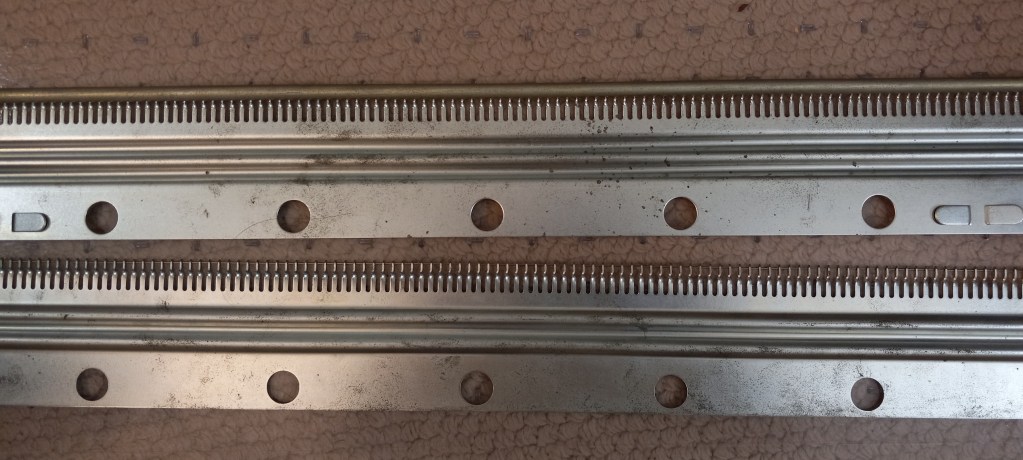
Brother KR810 ribber serviced and tested in December 2023

BUY HERE AND PAY LESS

Brother KR810 ribber ($500) + shipping ($50)

$550.00

Click here to purchase.

Brother KR810 ribber fits a wide variety of Brother knitting machines, from some of the vintage ones to the later models, all the way to the electronic ones.

This article is about specifically the KR810 ribber refurbished in December 2023. To learn more about pros and cons of the Brother KR810 ribber model, refer to the article in my Knitting Machine Encyclopedia.

The machine was thoroughly cleaned. All needles were cleaned and inspected individually, first visually and then by knitting on a full bed 1×1 ribbing (in two different combinations to make sure all needles were tested). All knitting tests were great. See a video of these tests on my channel.

The setup (consisting of main carriage, connecting arm and a ribber carriage) moved well and i was able to knit with just moving the carriages with one hand.

The machine knitted wonderfully thin yarns, sock-yarn-weight acrylic yarn and fingering mohair-containing slightly fuzzy yarn.

This machine will come with all assesories mentioned in the manual. However, the reinforcing brackets will not be included for the following reasons.

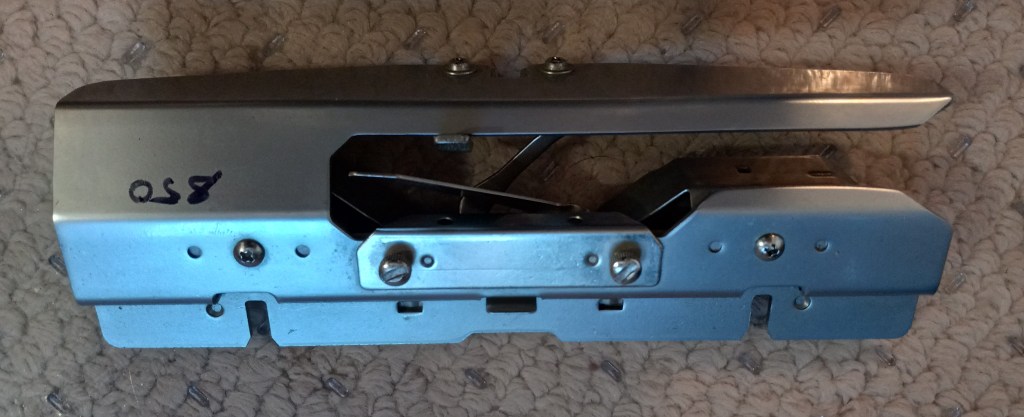
The original side brackets (that attach to the ends of the ribber) did not come with this machine. So, I borrowed from a KR850 ribber and they fit wonderfully.

Because the KR850 side brackets already have the “tongue” needed to attach the ribber to the table, the original KR810 brackets are no longer needed.

With this setup, the KR810 ribber attached wonderfully to both KH710 and KH970. However, I was able to knit only on the machine with a winder bed (KH970) than with the narrower bed (KH710). A potential reason is a slightly off angle between the machine and a ribber due to the different side brackets and table clamps. Thus, this ribber is sold as compatible with wider-needle-bed knitting machines (such as punch-card-capable machines (KH820 and above) as well as electronic machines (KH900 and above)).

I know some internet sources mention that this ribber is compatible with the push-button machines like KH552, KH710 and early punch-card machine, like KH800. But because I did not have the original side brackets, I could not confirm that this ribber can knit with these earlier knitting machines.

All buttons, dials, knobs and levers on the ribber carriage move freely.

Hard copy of the manual will NOT be included with the ribber but it can be found online for free.

The connecting arm has some rust specs all over it. I gently removed the protruding layer and applied oil for corrosion protection. But the corrosion damage is still visible. However, my tests showed that it does not affect the functioning of the ribber.

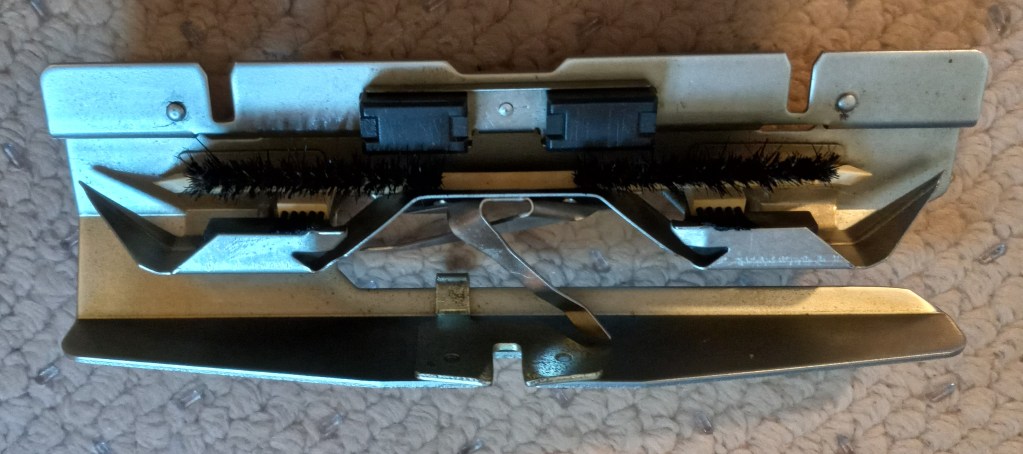
The brushes in the under-carriage section are in excellent shape.

Watch my video showing knitting on the double bed, containing this ribber and my wide-needle bed knitting machine. It worked great and the big advantage of this ribber is versatility and compatibility with large varieties of knitting machines.

Brother KR850 ribber prepared for Judith in December 2023

Brother KR850 ribber fits numerous standard-gauge Brother knitting machines. Read more about Brother KR850 ribber in my Knitting Machine Encyclopedia. The blog below is dedicated specifically to the ribber serviced in December 2023 for my customer.

Brother KR850 was serviced and tested for Judith in December 2023. My store offers other ribbers for Brother and other knitting machines.

This ribber comes with all assesories including a hard copy of the manual (not shown in the pictures).

The bed, carriage, and assesories were cleaned, inspected and tested. All needles were cleaned and inspected individually, first visually and then by knitting on a full bed 1×1 ribbing (in two different combinations to make sure all needles were tested).

Swatch test was performed first. Swatch tests are useful to ensure that the carriage functions work well. In the case of swatch tests, we do not have to worry about artifacts and problems (such as the correct tension of the yarn, yarn thickness, yarn texture, correct number of barrel weights, side weights, etc.) associated with large number of needles in working positions.

Then the machine was tested on a full bed in two different configurations to ensure that all needles form nice and correct stitches. Carriage is very easy to move on swatch and on a full bed.

All tests went great. See the video of these tests in my youtube channel.

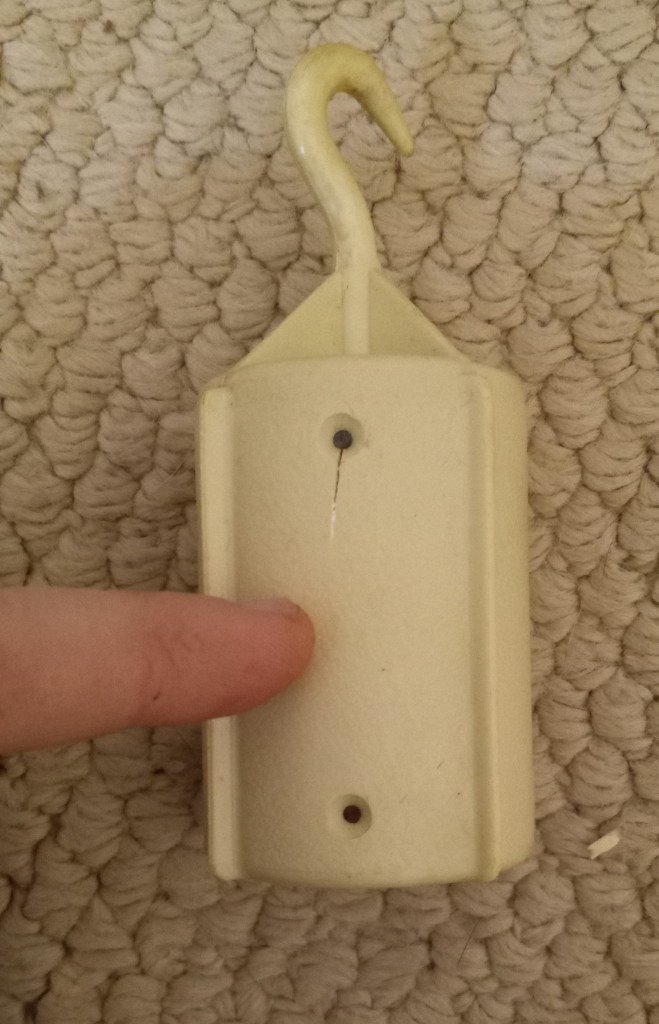
When knitting on the ribber, tension, the correct number of weights and the distance between the ribber and the main bed play a very important role. This machine handled really well two different distances between the ribber/machine beds and three different yarns (with different thicknesses and texture, see my video). One of the yarns was a mohair-containing fuzzy yarn. The machine handles it well too although some tests on the correct tension was needed as well as some wax (fuzzy yarns are more prone to static formation than other yarns).

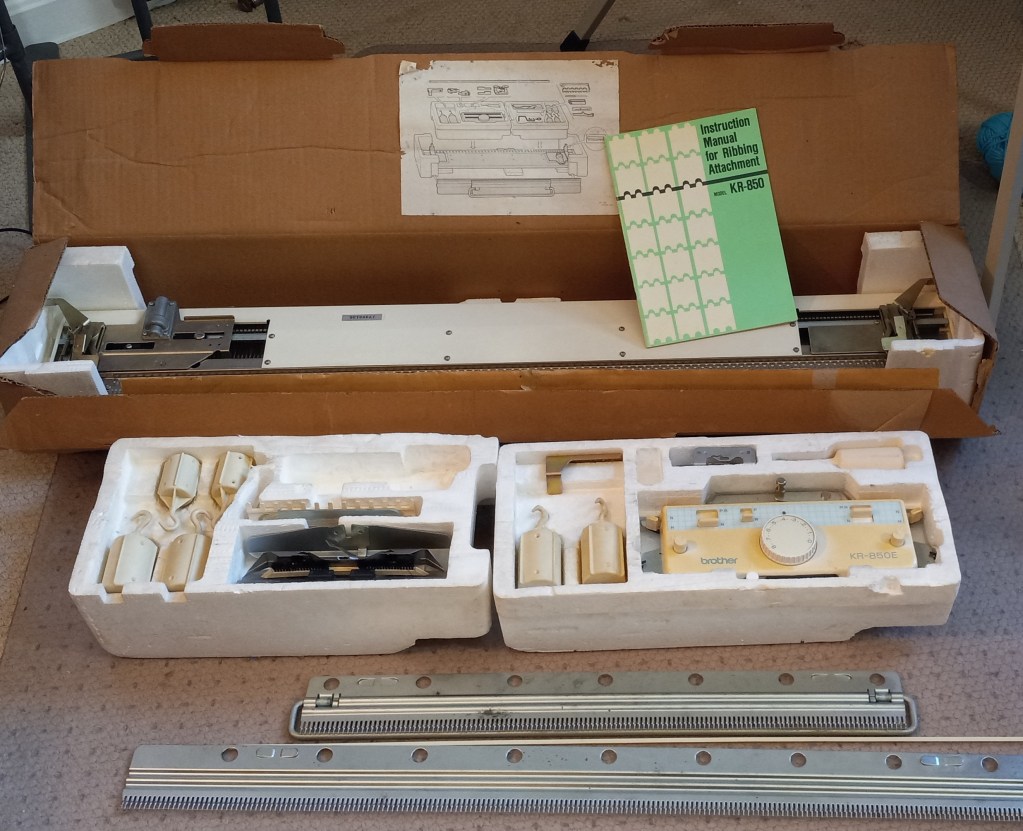
The machine will come in its original packaging: two Styrofoam forms to fit all assesories …

… and pads inside the bottom of the cardboard box to support and protect the machine.

The only obvious flaw was the tape attached to one of the cast-on combs. I did not remove it because actually it is convenient to have that tape to store the fine bar ( the long plastic and very fragile rod-like bar) more easily (often it is overlooked during unpacking and thrown away).

This machine would serve long years especially if regularly oiled, cleaned and stored in controlled environment.

Brother KH588 machine serviced in December 2023

This machine was ordered as a Christmas present from a loving husband to his crafty wife.

It is a very nice vintage setup with blue hues. This post is dedicated to this particular machine. To know more about this model, read in my Knitting Machine Encyclopedia about its pros and cons.

The machine was cleaned from old dust and gunk and tested. The sponge in the retaining bar was replaced and will come inserted into the machine. I completely replaced the weaving brushes on the sinker plate as the old ones completely decomposed.

All needles were removed, cleaned and inspected, first visually and then by knitting on a full bed. The full-bed knitting tests were on stockinet, tuck, slip and holding patterns. The video with all these tests demonstrates that the machine did not have any problems knitting these stitches and none of the needles showed any signs of forming misshapen stitches.

Lace carriage was not tested but all knobs and levers move without problems.

While knitting on a full bed all patterning buttons, knobs and levers were tested in action (with the exception of the N/MC lever but it moves freely) and are fully functional.

The machine comes with all major assesories (lace carriage, rails, row counter, sinker plate) and the majority of the minor assesories.

The row counter is from the new stock – the original row counter was missing from the setup.

The minor assesories missing are:

  • the assesories kit: it is simply a cover with pockets to keep assesories inside
  • the lid for the assesories box. The plastic was so weak that it crumbled when the machine arrived to me and I had to discard it.
  • hard copy of the manual will not be included but it is available online for free. I strongly recommend following the manual step-by-step as it is the best resource to start knowing your knitting machine.

The 3/1 needle selection/transfer tool is missing the one-prong therefor I will include a universal stitch transfer tool as well.

I will include an old wax in its tube that came with the machine. Also, there is half a bottle of still decent looking oil. I will include it as well. If it runs out, I recommend using Hoppe’s Elite Gun Oil, available on Amazon and in local hardware stores.

The manual lists mostly basic patterns but additional patterns are in this brochure.

Despite working flawlessly, the machine had some minor imperfections:

The pattern center panel has two cracks: on the right-hand side and in the middle. additionally the knob on the AB lever is from another machine and thus is not blue in color (the original knob was missing).

The assesories box has a crack on the side and a broken piece on the bottom. The plastics from the 1960s and 1970s were not as weathering resistant as current plastics and thus severely degrade with time especially when exposed to the UV light and moisture.

The case has some minor scuffs on the outer side.

Some of the stains on the lid will remain as they did not come off completely (and I do not subject the old plastics to extensive exposure to harsh solutions).

The lid has some minor rust stains on the inside.

The ratchet tool has a minor crack.

None of these imperfections and some minor missing assesories affected the functioning of the machine, as you can see in my test videos.

Replacing buttons in Brother 4-push button knitting machines

…in progress…

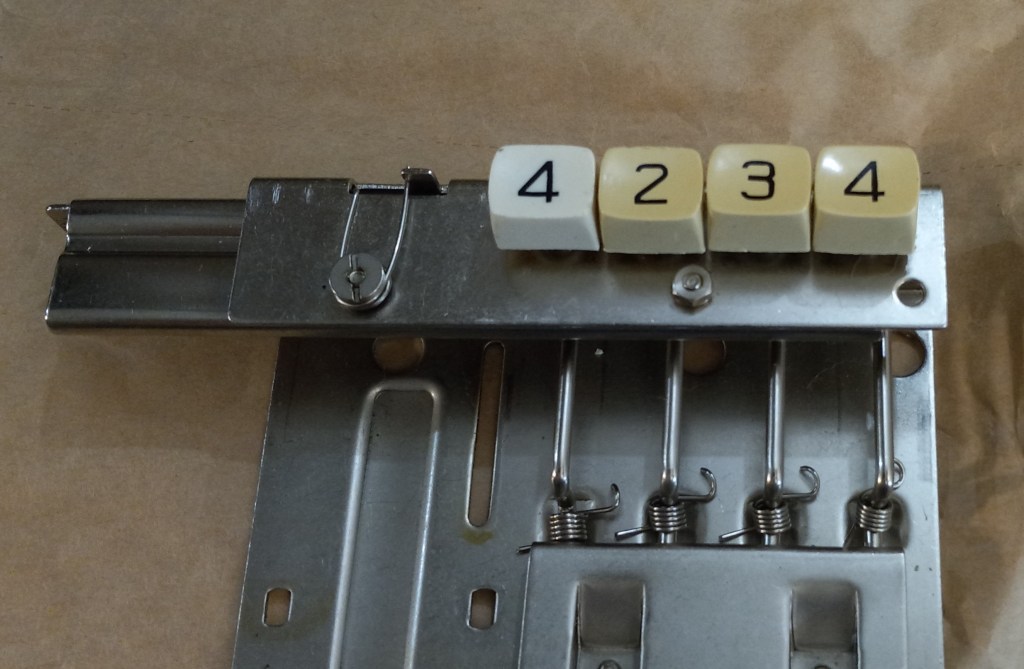
This blog article is for Brother knitting machines (KH521, KH531 and KH551) that have a needle selection mechanism with four push buttons.

When I needed to replace the push-buttons in the Brother KH551 knitting machine, I could not find any information on how to do it. I could also not find a service manual for 4-push button knitting machines.

Thus, I had to figure out on the go how to do it and I successfully did it already three times. Since I do not do it all that often, out of fear of forgetting certain details, I documented the whole process and outlined it here and also in a video.

I started with removing the side screws to separate the needle bed from the case.

Removed these screws …

… and these too (from the table bracket holders) …

… and then separated the needle bed from the case.

The cover for the button mechanism can be easily removed: there is one screw on the right-hand side, kinda underneath …

…and one in the middle of the cover, easily seen from the back.

Flip the bed and remove the button-rod mechanism by unscrewing all screws on the back. The two screws marked below hold the whole mechanism together while all others simply attach the mechanism to the needle bed.

After these scores are removed, collect the following parts: 4 rods with torsion springs, four buttons and four tension springs.

Next steps are reinserting the pushbuttons back into the patterning assembly.

First, insert the tension spring into the pushbutton and then inside the holding plate.

There is an opening on the flat portion of the button that needs to go through the vertical panel of the holding plate. Insert the rod into that hole.

Repeat with the rest of the buttons.

The small holding plate has narrow and wider grooves on the opposite sides.

Wider grooves go on top of the rods next to the elbows an narrow grooves go onto the ends of the rods. Press the plate firmly, flip (while holding firmly) and attach the screws.

Once these two most critical screws are in, we can stop holding them firmly.

We now flip the assembly again to adjust the positions of the torsion springs.

While holding (very tight) the straight end of the spring with one screwdriver, we stretch the torsion spring on the curled-end side and hook the spring on the rod. It might take you several attempts because it is hard and awkward to do. Don’t get discouraged. Repeat for the remainder of the rods/springs.

Once the pushbutton assembly is finished, we’ll need to put it back into the bed.

Just follow the first steps in the reverse order. If confused – watch my video again. Or follow the outlined steps below.

Insert the plate with buttons into the bed at an angle, …

…attach to the hook …

and insert the remaining screws (on the back) into the push-button assembly. Watch for the screw marked in red below. This should not be too tight otherwise the mechanism that governs the selecting strips might not move as freely. If you experience it, loosen up that screw.

Before inserting the needle bed into the case, check if your buttons move freely.

Then reattach the cover.

Insert the needle bed into the case, and reattach the screws on the needle bedside.

Now you can test if your button selection mechanism works by inserting 8 or so needles and activating the pushed-in buttons by the ratchet tool.

Good luck and hope this was useful.

Brother KR850 ribber serviced and tested in November 2023

Brother KR850 ribbing attachment converts a standard (4.5 mm gauge) flat bed knitting machines made by Brother into a double bed capable of rib and more advanced patterning. It has 200 needles and is compatible with all punchcard and electronic standard-gauge knitting machines. It does not knit on its own – it needs a knitting machine.

Read more about this model in my Knitting Machine encyclopedia.

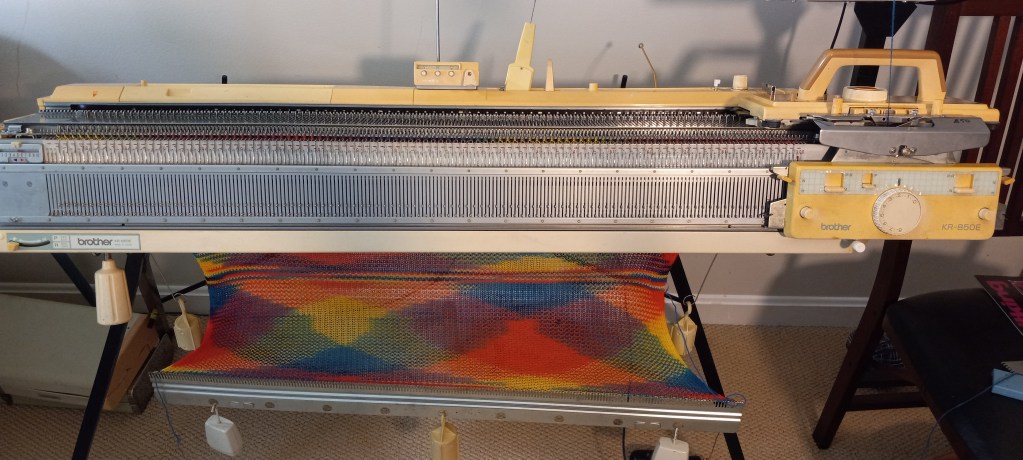
This particular ribber was tested and serviced by me on Brother KH860 knitting machine.

All needles were inspected and cleaned. All needles were also tested during knitting a 1×1 rib on two different needle configuration (to ensure that I knitted on all needles). See the test video for details and to understand what I mean more.

The bed and the carriage were cleaned as well.

This ribber comes with ALL assesories including hard copy of the manual.

It will also comes in its original box, which is in pretty decent shape.

I followed a nice video on how to adjust the distance between the ribber and the machine to form nice stitches and not to have dropped stitches. Actually, I found very easy to setup Brother KR850 unlike its other older counterparts (like KR830)

Knitting with a ribber requires an operator to pay attention to the edges: to add enough weight, make sure the yarn does not get stuck on pegs, etc. So, it is recommended not to knit on the very last 2-4 needles to ensure nice edges. I was able to achieve that during my tests.

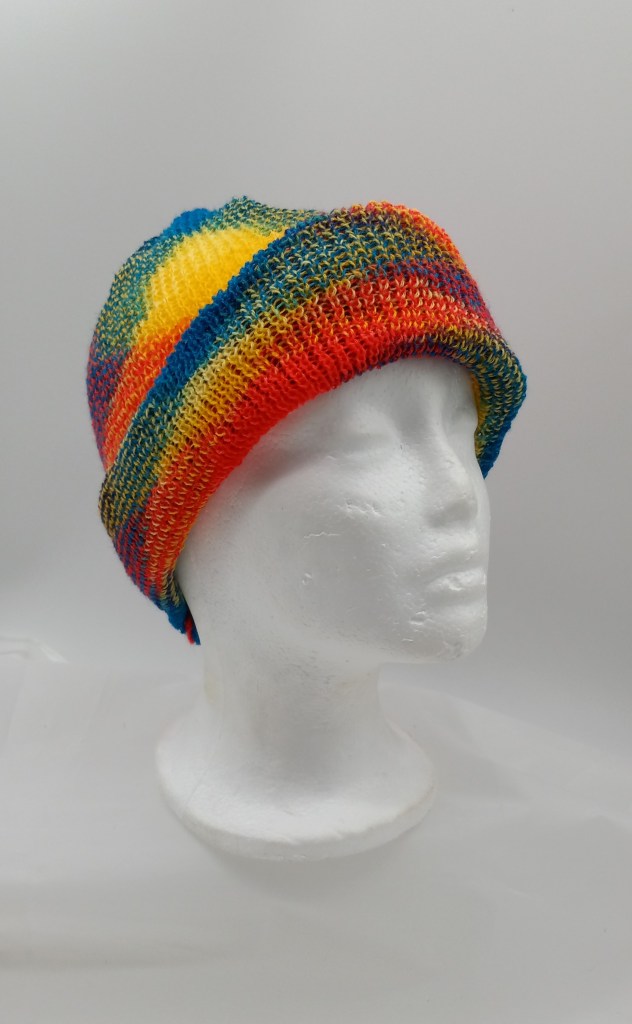
The long panel knitted during these tests was converted to this hat.

About flaws:

The machine itself does not have any flaws. The cast-on combs, however, have slightly bent tees at the ends and the wire as 3-teeth short. I looked in my collection for another cast-on comb. It turned out that they are almost all like this. Probably damaged during storage and/or transport. Inserting the wire into the groves/holes was not a problem but to remove the wire at the end of your work, you might need plyers. The little hook at the end of the wire broke off. Again, all wires I looked in my supplies that are long enough had the loop broken or missing.

No other imperfections were noticed. The machine works great and is highly recommended.

Brother KR850 ribbers as well as matching machines are regularly available in my store for purchase.

Brother KH860 knitting machine serviced and tested in November 2023

Brother KH860 is a knitting machine capable of creating patterns using punchcards. Read about pros and cons of this model in my Knitting Machine Encyclopedia. But in the mean time, read below about this particular machine.

This machine was cleaned and fully serviced. The sponge in the retaining bar was replaced. All needles were inspected and cleaned. The needles were also tested by knitting on a full bed (see the video).

This machine will be sold with ALL assesories. All looked brand new (even wax and oil). Even its own hard copy of the manual will be included although it can also be found online for free.

The row counter included with this machine is brand new (new stock).

The machine was tested using the same punchcard for tuck-, slip- and fair isle patterning on a full bed and all tests were great: no missed stitches, not tucked stitches where they are not supposed to be (tuck stitches often form due to bad needle latches).

The picture below shows the fair-isle pattern upclose knitted using a custom card.

This knitted fabric was then converted into this beautiful Christmas present bag.

Now about imperfections:

There is slight discoloration on the carriage handle – probably the motor was attached to the machine at some point. The plastic around the connection point has slight UV damage but is NOT damaged where the handle was attached to the motor head.

There is a little bit of delamination on the top plastic layer on the carriage. Also, the corner of the name plate is a bit chipped.

A plastic section of the rail guard/slider on the left-hand side of the carriage broke off. All my tests were performed without it. I did not experience any problems knitting. I still have the piece and it will be included with the machine but it will not be glued on.

If knitting on a full bed with the patterning option engaged (for tuck, slip and fair isle), the carriage needs to be pushed a bit down on the very edges otherwise the sinker plate touches the needles a bit. Maybe the bed is a bit warped on both ends. When knitting in the middle of the bed (when the panel is not knitted on all 200 needles), I did not need to push the carriage down a bit. Only when I knitted on all 200 needles in tuck stitch. As you will see in my video, it did not affect the knitting: I was able to knit without trouble and without too much effort. It is just something the operator needs to be aware of. All knitting machines have their own character and this is simply one of those character features.

Despite these minor flaws, the machine knitted and worked great. Other punch-card Brother knitting machines are available in my store.