
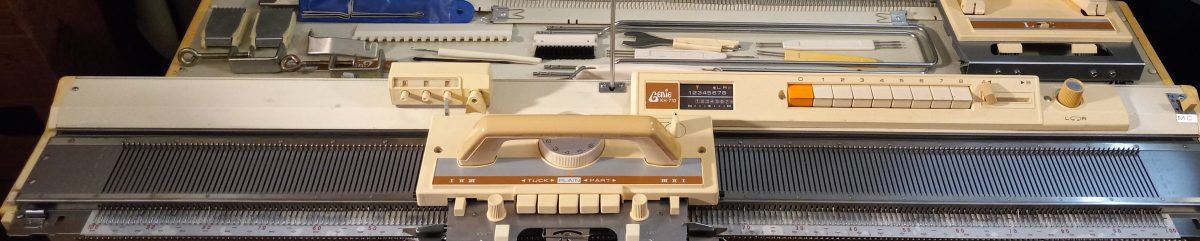
… this article is a constant work in progress as I accumulate more experience (personal) and based on what other people write about their problems and their fixes…
Problems with knitting machine related to the carriages often manifest themselves as:
- carriage moves smoothly on the needlebed to from left to right but NOT from right to left (and vice versa)
- carriage gets stuck on the bed
- buttons/levers/knobs/dials on the bed do not move freely or move slowly or do not retract sharply as they supposed to be
- mispatterned stitches or/and not correctly selected needles
Below are possible reasons and brief explanation how to fix them. More detailed explanation on how to fix these problems are available on the Internet.
- If you machine has patterning drums and they are not moving freely or stuck completely, it might be because of the old oil/grease, old lint and/or some yarn wrapped around the moving parts. SOLUTION: visually inspect the drums on the sides and remove any visible junk. Apply Kroil Oil firs to the drums and see if they start moving freely. I typically try to rotate the drums every 2-4 hours after applying (generously) the Kroil oil around them .
- Due to the old gunk and dried up oil, some of the moving levers (responsible for guiding the needles through the intricate passages of the carriage) get stuck. If you suspect a lever does not move, check against the same lever on the mirror side of the carriage: compare its movement, how fast it retracts, etc. SOLUTION: Apply Kroil oil around the lever to remove the old gunk.
- Carriage might have too much old grease and lint to move freely. SOLUTION: Clean the under carriage with 100% alcohol, ton of q-tips, and UPS greaseless lubricant.
- Springs inside the carriage disconnected from their corresponding posts. This might happen because the springs lost their tension/torque but also due to the impact (the machine or the carriage were dropped). SOLUTION: Check for any dangling springs. Compare the springs on the on the mirror side of the carriage to make sure the springs are attached correctly. Or refer to the manual or pictures on the Internet on how to attach the springs. One of such tutorials (but for the Brother knitting machine) was published by me and also available as a video.
If you think none of these problems/solutions apply to your, it might not be a problem with the carriage. It might be incorrect position of the carriage on the needle bed, bent needles, incorrect yarn threading through the mast, incorrect tension of the yarn, static, too-thick yarn, or (the culprit of almost all problems with knitting machines) old sponge in the retaining bar.
If you have a Brother machine, you might have some specific problems, which are described in another article.

gerçekten çok yararlı bi konu teşekkürler
Thank you! Glad you found it useful!
Sitenizin tasarımı da içerikleriniz de harika, özellikle içerikleri adım adım görsellerle desteklemeniz çok başarılı emeğinize sağlık.
Thank you!
I was given a Studio 321 that has been in an attic for 40 years. I’m trying to deep clean but can figure out how to get needles out, the hit the back edge and I don’t want to bend them, any suggestions? They all have residue from a corroded sponge bar that needs a thorough scrubbing.
Before you remove needles on your machine, make sure you completely removed the retaining bar. Then, take the needles out by grabbing them by their buds, and pushing forward all the way and then pull back while also lifting a bit so the end tip comes out of the groove.
Watch my videos where one of the things I demonstrate is how to remove and insert the needles (you can slow down the videos to see the steps better):
https://www.youtube.com/watch?v=nOpNhff-aXM
https://www.youtube.com/watch?v=H3sBW-CAQCU
Hope it helps and good luck!!
Bu konu hakkında bilgi vermeniz çok güzel. Genellikle türkçe içerikler az oluyor fakat böyle güzel içerikler görmek ve okumak çok zevkli.
Thank you! And thank you, Internet, for all translation services :))
Güzel aydınlatıcı makale için teşekkürler daha iyisi samda kayısı umarım faydalı çalışmalarınızın devamı gelir.
Thank you for your kind words!
Sitenizin tasarımı da içerikleriniz de harika, özellikle içerikleri adım adım görsellerle desteklemeniz çok başarılı emeğinize sağlık.
Thank you!