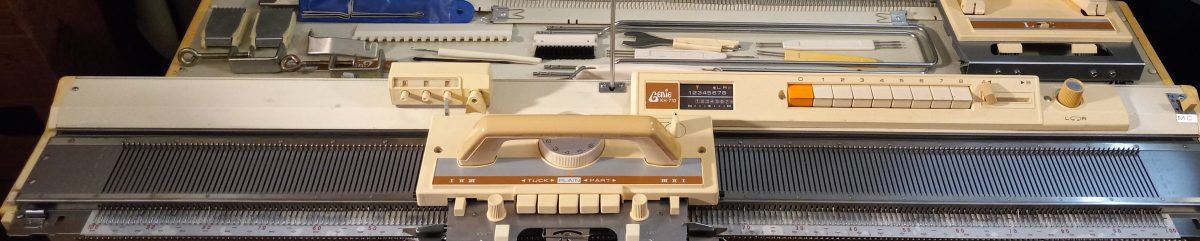
KH581 cleaned/fixed/tested in November 2022

MESSAGE ME AT FACEBOOK/COMFIKNITS IF YOU DONT SEE A PAYPAL PURCHASE BUTTON.

THIS MACHINE IS ALREADY SOLD….CHECK MY OTHER POSTINGS AS THE NEW MACHINES ARE COMING 1-2 TIMES A MONTH

A little bit about this model: Brother KH581 is an 8-push button machine. It first appeared on the market in 1969. This particular model was probably made specifically for Japan as the carriage has Japanese markings only (although this is the first and only KH581 I’ve seen so far in real life). It is similar to other eight push buttons Brother machines sold under models KH 588, KH561, KH560, KH585, although I have not tested those yet and there might be some minor differences. This model comes in pretty blue color and even some the assesories have blue tints. I find this color very attractive and unusual.

The standard setup comes with a lace carriage and rails. I think that is the first model to have both of these in its standard setup.

A big advancement of this model over its 4-push button knitting machines (like KH551) is the presence of a whole “pattern center”. It consists of familiar push buttons and a lever with a wrench but also of a slide indicator and a reverse knob. The manual is very clear about what they are but it still took me some time of playing with them to get what it does. Once I figured it out, it was almost like an EUREKA moment to me! I, once again, just was amazed how smart Japanese engineers are.

So, in regular 4-push buttons machines, we need to select the buttons (and then unpush them) every time we need to select certain needles. In 8-push button machines, we select the needles once and then the reverse knob and we simply tell the patterning center by how much the needle selection needs to be shifted. Once I got a hang of it, I was blown away by how simple it became to memorize your needle selection. In fact, you don’t memorize – you simply shift it. Also, excellent pattern charts in the manual explain it really well. Just don’t be discouraged by a learning curve and experiment with the swatch. You will see in my video that while knitting the butterfly pattern (referred to in the manual as “holding” pattern, I selected the buttons only once at the beginning. The rest of the needle selection was done by only turning the reverse and slide knobs. I also feel that this helps to reduce wear and tear on the buttons: the spring indeed will loose their strength from constant pushing and unpushing.

The manual shows how to work the most basic patterns. Additional patterns can be found in here.

The machine setup is very easy and almost intuitive. I still recommend following the instructions.

Pros and cons of KH581 in comparison to other brother knitting machines.

Pros (in no particular order):

+ Much simpler needle selection process especially for complex patterns, where different needles need to be selected during each row.

+ Lighter than more modern machines. Thus, it would be ideal for those with weaker upper bodies.

+ Relatively compact: needle bed is narrower than its younger counterparts.

+ Excellent for hand-knitters who want to transition to machine knitting. Often hand knitters are seeking for more even stitches or for less wear on their hand and finger joints when knitting every stitch manually, yet they don’t want to give up the pleasure and satisfaction of manipulating stitches. I had several customers who bought push -button machines from me for this exact reason.

+ Excellent for beginners, crocheters and knitters, as it is not overwhelming as electronic and punch card machines might seem at first.

+ Since the machine is mostly mechanical, not many things can go wrong. Just keep this machine free of dust (which can be achieved with regular vacuuming and sponge bar replacement) and free of moisture.

+ Pretty blue color which makes this machine stand out.

+ All tools are interchangible with other 4.5 mm gauge machines and can be easily purchased new or used.

+ Carriage is very easy to move. I was able to do it with just one hand (but it also depends on a correct combination of yarn and tension).

+ Matching ribbers are available and can still be found on the used market. In fact, I am testing a matching ribber (Brother KR580) right now.

Cons (in no particular order):

  • I was not a big fan of the tension mast being stuck inside the tool holder…
  • Replacement needles can only be found on a used market. Nobody makes them anymore. I have plenty or replacement available in my shop.
  • Fair isle knitting might not be as easy as on punch-card and electronic knitting machines.
  • Hand-manipulations of stitches and keeping track of which buttons to push and which levers to turn might be overwhelming for some knitters.

About this machine in particular:

It knitted very well and handled sport yarn, acrylic and wool, at different tensions really well. I did not feel that the machine was sensitive to yarn tension, which was pleasant and allowed me to relax while knitting.

I inspected every needle on this machine to make sure the bed has only good and well-functioning needles. I also inspected the stitches they make (this is why I run all my knitting demos on a full bed). I replaced a sponge bar and cleaned the machine.

Tests on a full bed confirmed that everything works great. I tested stockinet, slip-stitch, tuck-stitch and tuck with hold patterning. Check out my video to see this machine in action on a full bed. Below are pictures showing the swatches with patterns I tested.

I did not test the lace carriage but I thoroughly cleaned it and ensured that all buttons, knobs and levers moved freely.

All major assesories are included with this particular machine except for:

  • A hard copy of a manual. A scanned pdf copy can be downloaded for free here or here (this particular manual is the exact copy of the hard copy I used to learn this machine).
  • The lid to the storage box – it arrived to me just shuttered. It probably weakened due to its age and got cracked during transport.
  • Parafin (or wax) is not included. The original one was too crumbled to include it. When I tested this machine on three different yarns, including 100% wool and 100% acrylic, I did not feel I needed it. There are two groups of knitters with regard to using wax: those who swear by it and those who care less. You decide which one you are for yourself
  • A bottle with oil is also not included. The one that came with this machine was too dark to use it. I recommend Gun oil. A lot of knitters use it and I use it to clean and oil all my machines.
  • Cast-on thread is also not included but any smooth yarn of the correct thickness can be used instead.

None of these missing assesories affect the functioning of the machine.

This machine was probably meant for the Japanese market. Thus, the wording on the carriage is in Japanese. But you will very quickly learn that the two button on the left-hand side are for tuck and the two buttons on the right-hand side are for “slip” patterns. The position of these buttons is standard across all Japanese knitting machines.

I also felt that the buttons on this machine needed an extra strong push to remain in their pushed position ( I had to do it with my thumb, which is stronger, than an index finger). Just keep that in mind while playing with buttons.

I always convert the fabrics I create while testing the machines into cowls/neck warmers, which I then donate to local charities. Here is what I got while testing this machine:

Overall, I was pretty impressed with this model and this machine. I so wanted to play and experiment with how many different patterns I can come up with I hope you will enjoy experimenting with it too.

KX350 cleaned and tested in November 2022

Brother KX350 is a plastic bed, mid-gauge, knitting machine. It was my first ever flat bed knitting amchine and I am so glad that it was because otherwise, now knowing how capricious other machines can be, I would not have become an avid machine knitter.

This particular model was cleaned. The spong bar is new. Needles were checked.

It comes with the original box, although the box is somewhat beat up. The storofoam inside the box is a bit worn but clean and still holds the machine and the assesories well.

The set includes all standard assesories shown below. You can start knitting right away! It is super easy to setup up. The manual is written very well and is easy to follow. If you are a visual learner, a video tape includes additional instructions.

The machine sounds a bit loud. My husband calls it an old type writer. There is not much more to say about this particular machine as it behaved excellently during the full bed tests (knitting stockinette) and that all levers on the carriage move freely.

It is a wonderful machine for a beginner, and I am glad it is going to a loving home.

Read more about Brother KX350 model’s pros and cons in my previous blogs.

Flat Bed Brother KX350 knitting machine, cleaned and tested in October 2022

Brother KH 551 knitting machine refurbished in October 2022

This is my Brother KH551 machine tested and cleaned in October 2022.

The machine passed all my tests. I tested how needles move during their push-button selection and tested slip/part and tuck stitch patterning. I tested how this machine knits on a full bed using somewhat challenging yarns: boucle, fuzzy (mohair-like), and yarn with boucle-like specs. All knitted fabrics looked beautiful.

I installed a new sponge bar, checked ALL needles, ran several tests on them to make sure all latches are moving freely, and replaced all damaged needles with new (aka, from old stock) or with refurbished ones. After all this, I typically knit on the full bed to ensure that I did not miss anything while inspecting the needles. If needles do not knit properly (which I judge by the defects in the knitted fabric), I replace them.

I did not see any defects in the fabric – please, refer to my video for details.

The machine came to me with several accessories missing and without a hard copy manual.

  • The hard copy of the manual can be found here;
  • The toolbox which stores all accessories did not come with this machine. I placed all the tools in a bag and securely attached it to the bed for easier transport during shipping
  • I typically discard the oil/grease that comes with these old machines because of their age. I recommend using gun oil, which can be purchased here.
  • The small bag that stores the needles had to be thrown away. It is simply a container that holds them and is not critical
  • The sinker plat yarn hangers did not come with this machine. See page 19 in the manual on what these are needed for. I feel that their use is pretty specific – for plating. I consider myself an intermediate machine knitter and I am yet to learn this plating technique. I also feel that these yarn hangers can be imitated by a simple paper clip.

All knitting machines have their own characters and this one was no exception. I felt that it is somewhat more sensitive to tension or maybe I was just testing it with a challenging yarn. So, I discovered that it liked slightly more than average tension. I had to hang the weights to the corners of the knitted panel every other 10-15 rows or so. I needed to pay A LOT OF attention to the tension in the mast and adjust the tension on the dial. In general, on all machines, all projects will require several tests and swatches to determine the best yarn/tension combination.

Because this yarn was a bit more sensitive to tension, I am including complimentary claw weights (see the picture below, they are typically NOT included with a standard KH551 set).

Let’s talk about the imperfections of this machine:

The needle selection tools also had seen their days. But they still feel smooth to the touch.

My video shows some minor bents on the case.

The most annoying imperfection to me was a twitching row counter. I tried to fix it, oil it, and replace parts – to no avail. I feel that the plastic rotating gears wore over time and make the numbers twitch a bit when transitioning from 9 to 10 and from 19 to 20. I did not notice this twitching for other transitions. The operator simply needs to nudge the row counter during these transitions to keep the correct row count.

Overall, I would definitely consider having KH551 in my machine collection. It is a sturdy and hard-working machine. I hope its new owner will think so too.

Read more about this model in my previous posts on Brother KH551.

https://thoughtsandknits.com/2021/11/01/my-first-restored-and-tested-kh551-knitting-machine/

Brother KH551 – my second one

https://thoughtsandknits.com/wp-admin/post.php?post=1644&action=edit

Brother KH 930E, my second one, restored/cleaned/tested in October 2022

What was done with this machine in terms of cleaning and refurbishing:

  • Included tools that were missing (some are still missing-please read below). All major parts and assesories are included.
  • Cleaned outside
  • Opened the lid and cleaned under the lids using only isopropanol around the electronics
  • Inserted absolutely new sponge and a retaining bar (it is NOT a refurbished retaining/sponge bar). So, it should last longer.
  • Inspected all needs – run 2-3 visual inspections under different “angles”. Replaced all defective needles with brand-new ones.

All assesories are included except for:

  • Pattern book (it can be downloaded from here)
  • A hard copy of the manual (it can be downloaded here. The pdf cover page states that the manual is for KH940 but KH940 and KH930/930e are identical in their operations. The only difference between KH940 and KH930/930e is the size of the electronic storage memory: KH940 has more memory.)
  • Design sheets (they are simply graph paper; if you REALLY need it, any graph paper would do)
  • Tapestry needle (any plastic or metal needle would do)
  • Oil (the container that came with the machine was empty; but regardless – I recommend using newer/fresher oil. I typically use this gun oil)
  • Wax (the one that came with the machine was too old and crumbled)

Here are the pictures of all accessories. They all fit into a small build-in compartment (see the two left-hand side photos below).

The hole in the carriage handle is to attach the machine to the motor. The previous owner made this hole, not me. I don’t own such a motor!!!

Tests performed on this machine:

  • Tested needle selection – works great!
  • Tested on a full bed tuck, slip/part and fair isle – all worked great.
  • Tested file transfer – work great! Knitted a small item from this custom pattern.

Read more about pros and cons of this model in my Knitting Machine Encyclopedia: https://mightyknittymachines.com/brother-kh930-electronic-knitting-machine/

Additional notes on this machine:

  1. During tuck knitting, I always check the tuck wheels to make sure that they are always in their working position (pushed forward). I reach with my hand under the sinker plate while it is still on the bed and check it. When they accidentally slid back, the stitches move slightly forward on the needles and the nest row does not form correctly and a lot of looping occurs. So, this is why in the video you will see me constantly checking under the sinker plate. Once I figures out what to look for in my stitches (namely, not too much moving forward on the needles), I stopped checking these wheels/brushes. I also feel that if this problem occurs, the operator should play a bit with the tension (on the tension mast and on the tension dial) of their yarn. Also, tuck-stitching requires an optimized yarn tension and weight combination.
  2. The machine is somewhat sensitive to the yarn tension. Honestly, they all are so I recommend when starting a new yarn to play with tension on a small swatch before making a garment and knitting fast.
  3. The eight pins where the transfer cable gets inserted are fragile. Please be careful.
  4. Always turn off and even unplug this machine when not using its patterning capabilities. There are stories about motherboards being damaged if left for too long in ON condition. If this happens, replacement boards are available for purchase from somewhere in Honk Kong (but it is a reliable source).

The transfer cable is NOT included. I used my personal one.

Enjoy!