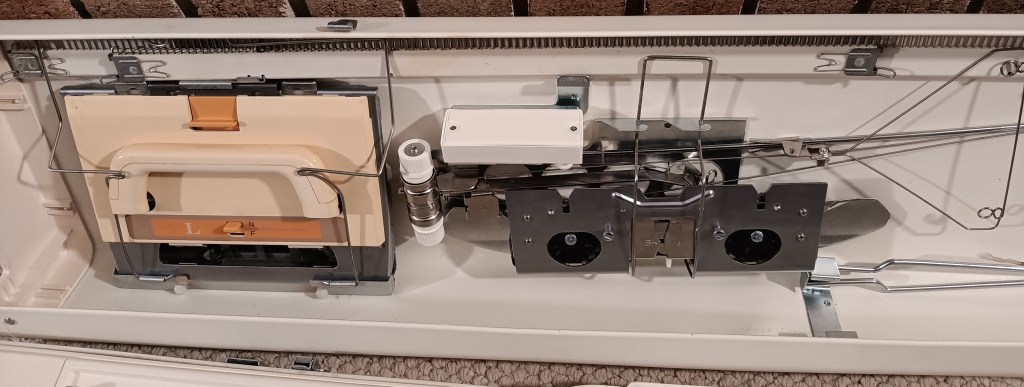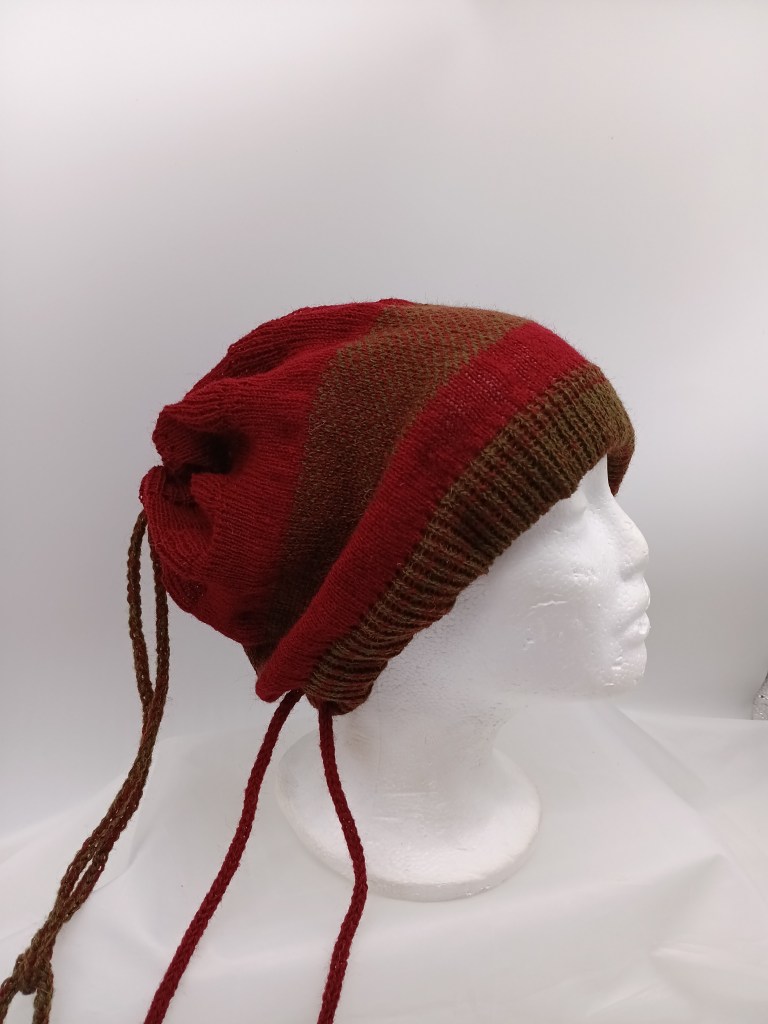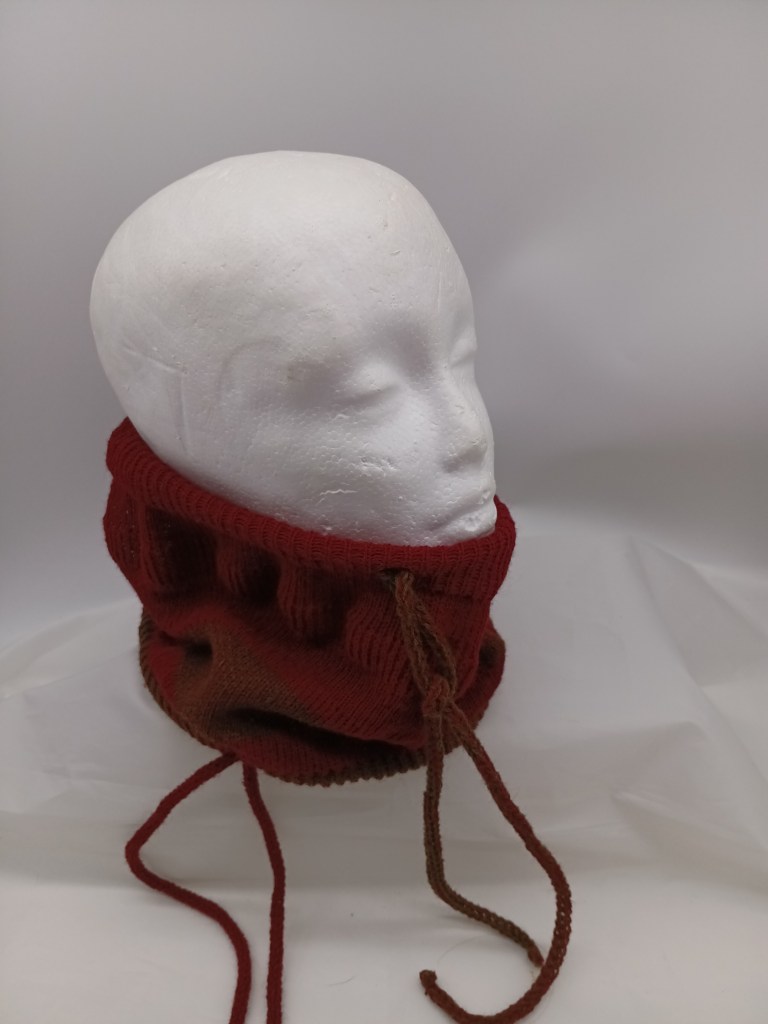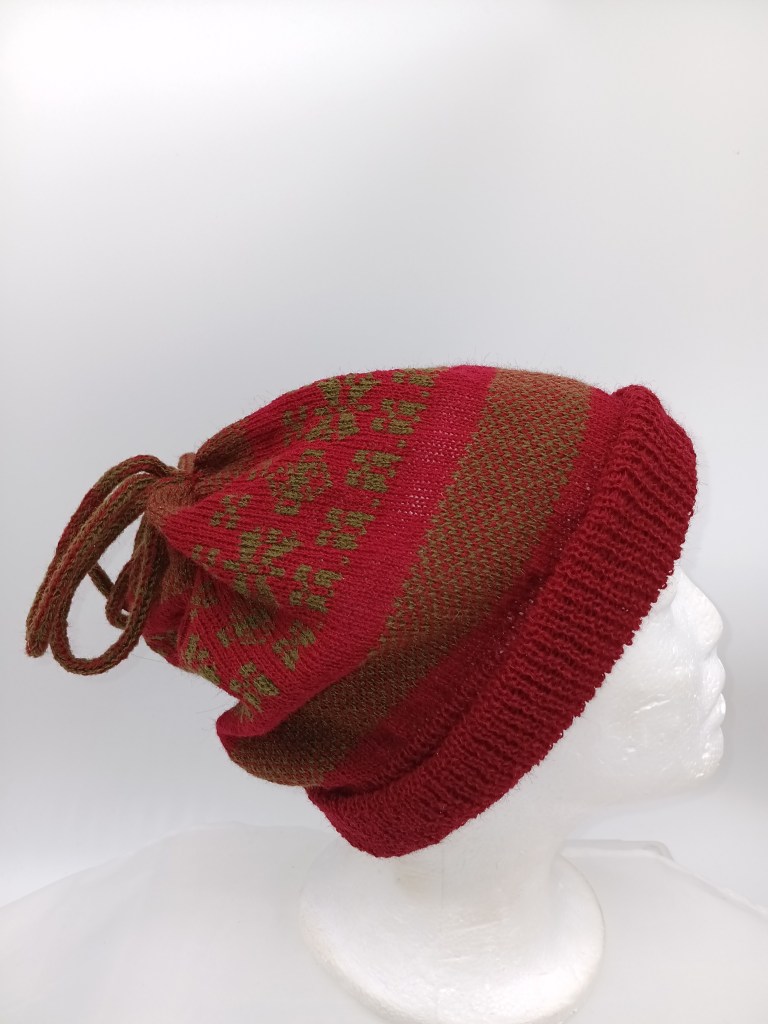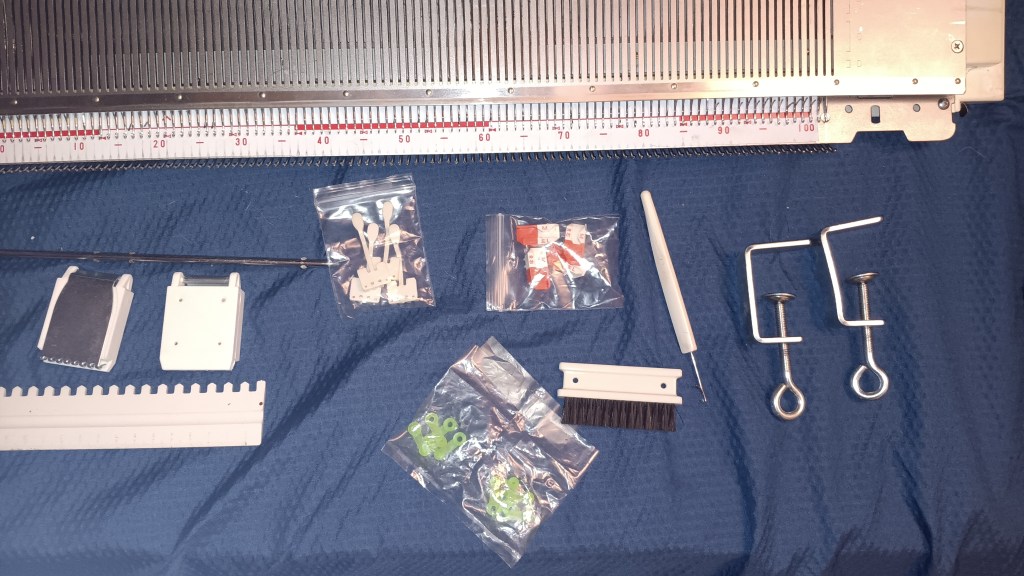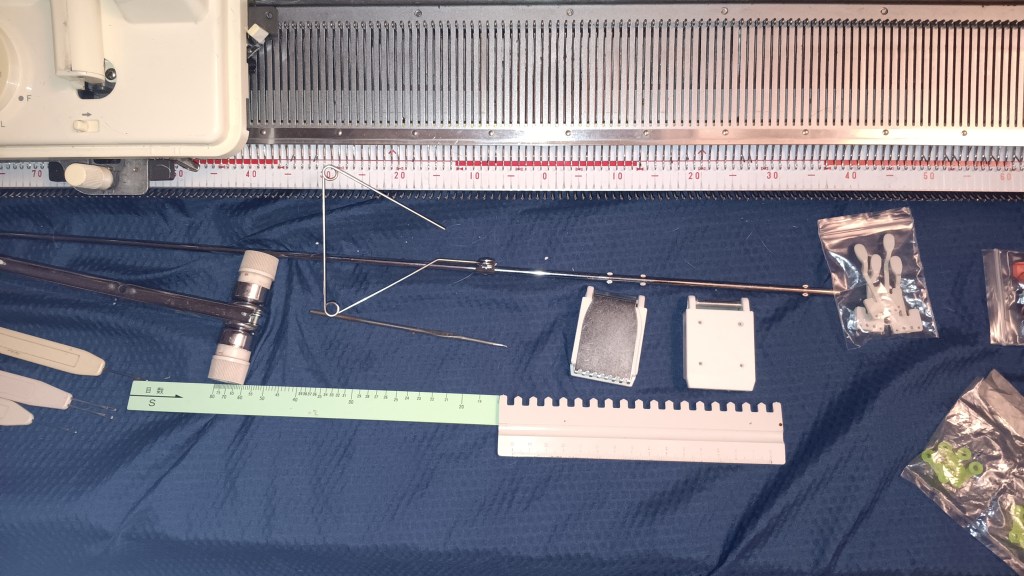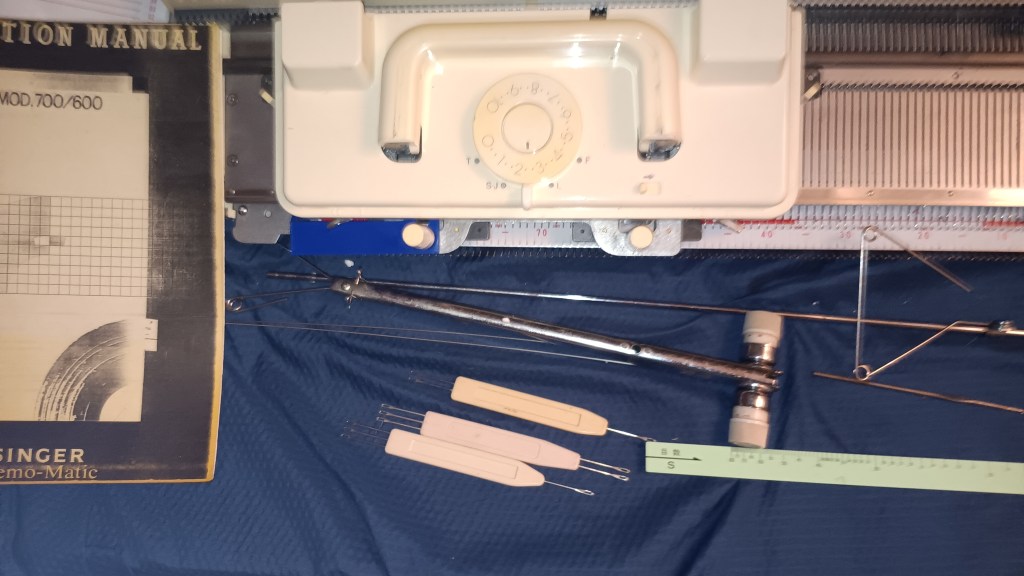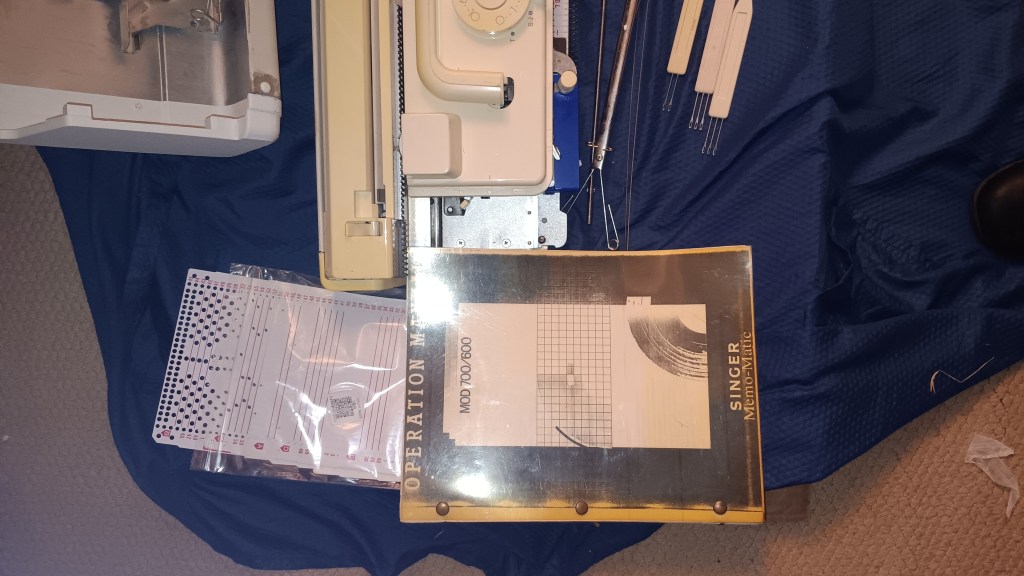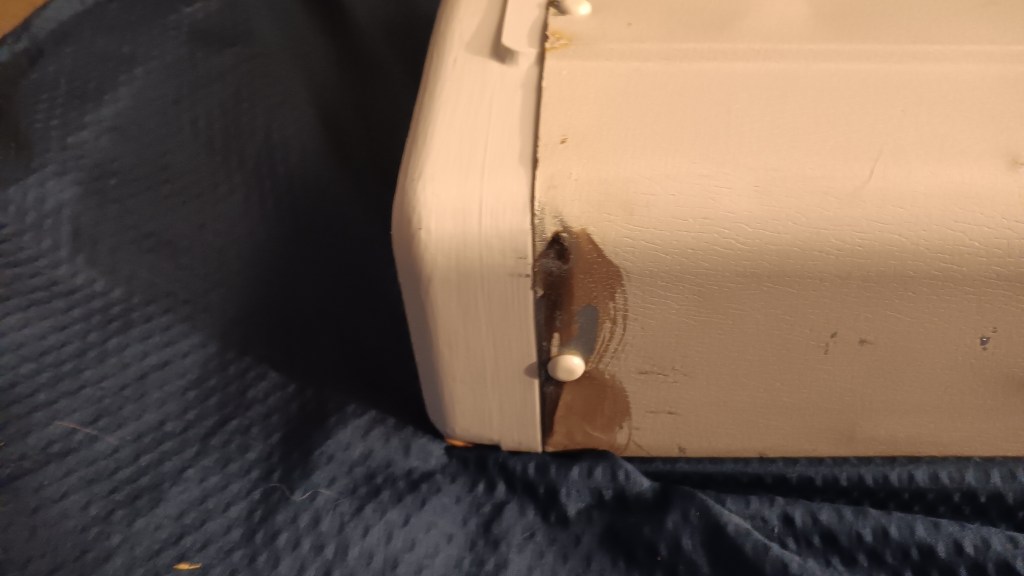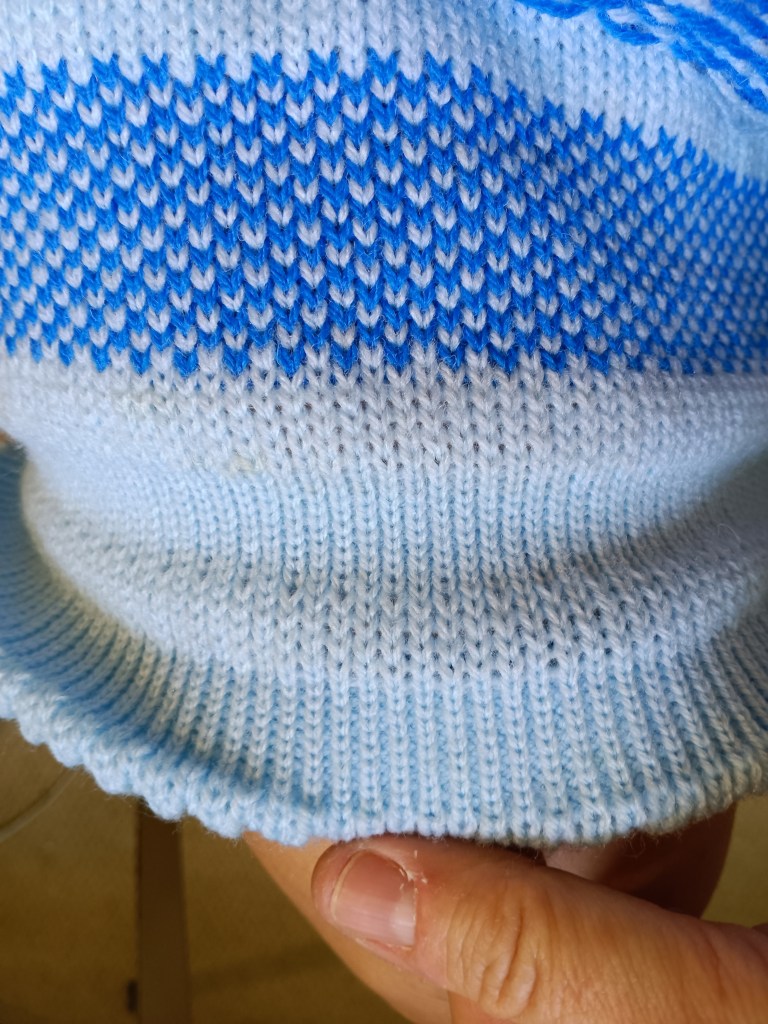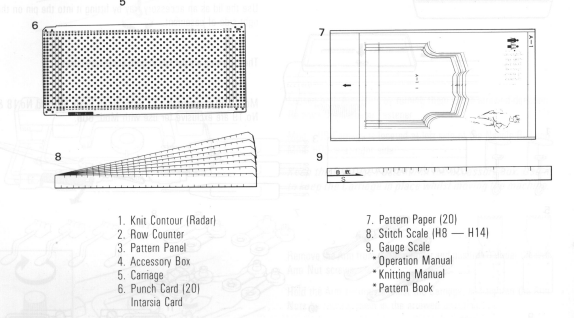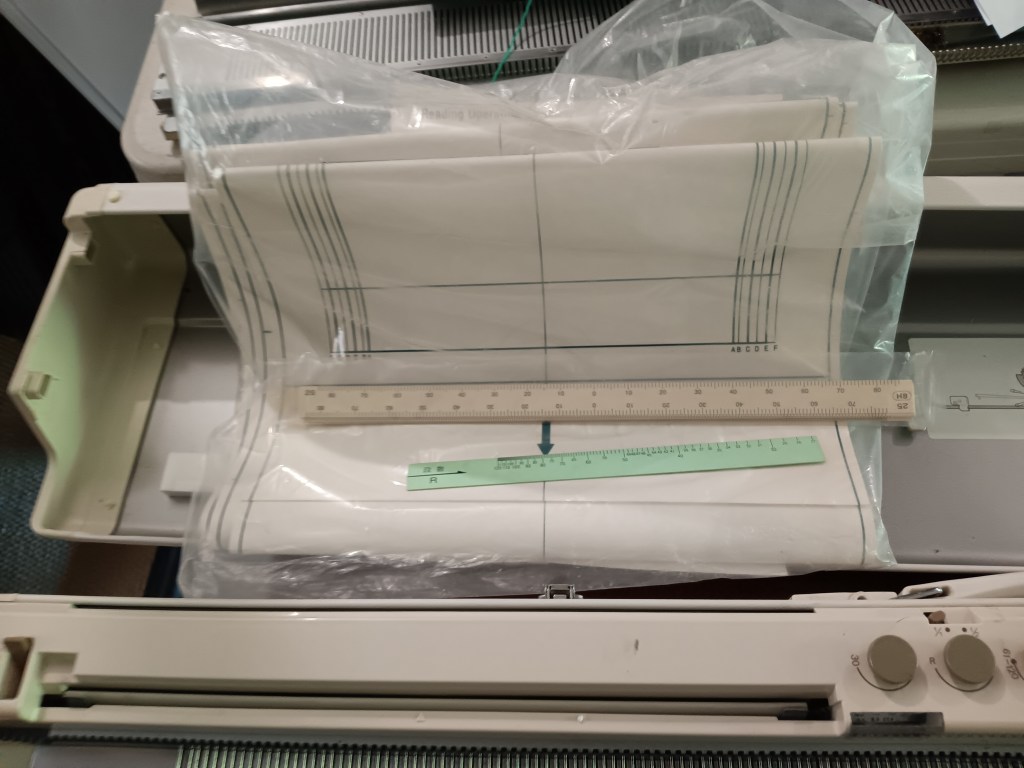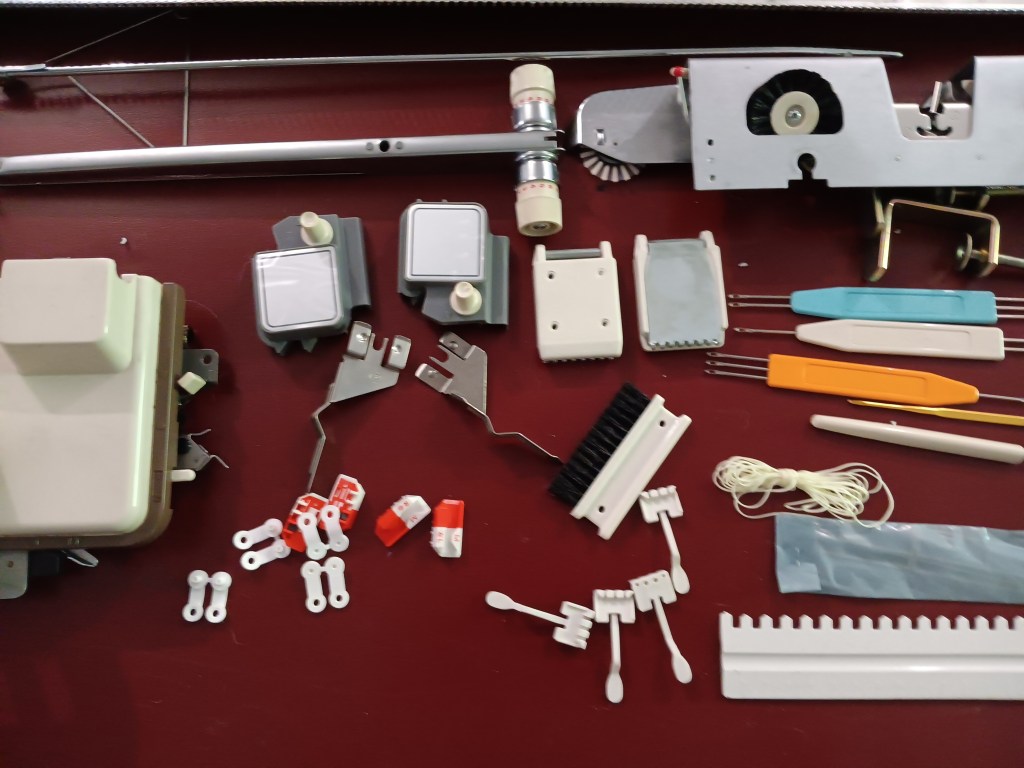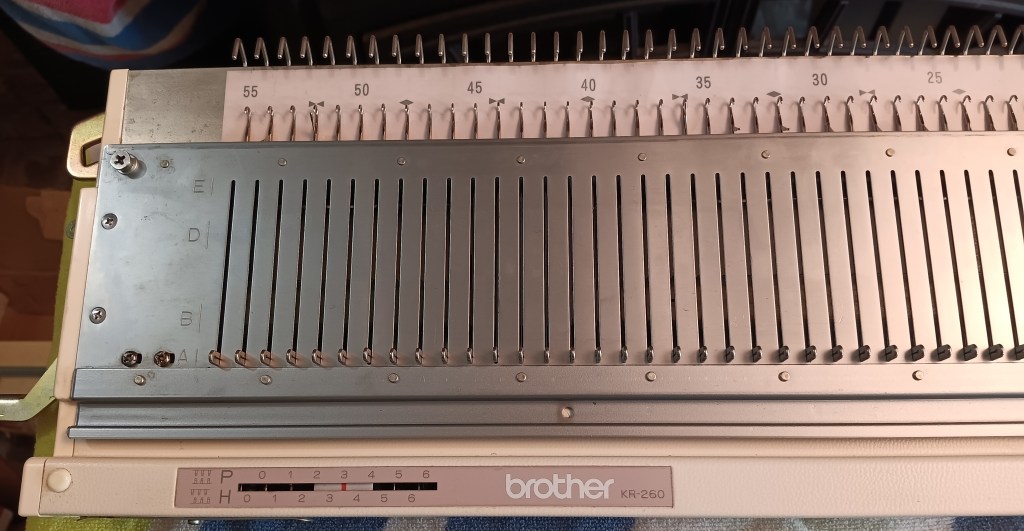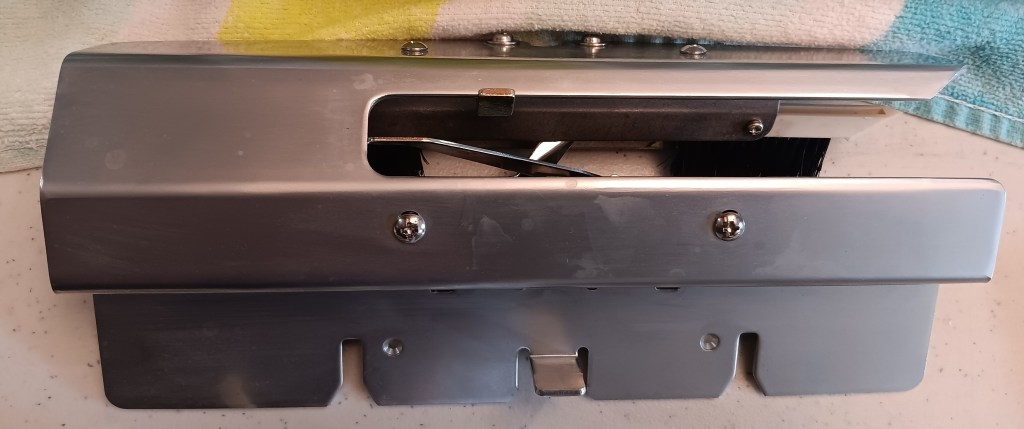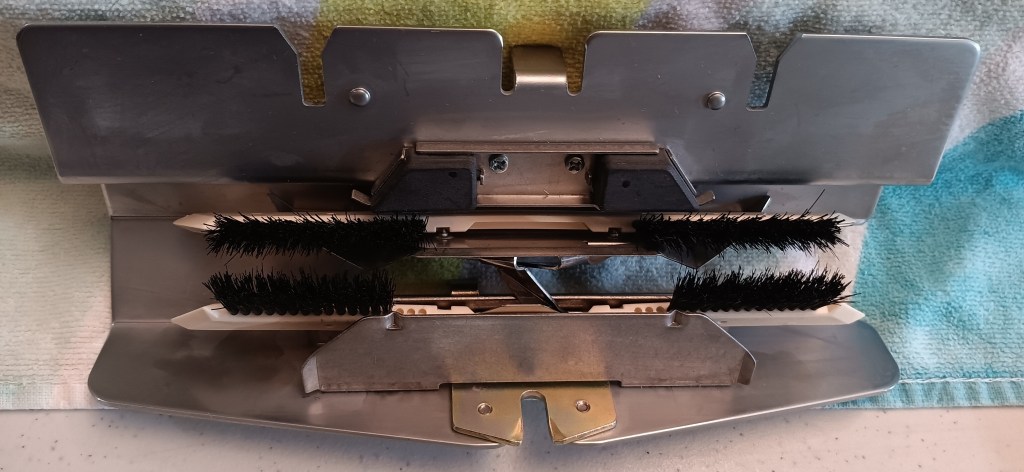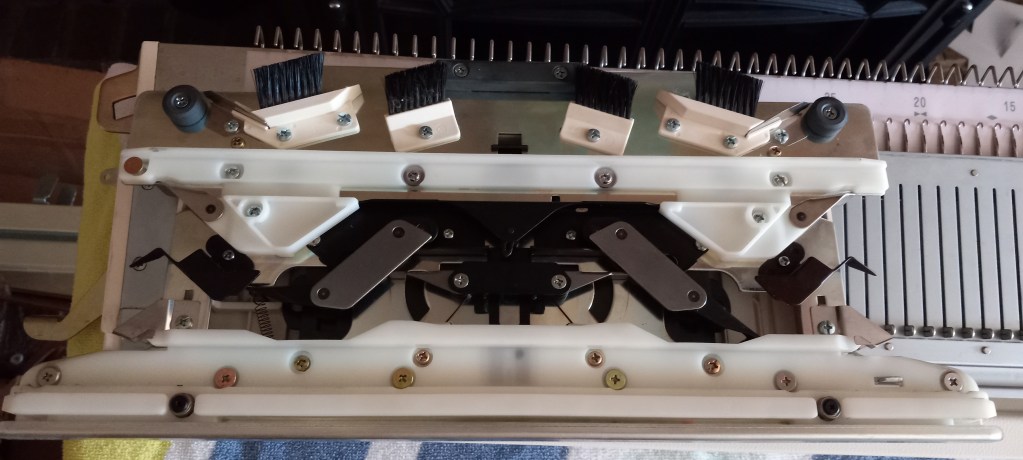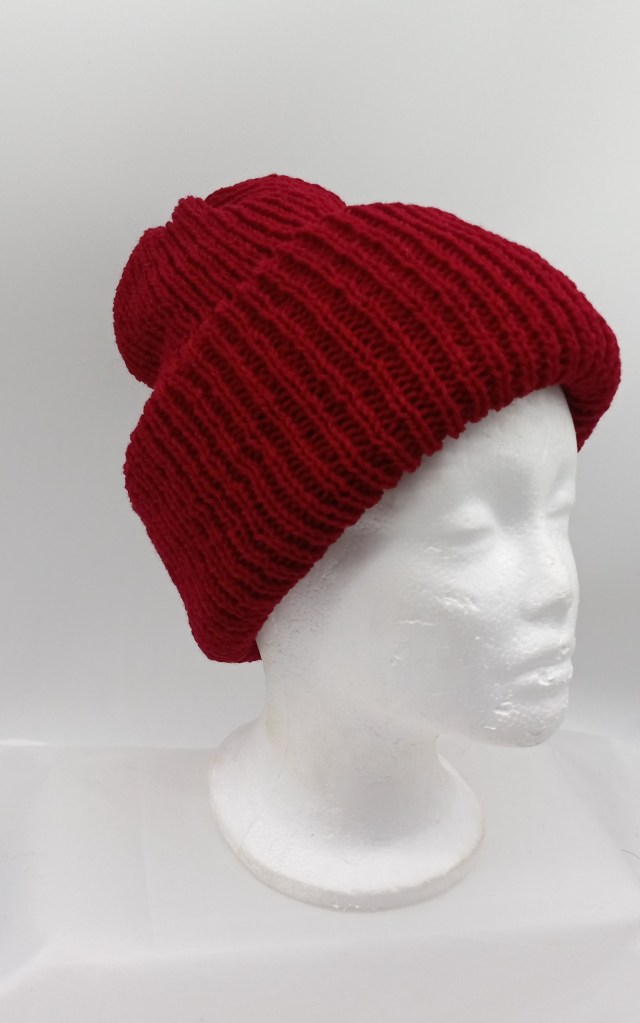
Making button holes when knitting using Brother garter carriage.

It is very easy to make horizontal button holes for small buttons when knitting projects using garter carriages. This blog is a text version of the video posted on the same subject.

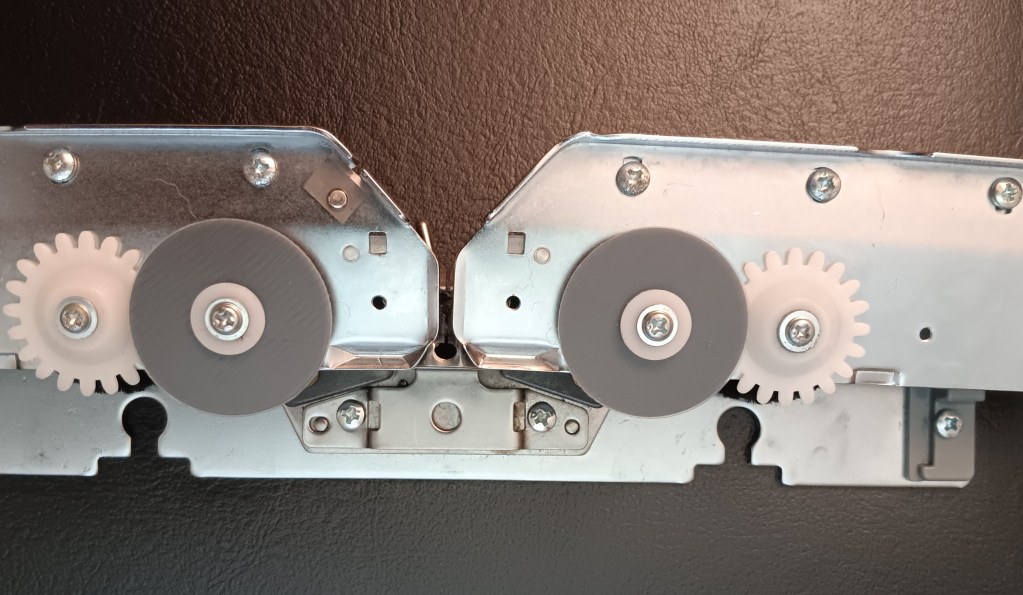
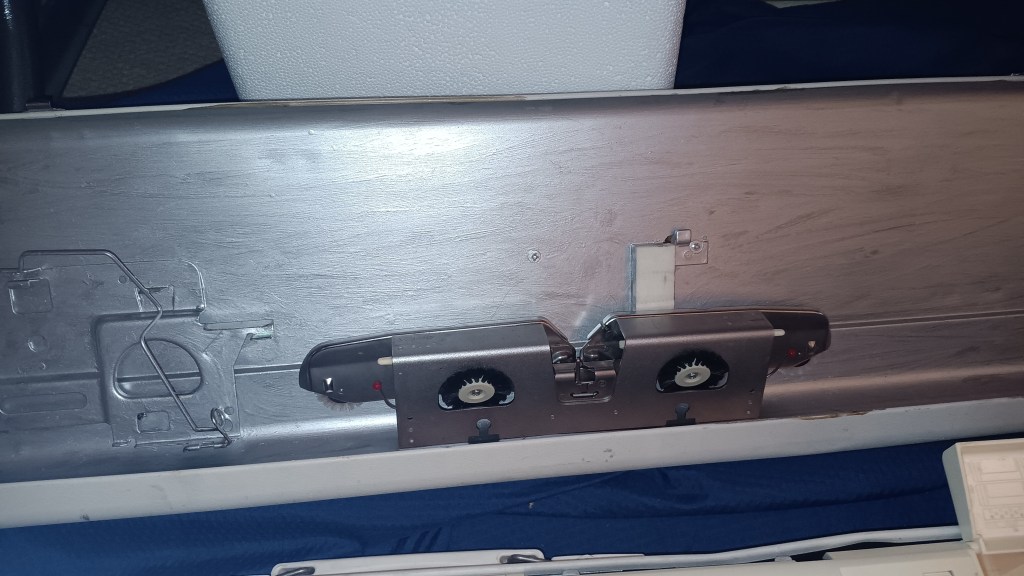
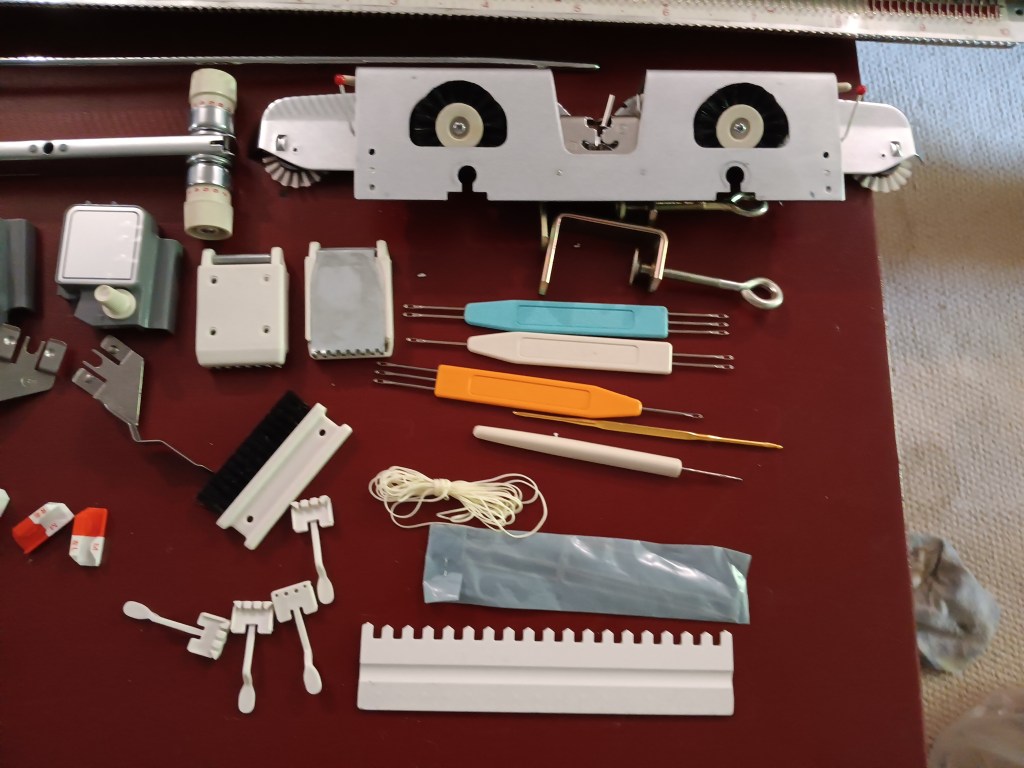
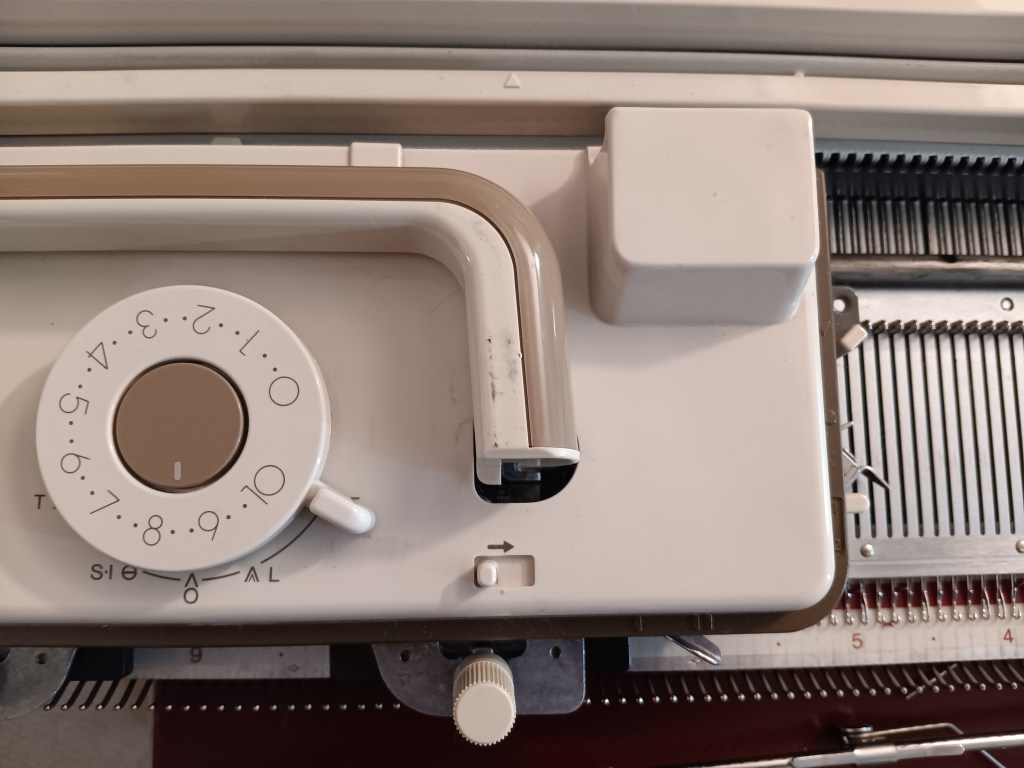
First, decide the position of the button holes. Pick two stitches (in my demo, I decided to pick two sets of two stitches where I knew the machine needles, not the carriage’s, would knit). Move the left stitch out of these two to the stitch to the left of it and the right stitch to the right of it. Push the freed needles back to B position.

Knit one row with your usual pattern. The needles that were empty, now have yarn hooked on them (no stitch formed). Using a double eyelet tool, take the yarn off one hook, twist it, and then put back into a needle. You just formed a loop. Do it for the remainin needles in the button hole.

Continue to knit as usual.

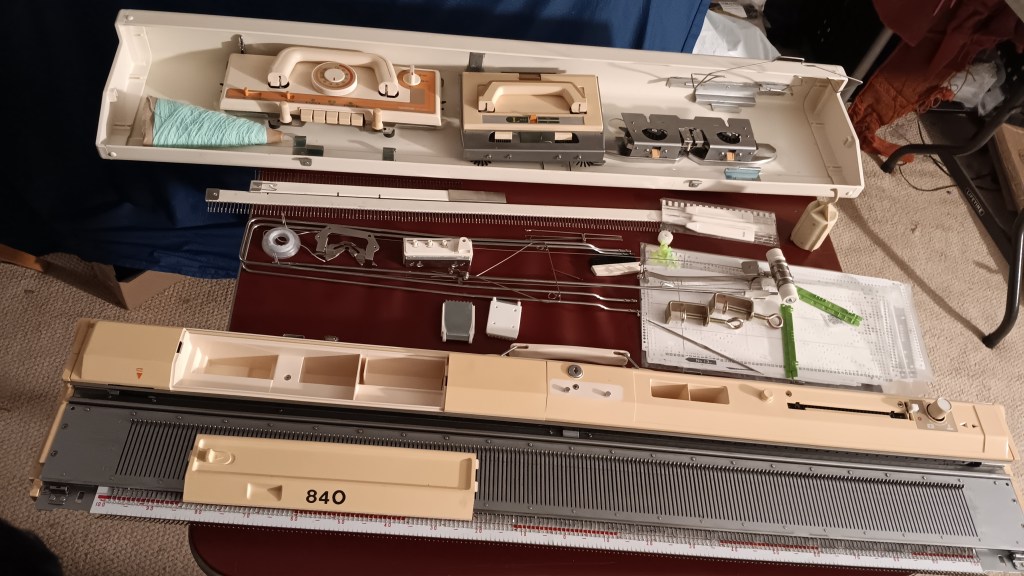
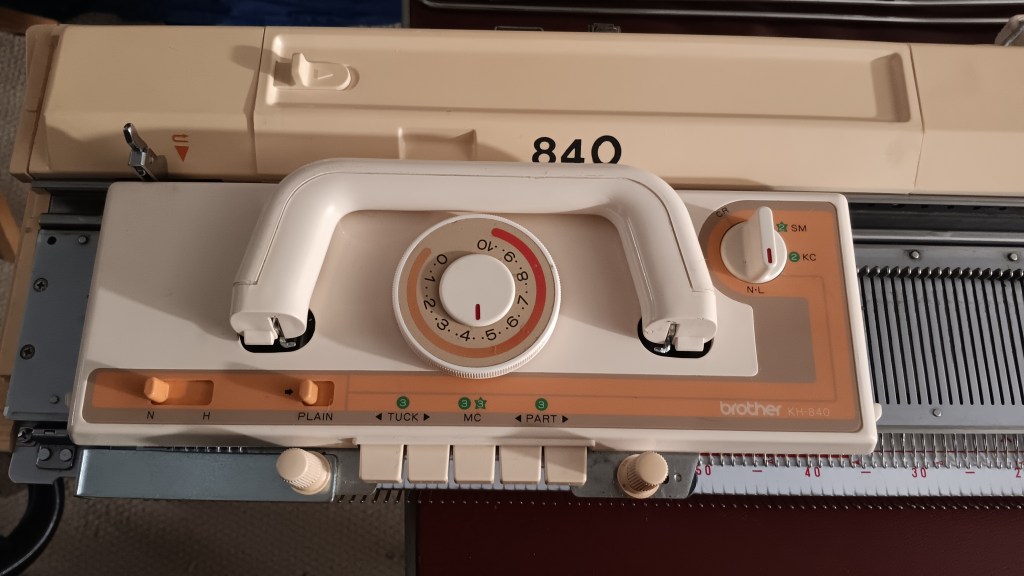
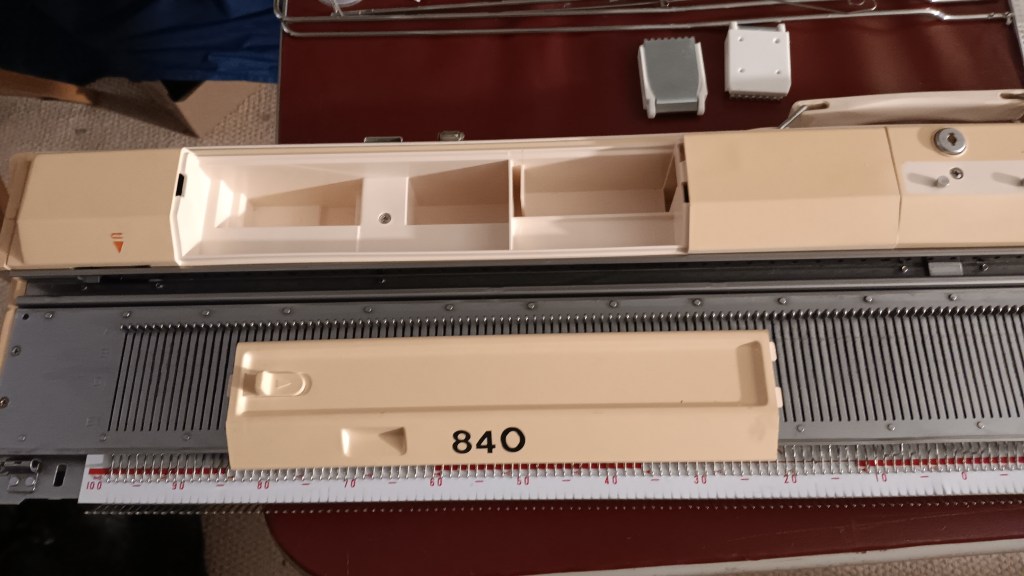
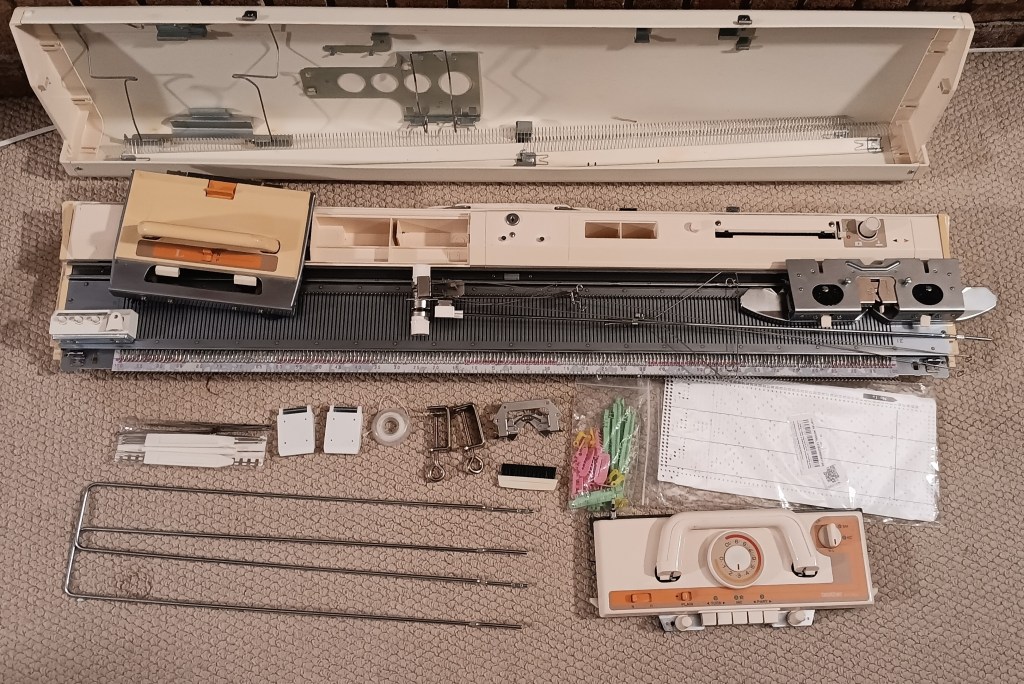
Brother KH840 knitting machine for Ray, December 2025

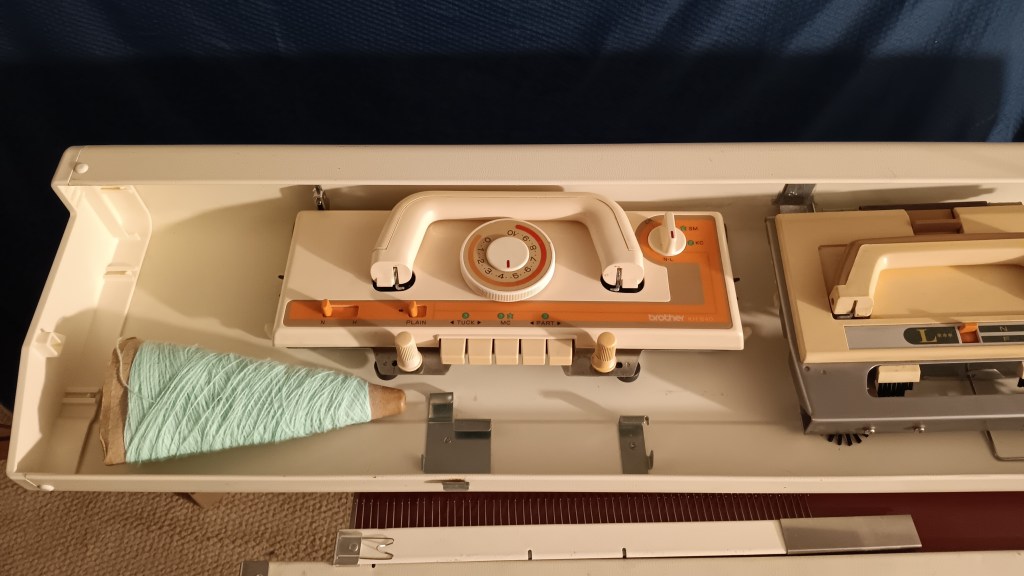
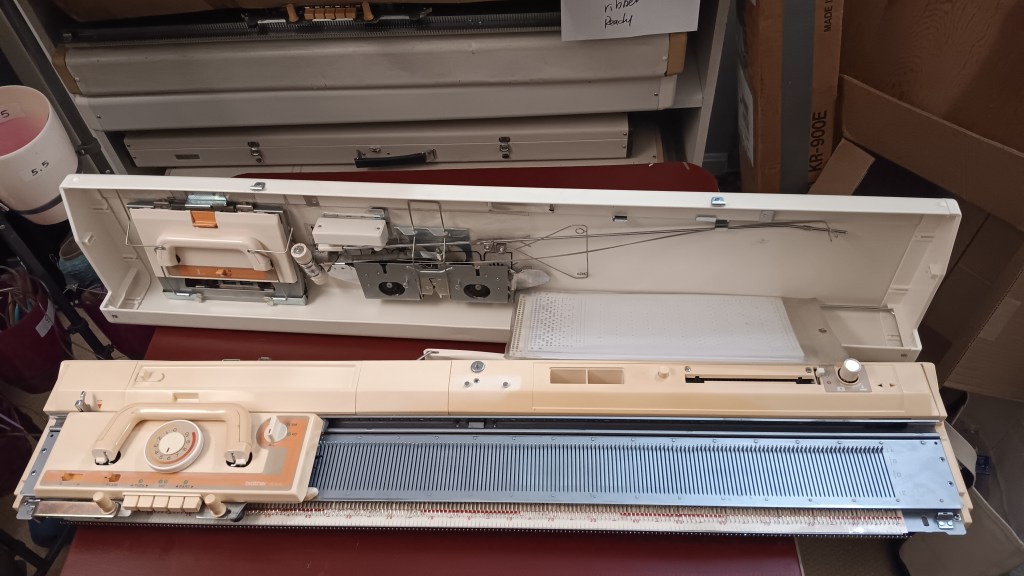
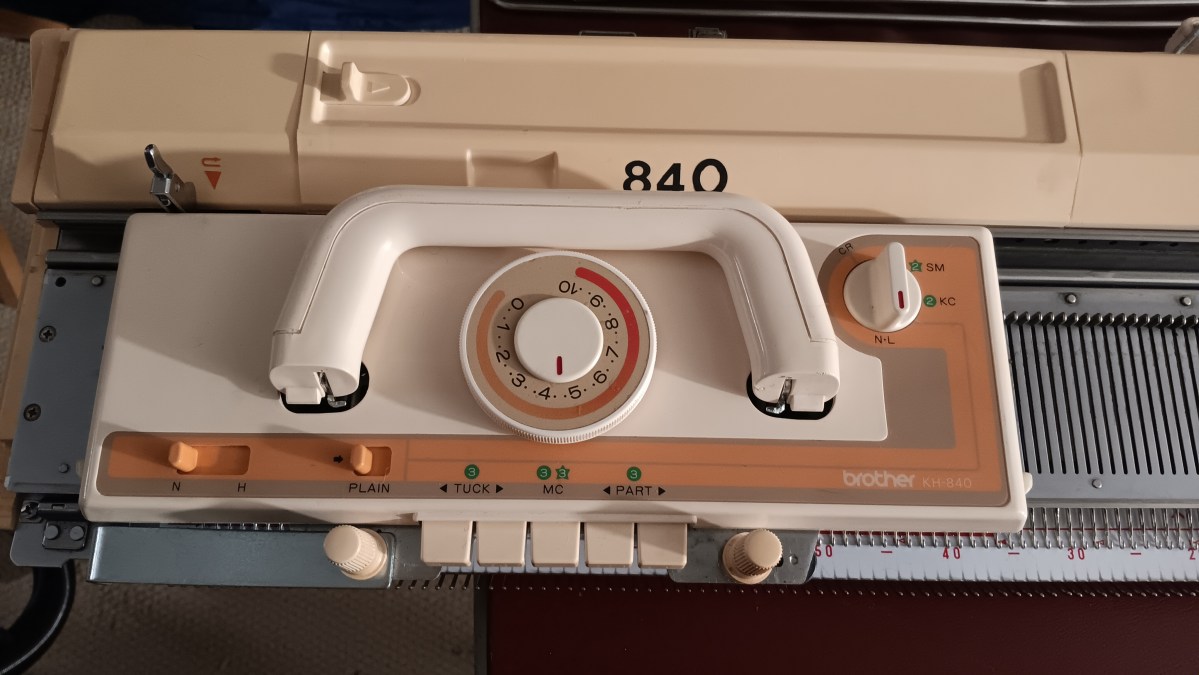
Brother KH840 knitting machine is a standard-gauge machine with 200 needles, 4.5 mm apart, and punchcard reading capabilities for patterning. Read more about the pros and cons of this model in my Knitting Machine Encyclopedia. This post is dedicated to a specific Brother KH840 serviced and tested in my shop in November/December 2025.

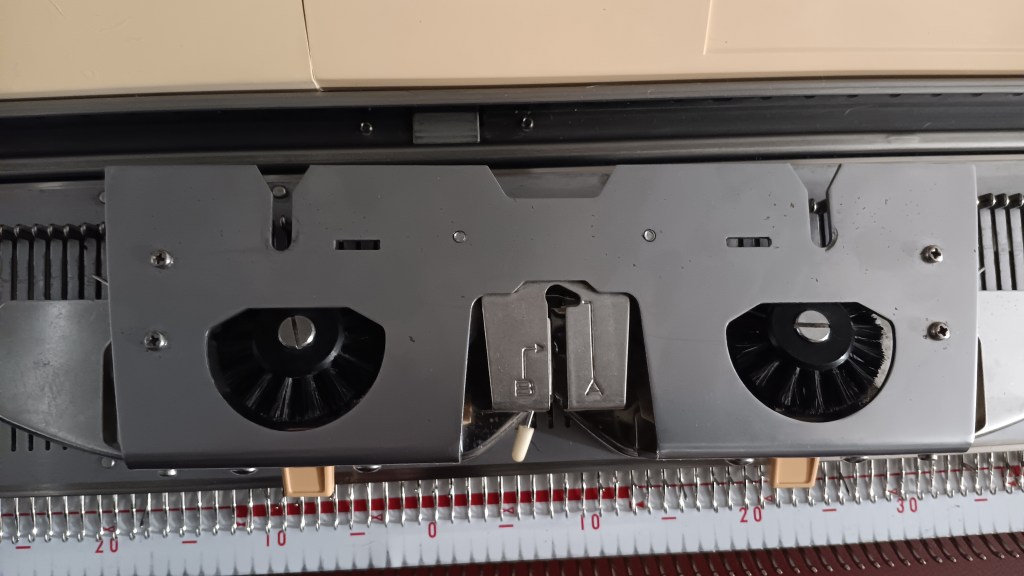
Per my usual routine, I deep-cleaned the punchcard reader, the timing belt cams, and the carriage. I removed all needles, cleaned them, and inspected. First visually and then while knitting on the full bed to ensure all needles (even after they passed the visual inspection) form the correct stitches. See the video of these tests. I knitted tuck, slip/part, and two-color fair isle. All tests went great with no mispatterning.

In the video, I forgot to attach the row counter during my tests. But a new row counter (new stock) will be included with the setup. The lace carriage was not tested but all buttons and levers move freely. It is a simple carriage and does not need extensive testing.

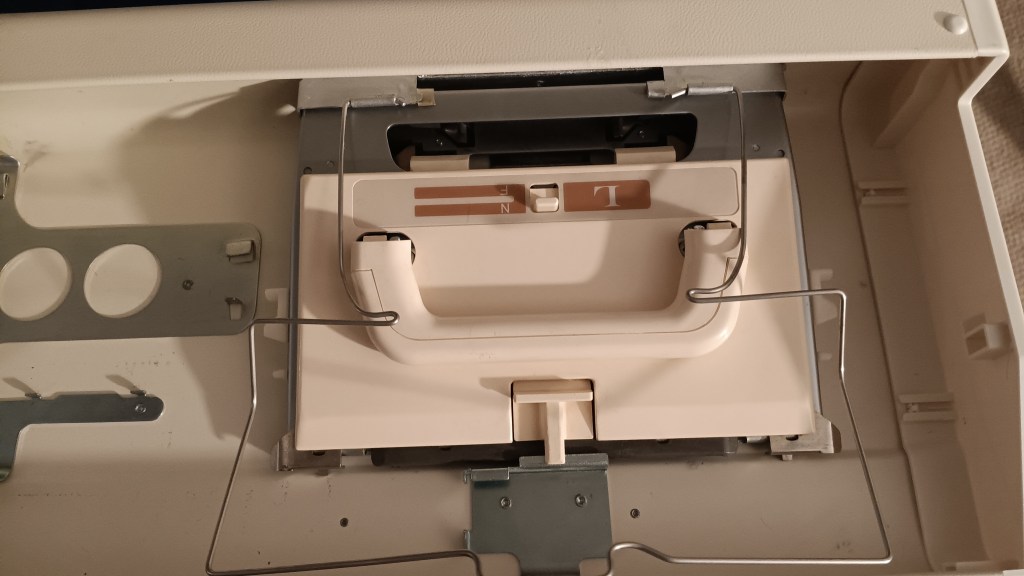
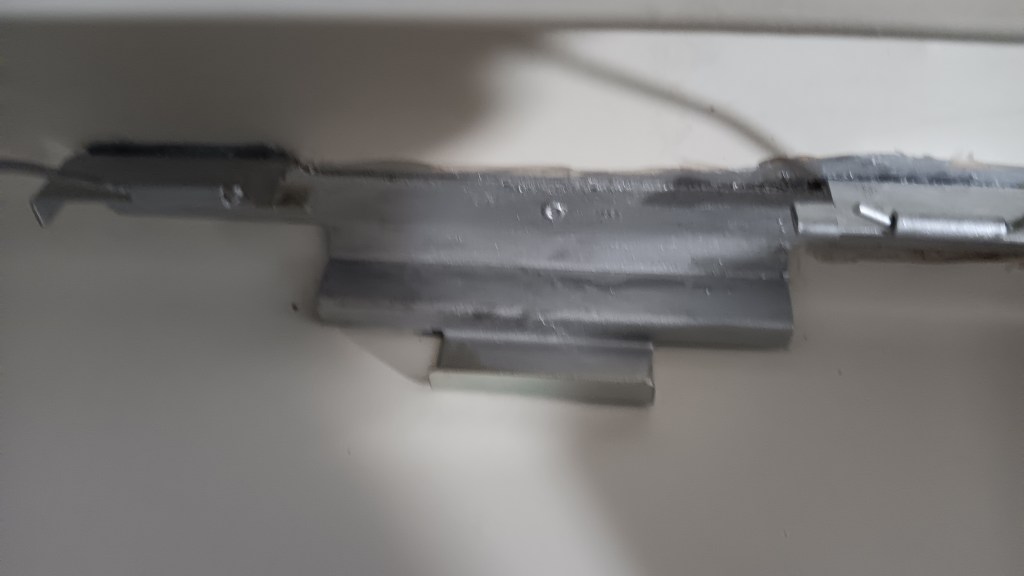
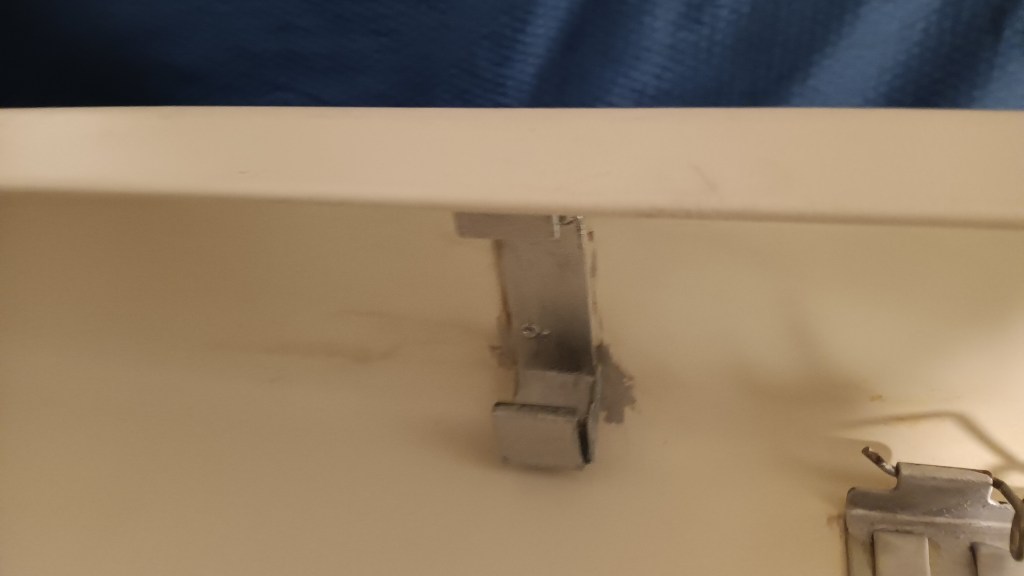
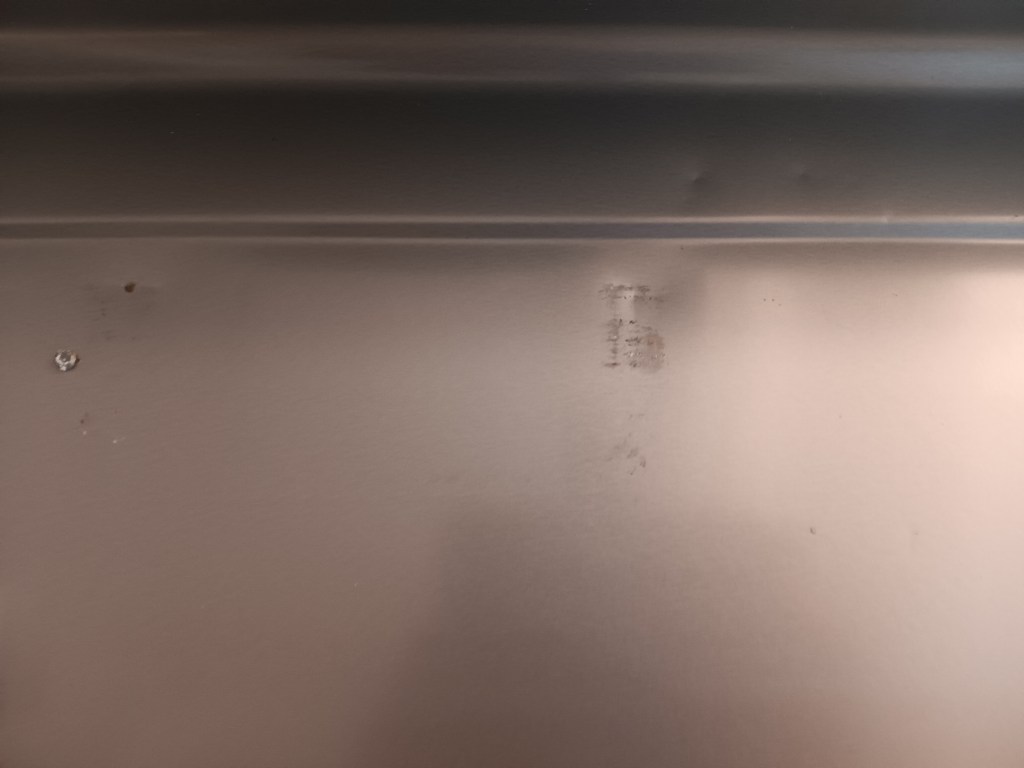
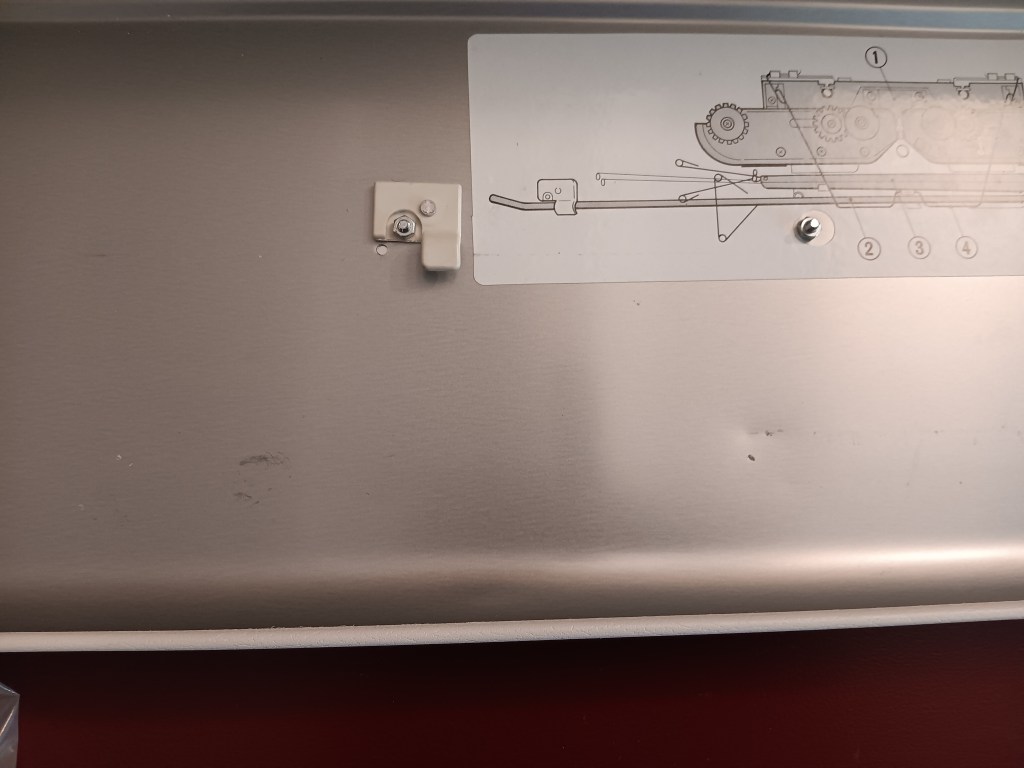
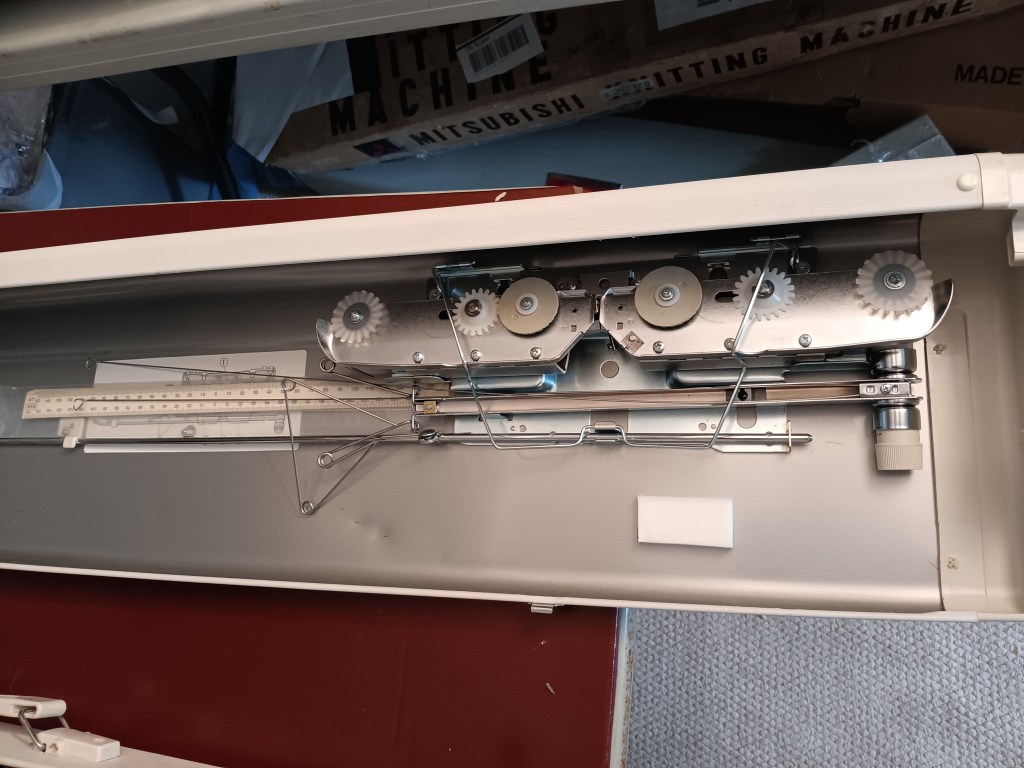
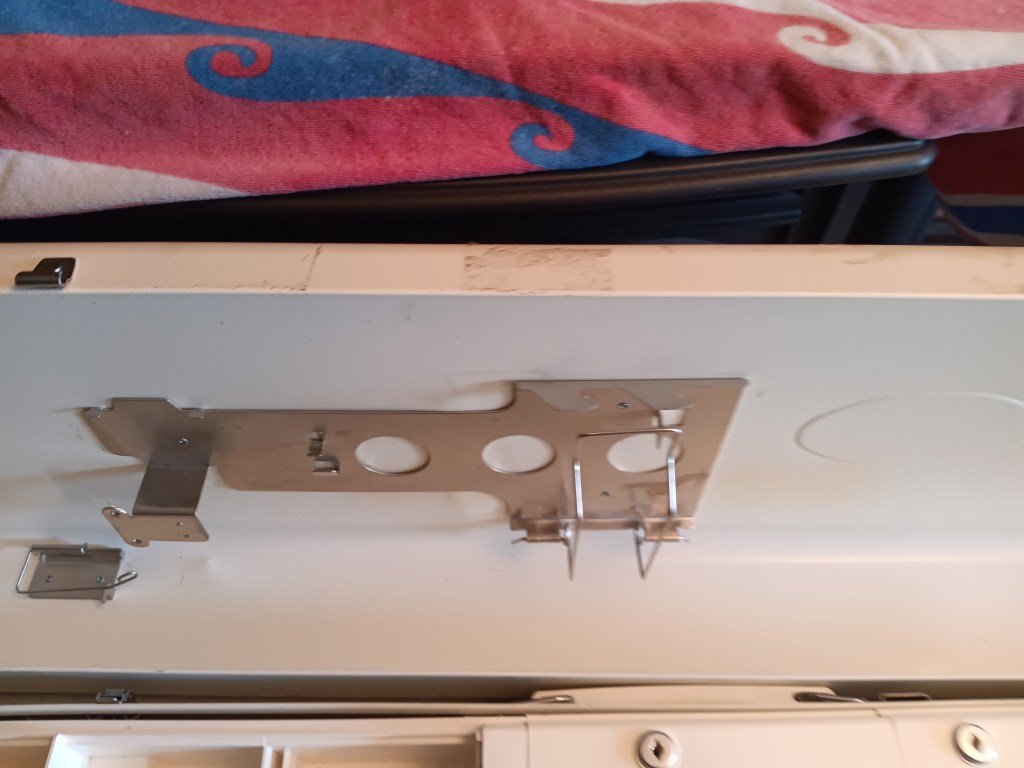
I treated minor rust spots on the inside of the case cover with a protective coating and Rustoleum. The needlebed itself did not have any rust spots.

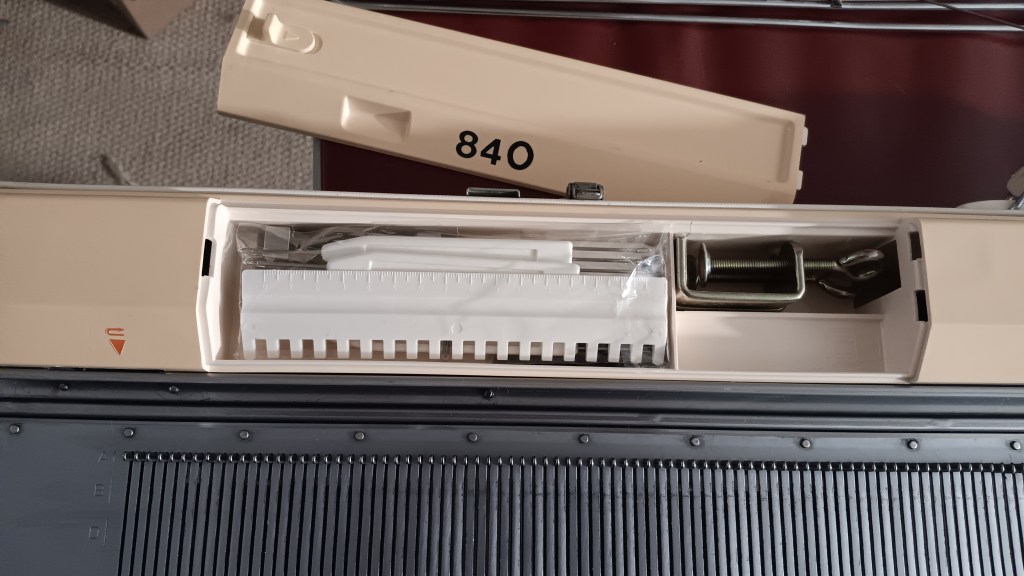
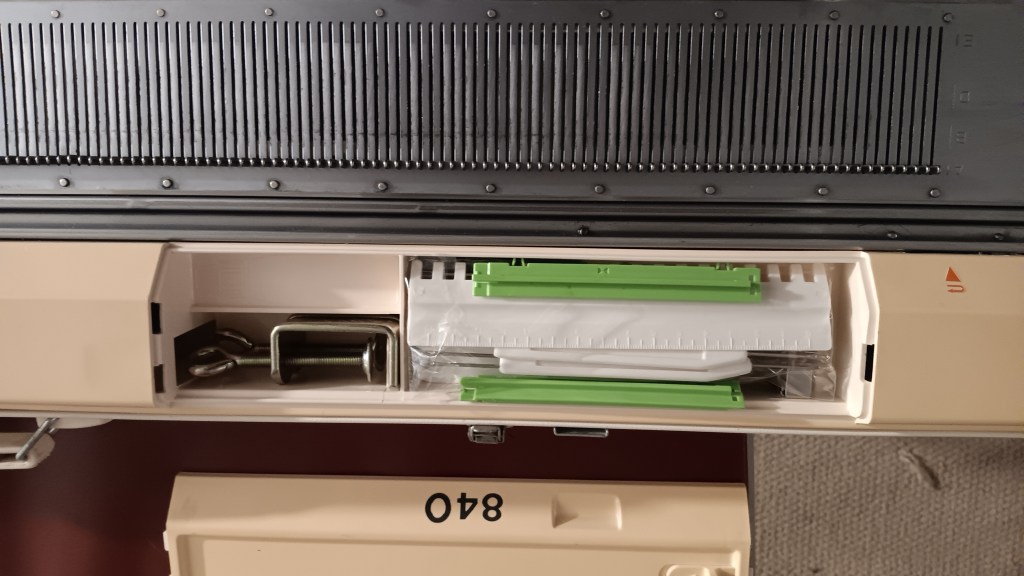
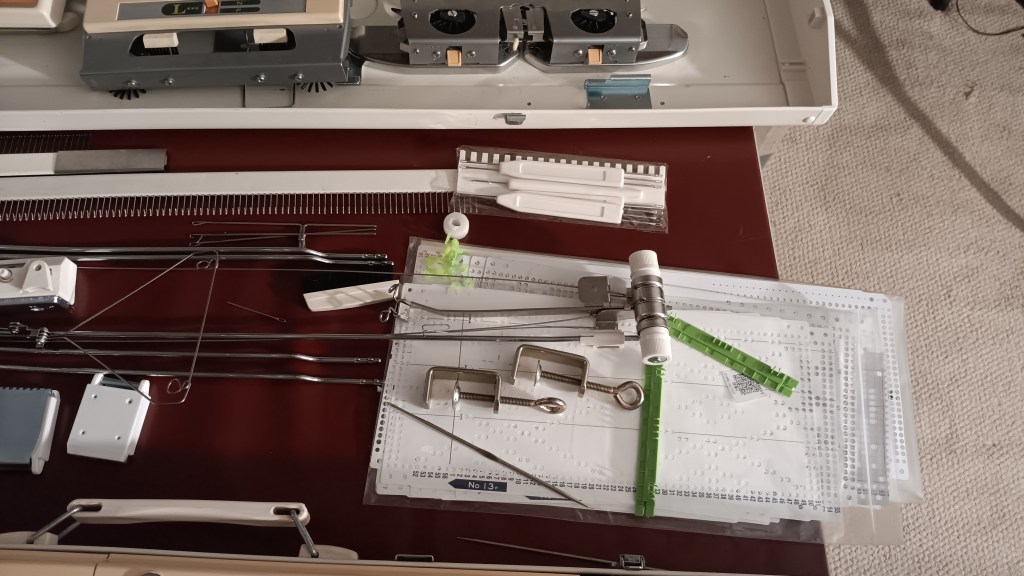
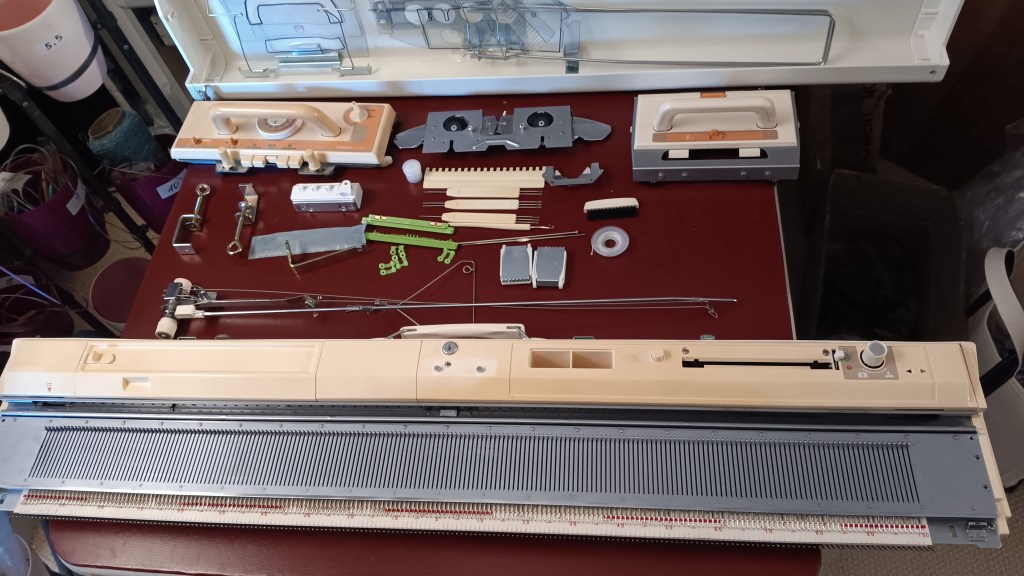
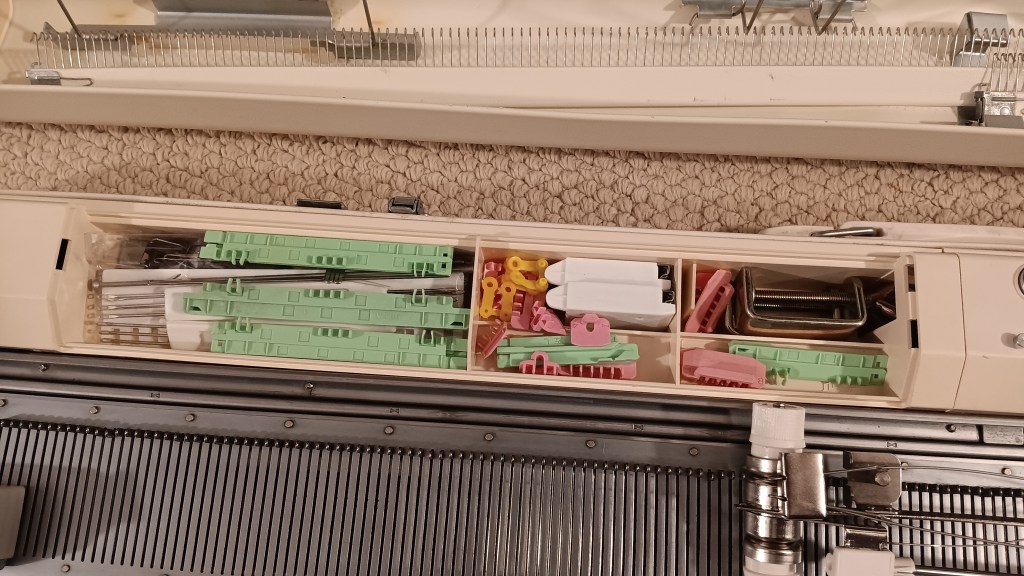
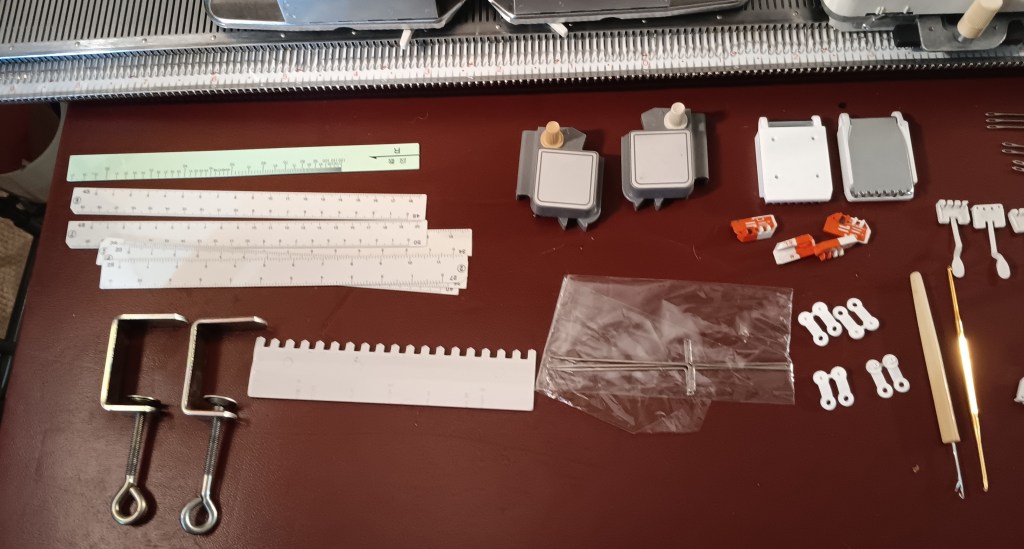
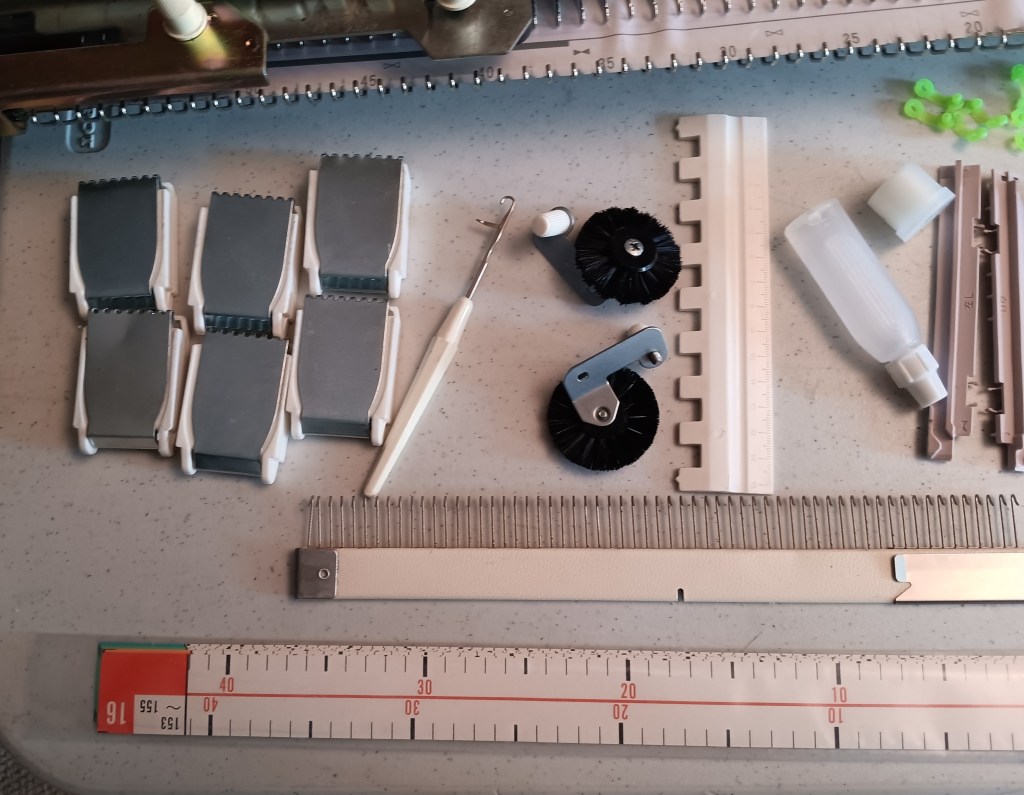
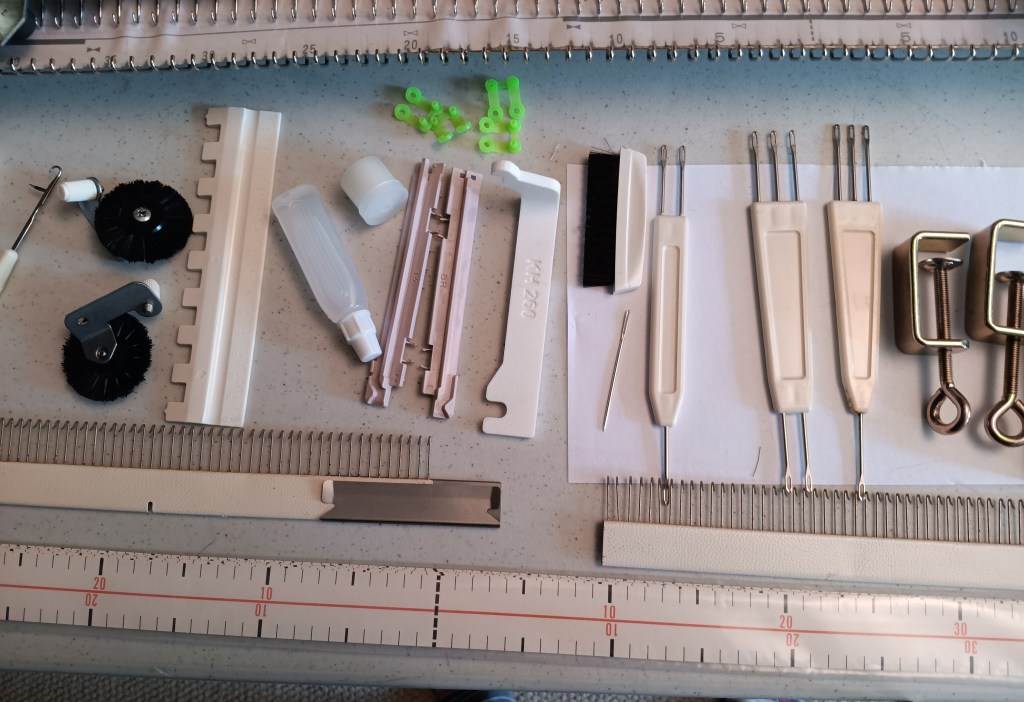
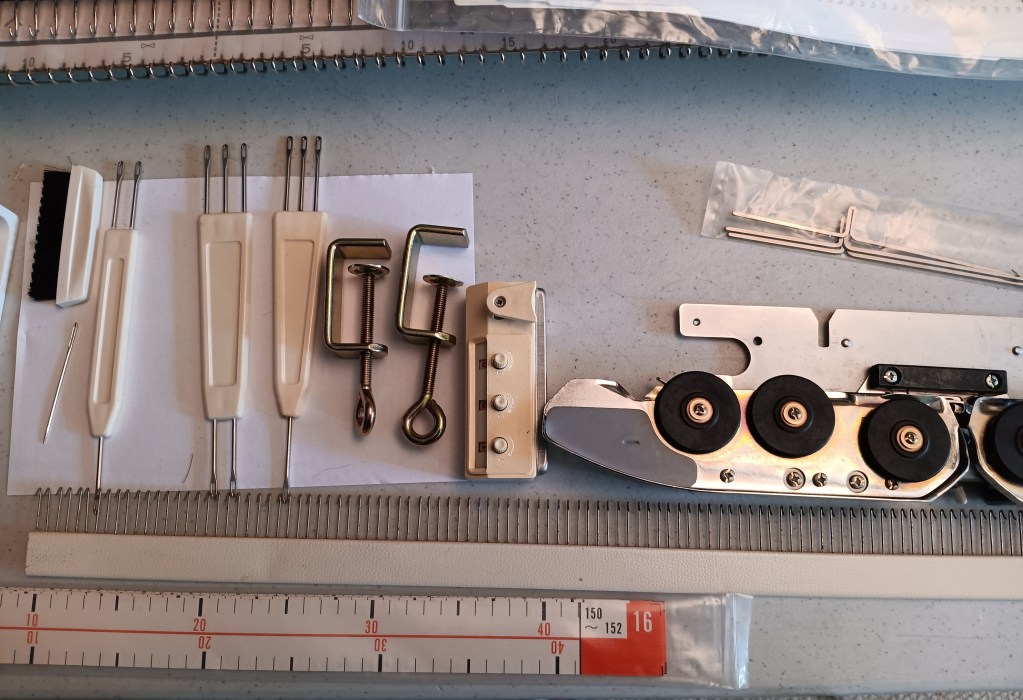
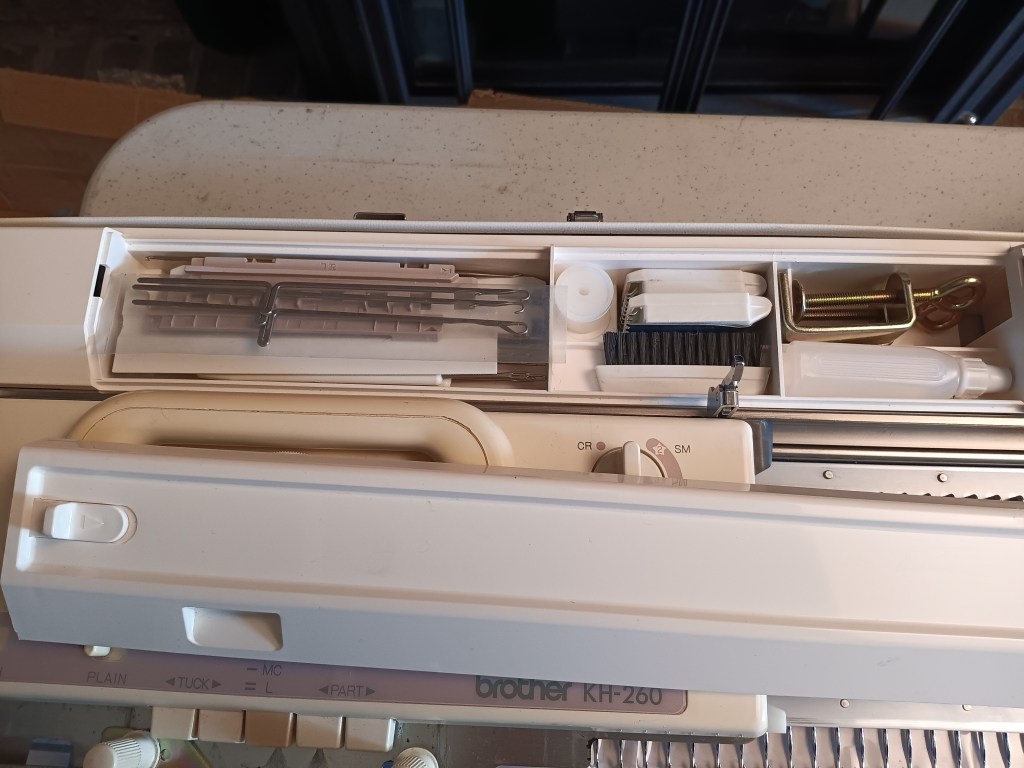
The machine will come with all major accessories and with only some minor accessories missing.

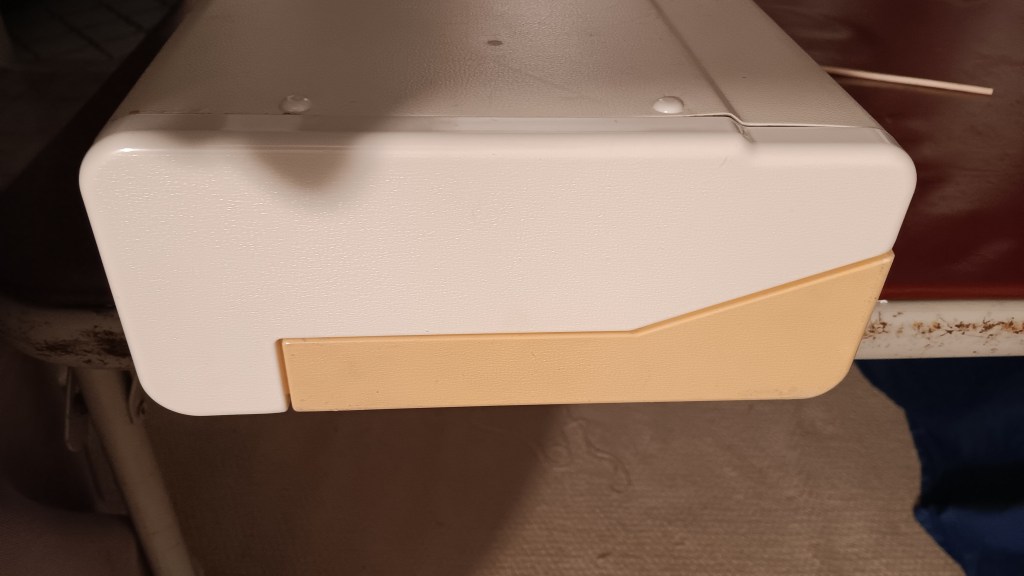
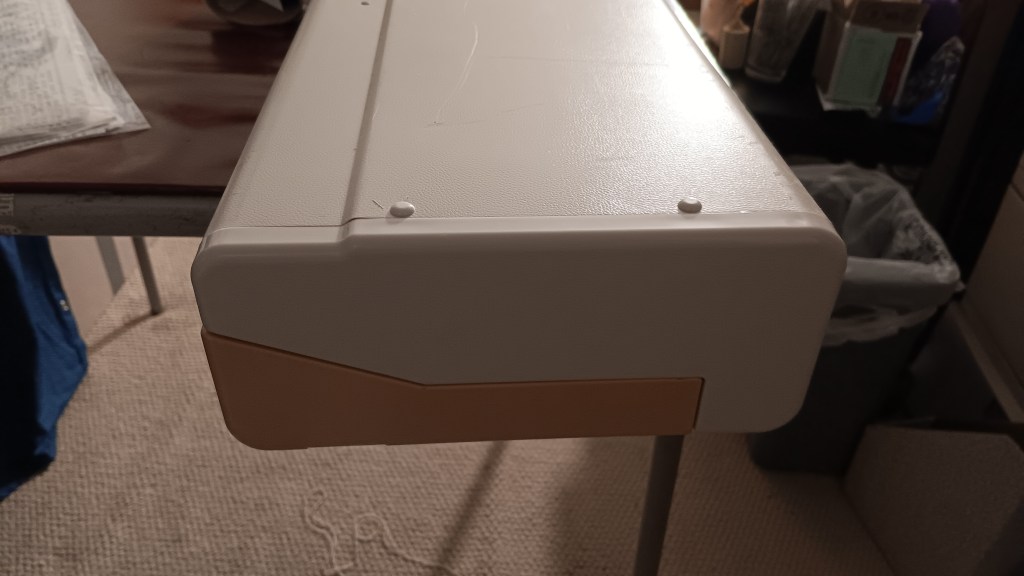
The lid has new plastic end caps. The old ones were cracked. Thus, you might see some color difference between the case end caps and the lid end caps. I also attached the lid end caps with brand new snap clips instead of old, yellowed ones.

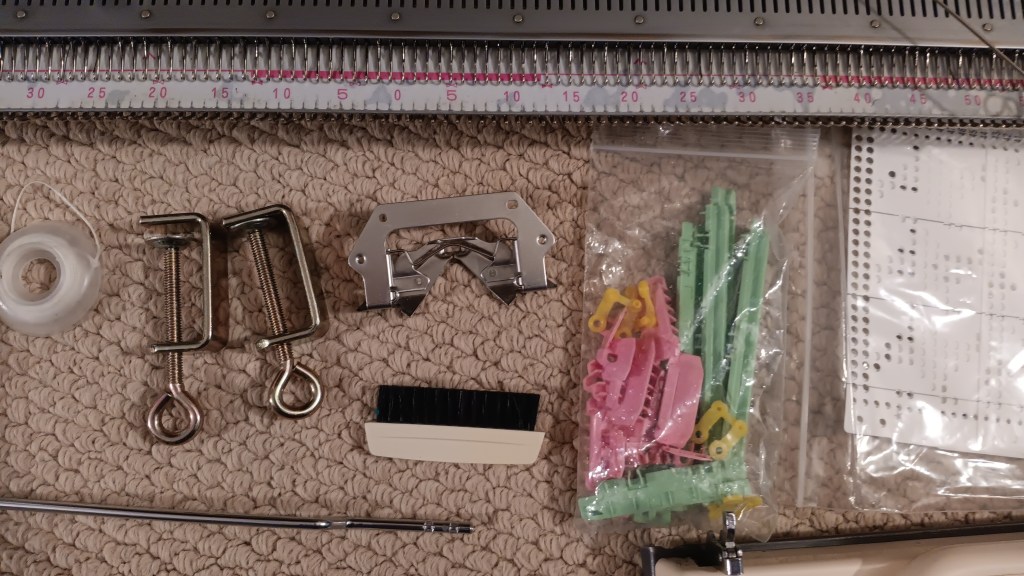
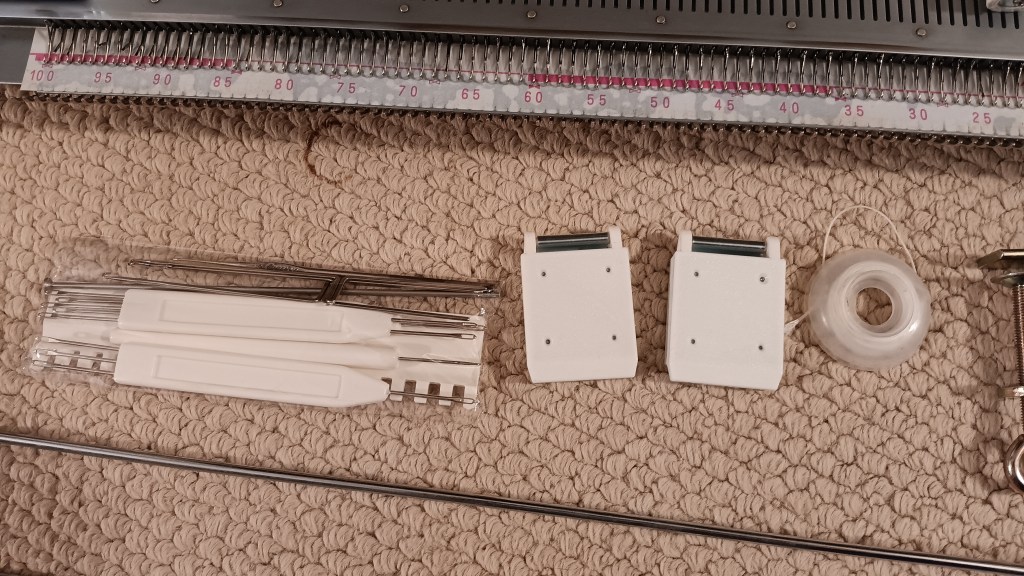
Table clamps, row counter and claw weights are new (new stock).

The missing accessories are:

  • Tapestry needle (any needle of your choice will work)
  • Lubricating oil (use Hoppe’s oil available on Amazon)
  • A hard copy of the manual will not be included, but it is available online for free.
  • The cast-on combs are not original to the KH840 setup but I am including a two-part Brother cast comb with a clip for extension.

All 25 punchcards are included but they are not the original Brother KH840 cards but they are for the Brother punchcard machine. The lace card #25 was damaged, so I replaced it with a card from another set. Some cards match those in the manual, and some don’t.

Imperfections:

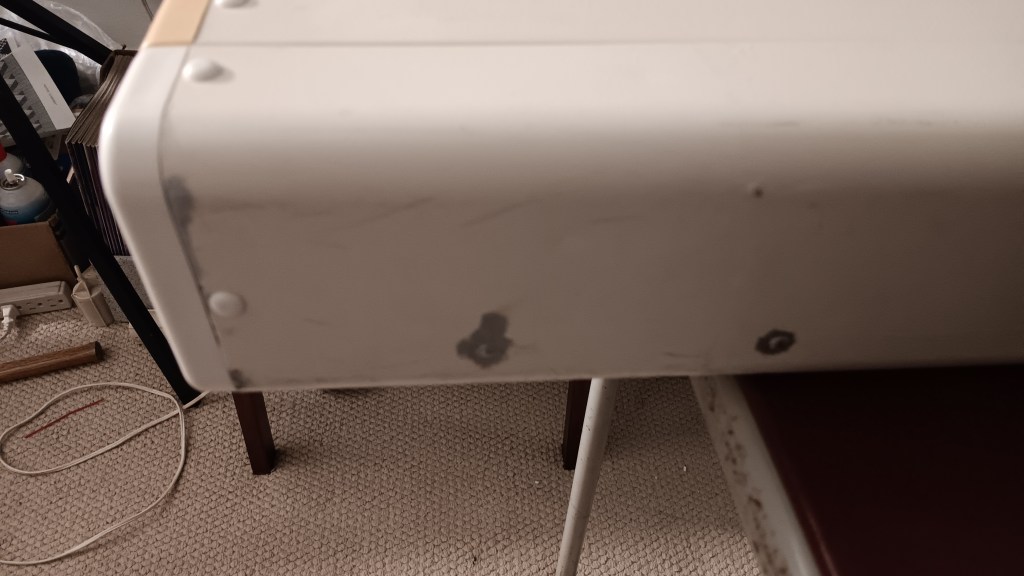
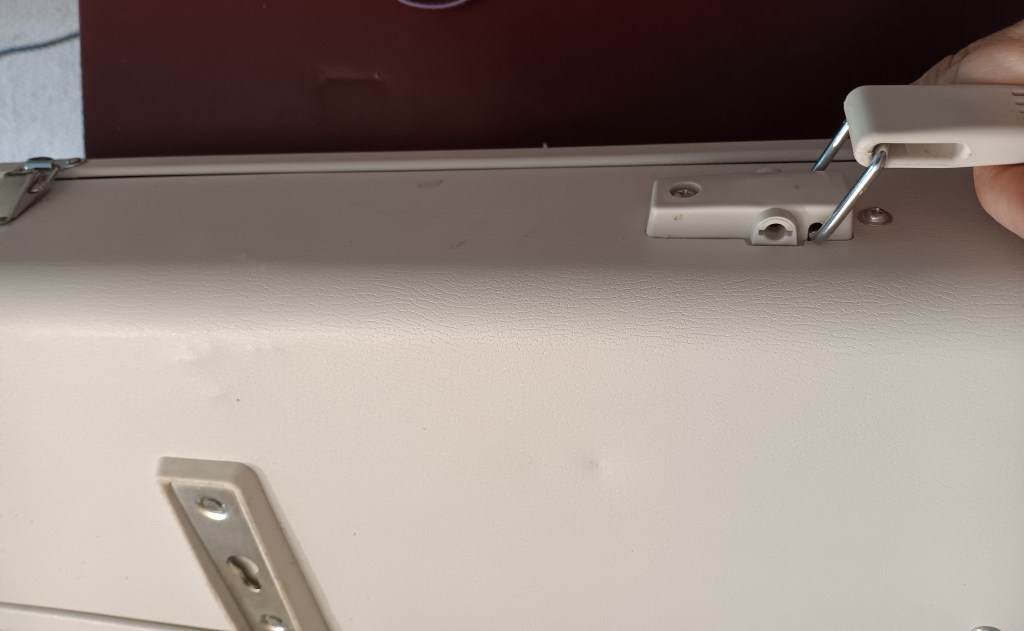
  • The case has some very minor scratches (not shown)
  • some mismatched discoloration because of the age-related yellowing and some parts being new(er).
  • handle for the main carriage has some very minor scratches

After this thorough cleaning, the machine behaved really well despite some minor imperfections.

Brother KH860 machine and Brother KR830 ribber (with KR850 carriage) serviced and tested in November 2025 in my shop

Brother KH860 knitting machine combined with Brother KR830/850 ribbing attachment is a powerful standard-gauge knitting setup capable of producing garments, blankets, and other knitted items. Read more about pros and cons of KH860, KR83,0 and KR850 in my Knitting Machine Encyclopedia. The post below is dedicated to the particular setup serviced and tested in my shop in November 2025.

A typical first step for any needlebed is to remove, clean and inspect all needles. Bent needles or those with bad latches are replaced with new stock. Then I clean the needlebeds and carriages from old gunk and grease. I opened both carriages and cleaned under the lids as well. All the needles were then tested while knitting various fabrics: tuck, slip, fair isle and ribbing (see the videos of the ribber and the machine).

Knitting machine:

I replaced the end caps for the lid and the main bed as they were cracked. You might see slightly different colors between left- and right-hand side plastic caps.

The machine was tested on all needles. I knitted tuck-, slip- (same as part) and two-color fair isle. I discovered several faulty needles during these tests and replaced all of them.

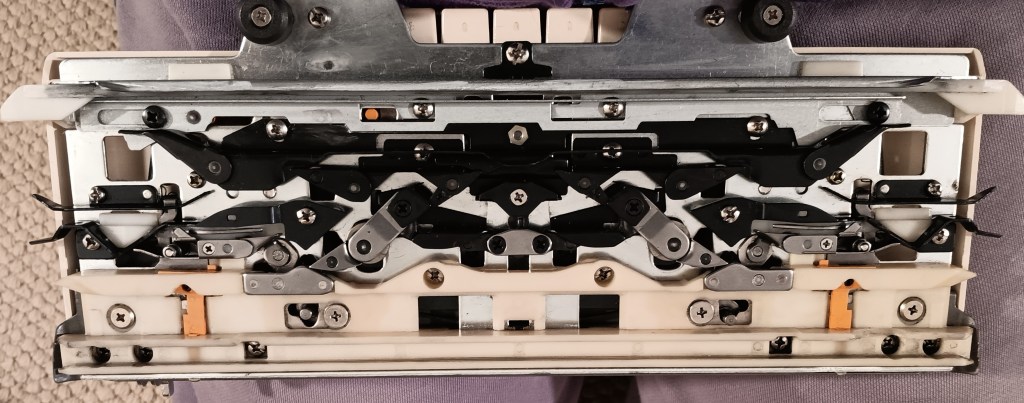
Punchcare reader was cleaned from old grease, insides were cleaned from lint and old gunk. Its functionality and needle selection were tested using card #1, where every other needle is selected on every other row (easy to see if there are any problems).

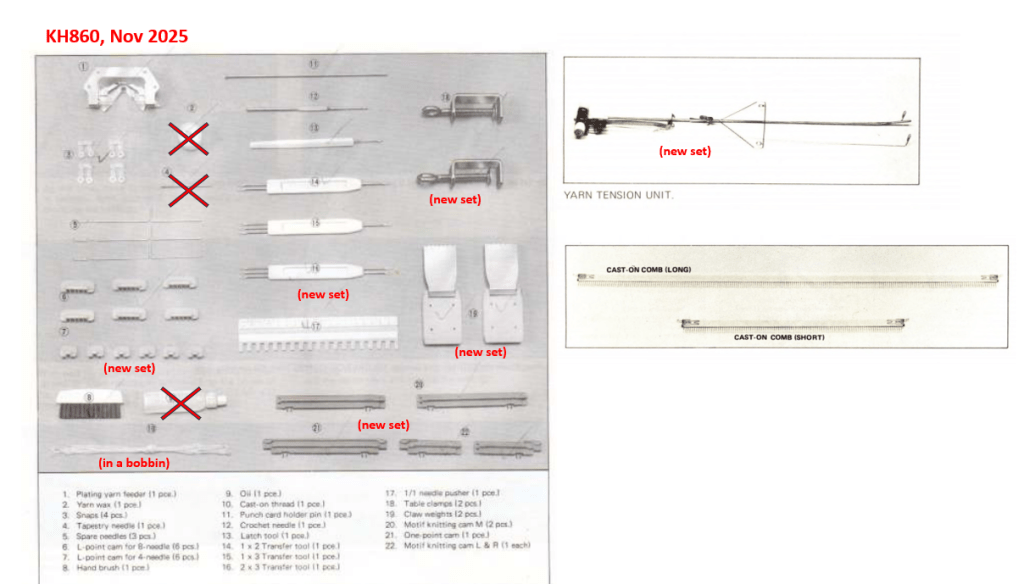
The machine came without many accessories, but I collected a nice, almost all-new stock of accessories.

The missing items are: oil (use Hope’s oil, available on Amazon); a tapestry needle (any needle of your choice will work); and wax.

Brand new (new stock) Brother row counter. Because it is new, its color is lighter than the plastic panels of the needle bed (they show yellowish discoloration due to the sunlight, which is typically seen with these machines).

The cast-on combs are in good shape, too.

New tension mast (new stock). A tension mast that came with this machine did not include a slot for the wax and a slot for the garter carriage sensor. The only “original” accessory is probably the carriage lock.

This KH860 does not include built-in garter carriage rails (in the past, I worked with some KH860 that indeed include those).

Imperfections:

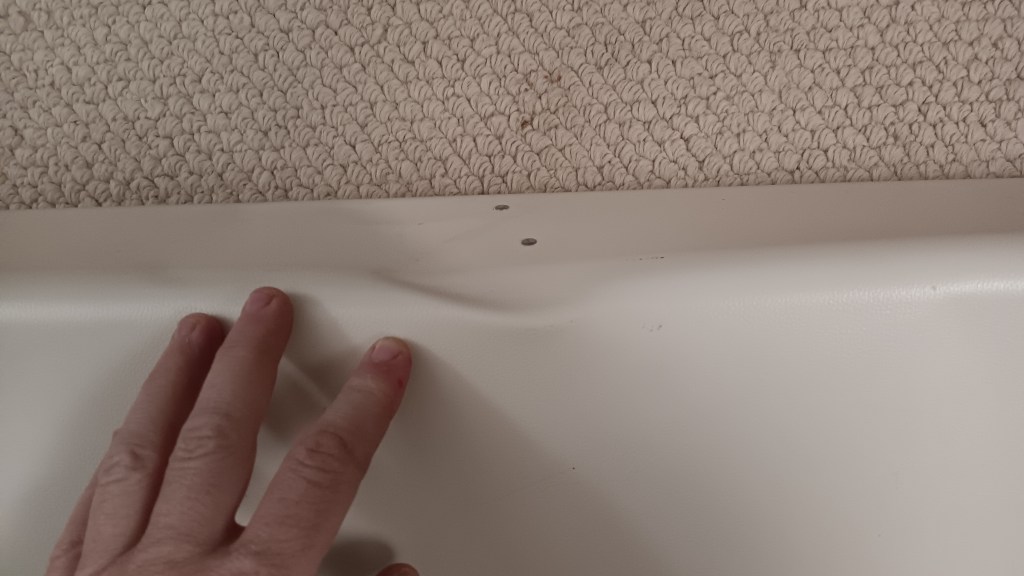
  1. Overall, the machine is in great shape. The case and the case lid are in good shape. The lid has one medium-sized ben,t but overall is almost free from scratches and scuffs.

2. Carriage has some minor rust spots on the plate where the sinker plate attaches, which I treated but not painted with Rustoleum (it sometimes creates too thick of a layer and might prevent smooth gliding). No rust inside the carriage or on the undercarriage side.

3. The lace carriage has a superficial crack and some minor scuffs on the handle.

4. The retaining bar with a newly replaced sponge strip goes in with a bit of effort. This configuration is the only one out of several I tested (I had to reglue several different sponges) that provides 100% accurate patterning on the whole bed. If the tape on the ends wears out (which happens if you remove the retaining bar often to replace needles, etc.), just tape with very thin medical tape with just one (non-overlapping) layer. Medical tape is the best because if it comes off, it is not as gluey as other tapes (like electrical tape).

Despite all the imperfections and a couple of missing minor accessories, the machine works great (see the video). The carriage slides on all needles (without yarn) very easily, with just one hand, with different carriage settings. Even with the yarn, it glides easily.

RIBBER:

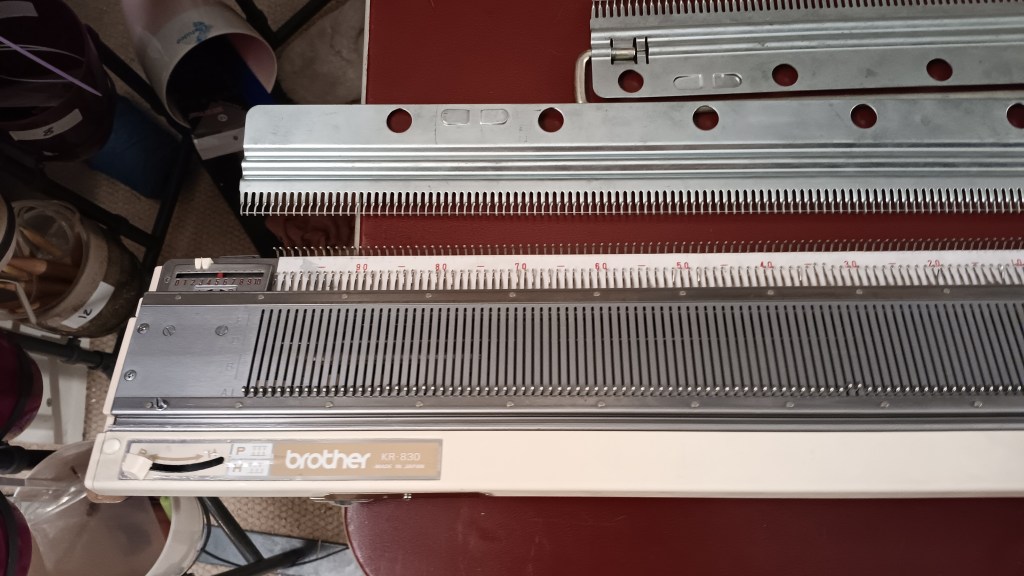
The ribber bed is KR830 model but the carrigae is for the KR850 (the lili buttons are a give-away).

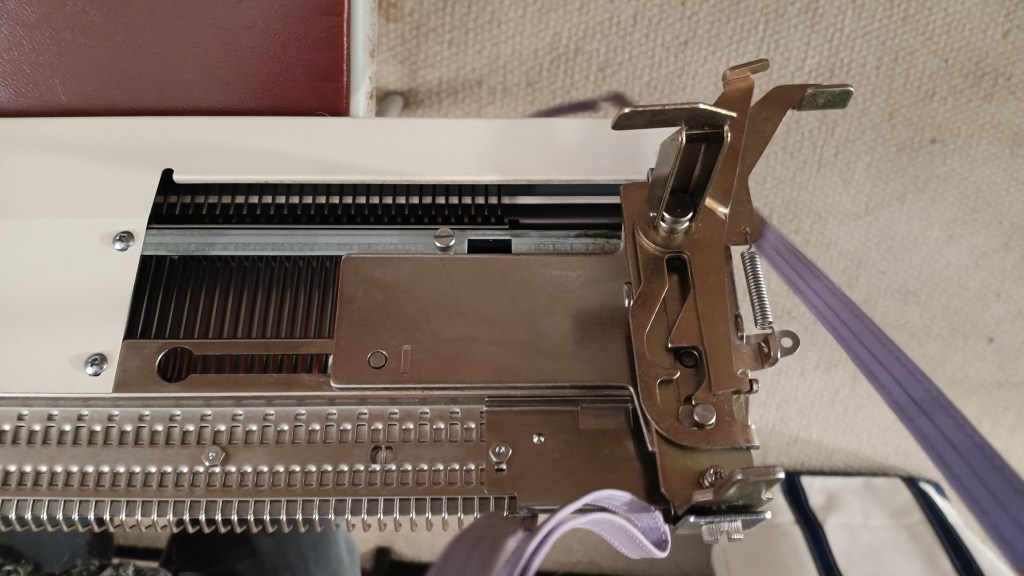
The carriage was deep-cleaned and inspected. All buttons, levers, and pressers work and move smoothly (see the video).

The ribber brackets were cleaned of old grease to ensure smooth movement (but you don’t want it too smooth to prevent the ribber from unplanned sliding down).

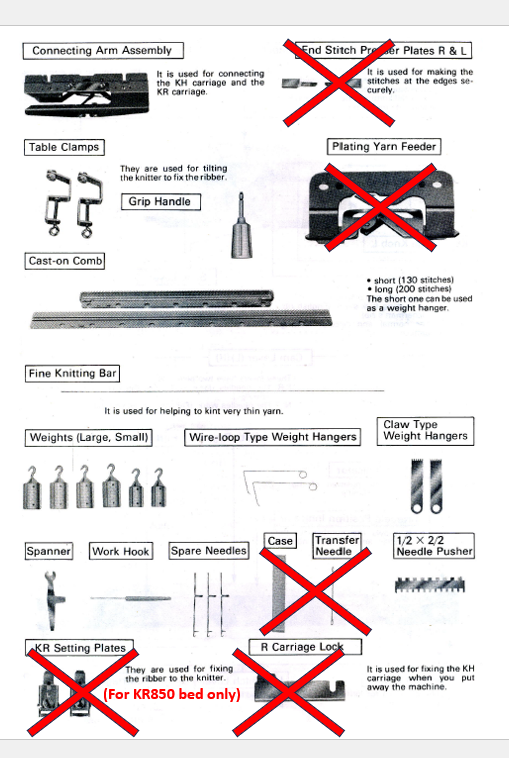
The machine comes with all accessories (including a hard copy of KR850 manual; KR830 can be found online). When attaching the needlebed, refer to the KR830 manual. When operating the carriage, refer to the KR850 manual. I do not have a plating feeder at the moment; that is an accessory to the KR850 carriage. Nor do I have the pressers (when I knitted, I did not use them at all). My understanding is that these are not all that critical. Most knitters do not get that advanced in choosing plating.

KR830 accesories
KR850 accessories

The ribber was tested using two different combinations of every other needle (it is easier to knit on every other needle than on all needles: problems associated with yarn and tension selection are less pronounced) to ensure that all needles form the correct stitches. I used two separate yarns but they are only different by color.

BTW, I am including the yarn I used while testing the ribber (the bluish one) for you to practice with a knwon-to-work thread

I am also including a manual for the KR850 for the carriage functions. I do not have a spare manual for the KR830 but it is available online for free. The only difference between KR830 and KR850 beds is the brackets: how they are inserted and attached to he main bed. All other settings and functions are the same. As a result, some of the accessories that typically come with the KR850 ribber bed will not be included with this KR830 bed.

Imperfections of the ribber:

  1. The cast-on combs are not as smooth as I wished, but the yarn does not get pulled. So I left them alone.
  2. The knob for the I-II change lever (at the bottom of the carriage) is in a bit rough shape. But it sits pretty tightly, so I left it along.
  3. When attaching the connecting arm to the main carriage, sometimes the plastic from the oister screw-on knobs comes off as small shavings (the metal screws rub against the thread on the oister knobs). It is pretty typical for these old machines.

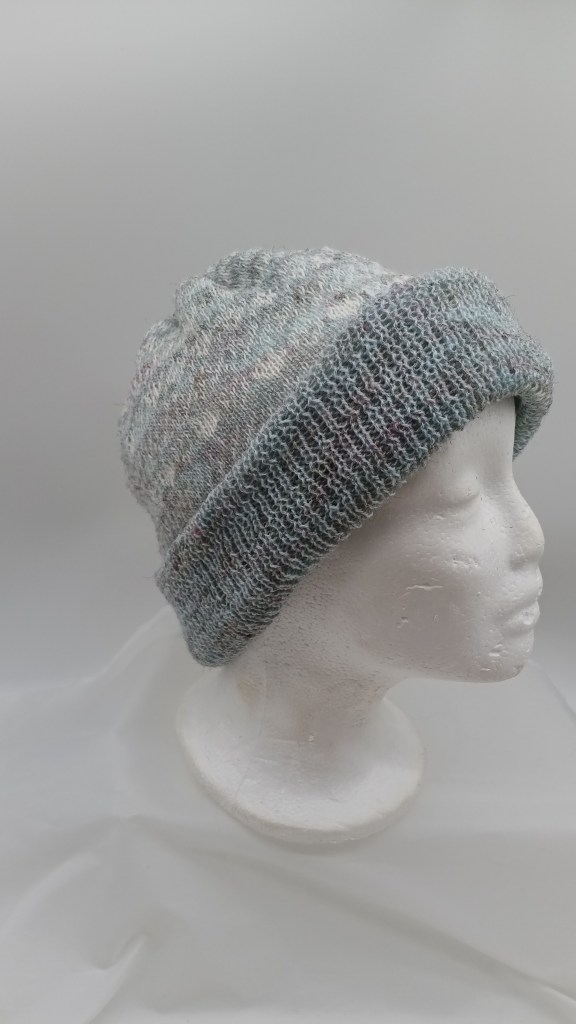
These imperfections are mostly cosmetical. They still did not interfere with me knitting several pieces of fabric that I converted into the items below.

Gift bag

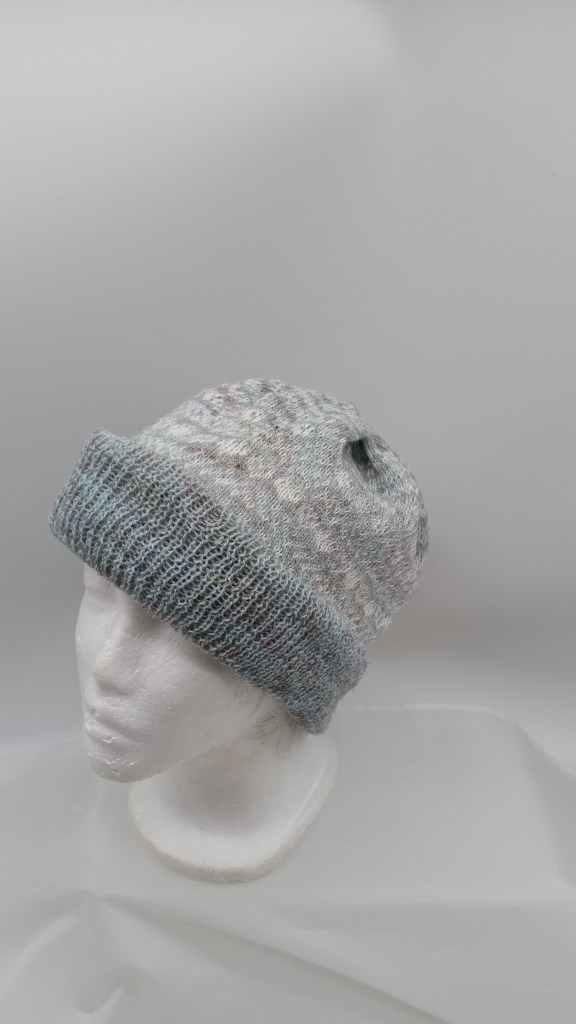
Hat:

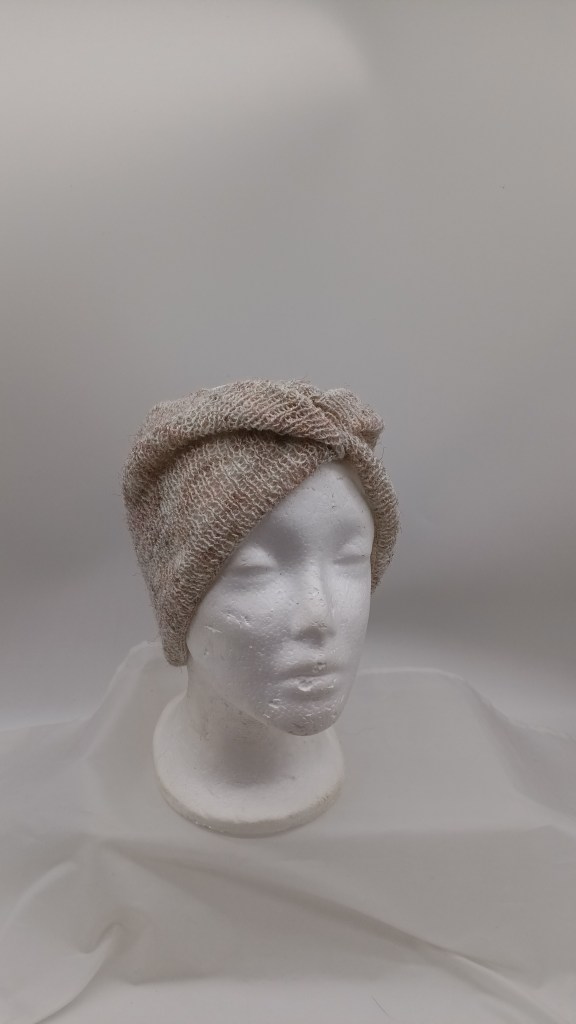
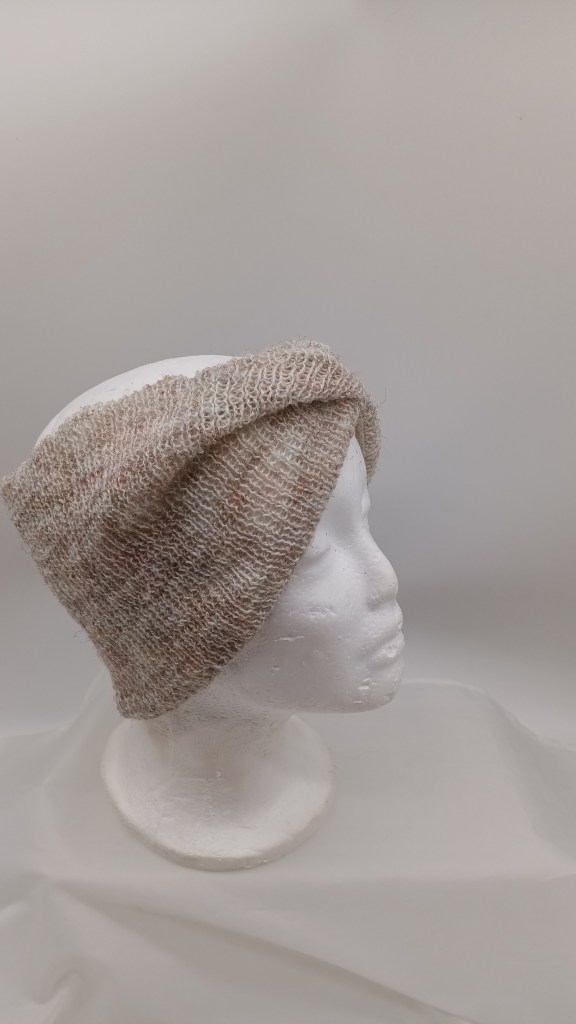
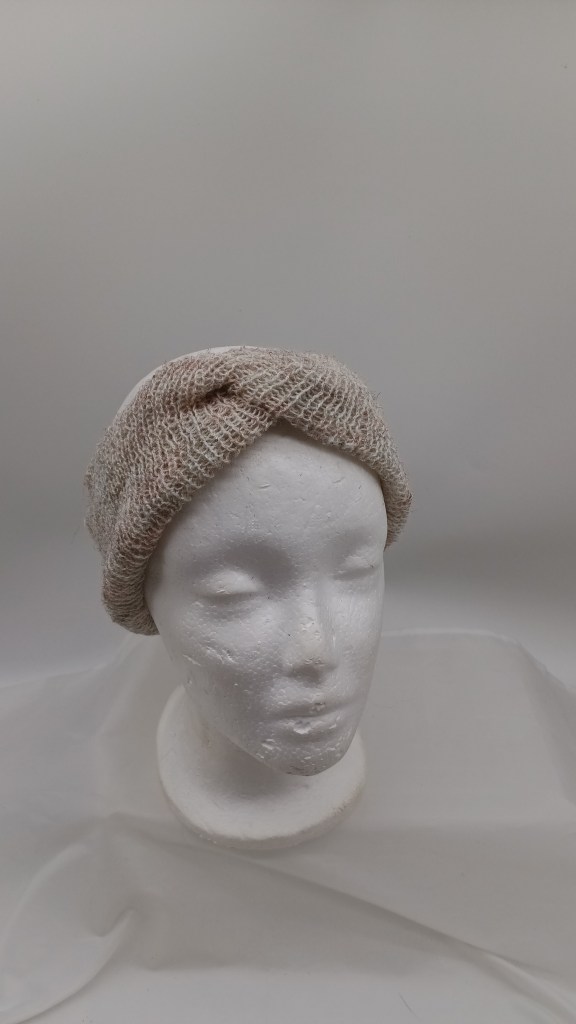
Ear warmer/head band:

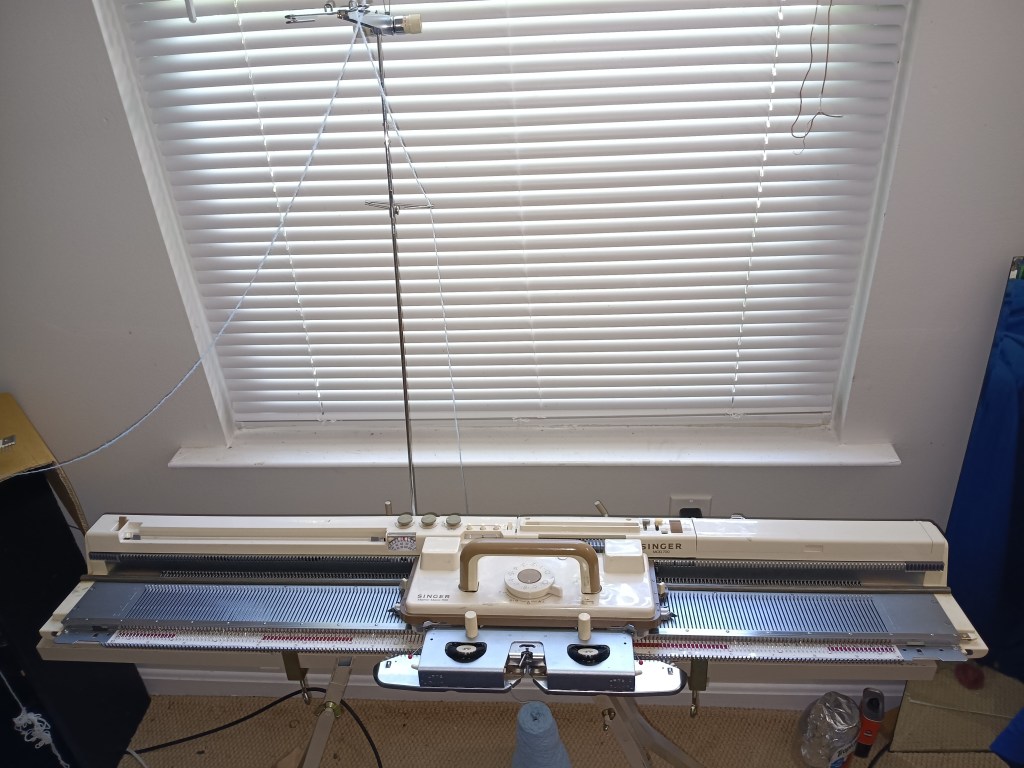
Studio by White SK740 knitting machine restored in my shop

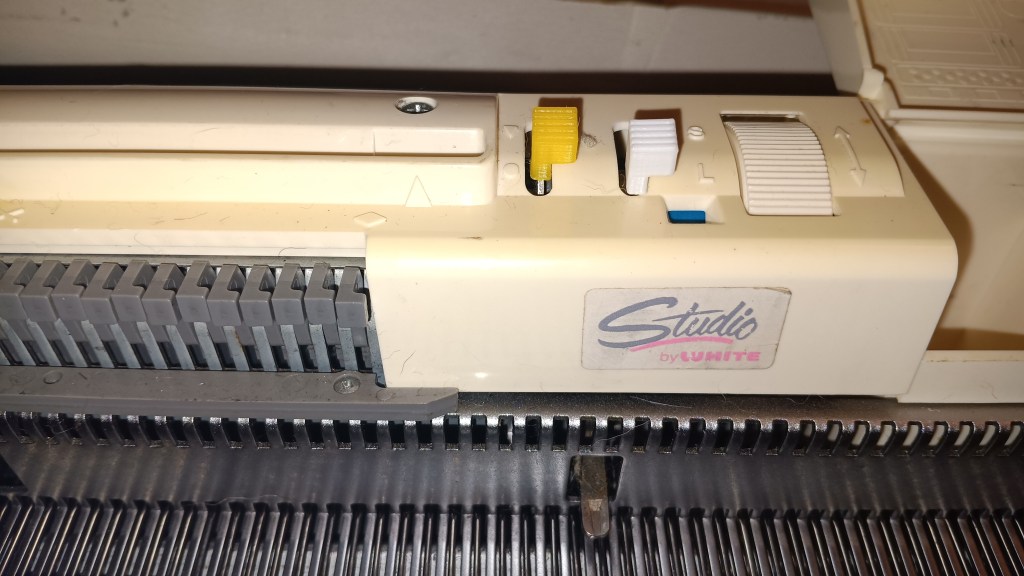
Studo by White SK740 knitting machine is a standard-gauge knitting machine manufactured by the Silver Reed company under the Studio brand name. The machine has 200 needles, 4.5 mm apart, which makes it a standard-gauge knitting machine. Read more about this model in my Knitting Machine Encyclopedia. Also, read the general details and pros and cons of a similar machine, Singer mod. 740. The post below is dedicated to a specific Studio by White SK740 knitting machine, refurbished, served, and tested in my shop.

I performed the regular maintenance on this machine.

  • The drums were oiled, inspected, and serviced to ensure they move freely.
  • All needles were removed, cleaned, and individually inspected.
  • The spongy strip in the metal retaining bar was replaced.
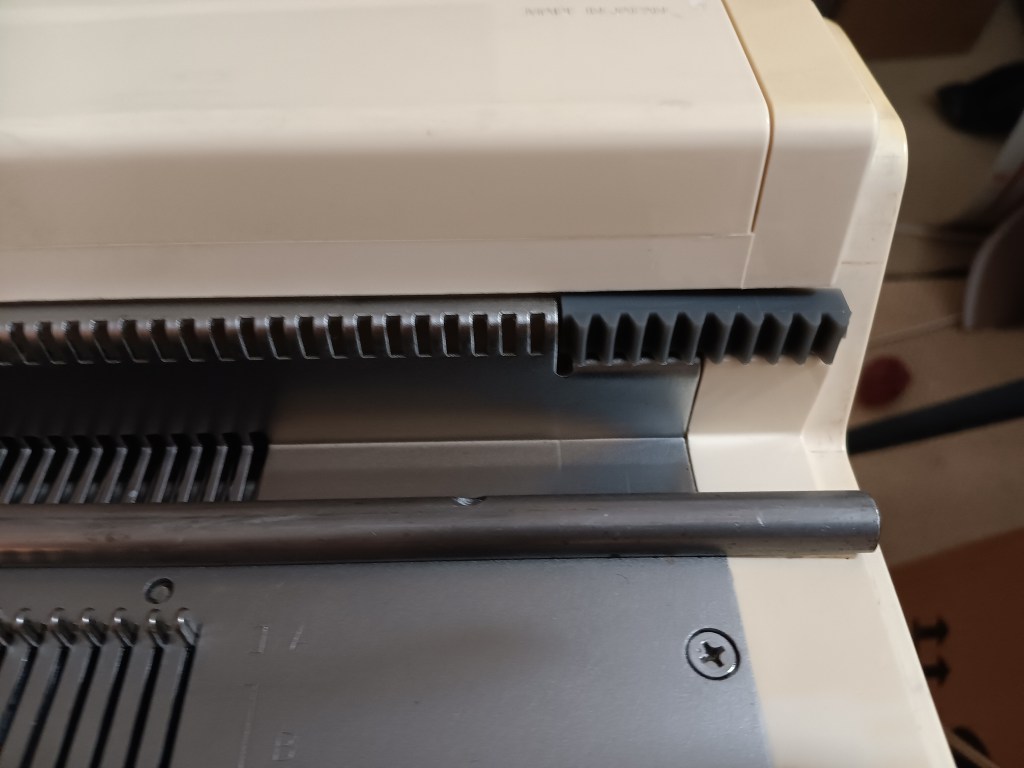
  • The side racks were also replaced with new ones.
  • Deep cleaned inside.
  • Cleaned the punchcard mechanism
  • Thoroughly wiped on the outside (I do not apply too many harsh chemicals to not cause further long-term damage to already fragile plastic components)
  • The machine was oiled thoroughly. Some lubricating oils might still bleed during your first knits. Just wipe them with a cloth.

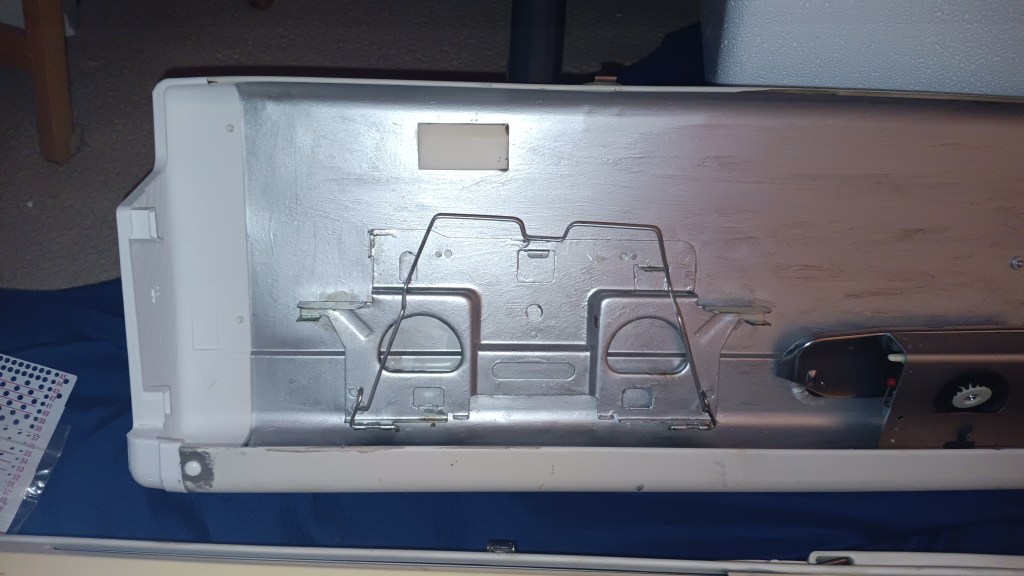
The lid for the machine was rusted, so I covered the rust on the lid with a special coating and then applied silver-colored Rust-Oleum. It might not look super artistic and pretty, but the rust is stopped and the cover looks very presentable.

End caps on the main bed have discoloration. End caps on the lid are new (I specially 3D printed them out of a very durable material because they were cracked). The plastic rivets are also brand new.

Additional maintenance performed:

  • completely replaced the plastic top cover for the carriage; replaced with new stock
  • I installed new rubber wheels on the sinker plate
  • The lever covers (little knob-like plastic pieces) are replaced with new 3D printed ones.
  • I cleaned the minor rust spots inside the punchcard mechanism and then covered them with Rust-Oleum to stop further corrosion

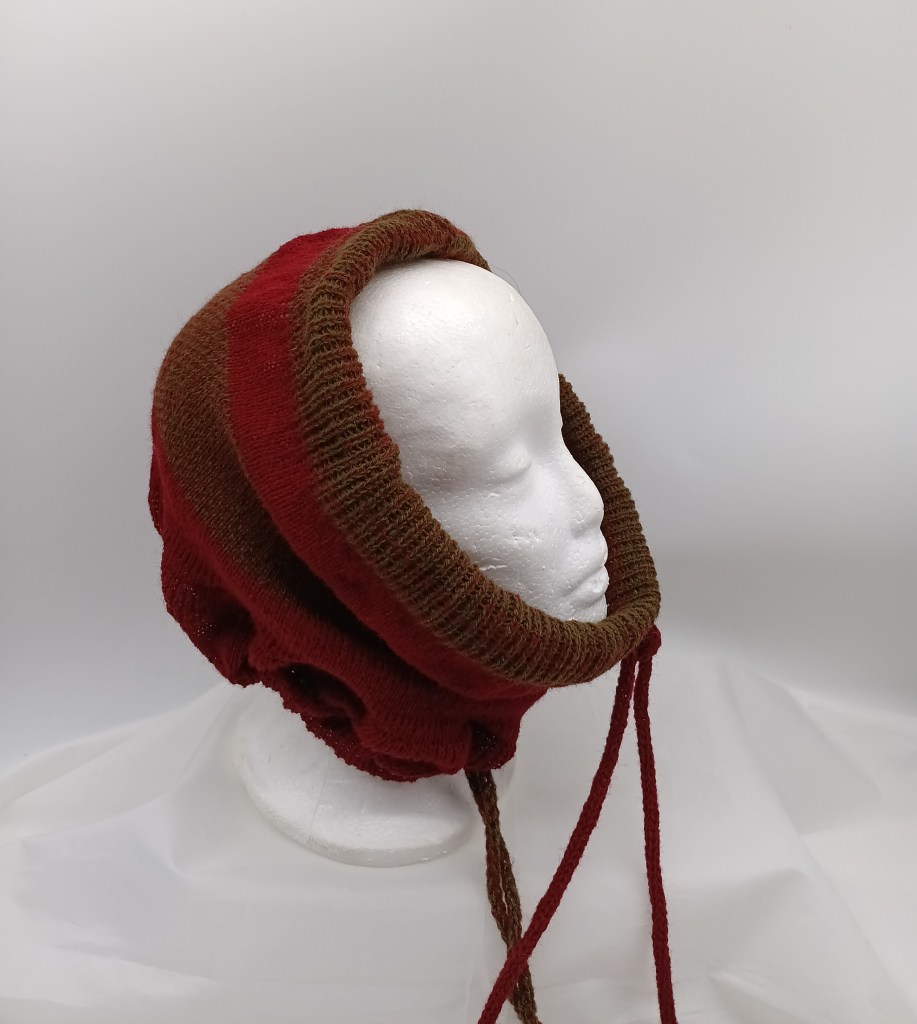
I tested the machine by knitting several patterns on all needles. The video of these tests can be seen here. I demonstrated that the machine successfully knitted tuck, slip/part, and fair isle patterns. I made three different items (hats and neck warmers) from the panels I knitted while testing this machine.

The brim on the last hats was made with the matching Studio SRP50 ribber (which is also available for purchase).

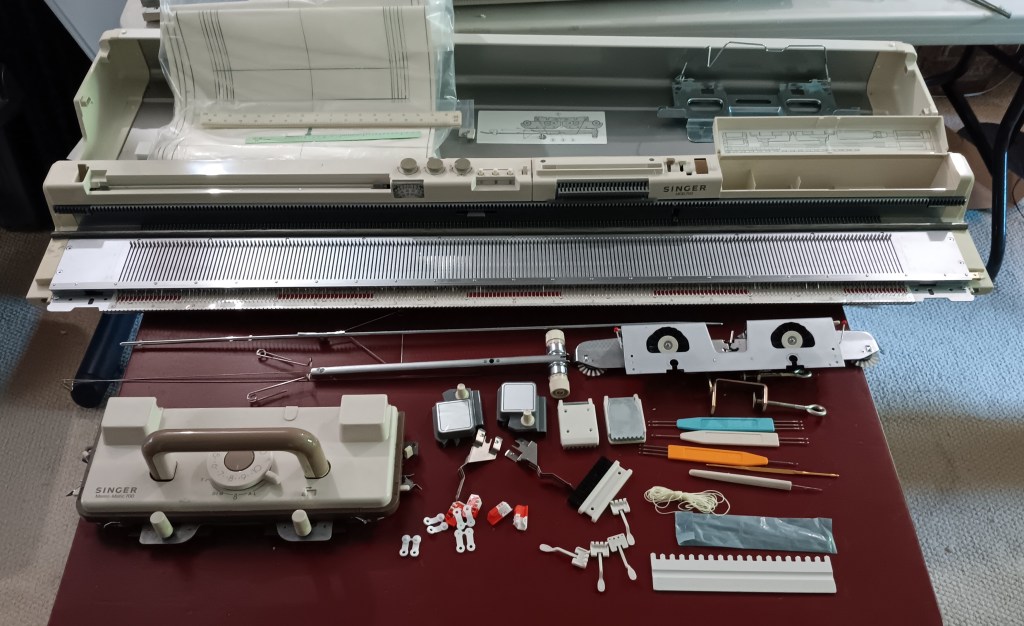
The machine will come with all the major accessories needed to knit.

Some of the accessories will not be included and this is why the price is lower than other machines of the same type sold in my shop. Also none of the missing accessories and imperfections prevented me from knitting and making beautiful things on this machine.

They are:

  • cast-on thread (any silky and strong thread can be used)
  • tapestry needle (any needle of your choice will work)
  • pattern paper for the knit leader
  • stitch scale
  • oil (it was old and I discarded it; use Hoppe’s oil from Amazon)
  • Magic Cams: They can be purchased on Amazon for under $30. They are neded for single motif knitting.

The knit leader accessories are missing, but my experience shows that knitters who are just starting do not even use the knit leader for garments. In fact, I do all my calculations for sweaters still by hand (its just how I was taught and I am just used to it).

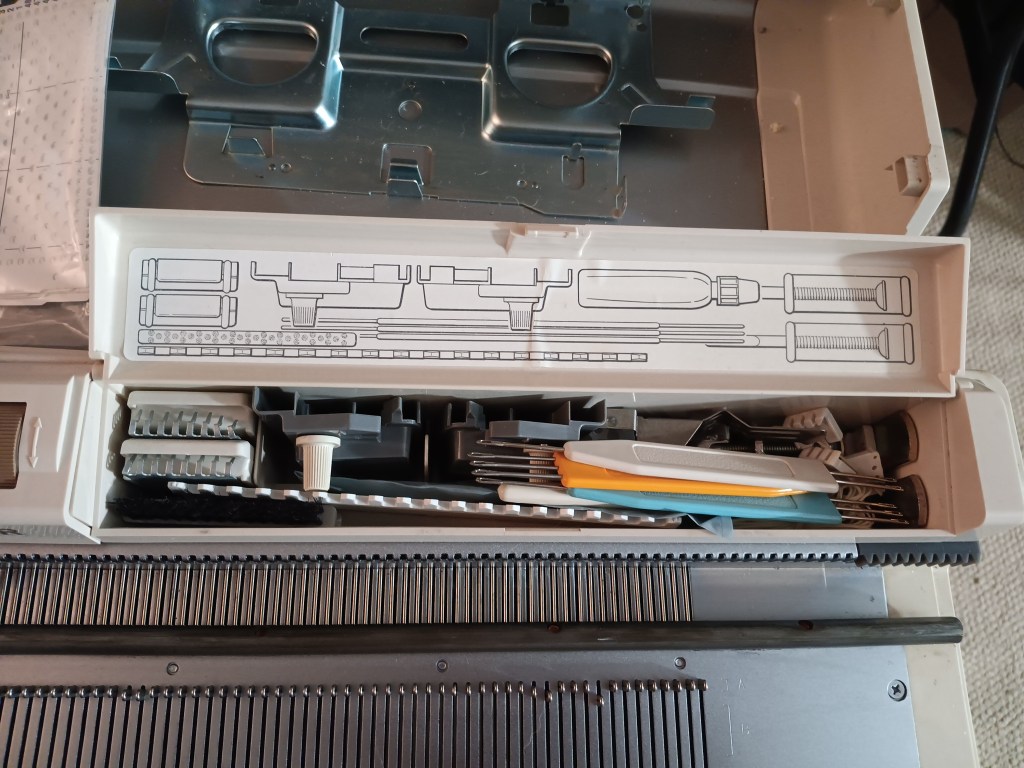
All accessories fit inside the built-in box:

Twenty punch cards will be included. The fifteen cards are generic ones with just one line on them, but most correspond to the cards mentioned in the pattern book for Studio mod. 700 machine. The other five cards were made in the 1980s specifically for the Studio/Silver Reed/Singer machines. The markings on these cards are in red, and they have three lines. These are not generic but cards from a special edition set that I am including to complement the punchcards set to 20.

Some other imperfections (besides missing accessories) of this machine:

Some of the silver-colord rustoleum pain blead on to the cover because I also had to cover some rust spots on the cover.

Table clamps need to be whiggled in a bit with force, but i like that they sit tightly.

There are some dents on the case, but they do not prevent the machine from functioning and closing well.

Hoping you will adopt this great machine for your knitting needs.

Working, mechanism, pros and cons of drums-based knitting machines (sold under the Silver Reed, Singer, Studio, Empisal model names) with punch card capabilites.

… in progress.

Knitting machines with punchcad capabilities have carriages with drums that glide on the back rail and also assist in needle selection when are passed over a punchcard reading mechanism pegs.

Well, since these patterning drums are such a prominent feature (which also makes these machines stand out from Brother punchcard knitting machines), a lot of cons and pros are asscociated with them.

PROS:

  • needle selection is localized to drums/carriages, thus fewer (theoretically) things to go wrong;
  • drums assist the carriage in sliding on the needle bed

COSN:

  • yarn and debri can tangle around these drums
  • these drums often freeze-up when the machine is not in use for a prolonged time due to solidified old grease/oil;

Here are my other observations/feedback so far:

Pegs on the drums pass the needles to either B position or C position.

When the patterning dial is in the fair isle position, the mani yarn goes onto the needles in C position.

I see blog posts stating that some of the clanking noise might be due to the static in the yarn. To solve this issue, attach wax on the tension mast so the yarn passes through it.

But some knitters experience that noise even when there is no yarn in the carriage. Sometimes, if the carriage was not recently serviced or the sponge in the retaining bar is old, you might hear some clanking noise. I am discussing this issue (as well as how to address/minimize it) in my video.

When the ribber connecting arm is attached (from SRP50 ribber – maybe others, still researching), the carriage cam dial does not turn from L to Stockinet freely. You will need to disconnect the connecting arm and the problem will be solved.

Studio 360K serviced in my shop in May 2025 for Sabine.

Knitting machine Studio mod. 360 coupled with the Singer MemoMatic 360K carriage, was serviced and fully tested in my shop in May 2025. To read the pros and cons of the Studio mod. 360 and Singer MemoMatic 360K read the corresponding posts in the Knitting Machine Encyclopedia. The post below is dedicated strictly to this specific machine and not the model overall.

This girl was manufactured in the 1980s (45 years ago) so it comes with its own character (read below in Imperfections).

The machine was thoroughly cleaned. I removed all plastic panels and cleaned them. I removed plastic end caps and clean inside the needlebed with the brush until not more lint and dust as coming out. The needlebed was vacuumed from inside and outside. All metal parts were oiled. The punchcard reading mechanism was tuned and cleaned with oil. Same for the carriage. All needles were removed and inspected and then tested on the full bed (knitted on all needles). I identified one faulty needle (the video shows the incorrectly formed stitches) and replaced it.

In fact, tests on full bed were performed using tuck-, slip- and fair-isle stitches. All stitches formed as they are supposed to. There was no mispatterning (see the full video). The video also shows that all buttons, levers and wheels move freely on the knit leader and the paper advances accordingly. Read the manual carefully when setting the knit-leader parameters as some of the knobs move at certain settings. The video also shows that the row counter work great as well.

I replaced bent plastic heel protectors (plastic circles around each wheel with soft brushes on the under side of the sinker plate – now shown). They bent kinda easily when the yarn is tangled around the wheels on the sinker plate.

Installed new end racks. I replaced the sponge in the retaining bar. The retaining bar sits a bit tight so if it needs to be removed, initially use pliers to get the bar the first tug.

The drums on the carriage move freely (see the video). The carriage with and without sinker plate moves freely on the carriage across the needles in A and B positions. Read below about some accompanying clanking noise.

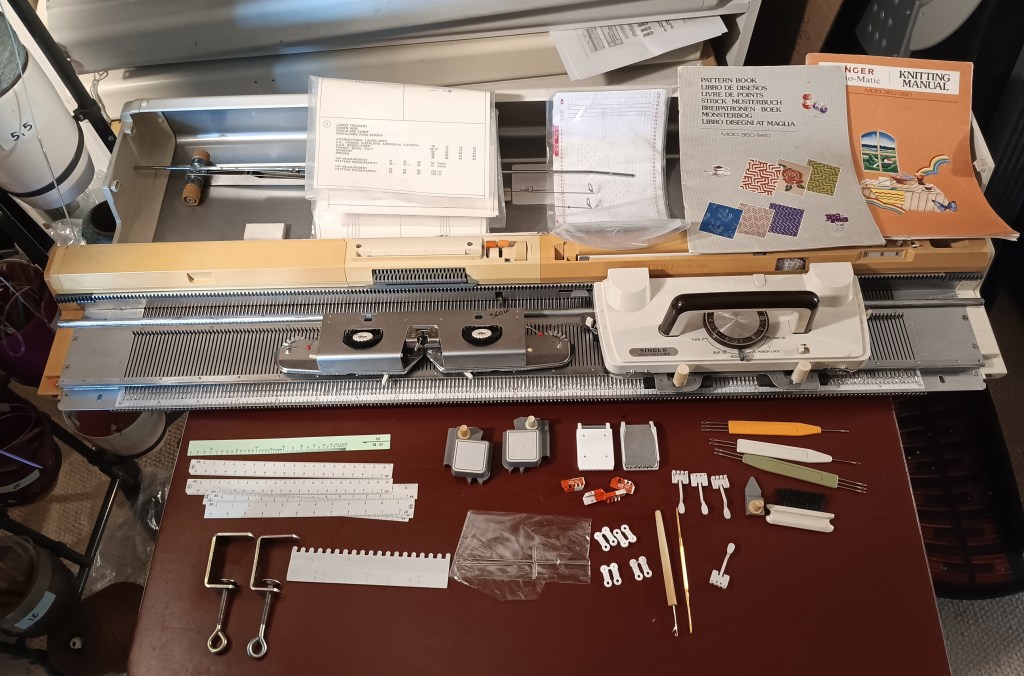
The machine will come with all major accessories.

Those that are not included are:

  • unravel cord (any smooth and strong thread or yarn will work);
  • tapestry needle (any needle will work)
  • punchcard rod (all tests i performed and shown in the video were done without it and it worked well).
  • oil (I get oil for my knitting machines on Amazon: Hopp’s gun oil)
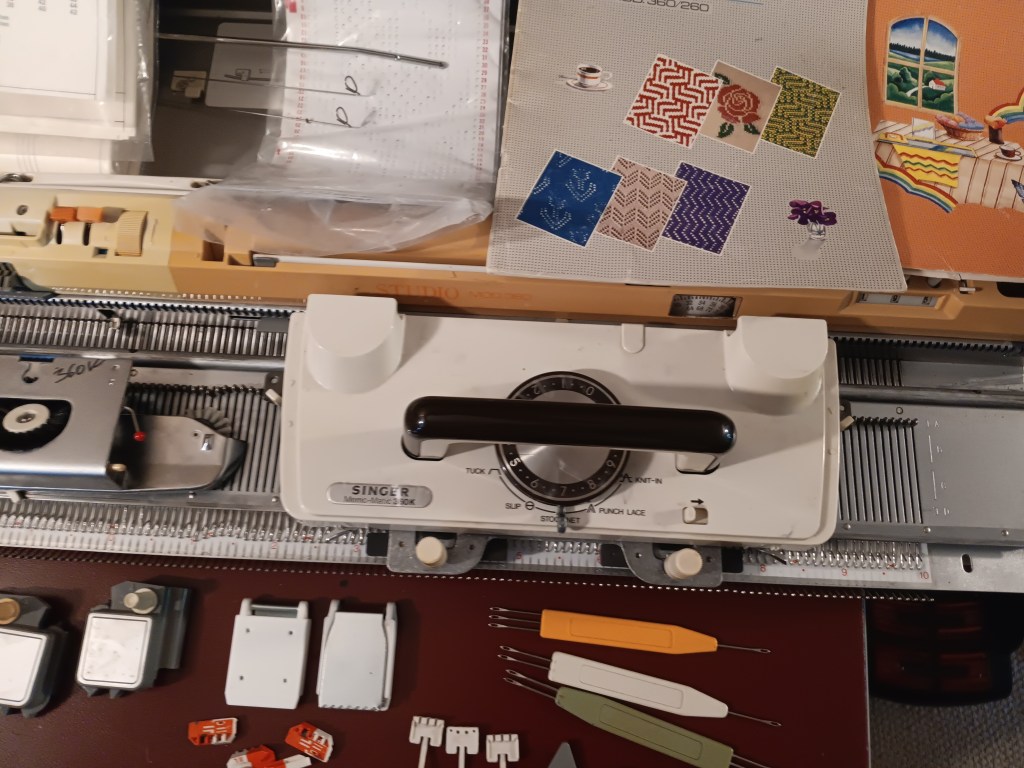
  • punchcard set has all 20 cards and they are original Singer/Studio punchcards but some are somewhat different than in the Pattern Book
  • A hard copy of the machine instruction manual will not be included but it can be downloaded online for free. The hard copies of the knitting manual and the pattern book are included.

Despite some discloration of the plastic and metal of the main bed, the case lid, and the needle bed are in overall good shape.

Imperfections:

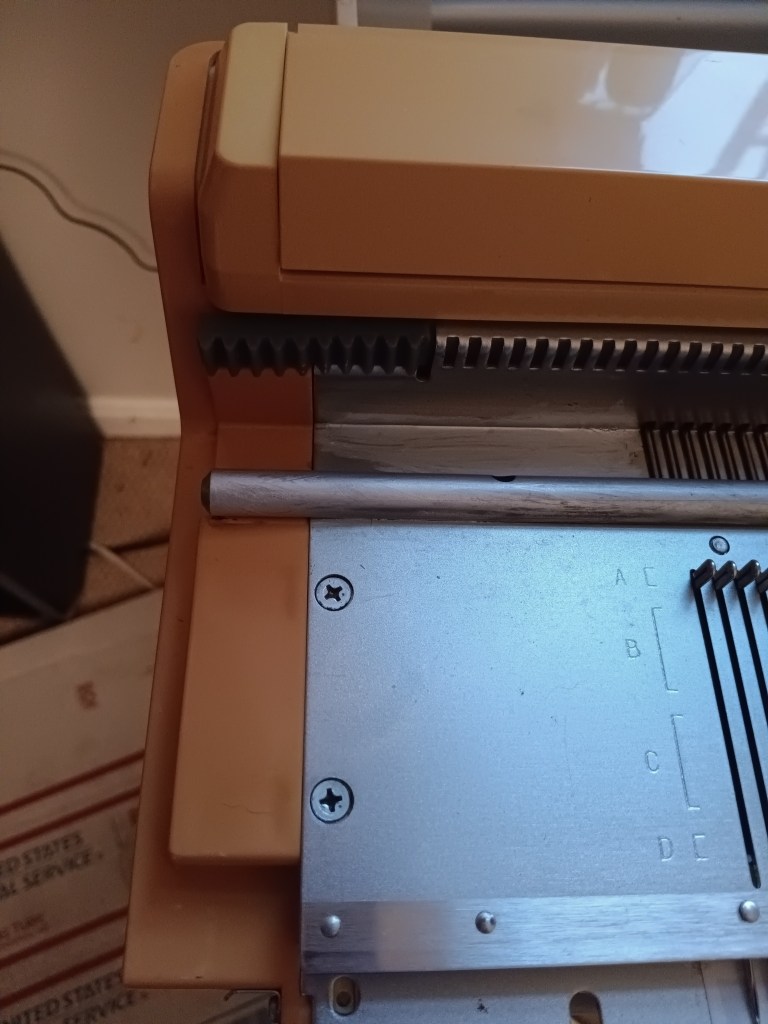
  1. There was some yellow discoloration, which could be potential rust spots. I covered them with a couple of protective coatings. The covered spots are not as noticeable in real life as shown in the pictures below. In fact, when I am looking at the machine right now, I can’t even see it (but I know it was there).

2. One of such spots is actually the railing itself (I needed to be 100% sure that there will be no further degradation due to rust). So I applied a thin layer of protective coating as well.

In some places, the coating comes of, which comes across as some minor debris. Just be aware of it (and not alarmed). Include cleaning the debris and carriage rail in your regular knitting machine cleaning routine.

3. It seems that either the plastic panels (including the end caps) were replaced by the previous owner, or the machine was exposed to the sunlight unevenly. Regardless, you can see that some panels show a different degree of yellowing (discoloration of the old plastic due to exposure to the UV light/rays). However, the plastic does not seem fragile (I’ve seen a LOT of weakened (due to UV) plastic parts). So the difference is only visual/aesthetic.

4. When I first started testing the machine by moving an empty carriage on the needlebed (with all needles in A, non-working, position), there was some clanking noise in some areas. I tried various carriages on this machine and they all sound like this. After troubleshooting this issue, I was able to improve it (watch this video on this issue) but due to the nature of this noise, it is not completely eliminated. This video discusses how to prevent/minimize that clanking noise. However, with regular maintenance and paying attention as well as moving the carriage in one smooth motion, this will not be an issue.

Despite all these imperfections, I enjoyed working with this machine. I made the gift bag below using various stitches shown in my test video (working on the pattern now).

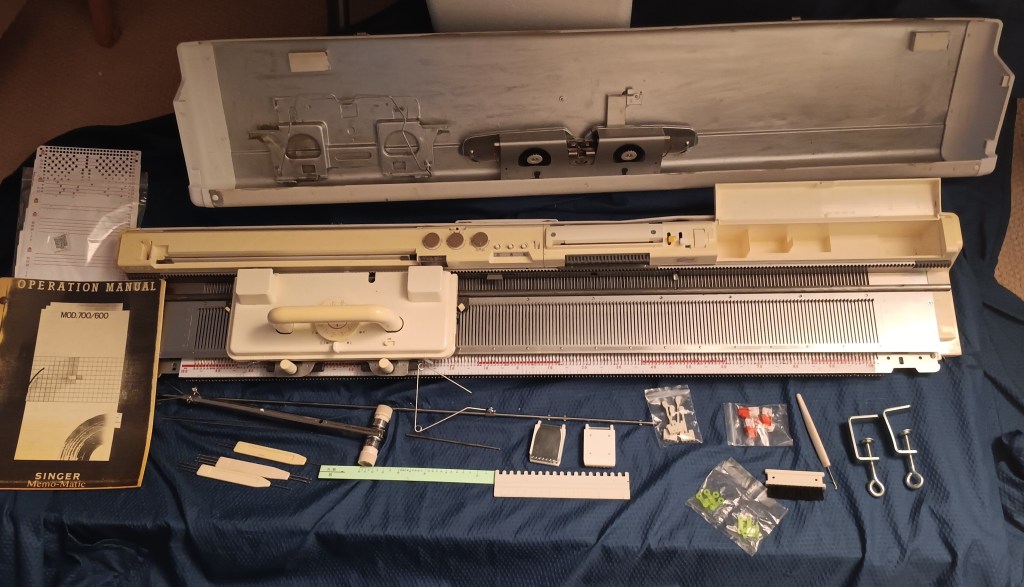
Singer 700 mod. knitting machines serviced and tested in my shop in April 2025.

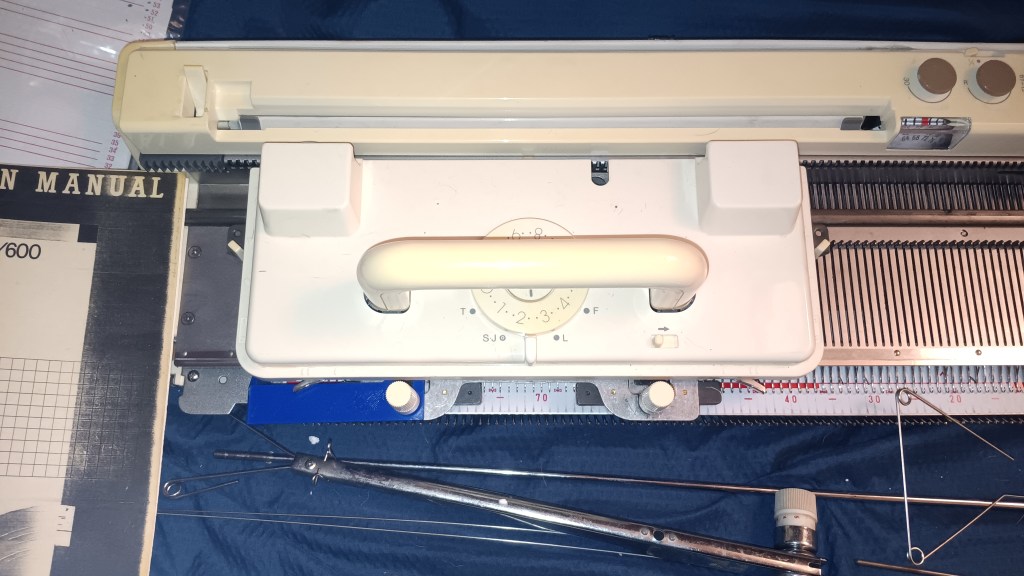
Singer MemoMatic 700 is a standard-gauge knitting machine with 200 needles, 4.5 apart. It has a punchcard reader (on the machine body) and patterning drums (on the carriage) which allows the machine to automatically select needles and knit patterns, like tuck, slip/part, fair-isle, weaving, lace, etc. Read more about this model in my Knitting Machine Encyclopedia. The rest of the post below is dedicated to a specific Singer MemoMaic 700 machine serviced and tested in my shop.

The case (including the end caps and the lid) is in great shape with minium scaffs and scratches. The plastic panels are in great shape too, with minimum discoloration due to the exposure to UV.

I cleaned the surface of the machine and the inside of it as well. I serviced and cleaned the punchcard mechanism and fine-tuned it to ensure flawless patterning. I opened the carriage and cleaned it thoroughly too, to ensure the drums and all other internal mechanisms move freely. The rubber wheels on the sinker plate were too fragile, so I replaced them with the old stock.

Installed new end racks (new stock).

I replaced the sponge strip in the retaining bar. I cleaned and inspected all needles to ensure they are not bent, latches move freely, and form correct stitches. Then I knitted on the full bed (i.e., on all needles) using tuck, skip/part, and two-color fair-isle to ensure that all needles indeed form correct stitches. I used several different kinds of yarns (you will even see in the video that the machine handled a couple of minor knits pretty well). I was very pleased by these tests, as the machine indeed handled well all the various yarns and all stitches formed correctly. The video of these tests is here.

The machine comes with all original accessories for the knit leader.

Knit leader was not tested in action but I checked all buttons, levers and knobs: they all move freely.

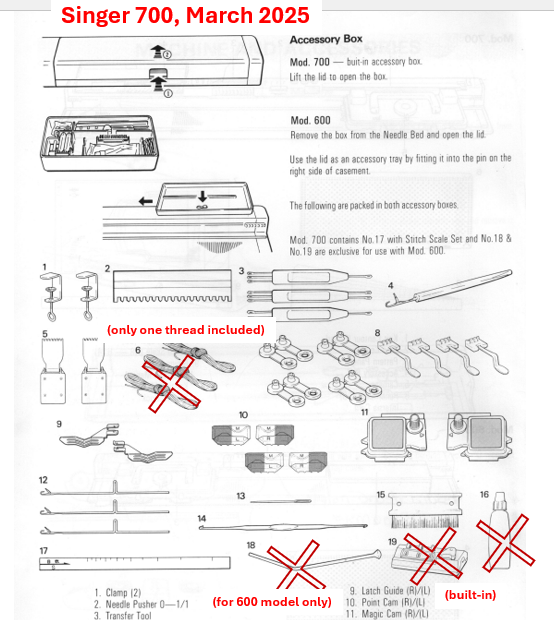
It comes with almost all the machine’s accessories.

The accessories fit nicely into a built-in box.

The standard accessories that are missing are: two cast-on threads (only one is included) and the oil (Hoppe’s Gun oil from Amazon is an excellent substitute).

The carriage lock is now shown in the list of accessories but the original metal carriage lock is included.

Note: The machine did not come with the original punch cards. I am including a generic set of 15 punch cards. Also, hard copies of the manuals are missing as well. But they are available online for free: pattern book, knitting manual, and operation manual.

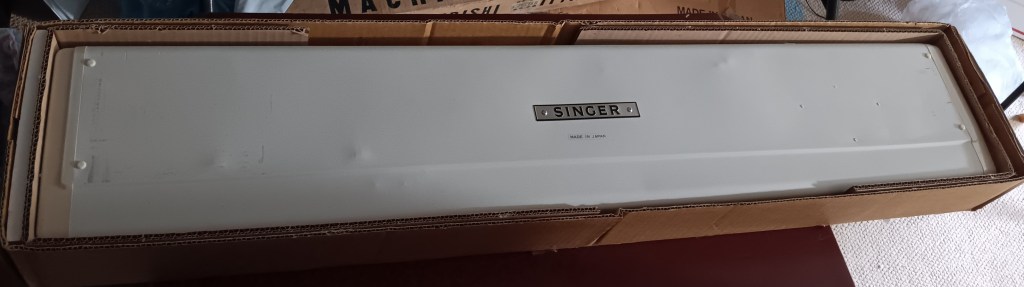
The machine is lucky enough to come with its own cardboard box as well (with a lid).

Now, about Imperfections:

– Because I applied cleaning oils during cleaning, you might notice that some of the oil might bleed out of the carriage (especially when moved back and forth several times), leaving some black-ish residue on the main bed. Just wipe it with a towel and continue knitting. This is not unusual as the oil becomes thinner as the carriage becomes warmer as it moves back and forth.

– when the lid sits on top of the main bed, there is a small lip. It is pretty typical for these old machines and does not affect the works of the machine. However, precuations will be needed when the machine is in storage: put it in a plastic bag when stored for a long time.

– The carriage handle has some minor scratches.

– The case also has some minor scratches and dents. But it is overall in very good shape.

I typically include pictures of an item I made while testing this machine. I indeed made a small blanket and a gift bag, but due to the time contains, they are not quite finished yet.

I think the new owner of this machine will be very pleased with it because it not only looks good, but it works fantastically and has some advanced functions other punchcard machines don’t: like built-in intarsia.

Brother KR260 ribber serviced in August 2024

Brother KR260 ribbing attachment fits bulky knitting machines Brother KH260 and Brother KH270. Read more about this ribbing attachment in my Knitting Machine Encyclopedia (…coming soon).

The article below is focused on the ribber I tested in August 2024 in my shop.

The ribber bed was thoroughly cleaned, the side brackets were cleaned and oiled, and all needles were removed and inspected individually (and then tested by knitting on the full bed).

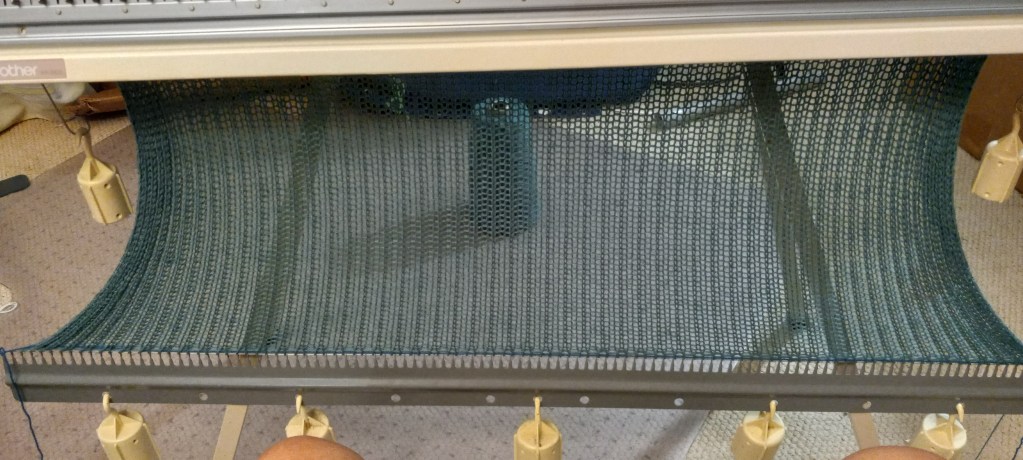
The distance between the main bed and the ribber was easy to adjust. I almost instantly got the optimum distance and was able to knit a swatch right away. See the pictures of the first cast-on row: all distances are even and there are no missed stitches.

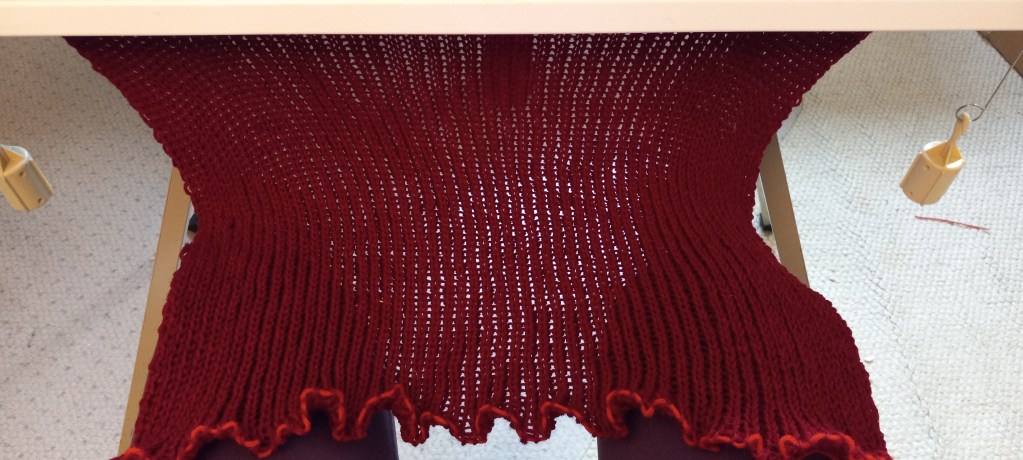
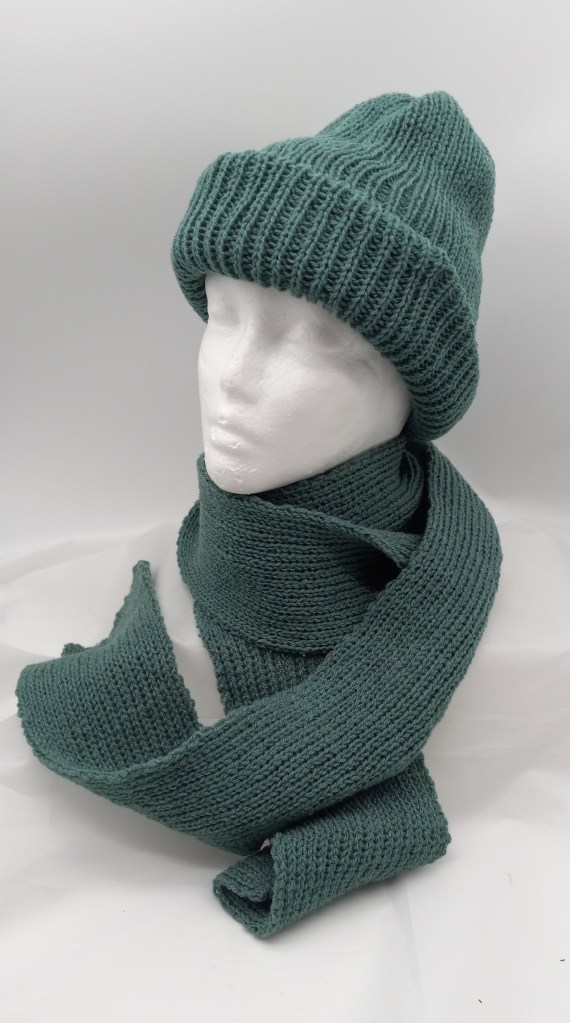
I left the side brackets in the machine so the next owner will not have to make too many adjustments. I knitted the swatch to several rows and made a narrow scarf out of it (see pictures below).

The retaining bar is new with the new sponge. (Typically I reuse the retaining bar (the metal part of the needle pusher) and attach a new sponge strip to it. For this ribber, I used a brand-new metal retaining bar with a brand-new sponge strip.

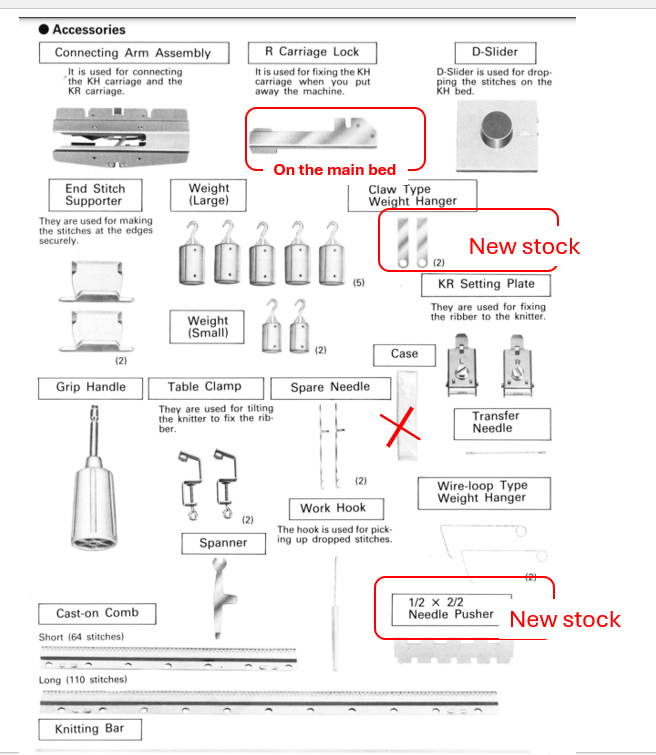
The machine comes with all minor and major accessories. One exception is a spare needle case: it was so old, that it crumbled as I opened it. The spare needles are inside a regular plastic bag.

Some accessories (1/2 and 2/2 needle pushers) are brand new from new stock.

The 1×1 needle pusher is also a handy tool but it is included with te main bed (Knitting machine).

All other accessories came with the machine but they are still in great shape.

Watch the tests on full bed in my video. I knitted 1×1 ribbing on every other needle on the bed and on the ribber. Thus, to check all ribber needles, I knitted two combinations of those needles to ensure I knitted in all needles. All stitches formed nicely! Thus, all needles, their latches, and the retaining/sponge bar functioned well.
The connecting arm is in great shape. All brushes are intact.

The ribber carriage is also in great shape and all buttons and levers move freely.

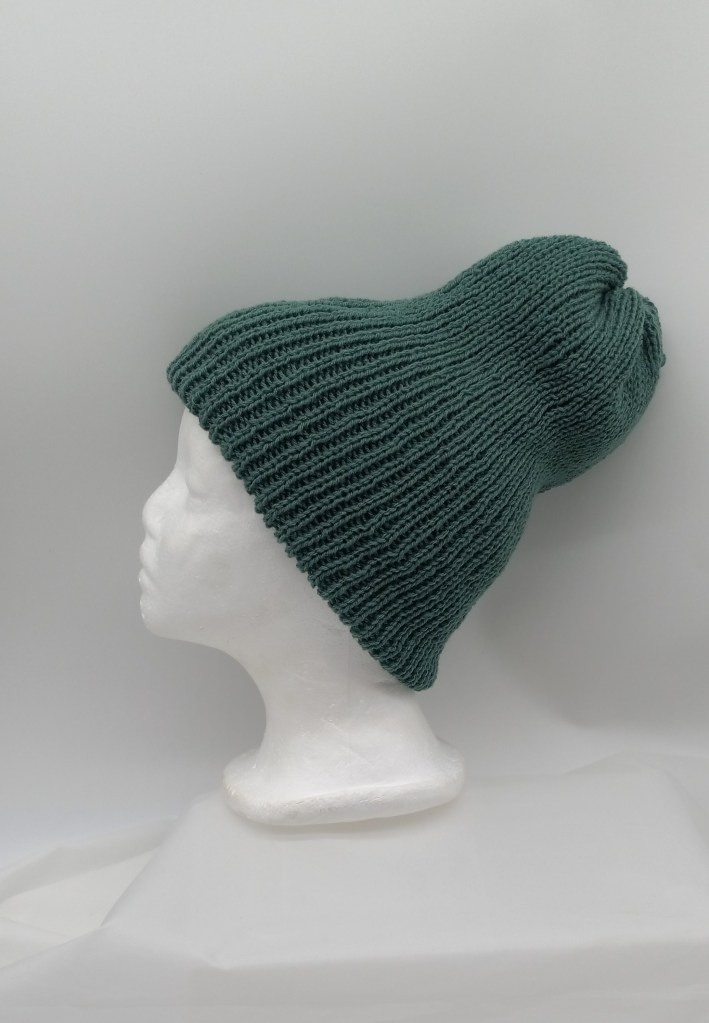
I will include the yarns I used to test this machine with the purchase so the next owner will start familiarizing themselves with this machine with the proven threads. These turns turned out to be pretty staticky. On the small swatch (narrow scarf, olive green color), the static was so strong that I could even feel it on my legs as I was knitting the long panel. On the large piece (olive green hat) the status was even stronger but the machine handled it very well: no grinding noise and no problems with tension. I did not use wax with the olive green yarn.

An original cardboard box for the ribber will NOT be included. I will, however, put the ribber into a cardboard box and wrap the accessories in bubble wrap.

Ribber cast-on combs are in great condition. If the wire does not go inside the holes, just rotate it a bit and it will slide in.

Brother KH260 knitting machine serviced in August 2024

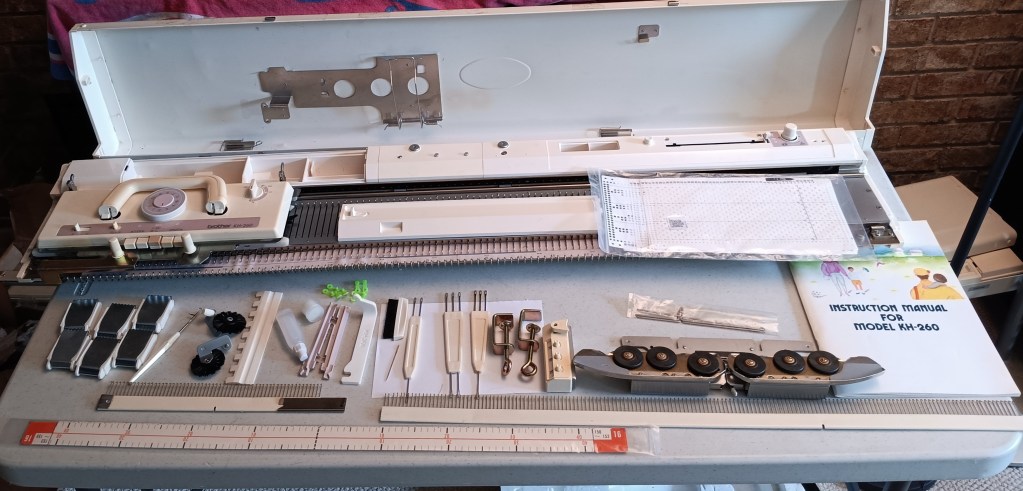
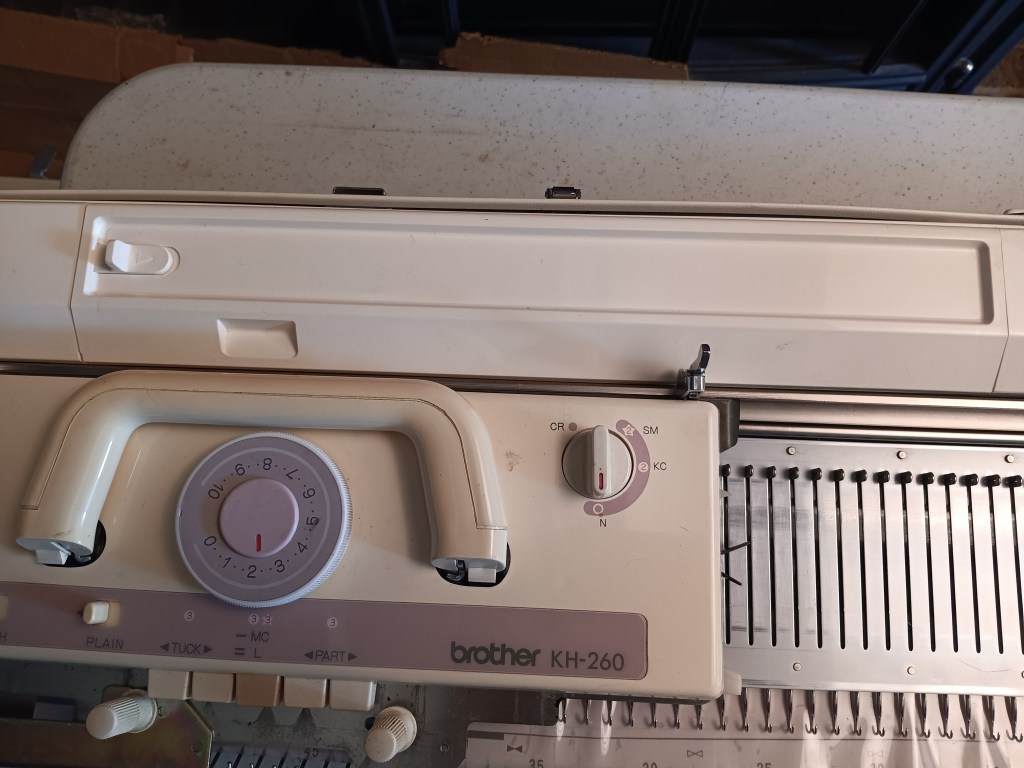
Brother KH260 is a bulky (9 mm gauge) knitting machine with 114 needles. Read about this model, as well as the pros and cons, in my Knitting Machine Encyclopedia. All information below is about a specific machine service in my shop in August 2024.

I cleaned and inspected the machine. I removed, cleaned, and inspected all needles. The needles and the patterning (including the punch card reader) were inspected with various cards. All of these features were also tested on all needles and with various cards. Watch the video of these tests here. This machine was also tested with a matching ribber, Brother KR260. watch the video of those tests here. The machine behaved very well during all those tests by itself and without the ribber. It was easy to adjust the proper distance between the machine and the ribber, which implies no warping of the metal beds.

The rubber wheels on the sinker plate are in great condition. The wheels for tuck-knitting move freely.

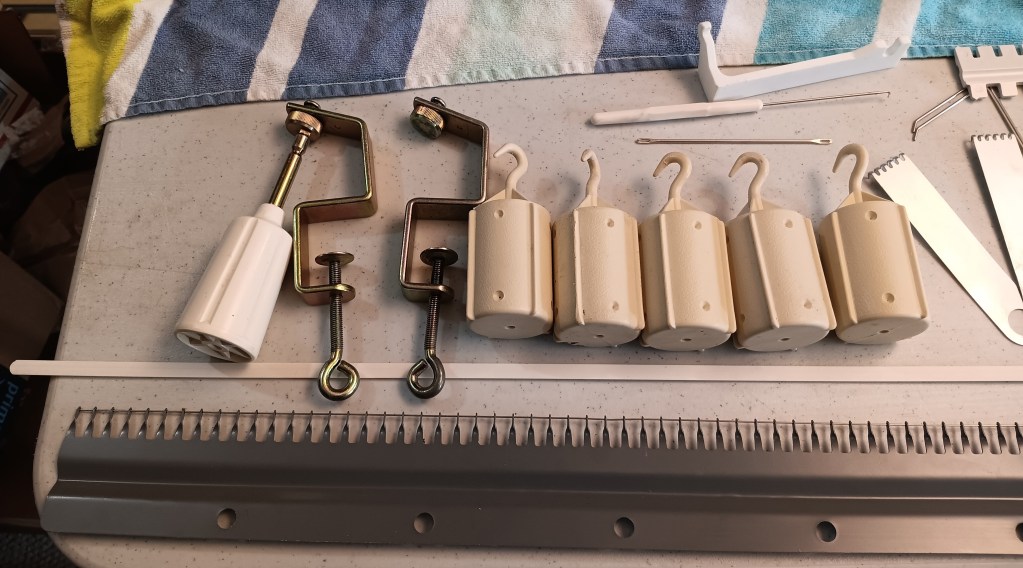
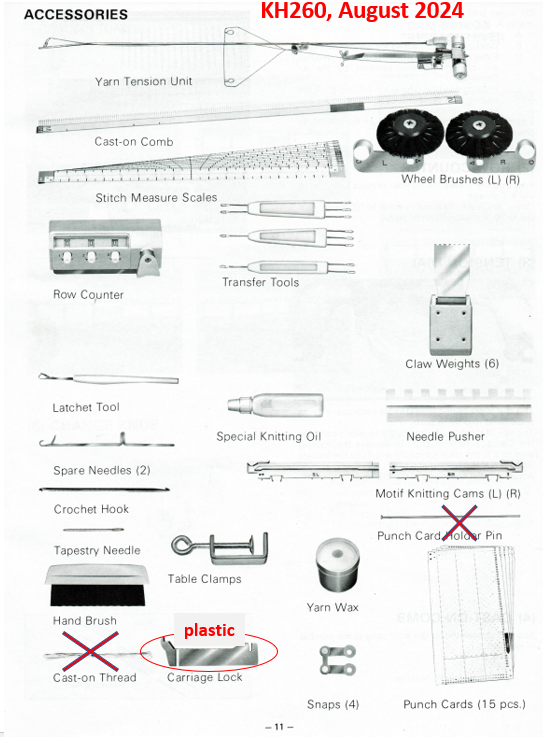
The machine will come with all major accessories: sinker plate, cast-on combs (short and long ones, attached together by the metal clip), tension mast (not shown in the picture above – forgot to include it, sorry) and a detachable row counter.

I also replaced the retaining bar: I inserted a completely new retaining bar + sponge bar (typically, I attach a new sponge to the existing retaining bar).

The machine will come with most minor accessories, including a hard copy of the manual (which is in decent condition).

The only accessories that are included are the cast-on thread (you can use any strong, silky yarn/thread) and a punchcard holder pin (all the tests in the video were done without that pin and all worked great).

Table clamps, stitch-measure scales, punchcards, and claw weights are brand new, from the new stock.

All minor accessories fit inside the toolbox.

The carriage lock is not the original (the machine did not come with one). I attached the machine with the carriage lock from the ribber (because I left the setting plates in after testing the ribber). But I am including a white plastic replacement carriage lock in case the machine is sold in the future without the ribber.

Since the machine came without the punch cards, I had to purchase them. The punchcard set included is marked with the letter P (as it is supposed to be for the KH260 models) but it is not an original set. It is brand new but the paper/plastic is a bit thinner than the original set. However, I checked and the card corresponds to those in the manual.

The machine came with the wax and oil in decent condition. Thus, those will be included as well. The mast still contains a piece of wax I used when I tested the machine (some yarn was a bit more staticky than the other but only when tested with the ribber).

The machine originally came without the carriage. I have included a substitute carriage (which was fully serviced and tested) this is why the color is a bit different from the main bed.

When selecting needles, make sure that the needle buds are as close to the marked B position as possible otherwise the carriage might have trouble. It is true for all knitting machines but bulky machines are especially “sensitive” to misaligned needles probably because the needle buds are so much bigger.

A couple of other very individual things for this machine: if the numbers in the row counter do not get triggered reliably, two things can be done. 1. Gently shift the plastic cover on which the row counter sits towards you. Even a little bit of movement will shift the row counter enough to make it more reliable. I installed it properly but the top cover can shift during the shipping/transport a little bit, enough to increase the distance between the tripper on the carriage and the row counter lever. 2. Pass the carriage slowly next to the row counter. If the carriage is moved quickly, the row counter is still triggered but the number does not increase. I thought it was the problem with the row counter, but I tried several. The best thing that works is to slow down around the row counter. The slower motion triggers it better so the number changes.

Imperfections:

  • the end caps have minor cracks. Those are super minor – I’ve seen machines in much worse conditions.
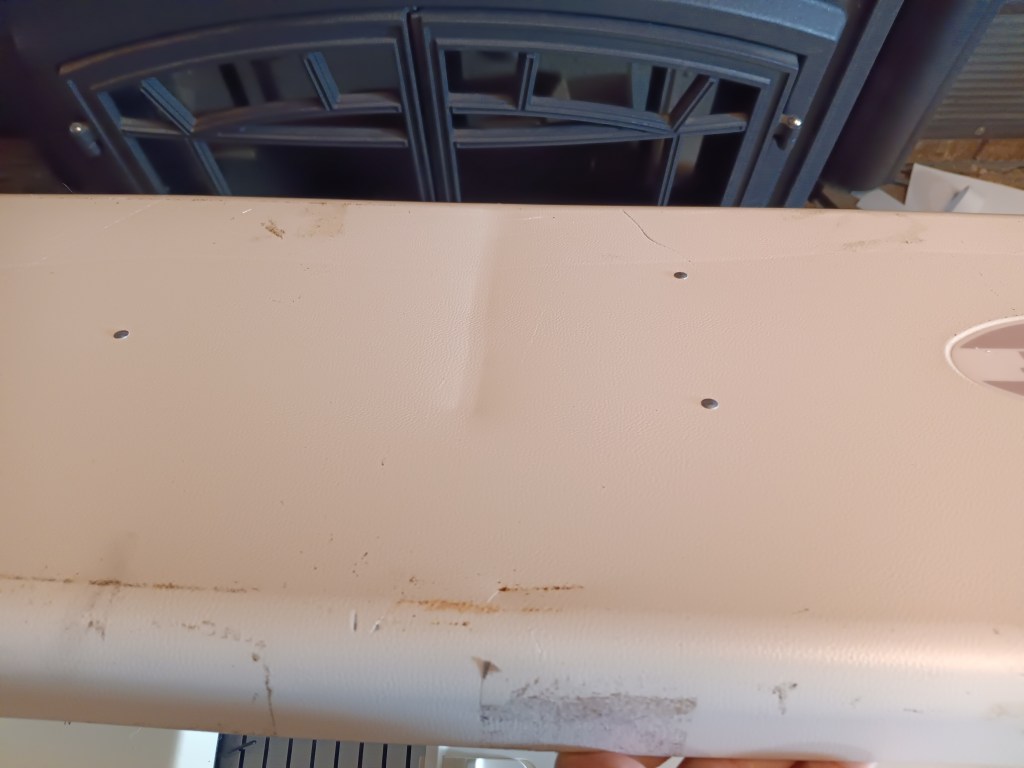
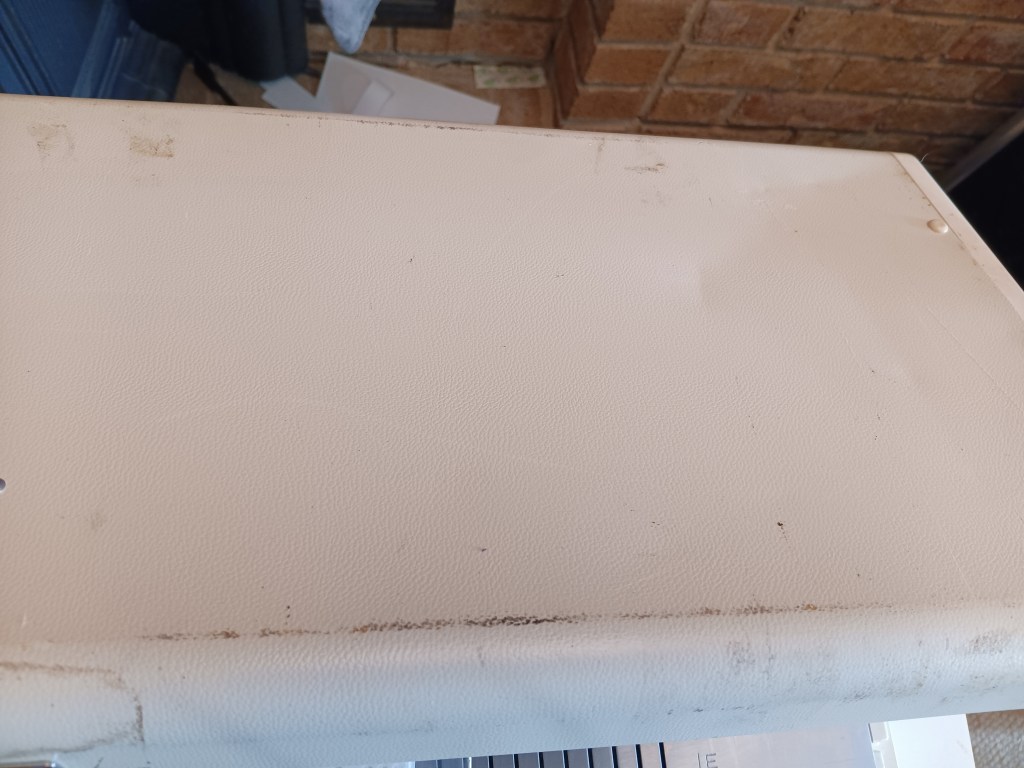
  • the lid and the case have some staining from scotch tape. I will be washing them off with soap and water but not with strong solvents (as it might severely damage the coating). Sometimes some especially sticky residues remain.
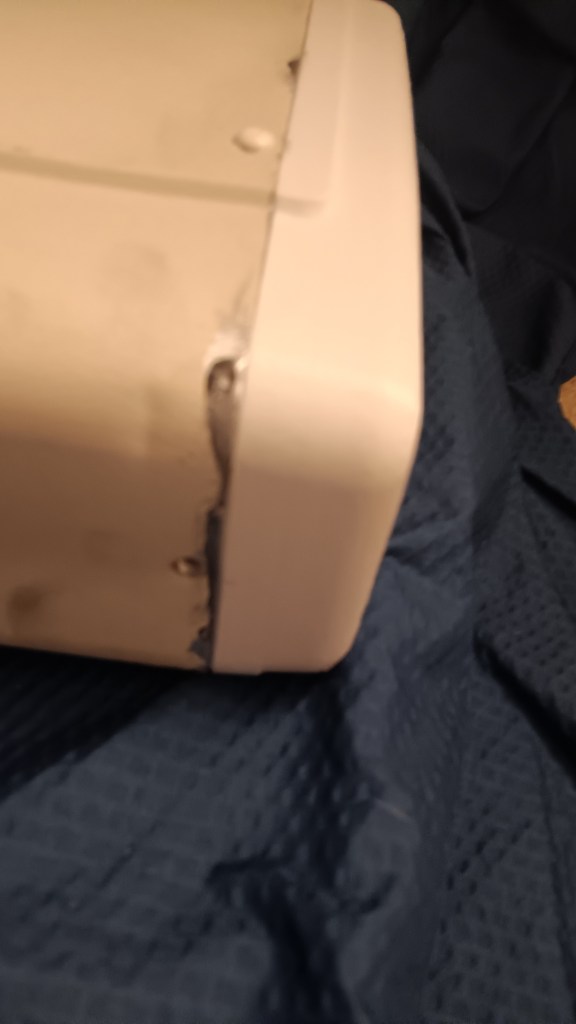
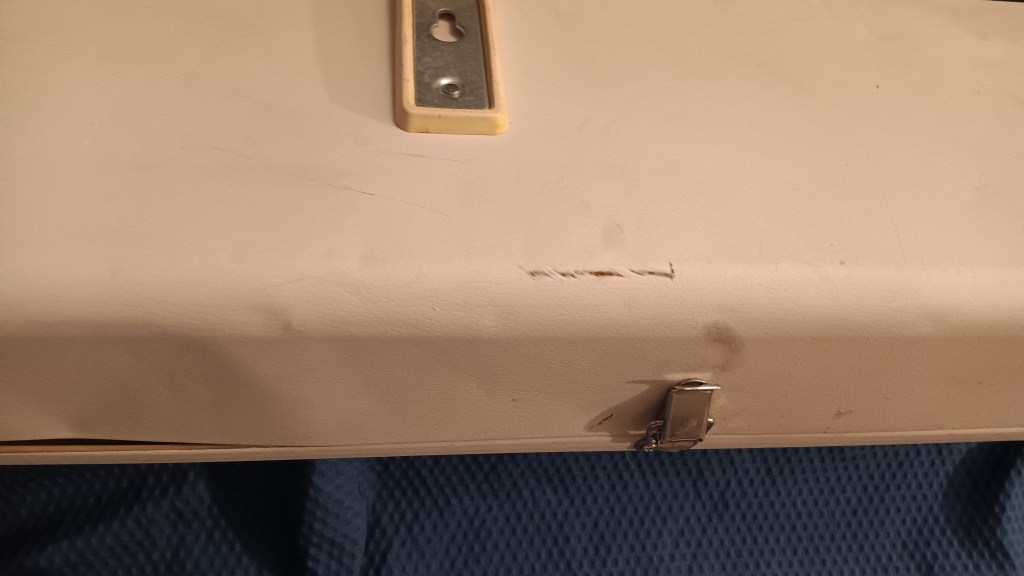
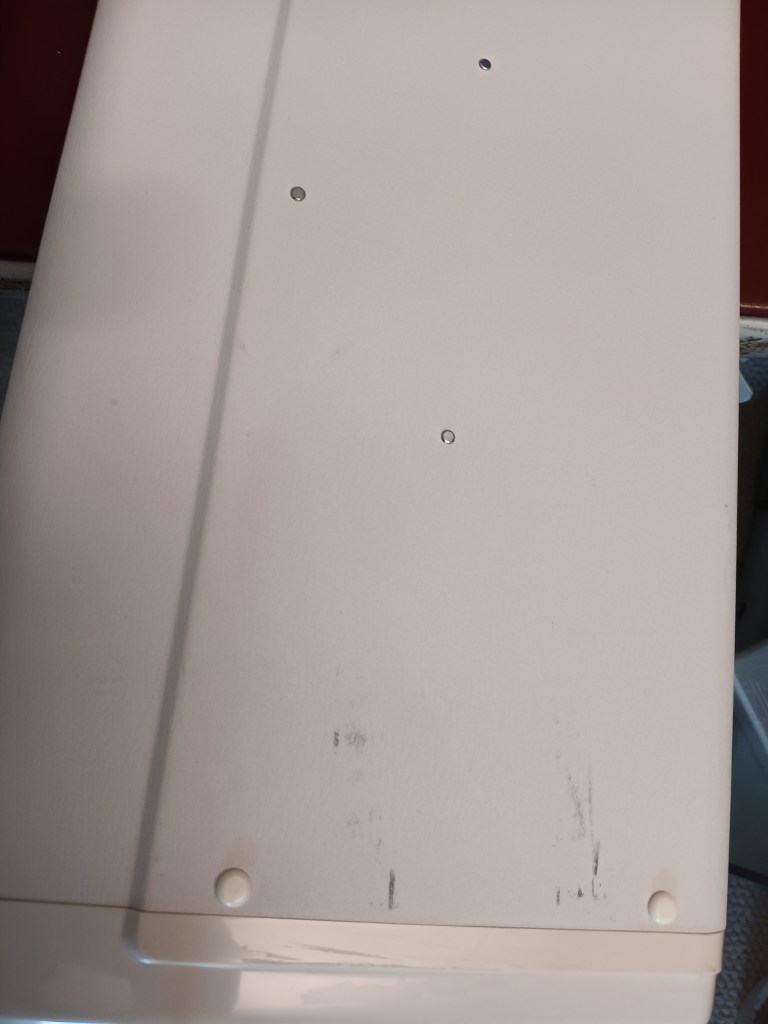
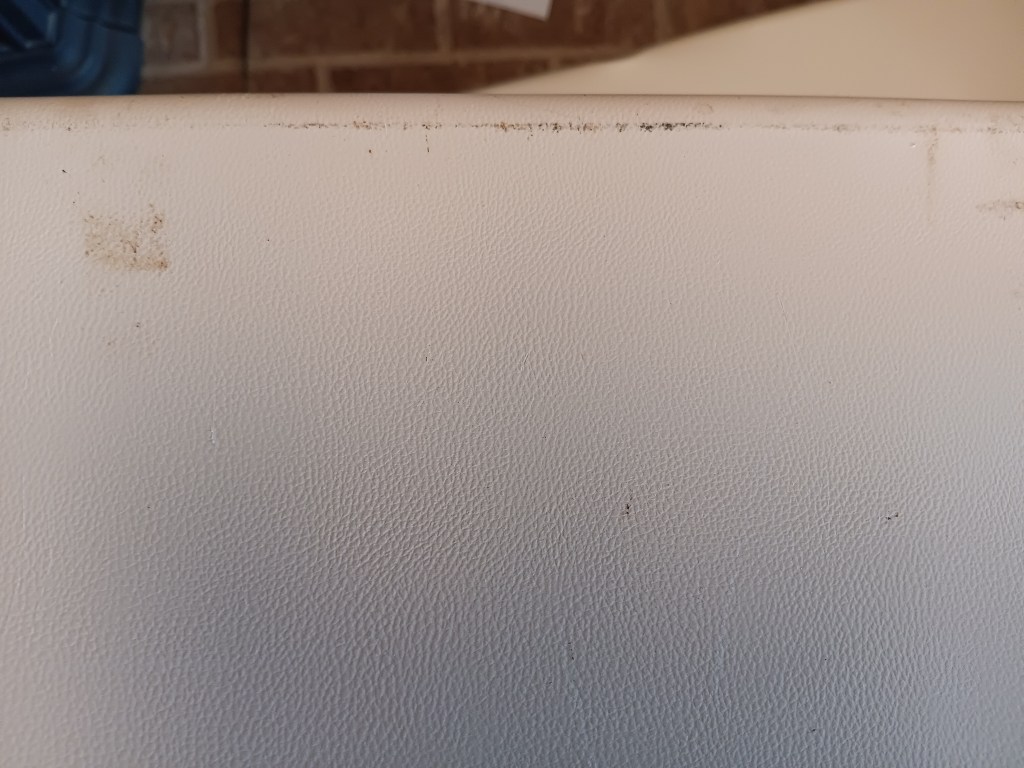
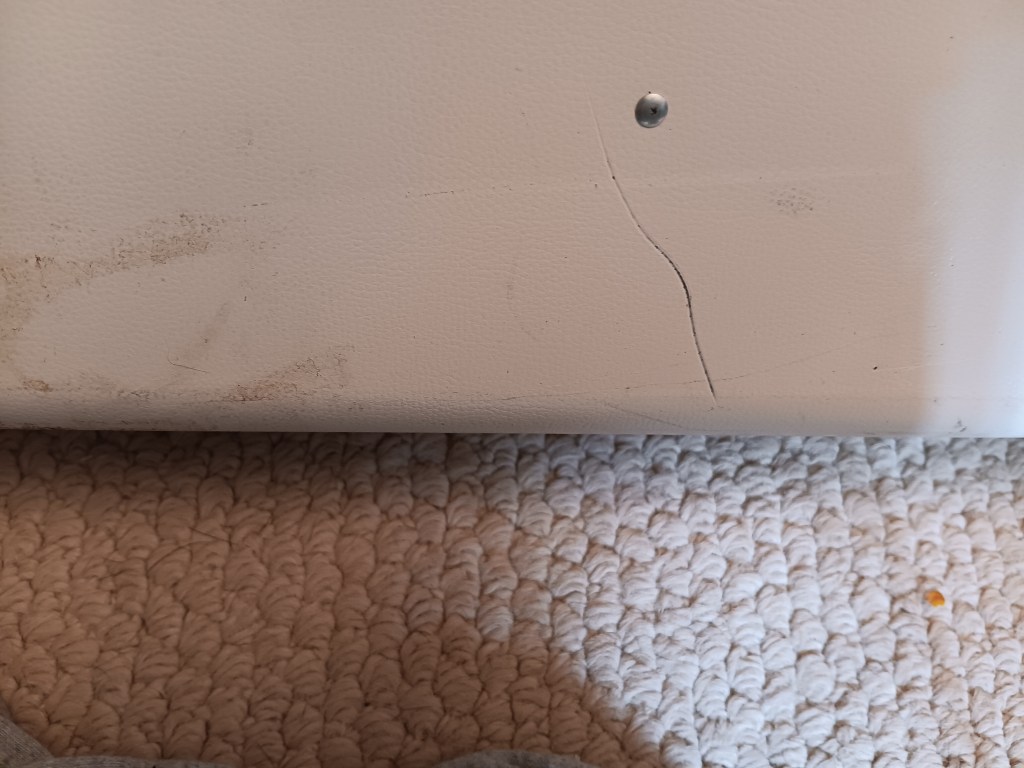
  • The case and the lid have minor scratches. Below is an example of the biggest one. Other minor scratches are not shown.

Brother KH860 knitting machine cleaned, serviced and tested in my shop in August 2024

Brother KH860 is a standard-gauge knitting machine with punchcard reading capabilities to select needles according to the pattern of the punchcard. Brother KH860 is a wonderful machine. Read more about its pros and cons in my Knitting Machine Encyclopedia. This blog entry is dedicated to a particular Brother KH860 knitting machine, cleaned, serviced, and tested in my shop in August 2024.

The machine was cleaned, all needles were removed and inspected for bends, faulty latches, and sticky latches…. The needles were cleaned, and polished where needed. The faulty ones were replaced with the new stock.

The sponge in the retaining bar was replaced. The machine was cleaned on the inside (without any major disassembling: I removed the end caps and the top plastic panel). The carriage was deep cleaned. All buttons and levers on the carriage move freely. The sinker plate was also cleaned and inspected. The tuck wheels move well. The brushes are in good shape.

Additionally, I tested the patterning (AKA needle selection) as well as the needle-in-action while knitting on the full bed. The video of these tests is here. The full bed tests included stockinet, tuck- and slip-stitches. I did not test weaving and lace.

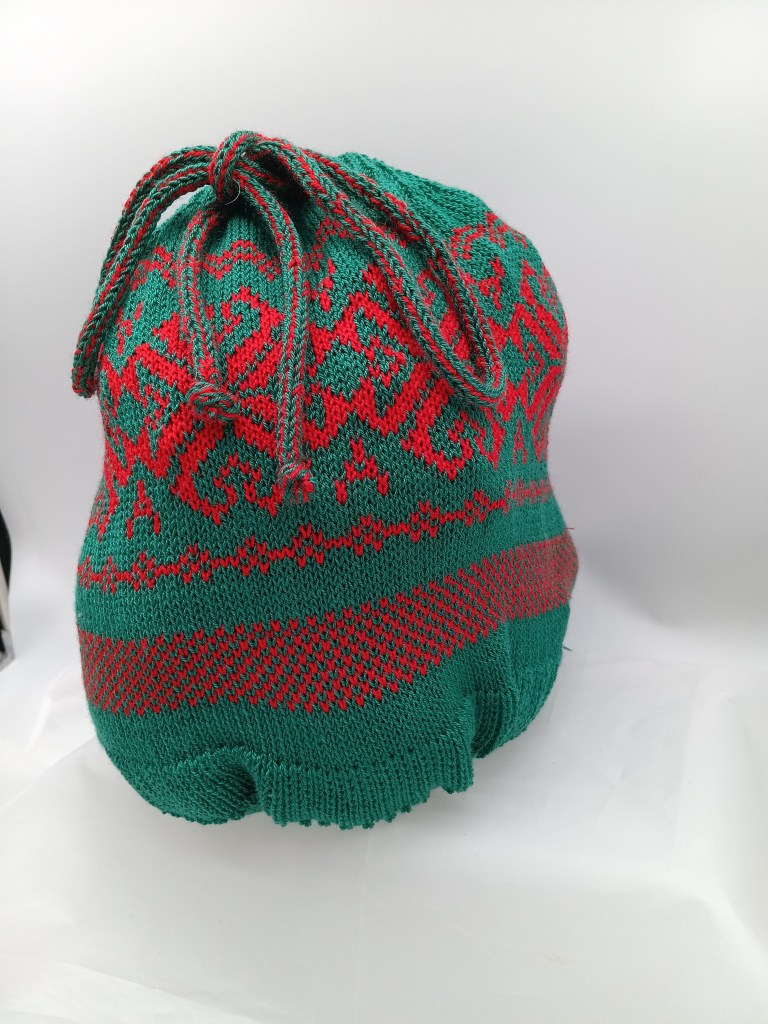
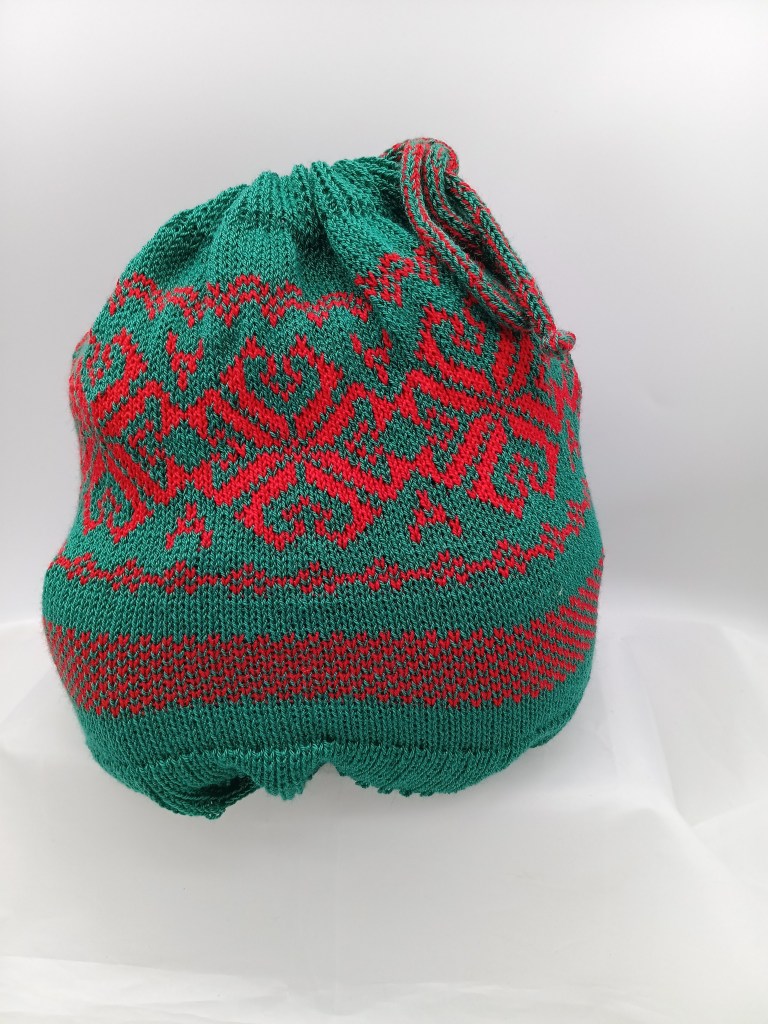
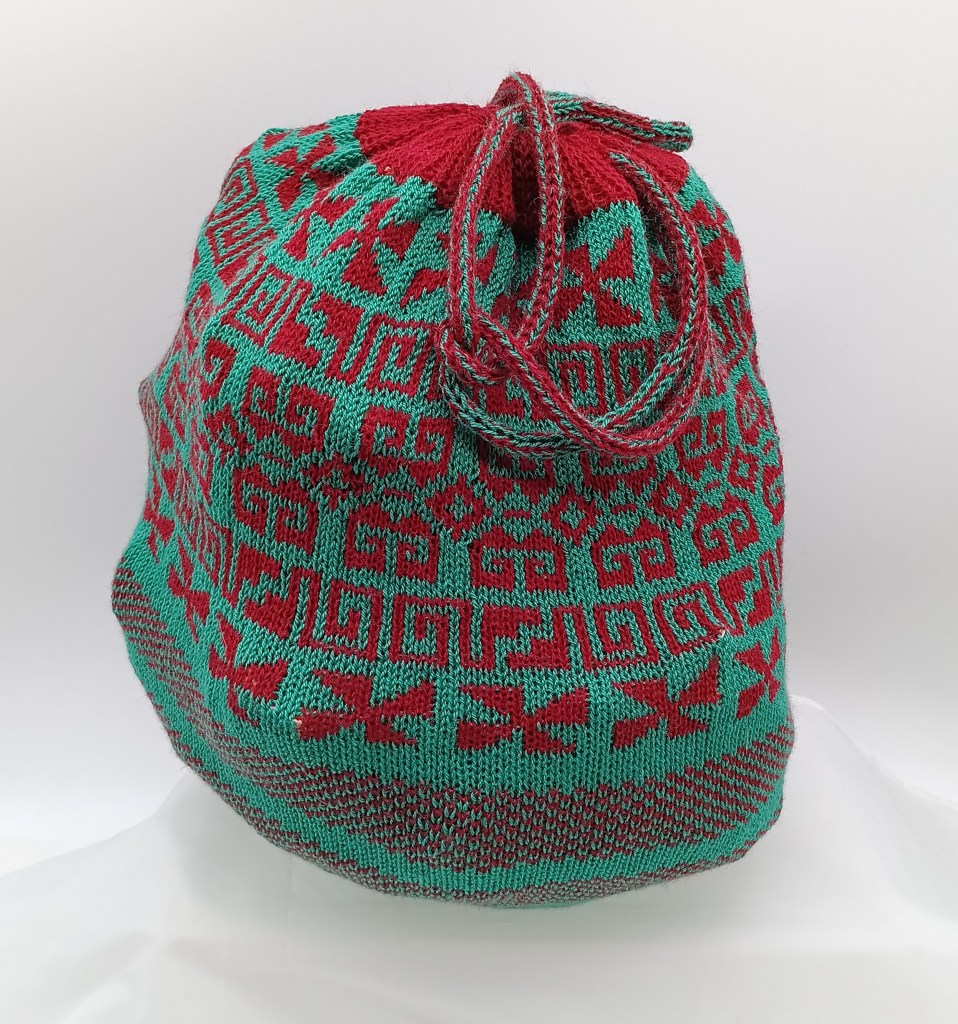
I typically like making something when I test these machines just to be able to show something from these tests. And if it is a wearable item, I donate it to charity. So, I converted the knitted fabric into a beret and a Christmas gift bag.

The lace carriage was not tested but all buttons and levers move freely. It is a very simple carriage and extensive testing is typically not needed.

Typically, I use card #1 for patterned tests. It is the card where every other needle (EON) is selected and the position of these EON needles alternates every row. In this case, any mispatterning will be immediately visible. Check out the video: all stitches formed beautifully. Also, for fair isle tests, I use very contrasting yarns where ANY mispatterning will be immediately noticeable.

The machine handles two kinds of yarn types very nicely (one an acrylic blend and 100% acrylic) and no static formed.

Some sources claim that Brother KH860 typically does not come with built-in garter carriage rails. Well, this is already the third KH860 that I came across that had them. Built-in garter carriage rails are great for future accessorization with a Garter carriage.

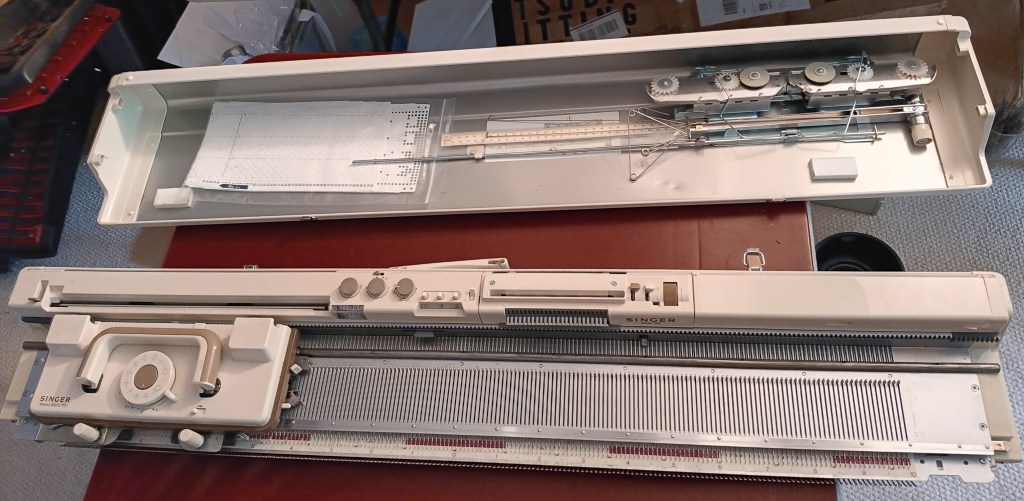
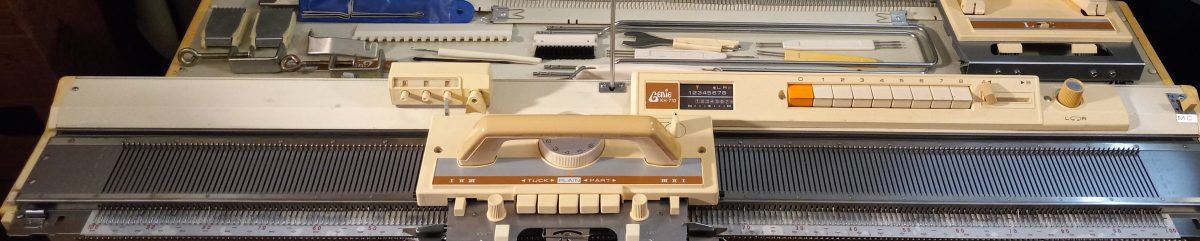
The machine had all major accessories (I only had to get cast-on combs from my stash – they are shown below in a disassembled state): lace carriage, extension rails, sinker plate, tension mast and of course the main carriage. They all fit into the lid of the case.

The machine came to me with very few minor accessories but I was able to find and collect the replacements.

The claw weights, transfer tools (with 2×1, 3×1, and 2×3 pegs), table clamps, set of motif cams, and the needle indicator strip are all new from the old and new stocks (yeah, new stock is probably a knock-off but serves the purpose).

The missing accessories are wax (it was so old it crumbled), a punchcard holder (a rod that is inserted into the small hole behind the punchcard reader) a tapestry needle (any needle will work – I like plastic needles), oil (get a gun oil on Amazon), and a cast-on thread (I use a strong silky thread or a thin acrylic yarn as my cast-on three).

The absence of these accessories did not affect the functioning of the machine. For example, all the tests shown in my video were performed without them: I did not need to insert a punchcard holder rod into the slot and the punchcards advanced without problems.

The punchcard set that came with this machine is not the original set. The original cards should have been marked with the letter J. Those included with this machine will be marked with the letter S. These cards correspond to those in the manual for the KH868 knitting machine (available for free here).

The hard copy of the manual for the KH860 model will also not be included with this machine but it is available online for free here.

Now about imperfections:

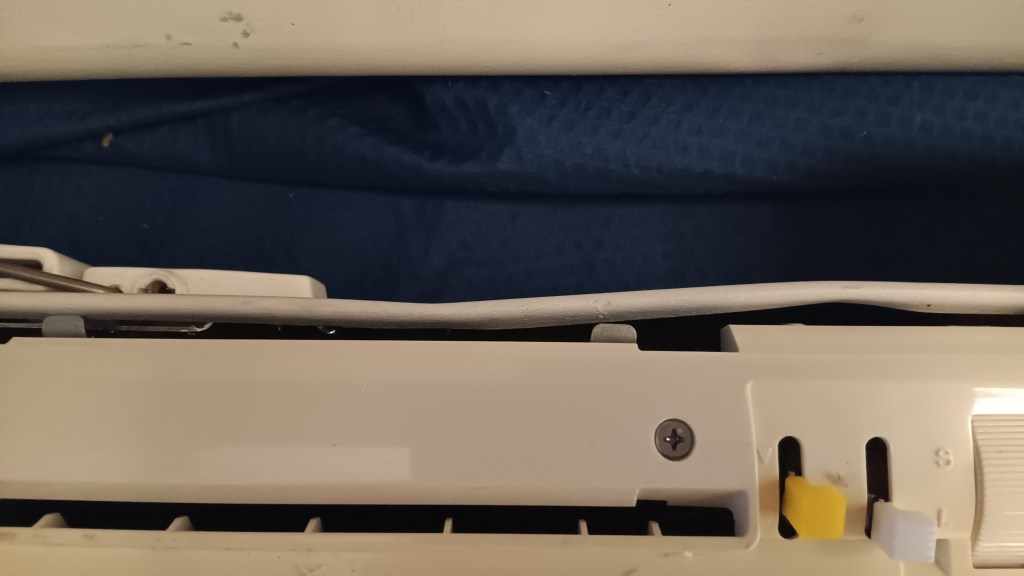
  1. Crack on the plastic near the knob for the punchcard reader. Although cosmetically not pleasing, it did not affect the functioning of the machine and/or the punchcard reader.

2. Because of the garter carriage rails and the carriage stoppers on each end of the needlebed, the carriage gets a bit stuck when pulled too far to the right or to the left (see the last couple of minutes of the video). It is just something that you’ll need to get used to.

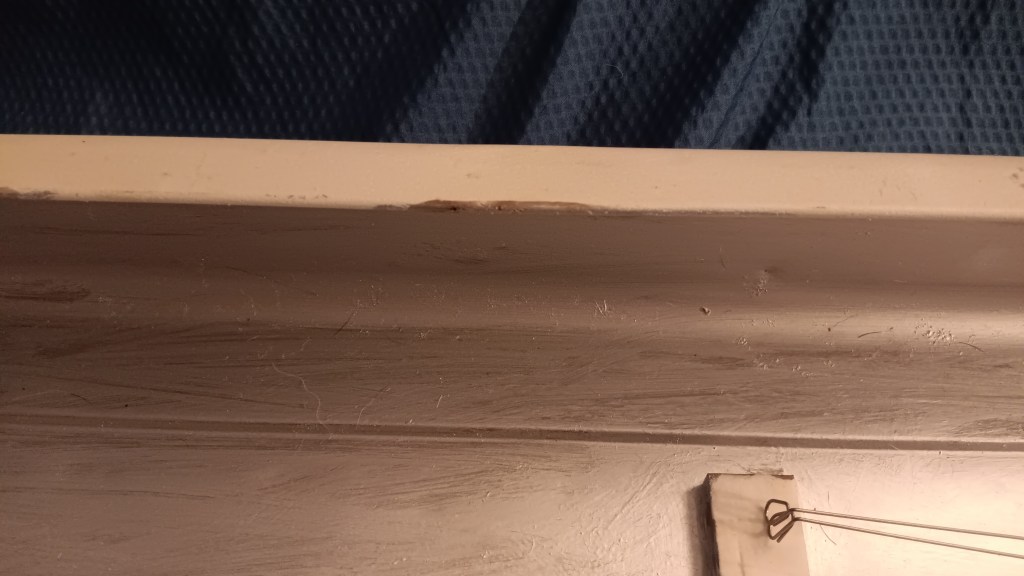
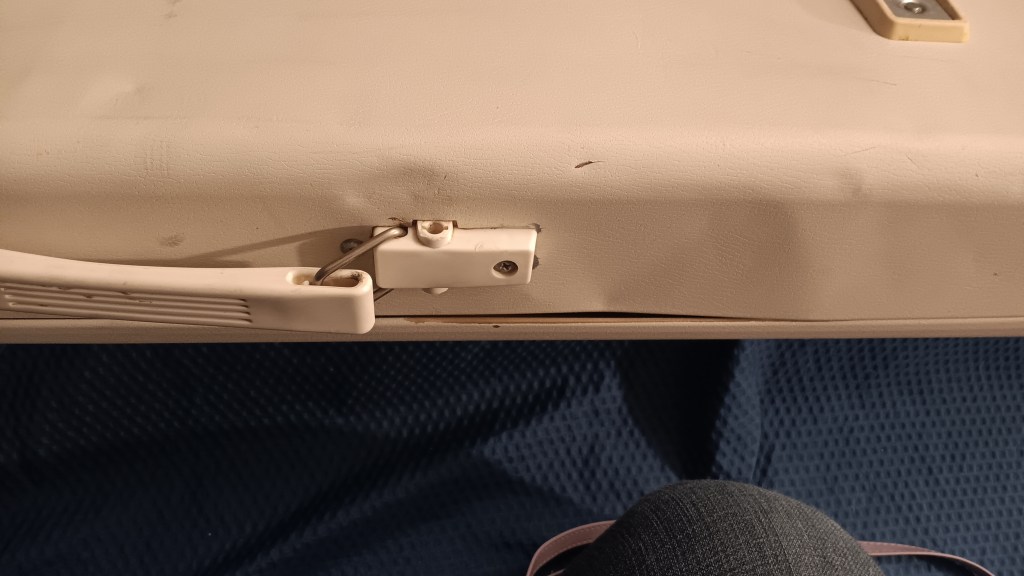
3. The lid and the case have some minor stains, scratches, and scruffs. Below are the pictures of some of them. Despite these minor cosmetic imperfections, the overall states of the case and the lid are pretty good. One of the best ones I’ve seen.

Happy Knitting!