
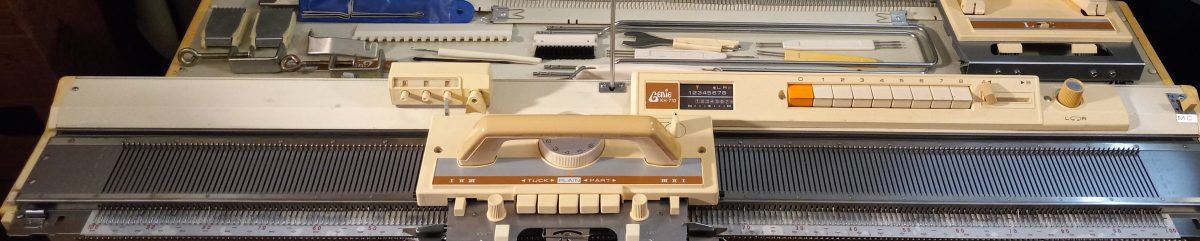
 Studio (also known as Singer, Silver Reed and Elna) machines are great machines to have for beginners or advanced knitters…They offer a lot of versatility. So far, I had a simple (without any automatic patterning with the exception of manual needle selection) and punch-card Studio machines. Studio 360K appeared on the market in 1980-1982. They are equipped with a 24-stitch patterning mechanism transferred to the needles using the punch-card reader.
The hero of this blog, Studio 360K, has 200 needles. The distance between needles (which is also called a gauge) is 4.5 mm, which is considered a “standard”. The best yarn for this machine is sports weight. Thicker yarns can be kitted on every-other needle.
This particular Studio 360K knitting machine came to me in a pretty decent shape so no major disassembling was required. There was no rust. I removed dust/dirt using a brush from under the bed (I did not disassemble it). I removed all needles and polished them as there was a tiny bit of rust on them where a bad (decomposed) sponge bar was touching them (it is pretty typical for old neglected machines). However, all the needles were inspected individually and I tested them by knitting on a full bed using different techniques. The short answer is – everything looked good. For more justification/information on how I judge it – refer to the youtube video made for this machine. The sponge bar was replaced at the beginning of August 2022. It was only used to test this machine (made three cowls on it – see below).
 The carriage was somewhat more sensitive to the combination of yarn and tension than the other machines I refurbished. If possible, I would recommend using new sport weight yarn, wound into cakes, and taking the yarn from the middle of the cake while knitting.
The machine came with no end rails. This is a typical problem for most Studio/Singer machines. These end-rails are rubber, which decomposes with time. Some Singer/Studio machines have metallic end rails but this one had separate rubber ones. They typically tend to decompose due to time and fall off. So, initially, these rubber end-rails were still present but while I was using the machine they fell off since they already showed a lot of cracking and deterioration. These end rails are also not very critical pieces and the machine will work fine without them. They are important when knitting on all 200 needles. But even in this case, if you slow down the carriage on the last 10-20 needles and don’t let the carriage slide too far, you will be ok. These end rails are needed to prevent drums from mis-patterning if the carriage is moved too far from the bed.
I typically do not include end-rails with my refurbished machines because most knitters do not use the full bed – only some needles in the middle. However, I felt that because this machine is sensitive to tension, it could be relatively easy for a new knitter to accidentally slide the machine from the bed. So, I installed the new Installed end rails. The carriage without them did not run as smoothly. FYI: if these decompose and fall again, the new ones simply snap on but the lid needs to be removed. Contact me if you need help with that.
BEFORE:Â Â Â Â Â Â Â Â Â Â Â Â Â Â Â Â Â Â Â Â Â Â Â Â Â AFTER:


I did not extensively test the knit leaders because I do all my calculations myself. But all buttons turn freely and the paper advances as the carriage moves back and forth. The video shows this as well.
The machine came to me without the original punch cards. I purchased a set so this machine has all accessories. Some of the punch cards correspond to the original set and some are different (more exciting, in my opinion).
The machine also DID not come with a hard copy of the manual but it can be found here (totally free). This and this brochures are also typically included with the package for 360K. they cover some knitting techniques as well as garment shaping. I found them very useful when I knitted my sweater last year.
All the tools are present, including replacement needles. If more are needed, I recommend purchasing the replacement needles here. Only one set of unraveling cord, card snaps, point cam, and yarn separators are included. The yarn separators and point cams are needed to knit 2 single motifs. To be honest, a single motif on punchcard machines requires a lot of skills. So, by the time the user decided to knit two single motifs (where two sets of these are needed), this knitter would be considered advanced and will either know where to get these parts or will switch to an electronic machine (single motif on electronic machines is so easy!!!). The carriage lock (accessory number 2) was not supplied with the original setup. So, I ordered a 3D printed one specifically for this machine. The card guide was also missing (accessory number 18). But I included a large knitting needle that I used while testing this setup.

This carriage runs on the bed a bit tighter than my other 360k. It is also very sensitive to tension. Make sure the yarn flows really REALLY smoothly and that the cake/bobbin/cone is right underneath the tension mast.
The machine has several cosmetic imperfections. They are:
- The discoloration on the carriage. It is not affecting its function. Probably a previous owner attached a sticker to it and the plastic around it became darker with time.
- Shipped end by the end rail. It also does not affect the functioning of the machine.
- A couple of scoff marks on the knit leader card advancing mechanism.


I also replaced the two front top panels (they are slightly lighter than the middle one – see the last picture above). They were severely cracked and needed to be totally replaced.
To learn about the general pros and cons of Studio/Singer 360K, please, refer to my previous post.
When I test machines, I really like to knit something in the process. So, I am making these wide pieces of knitted fabric, which I then convert to cows/hoods/neck warmers. Below are the cowls that I made while testing this machine:


You can see me making these in this video (no instructions though – yet!)
All these are going to charity to support the Happy Hats Maryland project to supply 1000 hats and scarves to those in need in my county.
Happy knitting with this machine!!
 Say hello to my freshly refurbished and tested Brother KH930 knitting machine. It was made in Japan in 1986 and is a standard machine with 200 needles. Standard means that the gauge is 4.5 mm (the gauge is the distance between needles). The needle bed is metal. This and the electronic components make this machine pretty heavy.
 Pros:
Pros:

 A convenient holder for tools is located to the very left of the electronic display:


 For example, a friend sent me a pattern for a blanket. The file was 200 stitches by 270 rows. Because 930 has limited memory, such a large file DAK can only be uploaded into the 930 in 66-row sections. So, 5 sections total. So, I first knitted 5 rows of stockinet (which is always recommended), then patterned the device and knitted the first section. The machine beeped and flashed 66 when my carriage was on the left. All needles were selected. While the carriage was on the left, I uploaded another pattern. Then I programmed the pattern and then knitted the last row of the previous section (where all the needles were still selected).
 While testing this machine, I manually entered two patterns (W and S for a vest for my son’s teddy bear) into the machine’s memory and used them to knit a vest. I successfully loaded a pattern from a disk (through FB100) and I also transferred a pattern through a direct link cable (from DAK) and knitted a book cover for my son with his initials.
 My ultimate goal is to learn about knitting machines as much as possible. Out of all machines I tested so far, which is only 12 (which includes Singer/Studio/Silver reed punch card machines, Brother manual and Brother push-button machines), this is by far my favorite. Luckily, I have three more of these machines and one is definitely going to live in my machine knitting garage!!! I hope you will think the same!!


 It comes with all accessories including (numbers are going in the order as they are listed in the
 in the box.
 Some Singer/Studio machines have metallic end rails but this one had separate rubber ones. They typically tend to decompose due to time and fall off. So, initially, these rubber end-rails were still present but while I was using the machine they fell off since they already showed a lot of cracking and deterioration.
  These end rails are also not very critical pieces and the machine will work fine without them. They are important when knitting on all 200 needles. But even in this case, if you slow down the carriage on the last 10-20 needles and don’t let the carriage slide too far, you will be ok. These end rails are needed to prevent drums from mispatterning if the carriage is moved too far from the bed.
 And last, but not least, pros and cons:
 A little bit of history: Singer/Studio 321 machines were introduced in 1972 and were the second earliest model capable of patterning with 24-stitch punch cards. It is a standard (4.5 mm) gauge machine with 200 needles. So, this machine is 50 years old!!


 Scrabby yarn (from
  Knitting by hand with this yarn was fun – it creates a unique texture without any effort. I also decided to use my Addi circular machine to see if I can make household items faster. So, I was able to knit loofahs, coffee holders (aka reusable sleeves for paper cups), place holders, table pads and coasters.
 The knitting on the machine became significantly easier after the first two rows. However, some of the stitches did not sink into the slots on their own and I had to help “them” . Even though the yarn will hide all defects because of the variegated colors and because of the twisties on the yarn, I still did not want to create tuck stitches because they sometimes lead to missed stitches. Check out my
 I purchased a new Hague linker directly from Hague in UK and so far I am very pleased although not everything is ideal. This is the only linker that I ever used so I don’t really have what to compare. My linker with the one with the electronic foot pedal control but the same pros and cons and advice are applicable to a manual machine.
 Pros and cons specifically for an electric linker:

