 Preface: If I had to describe this machine with just one word – it would be FLAWLESS!!!
But, first, a little bit of history. Brother KH551 knitting machines were introduced to the market in the 1960s and were the first machine with somewhat semi-automatic patterning capabilities. In this machine, there are 4 buttons, that you push to  prepare for the needle selection and then rotate the knob (using the wrench) to select the corresponding needles. It is an excellent machine for beginning knitters. I feel that it would be also great for people who are not quite yet ready to give up hand-knitting but want to have more even stitches and a bit faster progress…. Brother KH551 is also lighter than other machines mostly because its bed is narrower. The carriage is also significantly lighter and I could easily move it with just one hand.
The machine comes with heavy-duty cast-on combs that eliminate the need for any other weights. As you can see from my video, I did not attach any additional weights and had only one small problem with an  uneven stitch which is amazing considering no additional weights and a rather difficult (with specs and boucle) yarn.
Not the whole machine is light, but the carriage is also light and small and is ideal for somebody with small hands and not a lot of upper body strength. Its lightweight makes it pretty portable, compared to other machines. The machine is capable of plain old knitting with hand manipulations of the needles. But also is capable of semi-automatic needle selection. The petiteness of the  machine also makes it easier to store when not in use. I like the three-thread tension mast and a yarn clip in from of the tension mast rod. I love the three-horned tension section of the mast (not just a triangle) where each color of yarn can be inserted individually. However, the tension on the second and middle tension disk only has two settings (although they might depend on the very right one).
One feature of this model that I have not observed in others: There is some kind of protective lever at the end of the bed because the machine does not slide very easily from the end of the bed. One has to work really hard to “accidentally” pull it off the machine. In the video, you will see me seemingly struggling with the carriage towards the bed’s end (when knitting on a full bed only). But the knitting itself did not struggle: I believe it was just that protective mechanism in action.
The setup includes all major accessories. A couple of minor things are missing:
- Sinker plate yarn hanger. The machine came with only one. However, when or if or both you decide to knit using the plating technique (see p. 18-19 in the manua
 l), you can just make a similarly shaped hanger out of a heavy-duty paper clip). On other machines, when I knitted multicolor slip- and tuck-patterns, I was just leaving the thread on the side of the machine to keep it out of the way…Regardless of the technique you chose, the absence of this part does not affect the machine’s functioning and you can still do a LOT of various things with it using a variety of techniques.
- I did not want to include the old container with oil because I did not want to risk putting such old oil onto this machine. I recommend getting a Hoppe’s gun oil (this is what I used to clean the needles and lightly oil the machine) and oil only lightly on the parts mentioned in the manual.
This machine comes with two brochures: a hard copy of the manual (which is in great shape) and a knitter’s guide (which contains techniques, a bunch of how-tos advice, and a couple of examples on garment knitting). I used this brochure when I knitted my sweater last year (using another KH551). The manual is also available online but the scanned copy is not of great quality.
I tested this machine and other KH551 and I was very pleasantly surprised by how well it handles potentially challenging yarns. This machine handled boucle yarn without any problems. In fact, I did not even have to restart the knitting of this shawl. Check out a pretty pathetic attempt of me modeling it below. I later added decorative edging to the shawl. I found a yarn that matched the color of the tiny yarn specs (boucle), made a cord out of it, and then attached it to the edges. I actually like how it turned out. Light yet warm garments are the most favorite types of garments for my constantly-cold petite body.


A couple of other things I liked about KH551: Love the small container for tools. I like that it is so easy to remove and position onto the bed. I also love a special container that stores all the tools when not in use. The table clips are somewhat different than the younger models. It is first screwed onto the case and then onto the table.
I removed all the needles, cleaned them and inspected them all individually. I then knitted on a full bed machine, which helps me to identify faulty needles even more: when there is a propagating error or a flaw in the knitting that appears in the same place, it is definitely due to faulty needles.
A couple of disclaimers about this machine. The case (lid and the bottom part) has several very small dents (hey – it is over 50 years old after all! It is like us having age spots and wrinkles). The table clamp attachments (on the bottom portion of the case) were rusty and I cleaned them and painted those areas with rustoleum to slow down or even prevent further rusting to extend the life of this wonderful machine. It appeared to be the only place, where I observed rust on the main bed. There is some rust on the lid – at the ends where the metal ends touch the cover panel.


I replaced the sponge bar and cleaned the machine, carriage and sinker plate from dust/lint.

The row counter is easy to operate: also shows how many rows remained and how many rows are current. The numbers do not jump uncontrollably as in a couple of other machines I tested when you are trying to re-zero the ones- or tens positions. Basically, the numbers do not slip when you turn the wrong way. This type of row counter is actually my most favorite out of all other machines I tested.
To summarize, below are the lists of pros and cons for the Brother KH551:
Pros:
+ Carriage is very light and slides very easily
+ The bed is narrower than other machines – which makes it more compact
+ …and makes the machine lighter than other similar models
+ relatively easy deep cleaning – all parts are solid and straightforward to insert/assemble/disassemble
+ The needle count is engraved on the bed – so these slippery and constantly in-the-way paper liners showing the needle count won’t annoy you by constantly sliding and getting lost.
+ Threading the yarn is a bit more intuitive and straightforward in my opinion
+ built-in capabilities for 3 different yarns
+ the hard case is a combination of fake leather and plastic, which makes it not only look neater and nicer than other machines but also made durable. The case shows absolutely no discoloration despite the age of this machine.
Cons:
- The push-button mechanism helps to select the needles but you need to change the needles selected quite often (basically turn the ratchet tool to SET and OFF). It might be tedious and you need to keep track of the correct order. When I tested this machine, I got into this zen-like rhythm that helped no prevent mistakes…
- Some might find the machine too simple – yes, it has only limited patterning capabilities. However, with manual needle selection and yarn manipulation, the possibilities are endless.
- I discovered some typos in the manual when I was testing the patterns. I vaguely remember that I’ve seen an addendum to correct the errors but I cannot find it now. Maybe it was for another machine… Just keep it in
 mind when you try the patterns from the manual and they are not working.
 A little bit more about potential typos in the manual. I tried at least a dozen of times to knit the patterns on p. 33: a purl-like stitch on the left and another one on the right. The purl-like was either dropping stitches on the whole swatch or was tangling the yarn so bad that I had to start all over again multiple times…I do not exclude a complete operator failure….But: when I started reviewing the pattern on the right-hand side (the anonymous one on p. 33), I noticed some inconsistencies. I was still able to knit it but the pattern did not look like in the manual: see the picture below (the very top swatch) of what I got and compare it to the manual – two big differences. Well, at least the swatch did not fall off the bed like in the case of the “purl-like” pattern attempt. But that pattern (on the right-hand side in the manual) definitely had typos: Look at the schematics: it shows TUCK but the description writes PART. I vaguely remember seeing an addendum to one of the manuals of the machines I refurbished last year… Maybe the purrlike stitch pattern on the left also had typos/errors and this is why I could not figure it out… But I successfully knitted herringbone (not shown in my video – sorry), seed stitch A, seed stitch B (pics below and on a video), and diamond design (pattern I in the book on p28)….I then knitted these patterns on the whole bed and converted what I got into a hood/neck warmer/cowl…

Not much else to say about this machine left, other than it was an extremely pleasant experience working on it. Indeed, now, after failed attempts to knit a “purl-like” pattern, I want to go back and experiment with all possible knob and lever combinations to see what other UNKNOW YET patterns I will come up with.

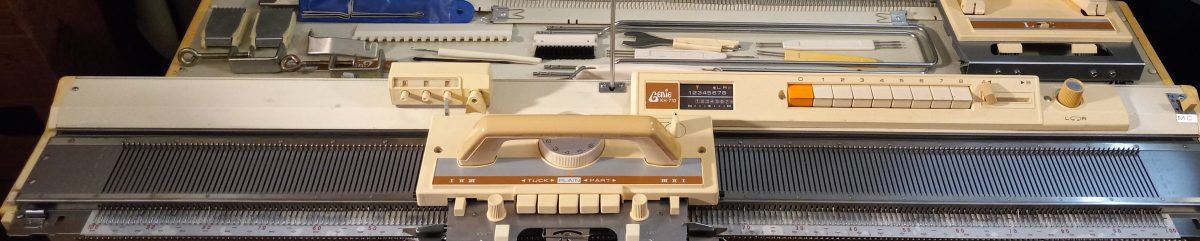


 Let me introduce a freshly cleaned and tested Brother KX350 knitting machine. It is a plastic flat bed knitting machine with 132 needles positioned 7 mm apart. So, it is considered a mid-gauge. But it handles bulky yarns (medium worsted) pretty well. I was able to easily knit Red Heart Super Saver yarn on this machine.


 The machine will be shipped in original box covered with brown shipping paper.


 Studio (also known as Singer, Silver Reed and Elna) machines are great machines to have for beginners or advanced knitters…They offer a lot of versatility. So far, I had a simple (without any automatic patterning with the exception of manual needle selection) and punch-card Studio machines. Studio 360K appeared on the market in 1980-1982. They are equipped with a 24-stitch patterning mechanism transferred to the needles using the punch-card reader.
 The carriage was somewhat more sensitive to the combination of yarn and tension than the other machines I refurbished. If possible, I would recommend using new sport weight yarn, wound into cakes, and taking the yarn from the middle of the cake while knitting.


 Say hello to my freshly refurbished and tested Brother KH930 knitting machine. It was made in Japan in 1986 and is a standard machine with 200 needles. Standard means that the gauge is 4.5 mm (the gauge is the distance between needles). The needle bed is metal. This and the electronic components make this machine pretty heavy.
 Pros:
Pros:

 A convenient holder for tools is located to the very left of the electronic display:


 For example, a friend sent me a pattern for a blanket. The file was 200 stitches by 270 rows. Because 930 has limited memory, such a large file DAK can only be uploaded into the 930 in 66-row sections. So, 5 sections total. So, I first knitted 5 rows of stockinet (which is always recommended), then patterned the device and knitted the first section. The machine beeped and flashed 66 when my carriage was on the left. All needles were selected. While the carriage was on the left, I uploaded another pattern. Then I programmed the pattern and then knitted the last row of the previous section (where all the needles were still selected).
 While testing this machine, I manually entered two patterns (W and S for a vest for my son’s teddy bear) into the machine’s memory and used them to knit a vest. I successfully loaded a pattern from a disk (through FB100) and I also transferred a pattern through a direct link cable (from DAK) and knitted a book cover for my son with his initials.
 My ultimate goal is to learn about knitting machines as much as possible. Out of all machines I tested so far, which is only 12 (which includes Singer/Studio/Silver reed punch card machines, Brother manual and Brother push-button machines), this is by far my favorite. Luckily, I have three more of these machines and one is definitely going to live in my machine knitting garage!!! I hope you will think the same!!


