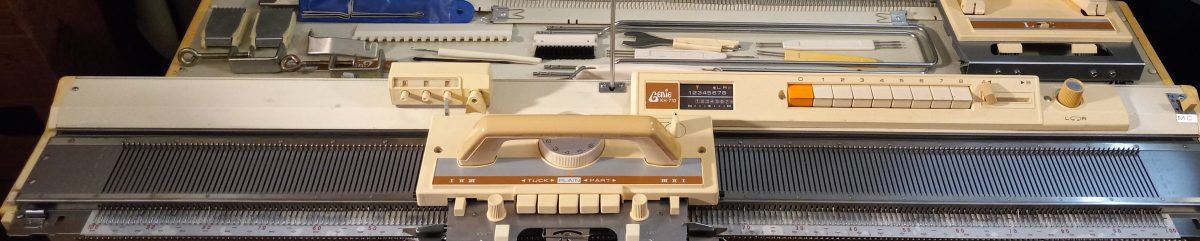
Brother KH260 refurbished in September 2022

Brother KH260 are wonderful and highly desired machines. They habe 110 needles, spaced 9 mm apart from each other).

This distance and large needles makes this machine “bulky”. Brother KH260 can handle a large variety of thicker yarns, including worsted. I tried double-thrded boucle yarn and it ahndled it well as well. I was especially happy about it because I love textures yarn, especially boucle, but not many machines can handle them.


What I did on this machine:

  • Removed all needles, cleaned them and inspected individually and then during knitting on a full bed.
  • Oiled carriage and ensured that all levers and kbod ove frely and do not mis-function during knitting
  • Cleaned the bed and gently cleaned the plastic parts

Overall the machine was in good shape before I started cleaning it. The case does not have any major bends/scratches. Only minor ones.

This machine came with all its assesories with some minor exeptions.

The card clips were missing – I cinluded two paris of new ones (small yellow plastic things in the picture below).

The assesories that are missing from the machine and wll not be included are:

  • Oil canister. I do not include old oil on purpose. Please, get a fresh/new oil. The recommended by many machine kntiters is Hoppe’s Elite Gun Oil
  • No ravel cord is included but any smooth strong yarn can be used.
  • Place card holder was missing from the set. As you can see in the video, I was not even using it and the cardreder worked well. However, any straight or bent hand-knitting needles will work. I included one.
  • -some manuals state that the machine comes wth 20-count punch card set. The hard copy of the manual that came with this machine lists only 15 cards. Indeed, a set containing only 15 cards came with it.


All tools fit into a tool box: a buil-tin compartment on the main bed.

This tool box is excellent to store assesories whlie the machine is not in use. The sinker plate, tuck-brushes, punchcard, tension rod and the row counter also fit wonderfully into the lid of the case when not in use.

The machine size is larger than all other single-bed flat-bed machines. The bed is winder and slitly longer.

The machine performed wonderfully with slip, tuck and fair isle patterning on full bed. I did not even have my usual trial/error starts. I did nothave to putz around too much with tension and the right number of hanging weights…. I was very pleased how well everything went.

I used this machine to knit simple stockinet, fair-isle, slip and tuck-stitch patterning. You can see those in my video. Below are the things I made while testing this machine and filming my demo.

Cowl/hoodie from a variegated dark red yarn using slip-stitch. Reversible/double sided.


Cowl/hoodie with a matching hat. Hoodie was knitted using a self-striping yarn and tuck-stitch patterning. Can be worn as reversible. The hat was knitted using simple stockinet. The ribbing was made by a mock-1×1 ribbing.

Cowl/hoodie knitted using fair isle and custom-made punch card. It can be worn as double-sided/reversible.


I did not really find a lot of cons for this machine. Maybe simple specifics of the machine which make it to stand out.

So, pros and cons are:

Pros:

+ Carriage (despite being heavy) is still relatively easy to move especially in KC mode (attached to a timing belt)

+ capable of handling thicker and textures (typically challenging) yarns

+ accessories, including needles, are still easy to find.

+ straightforward manual

+ because of the usage of thicker yarn, creates a texture similar to hand-knitting. I personally love those large stitches. Makes me instantly feel warm and cozy. The thicker yarn when knitted on loose tension also make the knitted fabric very soft and moldable (not stiff as on some standard machines).


Cons:

– Larger than other machines, including some other bulky models. It is also heavier.

– Expensive as they are highly desirable.

– carriage levers prone to sticking, especially when not in use for a long time. This might result in improper needle selection. But can be done with regular maintenance/care.

– requires more weights than other machines very likely because of heavier yarns.

– tuck brushes need to be installed. Some machines (mostly standard) already have built-in tuck-brushes on sinker plate. This is not really a con but just one more thing to keep track of and not to misplace.


Overall, machine knitters all over the world call Brother KH 260 a working horse. And I am in complete agreement!!

Electronic knitting machines and software combinations

This is a list for me as I am learning about various software and knitting machine combos. Feel free to comment if you see errors.


Wincrea

Passap E6000


image2track

Brother KH-930, KH-930e, KH-940, KH-950i, KH-965i, KH-970


Knit and Sew

Brother kh-940, KH-950i, KH-965i, KH-970, KH-930, KH-930M


DAK (design a knit)

All (to the best of my knowledge)


AYAB (All yours are beautiful)

Brother electronic machines


List of pros and cons of knitting machines I used

…in progress. Updated: June 2025

abbreviations:

b-in = built-in

mb = metal bed

sg = standard gauge

st = stitch

mb, sg, 200 needles, 24-st punchcard

https://youtu.be/L1GwyLg46V0 Can do tuck slip, 2-color fair isle; if carriage is stuck, unscrew the sinker plate, no built-in toolbox; has built-in knit leader; standard set of punchcards has only 10 cards, no hard case lid (all parts are inside a sterofoam packaging; budget, lightweight model. https://wordpress.com/post/thoughtsandknits.wordpress.com/427

m, sg, 200 needles, 24-st punchcard

https://youtu.be/27blcVPYAlw Can do tuck slip, 2-color fair isle; if carriage is stuck, unscrew the sinker plate, no built-in toolbox; no built-knit leader; compatible with standard add-ons (ribbers, knit-leaders, color changers, row counter) http://thoughtsandknits.com/2025/05/26/studio-mod-324-knitting-machine-prepared-for-lara/

md, sg 200 needles, 24-stpunchcard; b-in knit leader, tool tray

https://youtu.be/0PnXE_Bc8yc Can do tuck slip, 2-color fair isle; if carriage is stuck, unscrew the sinker plate, no built-in (but has stand-alone) toolbox; compatible with standard add-ons (ribbers, color changers, row counters) http://thoughtsandknits.com/2022/06/11/studio-326/

XXX

XXX

XXX

XXX

XXX

XXX

XXX

XXX

XXX

Review of Scrubby yarn and how it knits on circular knitting machines Addi

Scrabby yarn (from IceYarns or from RedHeart) has sort of an eye-lash thread but with the “eyelashes” are created with the twistiess. It is typically used to knit washcloth for dishes and baths

Knitting by hand with this yarn was fun – it creates a unique texture without any effort. I also decided to use my Addi circular machine to see if I can make household items faster. So, I was able to knit loofahs, coffee holders (aka reusable sleeves for paper cups), place holders, table pads and coasters.

Both IceYarns and RedHear offer a very wide variety of colors, including solid, two and three color variegated types. I chose white and black yarn because in my opinion it hides all the crumbs and spills really well

The IceYarn offers scrubby yarn as 100% polyester. One skein holds 3.53 oz (100 g) and contains 103 yards (95 m). Red Heart offers both 100% polyester (100g/3.53 oz and 85 meters/92 yards per skein) and 100% cotton yarn (weight and yardage depend on whether the color is solid or variegated). I only tested the 100% polyester yarn because I had cotton washcloths and I could never get rid of the smell of dirty dishes even after washing the scrubbies over and over again.

The cast-one was straightforward and relatively easy. It did help to keep the tension loos but not too loose because the yarn is silky (very smooth) enough where it can skip stitches (which we don’t want). However, I started using contrasting waste yarn because it is easier to manipulate the stitches afterward (in order to put the washcloths together )

The knitting on the machine became significantly easier after the first two rows. However, some of the stitches did not sink into the slots on their own and I had to help “them” . Even though the yarn will hide all defects because of the variegated colors and because of the twisties on the yarn, I still did not want to create tuck stitches because they sometimes lead to missed stitches. Check out my youtube video on how I dealt with these stubborn stitches.

A square scrubby took 12 rows. In the same video, I demonstrated the techniques I used to finish these square scrubbies. I tested them and they are washable on a regular cycle and even dryable on “knits” cycles. Coffee mug sleeves would probably take 12-30 rows depending on whether you like it single-or double-layered. Placement mats should be done on large Addi. I made mine rectangular and double-layered with 60 rows.

Hague Linker – review by ComfiKnits, April 2022

I purchased a new Hague linker directly from Hague in UK and so far I am very pleased although not everything is ideal. This is the only linker that I ever used so I don’t really have what to compare. My linker with the one with the electronic foot pedal control but the same pros and cons and advice are applicable to a manual machine.

What I did on Hague linker:

  • Linked the edges of the scarf knitted on standard knitting machines. As the Hague manual mentions, it is extremely important to get a hang by practicing putting the knitted edge on the linker’s pegs to create a very nice and even seam.
  • Linked the open stitches on every and every other needle. I use this technique when I was to create more stretchy edges. Check out my video on those.
  • Linked the edges of the scarf knitted on a bulky machine – was very pleased as well

Overall recommendations:

  • Learn how to put the knitted edge efficiently and evenly on the pegs.

    I typically try to put the whole piece on a linker – it helps me to evenly distribute the stitches along the piece length.

  • Always knit blank 10-12 stitches at the end to easy take of the linked piece of the machine and to hide the loose ends. By ‘blank’ stitches I mean the thread looping on itself without any underlying fabric.
  • Push the fabric placed on pegs as far as possible so it does not slide off.
  • Keep even tension between first and second fabric layer when joining them on pegs

Pros and Cons.

(+) The edge is nicer than when sewn by hand

(+) Faster than linking by hand

(+) Easy to see as you knit whether the edge is even or not

(+) the size of the linker is compact enough so I sometimes move the whole machine if for some reason I feel that moving the ring with pegs is not convenient. Or sometimes I move around myself whatever works, right?!?

(+) very well-written instructions and manual.

(+) If the needle breaks, it is easy to replace

(+) Parts are available from the manufacturer.

(-) even though there is a tension mast and a threading mechanism with tension control, I feel the flow of the threading yarn is not even. I tried to wind my thread in a different way and it still catches one in a while. But that’s ok and is easy to get control over.

(-) it does miss stitches once in a while. So the yarn threading, tension, combination of thread and the thickness of the knitted pieces are all important.

(-) Even though replacing a needle is relatively easy, putting it in the absolutely correct position requires trial and error. It is doable, yes! But I had to step away from my Hague linker for a couple of days not to get too frustrated

Pros and cons specifically for an electric linker:

(+) Hands are free – all control over the needle movement and speeds are through the foot pedal.

(+) The electric linker can be used manually as well but not many stitches.

(-) I wish the cord was a bit longer. But I wonder if this is some sort of safety precaution because the cord on my sewing machine is also shorter than I want.

I learned a lot by simply using and experimenting with various techniques. There is still a lot to knit and to link and to learn on Hague linker! Below are some products I finished on Hague!

Since this is the only linker I ever tried I cannot really compare it to anything else rather than sewing the garment pieces by hand and on a sewing machine. Overall I am very pleased and will continue getting a hang of various techniques, including decorative ones, on my Hague linker.

Testing Lion Brand 24/7 cotton yarn on Addi circular knitting machine

I was again trying to discover what yarns my Addi will like. Additionally, I was destashing and helping a friend with a charity project. So, I decided to see if I can make a scarf out of this Lion brand 24/7 Cotton yarn.

Each skein contains 186 yards (170 m) and 3.5 oz (100 g) of yarn. I used grey color – neutral color and can be a scarf for male or female.

Typically, cotton yarns are not very suitable on circular knitting machines because of their rigidity. Additionally, this yarn almost looked like a chain and had to stretch to it. Or maybe the thread could be described as a cord. However, the skein was wound so tightly, I could not even get the other end from inside of the skein. So, I decided to rewind it into a cake (which I strongly recommend for all projects on circular and flat bed machines especially operated with a power adapters or motors).

The yarn surprised me: it behaved flawlessly. I was able to hand-crank and get extremely even stitches. First, I was very cautious because at the very beginning (as always), the first rows knitted somewhat loose and I was worried the machine might even skip/tuck of drop stitches or skip the yarn. But once I had enough length and attached a weight, I was even able to knit the whole length of the scarf with a power adapter to my Addi. See my video that shows actual knitting speed – was pretty fast!!

Looks at this beautiful web of stitches created by both hand and drill-cranking.

One skein proivded 252 rows of the scarf with beatiful even stitches. I was so pleased!! I hope you will enjoy knitting with this yarn – just remember the apply enough tension to knit without problems.

List of machines I tested/refurbished/cleaned/fixed

Updated: March 2026;

Total machine count: 91

2 circular plastic

3 bulky basic

6 mid-gauge plastic bed

34 standard-gauge punchcard

18 ribbers

2 bulky punchcard

3 turn-knob

2 standard, basic

8 four-pushbutton

9 eight-pushbutton

6 electronic standard-gauge

Specific Machines:

Addi King 46 needles

Add Express 22 needles

Silver Reed SK120

Singer HK100

Singer 210 Memomatic

Brother KH210

Brother KH230

Brother KH260 (two) 

Studio SK303

Singer 321 (two)

Studio/Empisal mod. 324 (two)

Studio 326

Brother KX350 (five)

Singer/Studio 360K (seven)

Brother KH500

Brother KH550

Brother KH521

Brother KH551 (seven)

Brother KH552

Brother KH581

Brother KH585 (two)

Brother KH588 (two)

Brother KH601

Singer 666

Singer/Studio mod. 700 (two)

Brother (Genie) KH710 (two)

Studio by White SK740

Brother KH800

Brother KH830 (three)

Brother KH836

Brother KH840 (four)

Brother KH860 (four)

Brother KH881 (two)

Brother KH890

Brother KH892

Brother KH930 (four)

Ribbers

Brother KR260

Brother KR551

Brother KR580

Brother KR810

Brother KR830 (six)

Brother KR850 (four)

Studio SRN321

Studio SRP50

Brother KR321


Rare Brother KH-210 Bulky 9 mm gauge knitting machine review


This was my first “serious” machine that I worked on. It was also the first bulky (9 mm gauge) machine I worked on. It was a lot of fun!! Especially because I can easily use various yarn for hand-knitting…. (more on this later).

I could honestly say that this is the machine that made me fall in love with knitting machines and machine knitting. They are cute, great pieces of machinery and were built so well that even now, after 40-50 years of storage and use, they are still working great!

This is a rare machine and was made in Japan by Brother in 1977. You see more often KH230 model and a lot of KH260 models. This model seems to be almost identical to KH230, which was introduced to the market in 1981.

See the full video of how this machine works in here: https://youtu.be/Sjg2Y99rFkU

Before this one, I already started learning some flat-bed machine knitting techniques on Brother KH-X350. I liked it a lot but the cast-on process on KX350 was somewhat stranger…

So, when I read the manual of KH210 (which by the way came with the machine in a surprisingly great shape) and followed all the steps, I was pleasantly surprised how much easier it was to cast on using that suggested method on this machine.

Even though I cleaned this machine very well, it barely needed it. This model does not use sponge bars and maybe this is why the needles were in such a great shape. In fact, I found all metallic parts on this machine being in great shape. There was barely any rust. I did wiped all the needles well with the oily rag and then knitted several rows of waste yarn. So, if you decided to get this machine from me, all you need to do it open the lid, attach it to you table and start knitting!

So the great things about this machine are:

Feel solid

  • Has all major accessories
  • Has a hard copy of the manual
  • Does not need sponge bar
  • Great-looking
  • No rust
  • Box for all accessories
  • All major accessories present including 9 mm transfer tools and four spare needles
  • Knits worsted and thicker yarns than other machines
  • Rare model
  • Works great
  • Simple to use
  • Hard-cover case, which is in excellent conditions


There is just one spot on the main bed – to the very right. But it did not affect the functionality of the machine at all. I did not rub it too much because I did not want to compromise the integrity of the metal but the stains did not come out with just gentle rubbing with Windex and soapy water.


Couple other imperfections are:

  • Slightly chipped counter (but still works great): see the picture below where I show accessories and also I show it in the video
  • Spot on the main bed (shown in the picture above)
  • Couple of minor accessories are missing: cast-on thread, wax, lock to transfer carriage so it does not move during transport and storage. I wrapped it with plastic to fix it to the bed so it wont move during shipping.
  • Missing 4 needles on the bed but they are in the accessories kits
  • The accessories box is missing a lid


I enjoyed tremendously working with this machine. I knitted a scarf, a vert with cables for my son and a sweater with similar cables. I used mock-rib for bottom rib, for the V-neck and for the sleeves.


More good things about this machine:

Everything feels solid about this machine. The carriage is a pretty dark red/burgundy color.

The sinker has two slots for two yarn threads so you can use two colors at the same time. The left picture on the left shows that the right slot is in the working position, while the left slot is in “open” (or idling) position. The picture below on the right shows both slots open to demonstrate to you that they are there


The only reason I am selling this beauty because I feel I explored everything this machine offers and I want to move on to the next level of complexity – like knitting with buttons.

So, below is everything that’s included:

  • KH210 machine
  • KH210 carriage with sinker
  • Hard copy original manual
  • Box with tools: needle push tool, 9 mm transfer tools, large latch hook, spare needles, weights, clams
  • Tension mast, which folds nicely inside the case

Couple of words on which yarns successfully tried to use:

The video cited above shows that machine easily handled two types of yarns.

One was 50/50 wool//acrylic blend, 100 g/300 m (3.5 oz/325 yards) per skein marked as Light-Medium Worsted yarn. I knitted a scarf with this yarn and machine had no problems on tensions from 6 to 10. The yarn from which I made the sweater above was even bulkier: 100g/350 m per skein, and the machine handles even cabling well (cabling creates sometimes additional tension).


The other yarn was a double-thread yarn and I only knitted a swatch. The yarn had some fuzziness to it due to the nylon (aka polyamide) thread. The yarn itself is a 20/30/50 wool, acrylic, polyamide blend. Medium Worsted with 1.76 oz/131 yards per skein. However, the machine handled even this yarn without any static wonderfully on tension 5-7. (but I did not try tighter tension).


Tension mast and yarn guide        Sinker plate inside the case 


Serial number of Brother KH-210 Knitting Machine


Full view of the machine and all accessories

    Â