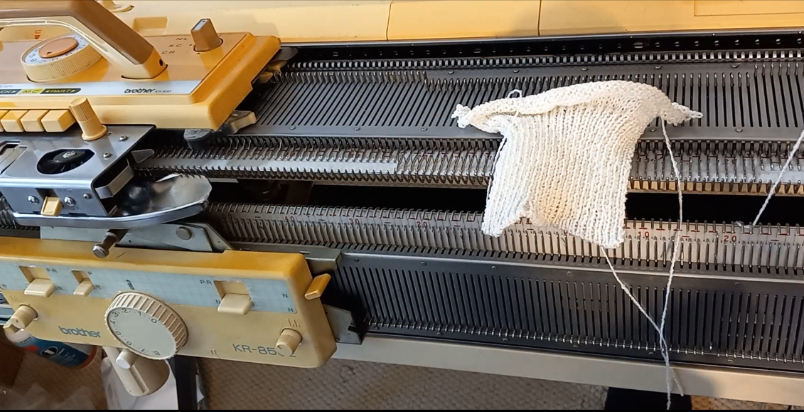
Working, mechanism, pros and cons of drums-based knitting machines (sold under the Silver Reed, Singer, Studio, Empisal model names) with punch card capabilites.

… in progress.

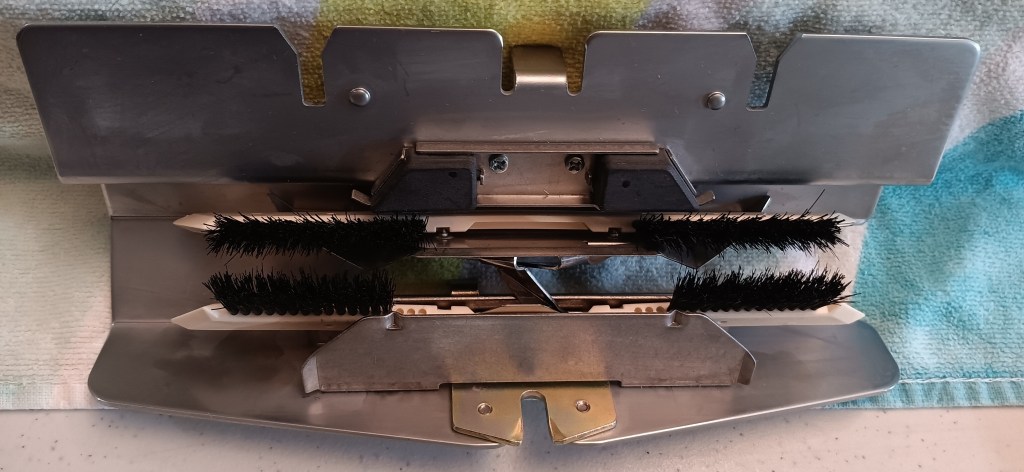
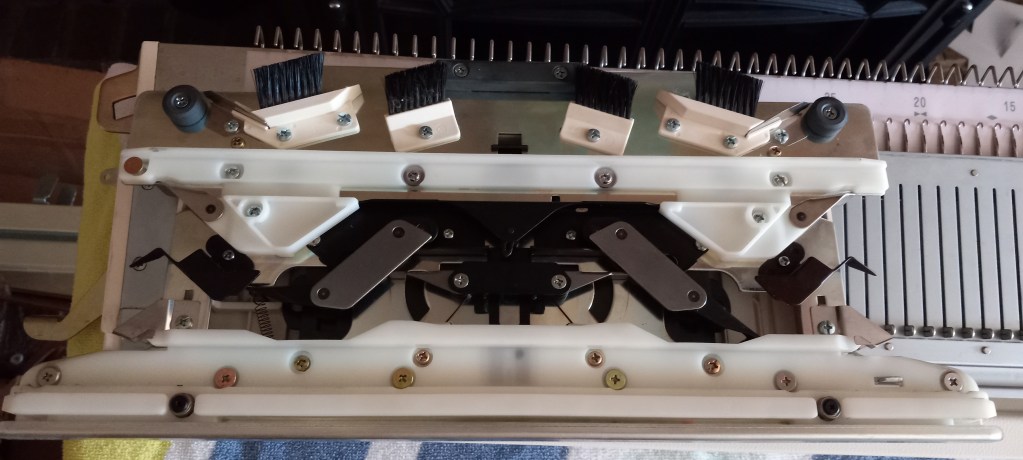
Knitting machines with punchcad capabilities have carriages with drums that glide on the back rail and also assist in needle selection when are passed over a punchcard reading mechanism pegs.

Well, since these patterning drums are such a prominent feature (which also makes these machines stand out from Brother punchcard knitting machines), a lot of cons and pros are asscociated with them.

PROS:

  • needle selection is localized to drums/carriages, thus fewer (theoretically) things to go wrong;
  • drums assist the carriage in sliding on the needle bed

COSN:

  • yarn and debri can tangle around these drums
  • these drums often freeze-up when the machine is not in use for a prolonged time due to solidified old grease/oil;

Here are my other observations/feedback so far:

Pegs on the drums pass the needles to either B position or C position.

When the patterning dial is in the fair isle position, the mani yarn goes onto the needles in C position.

I see blog posts stating that some of the clanking noise might be due to the static in the yarn. To solve this issue, attach wax on the tension mast so the yarn passes through it.

But some knitters experience that noise even when there is no yarn in the carriage. Sometimes, if the carriage was not recently serviced or the sponge in the retaining bar is old, you might hear some clanking noise. I am discussing this issue (as well as how to address/minimize it) in my video.

When the ribber connecting arm is attached (from SRP50 ribber – maybe others, still researching), the carriage cam dial does not turn from L to Stockinet freely. You will need to disconnect the connecting arm and the problem will be solved.

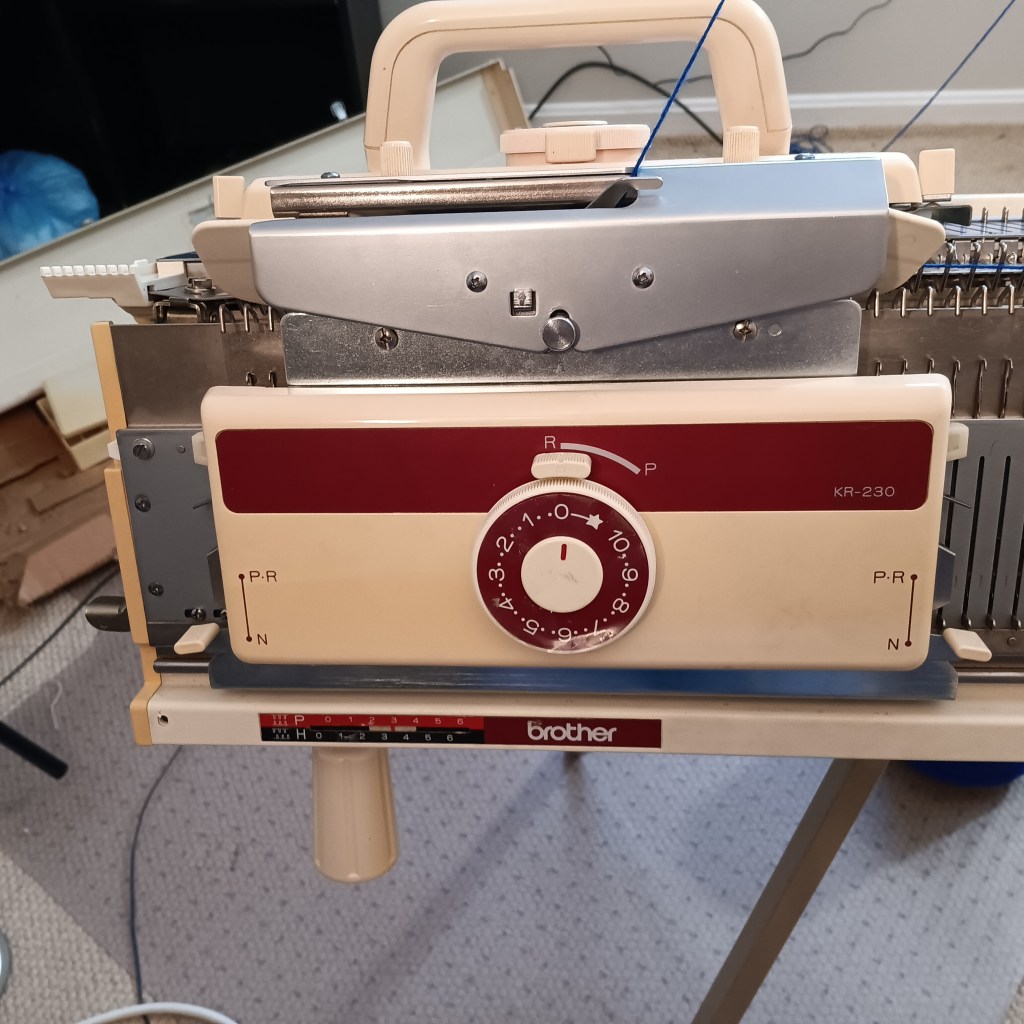
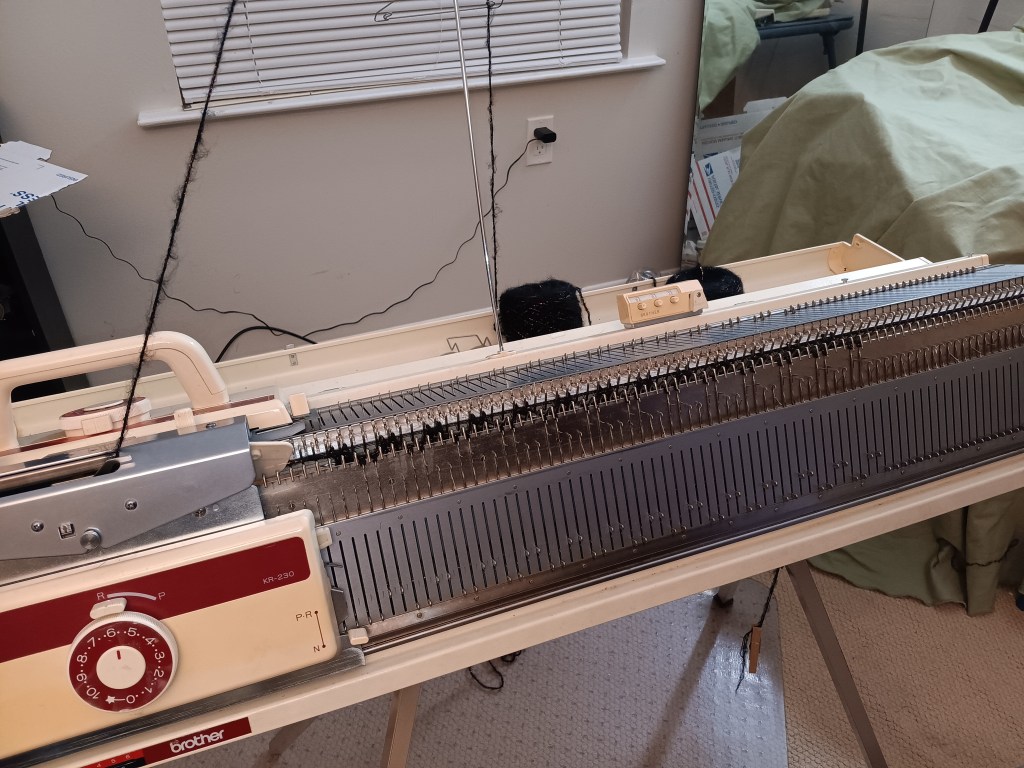
Brother KR230 ribber tested on Brother KH230 knitting machine

Brother KR230 ribbing attachment works with only one knitting machine: 9 mm -gauge (bulky) Brother KH230.

This post is dedicated to the KR230 ribber I refurbished in my shop.

To learn about the overall pros and cons of Brother KR230 ribbers, refer to my other blog post in my Knitting machine Encyclopedia.

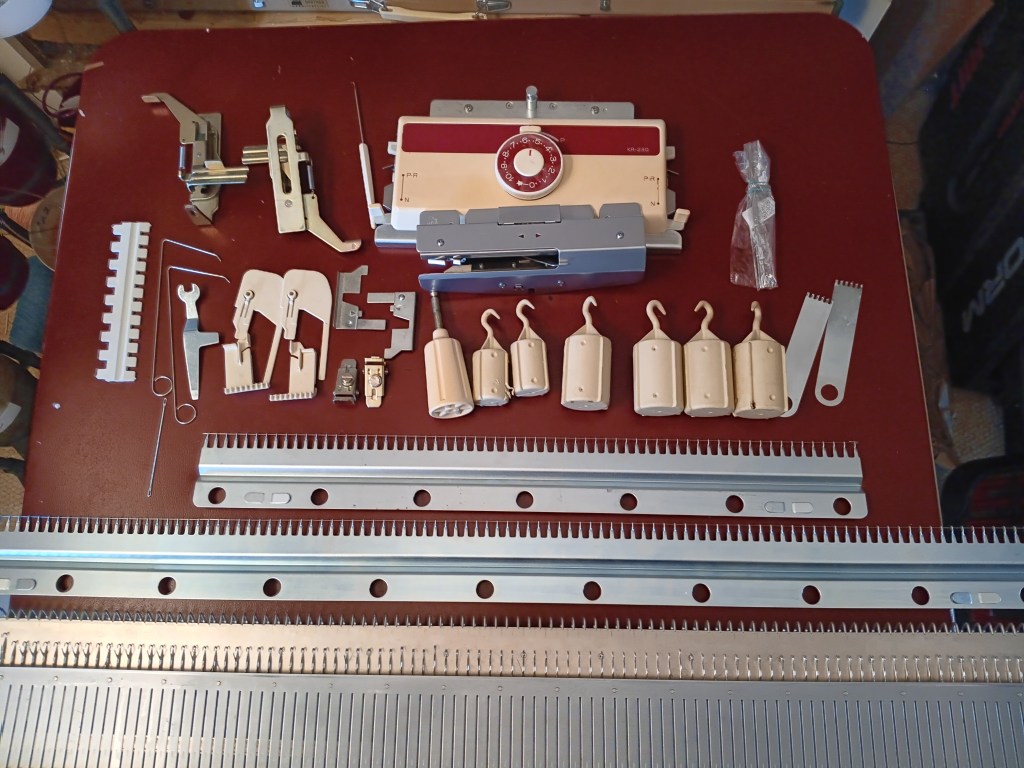
The ribber came without a lot of accessories but I was able to collect most important ones.

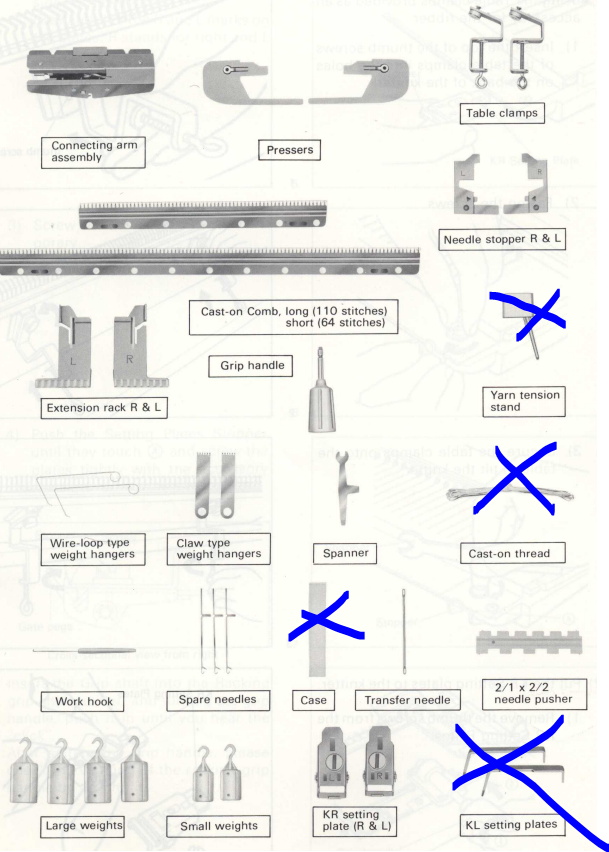
Thus, all major accessories will be included with the ribber with the exception of:

  • yard tension stand: since the machine I tested did not have the original (to the KH230) tension rod but a generic Brother tension rod, the yarn tension stand was unnecessary. But if you are buying JUST the ribber from me, and your Brother KH230 has the original tension mast, contact me, and I might be able to source the original yarn tension stand for you. I am actually not quite sure why the ribber came with this special yarn tension stand – maybe to create a right angle for the tension mast because it is quite unique and is unlike any other Brother knitting machine tension masts.
  • cast on thread: any silky and strong yarn will work
  • case for the needles
  • Knit leader setting plates: the machine did not come with those. Typically, new knitters new to machine knitting rarely use the knit leader and as a result, these parts get misplaced. If you advance enough to use KH230/KR230 setup with knit leader, these setting plates are available online for a reasonable cost.
  • hard copy of the ribber will not be included, but it can be found online. Keep in mind that the manual is written pretty poorly with typos.

I cleaned the needle bed, and side brackets. I cleaned and inspected all needles individually. Needles in good condition but with some minor rust were polished until they are smooth to touch (however, some discoloration might still be visible but it does not affect the needle functioning). I inspected the carriage and the connecting arm thoroughly too and replaced some broken plastic parts in it.

I included a brand new retaining bar with a brand new sponge.

I am also including new table clamps for the ribber (not shown). All tests were done with these table clamps (incorrect table clamps can create an incorrect angle between the main and the ribber beds and cause misalignment and, as a result, missed/dropped stitches).

The cast on combs that came with the ribber are in great shape.

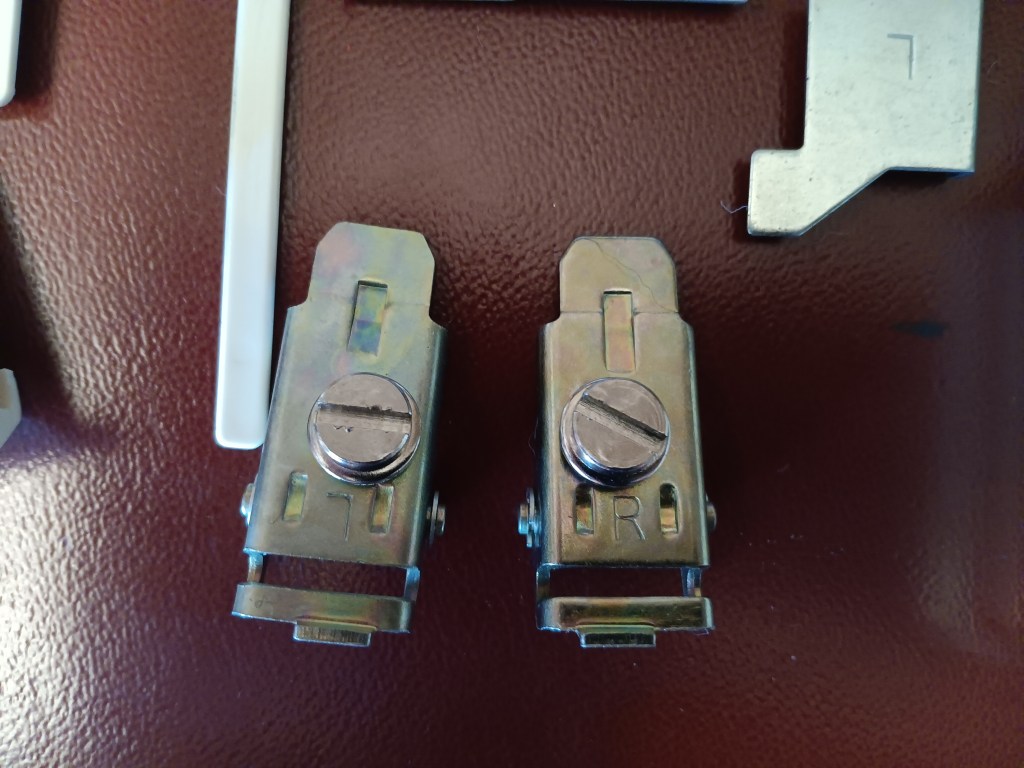
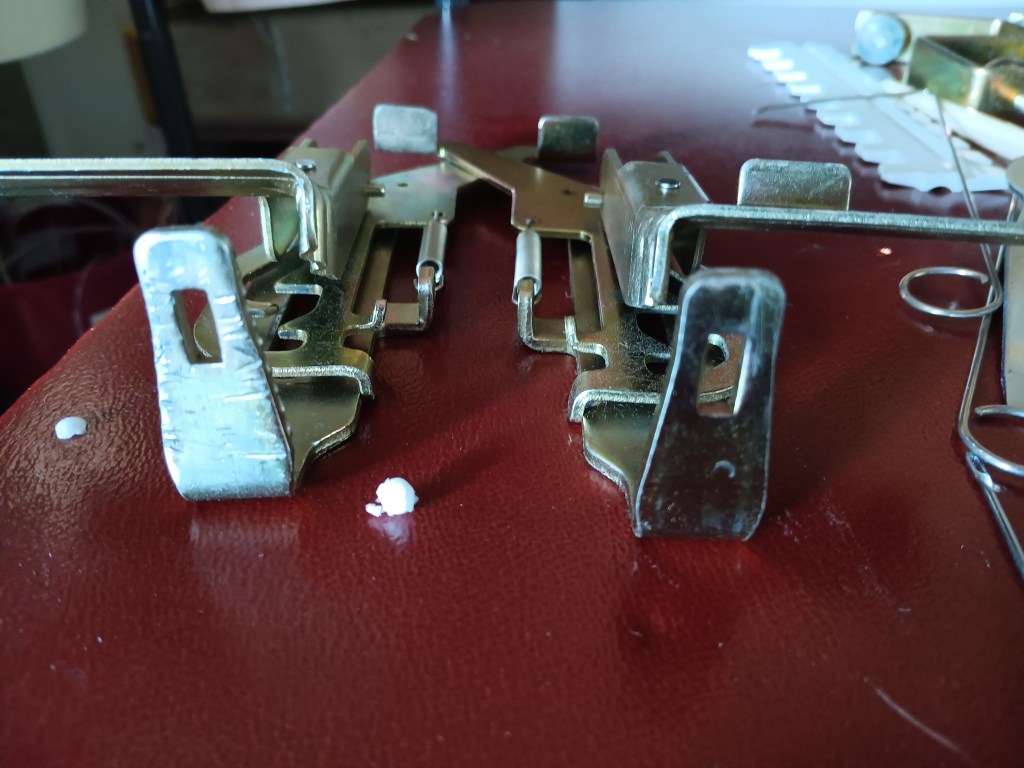
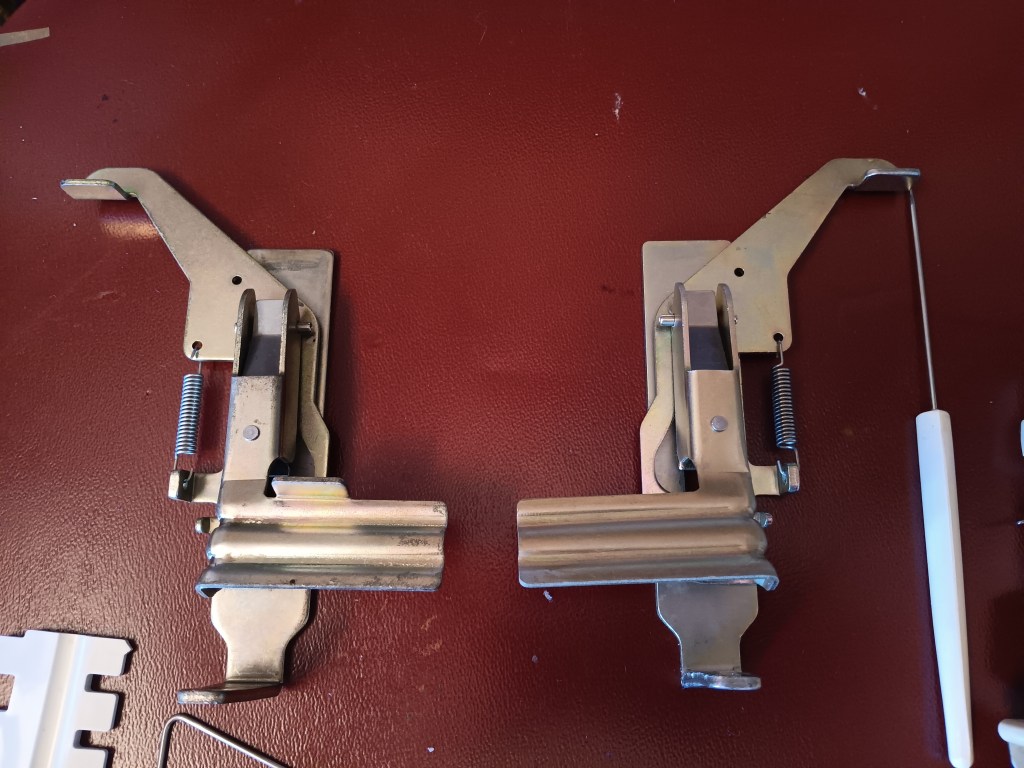
I also sourced out completely new setting plates for KR230. Notice that the setting plates are asymmetric, unlike settings plates for all other ribbers.

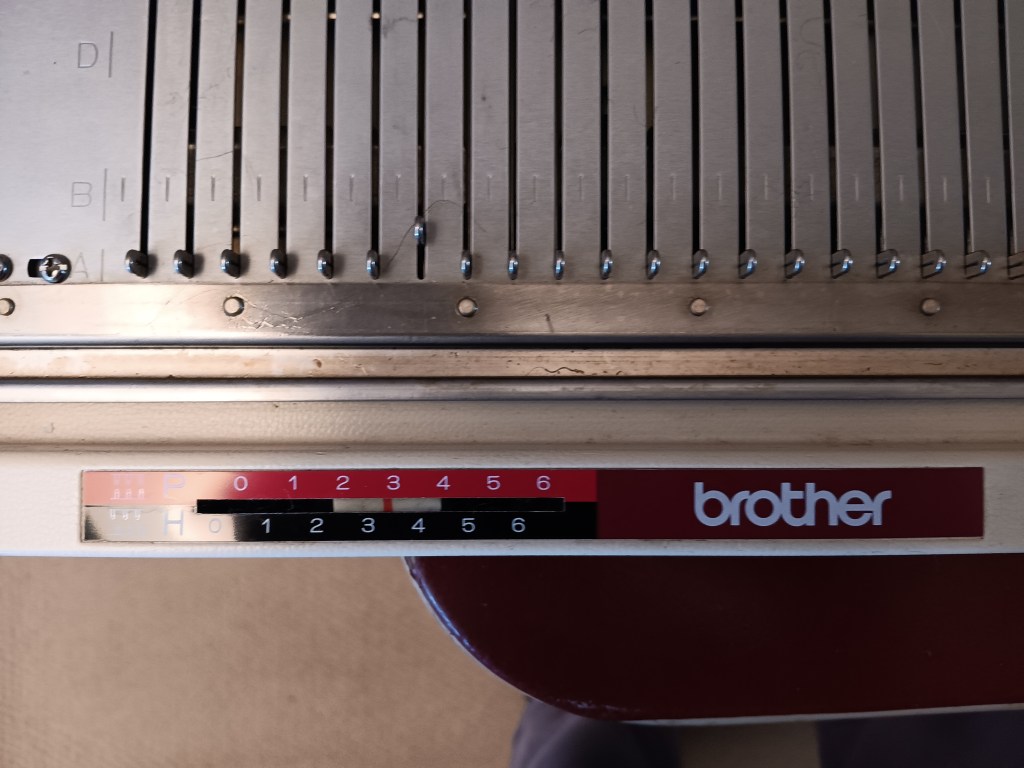
One feature that I like about the KR230 ribber is that there are markings on the needle bed for the working position (position B) of the needles.

I serviced and oiled the connecting arm to ensure that the wheel inside it moved freely as it is responsible for the indicator arros as well as for lifting the pressers to assist with pushing the stitches down.

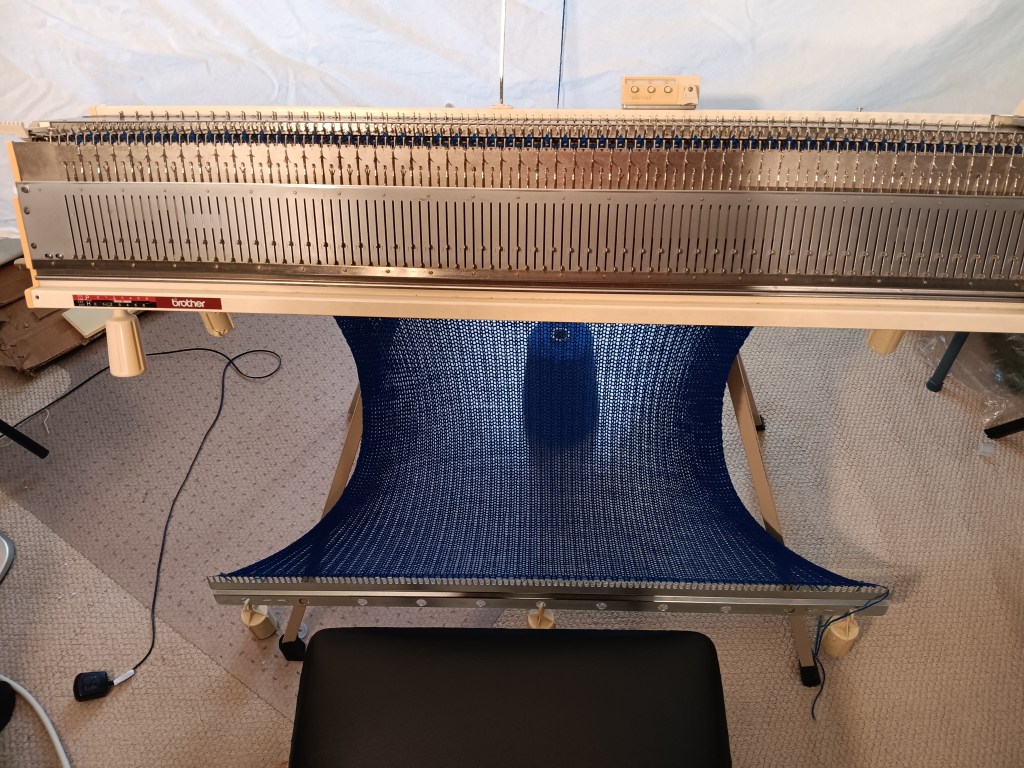
To ensure all needles knit properly as well as other are no hidden problems, I knitted on 20-30 needles as well as on all neeldees using several different yarns: acrylic sport-weight yarn, double-thread worsted-thickness acrylic-wool blend yarn, and a mohair-blend with Lurex thread in it. The machine handled all the yarns like a champ!

These tests are shown in my video. Prior to the tests, I made sure the distance between the needlebeds was adjusted to the optimum to ensure no missing stitches during the cast one and further one.

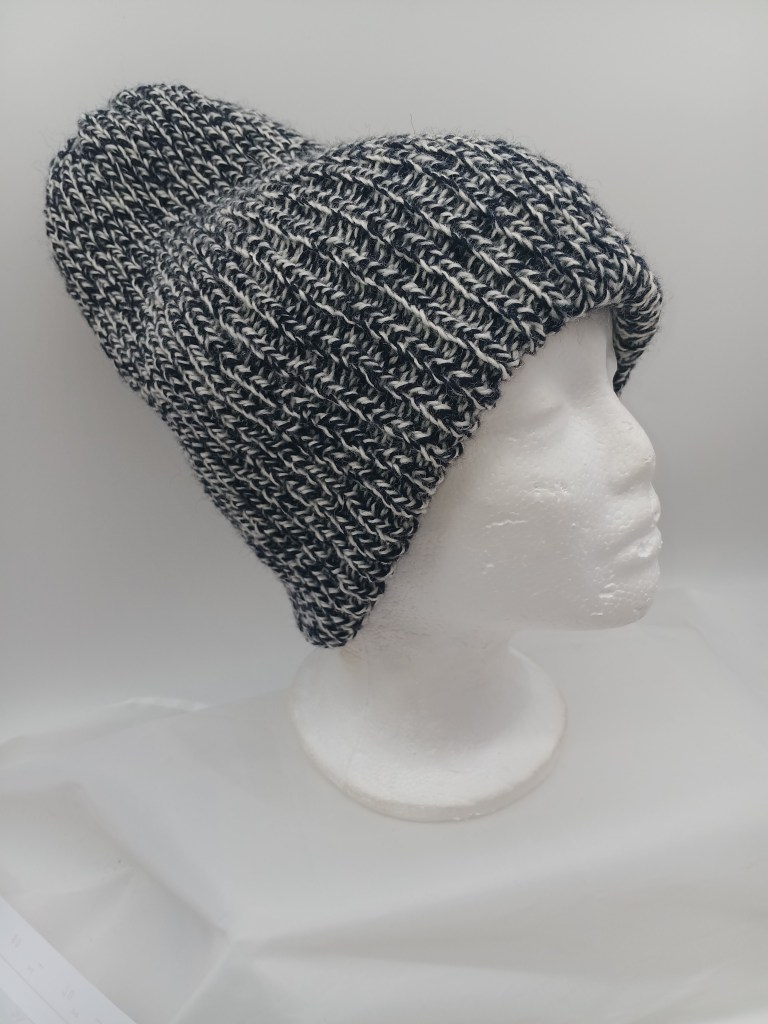
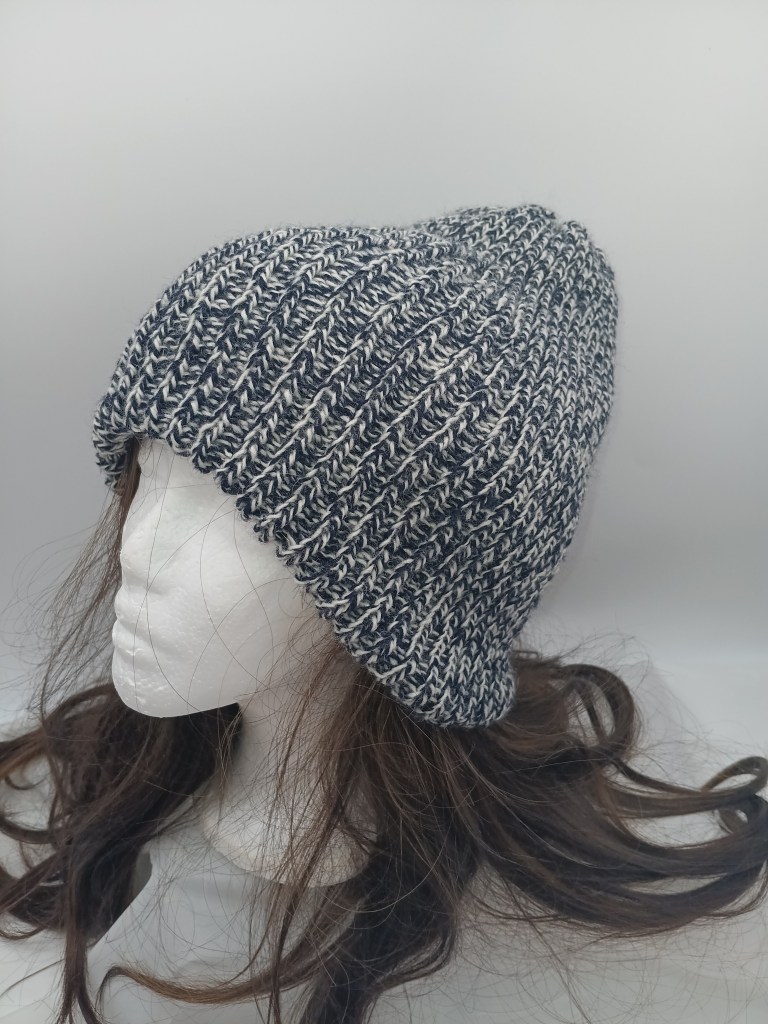
Below are the finished projects made from the panels knitted on Brother KH230/KR230 setup using the two out of three yarns I mentioned above.

Let me know what you think.

The ribber does not come with its original packaging. It will very likely be shipped in two different packages – long one for the needle bed and a smaller one (in size) for all other parts.

Below are the pros and cons of the Brother KR230 ribber I serviced in my shop (to read overall pros and cons of Brother KR230 ribber, refer to my Knitting Machine Encyclopedia):

PROS:

  • easy to set up
  • takes a variety of yarns (thickness- and texture-wise)
  • comes with all major accessories

CONS:

  • some minor accessories are missing (see above); however, their absence does not affect the functioning of the ribber.
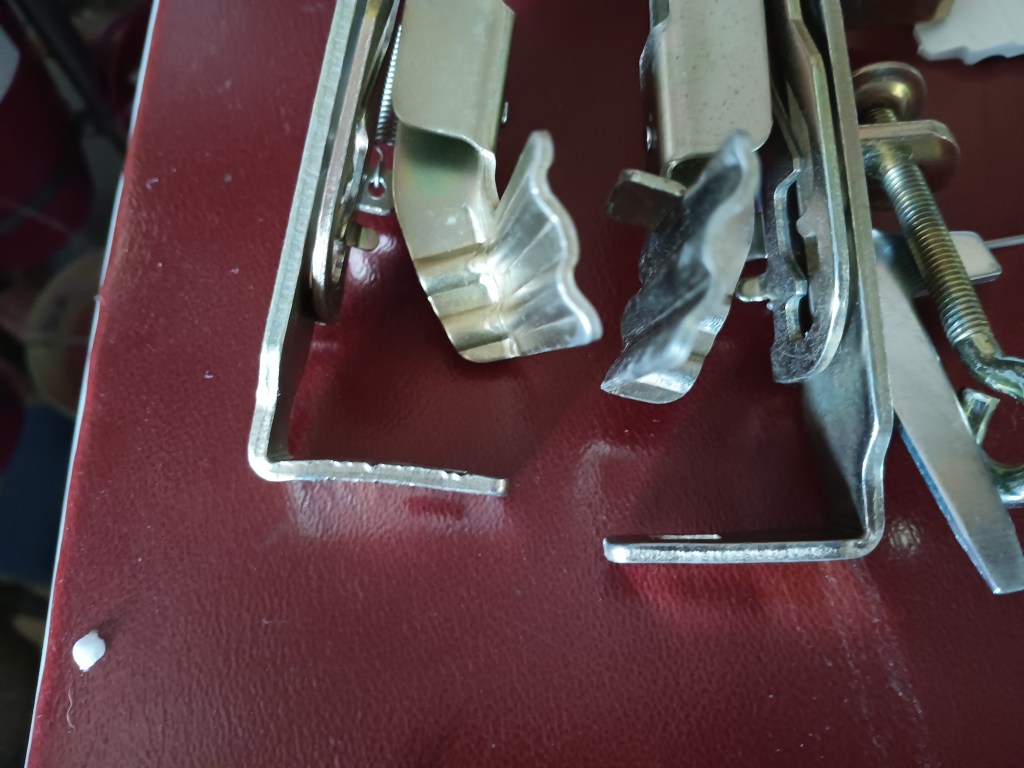
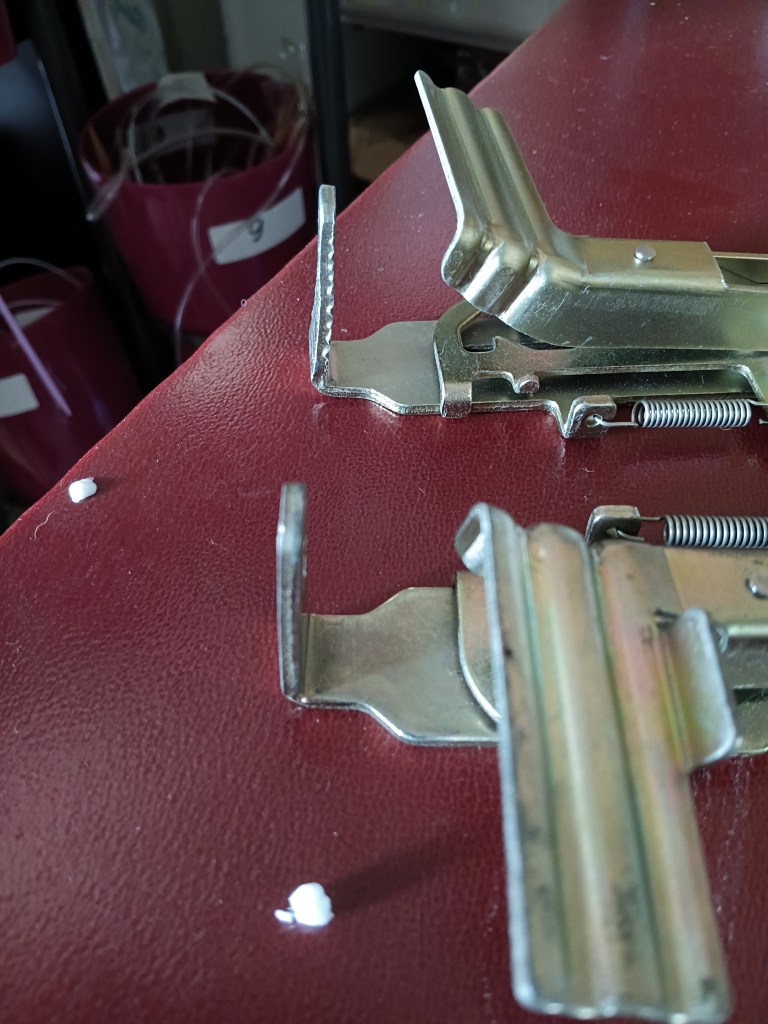
  • The part of the side bracket that gets inserted into the machine on the left-hand side was a bit bent and I straightened it. (The top surface of that section has scratches as a result of my strainitening it). The series of pictures below shows that bracket and that area from different angles. Again, it did not affect setting up the machine but the bracket needs to be pushed in with a bit more force than the other one. Just something to keep in mind when connecting the ribber to the main bed.

As you can see, I invested a lot of both time and money into this ribber to ensure it has all accessories and that it functions well before I pass it on to other knitting machine enthusiasts.

Brother KR260 ribber serviced in August 2024

Brother KR260 ribbing attachment fits bulky knitting machines Brother KH260 and Brother KH270. Read more about this ribbing attachment in my Knitting Machine Encyclopedia (…coming soon).

The article below is focused on the ribber I tested in August 2024 in my shop.

The ribber bed was thoroughly cleaned, the side brackets were cleaned and oiled, and all needles were removed and inspected individually (and then tested by knitting on the full bed).

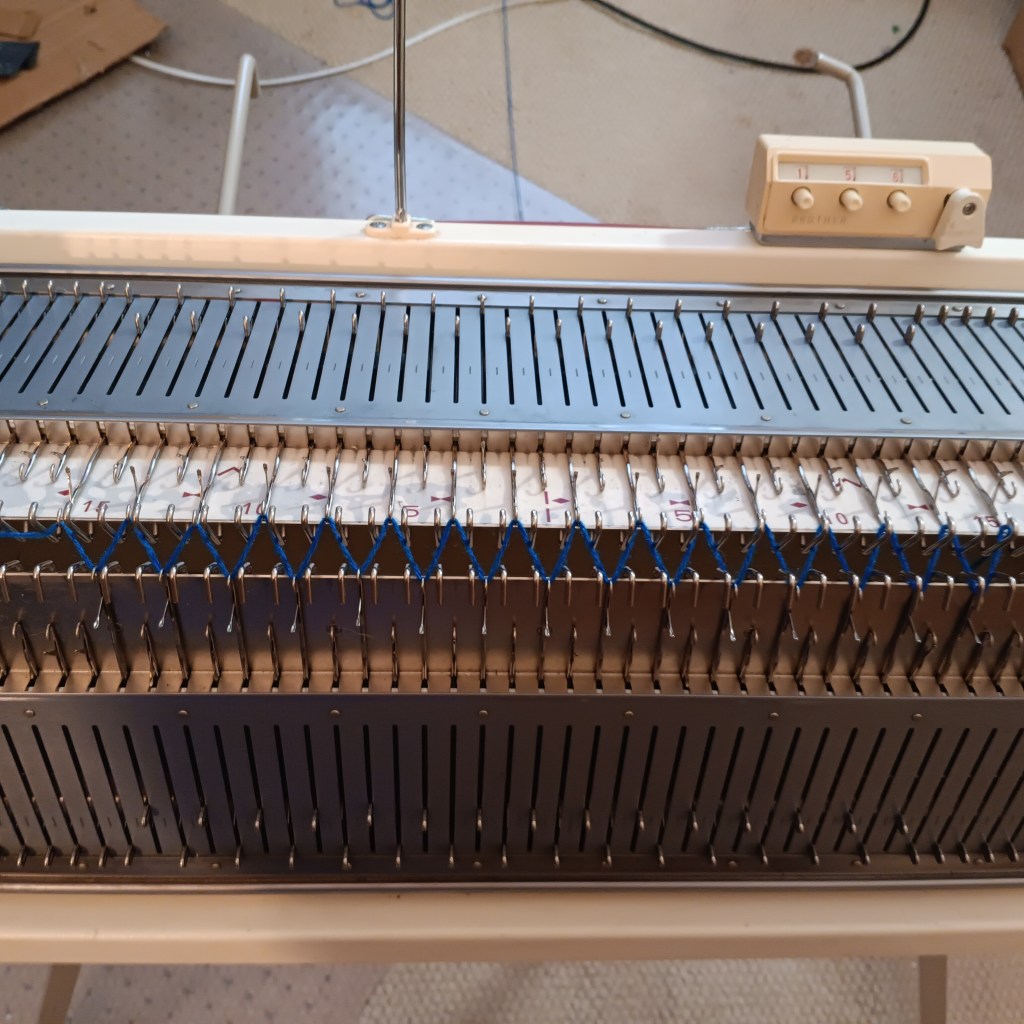
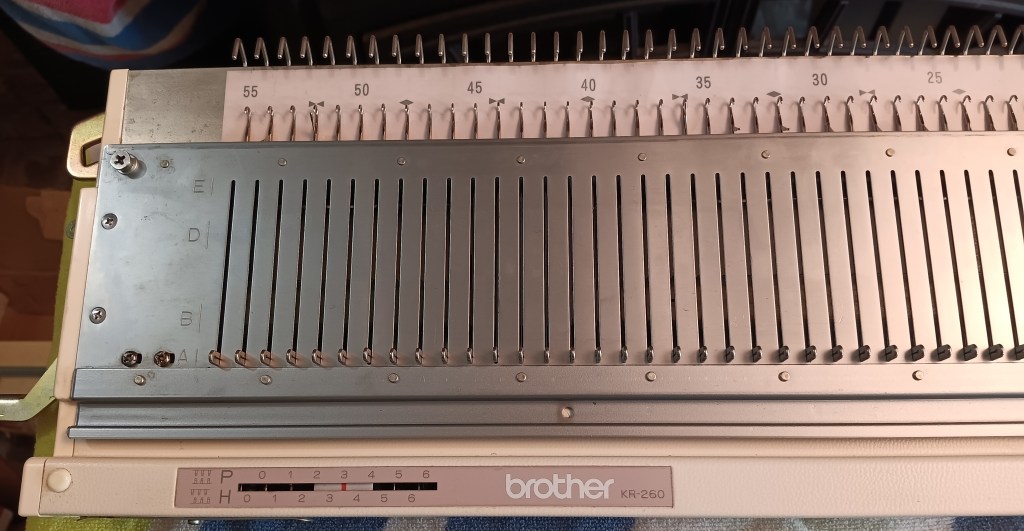
The distance between the main bed and the ribber was easy to adjust. I almost instantly got the optimum distance and was able to knit a swatch right away. See the pictures of the first cast-on row: all distances are even and there are no missed stitches.

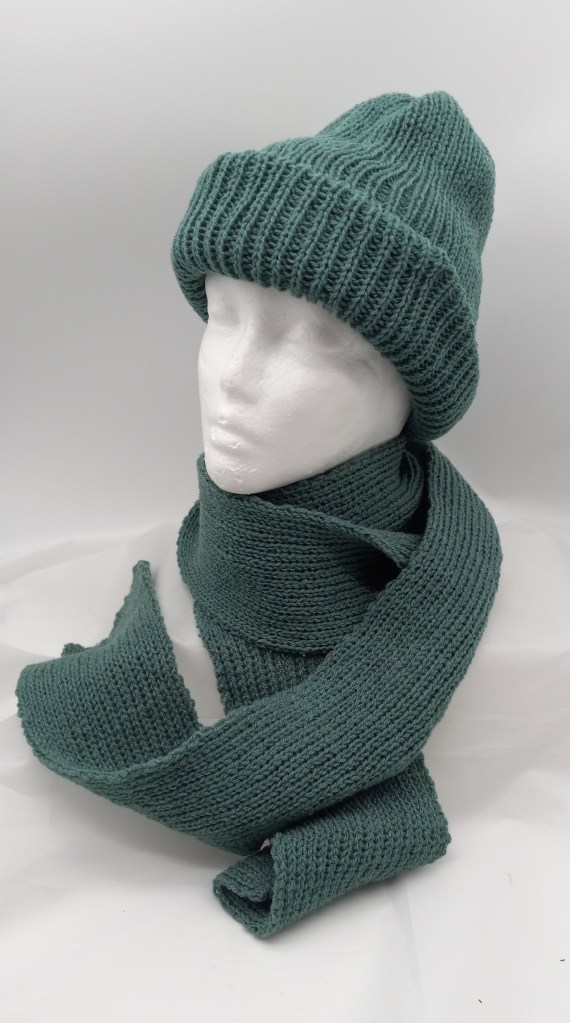
I left the side brackets in the machine so the next owner will not have to make too many adjustments. I knitted the swatch to several rows and made a narrow scarf out of it (see pictures below).

The retaining bar is new with the new sponge. (Typically I reuse the retaining bar (the metal part of the needle pusher) and attach a new sponge strip to it. For this ribber, I used a brand-new metal retaining bar with a brand-new sponge strip.

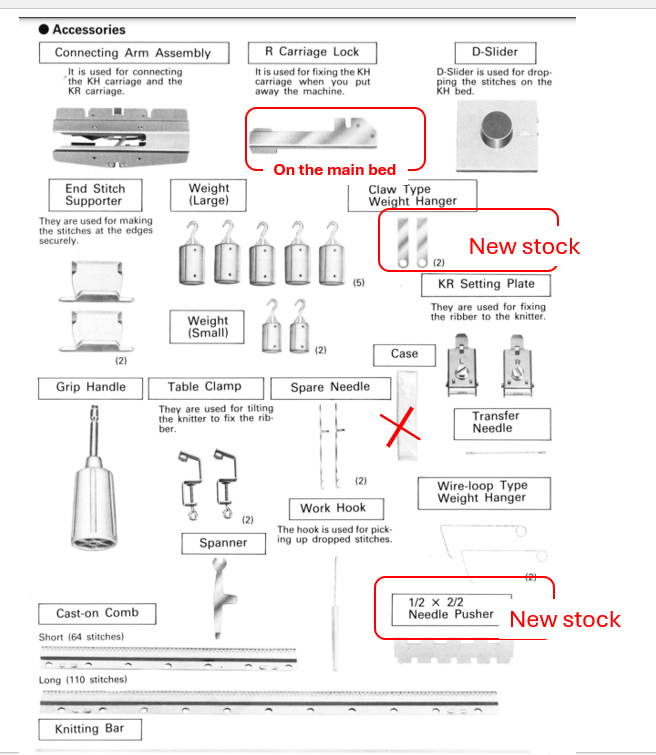
The machine comes with all minor and major accessories. One exception is a spare needle case: it was so old, that it crumbled as I opened it. The spare needles are inside a regular plastic bag.

Some accessories (1/2 and 2/2 needle pushers) are brand new from new stock.

The 1×1 needle pusher is also a handy tool but it is included with te main bed (Knitting machine).

All other accessories came with the machine but they are still in great shape.

Watch the tests on full bed in my video. I knitted 1×1 ribbing on every other needle on the bed and on the ribber. Thus, to check all ribber needles, I knitted two combinations of those needles to ensure I knitted in all needles. All stitches formed nicely! Thus, all needles, their latches, and the retaining/sponge bar functioned well.

The connecting arm is in great shape. All brushes are intact.

The ribber carriage is also in great shape and all buttons and levers move freely.

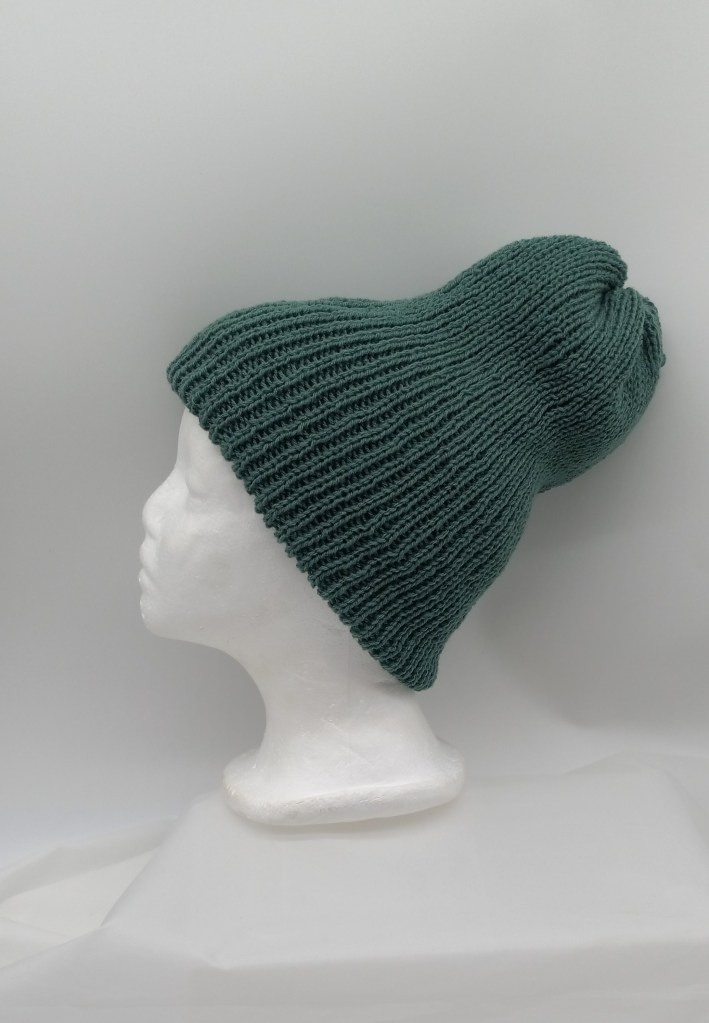
I will include the yarns I used to test this machine with the purchase so the next owner will start familiarizing themselves with this machine with the proven threads. These turns turned out to be pretty staticky. On the small swatch (narrow scarf, olive green color), the static was so strong that I could even feel it on my legs as I was knitting the long panel. On the large piece (olive green hat) the status was even stronger but the machine handled it very well: no grinding noise and no problems with tension. I did not use wax with the olive green yarn.

An original cardboard box for the ribber will NOT be included. I will, however, put the ribber into a cardboard box and wrap the accessories in bubble wrap.

Ribber cast-on combs are in great condition. If the wire does not go inside the holes, just rotate it a bit and it will slide in.

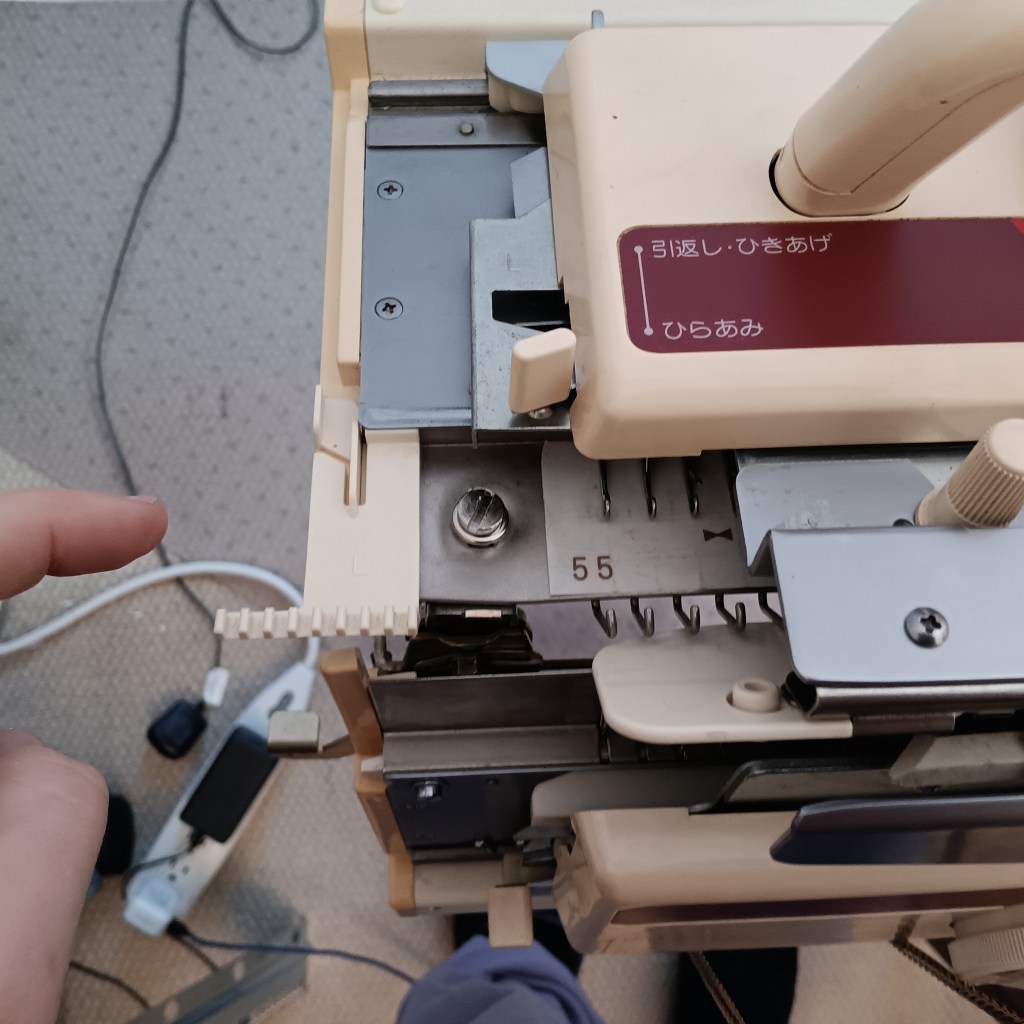
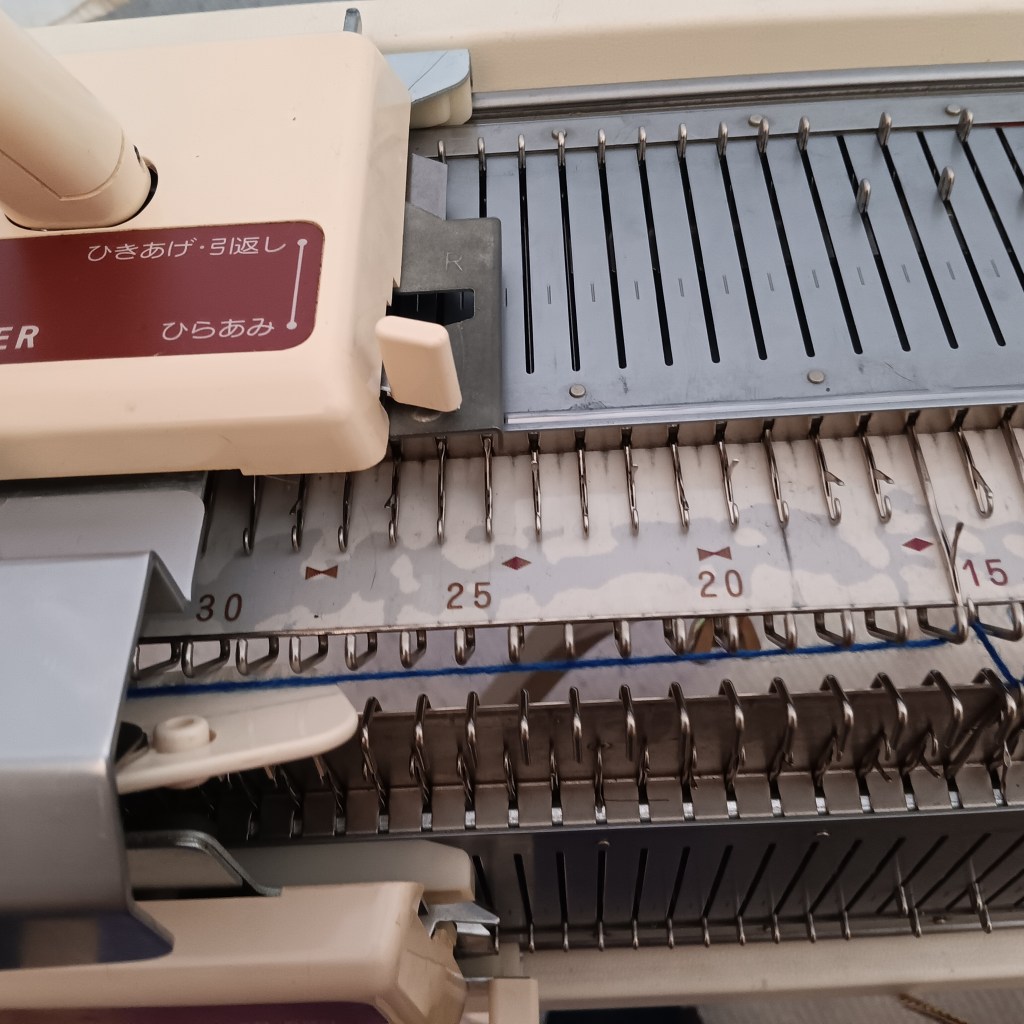
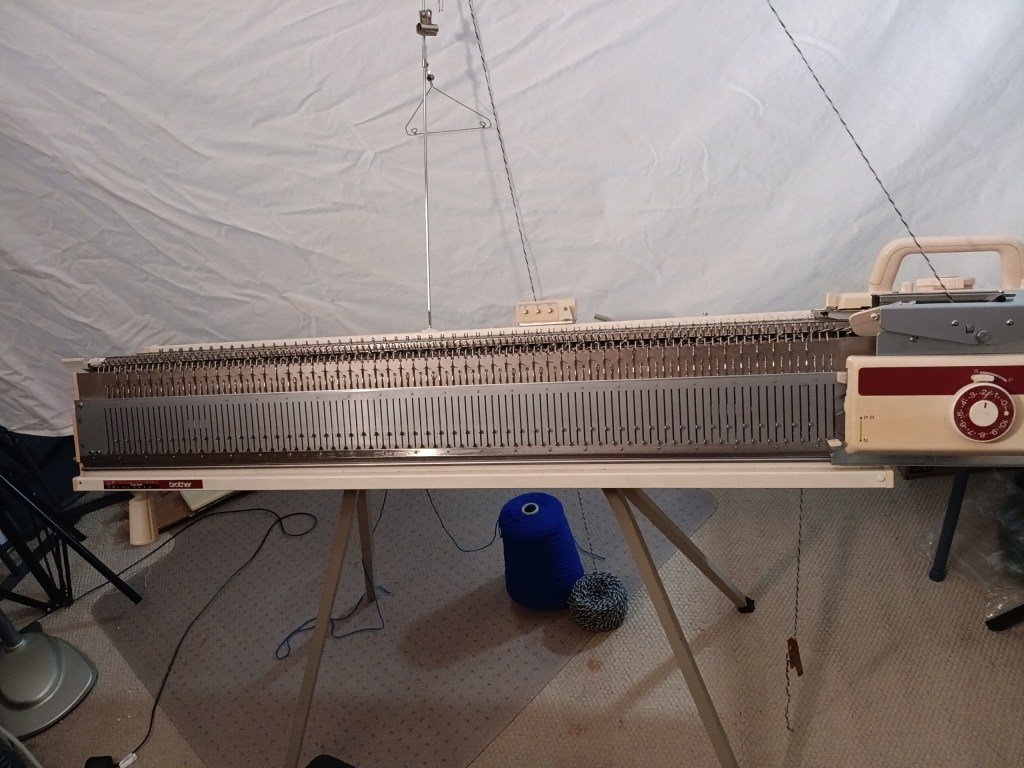
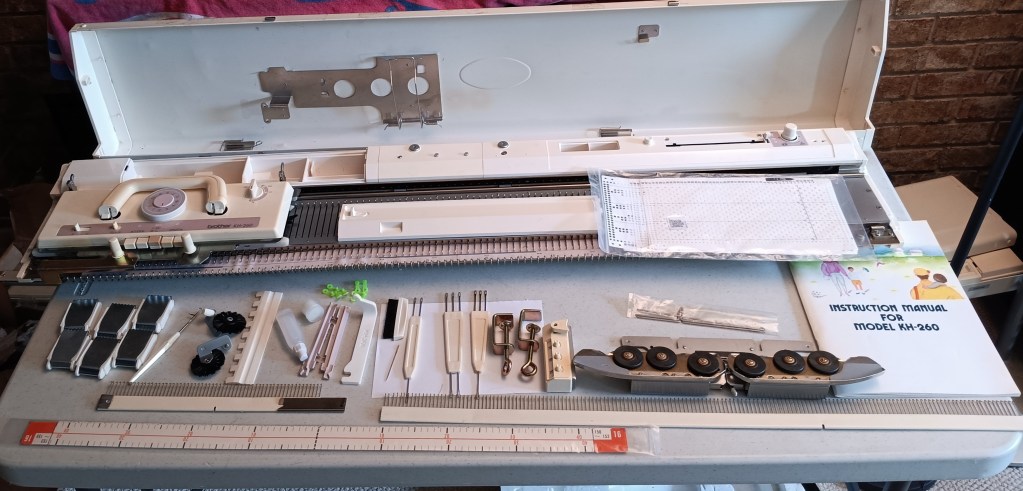
Brother KH260 knitting machine serviced in August 2024

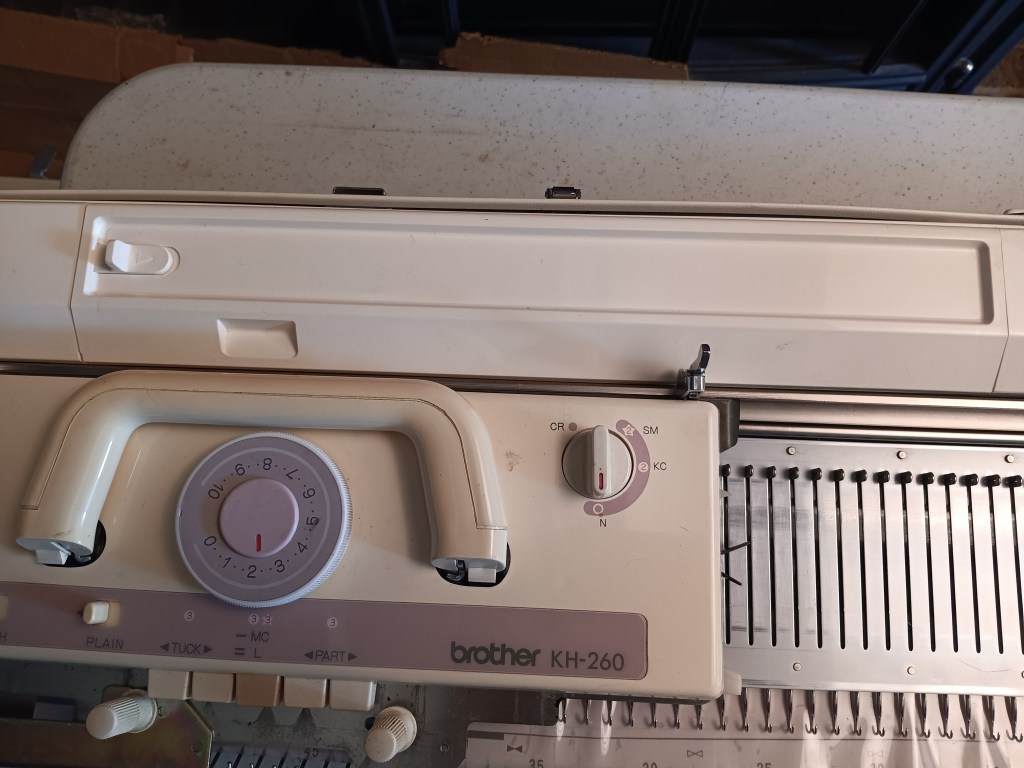
Brother KH260 is a bulky (9 mm gauge) knitting machine with 114 needles. Read about this model, as well as the pros and cons, in my Knitting Machine Encyclopedia. All information below is about a specific machine service in my shop in August 2024.

I cleaned and inspected the machine. I removed, cleaned, and inspected all needles. The needles and the patterning (including the punch card reader) were inspected with various cards. All of these features were also tested on all needles and with various cards. Watch the video of these tests here. This machine was also tested with a matching ribber, Brother KR260. watch the video of those tests here. The machine behaved very well during all those tests by itself and without the ribber. It was easy to adjust the proper distance between the machine and the ribber, which implies no warping of the metal beds.

The rubber wheels on the sinker plate are in great condition. The wheels for tuck-knitting move freely.

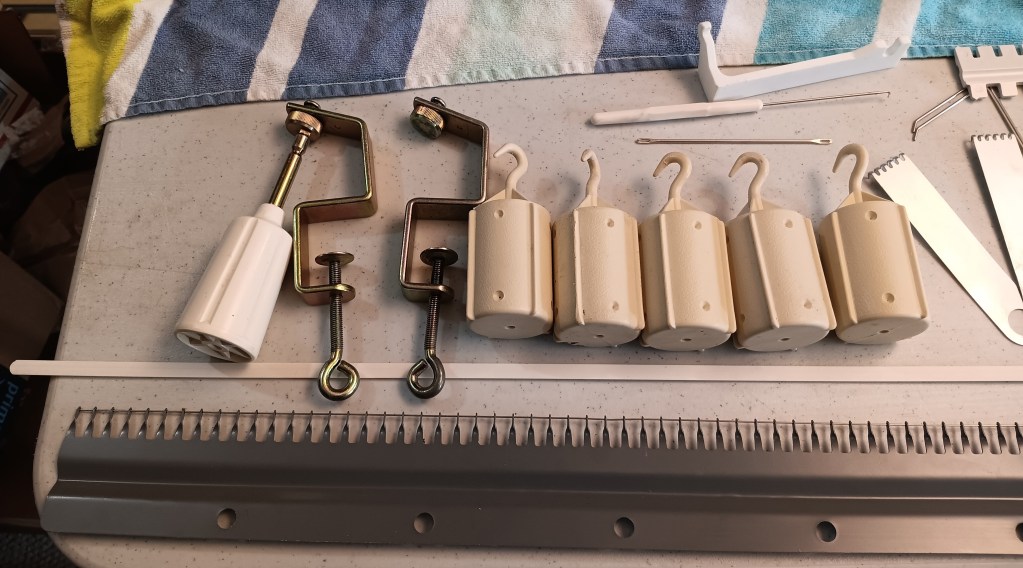
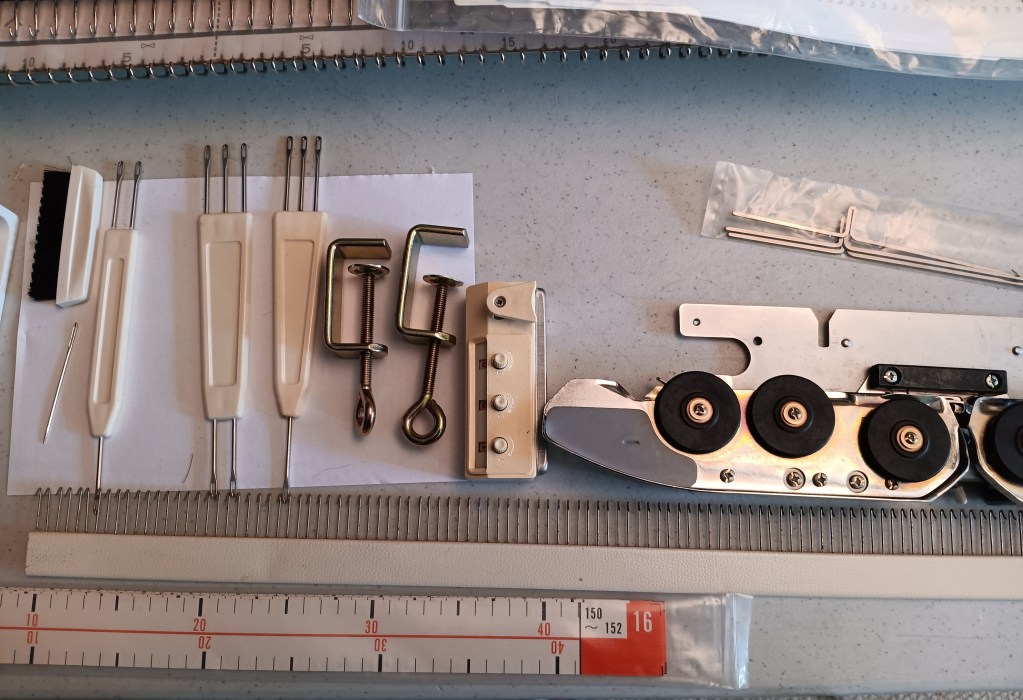
The machine will come with all major accessories: sinker plate, cast-on combs (short and long ones, attached together by the metal clip), tension mast (not shown in the picture above – forgot to include it, sorry) and a detachable row counter.

I also replaced the retaining bar: I inserted a completely new retaining bar + sponge bar (typically, I attach a new sponge to the existing retaining bar).

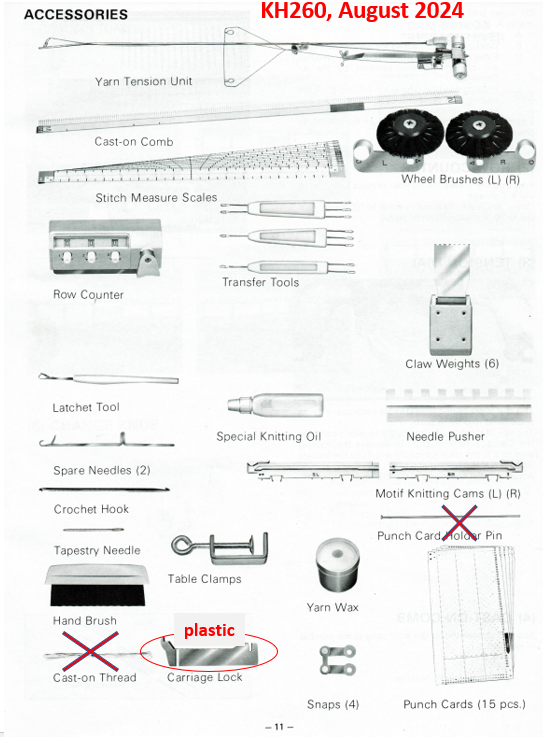
The machine will come with most minor accessories, including a hard copy of the manual (which is in decent condition).

The only accessories that are included are the cast-on thread (you can use any strong, silky yarn/thread) and a punchcard holder pin (all the tests in the video were done without that pin and all worked great).

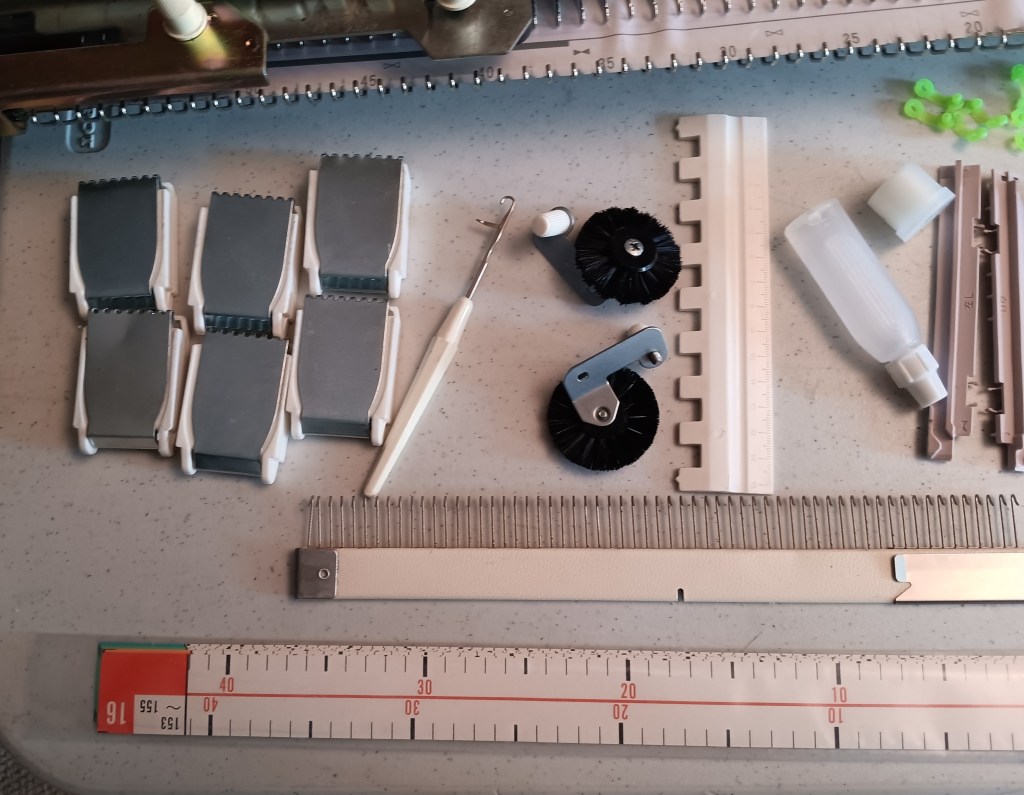
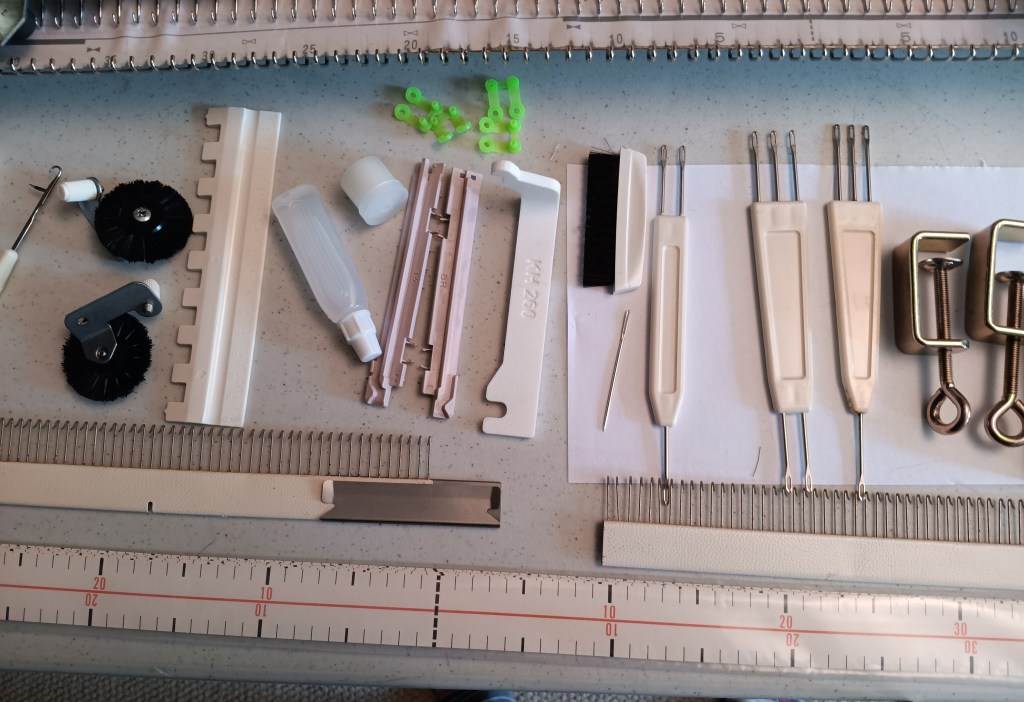
Table clamps, stitch-measure scales, punchcards, and claw weights are brand new, from the new stock.

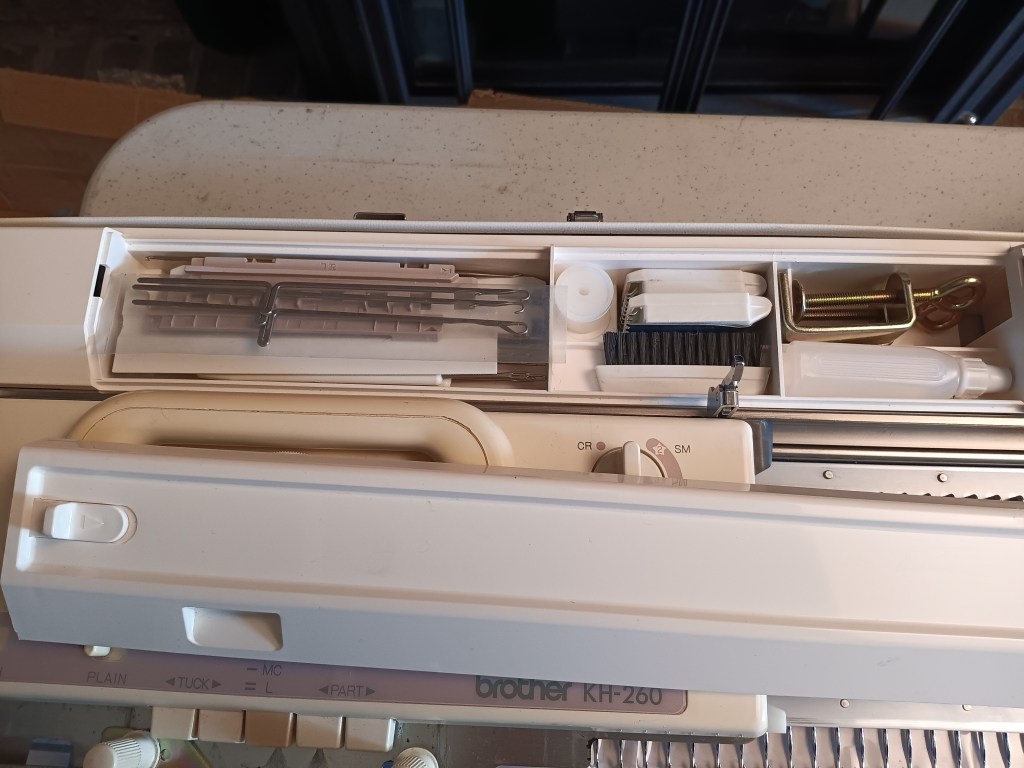
All minor accessories fit inside the toolbox.

The carriage lock is not the original (the machine did not come with one). I attached the machine with the carriage lock from the ribber (because I left the setting plates in after testing the ribber). But I am including a white plastic replacement carriage lock in case the machine is sold in the future without the ribber.

Since the machine came without the punch cards, I had to purchase them. The punchcard set included is marked with the letter P (as it is supposed to be for the KH260 models) but it is not an original set. It is brand new but the paper/plastic is a bit thinner than the original set. However, I checked and the card corresponds to those in the manual.

The machine came with the wax and oil in decent condition. Thus, those will be included as well. The mast still contains a piece of wax I used when I tested the machine (some yarn was a bit more staticky than the other but only when tested with the ribber).

The machine originally came without the carriage. I have included a substitute carriage (which was fully serviced and tested) this is why the color is a bit different from the main bed.

When selecting needles, make sure that the needle buds are as close to the marked B position as possible otherwise the carriage might have trouble. It is true for all knitting machines but bulky machines are especially “sensitive” to misaligned needles probably because the needle buds are so much bigger.

A couple of other very individual things for this machine: if the numbers in the row counter do not get triggered reliably, two things can be done. 1. Gently shift the plastic cover on which the row counter sits towards you. Even a little bit of movement will shift the row counter enough to make it more reliable. I installed it properly but the top cover can shift during the shipping/transport a little bit, enough to increase the distance between the tripper on the carriage and the row counter lever. 2. Pass the carriage slowly next to the row counter. If the carriage is moved quickly, the row counter is still triggered but the number does not increase. I thought it was the problem with the row counter, but I tried several. The best thing that works is to slow down around the row counter. The slower motion triggers it better so the number changes.

Imperfections:

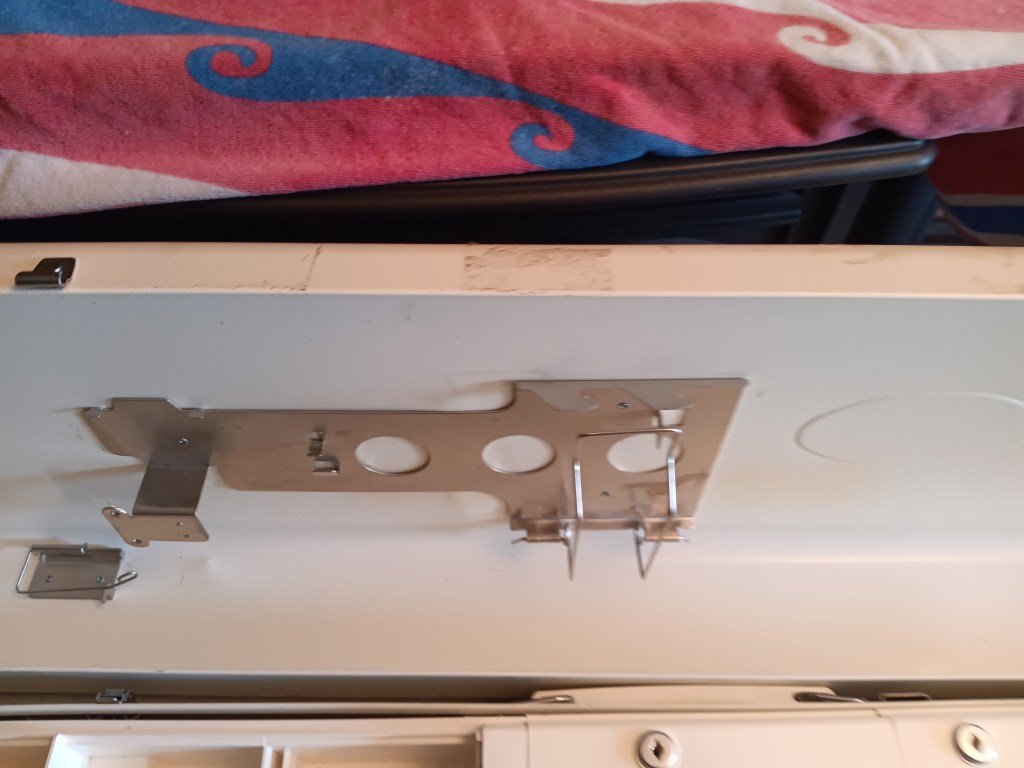
  • the end caps have minor cracks. Those are super minor – I’ve seen machines in much worse conditions.
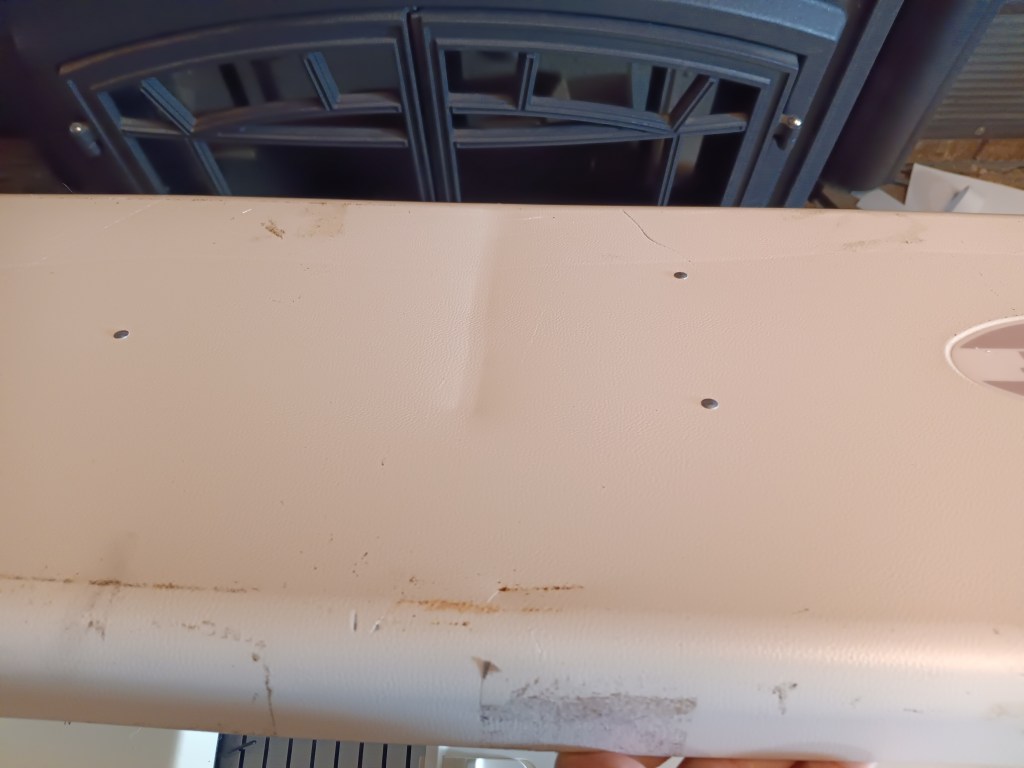
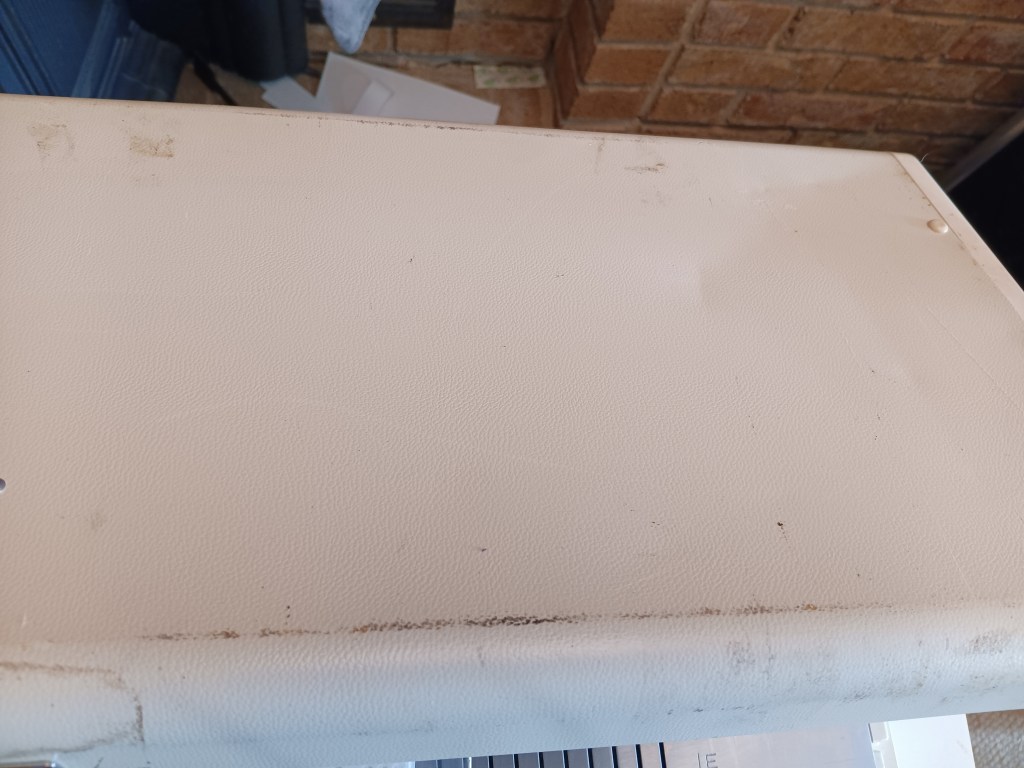
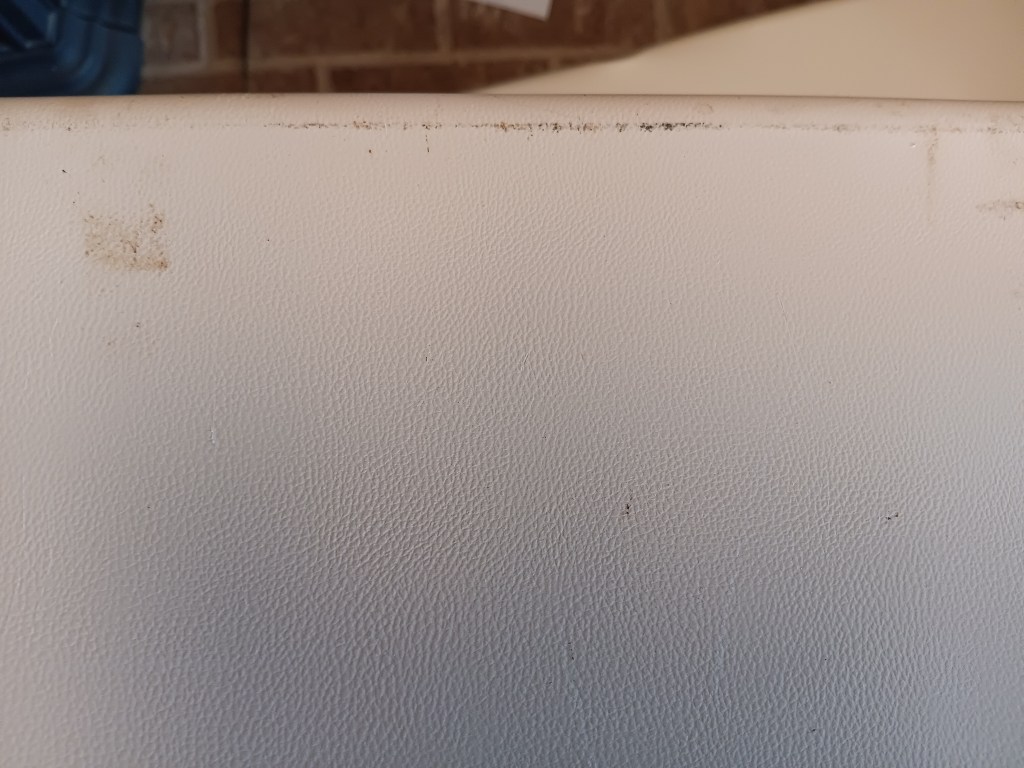
  • the lid and the case have some staining from scotch tape. I will be washing them off with soap and water but not with strong solvents (as it might severely damage the coating). Sometimes some especially sticky residues remain.
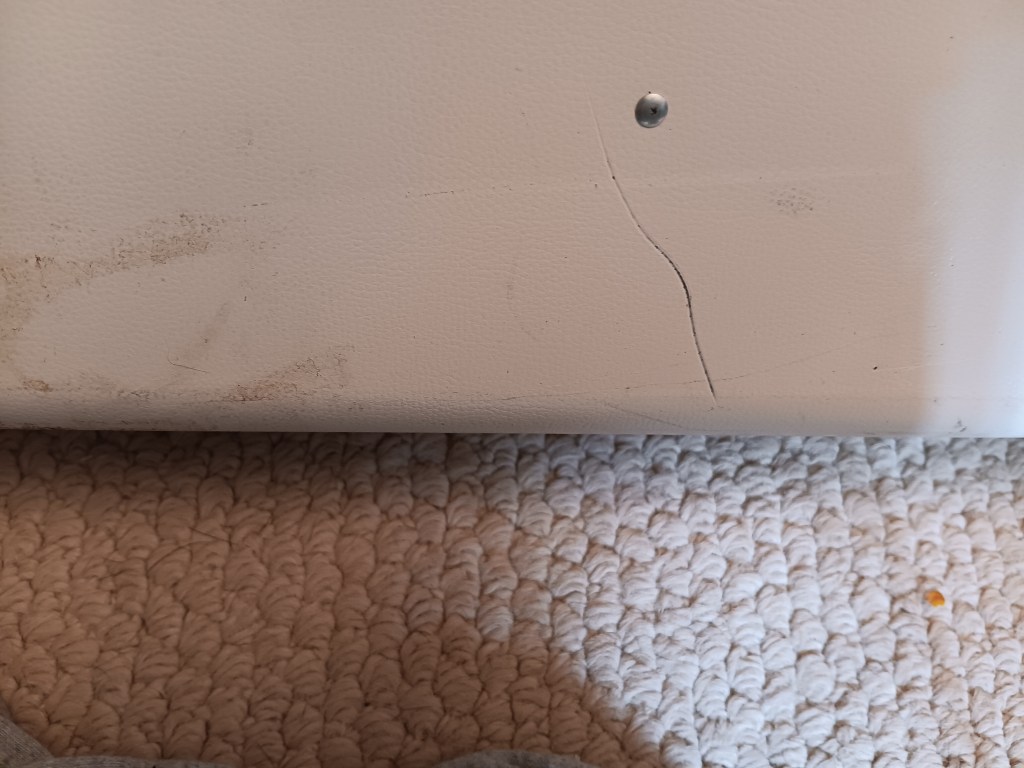
  • The case and the lid have minor scratches. Below is an example of the biggest one. Other minor scratches are not shown.

Brother punch-card knitting machines: quick reference

All Brother punch-card knitting machines have 200 needles. Except for the Brother KH260 model, all other punch-card Brother knitting machines are standard gauge (4.5 mm distance between needles).

Below is a summary of which punchcards were released for specific machines. Keep in mind that all these cards are interchangeable.

Miscellaneous
Card Set, letter
Standard-gauge machines
Brother KH830-836D
Brother KH840G
Brother KH860,881J
Brother KH890,891M
Brother KH864/868S
KnitKingKK93/KH893R
Bulky-gauge machines
Brother KH260P
Miscalleneous
Garter CarriageB-KG
Ribbers

Needle positions for Brother and KnitKing knitting machines.

Machines/Ribbers Model numbers
Needle Positions

12-stitch punchcard machines
KH800, KH801ABCDIDIIE

24-stitch punchcard machines
Bulky: KH260
Standard: KH810, KH811, KH820, KH821, KH830, KH831, KH836, KH840, KH850, KH851, KH860, KH864, KH871, KH881, KH890, KH891, KH893, KH894


A


B


D


E

Ribbers matching the Brother and KnitKing punchcard knitting machines
KR810, KR830, KR840, KR850, KR890, KR900, RK900ABDE
A – non-working position
B – standard working position
D, DI, DII – patterning positions
E – holding position

More summary information on punchcard knitting machines is coming up.

Needle positions of various flat-bed knitting machines and ribbers

Brother Knitting machines

A – non-working position

B – standard working position

C, DI, DII – patterning positions

E – holding position

Machine Model number
Needle Positions
Basic (manual) knitting machines
KM100, KH355, KH360, KH370, KH380, KH390, KH395ABCD
KH210, KH220, KH311ABCDE
KX350, KX395ABDE
KX355unknown
4-Pushbutton machines
KH35, KH212, KH218no indicators
KH511ABCDE
KH521, KH531, (Profile) KH551ABCDIDIIE
8-Pushbutton machines
KH110, KH120, KH552, Profile 585, KH587, KH588, KH705,
(Genie) KH710, KH601
ABCDIDIIE
KH561, KH571, KH581, (Profile) KH583, (Profile) KH585ABCDE
KH811 (also 24-stitch punchcard)ABDE
12-stitch punchcard machines
KH800, KH801ABCDIDIIE
24-stitch punchcard machines
Bulky: KH260
Standard: KH810, KH811, KH820, KH821, KH830, KH831, KH836, KH840, KH850, KH851, KH860, KH864, KH871, KH881, KH890, KH891, KH893, KH894
ABDE
Electronic machines
KH900, KH910, KH920, KH930, KH940, KH950, KH965, KH970ABDE
Ribbers
KR551ABC
KR110, KR120, KR586, KR710, KR810, KR830, KR840, KR850, KR890, KR900, RK900ABDE
KR582unknown

KnitKing Knitting machines

A – non-working position

B – standard working position

C, DI, DII – patterning positions

E – holding position

Machine Model numberNeedle Positions
24-stitch punchcard machines
Bulky:
Standard: KH881, KK91
ABDE
Electronic
Compuknit IV,ABDE

Silver Reed Knitting machines

Machine Model number
Needle Positions
SK120,ABDE

First steps of testing new-to-you ribber.

If you just purchased or snatched a ribbing attachment to your knitting machine, I can imagine how happy you are!

If your ribber came to you fully serviced and tested, you still need to learn yourself how to use it and attach to you machine. So, follow the steps below. However, if your ribber came to you AS IS, follow the steps outlined in my other article on how to clean and service it before you start the knitting tests.

  1. The first most important step is attaching your ribber to the main knitting machine bed. Your ribber manual is the best source for this. If you are a visual learner, there are plenty of youtube video on how to do it for your particular ribber.
  2. Before you even attach the ribber carriage, main carriage and the connecting arm together, you ABSOLUTELY have to make sure the distance between the main and ribber bed is the optimum. Too wide or too narrow distance between the beds will cause all kinds of problems: yarn is not latching onto the needles, resulting in dropped stitches, grinding noise, difficulties to move the carriage, bent latches, etc. for Brother knitting machines, the best manual that explains how to do it is for the Brother KR810 ribber (available online, just Google it). There are also a lot of YouTube resources on how to establish the optimum distance.
  3. Check all magnets on connecting arm and carriages to make sure nothing got stuck to them.
  4. Once you are satisfied with the distance, make sure the connecting arm is attached to the main carriage properly. (Poorly attached connecting arm will manifest itself in dropped stitches, grinding noise, difficulties in moving in one or both directions, damaged needles or needle latches). Follow manual instructions to the dot. Once you attached the connecting arm to the main carriage, run through the needles (no yarn) to make sure nothing is touching the connecting arm. Start with 20-30 needles and if everything is good, add another portion of 20-30 needles, and so on.
  5. Attach the ribber carriage (unless you have a vintage, earlier model, of ribber, in which case you don’t need to do that) to the connecting arm/main carriage assembly. Again, follow instruction to the dot. Then run again the carriage assembly through just the ribber needles. For this purpose, only bring 20-30 needles to working position and run the carriages through. If everything seems smooth, add another section of 20-30 needles, and so on.
  6. Start knitting on a small swatch. Start with 1×1 rib on every other needle. (When setting up the ribber and knitting the first cast-on rows, it is extremely important to move the needles to the B working position as close as possible. Otherwise the carriage might bend the latches.) Use very thin yarn at first. Preferably the yarn that is no prone to static. (Quick side note on how to check the static of the yarn: bring a small strand of yarn to the crack between the beds and if the yarn sticks to one of the beds, yep, you probably have static. Change the yarn or apply wax). Do not use cotton yarns. Thin smooth acrylic yarn should work. Starting with the very thin and smooth yarn will prevent you from having problems related to JUST yarn: static, tension, friction if yarn has texture. (Please, do not think that knitting swatch is a waste of your yarn or time. There are several learning opportunities. For example, you will also learn how to choose the right tension for the yarn you chose, practice transferring the stitches (by hand or using a transfer carriage), whether there is static with this yarn, etc.) Follow the cast-on and knit instructions to the dot. Knitting just a small swatch will let you 1) check whether all buttons and functions move freely on the ribber carriage and 2) master the cast-on procedure.
  7. Knit on a full bed using the yarn you had success on with the swatch. Start with the 1×1 rib on every other needle. I do not recommend knitting on ALL needles on the ribber – leave 1-3 on each end in non-working position. It will be easier to attach wire-weight-hangers and will also ensure you all stitches are knitted before the carriages returns in the opposite direction. Knitting on the full bed will show you whether all needles function well (If a needle is bend, misaligned, or has a sticky latch, stitches will not form properly. You might also see dropped stitches, tucked-stitches or lots of pull stitches. ) And also discover (if any) additional problems with the setup. (All minor problems not seeing while knitting the swatch might manifest in a full bed in a more pronounced way). The panels knitted on the full bed during your tests can be converted to hats (knit 100-120 rows for one-layered hat with a brim and 200+ rows for a double-layered hat). During your tests on a full bed you’ll also learn how to hang and rehang the wire-hangers with weights to ensure nice edges, how to recognize dropped stitches, how to catch dropped stitches on the very ends of the panel and what to do to prevent them, etc. Knitting on a full bed when you are just starting is a whole new game.

Let me know how the first test went!

Tension spring for Brother Knitting machine

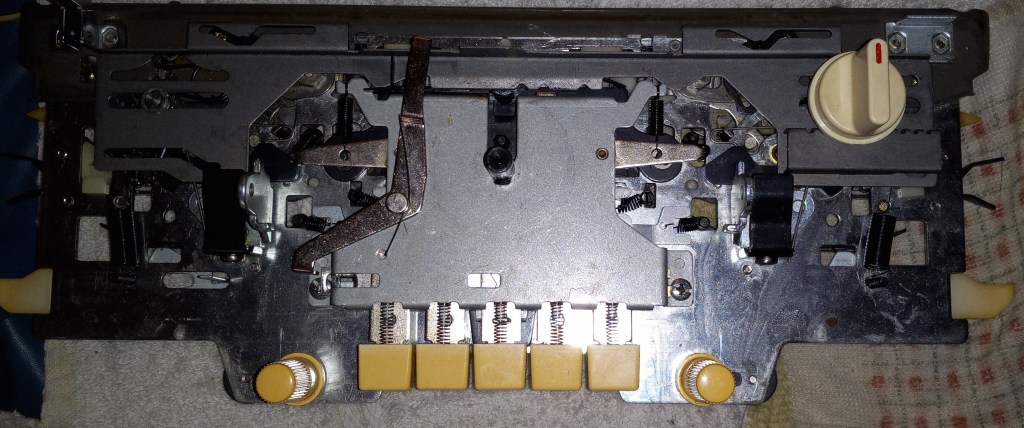
Carriages of Brother knitting machines have several types of springs to ensure smooth needle handling. This article is about a medium size spring, part of the intricate mechanism of Brother knitting machine carriages. These springs can be purchased in my store.

In particular, this short blog article is about a tension spring responsible for smooth the movement of the middle button on the carriage. (At the end of this article, I show other places in the carriage where the same type of spring can be used). This button is typically used to knit fair isle or/and to reset all other buttons.

To expose that spring, one needs to remove the plastic carriage cover (this step NOT covered in this article) and then remove the metal cover.

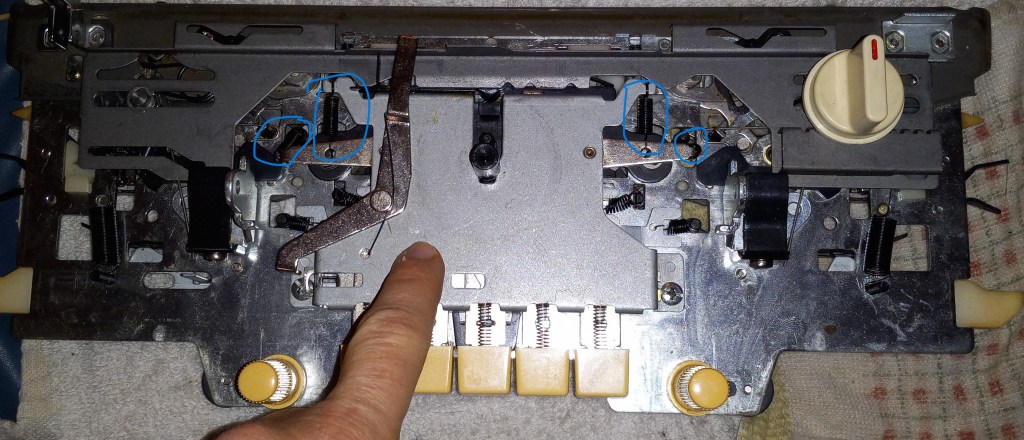
For that purpose, remove the two screws marked below.

The plate will then hang by the springs marked in the picture below but they do not have to be removed. Just push the metal plate out of the way. If the springs detach, they are easily to put back. Just take a picture of the agreement before removing the cover.

Once the cover is removed, you will see the springs right away. In my case, one of the springs was simply missing and the mechanism was not retracting automatically the way it was supposed to.

So the replacement spring was placed where one was missing. I made a short video showing where the spring was installed.

“How” the spring was installed is NOT shown in that video because it is kind of hard to capture how to attach the spring. But the loops of the spring need to grab the posts marked in the picture below.

The same spring can be used in positions shown below. The springs marked with crosses are either small/bigger in size or a spring without the loops (springs for the buttons) and thus, cannot be used.

Singer HK100, fully serviced and tested in December 2022

Singer HK100 plastic flat-bed knitting machine was made in 1983 to supply hobbyists with less expensive and simpler knitting machines. Indeed, it is extremely easy to set up and is almost intuitive to use. It still can produce a lot of nice garments with a variety of yarns. I personally tested some cotton yarns, acrylic (Red Heart โ€“ shown in my video), and the worsted wool blend. This machine is excellent for beginners who are just trying to get a feel for what machine knitting is like.

Singer HK100 is considered a mid-gauge/bulky knitting machine. It contains 120 needles and is capable of only manual stitch and needle manipulation to create various patterns, like, tuck, slip, fair isle, cables, lace, etc. However, there are so many youtube tutorials and printed patterns that the possibilities are endless.

The machine has a unique brown/white color combination, which makes this machine very distinguishable.

What I found especially user-friendly is the yarn guide/tension mast. It simply inserts into the carriage while the yarn cone or cake is positioned on the floor. The reason I find it newbie-friendly is that even seasoned machine knitters sometimes struggle with the metal tension masts on more advanced knitting machine models. Additionally, when I knit on my flat beds, I typically don’t lift my head up to see what’s going on with the yarn on the mast and sometimes there are sudden stops if the yarn tangles. In the case of HK100 and the yarn being right in front of you, you will always see what is happening with it and you can easily catch the knots before they choke your carriage. In fact, my video shows that there was a knot in the yarn, I caught as it was about to enter the carriage, untangled it, and then continued knitting without problems. I was very pleased that I fixed the problem on the go.

I also liked very much the intuitiveness of this machine. For example, when I was a newbie on my metal flatbed machines, I always had to look in the manual as to what the position of the levers meant; what I need to do to simply slide the carriage without knitting. On Singer HK100 there are not that many levers and the only function of the levers on the side of the carriage is to NOT KNIT ๐Ÿ˜Š You will see in my video that after I made a mistake, I simply pressed the lever and slid the carriage out of the way without knitting.

Another interesting observation I made with this model is that it handles knots without too much drama ๐Ÿ˜Š Here is what I mean by that: during one of my tests, my worsted wool blend tangled a bit and formed a small loose knot. It passed through the carriage so easily that I only saw the knitted-in knot after 10 (or so) rows. On one side, I was pleased because in my other machines, a knot in the yarn means a tighter row, breakage, sudden stopโ€ฆ But in this case, the knot became part of the knitted fabric. In fact, the knitted-in know was visible only on the wrong side but not on the right side.

Below are the specifics on the machine, I cleaned and tested and offering for sale here and in my Etsy store:

When I just took the machine out of the box (which looked like it was the original box), it looked like it was never used. However, it was dusty. I took out all the needles and cleaned and inspected each individually. I removed the sponge bar, cleaned the “canal” for it inside the machine (right under the flatbed), and inserted a new sponge bar. (Video on how to remove a retaining for inspection, or for a needle change bar is here.

The machine comes with all major assesories, a hard copy of the manual, and three brochures on how to knit various things (all in excellent, barely-use, like-new shape).

A couple of minor things missing are:

  • The plastic gauge ruler (also called a gauge scale). The gauge scale can be easily calculated manually. In fact, I find these rulers confusing.
  • Tapestry needle, but any needle can be used. In fact, I like using colored plastic needles since they have a larger opening and are not as sharp, and easier to see if dropped. But I am also not worried if I, my kids, or my other family members including dogs step on one.
  • Ravel cord. Actually, any smooth yarn could be used as a ravel cord (also sometimes called a waste-yarn thread). I keep several long sections of various yarns on the hook next to my machines to use as a ravel cord. Some knitters don’t even use ravel cords at all.

The fact that all these minor assesories are missing, does not affect how the machine works.

One missing part that I had to fix is a row counter tripper. The machine arrived to me without it. I glued a yellow piece of plastic shown below and it stayed throughout my whole testing.

To make sure it does not break again, I packed it with lots of bubble wrap. Other solutions are possible as well (for example, inserting an L-shape piece of plastic into one of the slots on the back of the carriage).


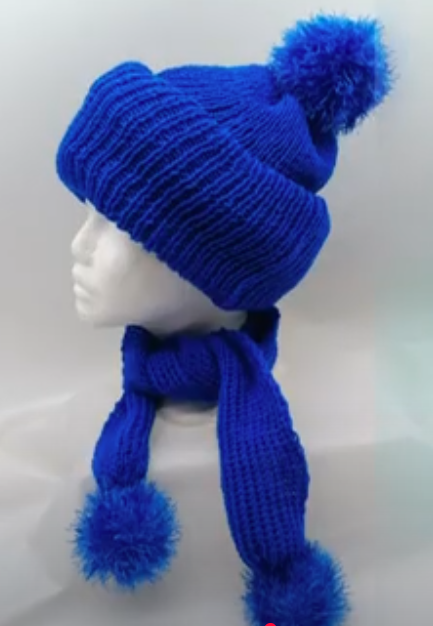
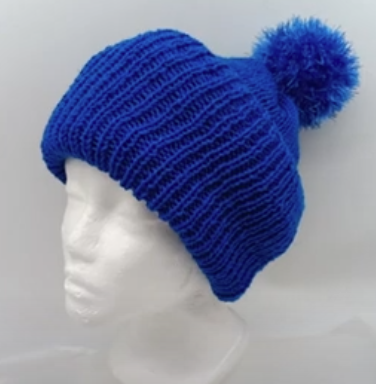
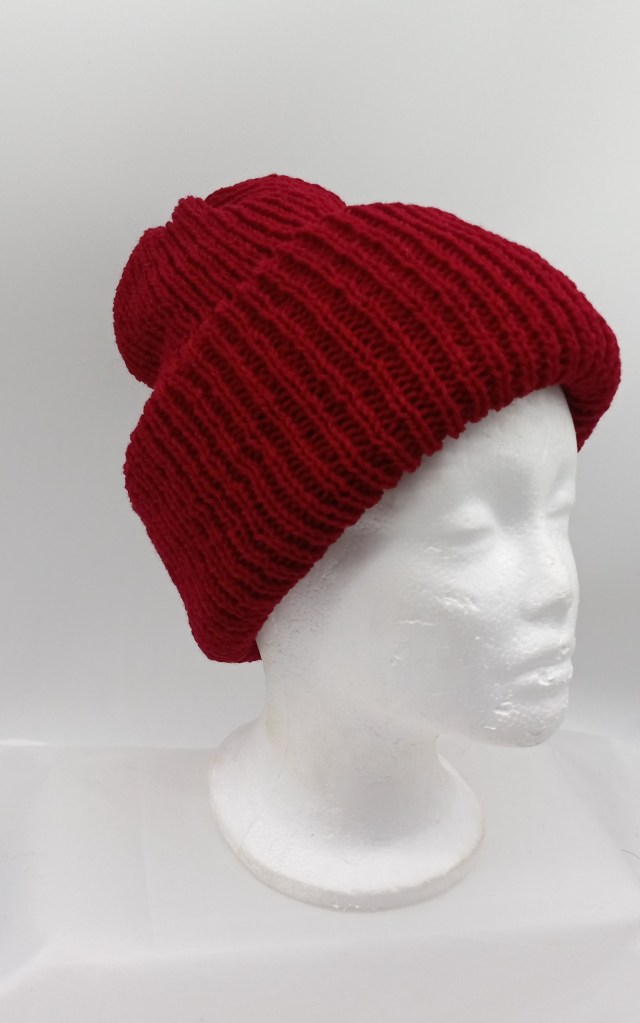
I recorded a video of almost all the tests I ran on this machine. The knitted fabrics were converted into a colorful cowl/neck warmer, and a set of matching scarf, and a slouchy hat.


A favor: please, comment on the blanket in the background. Apparently, I used it without my son’s permission and I am now in trouble. But if he hears from my readers how cute his favorite blanket is (it is his camping blanket), I might be forgiven ๐Ÿ˜Š)
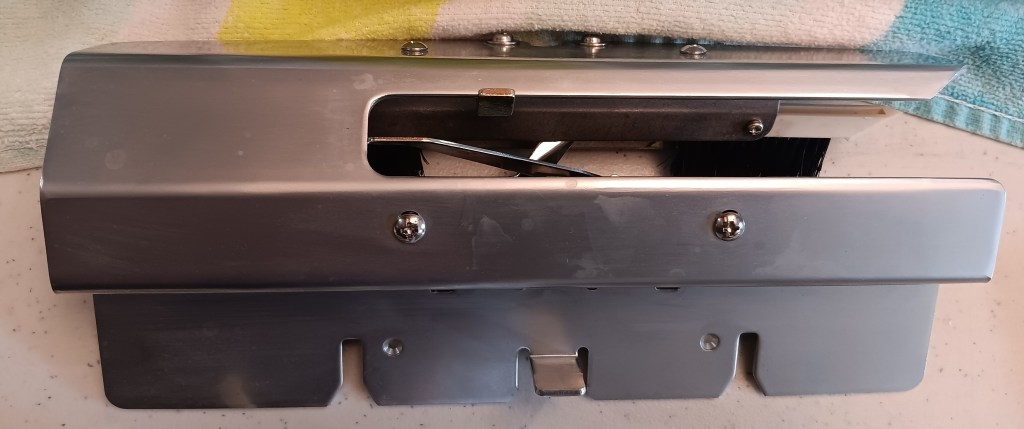
Personal knitting machines museum (those I personally tested_.

MACHINES:

Standard (4.5 mm gauge/distance between needles):

Basic models: Brother KH550

4-push buttons: Brother KH551

8-push buttons: Brother KH552, Brother KH581, Brother KH585, Brother KH588,ย  Brother KH601, Brother (Genie) KH710

Punch-cards:

Studio/Silver Reed.Studio.Empisal: Singer 321, Studio 326, Studio 360K, Singer 360K, Singer 210, Singer 700 memomatic

Brother: KH800, KH830, KH836, KH840, KH860, KH890,

Electronic: Brother KH930,ย  Brother KH930e, Brother KH940

Mid-gauge:

Basic models: KX350 (7 mm gauge), KnitKing Simple Seven (7 mm),ย  Singer KH100 (8 mm gauge)

Bulky:

Basic models: Brother KH210 (9 mm), Silver Reed SK120 (8 mm)

Punch-cards: Brother 260, Brother 260e

RIBBERS:

Standard: Studio SRN321, Brother KR580, Brother KR810, Brother KR830, Brother KR850, Brother KR850e,

Bulky: