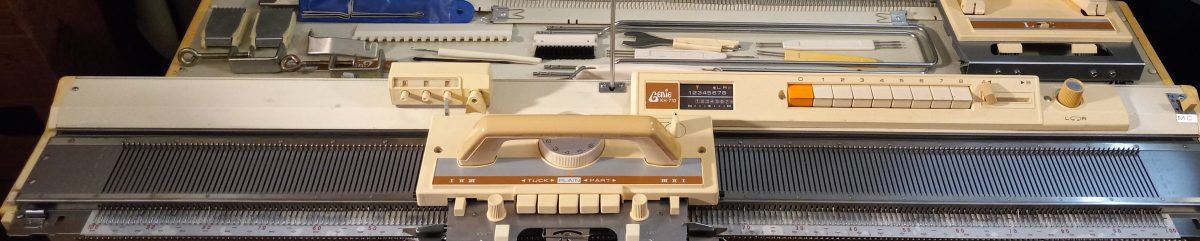
Comparison, pros and cons of Brother and Studio/Silver Reed/Singer punch-card knitting machines

… still in progress. Last update: January 2026

A vast majority of knitting machines on the current used market are from Brother and Silver Reed (also released under the Singer, Studio, and Empisal Knitmaster, Riccar, Silver names) manufacturers. In turn, a lot of models from these makers are machines capable of patterning using punchcards.

This article gives a general comparison of the punch-card reading and patterning mechanism of Singer/Silver Reed/Studio/Empisal knitting machines versus those released to the markets by Brother Co.

The patterning mechanism of Brother punchcard knitting machines is activated when the carriage is locked into the timing belt. Silver Reed (and also some of the Toyota models, like Elna EK2300) machines have patterned drums on the carriage.

I find that knitting on machines with patterning drums is a bit quieter than when knitting on machines with a timing belt. However, it is somewhat easier to move the carriage when it is also guided by the timing belt.

Both types of machines have their own problems. For example, yarn often tangels on machines with patterning drums. While machines with timing belts have a lot of issues with timing belt misalignment.

However, I find it easier and more straightforward to set up a tension mast on the Silver Reed machines than on the Brother. Sometimes I feel that when I unfold the head of the tension mast on Brother machines, I bend it too much.

With the regards to the tension masts: there are two slots on Singer/Studio/Silver Reed/Empisal machines (and they are in the case handle – so in the middle of the needlebed) to insert the tension mast. On Brother machines, there is one in the middle

I like that on Brother machines, the needles move forward according to the punch card. So, it is somewhat easier to see if the machine mispatterns. On Silver Reed/Studio/Singer machines, all needles (selected and not selected according to the punchcard) remain in one position (B). Thus, sometimes it is hard to see if the pattern is transferred to the needles correctly.

Patterning of the Singer/Siler Reed/Studio/Empisal knitting machines occurs when the drums pass the patterning center. Brother patterning occurs when the timing belt is latched onto the carriage (by activating the KC button). Thus, it is very important to follow the instructions on how to start knitting andpatterning using the punchcards for both models.

Clearing of the patterning in Silver Reed machines occurs when the lever passes the “clearing center “, while on Brother, the patterning selection changes when the carriage turns.

After working with it, I feel that standard-gauge Singer/Studio/Silver Reed takes yarns thinner and smoother than the same gauge Brother machines. It seems that Brother machines can handle yarns not just thicker but with a wider variety of textures. But it might be just my experience. Working with various yarns is always an interplay between tension, use experience, how tight the yarn is in the cake/cone, static (which depends not only on your yarn but on the condition of the bed and your environment, which also changes seasonally), etc.

… to be continued.

A quick guide to which machines have punchcard patterning capabilities:

Brother/Defendi/KnitKing/Jones*Empisal/Riccar/Silver/Silver Reed/Singer/Studio, etc.
STANDARD GAUGE
Brother:
KH810, KH810**, KH811**, KH820, KH821, KH830, KH831, KH835, KH836, KH838, KH840, KH850, KH851, KH860, KH864, KH868, KH871, KH880, KH881, KH890, KH891, KH892, KH893, KH894

Defendi: KM2000, KM3000

KingKing: KK91, KK93, KK98, KH830, KH881, KH891,
Elna: EK2400

Empisal KnitMaster:
MK70, 260K, SK313, 321, 322, 323, 324, 326, 328, 329, 360K, mod. 600, mod. 700, 700K

Riccar: RK-701, RK-702, RK-703, RK-704K, RK-705K, RK-706K, RK-707, RK-708, LECLE

Silver: SK250L, SK311, SK312, SK313, SK315, SK321, SK322, SK325, SK326, SK327, SK328, SK329, SK330, SK360

Silver Reed:
250L, SK280, SK282, SK360, SK640, SK700, SK700N

Singer: MK70, 210, 312, 313, mod. 313, 321, 322, 323, mod. 323, 327, mod. 327, 328, 329, 360K, 700K, 700, 740

Studio: 280, by White mod. 280, SK312, SK313, 315, mod. 321, mod. 322, mod. 323, mod. 324, mod. 326, mod. 327, mod. 328, mod. 329, 350, 360K, mod. 600, mod. 700, by White SK740
BULKY GAUGE
Brother: KH260
KnitKing: KH260, PC bulky
Elna: EK2300
Empisal Knitmaster: 155
Silver Reed: SK155, SK155P
Singer: mod. 155
Studio: mod. 155
Toyota: KS650
FINE GAUGE
Empisal Knitmaster: F270, F370
Silver Reed: F270, F370, SK370, SK670
Studio: 270, 370

*KH800 and KH801 models have a slightly different punchcard mechanism and thus are not considered in this comparison
**KH811 also has pushbuttons in the patterning center. Punchcard reading and needle selection work like in all other Brother punchcard machines.

Brother KH892e serviced and tested in March 2025

Brother KH892e is a blueish-color combo (anniversary edition) of the standard-gauge knitting machine Brother KH892. Read more about the pros and cons and features of KH892 in my Knitting Machine Encyclopedia.

This blog post is dedicated strictly to the Brther KH892e I serviced and tested in my shop in March 2025.

I removed the old sponge, cleaned the metal section of the retaining bar, and removed, cleaned, and inspected all needles. I was checking each needle for good latches, for being straight, and for having no rust.

I cleaned, serviced and inspected the punchcard reader mechanism, timing belt, and the drums guiding the timing belt to ensure absolutely reliable needle selection and patterning. The carriage was opened and deep cleaned as well.

After the machine was thoroughly serviced and cleaned, I first tested on all number of needles to ensure all carriage functions run well. I knitted stockinet first and then fair isle (see the video).

Then, I tested the machine on all needles to ensure that all needles formed correct stitches and that the needle selection worked across the full needle bed. All tests passed with flying colors (see the video).

The machine came with some accessories missing but I was able to source most of them out. So I included new-stock claw weights, table clamps, transfer tools, replacement needles, punchcards, and card snaps. I only used them during my tests.

The tension mast also did not come with the machine so I am including a brand new (new stock) mast. It is a bit hard to insert (and then to remove) it into the place for the tension mast but I kinda like it because sometimes when the tension mast sits too loose, it is too wobbly and messes up with my knitting (or yarn tension).

The cast on comb did come with the machine. It is a new design where the two sections, a longer and a shorter one, attach to each other. Well, the slide out each other easily. But I was still able to use it without problems. (All my tests in the video were made with that cast-on comb). I actually find of like it because in the past, some of the cast on combs attach to each other so hard that it actually hurts to pull them apart.

The original lace carriage will come with the machine. I cleaned the carriage and tested all the knobs but I did not test it in action. It is a simple enough carriage where I do not anticipate any problems.

The hard copy of the manual will NOT be included. But a free online version can be found here.

The punncard set (20 cards total, like in the manual) also did not come with the machine, so I included a set I purchased from new stock. Card #1 was used quite extensively during my tests, so it is a bit bent (which still did not affect its functionality). But all other cards are in great shape. Some match the cards in the manual and some don’t.

Cast-on lace is not included, but any strong, thin (and preferably silky) yarn will work the same. A tapestry needle is not included: any needle of your choice with a wide eye will work as fine. The oil will also not be included. I use Hoppe’s gun oil I purchase on Amazon for everyday lubricating and when I clean needles.

The original metal carriage also did not come with the machine. I am including a 3D printed plastic one.

The punchcard holder pin is also not included but all the tests I ran in the video were done without it so it is actually not such a critical component.

I replaced broken plastic rivets with new ones (new stock); therefore, some of them look whiter than others (not shown).

The little cap for the punchcard reader lever was cracked, and I replaced it with a new 3D printed one (on the right-hand side in the picture below).

Some of the imperfections:

– since I oiled the machine really well and used greaseless lubricants to clean the old gunk/first, the first tests might cause he machine to “sweat”( meaning the excessive oil might come to the service when heated due to the carriage being moved back and forth). Just have a piece of cloth by your side to wipe it away. It is shown in the video of my tests.

– The tension mast sits very tightly in its socket on the needlebed. Thus, some pressure/strength needs to be applied when inserting and pulling the tension mast out.

– Some of the teeth on the cast on the comb are a bit rusted. I chose to leave them be instead of risking them being bent. This is NOT a critical con at all.

– There is a tiny crack on the lever on the sinker plate. I see it pretty often in punchcard machines. It is not critical and does not affect knitting.

The spring that holds the lace carriage in the lid is acting up. I do not have a replacement spring, but this is a very non-critical component. I am posting it here so you are aware that it is not behaving when the lace carriage is removed from the case and put back together.

– The case and the lid have minor scratches and bumps. The most serious ones are shown in the photographs below.

Despite these minor flaws, this machine is beautiful and works beautifully.

I made the gift bag below from the fabric I knitted while testing this machine. Hoping the new owner will enjoy it too!

Machine knitting a double cable blanket with mock-purl stitches

This tutorial describes step by step how to make a double-layered blanket on a knitting machine without a ribber. The cables are separated by mock purl stitches to make them stand out.

The demo below was made on a bulky knitting machine (Brother KH230), but it can be applicable to any knitting machine of any gauge (standard, mid-, and fine-gauges): push-button machines like Brother KH551 and KH588, punchcard machines like Brother KH840 and Studio mod. 360, Silver Reed SK280 and even electronic knitting machines without using their electronic functions, just to name a few.

The video of the steps can be found here. My two yarns were different (the fuchsia yarn was thicker, and the pink yarn was thinner), so I had to knit a couple of swatches to figure out how many rows to knit to have the same length measurements. If you are a bit off, blocking will solve it (like ironing in sewing). By knitting swatches, you’ll also determine what is the best tension to run the yarn of your choice at.

1. Knitting the mock-ribbing.

– Bring every-other needle to position B across the whole needlebed or as desired. Cast-on using a cast-on comb with waste yarn. Knit several rows with the waste yarn. The last row (before starting knitting with main yarns) should be with either an unravel cord or any other easy-to-remove yarn.

– Reset the row counter to zero. Knit ten (or as many as desired) rows using yarn #1 (the backing yarn: in my case, the fuchsia colored yarn).

– Remove yarn #1 from the sinker plate (you can cut it or secure it behind the bed, out of the way) and thread a second yarn (from the side, yarn #2).

– Apply weights when needed on the edges to keep them neat and on the cast-on comb as well (which is especially needed for bulkier yarns).

– Knit 12 rows with yarn #2 (I knitted two more rows because my yarn #2 was thinner and also because I wanted the folded mock-ribbing to overhang a bit on the wrong side and not on the right side). I didn’t want any fuchsia color to show on the “right” side of the fold.

2. Folding the mock ribbing to create a rim for the cord (which we’ll add later).

– Remove side weights and remove the cast-on comb.

– Using a single-tip needle transfer tool, grab a yarn of the very first stitch on the first row knitted with yarn #2 and move it to the needle that is currently in position A. After the stitch is latched onto the needle, push this needle to the B position. Continue throughout the whole width of the knitted panel. At the end, you will have all needles in the B positions.

3. Preparing the front panel to knit cables.

– Hang the cast on comb on just-bolded mock-ribbing fold and add a weight onto it (to push the folded fabric a bit down so it does not get in the way of the carriage; without the weights, the folded fabric might jam the carriage).

– Loosen the tension a bit by 1-2 digits on the carriage dial (because now we have ALL needles in B position) and knit two rows with yarn #2 (the right-side yarn).

– Set the tension back to the optimum tension for yarn #2, and knit two more rows.

– Preparing for the mock-purl runners:

a) Starting with the needles in the center (closest to position “zero”), gently nudge the two needles on each side of it slightly forward. Perform this after every four needles. The stitches on the needles we slightly pushed forward will be transferred to the neighboring needles (and the freed needles will be pushed to A position). This empty space will create separation in the fabric, which will mimic the effect of purl-stitch runners around cables. Continue with this needle selection for the rest of the needle bed, including on the right-hand side. Your needles should be positioned as shown below. The first row is needles in position B; the second row is just slightly below position B. Note: on the very right-hand side edge of the needlebed, you will have 5 needles: 4 for a cable and one for the seam. On the left-hand side, you will have only four needles (we will not make a cable in the very left block of 4 needles).

b) Using a one-pring needle transfer tool, move the stitches from the needles we just slightly pushed forward onto the needles at the beginning of each 4-needle block (see the schematic below).

c) After the stitches are transferred, push the freed needle to A position. After you complete the needle transfer for all needles, your needle selection should look like the picture below. The empty spaces will create separation from the cables and 4-stitch stockinet blocks, acting at the same time like mock purl stitches. The contrasting backing will help with this effect.

– Knit two rows with yarn #2.

4. Making cables:

– Use two 2-prong transfer tools to switch two pairs of stitches to make a cable. Start with the first 4-needle block. It does not matter if you switch the stitches from left to right or from right to left. Just be consistent. After each swap of the stitches, move the needles to the E position (all the way out), which will be easier for your machine to handle.

– The second 4-needle block will be plan stockinet (not a cable), the third will be a cable, etc. So, you will have alternating 4-stitch stockinet runs with cable runs like those shown below in the photographs and in the schematics.

– After all cables are made, knit 6 rows with yarn #2 (“right” -side yarn), and then make cables again above those made in the previous section (starting with the first 4-needle block). Note: the first row right after the cables were knit will always be a bit tight. So, loosen the tension a bit (by 0.5-1), but then set the tension to the usual tension (after the first row).

– Knit repeating the cables every six rows until the desired length of the front panel is achieved. It is best (for a more pleasant visual appearance) to keep a 3:4 or 5:7 ratio between the width and the length of the blanket. So, when you make your swatch at the beginning of the project, calculate your final width and then figure out how many rows you’ll need to knit to achieve the desired length.

– After the desired length is achieved, move the needles that were in the A position into the working position B and knit two rows with yarn #2. Alternatively, if you prefer this second method better, prior to knitting the last two rows, make the stitches onto the needles that were in the A position all this time by pulling the walls of the neighboring stitches onto these needles.

5. Knitting a second mock-ribbing.

– Transfer every other stitch onto a neighboring needle and push the freed needle into A position. Do this for the whole width of the needlebed. You can use a one-prong tool or an adjustable 7-prong tool if making this blanket on a standard knitting machine (such a tool is not available for bulky machines unless it is custom-made).

– After this transfer, you will have only every other needle in B position. On every other needle, knit 12 rows with yarn #2 and 10 rows with yarn #1.

6. Folding the second mock ribbing.

– Remove all weights and a cast-on comb.

– Grab with 1-prong the stitch on the first row when we just started knitting on every other needle (the second mock-ribbing) and transfer it onto the needles in A position, while also bringing them into the B positions. It will create the fold.

– Attach the weights back on (I do it by hooking the cast-on comb onto the knitted panel and then attaching the weights to it; in this case, the weight is evenly distributed).

7. Knitting the backing.

-The yarn #1 should still be threaded through the sinker plate. So, continue to simple stockinet using yarn #1. Remember that the first row after we transferred all every-other-needle stitches might feel a bit tighter because now we have ALL needles in B position. So, you might want to loosen the tension by 1-2 for the first row. But then move it to the regular tension. In my case, yarn #1 was thicker than yarn #2, so I had to adjust the tension accordingly.

– Continue knitting stockinet until a desired length (AKA number of rows) is achieved. Don’t forget to rehang weights periodically.

8. Linking the panels together.

– Go to the mock-ribbing fold we made at the very beginning and remove the contrasting waste yarn (just one row we knitted at the end of the waste-yarn rows). Remove the waste yarn section.

– Find the last row of that mock ribbing that we knitted using yarn #1 and attach those stitches onto the needle bed onto every other needle. Take your time, and a nice seam will form. Continue for the rest of the bed.

– After all sitches are hooked onto the bed, attach a cast on comb (to push the folded fabric out of the carriage way) to the panel and weights and knit one row with yarn #1. Remove the cast-on comb.

9. Cast-off

– Use your favorite cast-off method to finish the panel and take it off the needles. The formed edge (seam) might seem a bit too thick if the blanket is made on the bulky knitting machine. So, as an option, link this edge/seam to the mock-ribbing fold to make it less obvious and to hide the linked seam of the fold.

10. Final steps.

– Link the sides together using a mattress stitch

– Knit two cords on the cord machine or on your own knitting machine (see here how to do it); insert them into the mock-ribbing folds.

– Wash and block the blanket