Brother KR830 refurbished in May 2024

Brother KR830 ribbing attachment is typically used with Brother Knitting machines, with model numbers KH8XX and KH9xx. To learn more about the pros and cons of the Brother KR830 ribber, refer to my Knitting Machine Encyclopedia.

This article is dedicated to a specific ribbing attachment, serviced and tested in May 2024 for Mercedes.

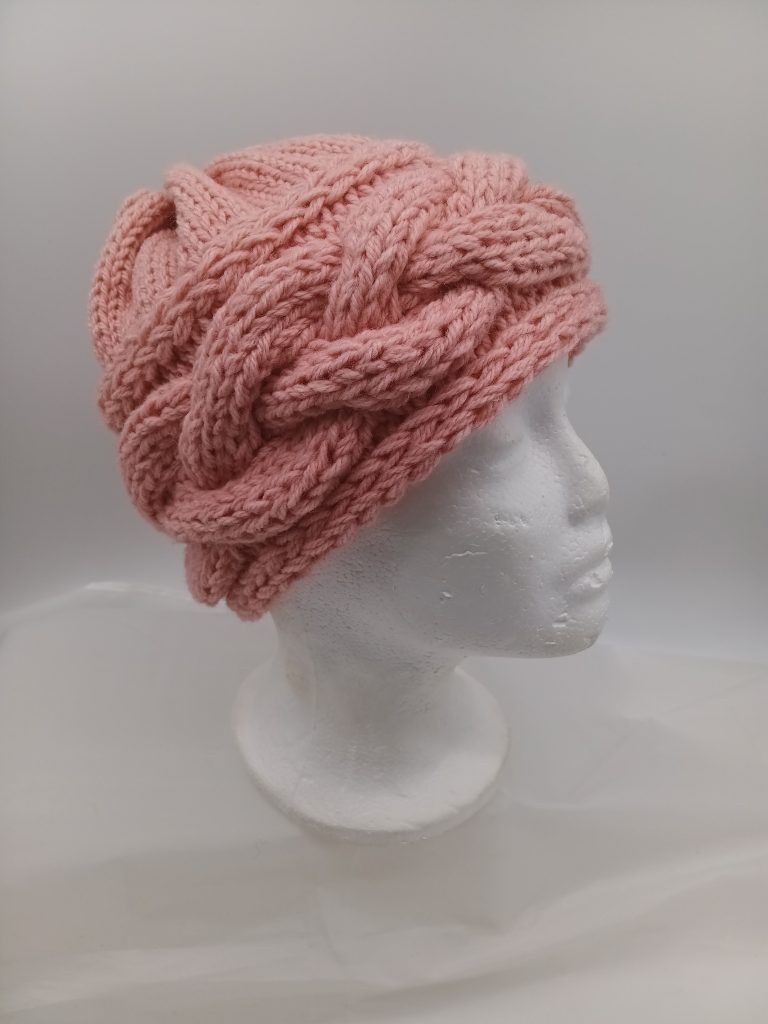
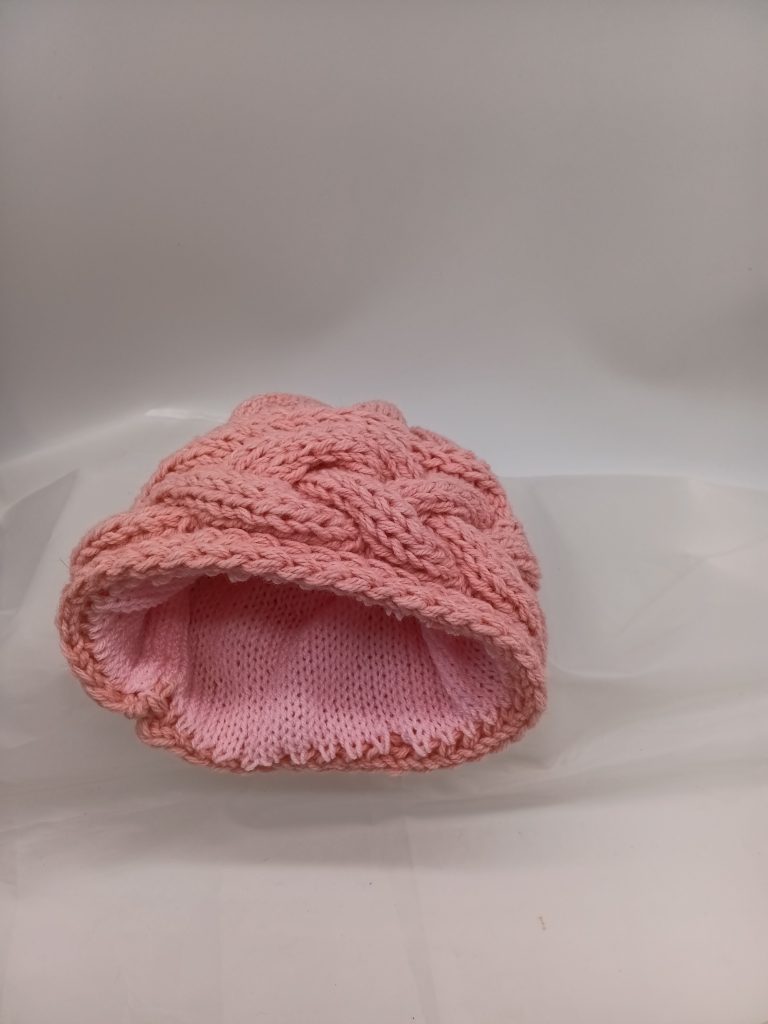
The machine was cleaned, all needles were inspected and then tested by knitting a 1×1 ribbing on the full bed. I did it in two different needle configurations to ensure I tested all needles. I also used two different yarns. Watch a video of all my tests.

I used my own Brother machine to test the ribber and to set up an optimum distance from the main bed.
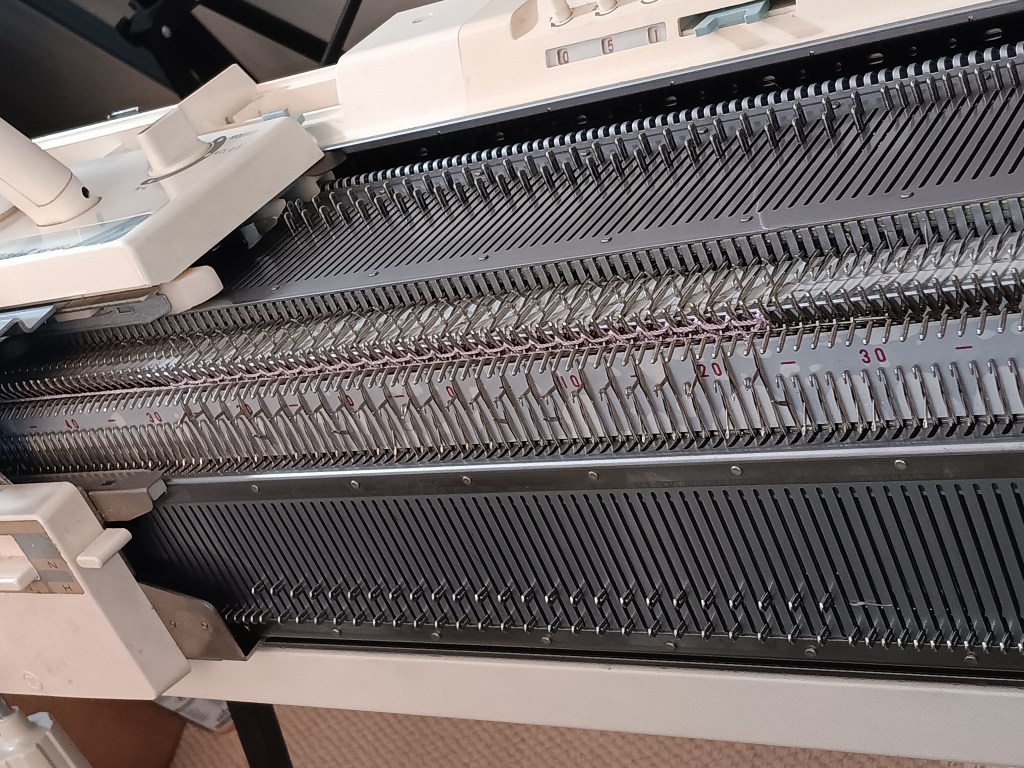
You will need to do it on your own machine. I like this video, which explains really well how to do it.

The levers, brackets, knobs and buttons on the ribber and on the carriage move really well.

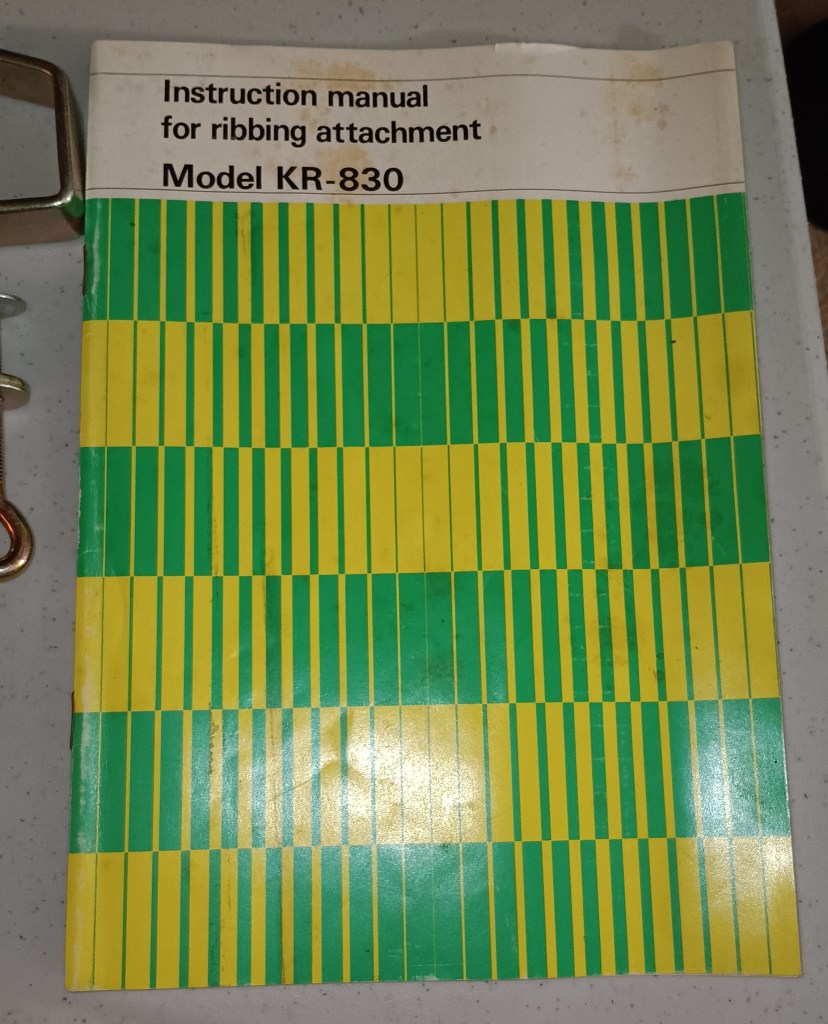
The ribber will come with all the accessories mentioned in the manual:

A hard copy of the manual (in English) will be included as well.

The ribber managed two different yarns (smooth and fuzzy) wonderfully. Again, refer to the video of all my tests. Just make sure you establish the correct distance between the ribber and the main bed as well as use the correct yarn tension. additionally do not forget to oil your machine and maybe even wax the yarn if you experience static or hear grinding sounds of your ribber.

When I tested the ribber, the last 3-5 needles sometimes were left in the non-working position. I did that so I could insert the wire hangers. You will see in my video that if I did not have any space to the side of the knitted panel, it would be hard to insert these changes. And they are absolutely needed to create neat edges and to ensure the yarn does not hang on the pegs.

The carriage slides very smoothly across the ribber. If you start knitting and the carriage is not moving smoothly, check the distance between the ribber and the machine, check if the connecting arm is attached correctly, wax your yarn, and decrease the tension of the yarn.

The ribber will be packed in the original cardboard packaging with the original Styrofoam inserts. They are in pretty rough shape (a bit dirty) but they still do a good job protecting the ribber and the parts.

Now about imperfections:

  • The hard copy of the manual shows some discoloration. But the pages are not damaged and the text is still clear.
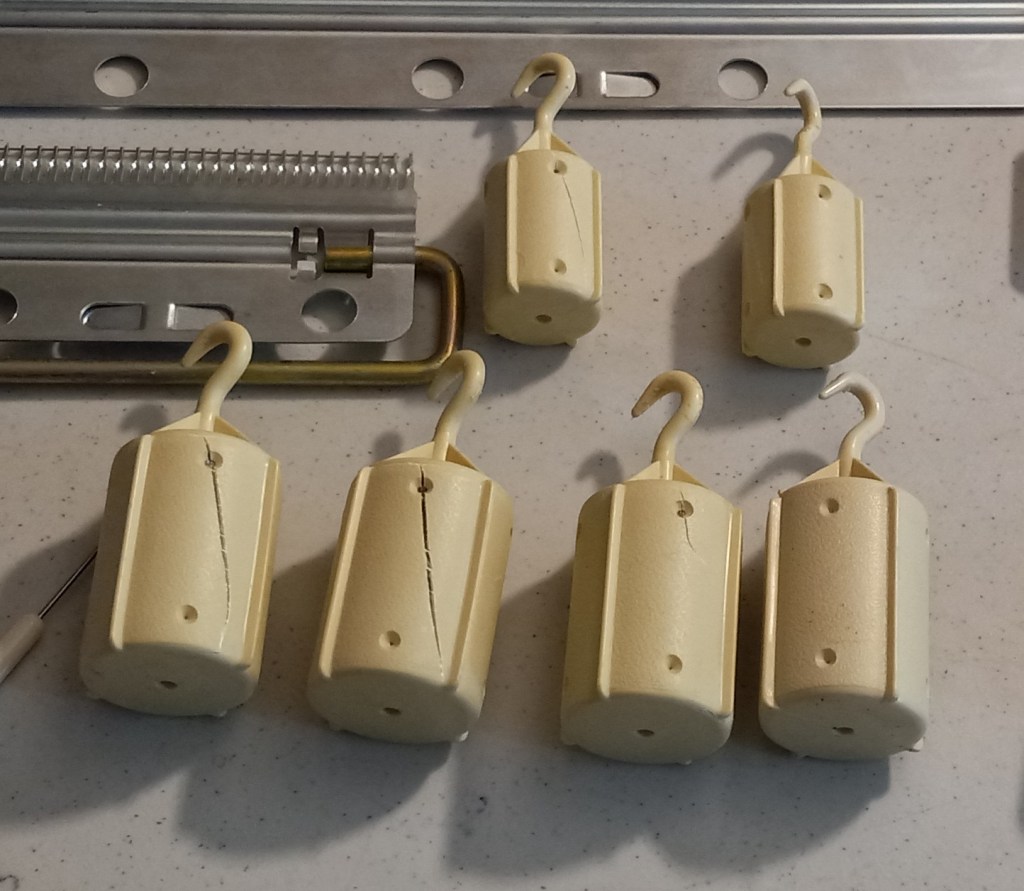
  • Some of the barrel weights have cracks but it does not affect their functioning.
  • There might be some spots and staining on the plastic of the ribber. I typically do not rub too much on the plastic to remove the dirt spots because I do not want to damage the old brittle plastic by excessive rubbing. Some scratches are present too. None of this affects the functioning of the ribber.
  • I greased and lubed all the parts so you will see some residual freeze/lubricant remaining.
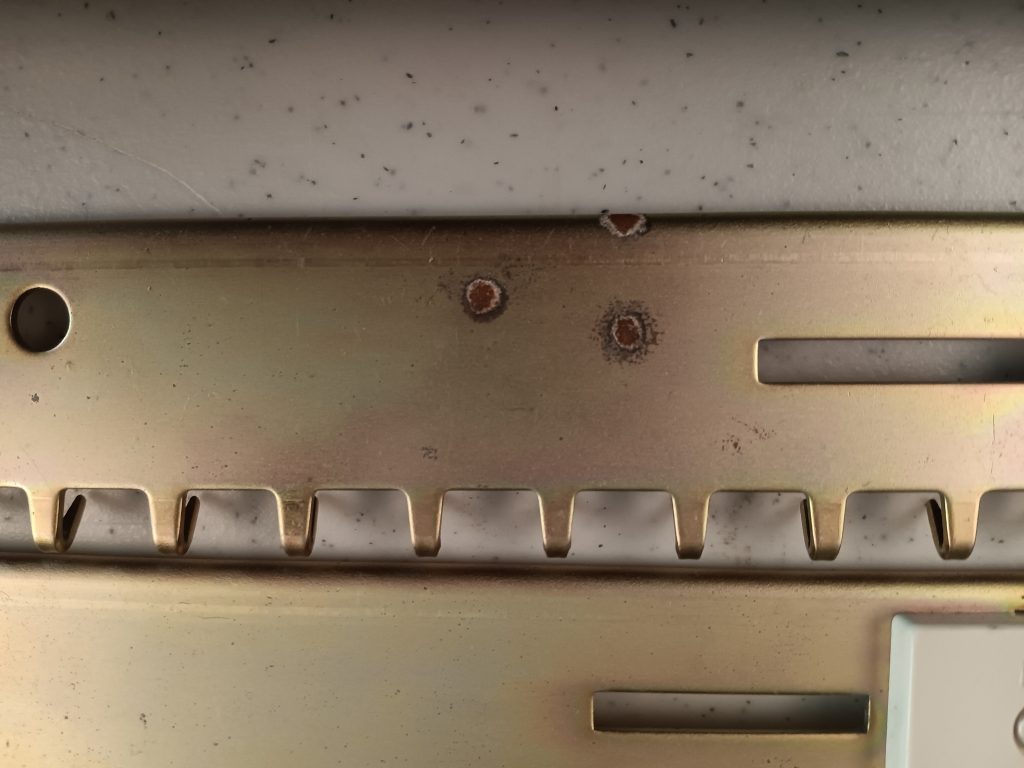
  • Cast-on combs have some minor rust spots but it does not affect their functioning.
I enjoyed working with this ribber! Hope you will too! Happy Knitting!
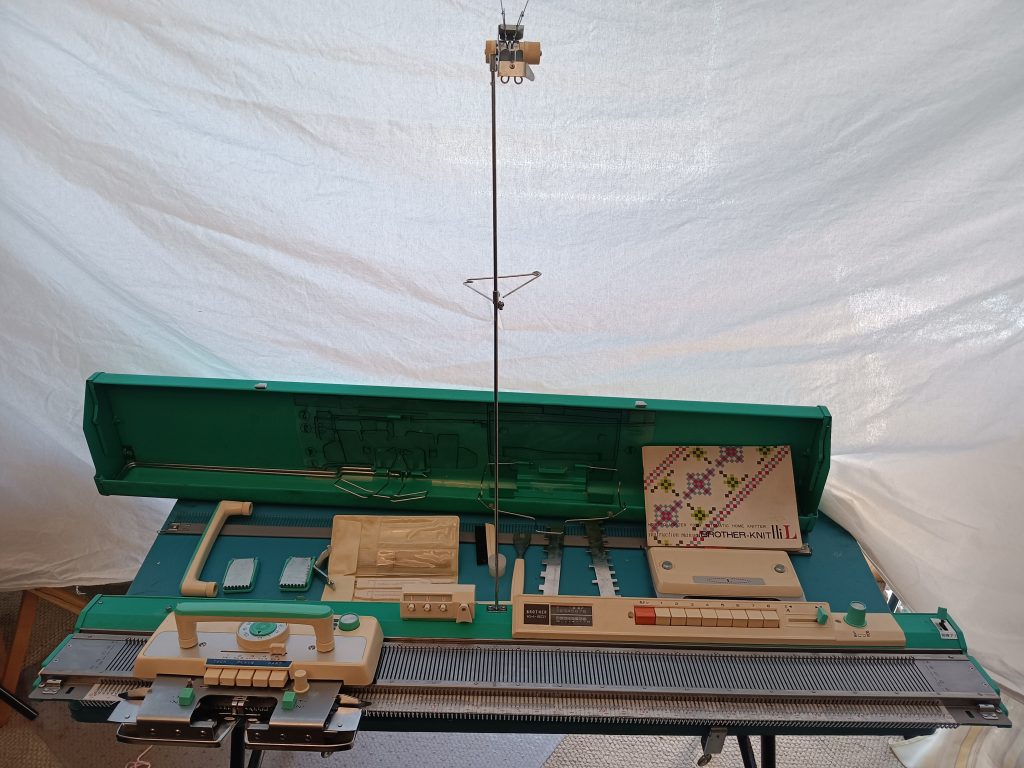
Brother KH601 knitting machine serviced in May 2024

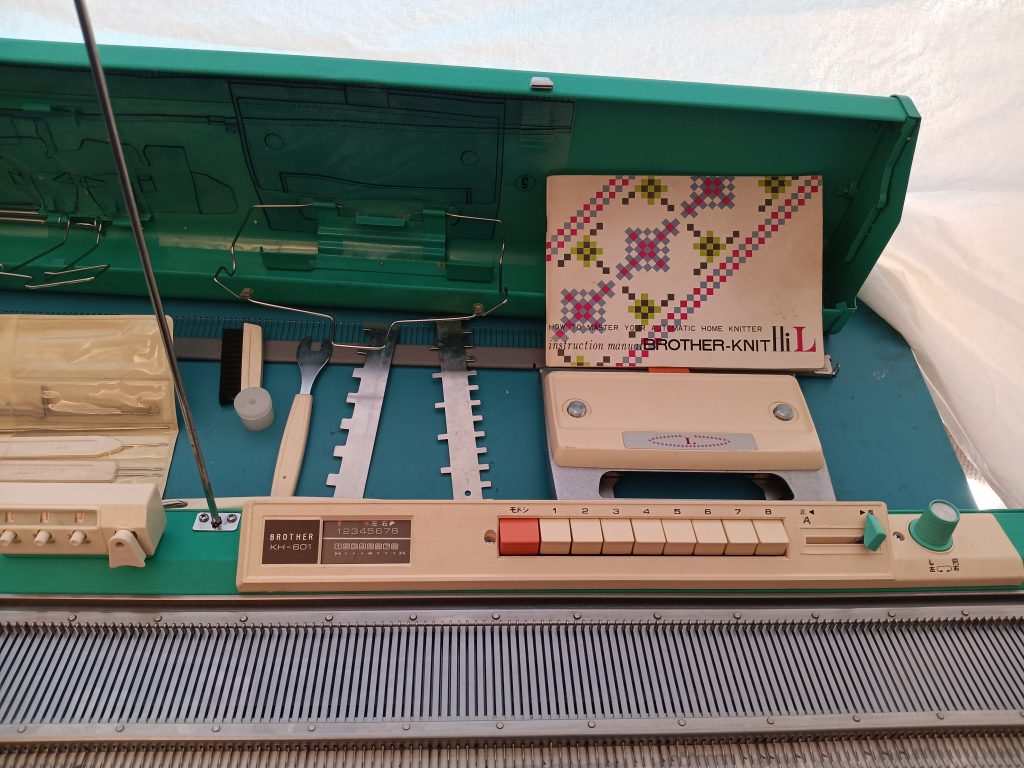
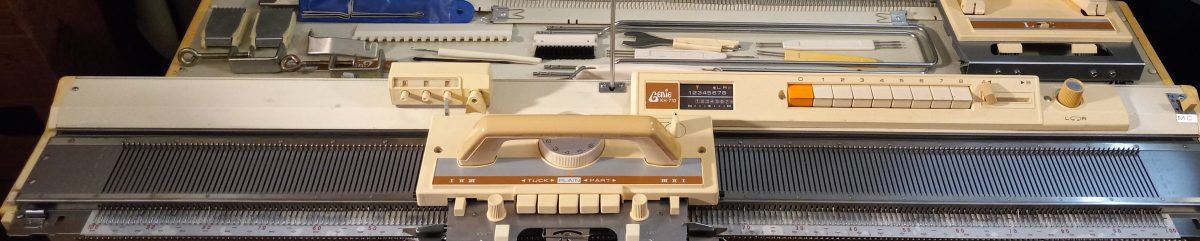
Brother KH601 knitting machine was released by Brother in the 1970s. It is a standard-gauge knitting machine with the needle selection performed by the pattern center and the 8-push buttons. Read more on pros and cons of this model in my Knitting Machine Encyclopedia.

The machine discussed in this blog was refurbished by me in May 2024. I lenjoyed working with this model and learning its mechanisms.

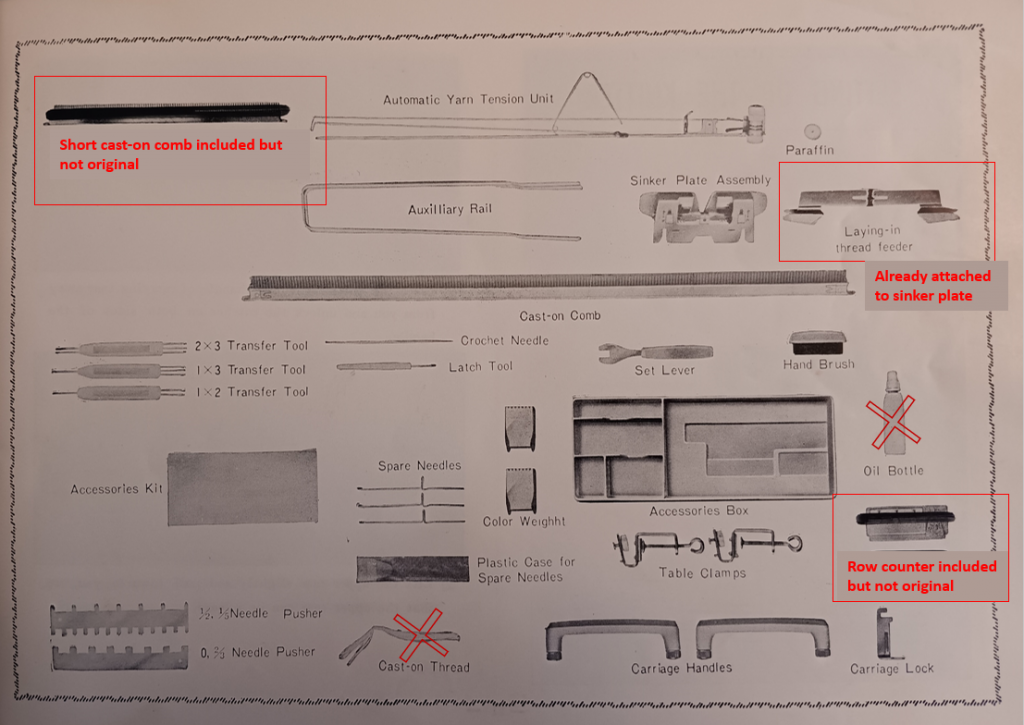
The machine comes with all major accessories (lace carriage, cast-on combs, extension rails, tension mast). The standard set includes one long cast-on comb (for the full bed) and one short one. The short one did not come with this machine so I will include a cast-on comb from my stash but its color is slightly different: greenish (while the original is greyish).

Most minor accessories are included as well. The row counter is not the original one (the original emerald-color one was missing – so I included a brand new cream-colored row counter from my stash). A hard copy of the manual will be included as well.

The accessories that are NOT going to be included are: cast-on thread (any strong thin yarn will work) and a bottle with oil (use Gun Oil instead). Laying-in thread feeders are already attached onto the sinker plate. Also, the machine did not come with the 1×1 needle ruler and I think this is such a basic tool that I included one from my personal stash. It is not metal like the original needle selection rulers but does the job.

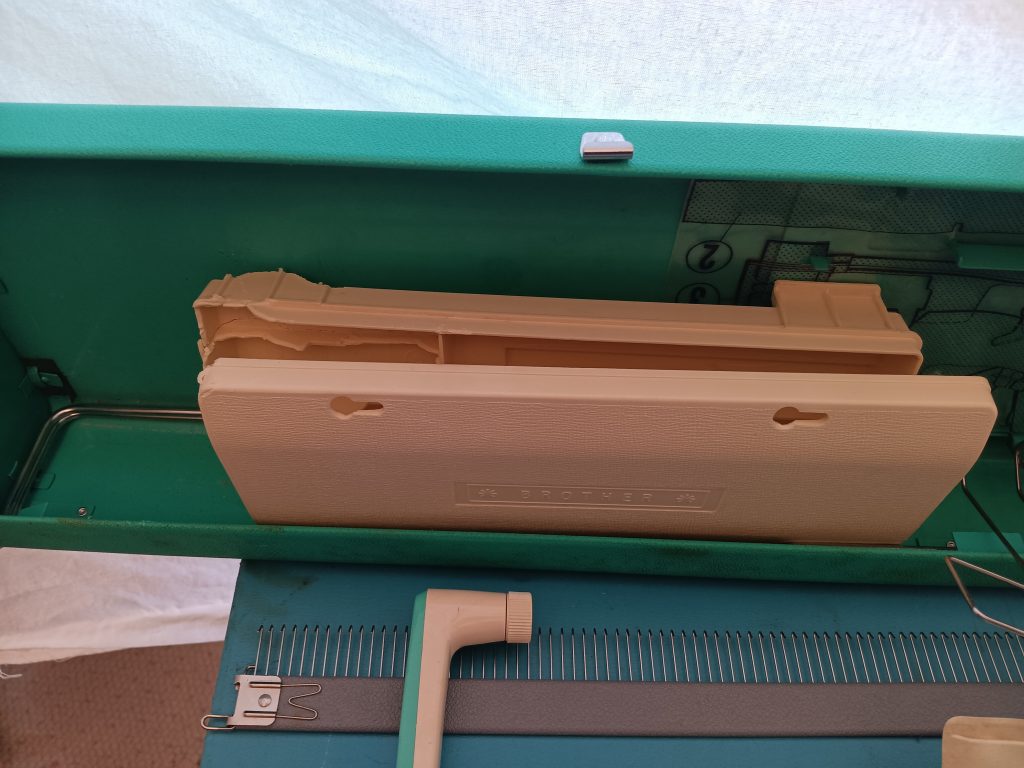
All minor accessories fit into the toolbox. Unfortunately, the old plastic became fragile and the box has several cracks and misses pieces that cracked. It still holds all the tools well and will be included with the machine.

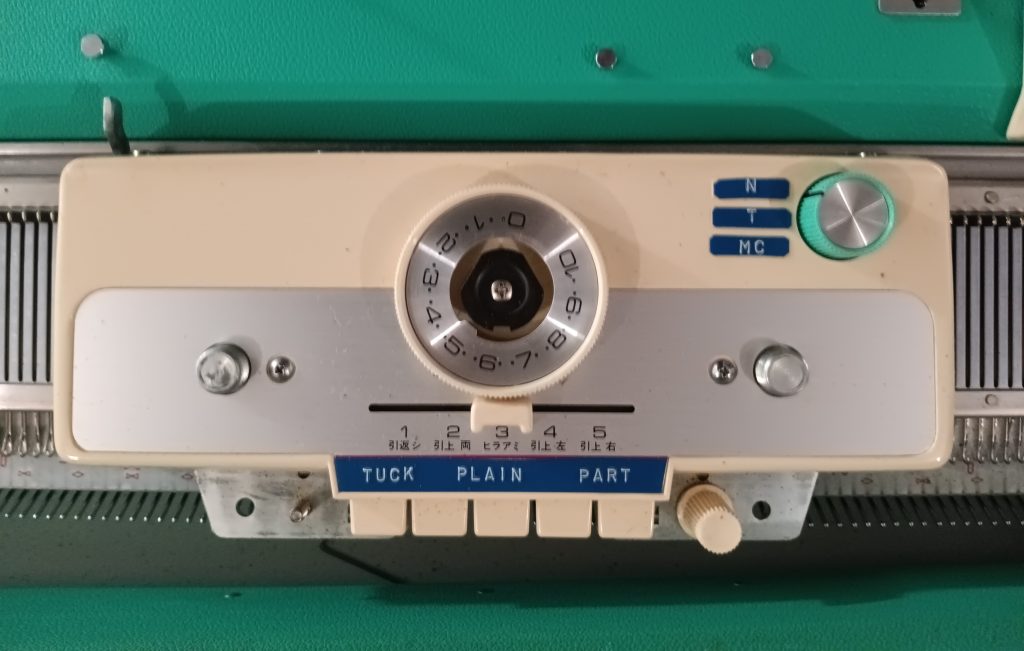
The carriage of KH601 differs a bit from all other 8-pusbutton machines I knitted on (KH5552-KH588-KH710): it has a sliding hold cam lever in the middle of the carriage right under the tension dial instead of two levers on the side.

The writings on the carriage and on the pattern center are in Japanese. But the previous owner left some marks in English – so it will be easy to understand and follow the manual.

The hard copy of the manual that came with this machine shows a slightly different carriage (a more standard for 8-pushbutton machines – with side levers rather than with a slide lever above the buttons on the carriage). There is a one-page insert (provided by the manufacturer, I believe) that shows the setting for this particular carriage.

I recommend using the manual for the KH800 to guide you on the HCL position (the sliding lever above the TUCK, PLAIN, and PART buttons) during patterned knitting.

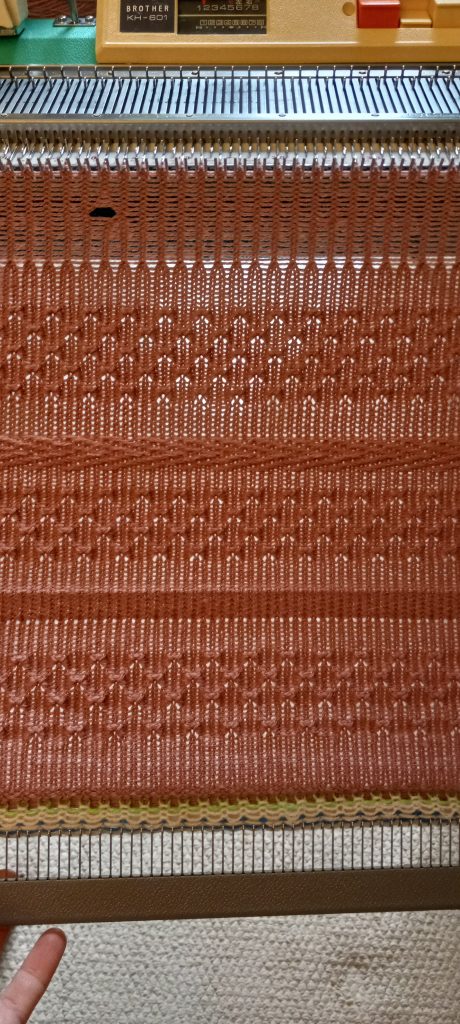
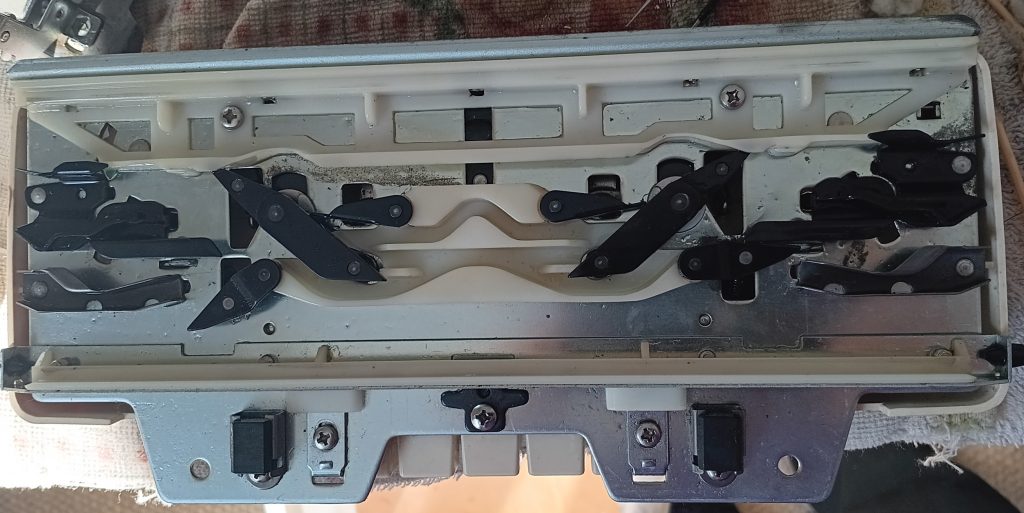
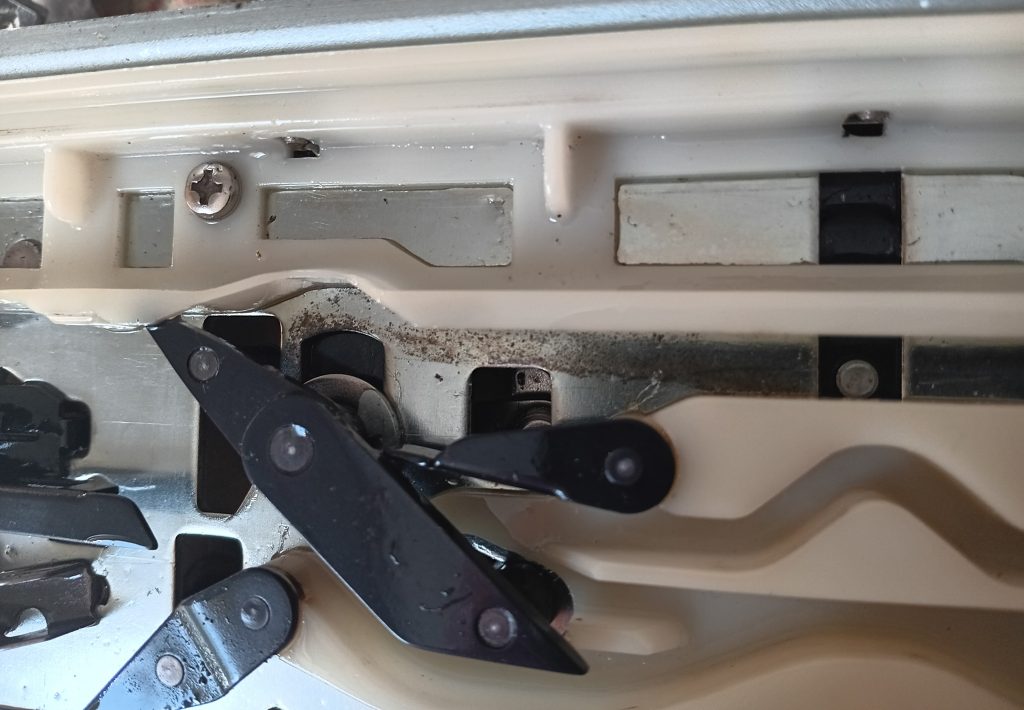
I thoroughly cleaned the machine, inspected and cleaned all the needles, replaced the sponge in the retaining bar, and cleaned and serviced the carriage (ensured all the levers, knobs, and buttons move freely). I then tested the needles by knitting various patterns on a full bed watch the video of these tests here).

All tests were passed with flying colors! The patterns I tested were the “butterfly” pattern with needles being held and then knitted, a 1×1 tuck pattern (the trickiest to execute out of all tuck-pattern, in my opinion) and a slip-stitch siz-zag pattern. All neeles worked great!

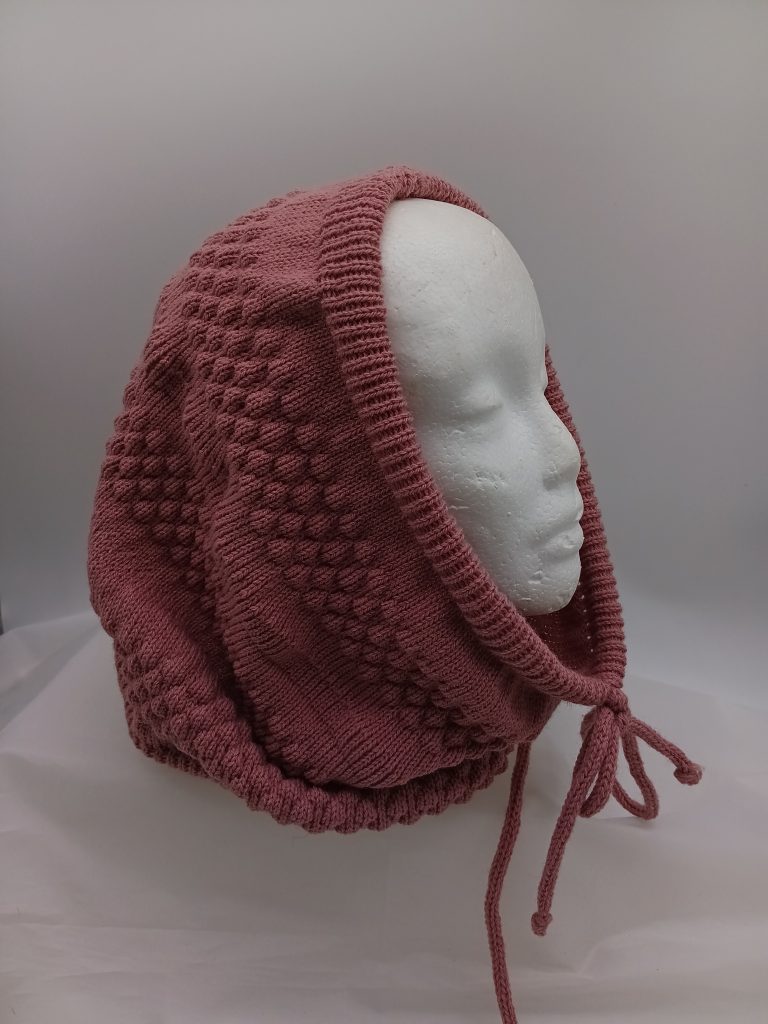
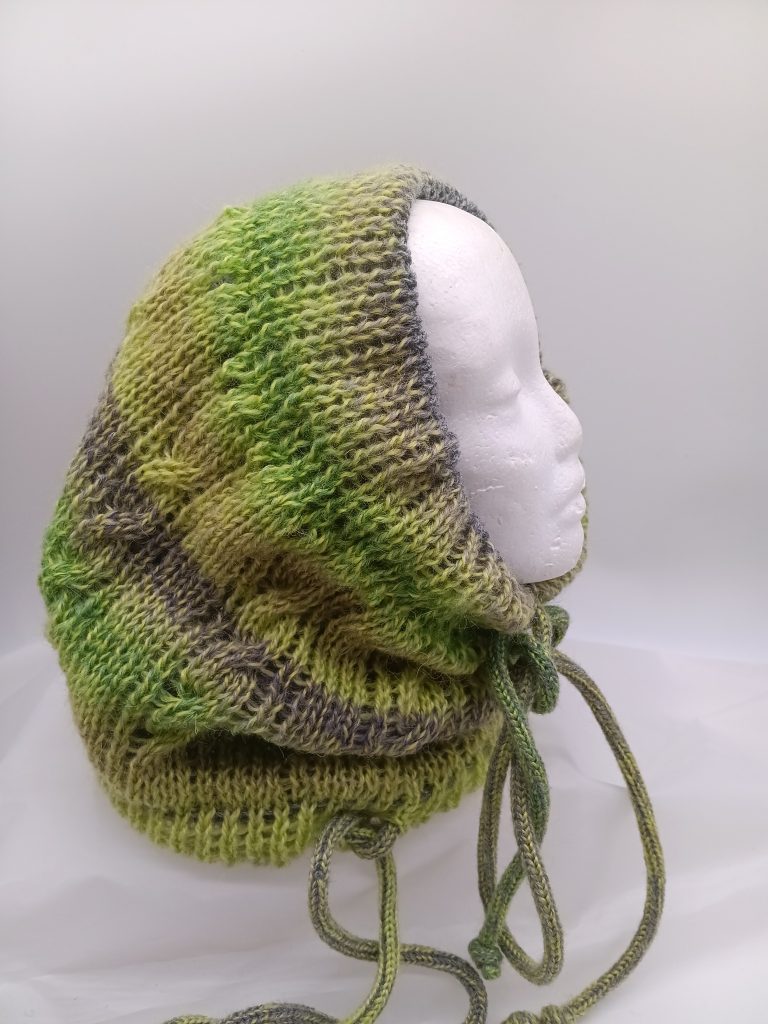
The knitted fabric was then converted into a reversible cowl/neck warmer/hood.

Now about imperfections:

  • Buttons #6 and #7 in the pattern center are a bit sluggish when are revered to the unpushed position. But only if they are unpushed by themselves. When pushed and then unpushed together, they are pretty perky. My video shows this flaw at the end but it did not affect the patterning or the knitting of the machine.
  • There are some minor scratches, stains, and bends on the case and the lid (not shown here but I will document them when I pack the machine).
  • The cracked tool storage box, with some especially fragile cracked areas, is missing. The lid for the storage box is a bit cracked too (not shown).
  • The greenish cover for the tension dial has a small broken nugget that holds it in place. It sometimes gets loose. I did not glue it completely because it needs to be removable in case the carriage requires disassembling. It does not affect the functioning of the carriage or the tension dial.
  • The carriage has minor rust and metal discoloration spots. It did not affect the functioning of the carriage.

Overall, this machine behaved very well. With regular oiling and cleaning, it will serve your knitting needs for many years!

This machine as well as other machines with punchcard patterning capabilities can be purchased from my Etsy store, or in my independent shop (for less).

Not sure which machine is right for you? Read how to choose the right machine for your needs. Regardless of the machine you choose, check out easy-for-beginners projects for your first knitting machine. Also, check my website for a blog article on the first steps with your new-to-you knitting machine.

Have questions? Get in touch with me through FaceBook: https://www.facebook.com/MightyKnittyMachines

Silver Reed SK120 knitting machine refurbished in May 2024

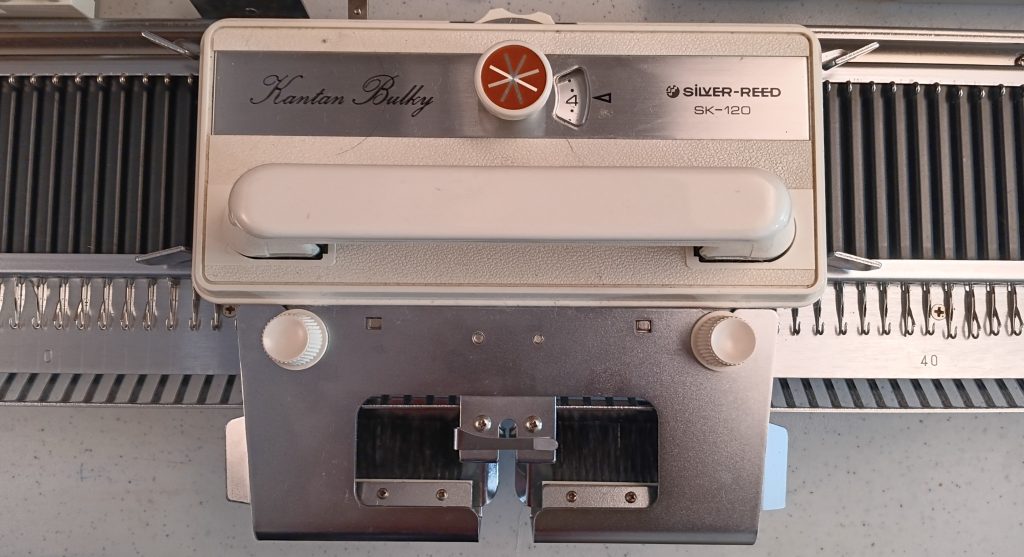
Silver Reed SK120 knitting machine is a flat-bed metal knitting machine with needles 8.0 mm apart. The bed contains 120 large needles. Read more about this model in my Knitting Machine Encyclopedia, including its pros and cons. The rest of the blog is dedicated to a specific Silver Reed Sk120 machine I serviced and tested in May 2024.

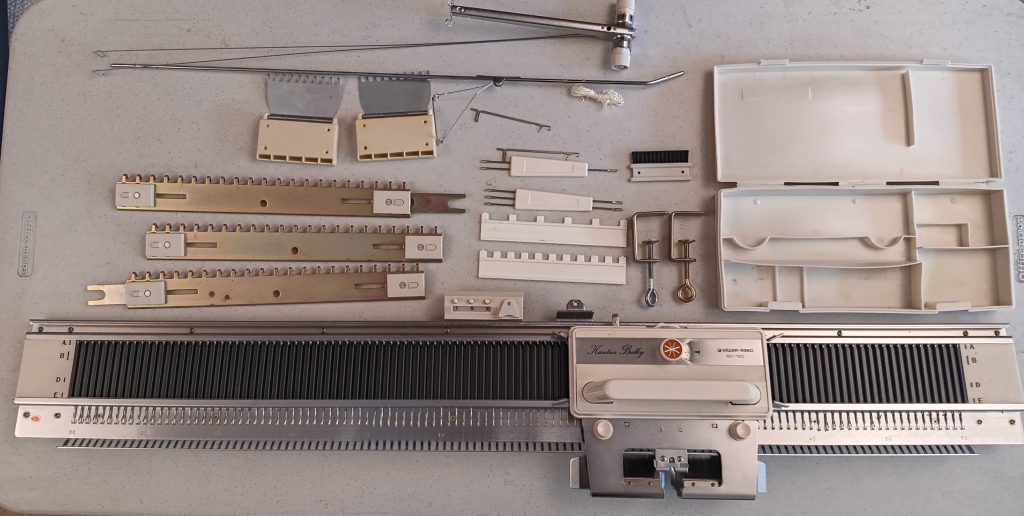
I loved working on this machine especially because of its simplicity. The machine I worked on was also marked as Kantan Bulky. This machine comes with all accessories except oil (use gun oil instead). All minor accessories fit into a toolbox, with an attached lid. The box is in great shape.

A hard copy of the manual will not be included but it can be found online for free.

I cleaned and inspected all needles and then tested them by knitting on a full bed (to ensure all needles form nice stitches). I replaced a sponge bar. The retaining bar is very narrow for this machine. Thus, it was a challenge to find such a narrow sponge. After a long online search and consultation with numerous online chats and forums, I settled on a window seal strip with the glue on one side. It is more rubbery than spongy. It was also somewhat hard to insert but I finally got a hang of it (used a thin plastic knife and gently stuck it one inch at a time. Check out a short video I created to help other knitters insert the sponge into an unusual retaining bar of Silver Reed SK120.

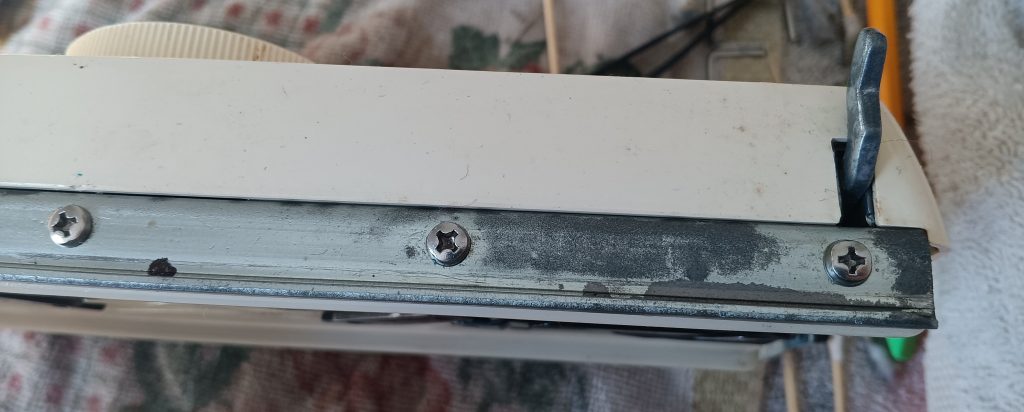
Although not ideal, this rubbery strip did a good job. Why not ideal: it seems that the needles rub against it and remove small chunks (see the picture below). Because of this, I feel the rubbery strip will need to be replaced a bit more often than on other knitting machines. But I will include the extra strip that I have left – enough for 2-3 more replacements. Additionally, the machine needs to be cleaned after each use. I gently vacuum it with the soft brush of my regular vacuum to remove these things after each use.

The machine handled thick yarns very well. The yarns I tried on this machine are:

  • Alara 50% acrylic/ 50% merino worsted yarn (50 g/ 100 m). I knitted a top of a hat.
  • Think, sport-weight like, 100% acrylic yarn. Those yarns often cause lots of static, which causes carriage jams.
  • Textured acrylic blend
  • Mohari-blend fuzzy yarn – made a two-layered neck warmer, transferrable to hood/cowl.

The machine handled all these yarns well (see the video of these tests). In some cases, I needed to apply extra wax and oil the machine well. The sturdy table will help a lot when operating on this machine with thick yarns on a full bed. I strongly recommend using every other needle on worted yarns.

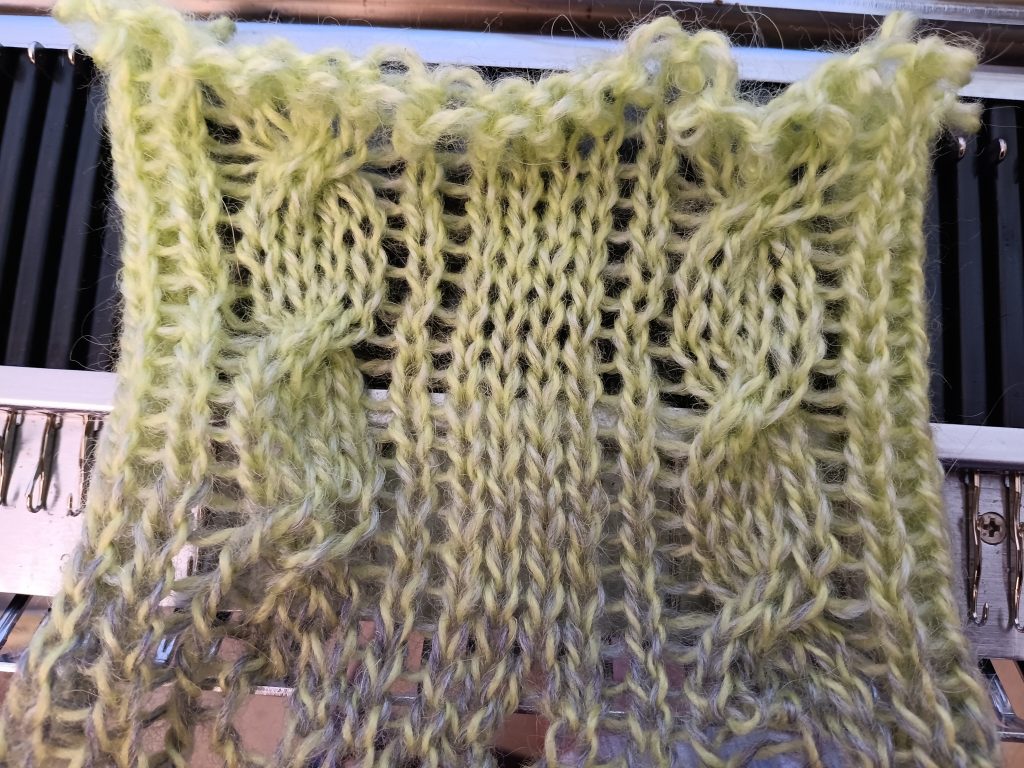
Below are the things I made while testing this machine:

If you are considering purchasing this wonderful machine, do not forget to read in my Knitting Machine Encyclopedia about pros and cons of the Silver Reedk Sk120 bulky knitting machine.

The only imperfection about this machine was a minor rust spot on the cast-on comb.

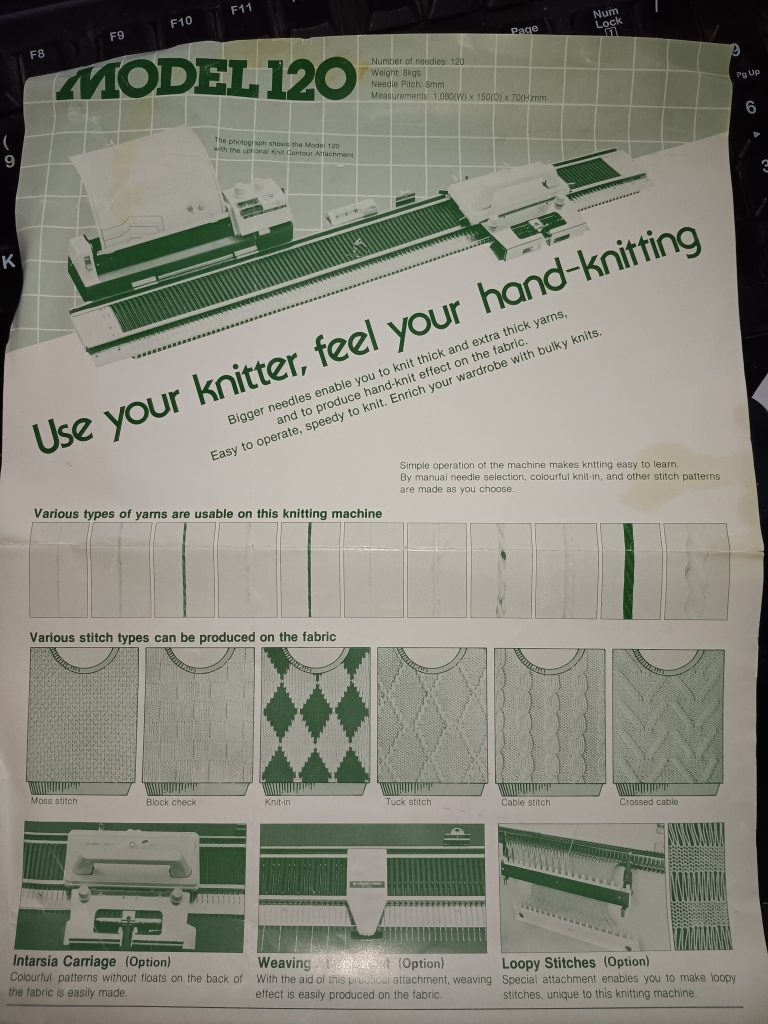
In conclusion, the most exciting feature of this machine is that it creates a fabric that looks and feels like hand-knitted. This personal observation is even supported by the marketing brochure from the 1970s I found in my stash.

Needle positions of various flat-bed knitting machines and ribbers

Brother Knitting machines

A – non-working position

B – standard working position

C, DI, DII – patterning positions

E – holding position

Machine Model number
Needle Positions
Basic (manual) knitting machines
KM100, KH355, KH360, KH370, KH380, KH390, KH395ABCD
KH210, KH220, KH311ABCDE
KX350, KX395ABDE
KX355unknown
4-Pushbutton machines
KH35, KH212, KH218no indicators
KH511ABCDE
KH521, KH531, (Profile) KH551ABCDIDIIE
8-Pushbutton machines
KH110, KH120, KH552, Profile 585, KH587, KH588, KH705,
(Genie) KH710, KH601
ABCDIDIIE
KH561, KH571, KH581, (Profile) KH583, (Profile) KH585ABCDE
KH811 (also 24-stitch punchcard)ABDE
12-stitch punchcard machines
KH800, KH801ABCDIDIIE
24-stitch punchcard machines
Bulky: KH260
Standard: KH810, KH811, KH820, KH821, KH830, KH831, KH836, KH840, KH850, KH851, KH860, KH864, KH871, KH881, KH890, KH891, KH893, KH894
ABDE
Electronic machines
KH900, KH910, KH920, KH930, KH940, KH950, KH965, KH970ABDE
Ribbers
KR551ABC
KR110, KR120, KR586, KR710, KR810, KR830, KR840, KR850, KR890, KR900, RK900ABDE
KR582unknown

KnitKing Knitting machines

A – non-working position

B – standard working position

C, DI, DII – patterning positions

E – holding position

Machine Model numberNeedle Positions
24-stitch punchcard machines
Bulky:
Standard: KH881, KK91
ABDE
Electronic
Compuknit IV,ABDE

Silver Reed Knitting machines

Machine Model number
Needle Positions
SK120,ABDE