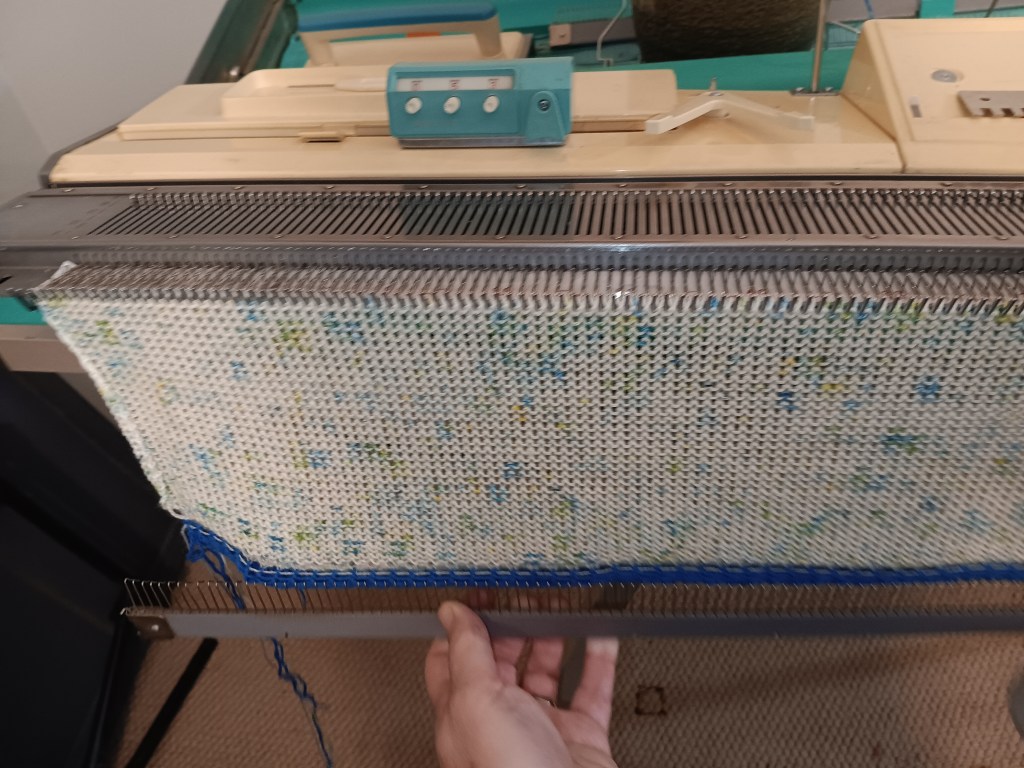
Two-color Fair Isle patterning on Brother KH800 and KH801 knitting machines.

These unique knitting machines, Brother KH800 and KH801, make it super easy to make punch cards and knit various patterns.

However, as I started to explore the steps on how to knit these various patterns, I discovered that the manual does not really present all the steps clearly, especially for the two-color fair isle knitting. So, a combination of researching manuals of similarly (with a ratchet) working push-button machines and my own trial & error, will be presented to you below as an attempt to ease up your learning of how to operate these wonderful machines. I also made a video of how I knitted a fair isle on my own Brother KH800 machine.

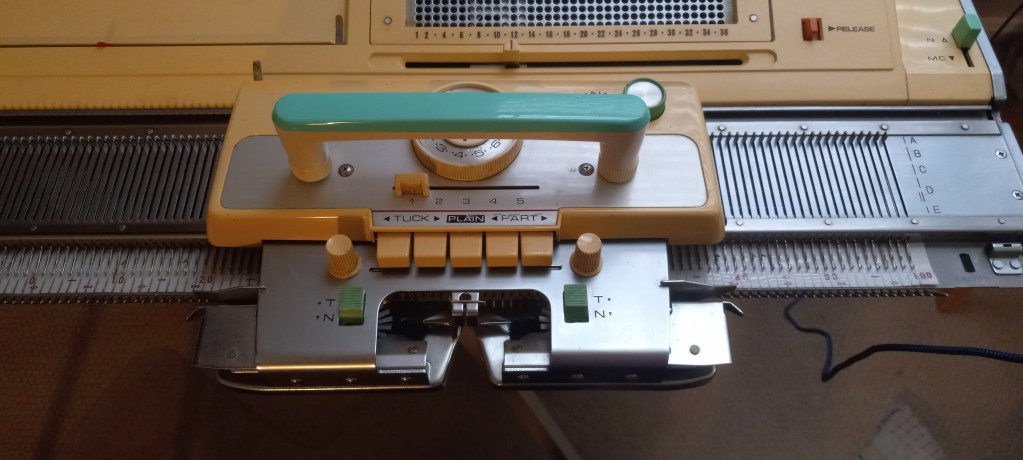
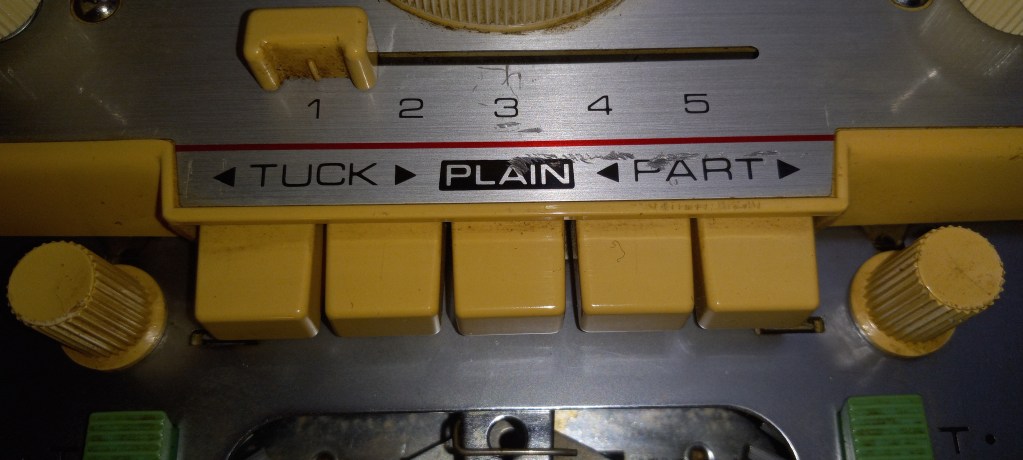
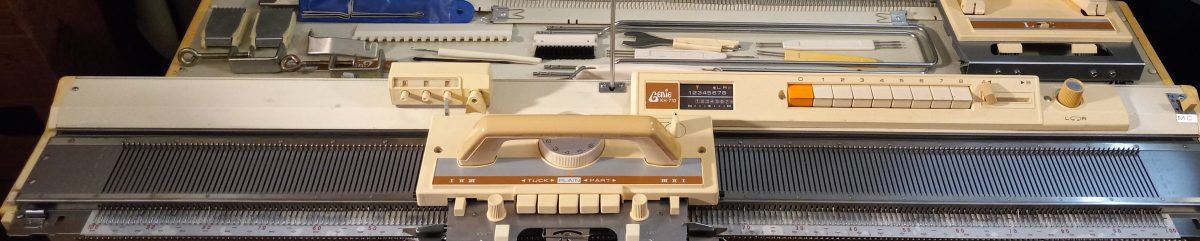
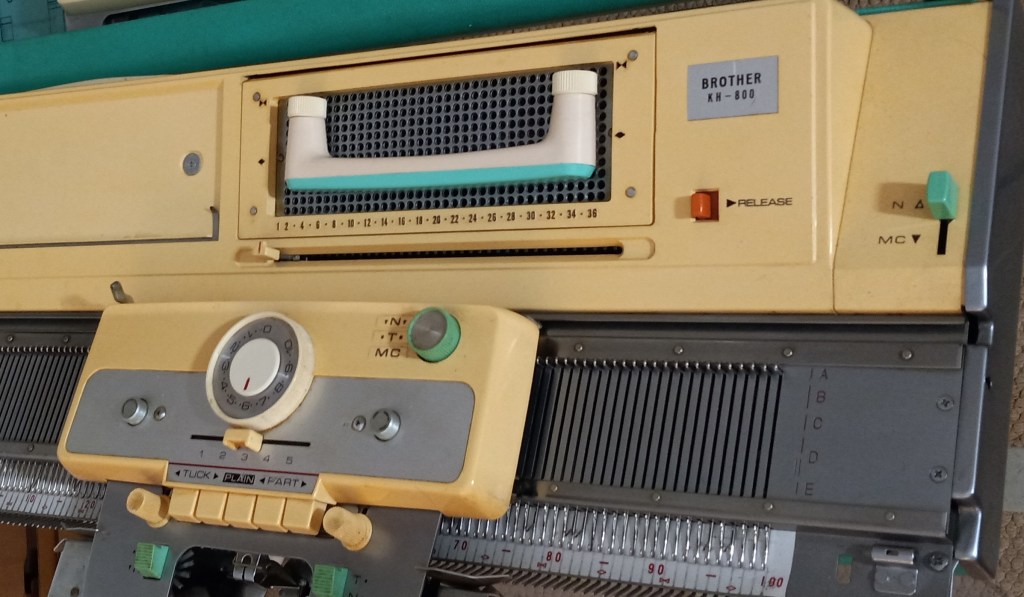
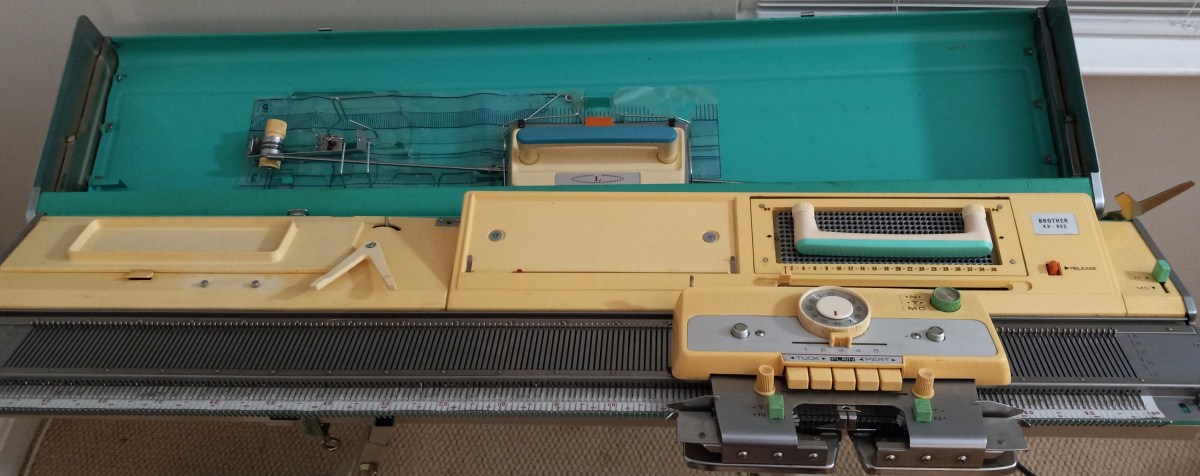
Before you even start, take a look at your main carriage. Find the N/T/MC knob in the top-right corner (we’ll need the MC settings). Please find the button on the carriage (we’ll need to push both PART buttons in). The slide lever on the carriage is on the settings “3”.

The change lever on the right-hand side of the needle bed in the top corner should be moved to MC.

These are the components we need to pay attention to to change to knit fair isle on Brother KH800 and KH801 knitting machines.

Preparation: knit several rows of stockinet in the main color. The second yarn is threaded into the left-hand side wire of the tension mast.

Step 1. The carriage is on the left side. On the carriage, set the change knob to MC and establish the desired tension (a two-color fair isle is recommended to knit at higher tension numbers). MC change lever is also at the MC setting. Holding cam lever (HCL) is at the setting “3”. Insert a desired punchcard and pull the step indicator up (“unlock” position) so it advances every time we knit one row.

Step 2. Move the carriage to the right. All needles will shift to DI position. Push both PART buttons on the carriage. Double-check your tension. Guide/insert the second yarn into the slot on the left side of the sinker plate.
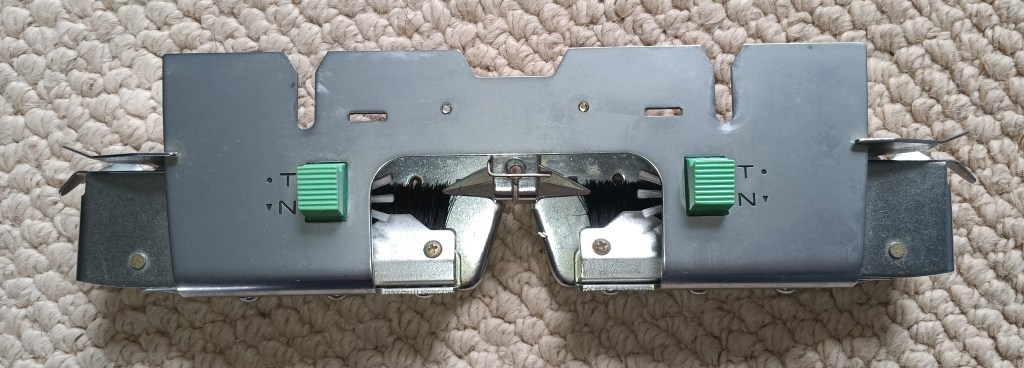
The manual for the KH800/KH801 knitting machines does a very poor job of showing how to insert/guide the second yarn into the slide slot of the sinker plate. I found an excellent demonstration in the manual for the KH710 knitting machine, which has very similar steps to the knitting fair isle. Also, watch my video on how I did it.
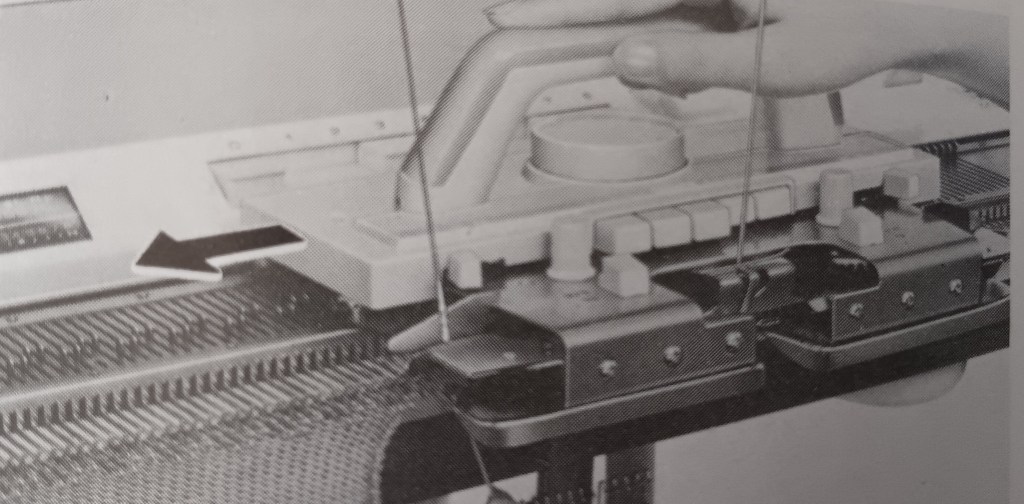
Step 3. Move the ratchet tool to move the needles according to the punch card. Notice they will split into the DI and DII positions. The needles that will knit with the second yarn remained in the DI position. The needles that will knit with the main yarn will move to the DII position. Move the carriage to the left while holding the second yarn gently (watch the video).
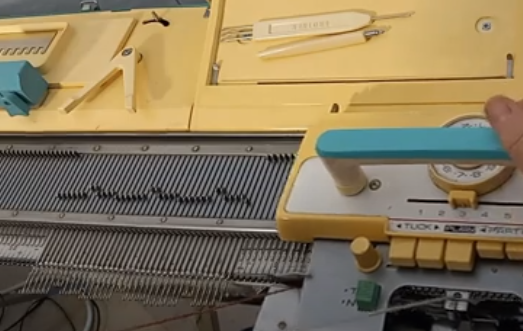
Step 4. Before moving the carriage back to the right, activate the needle selection for the second row: move the ratchet tool. As you move the carriage to the right, place the contrasting yarn onto the right-hand side guide of the sinker plate. Also, make sure that the row indicator moves after you pass the V-shaped trigger. If the row indicator does not move, pull it upwards.
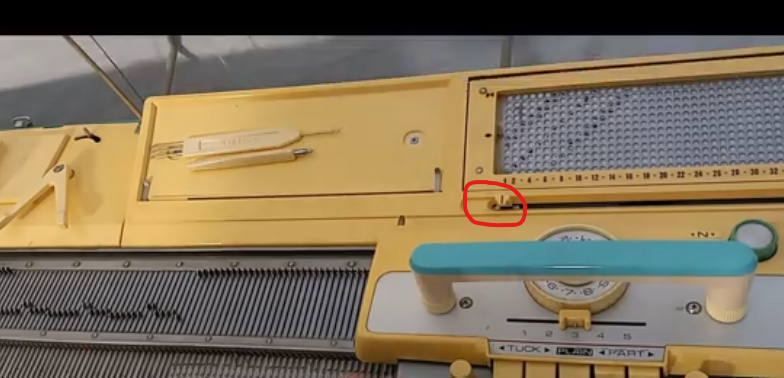
Continue these steps.

The same approach can be used on fair isle patterning on pushbutton machines, like Brother KH585, KH588, KH581, KH552, KH601, etc. The carriages for the pushbutton machines and for the 12-stitch punchcard models KH800 and KH801 are the same (except for the slide lever – the 8-pushbutton machines have side levers for the same purpose). Thus, after the needle selection, all consequent actions are very similar for all these machines.

Happy Knitting!
First steps of testing and learning a new-to-you knitting machine.

…this post is a collection of tests and tricks I use when I test knitting machines I refurbish. It is a continuous work in progress as I learn more about various knitting machines.

Preparation for the knitting:

  1. After you have fully serviced your machine (read the list of steps I follow in here – sponge bar section is especially important), place the carriage onto the need bed (while ALL needles are in non-working position A). and move it across the needle bed (without the sinker plate attached). Ensure that the carriage runs smoothly on the needle bed. Apply oil if necessary according to the instructions if you feel that your machine does NOT run smoothly. Also, check the contact points (between the carriage and the needle bed) for gunks/rust/debris since they can contribute not only to poor movement of the carriage but also to static accumulation and other problems down the road.
  2. Attach the sinker plate to the carriage according to the instructions. Run the carriage + sinker across the bed (the needles are still in non-working position A).
  3. Using a 1×1 needle selection comb (AKA ruler) move 20-30 needles to the B position (15 needles from the left of the “0” mark and 15 needles to the right). You will have every-other-needle in the B position. Run the carriage over the needles, first, without the sinker plate. You will see how the needles move while you run the carriage. If everything goes well, run the carriage with the sinker plate attached to the carriage.
  4. Move the remaining needles to B position. You will now have 30 needles next to each other, all in B position. Run the carriage and then carraige+sinker over these needles. Watch the needles move freely. If the needles move freely with only the carriage but not with the carriage+sinker, you might have a damaged sinker plate.
  5. If steps 1-4 did not give you any trouble, you are ready to knit your first swatch.

Knitting a first swatch:

  1. Review the manual which yarn is best with your machine. When choosing yarn for your first swatch, stay on the thinner side – we want to have our first knitting steps go smoothly and not go wrong because of the poor yarn choice. Once you learn to know your machine, you will know which yarns it can handle (and what to do so the machine can handle these yarns). For standard machines, I recommend sock-yarn-thickness and even thinner, for bulky and medium gauge machines – use sport-weight yarn.
  2. If your yarn came in a cone or a cake – you can skip this step. If your yarn is in a skein or a ball, you need to use a yarn winder to rewind your yarn into a cake or onto a cone. The reason is that during machine knitting you want as even yarn tension as possible.
  3. Bring 20-30 needles upfront and select every other needle (move them to the working position B). Run the carriage back and forth to even out the needles.
  4. Cast-on: I recommend using a cast-on method with a cast-on comb. Most Brother knitting machines have cast-on combs. Silver/Silver Reed/Studio cast-on combs do not typically come with cast-on combs. Cast-on combs can be purchased online. Or you can use an e-wrap cast-on method. Refer to the instruction manual of your machine for the recommended cast-on method.
  5. Once the first initial row is knit, knit several rows on every other needle. It will give you a good feel for the yarn thickness, tension and carriage behavior. Adjust tension as needed. The carriage needs to run smoothly.
  6. Bring the remaining needles to the working position. Increase the number on the tension dial. On all needles, the yarn tension needs to be looser than on every other needle. Knit several rows.

If all these tests are successful, you can now start experimenting with patterning as well as knitting on a full bed.

Brother KH800 knitting machine, serviced and tested in March 2024

Brother KH800 knitting machine

$625 machine + $110 shipping (with insurance)

$735.00

Click here to purchase.

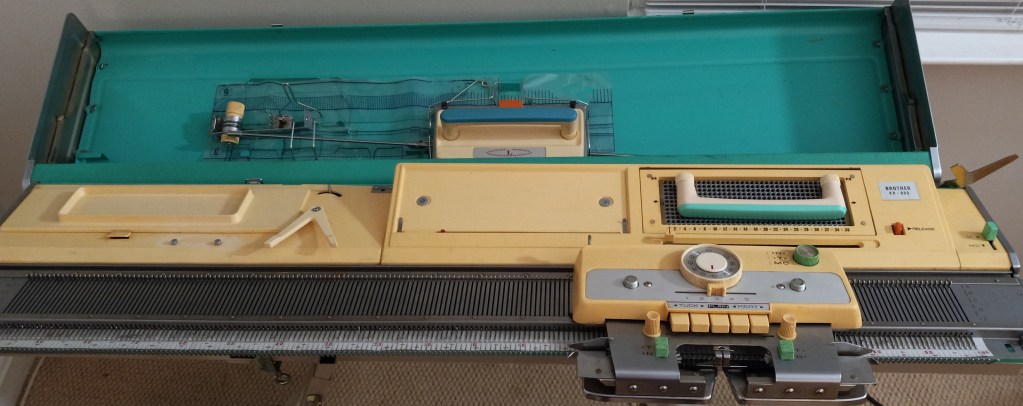
This blog is about a specific Brother KH800 knitting machine, which I cleaned, serviced, and tested in March 2024.

To learn about the Brother KH800 model, with all its pros and cons, read my Knitting Machine Encyclopedia.

All needles were removed, cleaned, serviced, and inspected. The sponge in the retaining bar was replaced. The case and the lid were wiped thoroughly but I did not subject the case and the lid to excessive rubbing to remove all staining. So some stains remain. The same applies to the plastic panel: I was able to remove most of the dirt and grime but some minor staining might still be visible.

I installed new weaving brushes (it is typically a pain in the butt to do it – so take good care of them). The old ones completely fell apart. They are not black as the original ones but white with strong bristles.

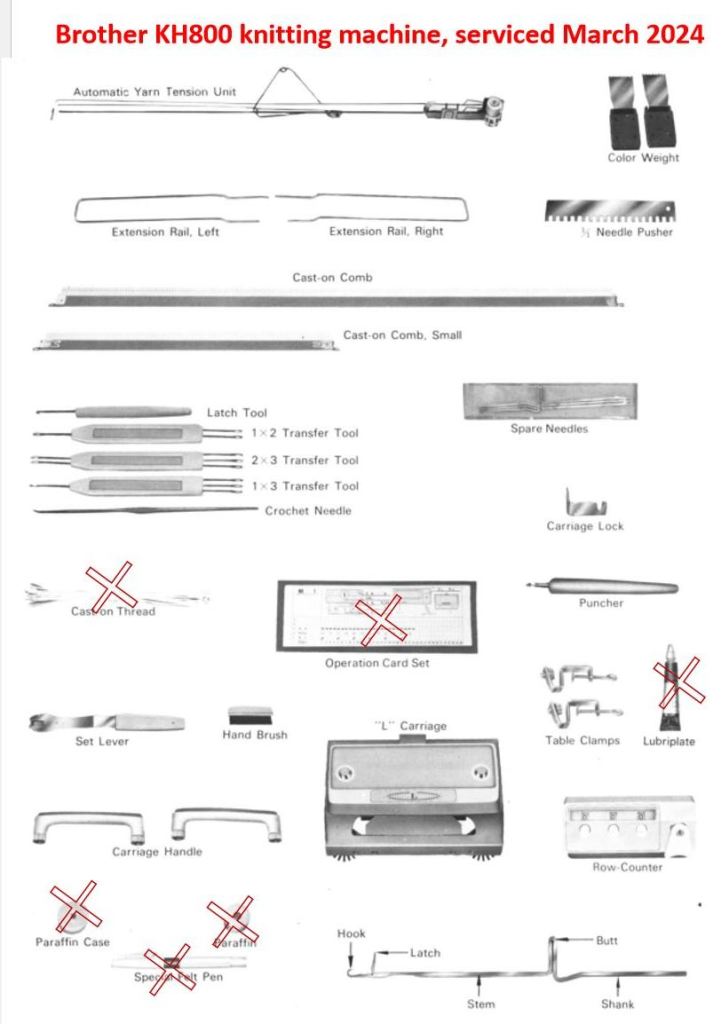
The machine will come with all major accessories (which fit inside the knitting machine case lid):

  • extension rails (to accommodate the lace carriage if you are using one or to accommodate the main carriage when you are knitting on the full bed)
  • tension mast
  • lace carriage
  • big and small cast on combs

Most critical minor accessories are included too:

  • metal 1×1 needle pusher
  • claw weights (greenish. like the machine)
  • latch and transfer tools as well as crochet needle
  • set of 3 spare needles
  • carriage lock
  • puncher
  • table clamps
  • set lever (also known as ratchet tool)
  • cleaning hand brush (good for cleaning carriage and removing some lint between the needles)
  • two carriage handles (one for the main carriage and one for the lace carriage)
  • row counter (I specifically looked for a greenish row counter to match the machine)

The minor accessories that are NOT included are marked below. These minor accessories do not affect the functioning of the machine. But read below about the punch and pattern cards.

The parafin is only needed for the yarns that are prone to static. The pen is actually for the knit leader and not for the machine. The greaze was old and I tossed it away. Any gun oil will work to service this machine. Any strong thin yarn can serve as a cast-on or waste-yarn thread.

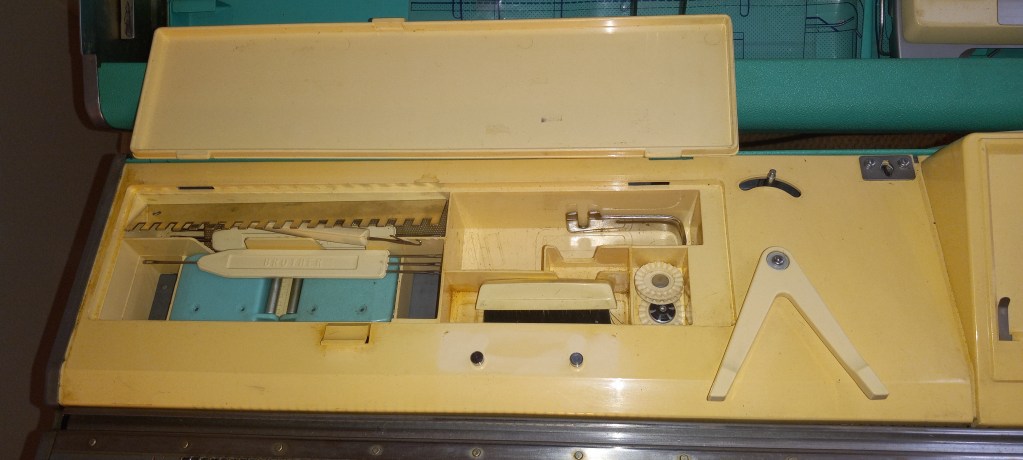
All minor advisories are stored inside the built-in box with the lid.

The handles for both carriage are screw on and are also stored in this storage box. The carriage moves very smoothly on the needlebed.

The machine did not come with the original hard copy of the manual. It can still be found online for free. I can include a printed copy that came with this machine – just let me know but it might add to the weight (1-2 lbs) of the shipping package.

Even though the original pattern and punchcards are missing, it is very easy to make your own cards. I made a video on how to do it and described it in another blog. Follow the links for free pdf-files for the blank and pre-patterned cards. In my video, I printed out and used those cards.

Also, the cards are very easily to make (punch). Simply insert the cut-out of a new card into the punchcard reader and punch the wholes either using the punch provided or using a simple pencil. I describe it in my other blog and show it in my video as well.

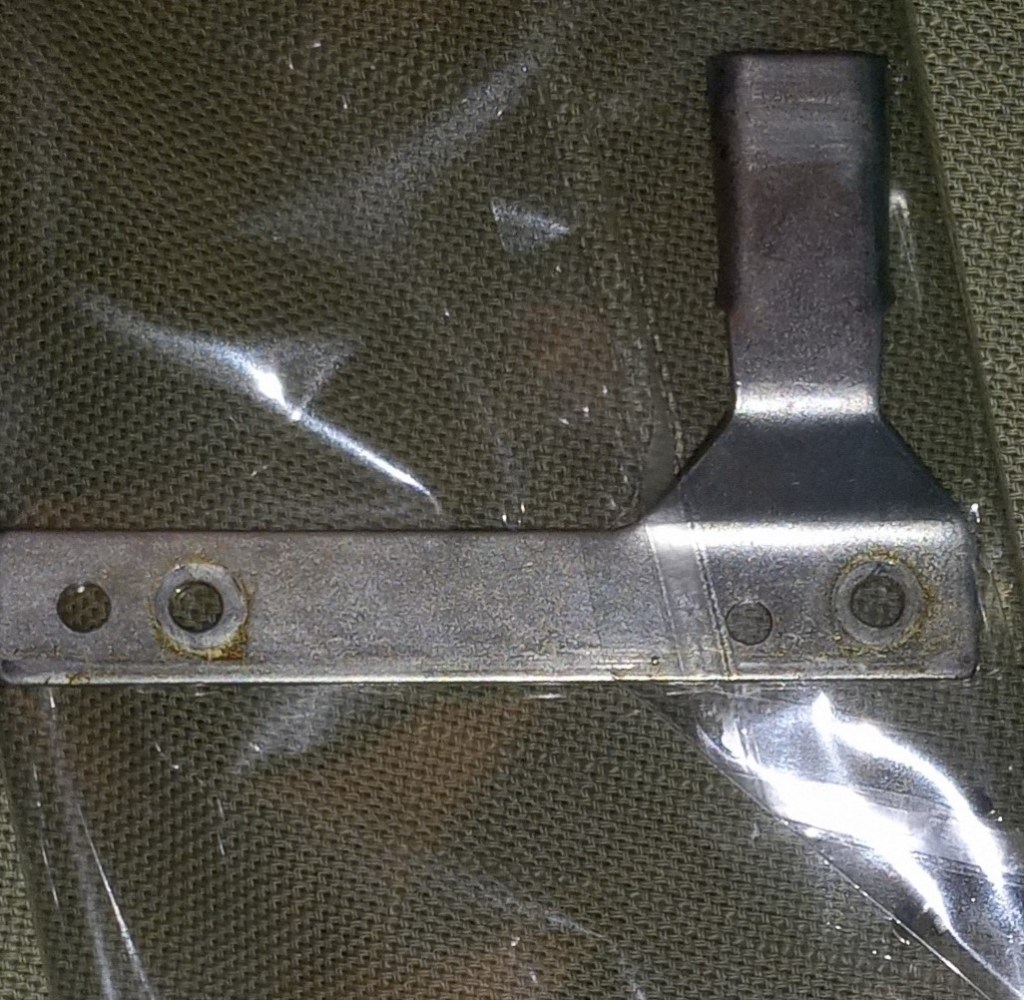
The machine can be easily attached to a knit leader using the triangular tripper and the rod above it. Read on the manual of a specific knit leader on how to attach the machine to it.

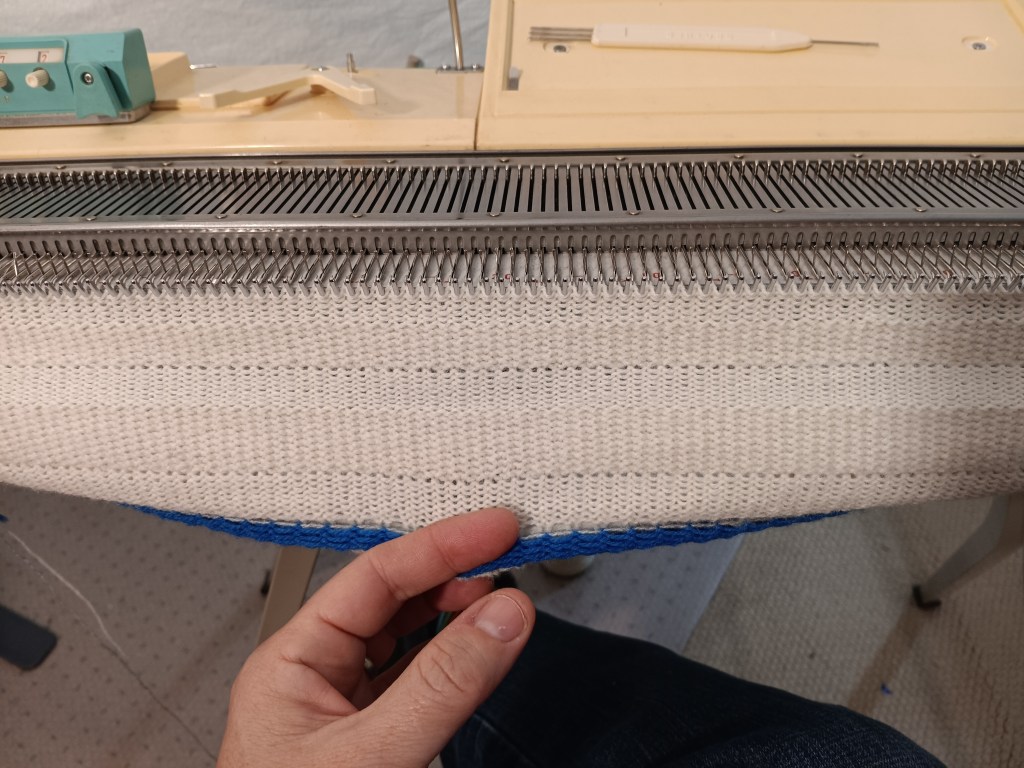
I knitted several swatches (tuck, slip, stockinet and fair isle) on this machine to ensure the carriage functions properly. I also knitted on the full bed to ensure all needles form proper stitches and that the patterning mechanism works well on the whole needlebed. Watch the video of all tests. The picture below shows the tuck-stitch fabric knitted during these tests.

Check out my blog and a video (…coming soon) on the fair isle patterning on this machine. It was quite interesting.

The panel I knitted during all these tests was converted to this 3-in-1 berett/cowl/hood shown below.

Turned out pretty good!!

Now about imperfections:

The most obvious imperfection is the scratches on the main carriage. They seem to be just cosmetic and did not affect the functioning of the machine.

All other impefections are also cosmetic. Like some minor dents and scratches on the lid and the case (not shown).

Vintage KnitLeader KL111 prepared for Sheryl, April 2024

KnitLeader KL111 + customer’s ship label

$44 + customer provides shipping label

$44.00

Click here to purchase.

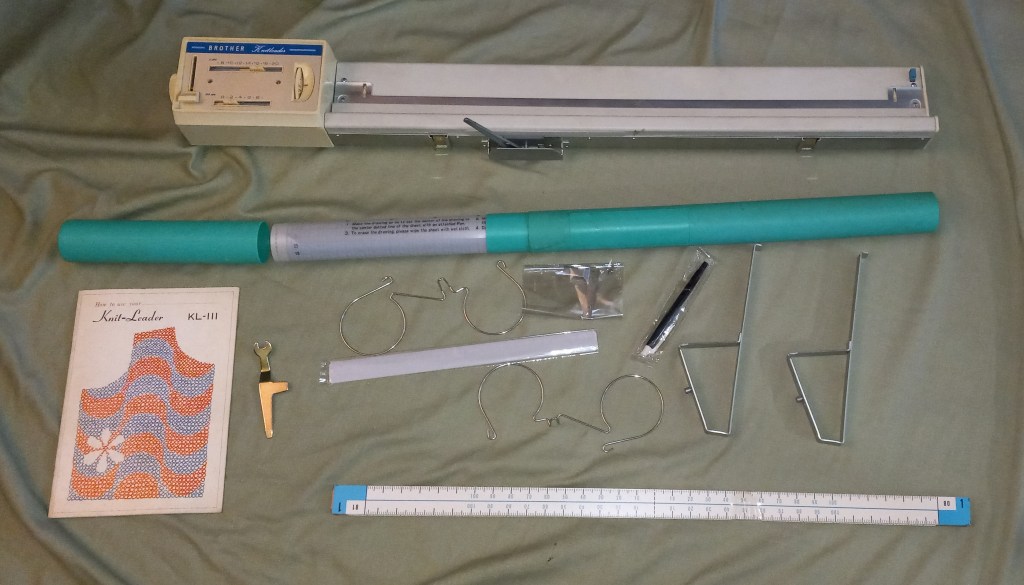
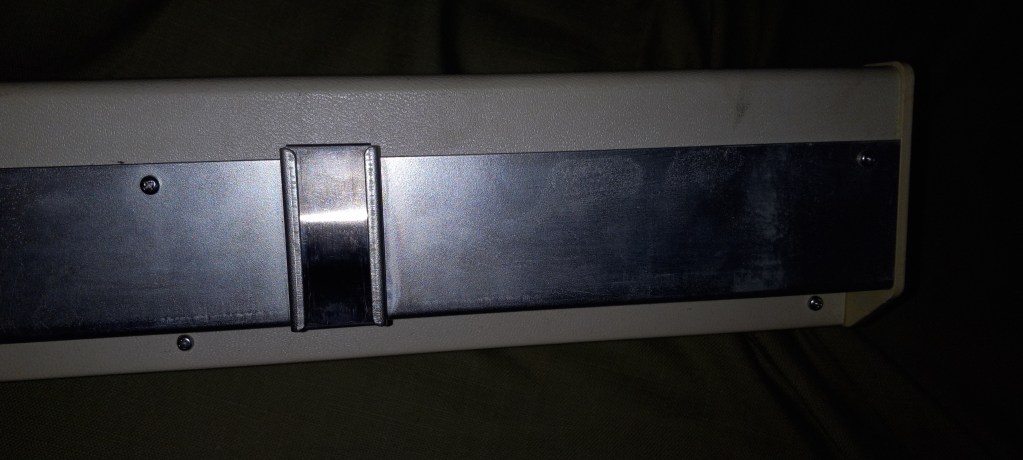
KL111 knitleader has all major accessories, including a good-looking hard copy of the manual, mylar sheets, scales, ruler and very important triangular brackets. The post below is about a particular knit leader but to know more details about the KL111 model, refer to my other post.

I did not test the knit leader on the machine but all the buttons, knobs and levers move freely. I inspected it thoroughly and wiped easy-to-remove dust and grime. Some stains remained – I do not like rubbing the plastic parts too extensively out of fear of damaging this old plastic even more.

The ratchet with the white handle is missing. So I will include the ribber spanner that fits well although is not as ergonomic as the original one. The handle can be improved a bit by applying several layers of tape.

The long scales seem like were never used. The mylar sheet also looks in great shape.

The knit leader tripped will be included if your carriage did not come with one.

The control center is in great shape also:

Below are some imperfections I noticed when preparing the knit leader. Most are the different degrees of staining on the boxy of the knit leader.