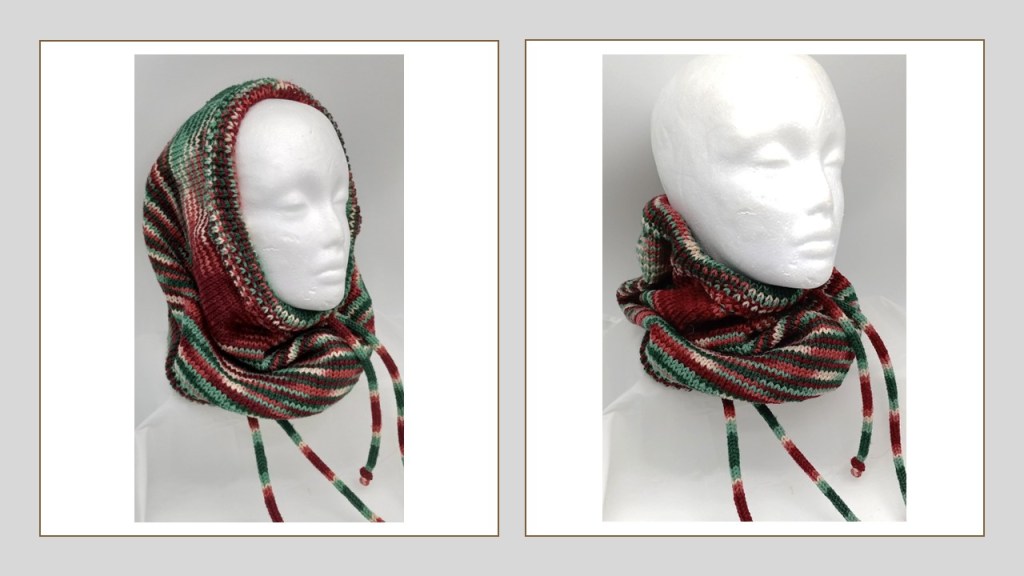
I knitted several variations of these cowls/neck-warmers. In fact, this is my favorite project to do while I am testing knitting machines. The reasons are:
- This project is done on a full bed, thus, I am checking whether all needles function and knit properly.
- This project can be done on any-gauge flat-bed knitting machine (mid, standard or bulky gauge) with or without patterning capabilities. Just choose the correct yarn for your gauge.
- No need to count your rows and stitches to calculate gauge, and no worries about changing tensions
- While knitting this hat, you will learn about the appropriate tension for the yarn I chose and how your machine will handle different yarns. I start with knitting on every other needle which is easier on the carriage if the yarn is too thick (thus, if you are experiencing problems with knitting on every-other-needle, that means the yarn is definitely too thick).
- It is a very easy project and fun. You will not only know you knitting machine better but in the process, you will make something wearable either for yourself, your friends, and relatives or for charity.
While working on this project you will learn how to 1) cast on with waste yarn, 2) create mock-ribbing, 3) fold the knitted fabric over, 4) cast off, 5) knit a cord and 6) make a buttonhole. You will need to know the basic stitches of sewing knitted fabric, like back-stitch, and mattress stitch, and, what yarn is good for you machine.
Below are the instructions on how I knitted the cowl/neck warmer/hood/hat below.

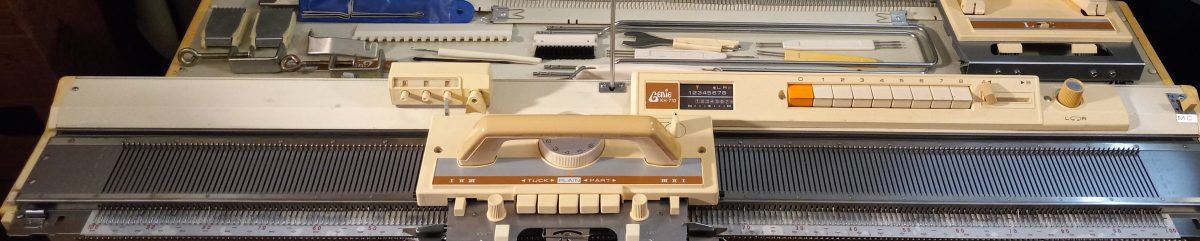
If some steps are unclear, refer to the video tutorial I created. These steps were performed on the Brother machine. Thus, some steps are specific to Brother machines only (like cast-on combs and the part button) but if you already know how to start knitting without the cast-on comb and how to make your machine knit in partial mode in one way, you can easily adjust those instructions below.
Additionally, the project I describe below was made on the standard-gauge knitting machine.
Step 1: Cast-on and knitting mock-ribbing.
- With your 1×1 needle selection ruler, bring every-other-needle to the working position (typically B-position).
- Run the carriage from right to left and back to even out all needles.
- Rezero the row counter.
- Thread the waste yarn into the carriage and knit one row.
- Hang the cast-on comb
- Knit several rows until you are sure all stitches are established well.
- Knit one row of contrasting strong yarn or with an unravel cord.
- Rezero the row counter again.
- Thread the main yarn into the carriage. Hang an optional barrel weight onto the middle of the cast-on comb.
- Knit 10 rows.
- Make a buttonhole. We will use it to insert the cord into the folded mock-ribbing. For this purpose, remove the stitch closest to the zero-position and put it onto the next needle in working positions. Move the just-emptied needle back to the B-position (standard working position).
- Knit 10 more rows.
- Fold the mock-ribbing. First, remove the cast-on comb. Then, using a one-eyelet tool, transfer the stitches that are right above the contrasting yarn (remember – the one row we knitted in sub-step 7 above?) onto the needles in non-working positions. Watch this step in the video at approximately 3 min 25 s position. After the stitches were transferred, make sure the needle is in the B-position. Continue for the rest of the fabric.

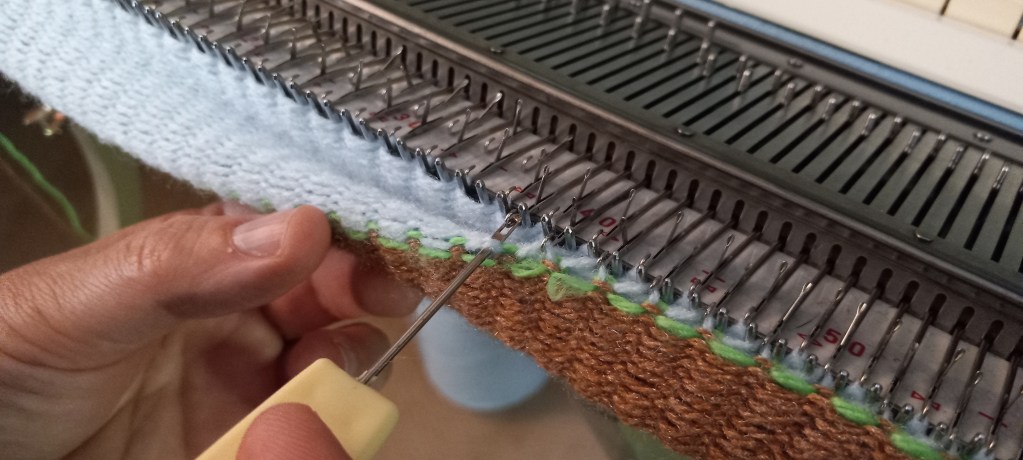
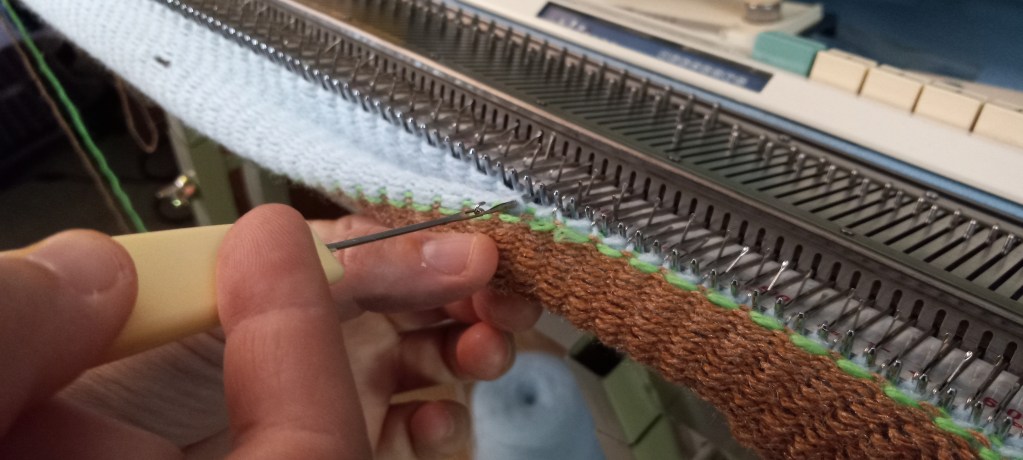
Step 2: Knitting the main section
- Optional: After the mock ribbing was folded, attach the cast-on comb to the section knitted with waste yarn. Increase the tension dial number by 1-3 numbers and knit one row. Because we just went from knitting on every-other-needle to knitting on all needles, it might be too tight to knit this very first row on the full bed. This is what we are loosening the yarn tension.
- Knit 80 rows. (In my demo, I knitted simple stockinet stitch. But you can knit any pattern you desire.) It is about 7-8 inches of the knitted fabric. If you want to make a longer cowl/neck-warmer, or a deeper bonnett, knit more rows. Also, if knitting on a bulky or mid-gauge machine, you might need fewer rows. 7-8 inches of the knitted fabric is a good approximation to get a good size cowl/neck warmer/hat/hood.
Step 3: Second mock-ribbing
- Using a one-eyelet tool, transfer the stitches from the every-other-needle to the neighboring needle. Move the needle without the stitch to A position (non-working position, pushed all the way in). Watch the video at 6 min 54 s if this step is unclear. I am also showing in the video that you can use an adjustable stitch transfer tool to move 2-4 stitches at a time. The adjustable tool can be purchased in my independent store or in my Etsy store.
- Continue for the rest of the needles. Optional but helpful: hang a claw-weight on the edge of the knitted fabric next to the stitches you are transferring. The transfer will go a bit smoother without snagged yarn.
- Increase the yarn tension by 2, i.e., decrease the tension dial by the number 2.
- Knit 10 rows on every other needle.
- Make a buttonhole as described above in step 1.11. After that knit 10 more rows. Or continue knitting for 10 more rows without making the buttonhole. Maybe you do not want the cord in the second ribbing. I also show in the video that the cord can be inserted into the mock-ribbing fabric without the buttonhole. So, at the end of this step you should have 20 rows of mock ribbing.
- Folding the second mock-ribbing: using a one-eyelet tool, transfer stitches from the 1st row of this mock ribbing to the needle in the working position. (See the video for details). In words: find the stitch right above the hole (created when we transferred every other needle) onto the working needle right above it. Continue for the rest of the panel. Even out the needles to be as close to the B-position as possible.
- Optional: Hang the cast-on comb with the weight onto the just-folded fabric. Loosen the yarn tension (increase the tension on the carriage dial by 1-2 numbers).
- Knit one row.
Step 4: Cast-off
- Remove the yarn from the carriage. Let it hang free on the side.
- Remove the cast-on comb.
- Using the one-eyelet tool, remove the stitch on the very edge of the needle bed and transfer it to the next needle. Manually knit a stitch on this needle (see the video for visual reference). The manipulations in this step are similar to the cast-off in hand-knitting. Continue for the rest of the needle bed.
- Close the last stitch and take the panel off the bed. Secure the last stitch with a knot.
- Hint: when making a stitch, push the last needle (with a needle with two stitches) to the A-position. In this case, it creates a long stitch and a loose cast-off seam.
- Optional: hang the claw weight on the fabric below the last needle in the working position. It will create tension on the fabric for easier removal of the stitches from the needles. Rehang as you cast-off the stitches.
Step 5: Sewing the panels together.
- Remove the contrasting yarn by pulling it out of the knitted panel.
- Remove the waste-yarn-knitted section. It will come off very easily after the contrasting thread is removed.
- Fold the fabric with the right sides touching each other (stockinet sides, in my case).
- Start sewing the fabric at the folded section. Match the internal sides of the folded section first. I like using backstitch for such seams (but it actually does not matter how it looks because this will be hidden inside the fold), moving to the outside edges. I like using a mattress-like stitching technique on the outer edges of the folded section of my knitted panel. After the fold, keep on sewing, again with the stitch of your choice. I like back-stitch – it creates very knit edges and seams on both sides.
- After reaching the second folded section, again, sew first the internal panels of the fold using a back-stitch and then the external sides using a mattress stitch. Hide the ends of the yarn used to sew the panels.
Step 5: Cord making
- Make two cords, roughly 30 inches long. Use your favorite method or make it on your flat-bad knitting machine (follow the steps outlined in my other article).
- Secure the ends of the cord: make a knot and then sew through the knot with the remaining yarn (watch my video on cord-making).
Step 6. Inserting the cords.
- Insert a safety pin into the knot of the end of the cord.
- Insert the safety pin head into the “button hole” we created.
- Thread the safety pin with the cord through the fold and pull out from the fold through the “button hole”.
- Do the same with the second cord on the second fold. Hint: if you forget to make a button hole, the 1×1 mock stitch ribbing is loose enough where you can insert the head of the safety pin through the stitches.
Happy Knitting!
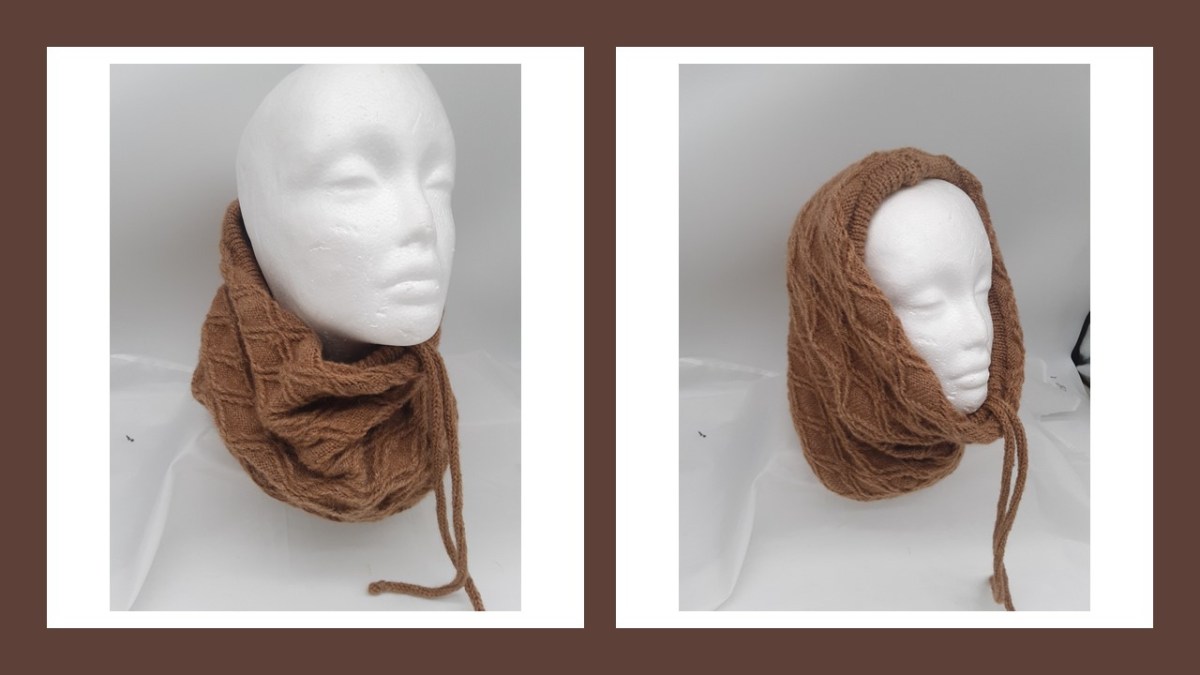
The same approach can be used for patterned panels, like those shown below.

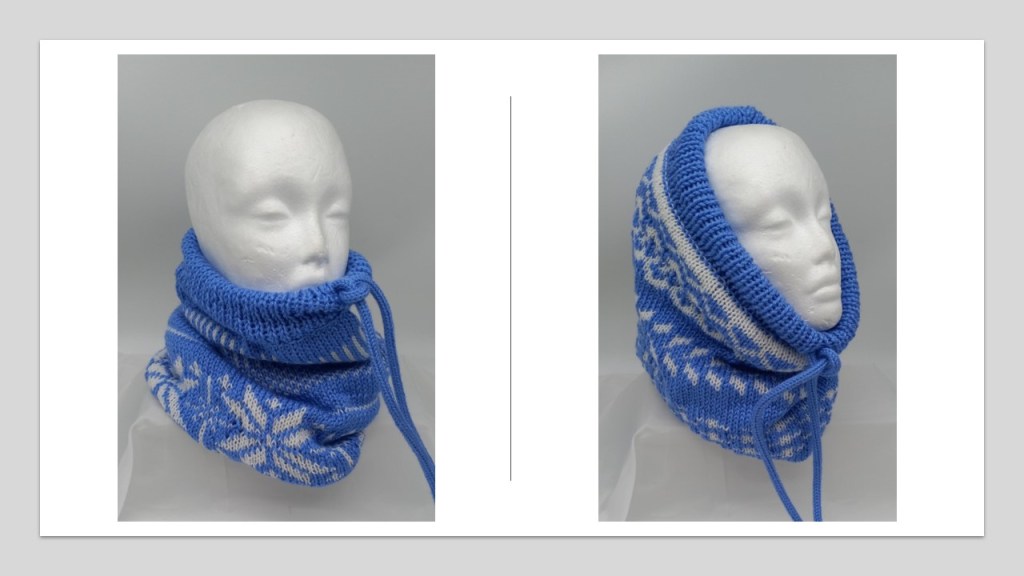
It can also be done on bulky and mid-gauge machines. Choose a variegated yarn for best effect: