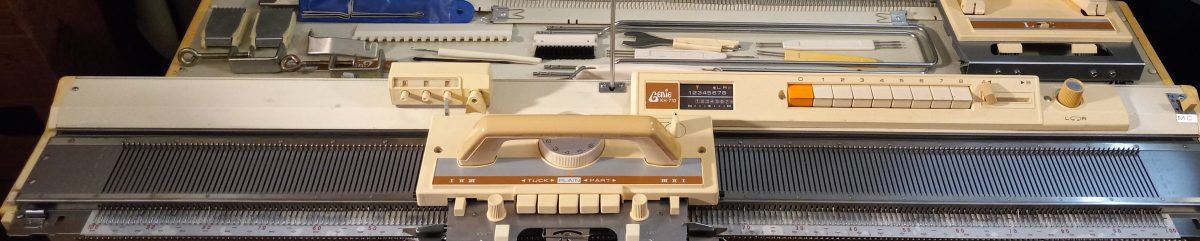
Brother Profile 585 for Georgia

Brother Profile 585 is a 8 push button machine with a pattern center. Read more about this model in my previous post.

Here is a brief overview of the setup prepared for Georgia with its pros and cons.

The machine was cleaned, the pattern center was checked for all functions. All needles were inspected, cleaned and tested (when knitting on a full bed). The carriage functions were tested manually (I moved all knobs and levers) and in work while knitting hold, tuck-, slip- and stockinette stitches. Lace carriage and lace knitting were not tested. However, the lace carriage for KH585 is very simple and I do not anticipate any problems with it.

The machine comes with all major assesories. All of them are in excellent shape (especially the cast on combs). A typical setup for Brother Profile 585 usually has only one cast one comb but this machine came with two – a long and a short one. They are metal and heavy on their own – excellent for cast on without any additional weights.

The handle (that screw onto the main and lace carriages) are from another setup. So, the color mismatches a bit the main blue color of the machine and other assesories. Because I had to borrow a handle from another setup, the lace carriage will not have a separate handle. (read more on that below)

The minor assesories that are NOT included are:

  • Parafin wax
  • Assesories kit (it is simple a plastic cover for transfer tools and spare needles)
  • Oil bottle (it was yellow and old and I discarded it). A gun oil from Amazon is recommended to use
  • Cast-on thread: I typically use any silky thin yarn/thread.
  • Only a handle for the main carriage is included. The handles are interchangible with the main carriage and the lace carriage. I could only find one handle to supply with this machine. If I come across another one, I will ship it for free. However, lace carriages are used quite seldom by beginners… So, I hope by the time you decide to try lace carriage, I will find an additional handle. Regardless, the lace carriage can be moved by hand without a handle: there are less moving parts and it simply slides on the main bed while transferring the stitches. Also, lace carriage is used for 1-2 rows in a pattern and then the main carriage is used.
  • Plastic case for spare needles
  • The hard copy of the manual is also not includd but can be found online. I strongly recommend folloiwng the manual while setting up and testing and learinig how to use this machine. It is written very well. The manual has some simple patterns. For more complex and diverse patterns check out this brochure.

This machine worked great as you can see in my video. I had no major problems with it. Some minor potential problems are:

  • An auxiliary rail on the left-hand side is missing. These are needed to secure extension rails when knitting with lace carriage. So, you will simply need to keep your lace carriage on the right hand side. I am currently looking for sources where – to get the missing one. When I find it, I will ship it for free. It will only inconvenience the operator while knitting lace.


Some buttons need a bit firmer pressing than others (in the video it is sometimes button #5). But with firm pressing the button remain in their pushed-in position.

Some snags occurring during the video demo were because of some knots in the yarn – it was an old cone I inherited with one of the machine knitting machine lots.

The tension dial on the main carriage has a piece broken off. The dial still rotates well without any problems. The damage is simply cosmetic.

The lace carriage is missing the name tag: you can see the glue is still on it but there is no name.

The case has minor scratches, discoloration, and dents. None affect how the lid closes and/or stores the machine.

Overall, this machine is in great shape and should knit without problems.

Brother KR580 ribbing attachment, cleaned and tested in May 2023

Brother KR580 ribber was first introduced to the market in 1966 to knit with 8-push button machines (KH552 and above all the way to KH560-KH588). According to some charts by creationgroup.com, KR580 ribber can even fit KH800 knitting machine. Genie 710 machine (sometimes called Brother KH710) is also an 8-push button machine but I could not information anywhere whether KR580 ribber will fit it. KH710 had some innovative design features (like all-plastic end-caps) that none of the earlier 8-push button machines have (KH562, KH581, Profile 585, KH588) but the width of the bed is the same and the needles are all interchangible among all 8-push button machines.

Because it is an older model, capable to create purl stitches when coupled with older models, the main carriage knits first and then the ribbing carriage moves the needles to working position.

The ribber needles simply latch on the yarn hanging between the needles on the main bed creating purl stitches. See a full demo in my video.

I feel that this gives a knitter a better idea which carriages causes troubles (if any) and see that needles are knitting and what not. Later ribber setups (equipped with a connecting arm, that attaches main carriage and a ribber carriages) work the same way but they ensure that only one movement is needed because the main and ribber carriage move at the same time.

About this particular ribber:

It was tested on Brother Profile 585 machine.

It has a pretty white color This is the first ribber for 8-oush button machines I’ve seen in real life and worked on. So, maybe all of them come in this pretty white color but I like it. It has such a classic 60ies look, like those corvettes you see on the road that cost nothing for the car insurance companies but are so pretty and so valuable on the used market.

The retaining bar is plastic – big PLUS: no need to replace it and worry about decomposing sponge in retaining bar corroding needles.

The machine comes with ALL assesories. Hard copy of the manual will not be included but it can be found online for free.

Tested a swatch on 1×1 ribbing

and 1×1 ribbing on the full bed but when every-other-needle was selected.

Hard copy of the manual will not be included but it can be found online for free.

Photos below show how the ribber fits onto the machine. The manual describes step-by-step instructions how to attach the ribber to the main bed.


The large screw goes into a place where a rail guard normally attaches.

Singer 360 with 700 carriage for Isabella

Singer 360 knitting machine is a standard gauge knitting machine (distance between needles is 4.5 mm). The machine has a built-in knit leader. It patterns automatically using a punch-card mechanism.

Specifically about this machine cleaned for Isabella:

The carriage that came originally with this machine was acting up. I opened it up to fix and noticed that somebody already tried to fix it and assembled it incorrectly. I did not want to delay the delivery of the machine so this 360k will be equipped with a more advanced carriage from a 700mod model and a matching sinker.

The main bed, all needles, all knobs and levers on the punch-card reader and knit leader are in excellent shape. All needles were inspected and the machine has a new sponge. The machine was tested on full bed to knit stockinet, slip-stitch, tuck-stitch and 2-color fair isle patterning (see my video with these tests). All needles behaved flawlessly and the carriage was moving freely without any problems at all. I was very pleased! Below are the panels I knitted. As always, these will be converted to cowls/neck warmers for charity.

In general, all knobs and buttons on 360 and 700 carriages are the same. One major exception is the levers for the tuck-knitting. 700 carriage does not have those levers. It was actually very easy to knit a tuck-stitch pattern with this carriage. I had zero problems from the beginning. The tuck-brushes on the 700 carriage do not have to be moved and they do not get tangled in thread when knitting. All these are huge advantages.

I did not test the knit leader but all knobs and levers move freely.

The machine will come with all major assesories.

A couple of minor assesories missing are:

  • Only two yarn separators are included. These are needed to knit single-motif. So, with just two yarn separators you can still knit a single motif but only one per panel.
  • A tapestry needle is not included: any metal or plastic needle will do
  • Only two point-cams are included. These too are needed to knit single-motif. With just two point-cams you can still knit a single motif but only one per panel.
  • Only one unravel cord is included. I typically use any contrasting yarn: not very thick and preferably very silky.

I also included an extra tool – very useful for beginners: a claw-weight/cast-on comb. In this case, you can knit one row on every other needle, hang a cast-on comb, knit a couple more rows until all stitches are knit, and then knit on all needles (described better in this manual on p. 9)

Because this machine had two major parts from two different machines below is the list of resources and manuals that Isabella will need to knit usefully on this setup. These brochures are available for free and discuss how to use the machines and how to knit garments:

  • Operation manual for 360mod knitting machine. This is a resource to go to when you need to know how to setup your machine, how to assemble it, troubleshoot, etc.
  • Knitting manual describes how to swatch, calculate gauge, how to use pattern paper and a knit leader to knit garments and how to make cloth in general.
  • Pattern book shows how the patterns on punch cards will look when knitted using different techniques. Although some of the cards might be slightly different.
  • Operation manual for 700 machine. Here is learn how to setup the knobs and levers on your 700 carriage.
  • Read pros and cons of Singer 360 in my previous posts:

https://thoughtsandknits.com/2022/09/04/360-for-laura-cleaned-in-august-2022/

https://thoughtsandknits.com/2022/08/07/studio-360-k-memomatci-reported-in-august-2022/

https://thoughtsandknits.com/2021/10/13/my-first-singer-360-memomatic-360k/

Now about imperfections:

The imperfections are mostly on the top lid of the whole case. It has several minor bumps.

There is one bend in the middle but the machine still closes. I decided against beating it up with the hammer to straighten it because It creates additional microcracks and makes the metal more prone to corrosion. The lid still closes with just a small push.


The case panel that attaches to the main bed (the bottom panel) has one bend as well (not shown in here).

The end-cap of the lid has a crack. It is pretty minor so I did not replace it to keep the cost low.

I am 100% confident that you will like this machine like I did!!! Happy knitting!