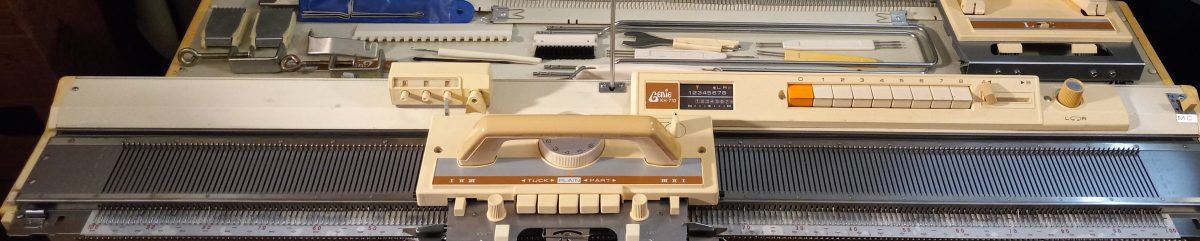
List of pros and cons of knitting machines I used

…in progress. Updated: June 2025

abbreviations:

b-in = built-in

mb = metal bed

sg = standard gauge

st = stitch

mb, sg, 200 needles, 24-st punchcard

https://youtu.be/L1GwyLg46V0 Can do tuck slip, 2-color fair isle; if carriage is stuck, unscrew the sinker plate, no built-in toolbox; has built-in knit leader; standard set of punchcards has only 10 cards, no hard case lid (all parts are inside a sterofoam packaging; budget, lightweight model. https://wordpress.com/post/thoughtsandknits.wordpress.com/427

m, sg, 200 needles, 24-st punchcard

https://youtu.be/27blcVPYAlw Can do tuck slip, 2-color fair isle; if carriage is stuck, unscrew the sinker plate, no built-in toolbox; no built-knit leader; compatible with standard add-ons (ribbers, knit-leaders, color changers, row counter) http://thoughtsandknits.com/2025/05/26/studio-mod-324-knitting-machine-prepared-for-lara/

md, sg 200 needles, 24-stpunchcard; b-in knit leader, tool tray

https://youtu.be/0PnXE_Bc8yc Can do tuck slip, 2-color fair isle; if carriage is stuck, unscrew the sinker plate, no built-in (but has stand-alone) toolbox; compatible with standard add-ons (ribbers, color changers, row counters) http://thoughtsandknits.com/2022/06/11/studio-326/

XXX

XXX

XXX

XXX

XXX

XXX

XXX

XXX

XXX

Brother KH551 – my second one

I took on a project of cleaning and conditioning this machine with enthusiasm because I already restored one Brother KH551 earlier this year. This machine was easy to clean – it needed some dusting, wiping, needle inspection, some needle replacement.


It came with ALL accessories (even including a silky thread) with the exception of hard copy of the manual (which can be found in here absolutely free: http://machineknittingetc.com/brother-kh551-user-guide.html).

Despite being familiar with Brother KH551 already, I was puzzled by some of the quirky perks of this machine.

For example, the sinker plate’s thread guide was somewhat different from the previous KH551 I restored: it had a bracket. I checked with FB experts on push button machines and they assured me that some KH551 indeed have such brace for better control over color change. When I was threading the yarn through this bracket, it did not cause me any discomfort and it only took two tries to get used to it.


Overall, the machine was in great shape even before I started restoring it. The row counter was not even stractch despite this machine being made in 1960s.

Even the undercarraige and the pegs were without any rust.


I extensively tested the patterning mechanism. I was not a big fan of constant ratcheting but I was pleased with the result. At least it was straightforward and easy to understand. Maybe sometimes challenging to keep track of the order of operation especially for a long pattern. Below you see several patterns I knitted by following the instrucions in the manual.


Then I wanted to make sure that the whole set of 200 needles functions smoothly. So, I started a blanket on a full bed and had good success!!

In my video I created specifically for this machine (https://youtu.be/epZrcb1MEZA) I show that it managed some challenging yarn pretty good as well!!


Below are the general pros and cons of Brother KH551:


Pros:

+ Carriage is very light and slides very easily

+ The bed is narrower than other machines – which makes it more compact

+ …and makes the machine lighter than other similar models

+ relatively easy deep cleaning – all parts are solid and straightforward to insert/assemble/disassemble

+ The needle count is engraved on the bed – so these slippery and constantly in the way paper liners showing the needle count won’t annoy you by constantly sliding and getting lost.

+ Threading the yarn is a bit more intuitive and straightforward in my opinion

+ built-in capabilities for 3 different yarns

+ the hard case is a combination of fake leather and plastic, which makes it not only look neater and nicer than other machines but also mode durable. The case shows absolutely no discoloration despite the age of this machine.


Cons:

  • The push-button mechanism helps to select the needles but every row, you need to change the needles selected (basically turn the ratchet tool to SET and OFF). It might be tedious and you need to keep track of the correct order.
  • Some might find the machine too simple – yes, it has only limited patterning capabilities. However, with manual needle selection and yarn manipulation the possibilities are endless.


Overall, I think this machine is excellent for somebody who wants to simply knit blankets, scarves or for people who find punchcard mechanisms and electronic mechanisms too overwhelming. It is also excellent machine for beginners since it is very robust and simple.

Also, you don’t even need to use patterning. Just find a thin self-striping yarn and knit by a simply stockinet stitch like I did to create this wonderful sweater for myself!!

List of machines I tested/refurbished/cleaned/fixed

Updated: March 2026;

Total machine count: 91

2 circular plastic

3 bulky basic

6 mid-gauge plastic bed

34 standard-gauge punchcard

18 ribbers

2 bulky punchcard

3 turn-knob

2 standard, basic

8 four-pushbutton

9 eight-pushbutton

6 electronic standard-gauge

Specific Machines:

Addi King 46 needles

Add Express 22 needles

Silver Reed SK120

Singer HK100

Singer 210 Memomatic

Brother KH210

Brother KH230

Brother KH260 (two) 

Studio SK303

Singer 321 (two)

Studio/Empisal mod. 324 (two)

Studio 326

Brother KX350 (five)

Singer/Studio 360K (seven)

Brother KH500

Brother KH550

Brother KH521

Brother KH551 (seven)

Brother KH552

Brother KH581

Brother KH585 (two)

Brother KH588 (two)

Brother KH601

Singer 666

Singer/Studio mod. 700 (two)

Brother (Genie) KH710 (two)

Studio by White SK740

Brother KH800

Brother KH830 (three)

Brother KH836

Brother KH840 (four)

Brother KH860 (four)

Brother KH881 (two)

Brother KH890

Brother KH892

Brother KH930 (four)

Ribbers

Brother KR260

Brother KR551

Brother KR580

Brother KR810

Brother KR830 (six)

Brother KR850 (four)

Studio SRN321

Studio SRP50

Brother KR321


My first restored and tested KH551 knitting machine

Hello World!! This is me, a freshly refurbished/cleaned KH 551!!!

This particular machine had seen its days before I acquired it. but still work really well, and will continue to work well after I thoroughly cleaned it and removed most of the rust.

To realize in how good of a share this machine is – let’s review a little bit of its history.

Brother KH551 machines first introduced to the market in 1960s. That makes this machine 55 years old!!! It might have been the first push button machine (with 4 buttons) with somewhat patterning capabilities (not involving 100% manual needle selection and manipulation).

I thoroughly checked the push buttons and their needle selection mechanism and was able to produce herring bone pattern (see below – sorry hard to see because I selected this white fuzzy yarn). But the fact that it could knit the fuzzy yarn says a lot!! Fuzzy yarns often require some additional loop jumping but this machine handles it like a pro!!

Patterning involves not only pushing the correct buttons but also some buttons on the carriage itself – which also work great! You press the buttons (1 through 4 on the right-hand side) and turn the ratchet to SET. This action selects the needles and pushes them forward. Watch it in my video – the way it happens is simply fascinating!!!

You will see some cracks and imperfections on this old lady (including some discoloration of the plastic components) but they absolutely do not affect the working mechanisms of this machine. POSTSCIPTUM: I change the handle on the carriage and fixed the bent lever:

The carriage looks like almost new now:

(BELOW IS AN OLD PICTURE – just in case you want to compare cracks and crannies ) (and for my reference as well)

Some minor rust spots are still present underneath the bed (see the picture below).But I decided against extensive brushing, which would remove too much of the good metal around the rust and induce and accelerate the corrosion further.

One accessory is missing – a small box called a “picker”. I guess it works like a small carriage to pick certain needles and to move them in certain position during initial needle picking. But it is absolutely not a critical part.

Pros:

+ Carriage is very light and slides very easily

+ The bed is narrower than other machines – which makes it more compact

+ …and makes the machine lighter than other similar models

+ relatively easy deep cleaning – all parts are solid and straightforward to insert/assemble/disassemble

+ The needle count is engraved on the bed – so these slippery and constantly in the way paper liners showing the needle count won’t annoy you by constantly sliding and getting lost.

+ Threading the yarn is a bit more intuitive and straightforward in my opinion

+ built-in capabilities for 3 different yarns

+ the hard case is a combination of fake leather and plastic, which makes it not only look neater and nicer than other machines but also mode durable. The case shows absolutely no discoloration despite the age of this machine.

Cons:

  • The push-button mechanism helps to select the needles but every row, you need to change the needles selected (basically turn the ratchet tool to SET and OFF). It might be tedious and you need to keep track of the correct order.
  • Some might find the machine too simple – yes, it has only limited patterning capabilities. However, with manual needle selection and yarn manipulation the possibilities are endless.

Overall, I think this machine is excellent for somebody who wants to simply knit blankets, scarves or for people who find punchcard mechanisms and electronic mechanisms too overwhelming. It is also excellent machine for beginners since it is very robust and simple.