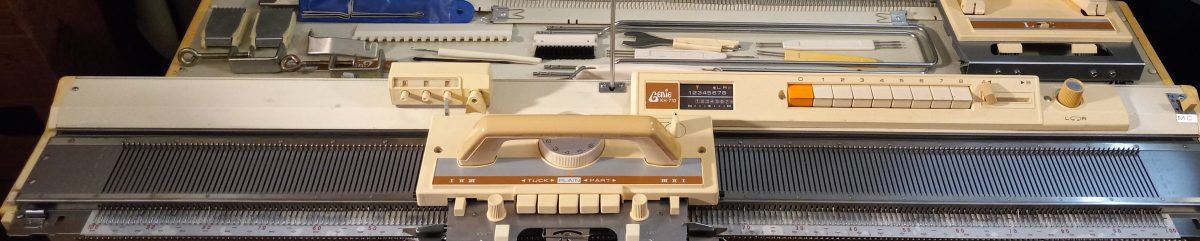
List of pros and cons of knitting machines I used

…in progress. Updated: June 2025

abbreviations:

b-in = built-in

mb = metal bed

sg = standard gauge

st = stitch

mb, sg, 200 needles, 24-st punchcard

https://youtu.be/L1GwyLg46V0 Can do tuck slip, 2-color fair isle; if carriage is stuck, unscrew the sinker plate, no built-in toolbox; has built-in knit leader; standard set of punchcards has only 10 cards, no hard case lid (all parts are inside a sterofoam packaging; budget, lightweight model. https://wordpress.com/post/thoughtsandknits.wordpress.com/427

m, sg, 200 needles, 24-st punchcard

https://youtu.be/27blcVPYAlw Can do tuck slip, 2-color fair isle; if carriage is stuck, unscrew the sinker plate, no built-in toolbox; no built-knit leader; compatible with standard add-ons (ribbers, knit-leaders, color changers, row counter) http://thoughtsandknits.com/2025/05/26/studio-mod-324-knitting-machine-prepared-for-lara/

md, sg 200 needles, 24-stpunchcard; b-in knit leader, tool tray

https://youtu.be/0PnXE_Bc8yc Can do tuck slip, 2-color fair isle; if carriage is stuck, unscrew the sinker plate, no built-in (but has stand-alone) toolbox; compatible with standard add-ons (ribbers, color changers, row counters) http://thoughtsandknits.com/2022/06/11/studio-326/

XXX

XXX

XXX

XXX

XXX

XXX

XXX

XXX

XXX

Singer 321, manual and carriage in Spanish

This was the first Singer 321 that I refurbished and cleaned. But having already gained experience in servicing and refurbishing Singer/Studio machines, I did not hesitate to start working on it.

A little bit of history: Singer/Studio 321 machines were introduced in 1972 and were the second earliest model capable of patterning with 24-stitch punch cards. It is a standard (4.5 mm) gauge machine with 200 needles. So, this machine is 50 years old!!

I inserted a brand new sponge bar and sponge bar (purchased it from the Knitting Closet). It was specifically advertised for Studio/Singer machines. It fit right in but the white plastic end sticks out only on one side. So, make sure you don’t push the bar too far otherwise it will be hard to get it out to replace the needles and to replace the sponge.

I removed all removable rust from the inside of the machine and covered some rusty spots inside the case with an anti-rust coating.

To remove the carriage from the needles in working positions (for example, to unravel a row or if the carriage is stuck), the sinker plate needs to be removed from the carriage first. It is a bit not as convenient as other, newer models, but not the end of the world, in my opinion. The dial on the carriage is in Spanish but it is intuitive to use, especially if you have an English copy of the manual in front of you. If you are a Spanish speaker, then it is an extra bonus for you!!!

The manual is very well written. This machine could be accompanied by Spanish or English versions. This particular machine has words in Spanish )on the carriage) and an accompanying manual in Spanish. Please, let me know which copy you prefer. I liked very much that this machine have pegs to attach a row counter on both sides of the bed. I knitted a shawl and was glad that I did not have to transfer carriage all the way to the opposite end just t count my rows. The machine comes with all accessories mentioned in the manual, all of which fit nicely into a special box. It includes a set of punch cards but only 18 – cards 14 and 16 are missing.


I tested all the knobs, levers and card readers extensively. I knitted patterns using tuck-stitch, slip-stitch and fair isle on partial and full bed.

The sinker plate and the tension mast fit inside the case lid when not in use.

Now about the imperfections. Maybe because this machine is 50 years old, or maybe because the previous owners did not love her as much, there are some cosmetic imperfections and cracks on the case. None of these affect the machine performance. See the pictures below with brief description.

Side racks are missing. They are rubber pieces that go on the ends of the bed to prevent the carriage from mis-patterning if knitting on a full bed. However, with careful knitting and by not going too fast, it can be avoided. As I demonstrated in my video, it did not affect me tuck-stitch knitting on a full bed.

The body of the machine has a spot that I could not remove.

The case cover has several dents. The one below is especially visible.

Some spots and discoloration on the outside of the case, including the handle

These are where the holding clamps attach at the bottom of the machine. They are rusty but are very strong and held a machine for me without problems/.

Overall, I was extremely pleased with this machine. It is simple yet strong and will serve its new owners long years if serviced and take care of correctly. Check my video blog, showing this machine in action.

Review of Scrubby yarn and how it knits on circular knitting machines Addi

Scrabby yarn (from IceYarns or from RedHeart) has sort of an eye-lash thread but with the “eyelashes” are created with the twistiess. It is typically used to knit washcloth for dishes and baths

Knitting by hand with this yarn was fun – it creates a unique texture without any effort. I also decided to use my Addi circular machine to see if I can make household items faster. So, I was able to knit loofahs, coffee holders (aka reusable sleeves for paper cups), place holders, table pads and coasters.

Both IceYarns and RedHear offer a very wide variety of colors, including solid, two and three color variegated types. I chose white and black yarn because in my opinion it hides all the crumbs and spills really well

The IceYarn offers scrubby yarn as 100% polyester. One skein holds 3.53 oz (100 g) and contains 103 yards (95 m). Red Heart offers both 100% polyester (100g/3.53 oz and 85 meters/92 yards per skein) and 100% cotton yarn (weight and yardage depend on whether the color is solid or variegated). I only tested the 100% polyester yarn because I had cotton washcloths and I could never get rid of the smell of dirty dishes even after washing the scrubbies over and over again.

The cast-one was straightforward and relatively easy. It did help to keep the tension loos but not too loose because the yarn is silky (very smooth) enough where it can skip stitches (which we don’t want). However, I started using contrasting waste yarn because it is easier to manipulate the stitches afterward (in order to put the washcloths together )

The knitting on the machine became significantly easier after the first two rows. However, some of the stitches did not sink into the slots on their own and I had to help “them” . Even though the yarn will hide all defects because of the variegated colors and because of the twisties on the yarn, I still did not want to create tuck stitches because they sometimes lead to missed stitches. Check out my youtube video on how I dealt with these stubborn stitches.

A square scrubby took 12 rows. In the same video, I demonstrated the techniques I used to finish these square scrubbies. I tested them and they are washable on a regular cycle and even dryable on “knits” cycles. Coffee mug sleeves would probably take 12-30 rows depending on whether you like it single-or double-layered. Placement mats should be done on large Addi. I made mine rectangular and double-layered with 60 rows.

Testing Lion Brand 24/7 cotton yarn on Addi circular knitting machine

I was again trying to discover what yarns my Addi will like. Additionally, I was destashing and helping a friend with a charity project. So, I decided to see if I can make a scarf out of this Lion brand 24/7 Cotton yarn.

Each skein contains 186 yards (170 m) and 3.5 oz (100 g) of yarn. I used grey color – neutral color and can be a scarf for male or female.

Typically, cotton yarns are not very suitable on circular knitting machines because of their rigidity. Additionally, this yarn almost looked like a chain and had to stretch to it. Or maybe the thread could be described as a cord. However, the skein was wound so tightly, I could not even get the other end from inside of the skein. So, I decided to rewind it into a cake (which I strongly recommend for all projects on circular and flat bed machines especially operated with a power adapters or motors).

The yarn surprised me: it behaved flawlessly. I was able to hand-crank and get extremely even stitches. First, I was very cautious because at the very beginning (as always), the first rows knitted somewhat loose and I was worried the machine might even skip/tuck of drop stitches or skip the yarn. But once I had enough length and attached a weight, I was even able to knit the whole length of the scarf with a power adapter to my Addi. See my video that shows actual knitting speed – was pretty fast!!

Looks at this beautiful web of stitches created by both hand and drill-cranking.

One skein proivded 252 rows of the scarf with beatiful even stitches. I was so pleased!! I hope you will enjoy knitting with this yarn – just remember the apply enough tension to knit without problems.

Second Singer Studio 360 Mod restored/cleaned/refurbished in March 2022

This machine was in decent shape when I got it. Even now, look how it shines even though there is some age-related discoloration on the plastic. It still needed a new sponge bar. A typical problem when the old sponge bars are not replaced in time is that it corrodes all needles. So, yes, some of the needles needed to be polished.

It was dusty so I also cleaned the bed and all the mechanisms. Patterning drums and the carriage needed some Kroil-oil treatment to get levers unstuck.

The machine works really well. I tested it on a full bed with stockinette stitch (to make sure all needles perform as they are supposed to). Check out my youtube video recorded specifically on this machine, which shows all these tests. (The only thing I did not test is the knit leader. I just do all my calculations myself and as of now don’t see a need in a kinit leader for my projects. The drum rotates though.

I tested fair isle, touch and slip stitch patterning. I also did a full bed fair isle testing.

See what cam out of these experiments on this machine:

  • A double-sided reversible scarf/neck warmer
  • And cozy, soft and very comfortable leg warmers

Some minor accessories are missing (but it will not prevent you from knitting even sophisticated things):

  1. No lace carriage: lace carriages are typically sold for Memo Matic Singer 360K separately.
  2. The machine came with only one set of punch card clamps, one set of yarn separators, one set of point cams and one silky thread/cord. Please, refer to the diagram below to know what these are. Point cams and yarn separators are only needed for single motif fair isle knitting. When you know how to do that, that means you are already very advance and by that time you will know whether you need an additional set and where to get it. Punch-card clips don’t break often but if they do, it is easy to get them on Aliexpress or Amazon.
  3. The machine also did not come with an auxiliary feeding cam (number 22 on the diagram below). This cam is needed when knitters knit garments with the help of knit-leader (also often called a knit radar or knit contour). I consider myself an intermediate knitter but I yet to use a knit leader. I do all my calculations myself.

Now about several imperfections on this machine.

  1. The tension dial on the carriage has slight dents (see below right under the handle). It absolutely did not affect my knitting, tension setup or stitch pick-up.
  2. Side racks (also often called as rail ends) are missing. Typically, these are plastic pieces with ribbing that are attached on each end of the bed. They can be ordered online as well. The machine actually came with them but they were so crumpled that fell off the bed instantly. So, I had to throw them away. Why I do not find them to be the critical components? An average knitter would rarely use a full bed to knit. These rail ends are needed so if your carriage to maintain the patterning of the drums when you are close to the end of the metal bed. Sometimes the carriage accidentally comes of the bed and the patterning can be messed up. However, even without these side racks, I was able to demonstrate a full-bed knitting with punch cards: I just slowed down the arrange movements towards the end-sides of the bed to make sure that the patterning drum remains on the tracks.
  3. I feel that on this machine, the carriage runs back and forth a bit louder than other machines even after a thorough oiling. I did not find any issues with the knitting though.
  4. The lid of the whole case has some chipping. The most critical is on one side (see the two pictures below).

The case, however, is still structurally intact. I simply recommend when the machine is in storage, to put it n a dry environment maybe just wrapped with a large plastic bed on the side where you see this hole.

Two other minor cracks/broken pieces are on the other side of the case lid and inside the lid where the tension mast attaches. These are not critical.

Overall pros and cons of Singer 360K:

Pros:

  • The patterning drums make it very easy to move the machine. They engage with the punch card mechanism very nicely without much noise.
  • The manual is very well-written and I was able to follow the instructions with ease and to learn all the techniques.
  • The other optional brochures included with the setup up contain information on the settings for punch cards to achieve certain pattern as well as how to knit garments of various shapes. I know these are available online, but when one knits, it is always nice to have a hard, high-quality, copy handy. All brochures could be found online.
  • Easy-to find replacement needles since these models are relatively “newer” ones. I get mine on Aliexpress.
  • The tools are pretty standard and are pretty interchangible with other models. All tools fit into a built-in box on the left-hand side of the machine.
  • Some might find having the built-in knit-leaders very handy: there is no need to have a separate long setup laying around – in this setup all fits into one carrier box
  • Includes an optional lace carriage
  • I found that putting this machine to storage and opening and closing is much easier than multiple brother machines I had a chance to struggle with. There is a very clear schematic on the cover with the order of how placing the parts together. I found this extremely helpful as putting these machines away is often a big frustrating struggle.


  • The carriage has a release lever (earlier Studio/Singer models do not), which is very convenient when a carriage needs to be removed from the bed in the middle of knitting if it gets stuck. In earlier models without this lever, one needs to unscrew the sinker plate and then lift the top cover of the carriage to remove the carriage from the bed.
  • Built-in row counter.

The cons are:

  • no timing belt, which might make the carriage movements somewhat hard depending on your tension and knitting pattern and technique. It was not a problem for me at all but after 200 rows of knitting my garment my hands and arms were a bit soar. Well, I guess this is how I can substitute my work out now.
  • The most significant flow in my mind is that the patterning drums often get stuck if not oiled regularly, especially when not used for a very long time or put into storage (I restored already two OTHER machines where the drums were simply shut… They needed soak in an oil bath and some heavy-duty disassembling). To avoid this problem, put some light oil regularly on the patterning drums.
  • Unlike Brother punch card machines, lace carriage is in a separate box. So, just one more thing to keep track off.
  • The row counter dial is at the end of the bed. Not too inconvenient but I personally prefer the row count to be right in front of me – not at the end of the bed.

The machine is currently for sale in my Etsy store.

Singer 700 Mod Memo-Matic Knitting machine

When I got this machine, it was in excellent shape. Previously I restored and cleaned Singer 210 MemoMatic and Studio 360K so I was familiar with Singer’s knitting machines designs.

Singer 700 is very similar to Studio 360: the most obvious differences are positions of punch card reader, knit leader and a row counter. Another prominent difference is that the row counter dial in Singer 700 is in the middle of the bed (versus at the very end of the bed on Singer 360). Singer 700 is also a later-released model. But maybe the reason for a later release is simply a rebranding – the name changed from Studio to Singer (or vice versa). Since all of this not critical, let’s get to the actual machine.

Singer 700 is a 24-hole punch card reading machine capable of slip- and tuck- stitch patterning and fair isle knitting. In fact, I learned fair isle knitting on this machine for the first time. I will post in a several blog article my thoughts about fair isle, common mistakes and problems and how to trouble shoot mis-patterning issues.

The machine came to me with all accessories, including all transfer tools, knit leader sheets, weights, etc. The gauge guides did not come with this machine (see number 8 below). The punch cards that came with this machine are mostly the same with some exception. (For example, intarsia card is not as shown in the manual). Some other cards are different as well. I tested the tuck and slip stitch cards and they worked fine.

The machine has its own original box and hard cover, both of which are in excellent shape.

The set of manuals that came with this machine includes only Operation manual (http://machineknittingetc.com/knitmaster-600-700-operation-knitting-machine-instruction-manual.html).

The knitting manual (which explains how to use the knit radar) is available here: http://machineknittingetc.com/knitmaster-600-700-knitting-machine-instruction-manual.html

The pattern book for this model is available here: http://machineknittingetc.com/knitmaster-600-700-pattern-manual.html

The accessories fit nicely into a storage box on the side of the machine. I used it also as a stand to keep my handy tools (stitch transfer and needle selector) during the actual knitting – otherwise they are constantly getting lost!

In this machine, I replaced a sponge but the bar is original. (the metal sort of “railing” that holds the sponge). Unfortunately, the machine came to me with a slightly chipped sponge bar end – the plastic piece that we grab to remove the sponge bar. However, it absolutely does not affect the function of the sponge bar and, especially, of the machine. I could still easily move the bar in and out.

As needles often rust due to the old sponge bar not being replaced in time, I remove all of them to make sure they did not rust. All needles were in excellent shape. I examined every single needle.

I tested this machine extensively with the exception of the knit leader (I don’t use knit leader as I do all my calculations myself). I am simply not used to knit leaders – it’s just the way I was first taught how to knit). Since this machine is very similar to Studio 360K and I already knew how to do simply tuck- and slip-stitch patterning, with this machine I mostly focused on learning how to knit fair isle.

I knitted fair isle on a full bed and then on only middle 90 needles to make leg warmers. I made several pairs and one of them are shown below. (I used a card I had for my other machine).

The machine has similar pros and cons to the 360K with one exception: the carriage on Singer 700 Mod moves much easier than on Studio 360K even though it does not have a timing belt!!!

Pros:

  • The patterning drums make it very easy to move the machine. They engage with the punch card mechanism very nicely without much noise.
  • The manual is very well-written and I was able to follow the instructions with ease and to learn all the techniques.
  • All manuals and brochures are available online.
  • All tools fit nicely into a built-in storage box, the cover of which actually shows how to arrange them.

  • Easy-to find replacement needles since these models are relatively “newer” ones.
  • The carriage has a release lever (earlier Studio/Singer models do not), which comes handy when the carriage gets stuck and needs to be removed from the bed in the idle of knitting.
  • The tools are pretty standard and are pretty interchangible with other models.


  • The carriage moves very easily – I currently have a shoulder injury but still move it without any pain.
  • Some might find having the built-in knit-leaders very handy: there is no need to have a separate long setup laying around – in this setup all fits into one carrier box
  • I found that putting this machine to storage and opening and closing is much easier than multiple brother machines I had a chance to struggle with. There is a very clear schematic on the cover with the order of how placing the parts together. I found this extremely helpful as putting these machines away is often a big frustrating struggle.
  • Built-in row counter: knitters should not worry that a detachable row counter would be lost (like for Brother machines).
  • All parts fit into a case. The schematics on the case lid shows how to put away the machine and it is very easy to follow (much easier than on Brother).


  • Easy-to-learn patterning. The knobs on the carriage are straightforward – just follow the steps in the manual.


    The cons are:

  • The most significant flow in my mind is that the patterning drums often get stuck if not oiled regularly, especially when not used for a very long time or put into storage (I restored already two OTHER machines where the drums were simply shut… They needed soak in an oil bath and some heavy-duty disassembling). To avoid this problem, put some light oil regularly on the patterning drums. Lucky for me, this machine had the drums in excellent shape.
  • I personally wish the setup included cast-on bars but it might also be my personal preference. However, cast on bars can be easily purchased.

    Take a look again at this beautiful setup and check it out on my Etsy page.

Brother KH551 – my second one

I took on a project of cleaning and conditioning this machine with enthusiasm because I already restored one Brother KH551 earlier this year. This machine was easy to clean – it needed some dusting, wiping, needle inspection, some needle replacement.


It came with ALL accessories (even including a silky thread) with the exception of hard copy of the manual (which can be found in here absolutely free: http://machineknittingetc.com/brother-kh551-user-guide.html).

Despite being familiar with Brother KH551 already, I was puzzled by some of the quirky perks of this machine.

For example, the sinker plate’s thread guide was somewhat different from the previous KH551 I restored: it had a bracket. I checked with FB experts on push button machines and they assured me that some KH551 indeed have such brace for better control over color change. When I was threading the yarn through this bracket, it did not cause me any discomfort and it only took two tries to get used to it.


Overall, the machine was in great shape even before I started restoring it. The row counter was not even stractch despite this machine being made in 1960s.

Even the undercarraige and the pegs were without any rust.


I extensively tested the patterning mechanism. I was not a big fan of constant ratcheting but I was pleased with the result. At least it was straightforward and easy to understand. Maybe sometimes challenging to keep track of the order of operation especially for a long pattern. Below you see several patterns I knitted by following the instrucions in the manual.


Then I wanted to make sure that the whole set of 200 needles functions smoothly. So, I started a blanket on a full bed and had good success!!

In my video I created specifically for this machine (https://youtu.be/epZrcb1MEZA) I show that it managed some challenging yarn pretty good as well!!


Below are the general pros and cons of Brother KH551:


Pros:

+ Carriage is very light and slides very easily

+ The bed is narrower than other machines – which makes it more compact

+ …and makes the machine lighter than other similar models

+ relatively easy deep cleaning – all parts are solid and straightforward to insert/assemble/disassemble

+ The needle count is engraved on the bed – so these slippery and constantly in the way paper liners showing the needle count won’t annoy you by constantly sliding and getting lost.

+ Threading the yarn is a bit more intuitive and straightforward in my opinion

+ built-in capabilities for 3 different yarns

+ the hard case is a combination of fake leather and plastic, which makes it not only look neater and nicer than other machines but also mode durable. The case shows absolutely no discoloration despite the age of this machine.


Cons:

  • The push-button mechanism helps to select the needles but every row, you need to change the needles selected (basically turn the ratchet tool to SET and OFF). It might be tedious and you need to keep track of the correct order.
  • Some might find the machine too simple – yes, it has only limited patterning capabilities. However, with manual needle selection and yarn manipulation the possibilities are endless.


Overall, I think this machine is excellent for somebody who wants to simply knit blankets, scarves or for people who find punchcard mechanisms and electronic mechanisms too overwhelming. It is also excellent machine for beginners since it is very robust and simple.

Also, you don’t even need to use patterning. Just find a thin self-striping yarn and knit by a simply stockinet stitch like I did to create this wonderful sweater for myself!!

Brother KX350 knitting machine tested in November 2021

My personal history with this machine was the following. Since I am an avid knitter and an avid yarn collector, I wanted to knit faster so I asked my daughter to get me a circular knitting machine. She got me both Addi big and small and I enjoyed it tremendously. Addi’s have certain limitations in terms of the yarn it can use – it hates slippery yarns!!! It also hates chenille yarns.

After I knitted a ton of headbands, scarves, bags, dog coats, head warmers, four sweaters, and several blankets, I wanted to continue experimenting with more techniques and yarns and my husband bought me Home Knitter KX350 on eBay.

It arrived in a pretty bit-up box but the insides (except for some dead flies and bugs) were excellent.

All accessories are inside a Styrofoam holder, which is an extremely convenient way to store and transport them.

The bed itself sits on the bottom of the cardboard box and the two Styrofoam packages are on each side of the plastic carriage.

Everything felt good about this machine. I liked how it felt to touch, and how the carriage moved (it was light and easy – which became especially important when I hurt my shoulder but did not want to give up knitting).

All the plastic parts – the two yarn clamps on each side, the tension rod, the row counter, and the tension mast holder – were inserted easily into the main machine. With the clamps being also attached to the main bed – you can move the whole setup up easily if, for example, you need to change tables.

I even liked how heavy-duty the cast-on combs are. Typical cast-on combs on metal flatbed Brother have very thin “teeth” that bend very easily and get tangled on almost any hanging yarn. The cast-on combs that come with KX350 are so heavy-duty that you don’t even need additional weights.

However, while wiping some dust off the machine, I discovered a lot of weird cruds when I flipped the machine over. I diligently removed the crud together with a strange long piece of fabric and was very proud of myself for how clean my new possession looked.

This crud and a long piece of narrow fabric turned out to be a completely gone-bad sponge bar…. Well, not realizing how important the sponge bar is, I started experimenting with knitting and made a lot of good progress. Yes, I got a lot of dropped stitches and spilled lots of curse words, but eventually figured out how to adjust the tension in certain parts and finished a scarf, a vest with cables (by hand-manipulation stitches) and a had with a mock-ribbing.

When the initial excitement subsided, I decided to expand my knowledge and started watching other videos on the knitting machine, and then somebody mentioned the sponge bar and how it helps with dropped stitches and even tension…. A revelation!!! I immediately realized that whatever the curd was, it needed to be put back but in better shape. One week later I was inserting a sponge bar – my first one ever!!! I thought all knitting machines had a sponge bar insertion process like this one….I almost gave up machine knitting when I read that the sponge bar needs to be replaced frequently.

It has a lot of pros compared to sponge bars of other flatbed machines and a couple of cons as well.

Needles for this machine are big and sturdy and from what I read are not interchangeable with other machines. But they can be easily found online.

Pros:

(+) Very easy to assemble and disassemble. If you are like me, always struggling with placing the sinker plate, the tension rod and cast-on bars inside the lid of metal flatbed knitting machines, you will like this setup – no more struggle. Guaranteed!!

(+) The sponge can be replaced without the need of glue.

(+) Needles are easily replaced without removing the sponge which is a HUGE advantage. They can be even changed in the middle of your project!

Pros of the machine itself:

(+) Most of the parts and replacement parts are readily available online. If you can’t find some, they can be 3D printed on a home printer – just ask around, there are a lot of machine-knitters, who are also 3D-printing enthusiasts.

(+) The plastic components of this machine make it very light and easy to handle – pack, unpack, move, and even assemble and disassemble. The way the brackets are hiding under the bed and unfold underneath it when you need them is very neat. I wish all machines had this way. The lightweight of this machine is excellent for people with some space limitations (take it out when using and then put it under the bed without too much straight when not in use).

(+) can be bought easily and use weather stripping. Size is important but not as for the metal flatbeds with metal sponge bars. You can even use pieces of two different sponges. The whole sponge sites pretty tightly inside that narrow passage – there is no way it will slide on its own.

(+) after you manage to insert it, needle insertion and reinsertion can be done without removing the sponge bar – which is a HUGE advantage compared to metal flatbed knitting machines. I even managed to replace a needle in the middle of one of my knitting projects.

(+) No hot glue or any other glue is required to insert it into the machine. This eliminates a lot of problems – as glue might stick to the insides of the machine, etc.

(+) no sinker plate – all mechanisms are inside the carriage. One less part to worry about getting lost! I see so many knitting machines being sold without sinker plates. In the case of KX350 you don’t have to worry about the sinker plate getting lost. Well, if you lose the whole carriage that’s another story.

(+) easily knits relatively thick yarns. I used a wool/acrylic blend on this machine (100g/230 m, 3.5 oz/255 yards) without any problems.

Cons of the sponge of KX350:

(-) Well, it is not a BAR but simply a long narrow sponge, like a weather stripping (for windows and doors). Inserting it without the solid support of a metal bar (like other Japanese machines have) is challenging. I did it without removing the holding plates (the way the Answer Lady shows in her video) and managed to accomplish quite a lot. That’s the only con so far.

Cons of the machine itself:

(-) It is not a metal bed machine – it is plastic (which later brings us to con number two below). So, technically parts are not as durable as parts for metallic flatbed machines. However, I kind of think of it as almost an advantage: plastic can be glued on but getting rid of the rusted parts on a metal knitting machine is a big pain.

(-) Because of its being plastic, when it works (when you move the carriage back and forth) the sound gets pretty strange. My husband calls it “an old typewriter noise”. It is different from the noise the metal flatbed machine makes but very similar to the noise other flatbed machines do (Like HK100, Addi, etc.). You can check my youtube video (https://youtu.be/OPesDA95b5M) to make sure you are ok with that noise. However, keep in mind that all machines make some sort of noise when being operated.

(-) Sponge bar replacement is somewhat challenging.

Overall, I feel that this is an ideal machine for beginners and as a first transition machine from plastic circular machines (like Addi and Snetro), like it was for me. It is also easy to store and transport as it is lightweight and all the parts are easy to install. I especially love the retractable table clamps. It is also ideal to knit “regular” yarn sold in hobby stores. I hope you will consider fostering or even adopting this wonderful setup!

Singer 210 Memomatic restored in November 2021


This Singer 210 memo-matic came to me in a very good shape yet still needed some TLC….

When I purchased it, I did not know much about Singer/Studio machines. So, I first restored Singer/Studio 360 and only then pulled this one out from my closet

I have to say that my shoulder did not complain a whole lot because this machine feels lighter than all others I handled so far. It is still not the lightest but I think what makes it light is that it does not come with a hard case cover. It came in a nice original cardboard box with Styrofoam layer, in which all accessories were stored.


This machine works flawless. I made a blanket on it while testing all its tuck and slip punch cards.


Pros:

(+) Worked great

(+) Looked at first not as overwhelming as other machines: it has less knobs and does not have a built in knit leader

(+) Not electronics – no need to rely on old electronic mother boards or on electricity

(+) Light-weight because it has no hard case cover but comes with the nice original cardboard box and a Styrofoam packing.

(+) easy to handle row counter: some row counters are flaky and the numbers jump back and forth when you are changing the dial manually…This dial did not give me any troubles at all!!

(+) putting machine and accessories into the case is really straightforward. Those who tried and struggle with placing the machine back into the storage into cases with hard cover (in which the sinker plate and the mast are stored in the lid) know what a struggle it is!! No struggle in this case – all accessories are inside a Styrofoam molds, which a re placed on top of the bed, which adds additional cushioning and security while storing the transporting the main bed.

(+) The carriage has a release lever which helps to remove the carriage in the middle of knitting (if it gets stuck) without removing the sinker plate.


Cons:

(-) the absence of hard case cover might be considered by some people as a con since storing this machine might come with its challenges: what is the carboard gets wet, what is the mice eat the Styrofoam?…It was not a problem for me and indeed, I liked it that it was not as heavy as my other machines.

(-) as with all Singer/Studio punch card knitting machines the patterning drums might freeze if the machine has not been used in a long time or stored, especially outside. This can be fixed though by spraying AeroKroil. There are a lot of resources explaining how to do it.

(-) not electronic and because of this the automatic patterning is somewhat limited. However, it is limitless, in combination with some manual stitch manipulation.

(-) does not come with cast-on combs – this was probably the biggest challenge for me (but I took cast-on combs from my other machines).

(-) I personally found that the tension mast is a bit close to the place where I was clipping the punch cards. It might not be a struggle for other people and it really was not for me, but I though I would mention it….


Compassion with Singer/Studio MemoMatic 360:

The comparison below simply shows difference features of the two models, and these features are not necessarily pros or cons. The reason I decided to put this comparison table together since, in my opinion, this machine is almost the same as Singer 360…. So, see below…


Singer 210 MemoMatic

Singer 360 MemoMatic

Hard case cover

NO

YES

Built-in knit leaders

NO

YES

Weight?

Lighter

Heavier

Punch card set

10 cards

15 cards


I really hope you will considering purchasing this model as your standard gauge machine (from me or from other seller). It is a great machine and definitely deserves your attention and love!

List of machines I tested/refurbished/cleaned/fixed

Updated: March 2026;

Total machine count: 91

2 circular plastic

3 bulky basic

6 mid-gauge plastic bed

34 standard-gauge punchcard

18 ribbers

2 bulky punchcard

3 turn-knob

2 standard, basic

8 four-pushbutton

9 eight-pushbutton

6 electronic standard-gauge

Specific Machines:

Addi King 46 needles

Add Express 22 needles

Silver Reed SK120

Singer HK100

Singer 210 Memomatic

Brother KH210

Brother KH230

Brother KH260 (two) 

Studio SK303

Singer 321 (two)

Studio/Empisal mod. 324 (two)

Studio 326

Brother KX350 (five)

Singer/Studio 360K (seven)

Brother KH500

Brother KH550

Brother KH521

Brother KH551 (seven)

Brother KH552

Brother KH581

Brother KH585 (two)

Brother KH588 (two)

Brother KH601

Singer 666

Singer/Studio mod. 700 (two)

Brother (Genie) KH710 (two)

Studio by White SK740

Brother KH800

Brother KH830 (three)

Brother KH836

Brother KH840 (four)

Brother KH860 (four)

Brother KH881 (two)

Brother KH890

Brother KH892

Brother KH930 (four)

Ribbers

Brother KR260

Brother KR551

Brother KR580

Brother KR810

Brother KR830 (six)

Brother KR850 (four)

Studio SRN321

Studio SRP50

Brother KR321