
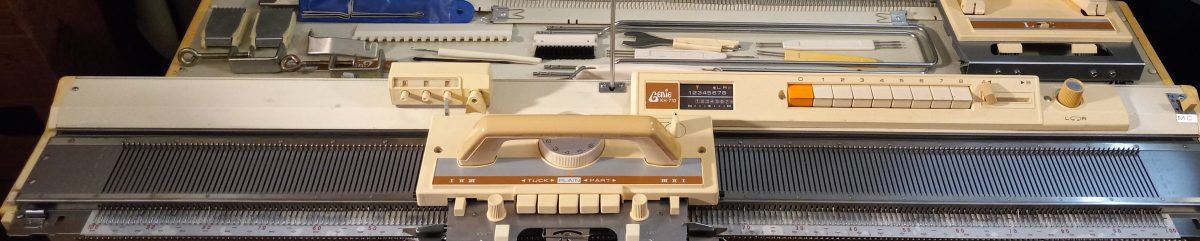
So far, I’ve been able to become very familiar with the Silver/Empisal Knitmaster/Studio/Singer turn-knob knitting machines: Empisal Knitmaster mod. 305, Knitmaster ES-302, Riccar RK-601, Silver SK-301, Silver SK-302, Silver SK-303, Silver SK-305, Singer 666, Singer 888, Studio SK-301, Studio SK-303. Thus, the pros and cons below are applicable to the following models:
PROS:
- light weight
- compact
- needles similar to the ribber (easy to find)
- The carriage is very easy to remove from the needlebed if it is jammed
- manual and pattern cards are available online for free
- sturdy end caps
- excellent for those who like the satisfaction of manual stitch manipulations
- excellent for beginners
- it is significantly faster to perform needle selection than manually and than the Brother pushbutton knitting machines (which involves the lever movement every time the needles need to be brought forward)
- no ratchet tool is required to move the needles forward (like in Brother push-button machines)
- needle selection pattern versus turn knob combinations is show on the front panel: no need to constantly refer to the manual
- ribbers were available to convert the machines into double-beds
CONS:
- bunch of knobs, buttons and levers might at first seem confusing
- vintage row counter if mispalced is hard to find
- somewhat limited patterning capabilities: manual needle selection is needed for complex patterns and patterns with more than 8 needle repetitions
- colored fair isle requires manual yarn manipulation (the knitter will need to lay the yarn onto the needles with open latches; might seem tedious on larger projects, but makes it easy to knit single motif patterns)
- limited number of add-ons: only ribber (no knit leaders, no color changers, no lace carriages, etc).
If you are new to machine knitting on flatbed machines and you just got a machine, consider the beginner-friendly projects I recommend to all my students and customers. These projects can be done on any machine with any gauge. Also, if you are unsure how to choose a knitting machine, check out an article I put together.
…stay tuned for more insights as I test other turn-knob knitting machines.