This wonderful machine was made in 1970th and, I think, it was the first model to include a built-in knit leader. Like most standard gauge knitting machines, the Singer 326 has 200 needles spaced 4.5 mm apart. It has a built-in row counter, punch-card reading mechanism for automatic patterning using a punch-card reading mechanism. I gave this machine a thorough clean. The carriage was also deep-cleaned and serviced and all knobs and levers and functions were thoroughly tested. Drums on the carriage move freely.
 It comes with all accessories including (numbers are going in the order as they are listed in the manual).
1) magic cams,
2) point cams,
3) separators,
4) box to store and transport all tools,
5) replacement knitting needles,
6) brush to clean the machine,
8) weaving arm,
9) container with oil
10) crochet hook

11) tapestry needle,
12) ravel cord for cast-on and to use as one-row intermediate level during waste-yarn knitting,
13) round brushes for tuck knitting (I already installed them on the sinking plate for you),
14) card snaps to clip the patterning cards together,
15) stitch scale (simply a set of rulers to help with knit-leader and stitch counting),
16) gauge scale to count stitches and your gauge on a swatch,
17) and 18) tension mast assembly,
19) weights to hang on the ends of your knitted piece,
20) set of stitch transfer tools,
21) tappet tool,
22) clamps to secure the machine to the table. On this particular machine with these particular clamps, it is somewhat hard to attach them to the bed– the bed needs to be at a certain angle. But with enough wiggle, they will fit in.
23) carriage lock to secure the carriage during transport and storage
24) card guide,
25) needle pusher and needle selector,
26) set of punchcards: the original set was supposed to include 20 cards but this machine came with only 19. Card #19 is missing,
27) a set of pattern paper with some patterns for knit-leader (also known as knit contour).
All accessories fit nicely  in the box.
A couple of minor accessories are missing:
- Only two-point cams are included. These are used for single-motif fair isle knitting. By the time you are ready to knit a single motif, you will be an expert in knitting and will know where to find the second pair (if you need to knit two single motifs).
- Name paper: it was included with the originally new machine so the owners can write their names to mark the machine as belonging to them.
- Ravel cord: any silky or acrylic yarn will work
I tested the machine on single -and double-color slip-stitch, tuck-stitch and fair isle techniques. On

this machine, the ‘fair isle’ is marked as a ”knit-in on the carriage. Old terminology? Hm..
I knitted on a full bed to make sure all needles were not bent and without any other defects. I knitted a double-sided reversible cowl on this machine.
A disclaimer: I typically completely disassemble machines only if they show a significant amount of rust or damage. The old screws often don’t make it threw frequent screwing and unscrewing. And these screws are hard to find in regular hardware stores.
A couple of things to keep in mind about Singer/Studio machines in general. It seems that table clamps for Singer/Studio are slightly different than those from Brother machines. Singer clamps have a slightly longer top part. However, not all Singer/Studio machines have clamps with flat tops (some have large screw-top fasteners).
 Some Singer/Studio machines have metallic end rails but this one had separate rubber ones. They typically tend to decompose due to time and fall off. So, initially, these rubber end-rails were still present but while I was using the machine they fell off since they already showed a lot of cracking and deterioration.
  These end rails are also not very critical pieces and the machine will work fine without them. They are important when knitting on all 200 needles. But even in this case, if you slow down the carriage on the last 10-20 needles and don’t let the carriage slide too far, you will be ok. These end rails are needed to prevent drums from mispatterning if the carriage is moved too far from the bed.
Some of the pictures above were taken prior to a complete cleanup – so the machine looks dusty on some. But it is much cleaner and happier now because it is a working horse and I hope you will adopt it for your knitting projects.
I did not extensively test the knit leaders because I do all my calculations myself. But all buttons turn freely.
The tuck brushes, according to the manual, need to be installed when knitting tuck-stitch patterns. In the video I created for this machine, I demonstrated that these brushes can stay on the sinker when knitting slip-stitch, stockinet, and fair-isle. Also, tuck-stitch can be knitted without these brushes (also shown in my video).
The sinker plate comes with already installed tuck-brushes and honestly, I do not recommend removing them as it is rather painful to put them back.
Overall, I was very pleased with this machine: it absolutely does not show its age and knits wonderfully! I hope you will be able to enjoy it soon too and knit a lot of wonderful garments! Talking about age: it might have some super minor scratches on the bed but everything else looks great.
 And last, but not least, pros and cons:
Pros:
- The patterning drums make it very easy to move the machine. They engage with the punch card mechanism very nicely without much noise.
- The manual is very well-written and I was able to follow the instructions with ease and to learn all the techniques.
- Easy to find replacement needles since these models are relatively “newer” ones. I get mine on Aliexpress.
- The tools are pretty standard and are pretty interchangeable with other models. Aliexpress also sells them.
- Some might find having the built-in knit-leaders very handy: there is no need to have a separate long setup lying around – in this setup, all fit into one carrier box
- I found that putting this machine to storage and opening and closing is much easier than multiple brother machines I had a chance to struggle with. There is a very clear schematic on the cover with the order of how to place the parts together. I found this extremely helpful as putting these machines away is often a big frustrating struggle.
The cons are:
- no timing belt, which might make the carriage movements somewhat hard depending on your tension and knitting pattern and technique. It was not a problem for me at all.
- The most significant flow in my mind is that the patterning drums often get stuck if not oiled regularly, especially when not used for a very long time or put into storage (I restored already two OTHER machines where the drums were simply shut… They needed to be soaked in an oil bath and some heavy-duty disassembling). To avoid this problem, put some light oil regularly on the patterning drums. Lucky for me, this machine had the drums in excellent shape
- This model does not come with a lace carriage
- The carriage does not have a release lever – if the carriage gets stuck during knitting, you will have to remove the sinker plate and then move the carriage.
So, I did everything for this machine so you can simply take it out of the box and start knitting (cleaned, tested, replaced sponge bar, and checked all needles). I hope this machine will soon find you 🙂

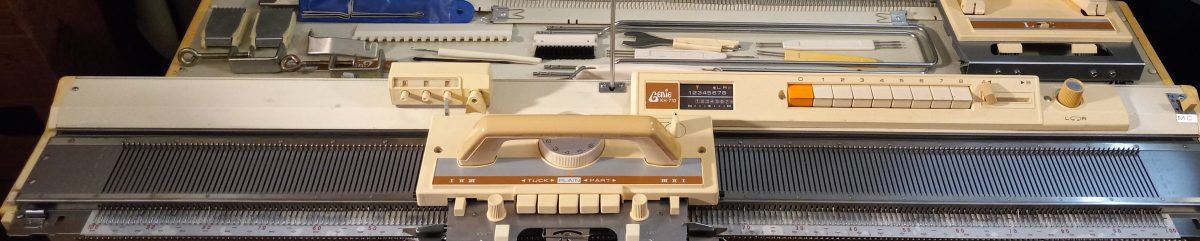


 Preface: If I had to describe this machine with just one word – it would be FLAWLESS!!!
 prepare for the needle selection and then rotate the knob (using the wrench) to select the corresponding needles. It is an excellent machine for beginning knitters. I feel that it would be also great for people who are not quite yet ready to give up hand-knitting but want to have more even stitches and a bit faster progress…. Brother KH551 is also lighter than other machines mostly because its bed is narrower. The carriage is also significantly lighter and I could easily move it with just one hand.
 uneven stitch which is amazing considering no additional weights and a rather difficult (with specs and boucle) yarn.
 machine also makes it easier to store when not in use. I like the three-thread tension mast and a yarn clip in from of the tension mast rod. I love the three-horned tension section of the mast (not just a triangle) where each color of yarn can be inserted individually. However, the tension on the second and middle tension disk only has two settings (although they might depend on the very right one).
 l), you can just make a similarly shaped hanger out of a heavy-duty paper clip). On other machines, when I knitted multicolor slip- and tuck-patterns, I was just leaving the thread on the side of the machine to keep it out of the way…Regardless of the technique you chose, the absence of this part does not affect the machine’s functioning and you can still do a LOT of various things with it using a variety of techniques.


 mind when you try the patterns from the manual and they are not working.
 A little bit more about potential typos in the manual. I tried at least a dozen of times to knit the patterns on p. 33: a purl-like stitch on the left and another one on the right. The purl-like was either dropping stitches on the whole swatch or was tangling the yarn so bad that I had to start all over again multiple times…I do not exclude a complete operator failure….But: when I started reviewing the pattern on the right-hand side (the anonymous one on p. 33), I noticed some inconsistencies. I was still able to knit it but the pattern did not look like in the manual: see the picture below (the very top swatch) of what I got and compare it to the manual – two big differences. Well, at least the swatch did not fall off the bed like in the case of the “purl-like” pattern attempt. But that pattern (on the right-hand side in the manual) definitely had typos: Look at the schematics: it shows TUCK but the description writes PART. I vaguely remember seeing an addendum to one of the manuals of the machines I refurbished last year… Maybe the purrlike stitch pattern on the left also had typos/errors and this is why I could not figure it out… But I successfully knitted herringbone (not shown in my video – sorry), seed stitch A, seed stitch B (pics below and on a video), and diamond design (pattern I in the book on p28)….I then knitted these patterns on the whole bed and converted what I got into a hood/neck warmer/cowl…
 Studio (also known as Singer, Silver Reed and Elna) machines are great machines to have for beginners or advanced knitters…They offer a lot of versatility. So far, I had a simple (without any automatic patterning with the exception of manual needle selection) and punch-card Studio machines. Studio 360K appeared on the market in 1980-1982. They are equipped with a 24-stitch patterning mechanism transferred to the needles using the punch-card reader.
 The carriage was somewhat more sensitive to the combination of yarn and tension than the other machines I refurbished. If possible, I would recommend using new sport weight yarn, wound into cakes, and taking the yarn from the middle of the cake while knitting.


 Say hello to my freshly refurbished and tested Brother KH930 knitting machine. It was made in Japan in 1986 and is a standard machine with 200 needles. Standard means that the gauge is 4.5 mm (the gauge is the distance between needles). The needle bed is metal. This and the electronic components make this machine pretty heavy.
 Pros:
Pros:

 A convenient holder for tools is located to the very left of the electronic display:


 For example, a friend sent me a pattern for a blanket. The file was 200 stitches by 270 rows. Because 930 has limited memory, such a large file DAK can only be uploaded into the 930 in 66-row sections. So, 5 sections total. So, I first knitted 5 rows of stockinet (which is always recommended), then patterned the device and knitted the first section. The machine beeped and flashed 66 when my carriage was on the left. All needles were selected. While the carriage was on the left, I uploaded another pattern. Then I programmed the pattern and then knitted the last row of the previous section (where all the needles were still selected).
 While testing this machine, I manually entered two patterns (W and S for a vest for my son’s teddy bear) into the machine’s memory and used them to knit a vest. I successfully loaded a pattern from a disk (through FB100) and I also transferred a pattern through a direct link cable (from DAK) and knitted a book cover for my son with his initials.
 My ultimate goal is to learn about knitting machines as much as possible. Out of all machines I tested so far, which is only 12 (which includes Singer/Studio/Silver reed punch card machines, Brother manual and Brother push-button machines), this is by far my favorite. Luckily, I have three more of these machines and one is definitely going to live in my machine knitting garage!!! I hope you will think the same!!


 A little bit of history: Singer/Studio 321 machines were introduced in 1972 and were the second earliest model capable of patterning with 24-stitch punch cards. It is a standard (4.5 mm) gauge machine with 200 needles. So, this machine is 50 years old!!


