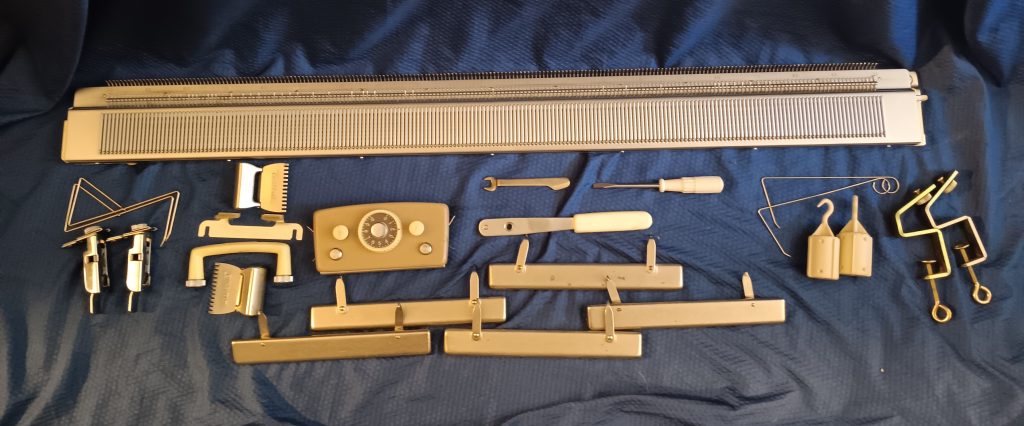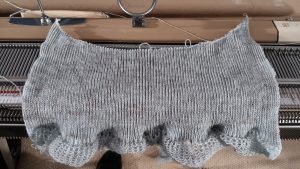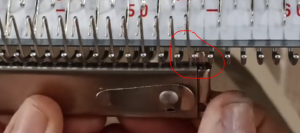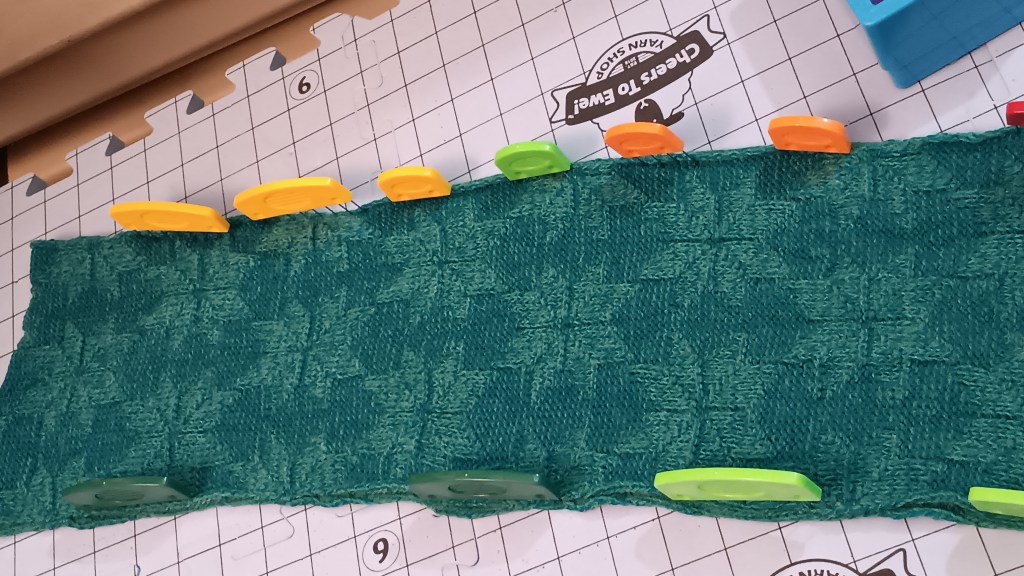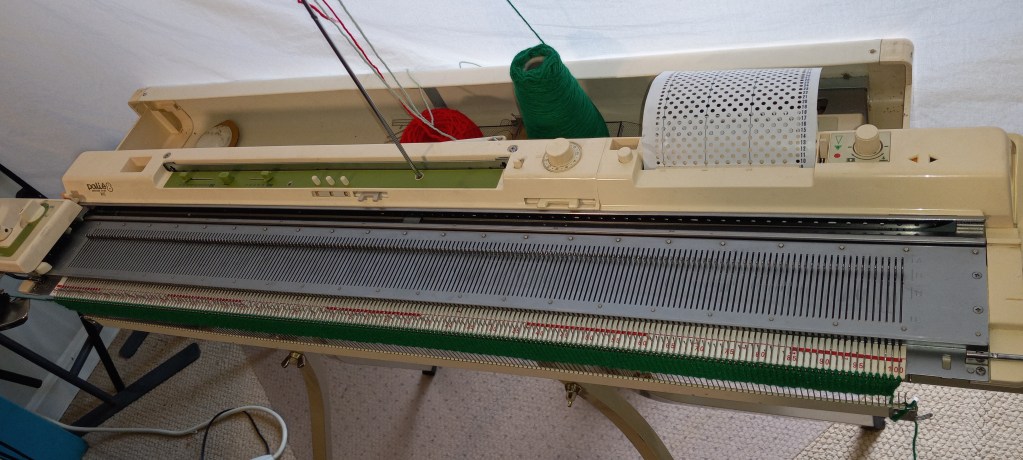
Making button holes when knitting using Brother garter carriage.

It is very easy to make horizontal button holes for small buttons when knitting projects using garter carriages. This blog is a text version of the video posted on the same subject.

First, decide the position of the button holes. Pick two stitches (in my demo, I decided to pick two sets of two stitches where I knew the machine needles, not the carriage’s, would knit). Move the left stitch out of these two to the stitch to the left of it and the right stitch to the right of it. Push the freed needles back to B position.

Knit one row with your usual pattern. The needles that were empty, now have yarn hooked on them (no stitch formed). Using a double eyelet tool, take the yarn off one hook, twist it, and then put back into a needle. You just formed a loop. Do it for the remainin needles in the button hole.

Continue to knit as usual.

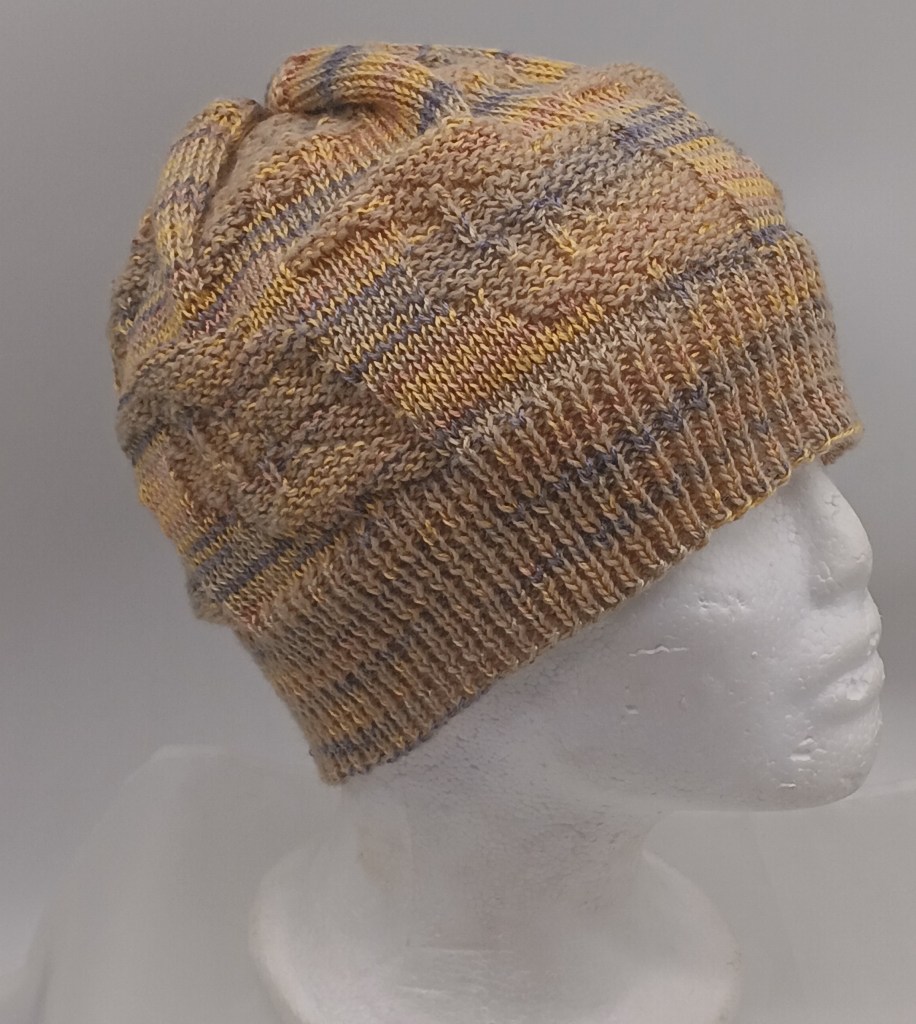
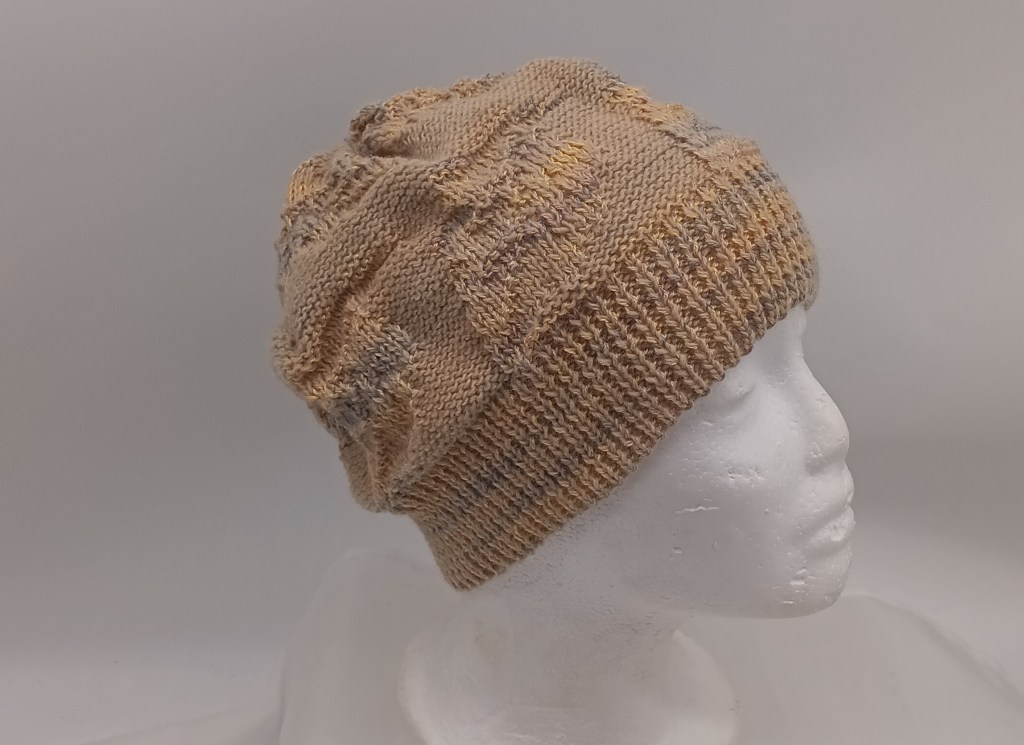
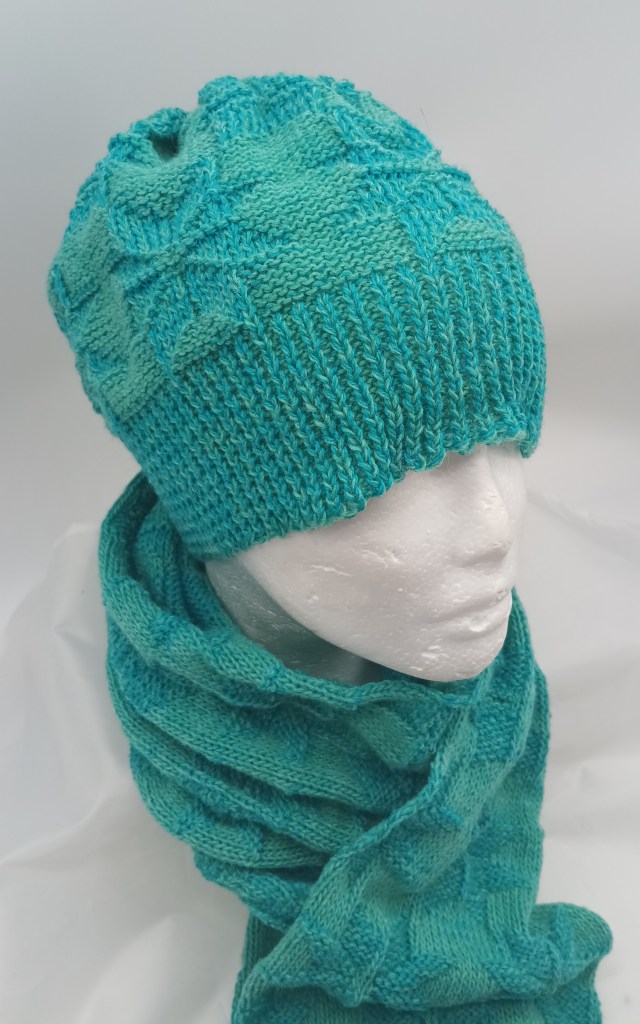
Hats with snowflakes knitted with two-color garter carriage

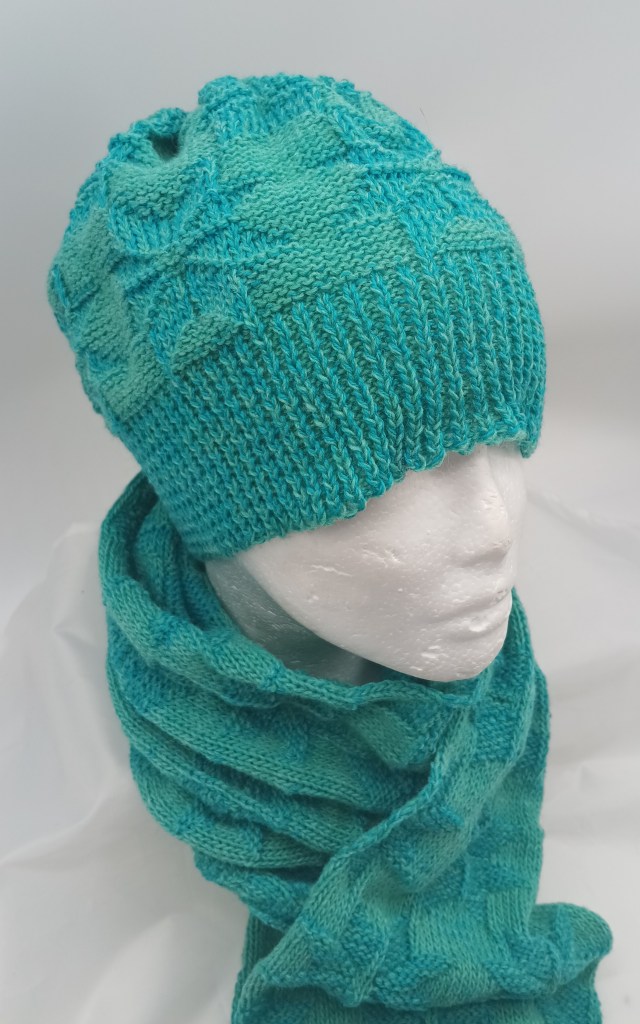
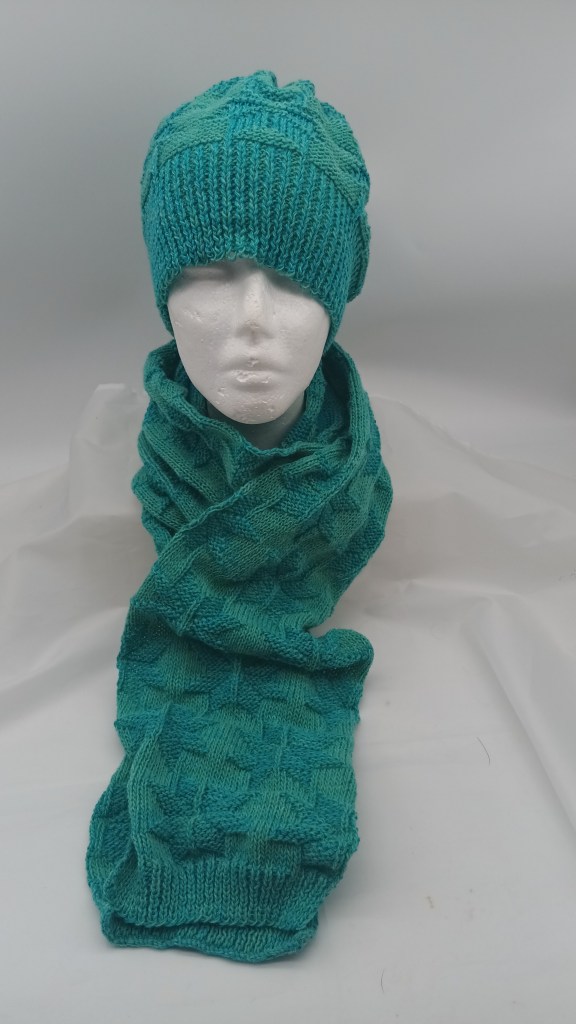
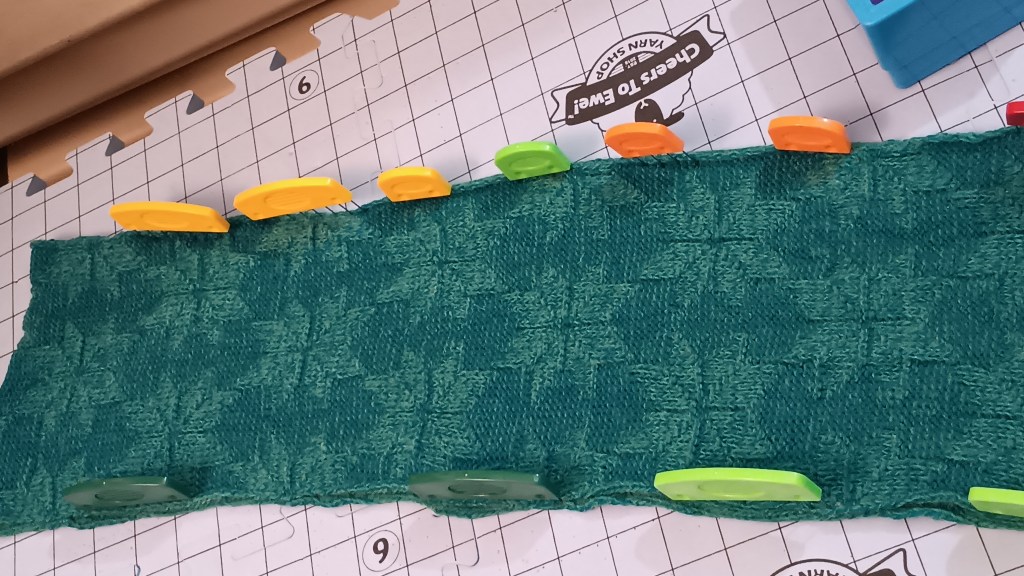
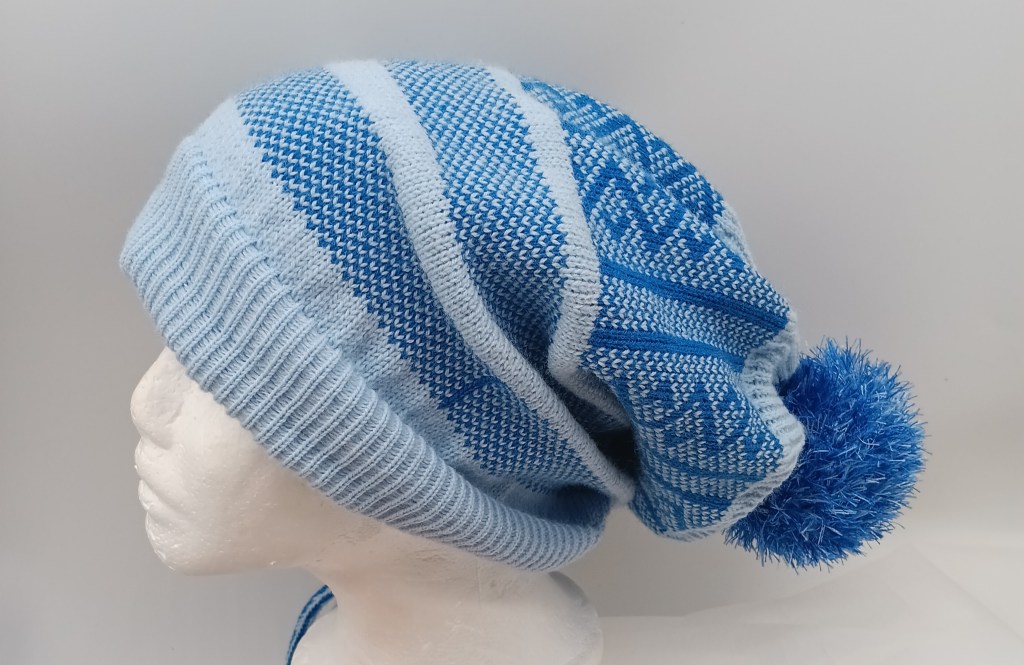
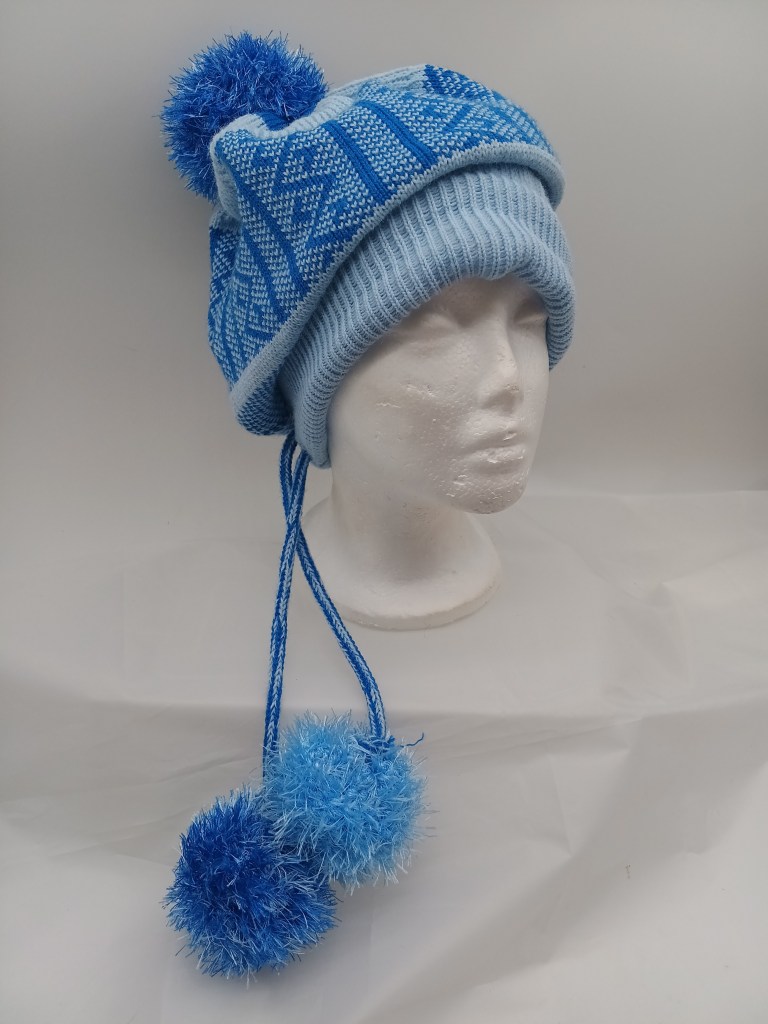
I loved this pattern so much that I tried a few combiantions of yarns and i am will experimenting. Basically, all hats have 21 rows of 1×1 ribbing (pattern 532 in the stitch book), then one full pattern with snoflakes (pattern #541 in the stitch book). For bigger/deeper hats I sometimes finished with 1×1 ribbing.

Color combo #1: The main yarn (on the right-hand side) is 50/50% wool/acrylic blend for handknitting. It is a teal color more on the green spectrum

Color combo #2:

Diary of my two-color garter carraige projects

What the two-color garter carriage did for me is hard to put in words. My journey with knitting machines started when i realized i had too much yarn on hands. After experimenting the crap out of Addi (I knitted sweaters, with cables, after NUMEROUS hats, scarves, and fingerless gloves) and Brother KX350 (also seaters with cables and socks), I needed more challenging projects. I could not decide which machine to choose, so to try them all I ended up buying multiple second-hand knitting machines… All kinds… So many that I started running out of space so I had to pass along all those machines. I cleaned them, tested them, figured out what I like about them, and did not. Moved on to the next one. … But I still really never had a chance to sit down and experiment and craft with all that yarn I accumulated…

Then I discovered Garter carriage. Thank god, out of a dozen garter caraiges I picked up along with the mahcines, one was fully operations (I am still fixing 11 others). The minute it created the perfect 1×1 ribbing, without curse words and snags that I was getting on the ribber, I was in love. I immediately knitted a blanket, and, as usual, multiple scarves and hats. I would not say I got bored (there were so many patterns and projects still to experiment with). But I saw the wonderful effects that two-color garter carriages created, so I wanted to continue to experiment (and along the way, to use all that yarn I have). So, I got the adapter.

After overcoming the initial learning curve, I started enjoying watching my two-color garter carriage making various fabrics so much, that I would bring my coffee into the room and just watch it knit. I would be combing impossible yarn. Consult with my son, who is an artist on colors and designs. Create my own designs… Oh boy. I finally had that long-awaited creativity and experimentation that I was yearning all this time. I still fix my machines and pass them along, but I also create these new designs, comine colors, test new patterns, create my own patterns…. The level of satisfaction it brings is just indescribable. Being creative and crafting, according to smart scientists, increases the levels of dopamine… These levels are now spilling to other areas of my life. Double benefits. Thanks, two-color garter carriage. I cherish and appreciate you!!

Hats with leaves

Hats with snowflakes.

Brother Garter carriages: thoughts and observations

… in progress as I am still learning and discovering …

I’ve spent the last two weeks fixing, disassembling, servicing, and cleaning all kinds of Garter carriages. I went through a mix of emotions: from agony of trying to identify the problem to fix to make the garter carriage work to complete awe watching the garter carriage knit a whole baby blanket just after I pressed all the necessary buttons.

In fact, it was so relaxing to watch Garter Carriage knit that my family would find me drinking coffee in front of it (instead of TV or a FaceBook page). Check out my pages with my projects, advice/notes, and patterns.

While being enthralled, I knitted swatches, hats, custom patterns, multicolor (just stripes, not using a true 2-color GC), blankets on all 200 needles…. So, below are my observations and notes.

Garter carriage is a bulky (meaning, big) carriage but unlike a main machine carriage, it knits on its own but slow. Garter arriages are temperamental. In fact, VERY! Som below I am compling a list of commonly appearing quesionts, my observations, and knowldge (acquired by making a LOT of mistakes).

The garter carriage moves too slowly.

If you want you GC to move faster, adjust the dial on its power supply. Right (“H”) is to increase the speed. If this does not change the speed, it is very likely that either the motor is malfunctioning or there is gunk in the carriage preventing it from moving faster.

The garter carriage stopped and is not moving.
  • The service manual describes some of the possible reasons:
  • Check if the power supply is actually working. My carriage stopped working literally in the middle of a project, and i could not figure out what was going on until I decided to try a different power supply. Well, the previous power supply decided to die without a warning.
  • The motor is not running. There are several reasons for that: bad motor, incorrect connection to the electrical outlet, yarn sensor is down, your row counter is at zero, a knot in the yarn feeder… Refer to the service manual for more detailed information.
What might cause garter carriage to randomly drop stitches?
  • bad (bent needle): it might have a sticky latch, be bent, misaligned or stuffed with lint. Check this first.
  • yarn is too thick. Solution: decrease tesion (increase the number on the dial) or switch the yarn. I was able to use yarns on garter carriage that a regular standard-gauge machine cant. BUt there is always a limit.
  • problematic yarn: fuzzy, or with boucle, or staticky, or stretchy yarn, or simply yarn that does not want to knit on the garter carriage (it happened to me; I put it in a bag and marked “GC cannot knit”).
  • check sponge bar: the spongy part needs to be about 1 cm above the metal sides. also: is it still spongy? is it even across the length of the retaining bar?
  • gate pegs might be bent or out of line. Check gate pegs from different angles.
  • clean the brushes from fluff and dust.
  • insufficient or too much weight

Overall, Garter carriages are quite temperamental.

Why does my garter carriage turn in the wrong place?

There are actually a lot of reasons for that, and they depend on the situation.

  • old grease and gunk. Solution: open up your carriage and clean it up.
  • if you recently disassembled your garter carriage, check if the turning cams are installed correctly
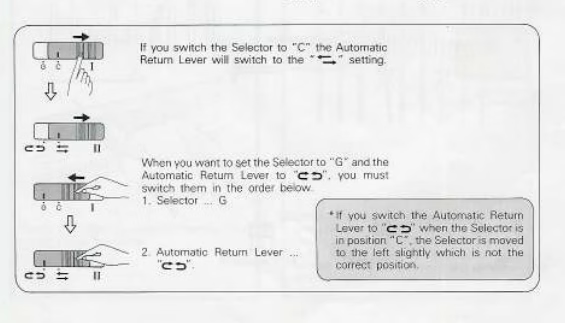
  • check the manual: it says for the automatic “turn” function, the slider needs to be moved to “G” first otherwise it causes problems.
  • make sure your needlebed DOES NOT miss any needles. It will trigger the turning cams incorrectly.
Are extension rails necessary?

It depends on the width of what you are knitting and also on your comfort level. It also depends on your machine. For example, the needlbed of the Brother KH930 is pretty wide (beyond where the needles are nested). In additional, the end cap on the right-hand side is wide too. So, even if you are moving the garter carriage past the sensor (to activate the “GC ON” light on the machine), rails are not necessarily. Thus, even if you are knitting on the full bed (like shown in this video), rails are not all that necessary.

What are good yarns to use with the garter carriage?

Gareter carraiges can handle yarns thicker than the standard machines can. Mostly because it knits one stitch at a time and pulls the yarn to form one one stitch at a time. Couple of examples: For example, I made a wonderful blanket with “we love yarn” (400 g/1312 m; 100 g/328 m) per ball) which is considered pretty thick for standard-gauge machines. This yarn creates beautiful texture and is machine washable at 104 F. I made a blanket with the cream yarn with tension 9 for the border and 10 for the main body. One skein of mega ball was enough. Two color garter carriages will need thinner yarns (for both feeders). But in both cases, knitters need to experiment with yarns and tensions. The golden rule: if the machine struggles, increase the number on the tension dial (which loosens the tension). Still struggle: the yarn is not compatible with your garter carriage.

Do I need to remove the ribber bracket to use the GC on my machine?

Just the brackets should not affect GC functioning. However, some believe that the best angle for GC to work properly is when the machine is flat. Thus, use the flat table clamps, not the S-curved ones (those that we use to attach our machines to ribbers).

Do I need to use cast-on comb?

Yes and no. Some knitters like to hang the cast-on comb on the 3rd or further rows. Some knit without it. I found that with thicker yarns and for two-color carriage, cast-on combs benefit me. Again: try and see for yourself.
Why are GC needles so expensive?

Simple answer: supply and demand.
My garter carriage is mispatterning.

Again, there are several reasons, including, gunked-up machine. But also:

  • you forgot to activate the GC light on the machine (if your machine is electronic)
  • bad garter carriage needle: replace it
  • not super fresh sponge in the retaining bar
  • bent or defective main bed needles


Brother KH881 serviced and tested in July 2024

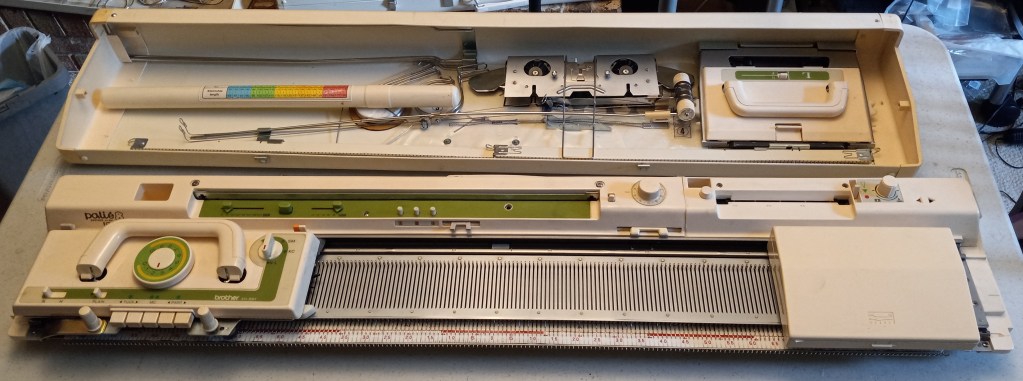
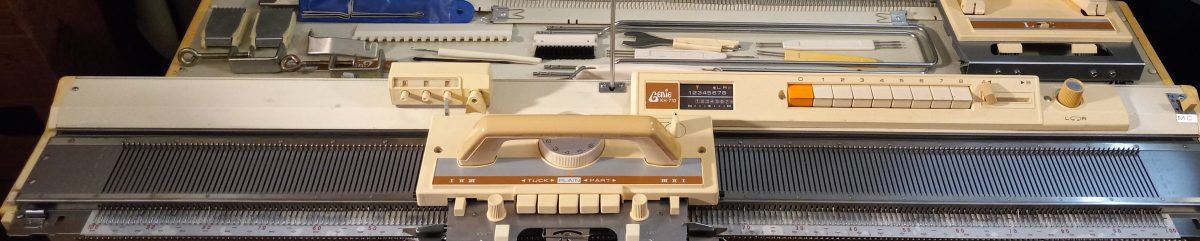
Brother KH881 is a standard-gauge knitting machine with 200 needles and a built-in knit leader. Read more about the pros and cons of the Brother KH881 knitting machine model in a separate blog post. This post is specifically about Brother KH881 serviced and fully tested in my shop in July 2024.

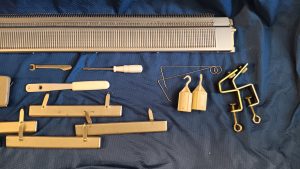
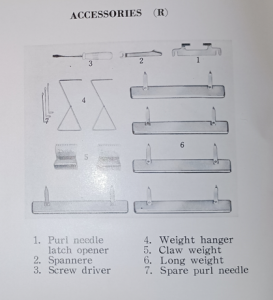
Brother KH881 came to me without a lot of accessories and even without a carriage. I found a replacement carriage and all minor missing accessories.

Most of the other major accessories were present with the machine and almost all accessories will be included.

The still missing minor accessories are:

  • oil: it was old and I had to toss it away (use a Gun oil available on Amazon instead)
  • cast-on thread (you can use any silky and strong yarn)
  • the wax is technically not included but there was a piece still attached to the tension mast and it worked well while I knitted. I will include the plastic case for the wax.
  • A punchcard holder pin is also not included. All the tests shown in my video for this machine were performed without this rod.

These minor accessories are stored in a special toolbox.

The toolbox sits on the needle bed when the machine is stored away.

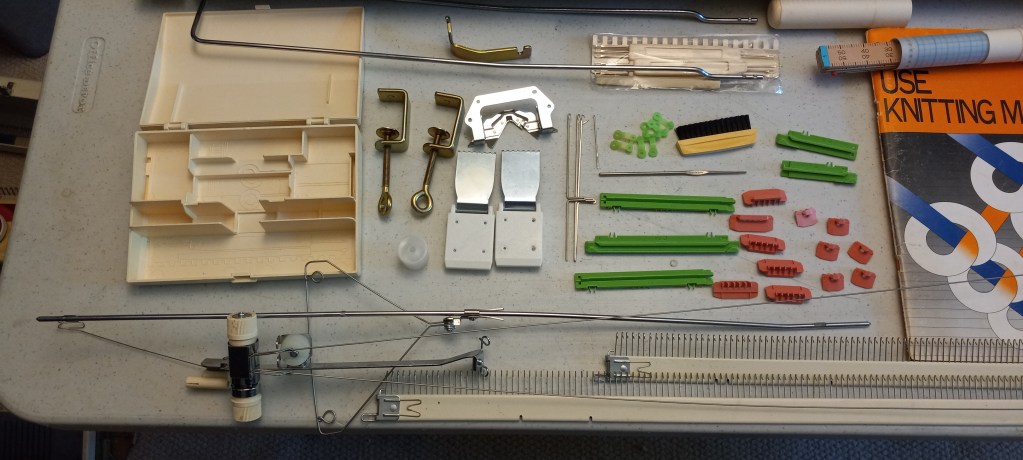
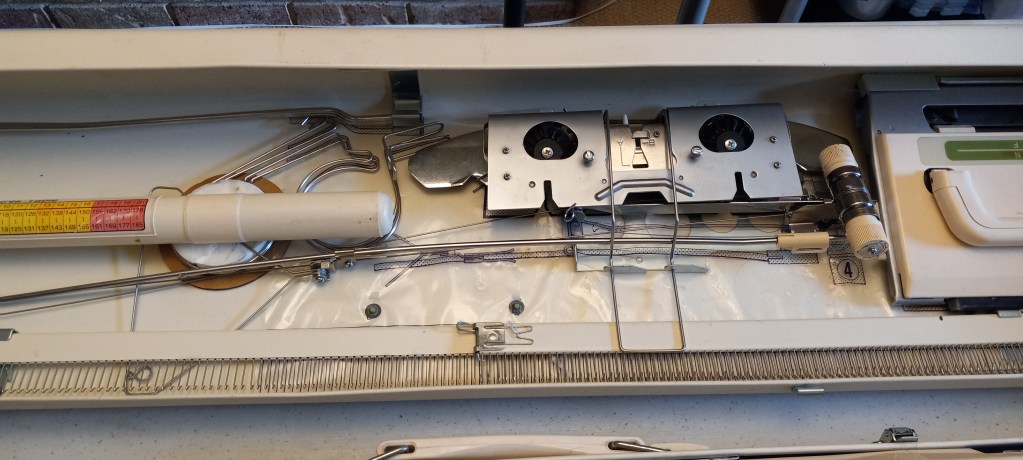
All major accessories are included as well: lace carriage, tension mast, knit leader sheet guides, row counter, cast-on combs, and extension rails. The major accessories fit nicely into the lid. The lace carriage was not tested but it is much simpler than the main carriage, so no problems are anticipated and I checked that all buttons move freely.

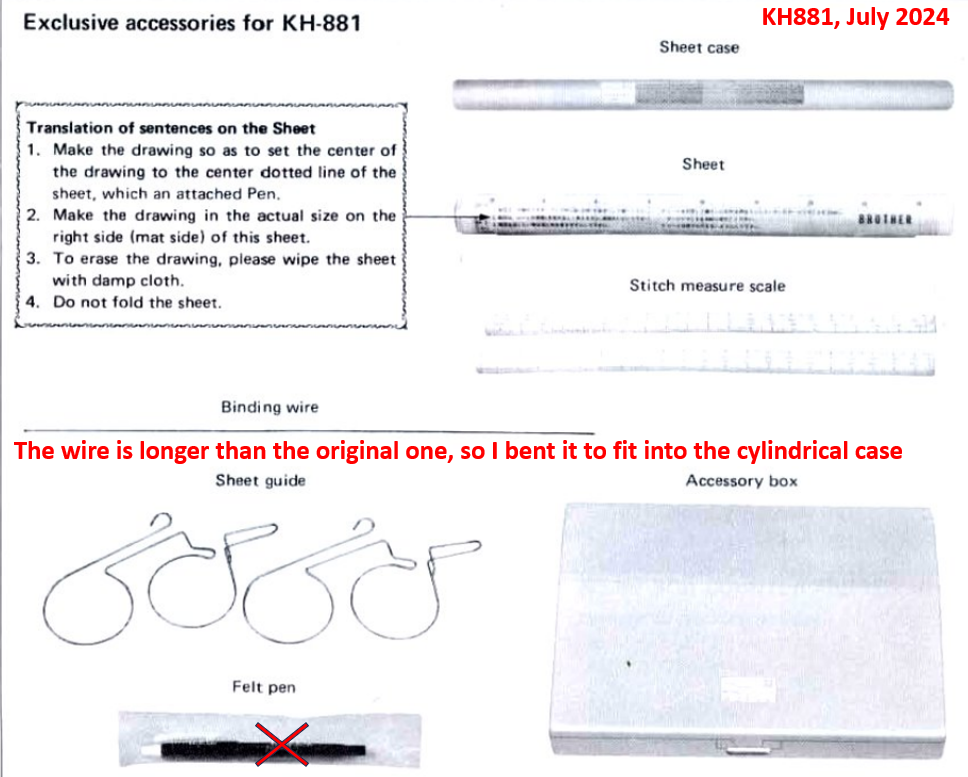
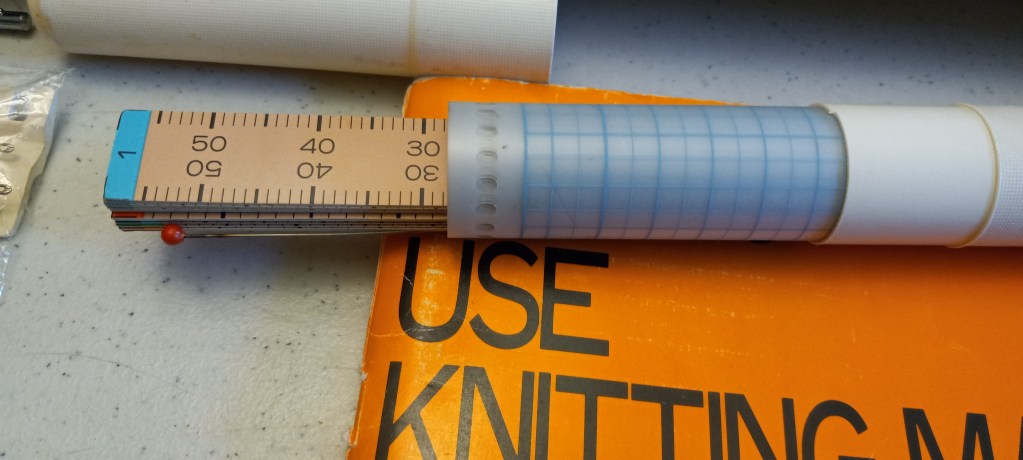
For the knit leader, the only missing accessory is a felt pen (it didn’t write – too old, so I also tossed it away). I read in the online forums that washable Crayola markers work as well as whiteboard markers. To remove, machine knitters advise to use a gum eraser. Depending on the pen, rubbing alcohol on a cotton swab works well too.

The binding wire was originally missing but I included a binding wire from a set from the KL116 knit leader.

The wire I included is a bit longer than the wire that came with KH881. So I bent it to fit into the sheet case. It is very easy to unbend it. The purpose of this wire is to temporarily “seam” the knitted panels together.

So, the punchcard set is brand new – never used. It contains 20 cards, 6 of which are for lace knitting. The machine will come with the original hard copy of the knit leader manual and the hard copy of the instruction manual as well.

THE WORK DONE ON THIS MACHINE:

The machine was deeply cleaned, all needles were inspected, and faulty needles were replaced. The sponge it replaced in the retaining bar. This machine was given a lot of TLC, in particular to the punch card reader and the needle replacement mechanism to ensure they function well. I then ran tests on a full bed to again ensure needle selection on the full bed and that all needles form stitches as they are supposed to.

The knit leader was not tested but I checked and all the buttons and levers move freely and advance when triggered.

Now about the tests:

I tried 4 different yarns on this machine: one blend, and three acrylic yarns. The thicknesses varied too. The machine formed stitches wonderfully with all these yarns. I knitted on a full bed using tuck-stitch, slip-stitch, and fair isle. I used card #1 and other cards (with a 24-stitch repeat pattern) too. I like using card#1 (which has a 2-stitch repeat pattern and thus, every other needle is selected) because it immediately shows incorrectly selected needles. Additionally, any errors will be shown on the fabric (especially in Fair Isle).

Watch the full video of these tests.

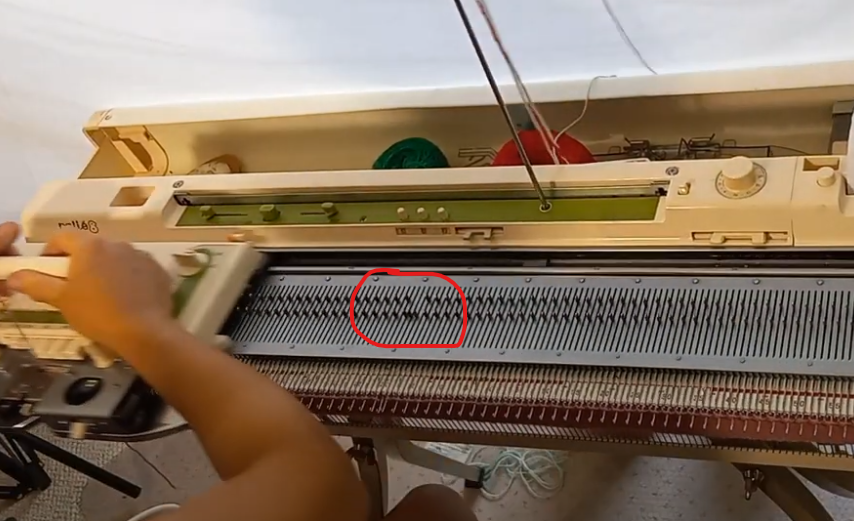
There was only one hick-up during these tests. When I was knitting tuck-stitch with the 2-stitch repeat pattern (using card #1), I did not notice right away that in one place, one needle is selected incorrectly. There was a 3-needle cluster (around left-hand side needle #20) that I did not catch.

Three-needle cluster due to the faulty (and not correctly selected) needle during the tuck-stitch knitting on the full bed.

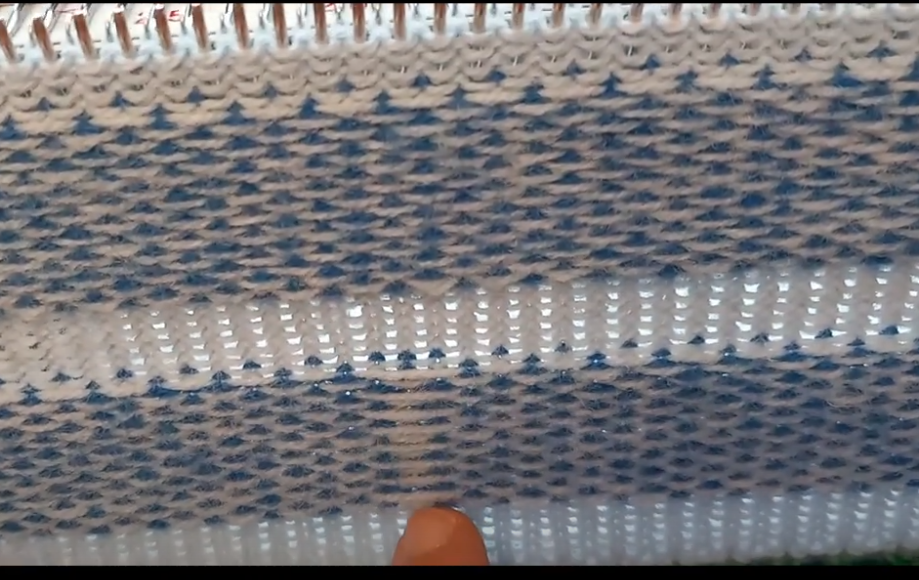
… And the knitted fabric did not show this flaw (tuck stitch hides the errors well – see the picture below).

Even though the needle was NOT selected correctly around needle #20, the error did not translate in the pattern: all stitches look the same.

So, when I started knitting fair-isle with the same punchcard and 2-stitch repeat pattern, the same needle was not being selected correctly.

… But this time, I was able to clearly see the incorrectly formed stitches (due to the color contrast of the two yarns).

The reason for mispatterning was a bent needle: the end of the needle that gets pushed by the selection plates was out of place due to this bent. After the faulty needle was replaced, I encountered no more problems with the needle selection.

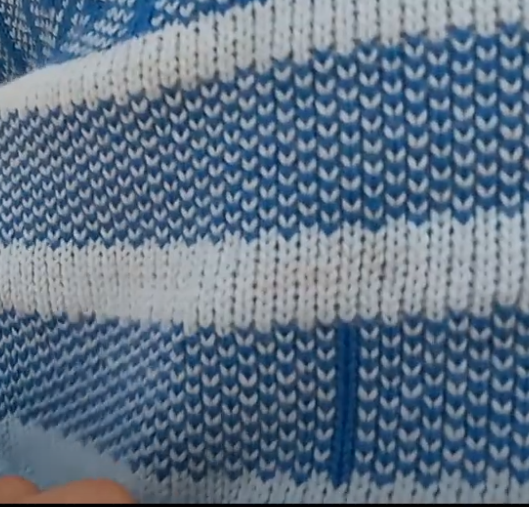
The top pattern was knitted after the faulty needle was replaced: notice long floats around needle #20 are no longer present.

Below is the image showing how the incorrectly-selected needle manifested itself in the pattern.

Below are the things I made from the panels I knitted while testing this machine with various yarns.

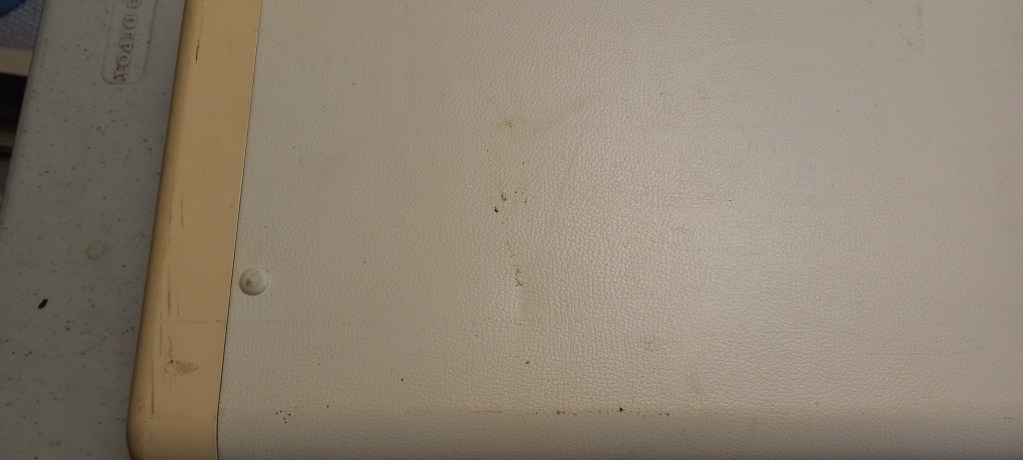
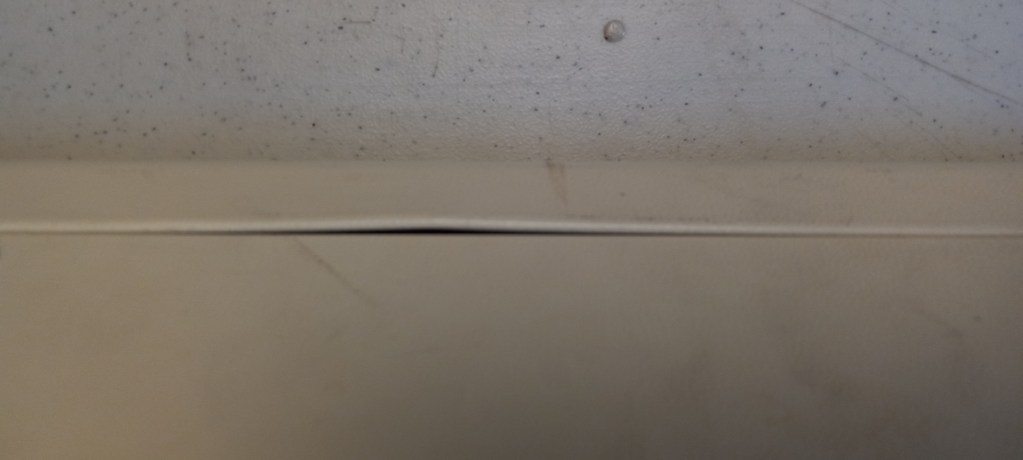
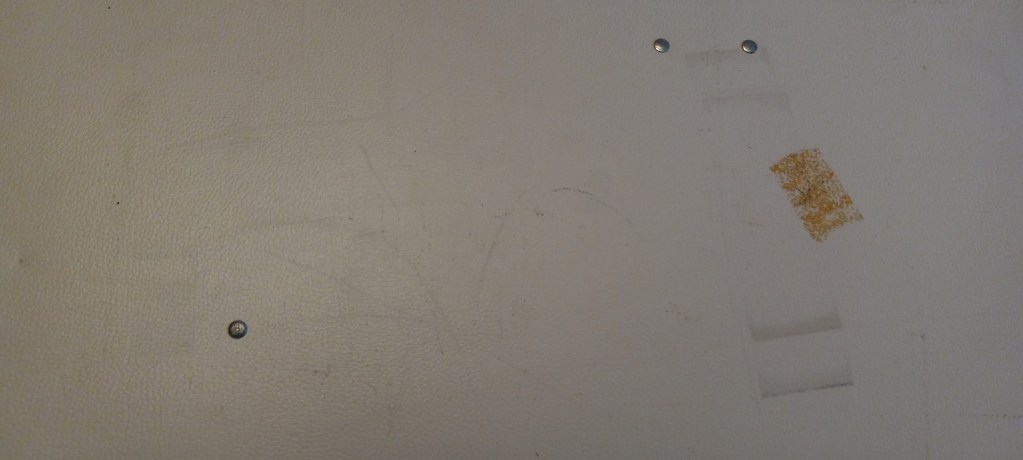
Now about imperfections: they are mostly related to the case (minor stains, scratches, and slight bends). See the pictures below.

Additionally, there were some very minor rust spots on the case, which I covered with a special coating to inhibit the corrosion and to cover it up as well (not shown) These rusty imperfections are not visible.

I hope you will consider this machine for your knitting needs.

Happy Knitting!

Vintage KnitLeader KL111 prepared for Sheryl, April 2024

KnitLeader KL111 + customer’s ship label

$44 + customer provides shipping label

$44.00

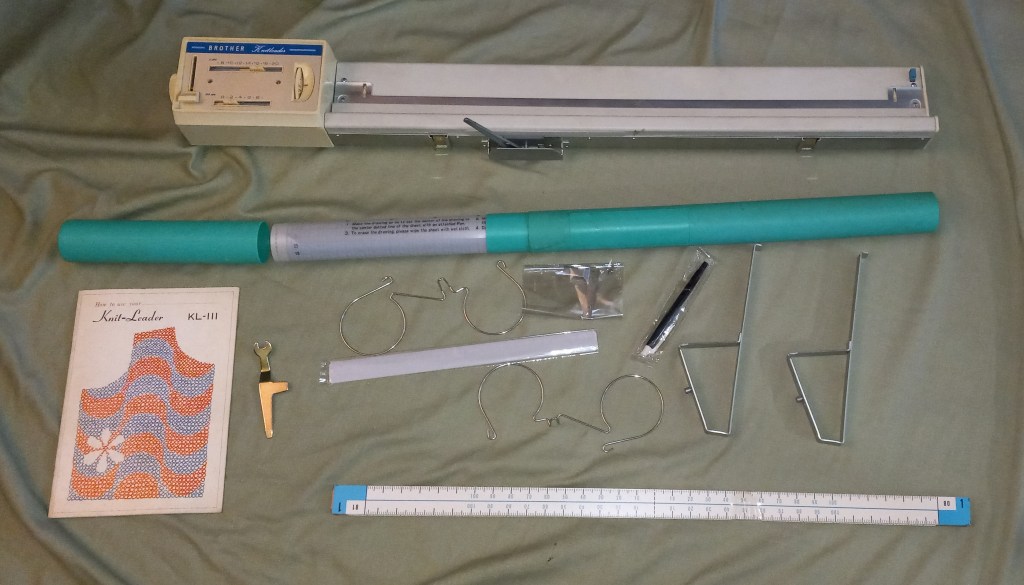
KL111 knitleader has all major accessories, including a good-looking hard copy of the manual, mylar sheets, scales, ruler and very important triangular brackets. The post below is about a particular knit leader but to know more details about the KL111 model, refer to my other post.

I did not test the knit leader on the machine but all the buttons, knobs and levers move freely. I inspected it thoroughly and wiped easy-to-remove dust and grime. Some stains remained – I do not like rubbing the plastic parts too extensively out of fear of damaging this old plastic even more.

The ratchet with the white handle is missing. So I will include the ribber spanner that fits well although is not as ergonomic as the original one. The handle can be improved a bit by applying several layers of tape.

The long scales seem like were never used. The mylar sheet also looks in great shape.

The knit leader tripped will be included if your carriage did not come with one.

The control center is in great shape also:

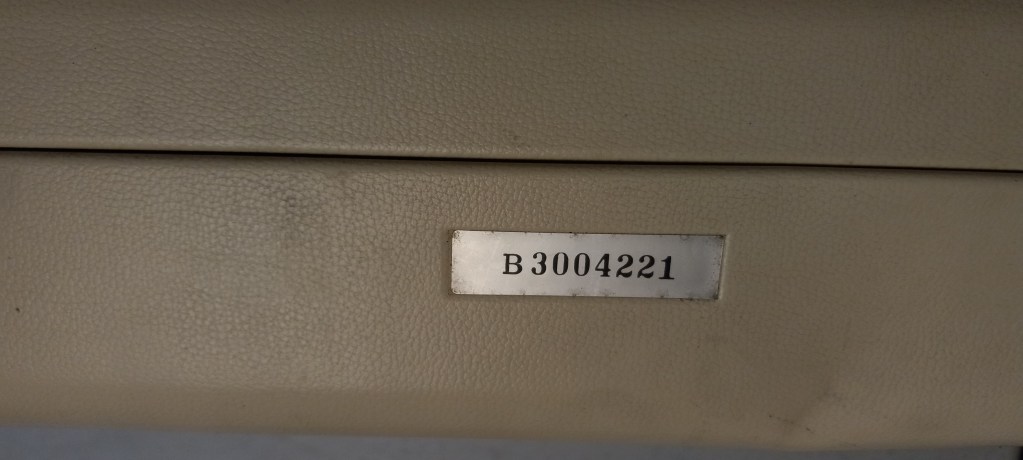
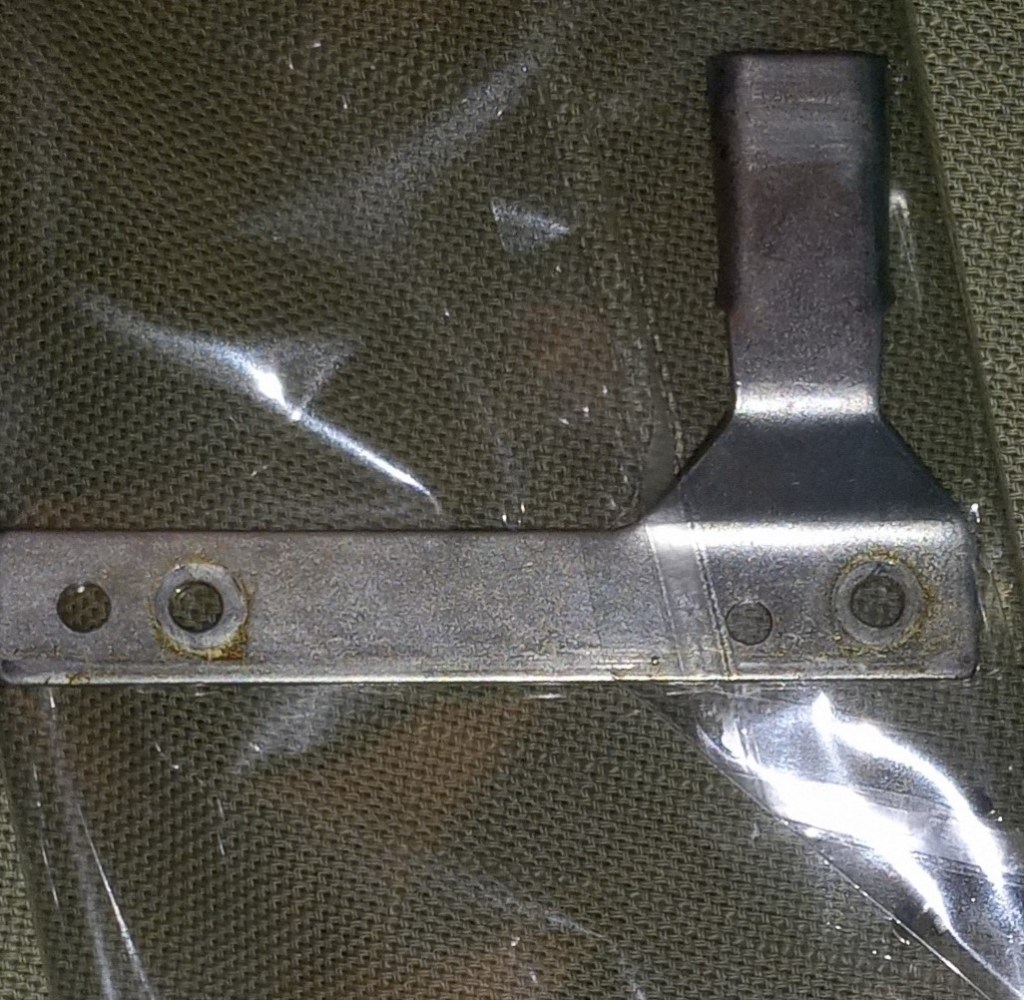
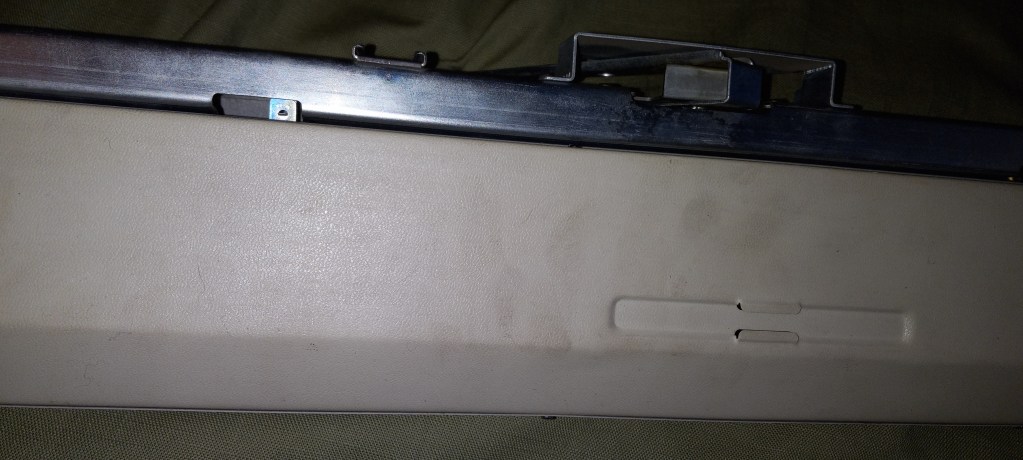
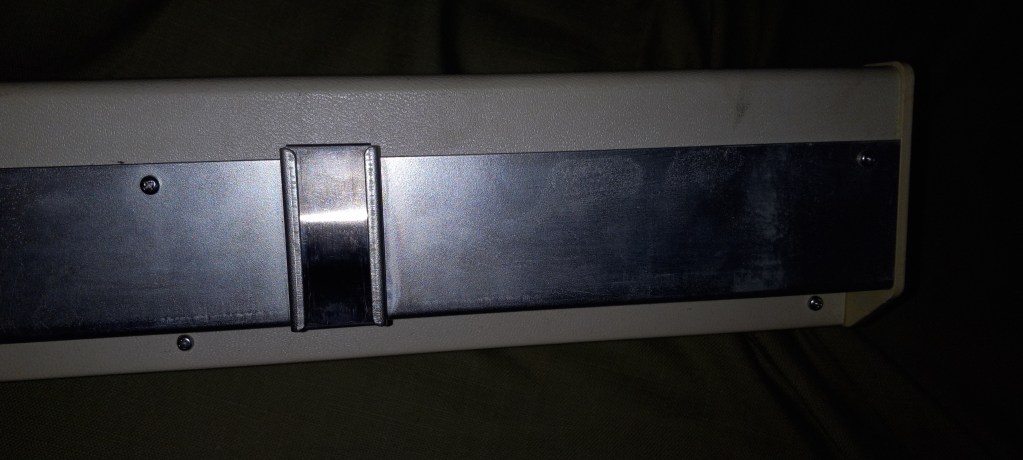
Below are some imperfections I noticed when preparing the knit leader. Most are the different degrees of staining on the boxy of the knit leader.

About retaining bars in knitting machines and ribbers.

… this article is in constant progress as I learn about various knitting machines and their retaining bars.

Almost all knitting machines and ribbers have retaining bars. Some machines have retaining bars with a sponge attached to them. Some machines (the majority of plastic flatbed machines) have only a long and narrow sponge (without the metal holder). Ribbers come with either a “retaining bar+sponge” assemble or only with the plastic retaining bar (no sponge strip).

The main role of these retaining bars is to hold the needles in place and to prevent it from bouncing up and down when knitting.

Below are the situations when you want and need to remove (and inspect in many cases) the retaining bar:

  1. When you just purchased your machine (especially used and NOT recently serviced), the first thing you need to do is to remove your retaining bar and inspect it. I made a short video on how to do it because I have been asked about it so many times by my customers.
  2. When you need to replace faulty needles.
  3. When you need to clean your machine.
  4. When you notice your knitting machine mispatterning without any good reason.

Hopefully, you purchased your knitting machine new or recently serviced. In this case, the sponge should be 1-2 cm above the metal edge of the retaining bar.

But in most cases, this is not the case. Thus, it is possible that when you remove the retaining bar, you will see a disintegrated sponge. I’ve seen some spongy strips being just a gooey mess. The old sponge needs to be removed as soon as possible (since it often corrodes the needles) and replaced.

There are two ways to approach this replacement.

First approach: just replace the spongy strip

If you decide to replace the sponge, you will need to remove all this goo. I first use a flat-head screwdriver to scrape all the residue out of the retaining bar canal. Then, I use “Goo Gone” to remove the rest of the residue. I typically do it outside because it is a very messy process. I pour a thin layer of “Goo Gone” liquid into the retaining bar and wait for hours. Then I scrape the remains of the old sponge again with the screwdriver. Lastly, I wash the retaining bar with soap and water, wipe it really well and let it dry (or blow dry it). You can purchase just the sponge in my store.

I sometimes read in forums that some thrifty machine knitters get a simple weather stripping and use them as sponge strips. Well, those have different dentistry and sometimes do not have a silky ribbon on one side. Also, they are not suited to be exposed to oils and might decompose rapidly leaving a sticky (potentially unremovable) residue inside your machine.

I read that experienced machine knitters use different ways to attach the spongy strip to the retaining bar. (By the way, the width of the spongy strip is not as critical and it can be a little bit narrower than the channel of the retaining bar but not by much). I tried different glues and my current choice is hot glue. Some machine knitters use wood glue. I apply the glue to the metal part of the retaining bar and attach the strip to the metal by the sponge side (not the silky ribbon side). I then tape the ends if the sponge to the plastic ends. I like using medical tape. Only one layer of the tape is enough to secure the ends of the sponge. More layers will only get stuck when you insert the newly refurbished retaining bar back into the machine. To avoid stripping this tape, push it down on the ends of the retaining bar while inserting it into the machine.

Second approach: buy a new retaining bar

Or if you do not feel like dealing with all this mess, you can purchase a retaining bar with a sponge already in it. Before you order a new retaining bar, make sure you measure the dimensions of your old bar: its width and its length.

Most commonly used by machine knitters Brother, Studio/Silver Reed/Singer, and Toyota knitting machines have somewhat similar retaining bars but there are some differences depending on the model and the gauge of the machine.

For the retaining bars for these machines, there are three different lengths (41, 43, and 47 inches) and two different widths (0.375 and 0.5 inches). This is why it is important to measure your old retaining bar to ensure that you are getting the retaining bar suitable for your machine. Most JUKI, Toyota, Silger/Silver Reed/Studio, Artisan knitting machines use 0.375-inch wide retaining bars. The lengths are either 41 or 43 inches (depending on the model).

I’ve read stories on FaceBook groups, where the new machine knitters were puzzled by the fact that they JUST replaced the sponge bar and the needles do not move, advance, or retract the way they are supposed to. I especially see I happen to be the owner of 8-push button Brother knitting machines. There is somewhere out there some incorrect information on the retaining bar for these machines. 4-push-button machines use a 0.375-inch wide retaining bar and the 8-pushbutton machines use a 0.25-inch wide retaining bar. (I’ve refurbished over a dozen pushbutton machines and I know the difference first-hand).

Brother ribbers use plastic retaining bars without sponges. When (re) inserting the retaining bar into the Brother ribbers, the concave surface (the “channel”) should face you.

There are machines with unique retaining bars – I will update the blog soon when I learn more. I am also putting a table on machines (and models) and retaining bar compatibility. Stay tuned!

In the meantime, enjoy your adventure in retaining/sponge bar replacement!

PS. I measured several dozens of retaining bars with my calipers. Even though the “official” measurement is 0.375 and 0.5 inches, mine are measured as 0.40-0.41 and 0.44-0.46 inches respectively. This inaccuracy in inches makes me like the mm scale (aka metric) a bit better. So the narrower retaining bars are 10.0-10.5 mm while the wider are 11-12 mm wide. Who knew that just 1 mm would make such a difference but it does! I had an incorrect bar installed on my KH581 8-pushbutton machine and the needles would not go back from E to B (or A) position!!!

Review of Scrubby yarn and how it knits on circular knitting machines Addi

Scrabby yarn (from IceYarns or from RedHeart) has sort of an eye-lash thread but with the “eyelashes” are created with the twistiess. It is typically used to knit washcloth for dishes and baths

Knitting by hand with this yarn was fun – it creates a unique texture without any effort. I also decided to use my Addi circular machine to see if I can make household items faster. So, I was able to knit loofahs, coffee holders (aka reusable sleeves for paper cups), place holders, table pads and coasters.

Both IceYarns and RedHear offer a very wide variety of colors, including solid, two and three color variegated types. I chose white and black yarn because in my opinion it hides all the crumbs and spills really well

The IceYarn offers scrubby yarn as 100% polyester. One skein holds 3.53 oz (100 g) and contains 103 yards (95 m). Red Heart offers both 100% polyester (100g/3.53 oz and 85 meters/92 yards per skein) and 100% cotton yarn (weight and yardage depend on whether the color is solid or variegated). I only tested the 100% polyester yarn because I had cotton washcloths and I could never get rid of the smell of dirty dishes even after washing the scrubbies over and over again.

The cast-one was straightforward and relatively easy. It did help to keep the tension loos but not too loose because the yarn is silky (very smooth) enough where it can skip stitches (which we don’t want). However, I started using contrasting waste yarn because it is easier to manipulate the stitches afterward (in order to put the washcloths together )

The knitting on the machine became significantly easier after the first two rows. However, some of the stitches did not sink into the slots on their own and I had to help “them” . Even though the yarn will hide all defects because of the variegated colors and because of the twisties on the yarn, I still did not want to create tuck stitches because they sometimes lead to missed stitches. Check out my youtube video on how I dealt with these stubborn stitches.

A square scrubby took 12 rows. In the same video, I demonstrated the techniques I used to finish these square scrubbies. I tested them and they are washable on a regular cycle and even dryable on “knits” cycles. Coffee mug sleeves would probably take 12-30 rows depending on whether you like it single-or double-layered. Placement mats should be done on large Addi. I made mine rectangular and double-layered with 60 rows.

Hague Linker – review by ComfiKnits, April 2022

I purchased a new Hague linker directly from Hague in UK and so far I am very pleased although not everything is ideal. This is the only linker that I ever used so I don’t really have what to compare. My linker with the one with the electronic foot pedal control but the same pros and cons and advice are applicable to a manual machine.

What I did on Hague linker:

  • Linked the edges of the scarf knitted on standard knitting machines. As the Hague manual mentions, it is extremely important to get a hang by practicing putting the knitted edge on the linker’s pegs to create a very nice and even seam.
  • Linked the open stitches on every and every other needle. I use this technique when I was to create more stretchy edges. Check out my video on those.
  • Linked the edges of the scarf knitted on a bulky machine – was very pleased as well

Overall recommendations:

  • Learn how to put the knitted edge efficiently and evenly on the pegs.

    I typically try to put the whole piece on a linker – it helps me to evenly distribute the stitches along the piece length.

  • Always knit blank 10-12 stitches at the end to easy take of the linked piece of the machine and to hide the loose ends. By ‘blank’ stitches I mean the thread looping on itself without any underlying fabric.
  • Push the fabric placed on pegs as far as possible so it does not slide off.
  • Keep even tension between first and second fabric layer when joining them on pegs

Pros and Cons.

(+) The edge is nicer than when sewn by hand

(+) Faster than linking by hand

(+) Easy to see as you knit whether the edge is even or not

(+) the size of the linker is compact enough so I sometimes move the whole machine if for some reason I feel that moving the ring with pegs is not convenient. Or sometimes I move around myself whatever works, right?!?

(+) very well-written instructions and manual.

(+) If the needle breaks, it is easy to replace

(+) Parts are available from the manufacturer.

(-) even though there is a tension mast and a threading mechanism with tension control, I feel the flow of the threading yarn is not even. I tried to wind my thread in a different way and it still catches one in a while. But that’s ok and is easy to get control over.

(-) it does miss stitches once in a while. So the yarn threading, tension, combination of thread and the thickness of the knitted pieces are all important.

(-) Even though replacing a needle is relatively easy, putting it in the absolutely correct position requires trial and error. It is doable, yes! But I had to step away from my Hague linker for a couple of days not to get too frustrated

Pros and cons specifically for an electric linker:

(+) Hands are free – all control over the needle movement and speeds are through the foot pedal.

(+) The electric linker can be used manually as well but not many stitches.

(-) I wish the cord was a bit longer. But I wonder if this is some sort of safety precaution because the cord on my sewing machine is also shorter than I want.

I learned a lot by simply using and experimenting with various techniques. There is still a lot to knit and to link and to learn on Hague linker! Below are some products I finished on Hague!

Since this is the only linker I ever tried I cannot really compare it to anything else rather than sewing the garment pieces by hand and on a sewing machine. Overall I am very pleased and will continue getting a hang of various techniques, including decorative ones, on my Hague linker.

Brother yarn winder

As all my other assesories, this yarn winder was inherited by me with the two large lots of knitting machine and their assesories.

After testing several variety of different yarn winders, I realized that this model and this yarn winding mechanism is actually my favorite (check my blog for the pros and cons of other yarn winder as well as a table comparing severla at once).

Like most home and hobby yarn widners, this one has a screw-on clamp that has a winder range and allows the winder to be attach to variety of thick and thin table surfaces.

Both of the yarn-guide rods have a spiral thread-through mechanism – so if you screwed up your yarn winding, you don’t have to cut it to start all over (like some other models).

The second rod (or yarn guide) is rotating which allows for a more even yarn distribution and also for a bigger yarn skeins to be wound.

Well, it is kind of hard to find many words to describe this yarn winder (as well as others).

I think it would be better if you simply watch my short video:


I really hope you can buy this yarn winder since , in my opinion, it is one of the best ones!!