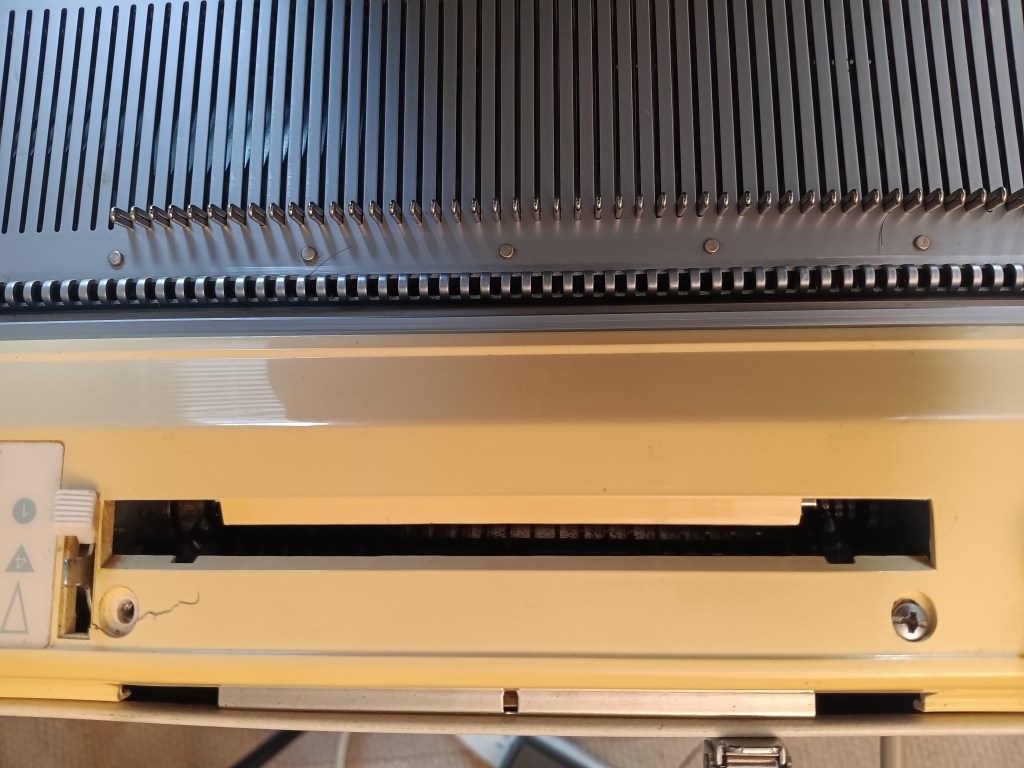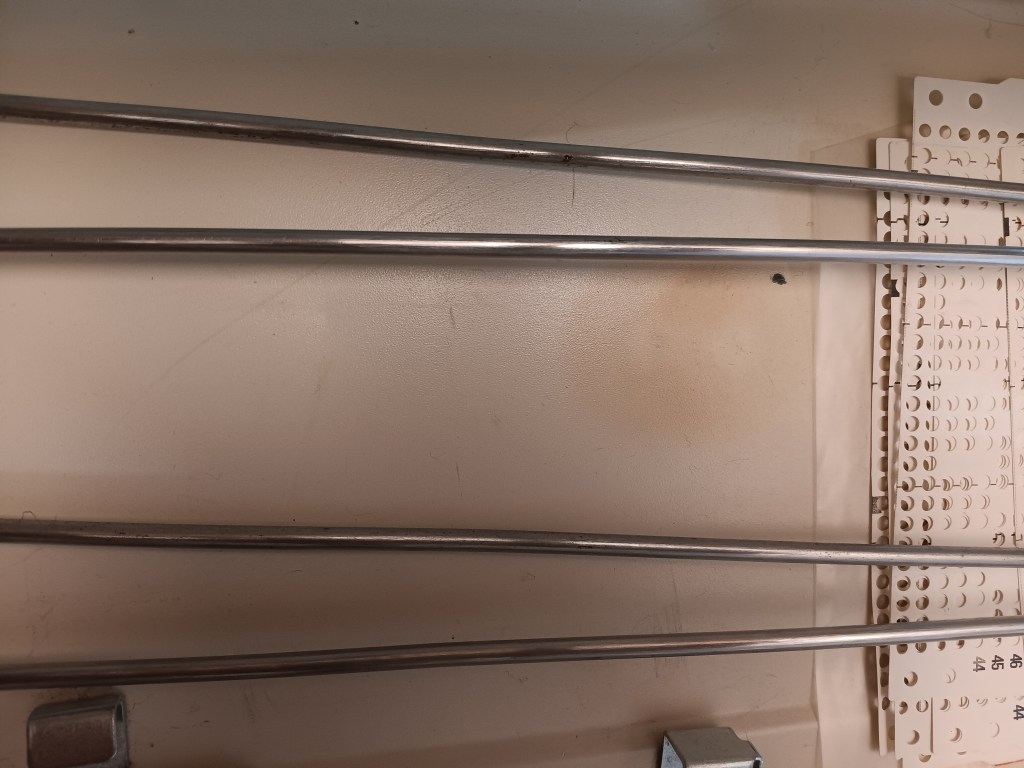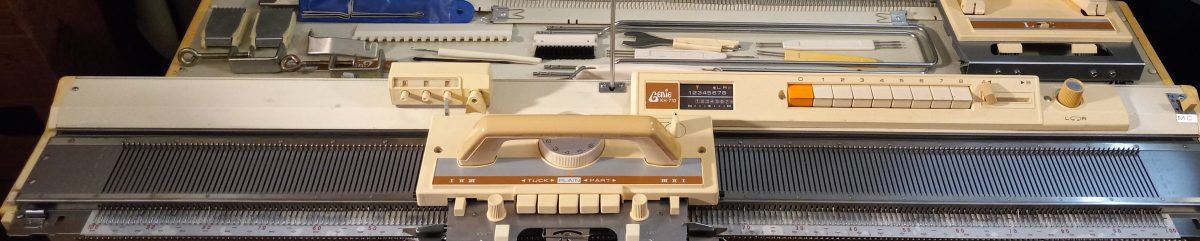
KnitKing KH881 refurbished, serviced and tested in my shop in July 2024

KnitKing KH881 knitting machine is a standard-gauge knitting machine with 200 needles, 4.5 mm apart. It is identical to Brother KH881. It contains a built-in knit leader. Read more about this model in my Knitting Machine Encyclopedia. The remainder of this article will be dedicated to a specific KnitKing KH881 knitting machine, serviced in my shop in July 2024.

This machine was cleaned; the card reader mechanism was thoroughly inspected and cleaned as well. The sponge in the retaining bar was replaced. All needles were taken out, cleaned, and inspected. Faulty needles were replaced with new ones (from a new stock). The knit leader was also deep-cleaned and inspected.
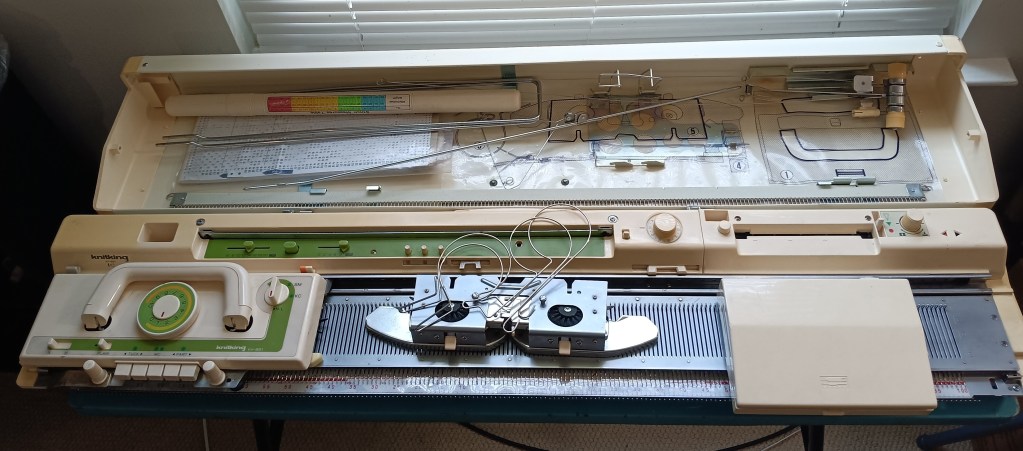
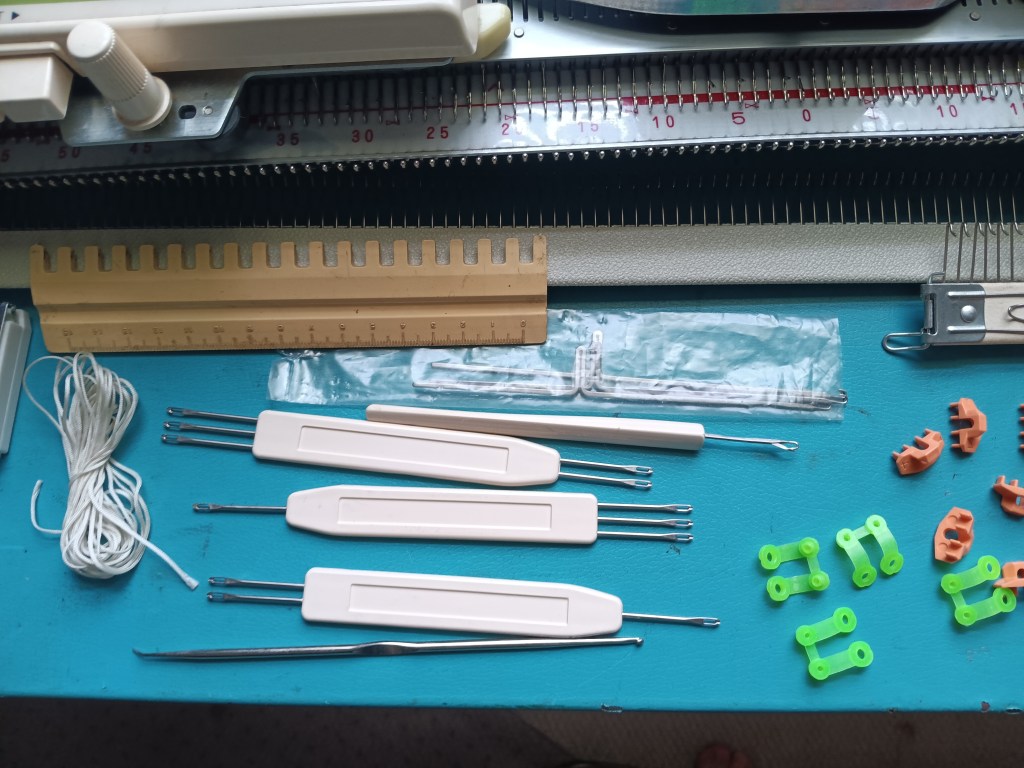
The machine came to me without the carriage and all other major accessories. I collected the major accessories from new and old stock to ensure a complete set. Thus, the knit-leader scales, sheet guides, mylar sheet, extension rails, tension mast, sinker plate, tool storage box and cast-on combs are all included.
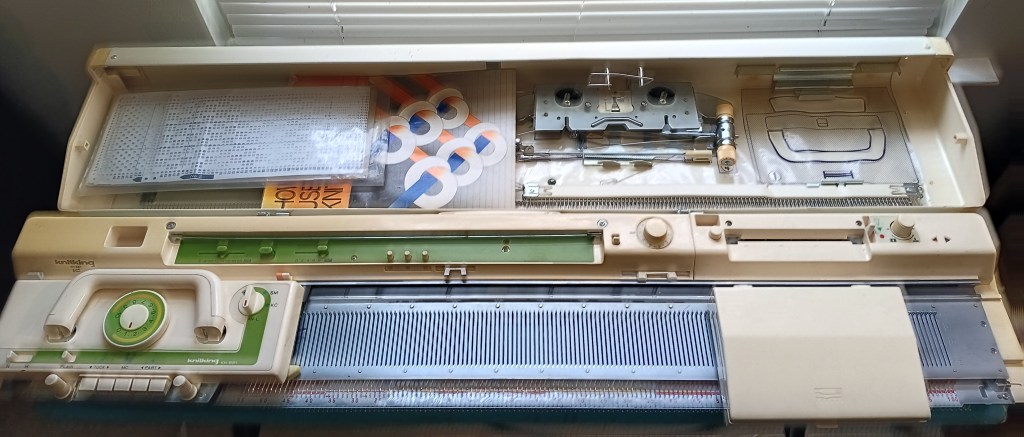
The lace carriage, however, is NOT included with this machine. The absence of lace carriage is reflected in the price of the machine. Lace carriages can be purchased either as a new- and/or old-stock online for $70-100.

The machine was tested by knitting on a full bed to ensure that the patterning is flawless on the whole needle bed and that all needles form the correct stitches. Watch the video of these tests. I demonstrated in another video how a faulty needle was identified and replaced. after it was replaced, all stitches formed very nicely. The patterning on the full bed was done using tuck-, slip- (part) and fair-isle stitches. All patterns were knitted beautifully.

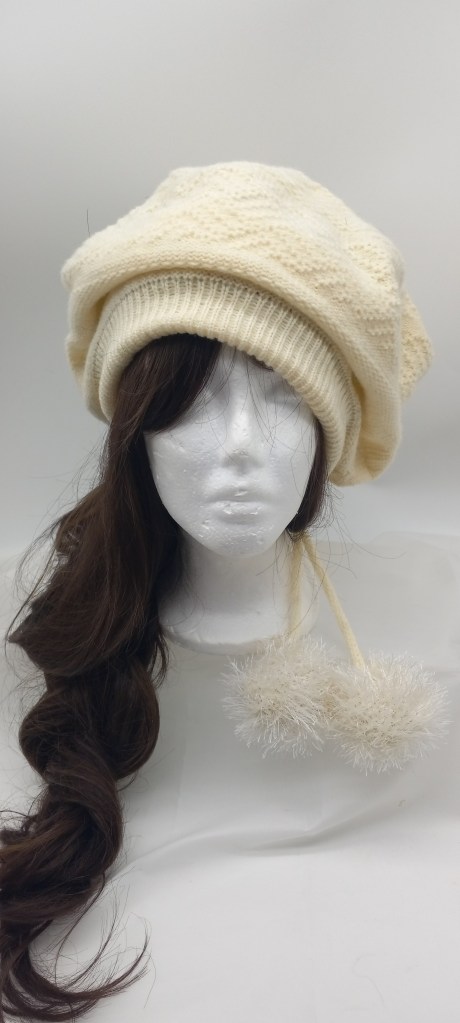
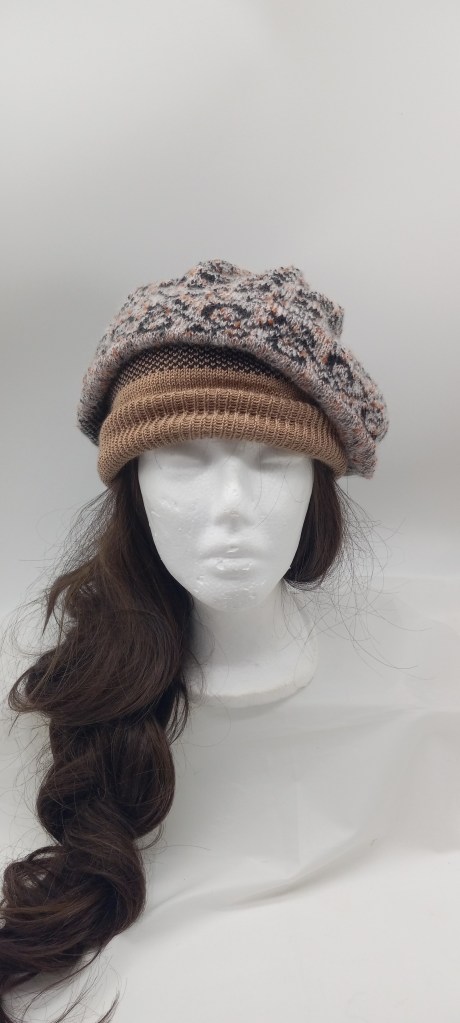
The carriage moved very smoothly and I did not experience any static with the two different yarns I used: very silky etamin yarn, 100% acrylic yarn of fingering weight and a textures yarn with some fuzz and occasional boucle features. The machine handled all these yarns wonderfully. Below are the items I made from the fabrics I knitted while testing this machine. They are going to the local charity.
The knitleader was not tested with the mylar sheet but all buttons and levers of the knitleader move and the wheels rotate (thus, the paper will advance) as the carriage moves across the needlebed triggering the knitleader advancement mechanism.

Because the machine did not come with this particular carriage, the color of the carriage is lighter than that of the plastic on the rest of the machine: it is yellowish from the sunlight damage.

The long cast-on comb is in excellent shape but is from my personal stash. The color is a bit off-white since it is from another machine.

The majority of the minor accessories are also included, including a hard copy of the manual.
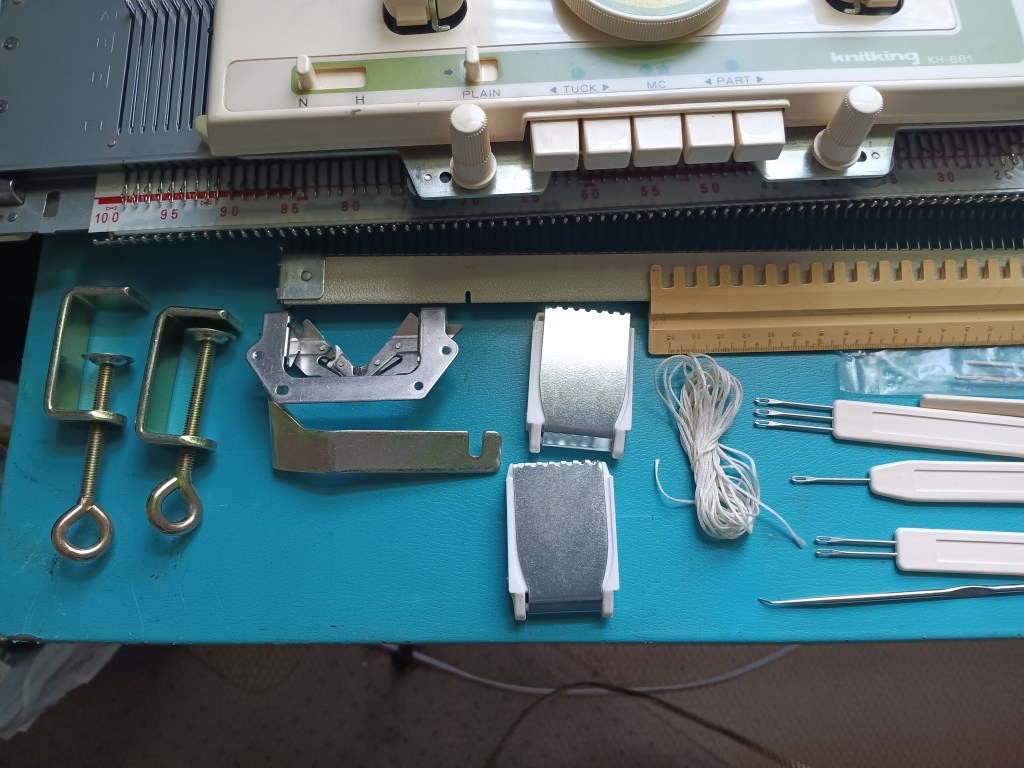
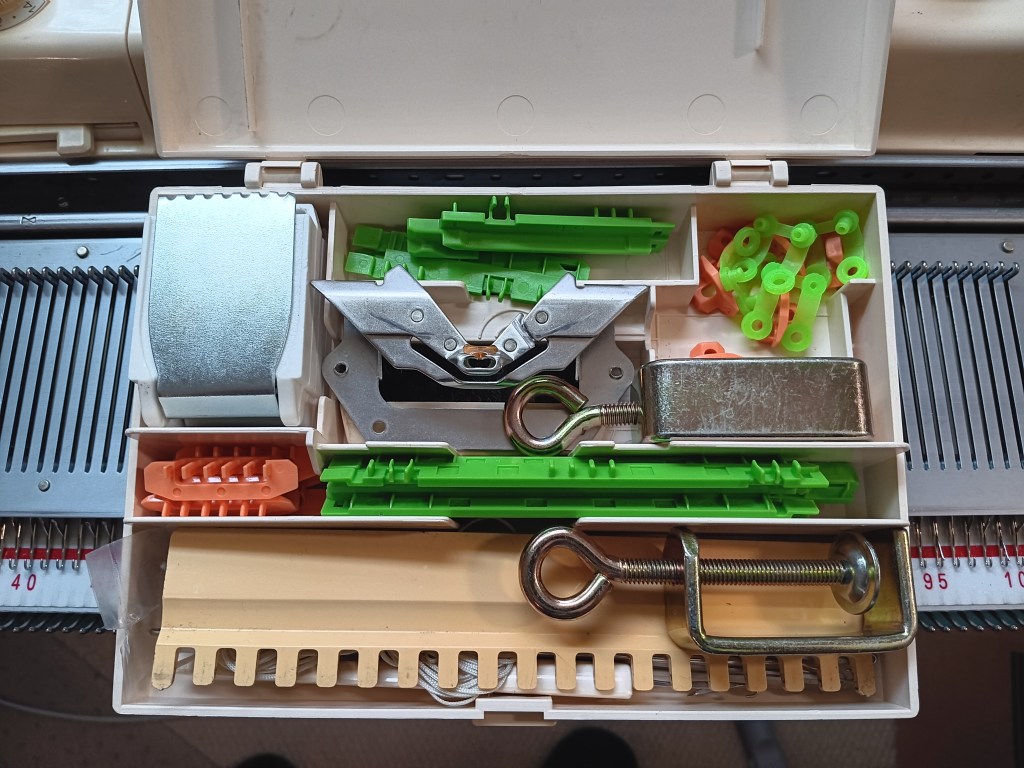
The toolbox sits on the needle bed when the machine is not in use.

All minor accessories fit inside a toolbox with a lid. The table clamps and the craw weights are from the new-stock and are still clean and shiny.
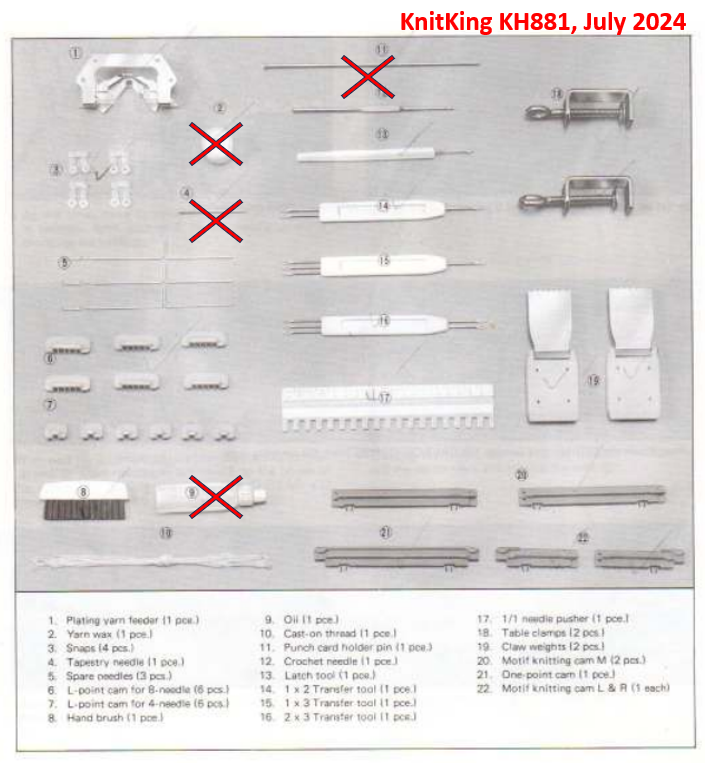
A couple of minor accessories that are missing and not going to be included are:

  • tapestry needle,
  • punchcard rod (during my tests I knitted without using this rod and the punchcard reader worked well and the cards advanced without problems)
  • wax – the wax that came with the machine was so old, it stumbled.
  • oil – it was brown and old so I disposed of it. For your knitting machine needs, use Hoppe’s gun oil available on Amazon.
The only knitleader accessory that is not included is a felt pen. I read on forums that Crayola markers work well. Check out my Knitting Machine Encyclopedia on recommendations for the felt pen substitute.

Now about imperfections:

  • The color large cast-on comb is a bit off because it did not come with the machine and is from my personal stash
  • No lace carriage is included, which is reflected in the price.
  • the case and the case lid have some minor bends and scratches (too many to list here)
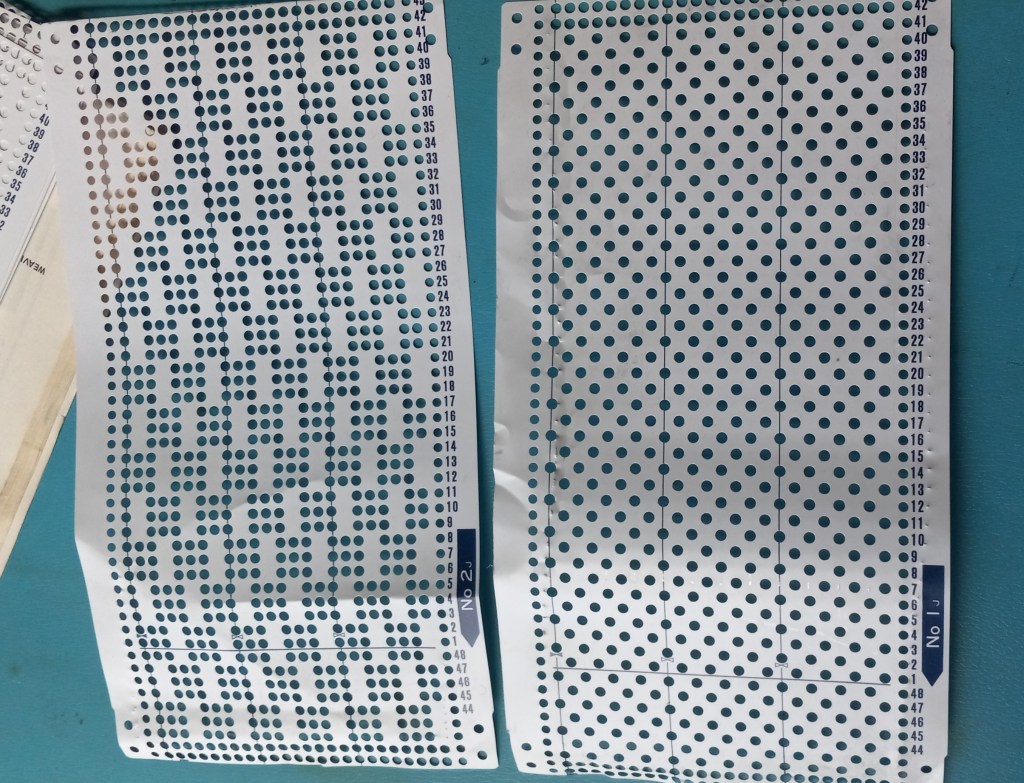
  • Some of the punchcards that came with the machine are a bit torn/bent but they still work really well (I’ve seen cards in worth conditions and they still worked well)
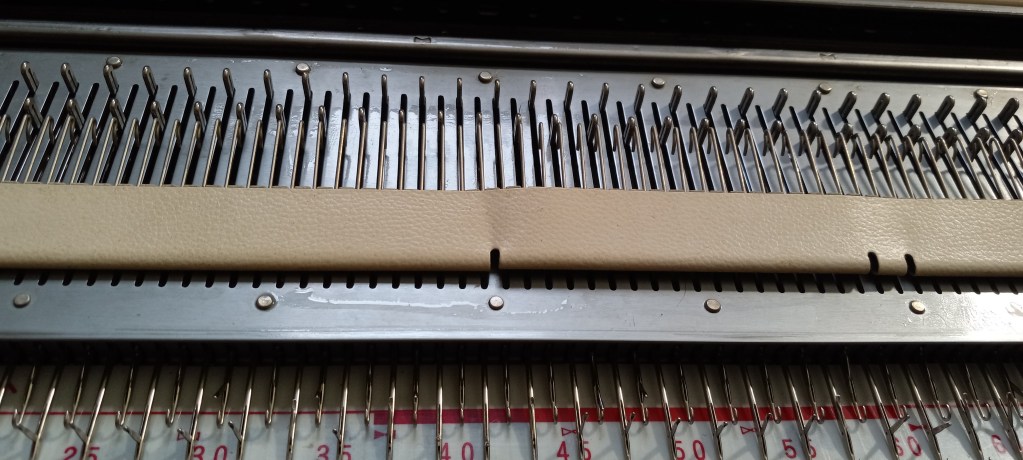
  • The small cast-on comb has a slight bent. It does not affect its functioning (latching onto the stitches). See the video demonstrating that the teeth latch onto the stitches very nicely without any problems. In the video, some of the teeth are slightly bent. I already unbent them (which was very easy). But keep in mind that these teeth bend easily but it is also very straightforward to push them back into their correct position.
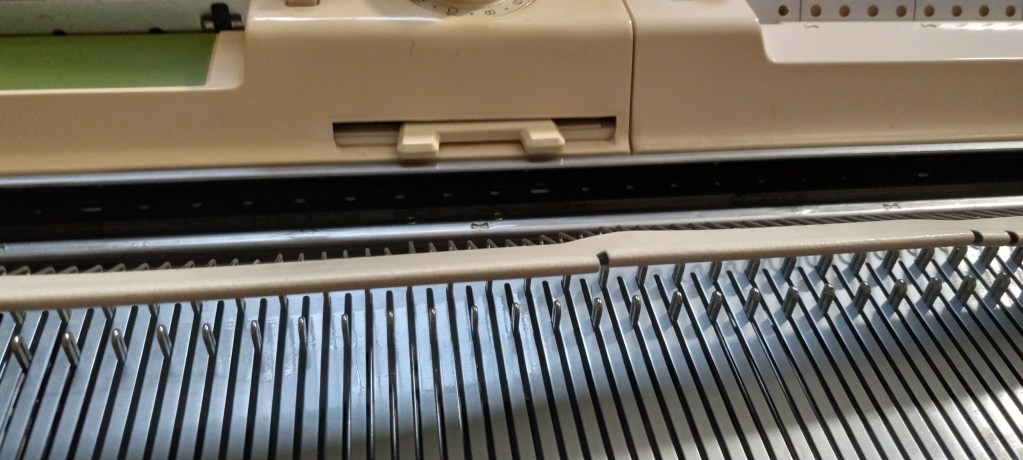
Happy knitting with this wonderful machine!

Brother KH860 knitting machine cleaned, serviced and tested in my shop in August 2024

Brother KH860 is a standard-gauge knitting machine with punchcard reading capabilities to select needles according to the pattern of the punchcard. Brother KH860 is a wonderful machine. Read more about its pros and cons in my Knitting Machine Encyclopedia. This blog entry is dedicated to a particular Brother KH860 knitting machine, cleaned, serviced, and tested in my shop in August 2024.

The machine was cleaned, all needles were removed and inspected for bends, faulty latches, and sticky latches…. The needles were cleaned, and polished where needed. The faulty ones were replaced with the new stock.

The sponge in the retaining bar was replaced. The machine was cleaned on the inside (without any major disassembling: I removed the end caps and the top plastic panel). The carriage was deep cleaned. All buttons and levers on the carriage move freely. The sinker plate was also cleaned and inspected. The tuck wheels move well. The brushes are in good shape.

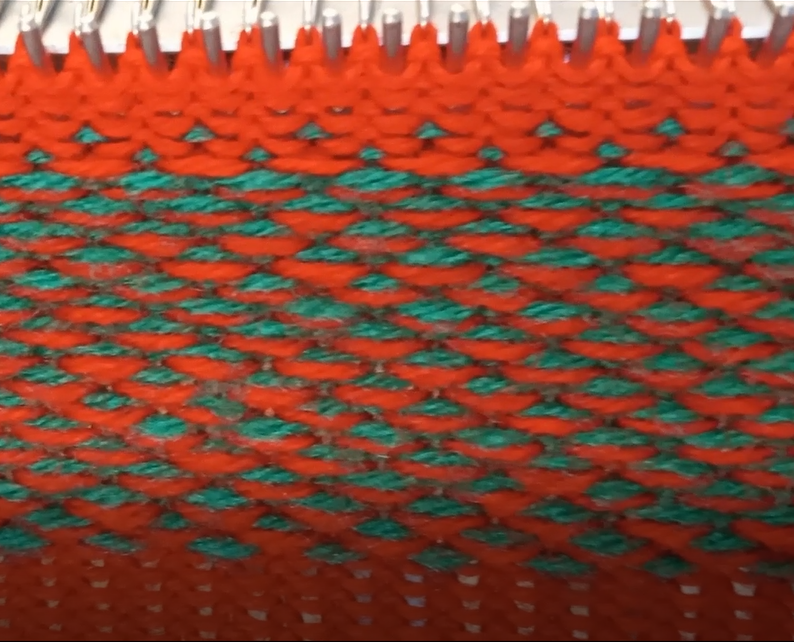
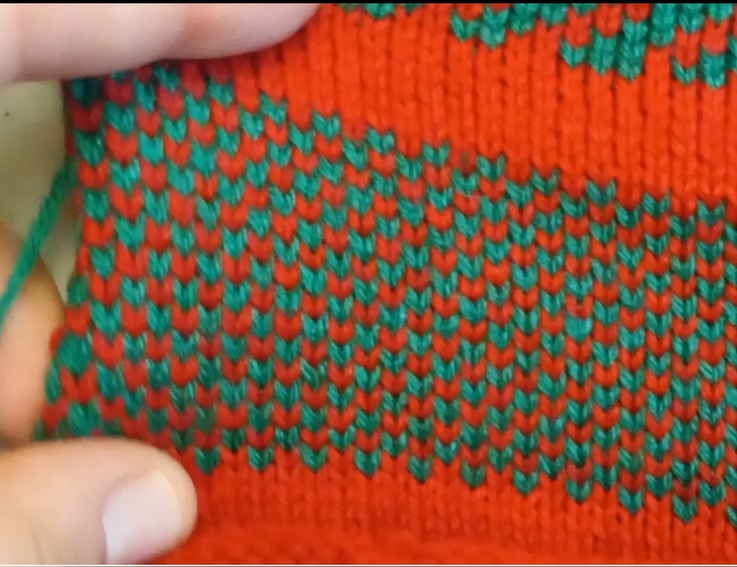
Additionally, I tested the patterning (AKA needle selection) as well as the needle-in-action while knitting on the full bed. The video of these tests is here. The full bed tests included stockinet, tuck- and slip-stitches. I did not test weaving and lace.

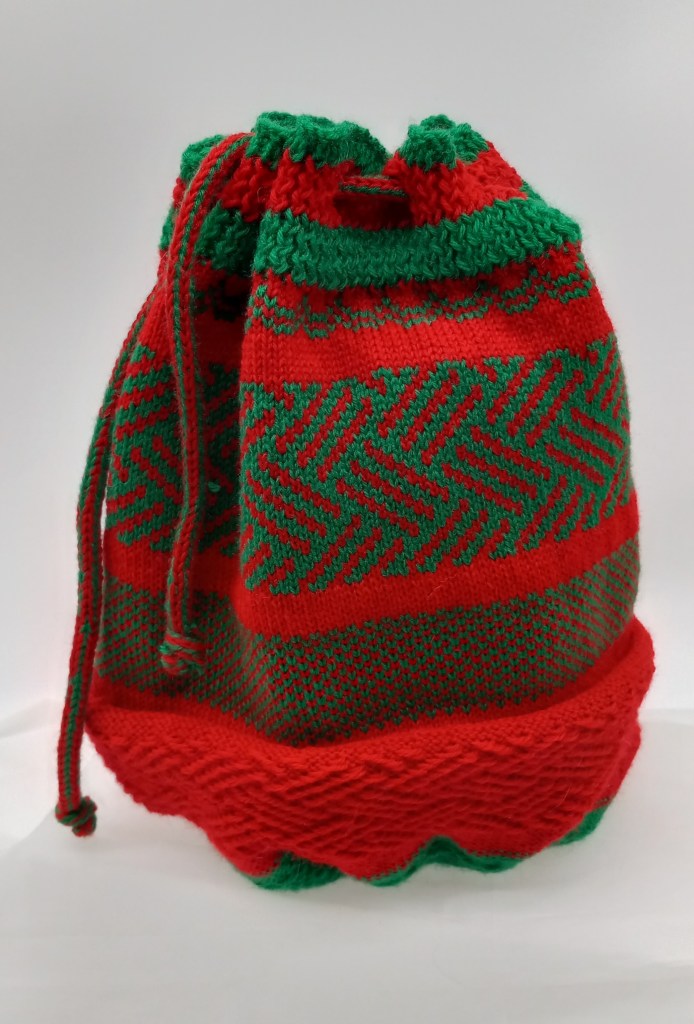
I typically like making something when I test these machines just to be able to show something from these tests. And if it is a wearable item, I donate it to charity. So, I converted the knitted fabric into a beret and a Christmas gift bag.

The lace carriage was not tested but all buttons and levers move freely. It is a very simple carriage and extensive testing is typically not needed.

Typically, I use card #1 for patterned tests. It is the card where every other needle (EON) is selected and the position of these EON needles alternates every row. In this case, any mispatterning will be immediately visible. Check out the video: all stitches formed beautifully. Also, for fair isle tests, I use very contrasting yarns where ANY mispatterning will be immediately noticeable.

The machine handles two kinds of yarn types very nicely (one an acrylic blend and 100% acrylic) and no static formed.

Some sources claim that Brother KH860 typically does not come with built-in garter carriage rails. Well, this is already the third KH860 that I came across that had them. Built-in garter carriage rails are great for future accessorization with a Garter carriage.

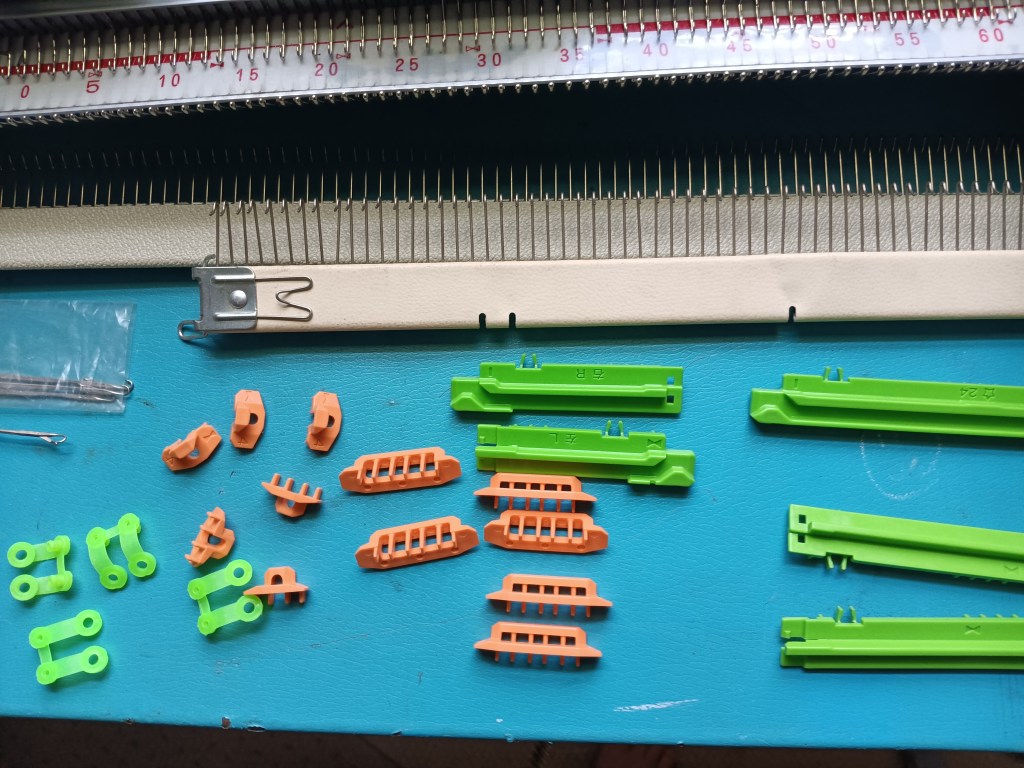
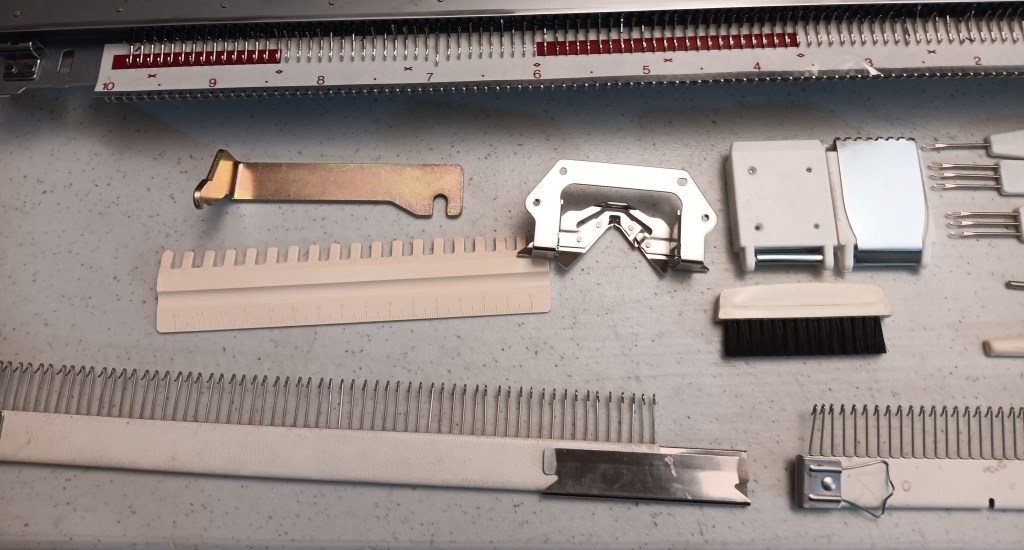
The machine had all major accessories (I only had to get cast-on combs from my stash – they are shown below in a disassembled state): lace carriage, extension rails, sinker plate, tension mast and of course the main carriage. They all fit into the lid of the case.

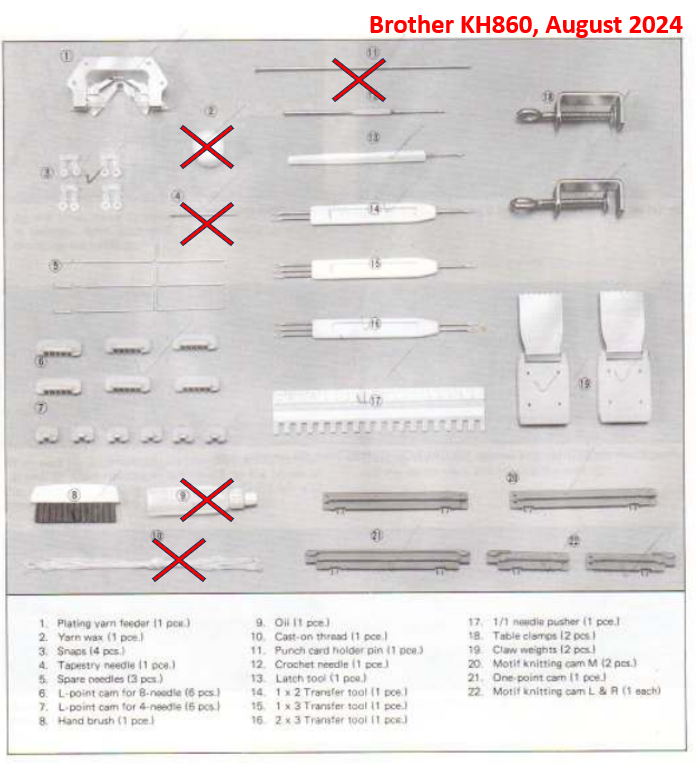
The machine came to me with very few minor accessories but I was able to find and collect the replacements.

The claw weights, transfer tools (with 2×1, 3×1, and 2×3 pegs), table clamps, set of motif cams, and the needle indicator strip are all new from the old and new stocks (yeah, new stock is probably a knock-off but serves the purpose).

The missing accessories are wax (it was so old it crumbled), a punchcard holder (a rod that is inserted into the small hole behind the punchcard reader) a tapestry needle (any needle will work – I like plastic needles), oil (get a gun oil on Amazon), and a cast-on thread (I use a strong silky thread or a thin acrylic yarn as my cast-on three).

The absence of these accessories did not affect the functioning of the machine. For example, all the tests shown in my video were performed without them: I did not need to insert a punchcard holder rod into the slot and the punchcards advanced without problems.

The punchcard set that came with this machine is not the original set. The original cards should have been marked with the letter J. Those included with this machine will be marked with the letter S. These cards correspond to those in the manual for the KH868 knitting machine (available for free here).

The hard copy of the manual for the KH860 model will also not be included with this machine but it is available online for free here.

Now about imperfections:

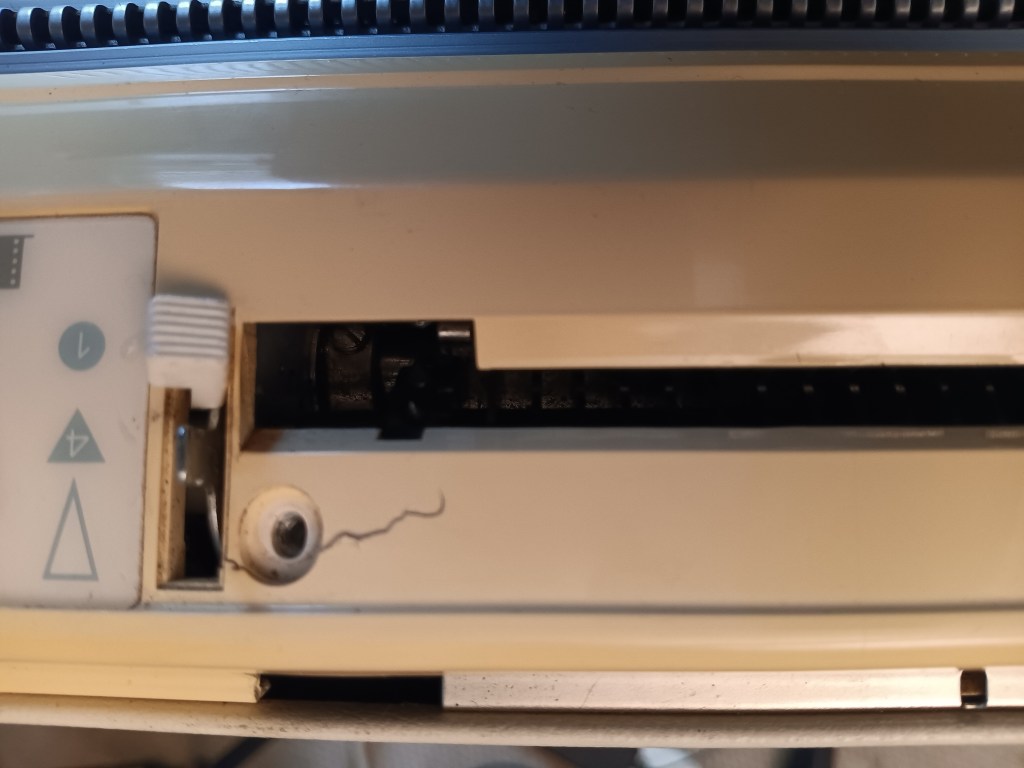
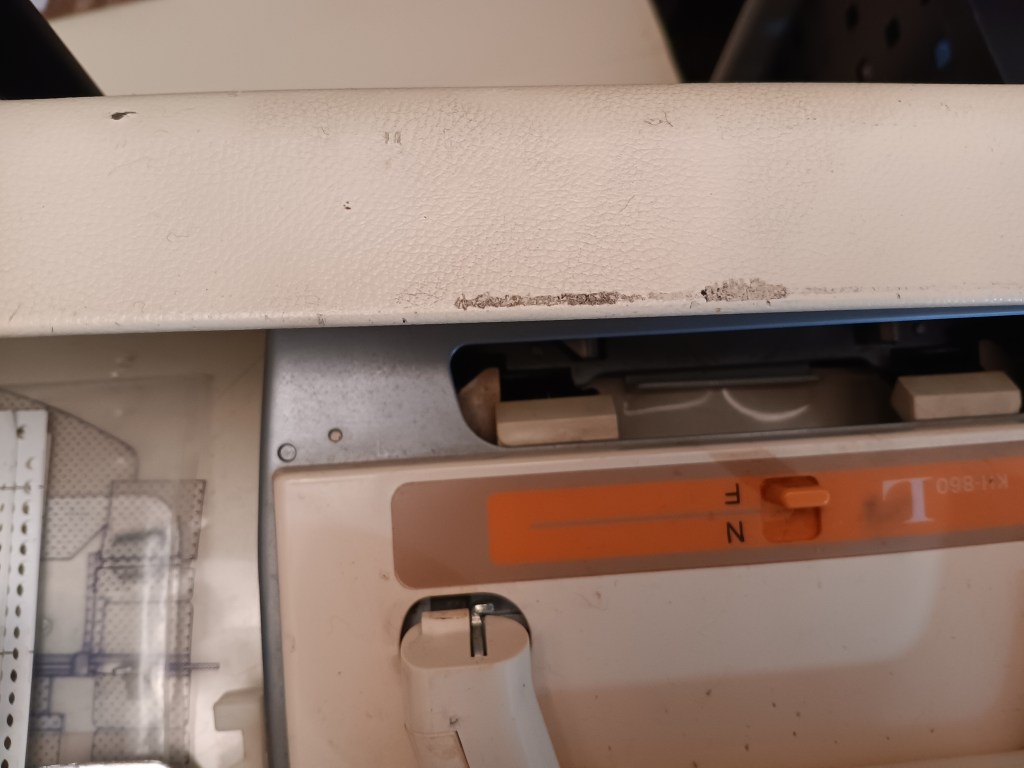
  1. Crack on the plastic near the knob for the punchcard reader. Although cosmetically not pleasing, it did not affect the functioning of the machine and/or the punchcard reader.

2. Because of the garter carriage rails and the carriage stoppers on each end of the needlebed, the carriage gets a bit stuck when pulled too far to the right or to the left (see the last couple of minutes of the video). It is just something that you’ll need to get used to.

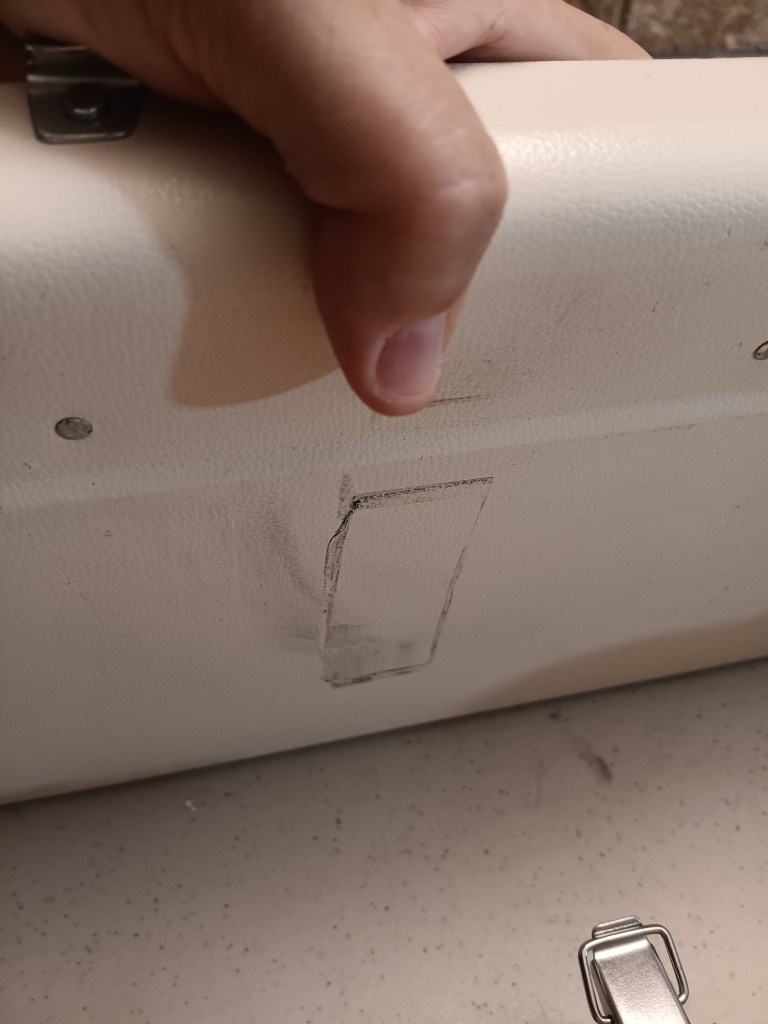
3. The lid and the case have some minor stains, scratches, and scruffs. Below are the pictures of some of them. Despite these minor cosmetic imperfections, the overall states of the case and the lid are pretty good. One of the best ones I’ve seen.

Happy Knitting!

Review of Passap electronic knitting machines.

… still a work in progress

Pros:

(+) More needles than any of the hobbyist’s Silver Reed/Studio and/or Brother electronic knitting machines.

(+) Double bed: no need to putz around with aligning robbers to the main needlebed.

(+) Numerous built-in patterns.

(+) Knit great double bed jacquard, lace, etc.

Cons:

(-) Bulky: big in size; bigger footprint than other knitting machines

(-) More expensive than other electronic knitting machines. The exclusion would be bulky electronic Brother KH270, Silver Reed SK890, fine-gauge Silver Reedk SK830, mid-gauge Silver Reed SK860, and standard-gauge Brother KH970. Those machines are either on the same price range or just a bit more expensive depending on the geographic area and demand in your market.

Brother electronic knitting machines: description, comparison, pros and cons.

… still in progress. Stay tuned as I collect more information.

If you already read my post on how to choose a knitting machine and decided that you want an electronic knitting machine and in particular a Brother one, you are in the right place then.

I would strongly recommend electronic knitting machines to both computer/electronics savvy and non-savvy knitters.

People who are just users of electronics can have a lot of fun with the over 500 of various built-in patterns (only 50 for KH900 and non for KH910).

On top of that, computer-savvy people can create their own patterns in various programs, download them onto the machine, and knit wonderful custom things. Some even hack/modify the electronics to get the machine to read the patterns automatically from the computer.

Pros of Brother electronic knitting machines:
– Electronic brother machines have a lot of built-in fair-isle, weaving-, tuck-, part/slip-, and lace patterns (the exception is KH 910 – more on that later).
– All electronic Brother machines can be accessorized with a color changer (4-color changer for most KH9xx machines and 6-color changer for KH970). 4-color changers are easy to find and are pretty affordable.
– All electronic Brother knitting machines can be easily accessorized with ribbers (KR830, KR850, KR880 and KR900), which are also easy to find.
– Custom patterns with different colors could be created using various software and then transferred to the machine (read a separate article on that).

– Electronics can also be modified and the patterns can be read by the machine directly from the computer. Thus, no need of transfers (some machines do not have enough memory to accept a large pattern. In this case, the pattern needs to be split into several transfers, which adds uncertainty to inexperienced knitters).

Cons of electronic knitting machines:
– Brother KH910 without conversion (aka hacking) to AYAB can only use mylar sheets to knit patterns. Those are hard to find. But still possible. It does NOT have any built-in patterns. Because of all of this, and because of only the 60-stitch repeat pattern built-in mechanism, machine knitters learned how to hack the electronics, forgo the mylar sheets, and just pass on the patterns from the computer.
– Brother KH930: has over 500 built-in patterns. It is a bit more desirable than KH910 because of this. It, however, has limited memory and large custom patterns need to be uploaded in parts. but there are ways to go around it. KH940 is identical to KH930 but has a bit more of memory (but harder to find than KH930) and a whole pattern for, let’s say, medium size throw can be loaded in one file transfer.
– electronics can be finicky sometimes and, thus, need lots of TLC and attention (like, making sure the machine it turned off and not left ON overnight; if the machine feels warm, stop knitting and turn the machine off). However, replacement motherboards are still available or the machine can be converted to AYAB.

– KH970 are very desirable but also hard to find. However, be aware that some knitters love it and some hate. The electronic console is not as straightforward/intuitive to learn. This machine can still be connected to DAK. AYAB is not recommended because this machine is so expensive and because it has so many prebuilt-in patterns.

Brother punch-card knitting machines: quick reference

All Brother punch-card knitting machines have 200 needles. Except for the Brother KH260 model, all other punch-card Brother knitting machines are standard gauge (4.5 mm distance between needles).

Below is a summary of which punchcards were released for specific machines. Keep in mind that all these cards are interchangeable.

Miscellaneous
Card Set, letter
Standard-gauge machines
Brother KH830-836D
Brother KH840G
Brother KH860,881J
Brother KH890,891M
Brother KH864/868S
KnitKingKK93/KH893R
Bulky-gauge machines
Brother KH260P
Miscalleneous
Garter CarriageB-KG
Ribbers

Needle positions for Brother and KnitKing knitting machines.

Machines/Ribbers Model numbers
Needle Positions

12-stitch punchcard machines
KH800, KH801ABCDIDIIE

24-stitch punchcard machines
Bulky: KH260
Standard: KH810, KH811, KH820, KH821, KH830, KH831, KH836, KH840, KH850, KH851, KH860, KH864, KH871, KH881, KH890, KH891, KH893, KH894


A


B


D


E

Ribbers matching the Brother and KnitKing punchcard knitting machines
KR810, KR830, KR840, KR850, KR890, KR900, RK900ABDE
A – non-working position
B – standard working position
D, DI, DII – patterning positions
E – holding position

More summary information on punchcard knitting machines is coming up.