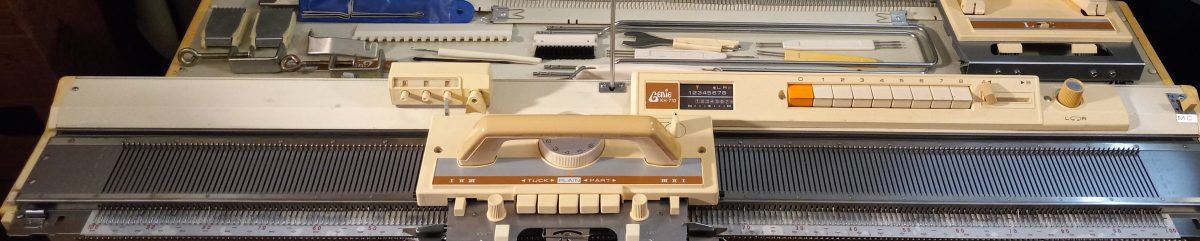
Brother Profile 552 knitting machine is an 8-push button knitting machine. It is probably the first 8-push button machine and it appeared on the market around 1964. The pattern center includes eight needle selection buttons, a reverse lever, a slide dial, and a set lever.Â
This is my fifth 8-pushbutton knitting machine refurbished and prepared for other knitters and I am completely falling in love with these machines!!

The role of the set lever is to bring the needles forward: you push the corresponding buttons and then rotate the set lever with a special wrench and the needles move forward.
The role of the reverse lever is that: for example, you want to select needles 2 through 8. So, you simply push button #1, turn the reverse lever to B and rotate the set lever: all but needles in position 1 will be brought forward.
The role of the slide dial is to shift the needle selection. For example, a pattern requires the selection of needles 1 and 5, then 2 and 6, then 3 and 8. Instead of pushing and unpushing the corresponding buttons, you simply push buttons 1 and 5 and then simply move the slide dial to the corresponding number of places. If you move the dial only once, needles 2 and 6 will be selected even though buttons 1 and 5 are still pushed in. If you move the slide dial two places, then (even though the buttons 1 and 5 are pushed in) needles in positions 3 and 7 will be moved forward.
The additional patterning is accomplished by moving and holding the cam lever in positions I, II, or III and by pressing pattern selector buttons.

Now about this specific machine. I refurbished, cleaned, and serviced it. A completely new sponge bar was inserted. All needles are cleaned and inspected individually. They were also checked by knitting on a full bed to make sure they form the stitches properly.
It will come with all major assesories:
- The toolbox with a lid
- Latch hook, crochet hook
- Transfer tools
- Needle selection rulers
- Claw weights (greenish to match the color of the machine)
- Brush to clean the carriage and the needle bed
- Replacement needles
- Ratchet for the set lever
- Carriage lock
- Handle for the mani carriage
- Two cast-on combs – one long for the full bed and one shorter for swatches
- Table clamps
- I will even include
- Yarn mast
- Bottle with oil
- Wax (two small wax cylinders will be included – the reason why is below).
The hard copy of the manual will not be included but it can be found here. Additionally,
All these assesories are shown in the picture below.
The assesories fit nicely into a special toolbox.
And the toolbox then sits on the bed. So, you have all you need for your knitting set up in one place.
I always like to knit on a full bed when I test my machines. First, it gives me a chance to see if I overlooked any defective needles. Even when inspecting each needle individually, it is easy to miss a latch that is not moving as freely, a slight bend in the tip of the needle, etc. So, when I knit on a full bed, I see immediately if there are needles that repeatedly mispattern or create strange stitches. If defects on the fabric occur randomly – it is very likely not a defective needle since these defects might be due to the carriage snags, some small knots, or imperfections in the yarn (yarn splits sometimes, which might also result in uneven stitches randomly appearing on the knitted fabric).
 The second reason to knit on a full bed, which is especially important for push-button machines, is to see if all needle pushers inside the machine are working as they are supposed to be. The patterning mechanism on push-button machines uses long strips. They look sort of like needle selection tools (some people call them combs or rulers). Each metal strip has “teeth”, shifted by one position on each strip. There are 4 strips for 4-button machines and 8 for 8-button
  machines. The position of the teeth is shited by one on every strip. There are, accordingly, 4 and 8 positions on the strips for 4- and 8-button machines. So, if these “teeth” are bent, or damaged, not all needles will be pushed forward. And this is what I am checking when I knit patterns on the full bed on push-button machines.
So, on this machine, I knitted slip-stitch and tuck-stitch on the full bed. The stockinet was very easy to knit. When I knitted the pattern, I noticed that the tension was getting tighter and tighter. It was due to the static accumulation. This was the first time I experienced such static accumulation (using the same yarns on other machines) but attaching a wax to the tension mast solved the problem.
Knitting a 1×1 tuck pattern on this machine uses all needles. In the first row of the pattern, all odd needles are selected and in the second row of the pattern, all even needles are selected. So, on a full bed when knitting this tuck-stitch we test the needle selection and how needles knit the tuck-sitch. All went well as shown in my video. After such a successful test, I then knitted a pouch for my husband’s paddle (the knitting process is shown in the video, and the end result is on the picture to your right).
This brings us to the imperfections of this particular Brother Profil 552 knitting machine:
Buttons need firm pushing. Sometimes I had to press the button twice or three times. The firmer you press, the fewer times you’ll need to repeat pressing. Also, all the levers need to be in their default positions when you start pressing the buttons. Once the buttons are pressed, they are firmly sitting in their positions and do not jump back. It took me some time to get used to firmly pressing the buttons. But once I got used to the right force needed to push the buttons and reset all levers before, all went smoothly. This is one of the reasons this machine needs a patient knitter. Watch my video to see how these buttons sometimes misbehave.
The second imperfection of this machine is slight discoloration of the metal surface as well as roughness. I only see this discoloration on the carriage. However, keeping in mind that this machine is over 55 years old, this should not be surprising. And I still think that this machine has a lot to offer for another 20-30 years, especially if serviced and maintained well. However, because of this, the static accumulation on this machine is a bit more than average. But this problem is solved by using wax and regular oiling. Thus, with this setup, I am including two wax cylinders. This is the second reason this machine needs a patient and caring knitter who will ensure all the setup steps are undertaken prior to the knitting and ensure this machine is well-kept and serviced timely. One tube of oil will be included. Another good oil to use is gun oil on Amazon.

The third imperfection is the levers on the carriage. The lever on the right-hand side slides not as smoothly as on the left-hand side. The metal bracket on the left-hand side was popped out when I got this machine. I fixed it and secured it (it will NOT pop out again) but the metal grooves are not as smooth). I am a petite woman with medium-strength hands and I still move the levers without too much force. At the end of my video, I show the movements of these two side levers.
Video of tests and demo of all imperfections is here.
A couple of cosmetic flaws are shown in the photos below.
Scratches inside the lid:

Minor dents on the outside of the lid.

Scuff mark on the right-hand side of the carriage.

The machine knits wonderfully despite imperfections. In fact, push-button machines handle some unusual yarns better than punch-card machines (not sure why but maybe due to the more fragile nature of the punch-card mechanism – if lint or dirt is stuck in it, it will not pattern properly…??). This is why I like these machines so much. They are working horses!! A combination of automatic stitches selection with hand manipulation of the needles will give a knitter a lot of possibilities!! Yes, punch cards and electronic machines are more versatile and people think they are easier. But think about it: to come up with a novel design for a punch-card machine, a knitter needs to carefully punch a card and then test it. But the design is limited to a 12-24 stitch-repeat pattern. Yes, on an electronic machine one can use repeat patterns with more stitches but then the software is needed, special cables and all those machines are still expensive to buy!!
The bottom line is: there are fewer things going wrong with the mechanically-patterning push button machines and this is why I love them and highly recommend them to a beginner machine knitter or to hand-knitters who still would like to maintain the satisfactory feeling of knitting by hand but with a bit of help from the machine in speed and forming more even stitches!!
I am currently testing KR580 ribber, which fits Brother Profile KH552 machine.