
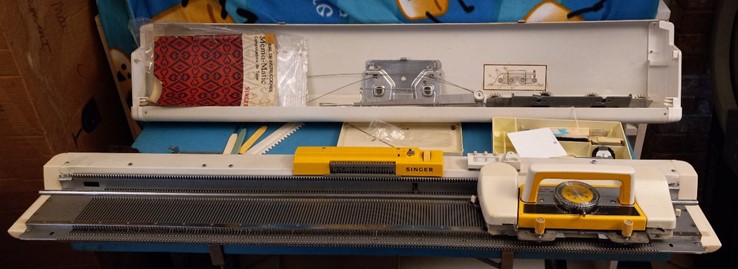
Overall view of the setup.
Right-hand side end cap on the main bed
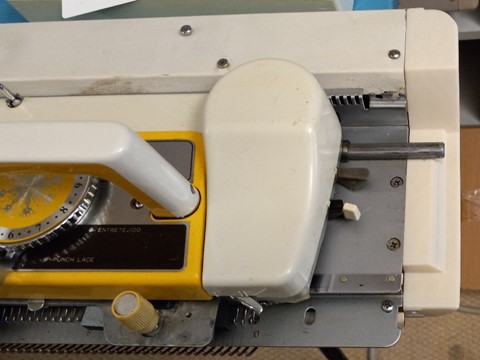
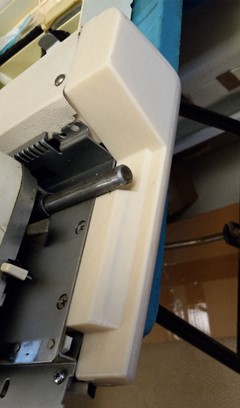
The left-hand-side end cap on the main bed
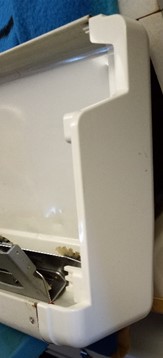
The lid with replaced end-caps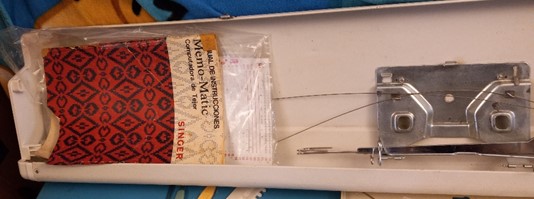

The lid end cap upclose
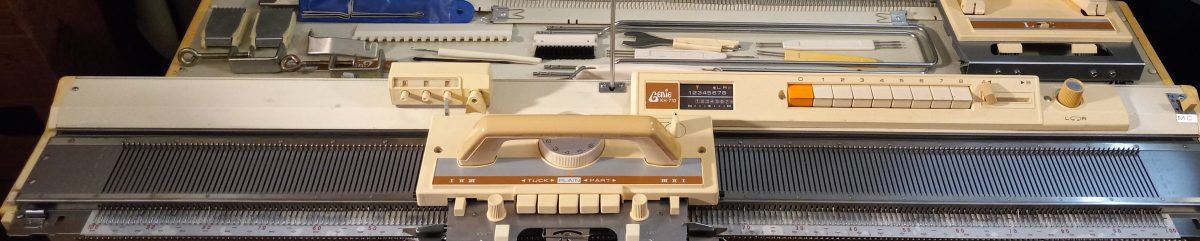
Overall view of the setup.
Right-hand side end cap on the main bed
The left-hand-side end cap on the main bed
The lid with replaced end-caps
The lid end cap upclose
 This is a Brother KH588 knitting machine with an 8-push button needle selection mechanism. This model was released to the market in the late 1960s-early1970s. This model is equivalent to a rebranded Genie 710 (in case you need to search for information related to this machine). These are other 8-push button models similar to this one: KH581, KH560, and KH552, but their pattern control center is a bit less “sophisticated”. The pattern control center in KH588 makes your job of creating patterns and following the sequence of which buttons and levers to push the easiest.
The “patterning center” consists of:
In my video, recorded specifically for this machine, I demonstrate three patterning techniques and how I moved the levers, knobs and a ratchet. At first, it took me a while to figure out a chart but after just 5 minutes, I was able to develop a groove and knitted faster without problems. More sophisticated patterns (many of them can be found here) will probably need a bit more concentration. I also tested knitting cables on this machine. The hardest part of the cables is to keep track of which stitches on which needles to swap. But with the patterning center on this machine, these positions can be kind of memorized by the buttons pushed and it makes keeping track of stitch-swapping easier.
A couple of things I personally found interesting in this model. Check out the carriage image below, in particular, the levers on the bottom left and right sides of the carriage with markings I, II, and III. This feature was unusual to me since in other early versions of Brother knitting machines (manual 4- and 8-push buttons) these levers are on the actual sides of the carriage. I found this feature of KH588 very convenient. The positions of the levers are right in front of your eyes and it makes it less hard to overlook the position of these levers (which happens quite often ).
 About this particular brother KH 588 machine.
In this particular machine, the words on the carriage (with the exception of huge BROTHER branding) are in Japanese. I asked the knitting community and apparently, not all KH588 are in Japanese. At the very end of this blog, I show pictures to be used as English references. Maybe this machine was brought from Japan.
Below are the pictures of pattern examples I tested (also shown in my video on all 200 needles).


The knitted fabrics I created while testing this machine were converted to the two cowls shown below. They are going to be donated to a charity in my area.


The machine comes with all major assesories, including the extension rail, cast-on combs (tucked in the lid), and the lace carriage.


A couple of minor accessories missing are:

I included a 1×1 needle selection tool – it is not part of a standard setup but is very handy to use, especially for a quick 1×1 (or every-other-needle (EON) cast on).

The hard copy of the manual will NOT be provided but can be found in here.
Couple of other useful links:
Now, about the imperfections of this machine and setup.
The posts, where the handle attaches to the lace carriage, show some rust. The handle still attaches well and effortlessly.

There are some minor rust spots on the sinker plate (on the underside, on one side only

The case has some pumps but nothing major. The toolbox has some cracks – the plastic is too old and brittle. It is also missing a lid (or it never had a lid – not sure since the manual says nothing about the lid).


None of these imperfections affected the working functions of this machine.
The machine came with several damaged needles and I had to replace them. Since nobody manufactures new needles for these machines, I had to use refurbished needles from a machine I stripped for parts. I tested the needles I inserted into this machine to make sure they knit well without problems. Here is the video of the exact needles I placed into this machine.
Below are the images of another KH588 but with all English writing (kindly provided by other push-button knitting machine enthusiasts from https://www.facebook.com/groups/PushButtonPatterningKnittingMachines) to be used as a reference when operating this particular KH588. I included the hard copies of these pictures with the setup for Holly.
