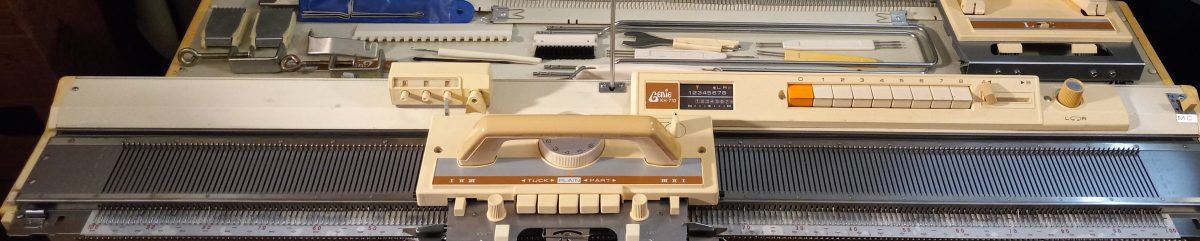
This was the first Singer 321 that I refurbished and cleaned. But having already gained experience in servicing and refurbishing Singer/Studio machines, I did not hesitate to start working on it.
 A little bit of history: Singer/Studio 321 machines were introduced in 1972 and were the second earliest model capable of patterning with 24-stitch punch cards. It is a standard (4.5 mm) gauge machine with 200 needles. So, this machine is 50 years old!!
I inserted a brand new sponge bar and sponge bar (purchased it from the Knitting Closet). It was specifically advertised for Studio/Singer machines. It fit right in but the white plastic end sticks out only on one side. So, make sure you don’t push the bar too far otherwise it will be hard to get it out to replace the needles and to replace the sponge.

I removed all removable rust from the inside of the machine and covered some rusty spots inside the case with an anti-rust coating.
To remove the carriage from the needles in working positions (for example, to unravel a row or if the carriage is stuck), the sinker plate needs to be removed from the carriage first. It is a bit not as convenient as other, newer models, but not the end of the world, in my opinion. The dial on the carriage is in Spanish but it is intuitive to use, especially if you have an English copy of the manual in front of you. If you are a Spanish speaker, then it is an extra bonus for you!!!

The manual is very well written. This machine could be accompanied by Spanish or English versions. This particular machine has words in Spanish )on the carriage) and an accompanying manual in Spanish. Please, let me know which copy you prefer. I liked very much that this machine have pegs to attach a row counter on both sides of the bed. I knitted a shawl and was glad that I did not have to transfer carriage all the way to the opposite end just t count my rows. The machine comes with all accessories mentioned in the manual, all of which fit nicely into a special box. It includes a set of punch cards but only 18 – cards 14 and 16 are missing.


I tested all the knobs, levers and card readers extensively. I knitted patterns using tuck-stitch, slip-stitch and fair isle on partial and full bed.


The sinker plate and the tension mast fit inside the case lid when not in use.

Now about the imperfections. Maybe because this machine is 50 years old, or maybe because the previous owners did not love her as much, there are some cosmetic imperfections and cracks on the case. None of these affect the machine performance. See the pictures below with brief description.
Side racks are missing. They are rubber pieces that go on the ends of the bed to prevent the carriage from mis-patterning if knitting on a full bed. However, with careful knitting and by not going too fast, it can be avoided. As I demonstrated in my video, it did not affect me tuck-stitch knitting on a full bed.


The body of the machine has a spot that I could not remove.

The case cover has several dents. The one below is especially visible.


Some spots and discoloration on the outside of the case, including the handle


These are where the holding clamps attach at the bottom of the machine. They are rusty but are very strong and held a machine for me without problems/.


Overall, I was extremely pleased with this machine. It is simple yet strong and will serve its new owners long years if serviced and take care of correctly. Check my video blog, showing this machine in action.


 Scrabby yarn (from
  Knitting by hand with this yarn was fun – it creates a unique texture without any effort. I also decided to use my Addi circular machine to see if I can make household items faster. So, I was able to knit loofahs, coffee holders (aka reusable sleeves for paper cups), place holders, table pads and coasters.
 The knitting on the machine became significantly easier after the first two rows. However, some of the stitches did not sink into the slots on their own and I had to help “them” . Even though the yarn will hide all defects because of the variegated colors and because of the twisties on the yarn, I still did not want to create tuck stitches because they sometimes lead to missed stitches. Check out my