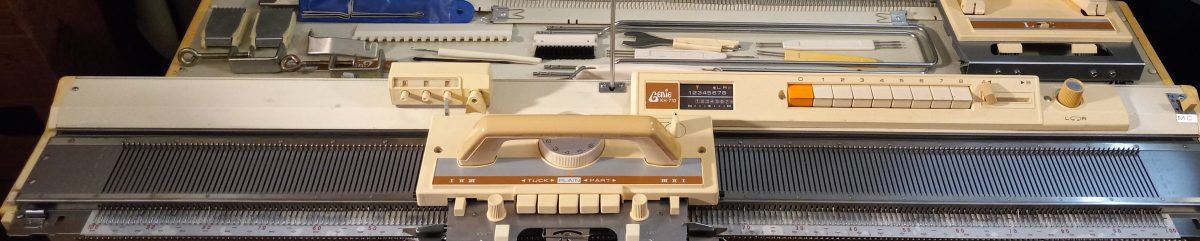
Brother KX350 knitting machine tested in November 2021

My personal history with this machine was the following. Since I am an avid knitter and an avid yarn collector, I wanted to knit faster so I asked my daughter to get me a circular knitting machine. She got me both Addi big and small and I enjoyed it tremendously. Addi’s have certain limitations in terms of the yarn it can use – it hates slippery yarns!!! It also hates chenille yarns.

After I knitted a ton of headbands, scarves, bags, dog coats, head warmers, four sweaters, and several blankets, I wanted to continue experimenting with more techniques and yarns and my husband bought me Home Knitter KX350 on eBay.

It arrived in a pretty bit-up box but the insides (except for some dead flies and bugs) were excellent.

All accessories are inside a Styrofoam holder, which is an extremely convenient way to store and transport them.

The bed itself sits on the bottom of the cardboard box and the two Styrofoam packages are on each side of the plastic carriage.

Everything felt good about this machine. I liked how it felt to touch, and how the carriage moved (it was light and easy – which became especially important when I hurt my shoulder but did not want to give up knitting).

All the plastic parts – the two yarn clamps on each side, the tension rod, the row counter, and the tension mast holder – were inserted easily into the main machine. With the clamps being also attached to the main bed – you can move the whole setup up easily if, for example, you need to change tables.

I even liked how heavy-duty the cast-on combs are. Typical cast-on combs on metal flatbed Brother have very thin “teeth” that bend very easily and get tangled on almost any hanging yarn. The cast-on combs that come with KX350 are so heavy-duty that you don’t even need additional weights.

However, while wiping some dust off the machine, I discovered a lot of weird cruds when I flipped the machine over. I diligently removed the crud together with a strange long piece of fabric and was very proud of myself for how clean my new possession looked.

This crud and a long piece of narrow fabric turned out to be a completely gone-bad sponge bar…. Well, not realizing how important the sponge bar is, I started experimenting with knitting and made a lot of good progress. Yes, I got a lot of dropped stitches and spilled lots of curse words, but eventually figured out how to adjust the tension in certain parts and finished a scarf, a vest with cables (by hand-manipulation stitches) and a had with a mock-ribbing.

When the initial excitement subsided, I decided to expand my knowledge and started watching other videos on the knitting machine, and then somebody mentioned the sponge bar and how it helps with dropped stitches and even tension…. A revelation!!! I immediately realized that whatever the curd was, it needed to be put back but in better shape. One week later I was inserting a sponge bar – my first one ever!!! I thought all knitting machines had a sponge bar insertion process like this one….I almost gave up machine knitting when I read that the sponge bar needs to be replaced frequently.

It has a lot of pros compared to sponge bars of other flatbed machines and a couple of cons as well.

Needles for this machine are big and sturdy and from what I read are not interchangeable with other machines. But they can be easily found online.

Pros:

(+) Very easy to assemble and disassemble. If you are like me, always struggling with placing the sinker plate, the tension rod and cast-on bars inside the lid of metal flatbed knitting machines, you will like this setup – no more struggle. Guaranteed!!

(+) The sponge can be replaced without the need of glue.

(+) Needles are easily replaced without removing the sponge which is a HUGE advantage. They can be even changed in the middle of your project!

Pros of the machine itself:

(+) Most of the parts and replacement parts are readily available online. If you can’t find some, they can be 3D printed on a home printer – just ask around, there are a lot of machine-knitters, who are also 3D-printing enthusiasts.

(+) The plastic components of this machine make it very light and easy to handle – pack, unpack, move, and even assemble and disassemble. The way the brackets are hiding under the bed and unfold underneath it when you need them is very neat. I wish all machines had this way. The lightweight of this machine is excellent for people with some space limitations (take it out when using and then put it under the bed without too much straight when not in use).

(+) can be bought easily and use weather stripping. Size is important but not as for the metal flatbeds with metal sponge bars. You can even use pieces of two different sponges. The whole sponge sites pretty tightly inside that narrow passage – there is no way it will slide on its own.

(+) after you manage to insert it, needle insertion and reinsertion can be done without removing the sponge bar – which is a HUGE advantage compared to metal flatbed knitting machines. I even managed to replace a needle in the middle of one of my knitting projects.

(+) No hot glue or any other glue is required to insert it into the machine. This eliminates a lot of problems – as glue might stick to the insides of the machine, etc.

(+) no sinker plate – all mechanisms are inside the carriage. One less part to worry about getting lost! I see so many knitting machines being sold without sinker plates. In the case of KX350 you don’t have to worry about the sinker plate getting lost. Well, if you lose the whole carriage that’s another story.

(+) easily knits relatively thick yarns. I used a wool/acrylic blend on this machine (100g/230 m, 3.5 oz/255 yards) without any problems.

Cons of the sponge of KX350:

(-) Well, it is not a BAR but simply a long narrow sponge, like a weather stripping (for windows and doors). Inserting it without the solid support of a metal bar (like other Japanese machines have) is challenging. I did it without removing the holding plates (the way the Answer Lady shows in her video) and managed to accomplish quite a lot. That’s the only con so far.

Cons of the machine itself:

(-) It is not a metal bed machine – it is plastic (which later brings us to con number two below). So, technically parts are not as durable as parts for metallic flatbed machines. However, I kind of think of it as almost an advantage: plastic can be glued on but getting rid of the rusted parts on a metal knitting machine is a big pain.

(-) Because of its being plastic, when it works (when you move the carriage back and forth) the sound gets pretty strange. My husband calls it “an old typewriter noise”. It is different from the noise the metal flatbed machine makes but very similar to the noise other flatbed machines do (Like HK100, Addi, etc.). You can check my youtube video (https://youtu.be/OPesDA95b5M) to make sure you are ok with that noise. However, keep in mind that all machines make some sort of noise when being operated.

(-) Sponge bar replacement is somewhat challenging.

Overall, I feel that this is an ideal machine for beginners and as a first transition machine from plastic circular machines (like Addi and Snetro), like it was for me. It is also easy to store and transport as it is lightweight and all the parts are easy to install. I especially love the retractable table clamps. It is also ideal to knit “regular” yarn sold in hobby stores. I hope you will consider fostering or even adopting this wonderful setup!

Singer 210 Memomatic restored in November 2021


This Singer 210 memo-matic came to me in a very good shape yet still needed some TLC….

When I purchased it, I did not know much about Singer/Studio machines. So, I first restored Singer/Studio 360 and only then pulled this one out from my closet

I have to say that my shoulder did not complain a whole lot because this machine feels lighter than all others I handled so far. It is still not the lightest but I think what makes it light is that it does not come with a hard case cover. It came in a nice original cardboard box with Styrofoam layer, in which all accessories were stored.


This machine works flawless. I made a blanket on it while testing all its tuck and slip punch cards.


Pros:

(+) Worked great

(+) Looked at first not as overwhelming as other machines: it has less knobs and does not have a built in knit leader

(+) Not electronics – no need to rely on old electronic mother boards or on electricity

(+) Light-weight because it has no hard case cover but comes with the nice original cardboard box and a Styrofoam packing.

(+) easy to handle row counter: some row counters are flaky and the numbers jump back and forth when you are changing the dial manually…This dial did not give me any troubles at all!!

(+) putting machine and accessories into the case is really straightforward. Those who tried and struggle with placing the machine back into the storage into cases with hard cover (in which the sinker plate and the mast are stored in the lid) know what a struggle it is!! No struggle in this case – all accessories are inside a Styrofoam molds, which a re placed on top of the bed, which adds additional cushioning and security while storing the transporting the main bed.

(+) The carriage has a release lever which helps to remove the carriage in the middle of knitting (if it gets stuck) without removing the sinker plate.


Cons:

(-) the absence of hard case cover might be considered by some people as a con since storing this machine might come with its challenges: what is the carboard gets wet, what is the mice eat the Styrofoam?…It was not a problem for me and indeed, I liked it that it was not as heavy as my other machines.

(-) as with all Singer/Studio punch card knitting machines the patterning drums might freeze if the machine has not been used in a long time or stored, especially outside. This can be fixed though by spraying AeroKroil. There are a lot of resources explaining how to do it.

(-) not electronic and because of this the automatic patterning is somewhat limited. However, it is limitless, in combination with some manual stitch manipulation.

(-) does not come with cast-on combs – this was probably the biggest challenge for me (but I took cast-on combs from my other machines).

(-) I personally found that the tension mast is a bit close to the place where I was clipping the punch cards. It might not be a struggle for other people and it really was not for me, but I though I would mention it….


Compassion with Singer/Studio MemoMatic 360:

The comparison below simply shows difference features of the two models, and these features are not necessarily pros or cons. The reason I decided to put this comparison table together since, in my opinion, this machine is almost the same as Singer 360…. So, see below…


Singer 210 MemoMatic

Singer 360 MemoMatic

Hard case cover

NO

YES

Built-in knit leaders

NO

YES

Weight?

Lighter

Heavier

Punch card set

10 cards

15 cards


I really hope you will considering purchasing this model as your standard gauge machine (from me or from other seller). It is a great machine and definitely deserves your attention and love!

List of machines I tested/refurbished/cleaned/fixed

Updated: March 2025;

Total machine count: 68

2 circular plastic

3 bulky basic

2 bulky punchcard

6 mid-gauge plastic bed

2 standard basic

5 four-pushbutton

9 eight-pushbutton

22 standard-gauge punchcard

13 ribbers

4 electronic standard-gauge

Specific Machines:

Addi King 46 needles

Add Express 22 needles

Brother KH210

Brother KH230

Brother KH260 (two) 

Brother KX350 (five)

Brother KH500 (two)

Brother KH551 (five)

Brother KH552

Brother KH581

Brother KH585 (two)

Brother KH588 (two)

Brother KH601

Brother KH710 (two)

Brother KH800

Brother KH830 (two)

Brother KH836

Brother KH840

Brother KH860

Brother KH881 (two)

Brother KH890

Brother KH892

Brother KH930 (four)

Silver Reed SK120

Singer HK100

Singer 210 Memomatic

Singer 321 (tw0)

Studio mod. 324 and Empisal Knitmaster 324 (two)

Singer 360K and Studio mod. 360 (six)

Singer mod. 700 MemoMatic (two)

Studio 326

Ribbers

Brother KR260 (two)

Brother KR551

Brother KR580

Brother KR810

Brother KR830 (four)

Brother KR850 (three)

Studio SRN321


My first restored and tested KH551 knitting machine

Hello World!! This is me, a freshly refurbished/cleaned KH 551!!!

This particular machine had seen its days before I acquired it. but still work really well, and will continue to work well after I thoroughly cleaned it and removed most of the rust.

To realize in how good of a share this machine is – let’s review a little bit of its history.

Brother KH551 machines first introduced to the market in 1960s. That makes this machine 55 years old!!! It might have been the first push button machine (with 4 buttons) with somewhat patterning capabilities (not involving 100% manual needle selection and manipulation).

I thoroughly checked the push buttons and their needle selection mechanism and was able to produce herring bone pattern (see below – sorry hard to see because I selected this white fuzzy yarn). But the fact that it could knit the fuzzy yarn says a lot!! Fuzzy yarns often require some additional loop jumping but this machine handles it like a pro!!

Patterning involves not only pushing the correct buttons but also some buttons on the carriage itself – which also work great! You press the buttons (1 through 4 on the right-hand side) and turn the ratchet to SET. This action selects the needles and pushes them forward. Watch it in my video – the way it happens is simply fascinating!!!

You will see some cracks and imperfections on this old lady (including some discoloration of the plastic components) but they absolutely do not affect the working mechanisms of this machine. POSTSCIPTUM: I change the handle on the carriage and fixed the bent lever:

The carriage looks like almost new now:

(BELOW IS AN OLD PICTURE – just in case you want to compare cracks and crannies ) (and for my reference as well)

Some minor rust spots are still present underneath the bed (see the picture below).But I decided against extensive brushing, which would remove too much of the good metal around the rust and induce and accelerate the corrosion further.

One accessory is missing – a small box called a “picker”. I guess it works like a small carriage to pick certain needles and to move them in certain position during initial needle picking. But it is absolutely not a critical part.

Pros:

+ Carriage is very light and slides very easily

+ The bed is narrower than other machines – which makes it more compact

+ …and makes the machine lighter than other similar models

+ relatively easy deep cleaning – all parts are solid and straightforward to insert/assemble/disassemble

+ The needle count is engraved on the bed – so these slippery and constantly in the way paper liners showing the needle count won’t annoy you by constantly sliding and getting lost.

+ Threading the yarn is a bit more intuitive and straightforward in my opinion

+ built-in capabilities for 3 different yarns

+ the hard case is a combination of fake leather and plastic, which makes it not only look neater and nicer than other machines but also mode durable. The case shows absolutely no discoloration despite the age of this machine.

Cons:

  • The push-button mechanism helps to select the needles but every row, you need to change the needles selected (basically turn the ratchet tool to SET and OFF). It might be tedious and you need to keep track of the correct order.
  • Some might find the machine too simple – yes, it has only limited patterning capabilities. However, with manual needle selection and yarn manipulation the possibilities are endless.

Overall, I think this machine is excellent for somebody who wants to simply knit blankets, scarves or for people who find punchcard mechanisms and electronic mechanisms too overwhelming. It is also excellent machine for beginners since it is very robust and simple.