
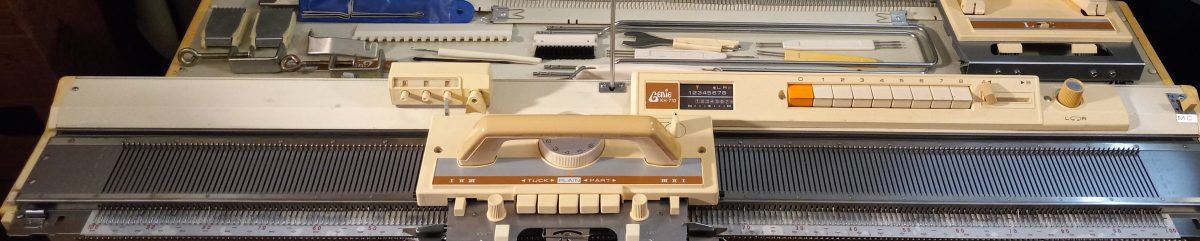

Brother KH836 knitting machine is one of the many models of knitting machines with punch-card capabilities manufactured by Brother. The machine is standard gauge (which means the distance between the needles is 4.5 mm). There are 200 needles. It accepts punch cards with 24-holes (which makes it capable of knitting patterns with 24-stitch repetitions).
Unlike its younger counterparts (Like Brother KH892 and KH894), it does not have built-in intarsia. But KH836 works with KA8210 intarsia carriage.
After working on both punch-card Singer/Studio Brother machines, I can see clear differences and personal pros and cons. But both machines are still great and offer a variety of possibilities. The thing I like about Brother punch card machines compared to Singer/Studio ones is that the lace carriage comes as a standard accessory. I like that rails are included as well to put the second or lace carriage to the side while using the main carriage on a full bed. I very much like the presence of the cast-on combs since using them is my favorite (and quickest in my opinion) method to start knitting.
However, unlike Brother lace carriages, Singer/Studio lace carriage (even though it is sold separately and is quite pricey) needs only one pass when knitting lace since it transfers the stitches and knits them at the same time. To me, Singer/Studio’s patterning with drums seems a bit more straightforward and easy to follow, unlike a needle selection mechanism on Brother hidden inside the bed. But again, those are minor differences. I also don’t understand why a rod is needed on Brother to hold the punch card together: it always disappears/loses itself and honestly, I always forget to insert it and the machine knits ok with it anyways. There might be other differences but these are the ones that seem the most substantial to me. Yet, they still do not affect the usage of those machines at all and both companies made very solid hard working machines.

Now about this particular knitting machine, Brother KH836, that I serviced in July 2023.

It comes with all major and almost all minor assesories.
All accessories can be stored in a convenient built-in compartment. 
The minor assesories missing are:
- Cast-on thread: any smooth strong yarn will do (not too thick though)
- Wax – the one that came with the machine was too old and just crumbled
- Oil – the one that came with the machine was too old and yellow so I discarded it. A good oil for knitting machines is gun oil available on Amazon.
- A hard copy of the manual will not be provided but an electronic copy can be found here.
The absence of these assesories absolutely does not affect the functioning and use of the machine.

The work done on this machine:
- Inspected and cleaned all needles;
- Cleaned the main bed and under the lid;
- Serviced the patterning mechanism;
- Replaced sponge in the retaining bar
- Serviced carriage – oiled and got all buttons unstuck

The machine was tested on a full bed (to make sure all needles and needle latches are in excellent shape) using stockinet, tuck-, -sli- and fair isle stitch-patterning. All looked perfect. See the cowls/hoods below I made from the fabric knitted during tests.
The beige/greenish yarn was somewhat borderline thick for this machine to knit on all needles (not every-other needle). The slip- and tuck-stitch patterning were still perfect on a full bed (see my video of all tests). So, the fair isle with beige/green yarns was giving me some minor mispatterning. When I switch to thinner yarn (brown/camel natural colors), I did not have any troubles with fair isle.
Case is in pretty decent shape with only some minor dents and scratches. Overall the machine is in great shape and no visible rust on the main bed.
I cleaned the lace carriage and checked all the knobs and levers but I did not test any lace-patterned knitting. 

This machine and other Brother punch-card machines are easy to maintain. Spare needles are still available for purchase new and on a used market. Sponge-bar needs to be replaced 1-2 times a year depending on usage. With regular cleaning (suck out by vacuum all lint and dust from the machine) and oiling will prolong the life span of this machine to almost forever. This machine is perfect for people who want to knit something quickly with predetermined patterns, who like creating their own patterns by punching holes in the cards and for those who are looking a bit more functionality than simple manual machines. There is a myriad of additional assesories available for Brother machines, which makes this machine a very desirable tool for volume knitters and for those who just like to experiment and create garments for family and friends. Now about imperfections. Some minor rust on the carriage – it is typical whiteish rust. A potential problem might be additional static, which can be handled with wax. I did not experience any static with this carriage/machine and did not need to wax my yarn (I used acrylic yarn). These rust spots are actually very minor (compared to some carriages I’ve seen and those still worked). So, besides mentioned above, I do not anticipate any problems and I did not experience any during my tests.


Hope these imperfections will not stop you from adopting this hard-working machine capable of creating a lot of beautiful garments and things.
 Brother Profile KH500 Knitting machine is a lightweight machine with manual-only needle manipulation capability. It looks very similar to 4-push button machine, like Profile KH 551. But since it has a more advanced row counter, I assumed that it was manufactured after it – maybe in the very early 1970-ies. A could not find any specific information anywhere on the web or in printed brochures. Other indications that this machine was a later but simplified version of push-button machines is KH500 still has slots for the extension rail (but does not come with the lace carriage) and slots to attach a ribber. The original cardboard box still shows the older version of the row counter….


 .
.
 This machine is simple but offers tremendous potential for those who want to continue to feel the satisfaction of knitting manually. This machine is excellent for those transitioning from hand-knitting to machine knitting, for those who are not quite ready to give up control over stitch manipulations to the machine, for those who like simple knits but can’t quite get the stitches even, and for fiber artists.


 The two round pillars to screw the handle onto the carriage are a bit discolored. I decided not to polish it not to remove even more of a protective coating. The handle still crews on without problems.


 Brother Profile 552 knitting machine is an 8-push button knitting machine. It is probably the first 8-push button machine and it appeared on the market around 1964. The pattern center includes eight needle selection buttons, a reverse lever, a slide dial, and a set lever.Â
Brother Profile 552 knitting machine is an 8-push button knitting machine. It is probably the first 8-push button machine and it appeared on the market around 1964. The pattern center includes eight needle selection buttons, a reverse lever, a slide dial, and a set lever. 


 The second reason to knit on a full bed, which is especially important for push-button machines, is to see if all needle pushers inside the machine are working as they are supposed to be. The patterning mechanism on push-button machines uses long strips. They look sort of like needle selection tools (some people call them combs or rulers). Each metal strip has “teeth”, shifted by one position on each strip. There are 4 strips for 4-button machines and 8 for 8-button
  machines. The position of the teeth is shited by one on every strip. There are, accordingly, 4 and 8 positions on the strips for 4- and 8-button machines. So, if these “teeth” are bent, or damaged, not all needles will be pushed forward. And this is what I am checking when I knit patterns on the full bed on push-button machines.


 the main


 The pattern center features 8-push buttons, set-lever (the one that moves the needles after the corresponding buttons are pushed), reverse lever (to determine whether the operator wants to bring forward the needles that are selected or those NOT selected), slide dial (the knob helping the knitter to shift the needle selection by 1-8 positions without pushing/unpushing or selectin/unselecting the needles) and MC change lever.


